
What Is Leverage Trading in Crypto?
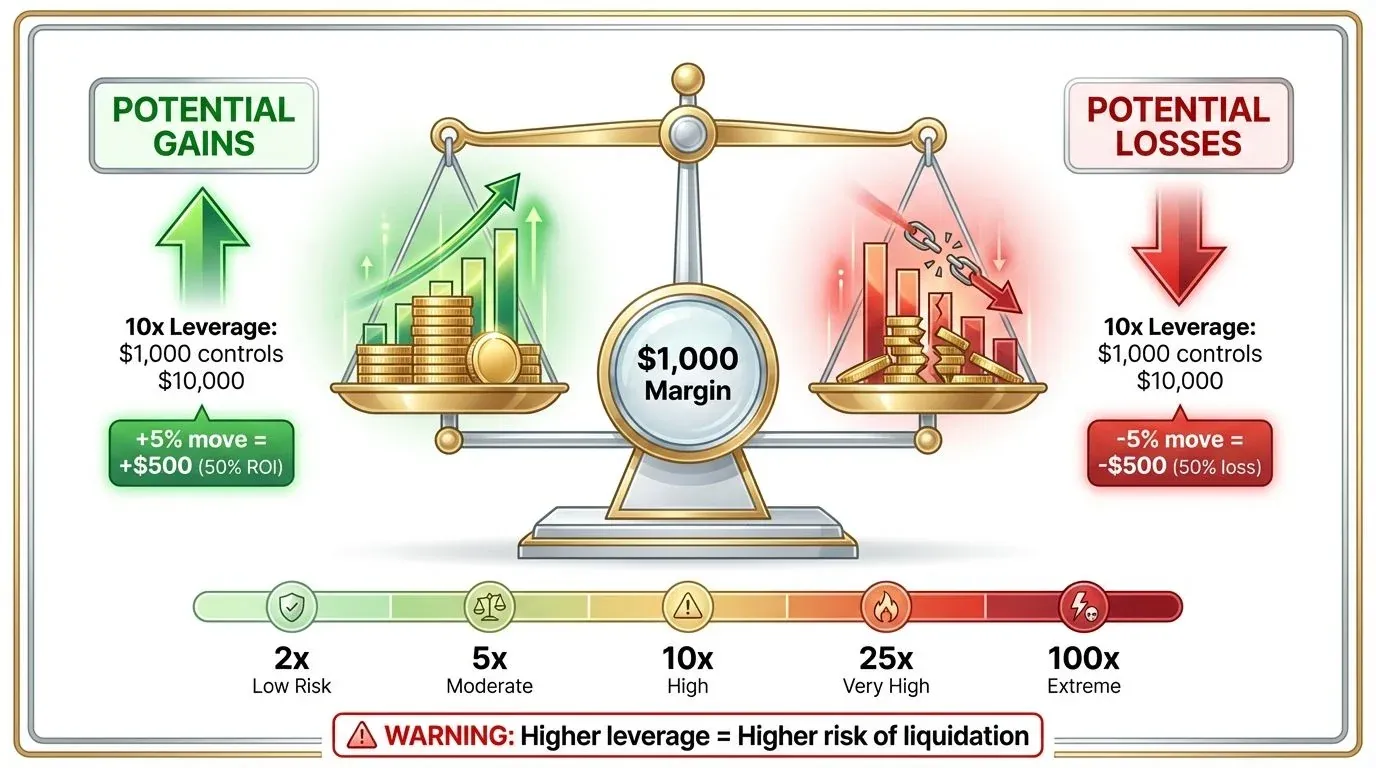
Leverage trading in crypto allows you to control a position size that is larger than the capital you actually deposit. Instead of buying $1,000 worth of Bitcoin with $1,000, you can use $1,000 as collateral to open a $10,000 position at 10x leverage. The extra $9,000 is effectively borrowed from the exchange or a liquidity pool.
This amplification works in both directions. A 5% price move on a 10x leveraged position results in a 50% gain or a 50% loss relative to your deposited collateral. That dual-edged nature is what makes leverage one of the most powerful and dangerous tools in crypto trading.
Leverage trading exists primarily in derivatives markets, including futures contracts, perpetual swaps, and margin accounts. Unlike spot trading where you own the underlying asset outright, leveraged positions are contractual agreements backed by collateral. If the market moves against you far enough, the exchange closes your position automatically, a process called liquidation, and you lose the collateral you put up.
Crypto markets run 24 hours a day, 7 days a week, with significantly higher volatility than traditional financial markets. These two factors together make leverage trading in crypto uniquely unforgiving. Understanding the mechanics thoroughly before risking real capital is not optional; it is essential.
How Leverage Works: Margin, Collateral, and Multipliers
The Core Mechanics
When you open a leveraged position, you deposit an amount of collateral called the initial margin. The exchange then allows you to control a larger notional position. The ratio between your position size and your margin is the leverage multiplier.
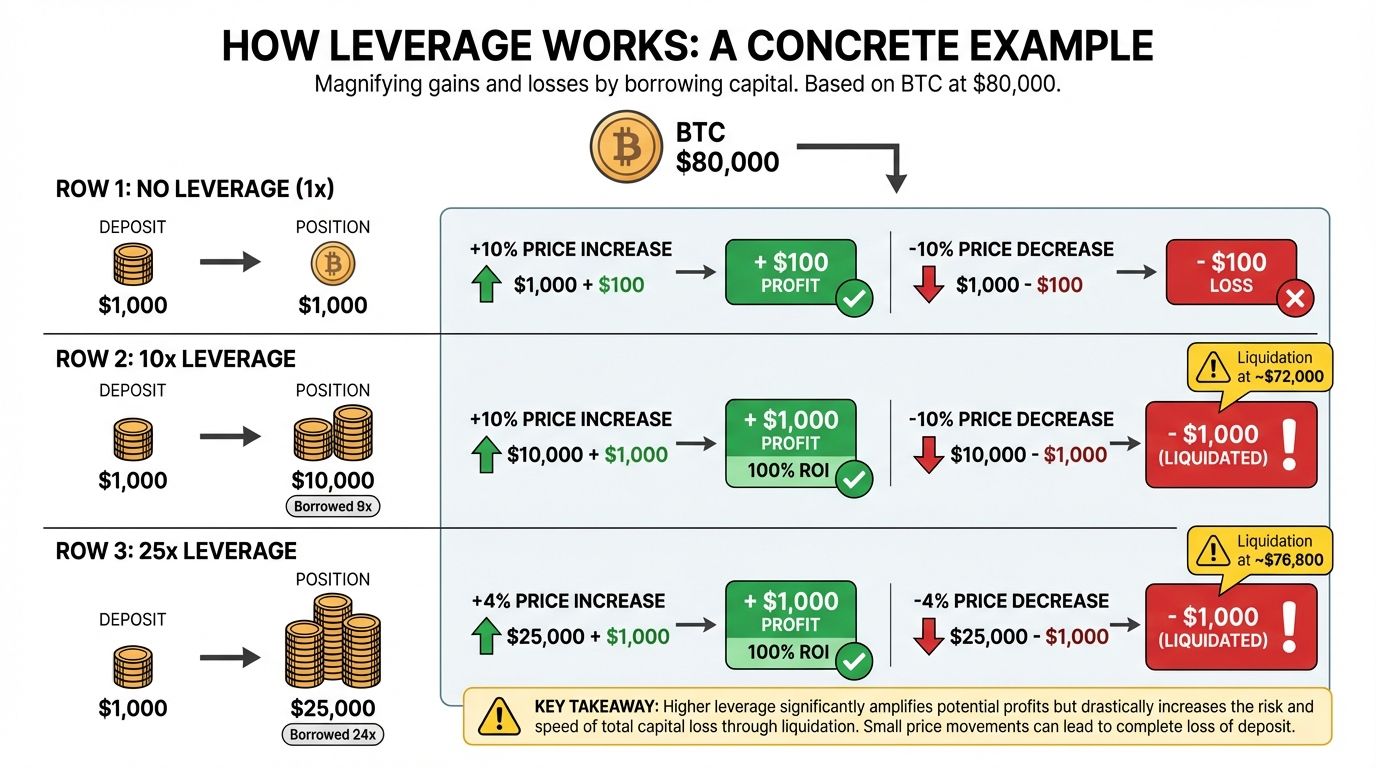
Here is a concrete example using BTC/USDT:
- BTC is trading at $80,000
- You deposit $1,000 as initial margin
- You open a long position at 10x leverage
- Your position notional value is $10,000 (0.125 BTC)
If BTC rises 5% to $84,000, your position gains $500 (5% of $10,000). That is a 50% return on your $1,000 margin.
If BTC falls 5% to $76,000, your position loses $500. That is a 50% loss on your $1,000 margin. At roughly an 8 to 10% adverse move, you approach liquidation territory, where the exchange closes your position to prevent a negative balance.
Leverage Levels and Their Risk Profile
Exchanges offer different maximum leverage depending on the asset and regulatory context. Common tiers:
- 2x to 5x: Low leverage, often used by swing traders. A 20% adverse move at 5x leads to full loss of margin.
- 10x: Popular among active traders. An 8 to 10% move against you can trigger liquidation.
- 20x to 50x: High risk. Even routine intraday volatility in BTC can liquidate positions at these levels.
- 100x: Extremely high risk. A 1% adverse move wipes 100% of margin. Only suitable for very short-term scalps by experienced traders.
The higher the leverage, the tighter the band between entry and liquidation. With crypto assets routinely moving 3 to 8% in a single hour, anything above 20x requires near-perfect timing and disciplined stop-loss placement.
Types of Leveraged Products
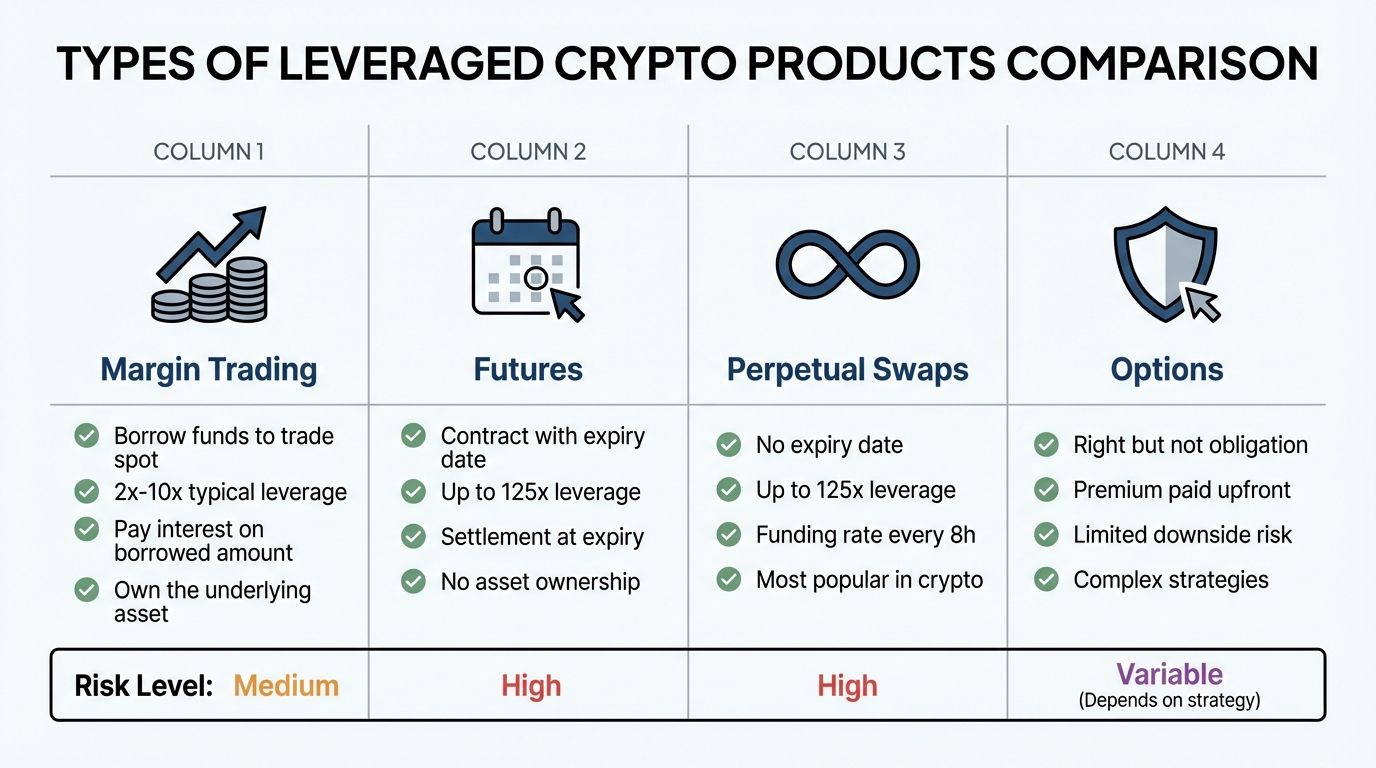
Margin Trading
Margin trading lets you borrow funds directly from the exchange to buy or short-sell a spot asset. You own (or short) the actual asset but with borrowed capital. Interest accumulates on borrowed funds hourly or daily. If the value of your account falls below the maintenance margin threshold, you receive a margin call and must either add funds or reduce your position.
Margin trading is available on many spot exchanges and typically offers lower maximum leverage (2x to 10x) compared to derivatives markets.
Futures Contracts
Futures are standardized contracts to buy or sell an asset at a set price on a specific expiration date. In crypto, quarterly futures (expiring every three months) are the most common. The price of a futures contract can trade at a premium or discount to the spot price, a difference called the basis. As expiration approaches, the futures price converges with spot.
Futures on major exchanges can go up to 125x leverage on BTC, though default and recommended limits are far lower.
Perpetual Swaps
Perpetual swaps are the most popular leveraged product in crypto. They function like futures contracts but have no expiration date, meaning you can hold a position indefinitely. To keep the perpetual price anchored to the spot price, exchanges use a funding rate mechanism.
The funding rate is paid periodically (typically every 8 hours) between long and short holders. If the perpetual price is above spot (more bullish sentiment), longs pay shorts. If the perpetual price is below spot (bearish sentiment), shorts pay longs. A strongly positive funding rate over time can significantly eat into profits for long-position holders, even on winning trades.
Options
Crypto options give you the right, but not the obligation, to buy (call) or sell (put) an asset at a specific price before or at expiration. Options provide leveraged exposure with a defined maximum loss (the premium you pay), which makes them attractive for risk-averse strategies. However, options pricing involves time decay (theta) and implied volatility, adding complexity that requires additional learning before deployment.
Cross Margin vs. Isolated Margin
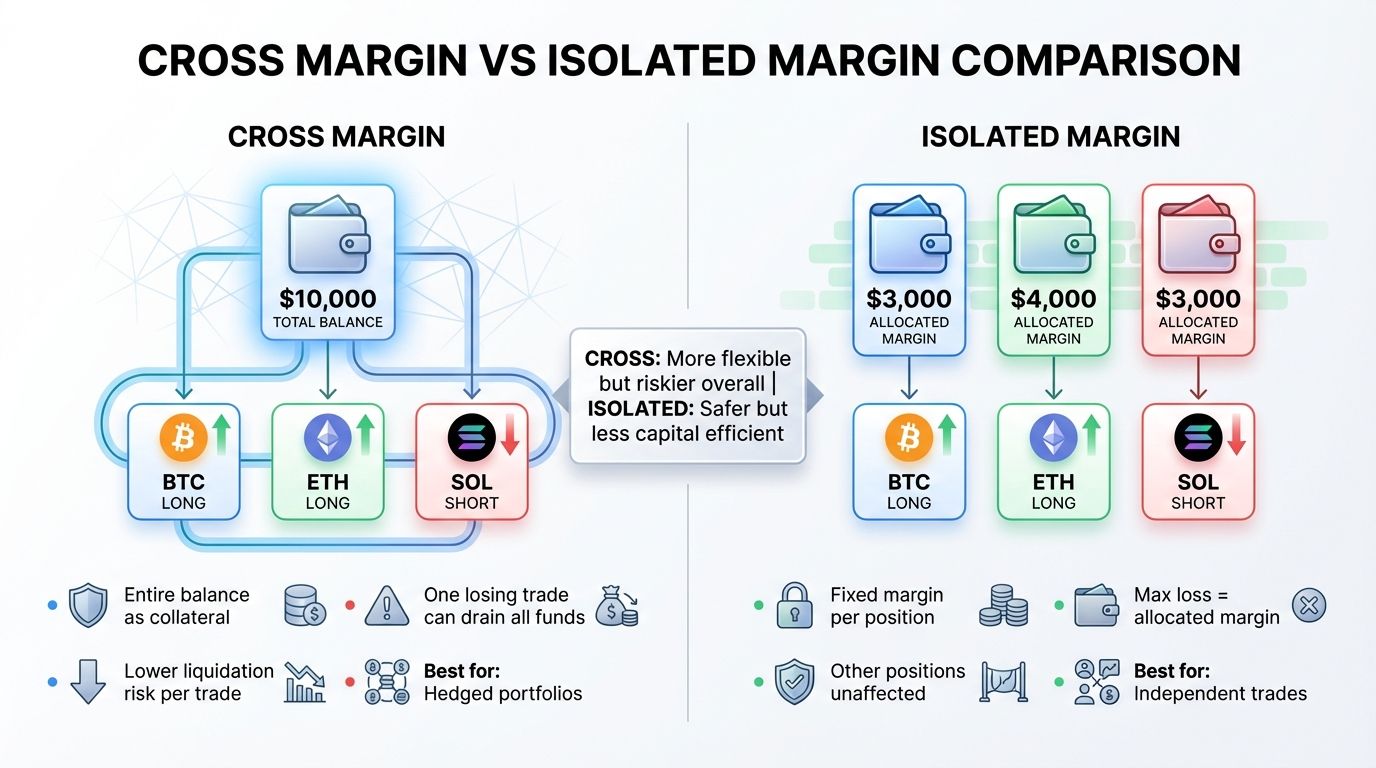
One of the most important decisions before opening any leveraged position is choosing between cross margin and isolated margin. The two modes have very different risk profiles.
Isolated Margin
In isolated margin mode, you allocate a fixed amount of collateral to a specific position. If that position moves against you and reaches liquidation, only the isolated margin is at risk. The rest of your account balance is protected.
Example: You have $5,000 in your account. You open a BTC long with $500 isolated margin at 10x leverage. If BTC drops 9%, your $500 is liquidated. Your remaining $4,500 is untouched.
Isolated margin gives you granular control over how much you risk per trade. It is the preferred mode for most active traders.
Cross Margin
In cross margin mode, your entire available account balance acts as collateral for all open positions. This makes liquidation less likely to occur quickly since the exchange can draw on your full balance to maintain positions during adverse moves. However, if a trade goes severely wrong, the exchange can drain your entire account, not just the capital you intended to risk on that single trade.
Example: You have $5,000 in your account. You open a BTC long using cross margin. If the market moves sharply against you, the exchange uses all $5,000 to prevent liquidation. A large enough move can wipe the entire balance.
Cross margin is sometimes used by experienced traders who want to avoid premature liquidation from temporary volatility spikes. For most traders, isolated margin is the safer default.
Calculating Liquidation Price
Understanding where your liquidation price sits before entering a trade is non-negotiable. The formula varies slightly by exchange but follows a consistent logic.
Basic Liquidation Price Formula (Long Position)
Liquidation Price = Entry Price x (1 - (1 / Leverage) + Maintenance Margin Rate)
Using approximate values: if you enter a BTC long at $80,000 with 10x leverage and the maintenance margin rate is 0.5%:
- (1 / 10) = 0.10
- 1 - 0.10 = 0.90
- 0.90 + 0.005 (maintenance margin) = 0.905
- Liquidation Price = $80,000 x 0.905 = $72,400
This means if BTC drops from $80,000 to approximately $72,400 (a 9.5% move), your position is liquidated.
For Short Positions
The logic is reversed. The liquidation price sits above your entry price. At 10x leverage on a short entered at $80,000, the liquidation price would be approximately $87,600.
Most exchanges display your liquidation price in the order confirmation and position management panel. Always verify this number before confirming a trade. Setting a stop-loss well before the liquidation price is the only way to retain control over the outcome.
Risk Management for Leveraged Trading
Position Sizing
Never allocate more than a fixed percentage of your total capital to any single leveraged trade. A common rule: risk no more than 1 to 2% of your total account on a single trade. This is calculated from your stop-loss distance, not your total position notional value.
Example: Account size $10,000. Risk per trade: 1% = $100. If your stop-loss is 2% away from entry, your position size should be $5,000 notional (at which point a 2% move equals $100 loss). Adjust leverage accordingly.
Stop-Loss Placement
A stop-loss is not optional in leveraged trading. It is the difference between a managed loss and a wipeout. Place your stop-loss based on technical levels (support, resistance, key moving averages) rather than arbitrary percentages. The stop placement should dictate your position size, not the other way around.
In volatile markets, consider using stop-loss orders with slight buffer below key support levels to avoid being stopped out by wicks (brief price spikes below support that quickly recover).
Maximum Leverage Guidelines
- New traders: Start at 2x to 3x maximum until you understand liquidation mechanics through real experience.
- Intermediate traders: 5x to 10x on high-liquidity pairs with clear technical setups.
- Experienced traders: Up to 20x on short-term scalps with tight stops and small position sizing.
- Avoid: Leverage above 20x on crypto unless you are an institutional desk with sophisticated risk systems. The math is unforgiving.
Diversifying Across Positions
Avoid concentrating all leveraged exposure in one direction on one asset. Holding multiple smaller leveraged positions across different assets with moderate leverage is generally safer than one massive position at high leverage.
Common Mistakes in Leverage Trading
1. Using maximum available leverage: Exchanges offering 100x leverage are not recommending you use it. Default to low leverage and increase only when your strategy justifies it with backtested evidence.
2. No stop-loss: Leaving a leveraged position open without a stop-loss is speculating that the market will never move far enough against you. In 24/7 crypto markets, that assumption fails regularly.
3. Averaging down on losing leveraged positions: Adding to a losing leveraged position accelerates the approach of your liquidation price. Unlike spot trading, averaging down in leveraged positions can destroy an account.
4. Ignoring funding rates: Holding a perpetual swap long in a market with a high positive funding rate means you are paying a fee every 8 hours. A trade that wins on price movement can still lose money if held through sustained high funding costs.
5. Emotional over-leveraging after a loss: Taking larger positions at higher leverage to recover losses quickly is one of the fastest ways to blow up a trading account. Losses should trigger a review of strategy, not an escalation of risk.
6. Not accounting for fees: Leveraged trading fees (opening fee, closing fee, funding rate) compound quickly. A trade that appears profitable at face value may result in a net loss after fees on high-frequency strategies.
Pros and Cons of Leverage Trading
Advantages
- Capital efficiency: Control large positions without locking up large amounts of capital.
- Profit from both directions: Leveraged short positions allow you to profit during bear markets.
- Hedging: Futures and perpetuals allow spot holders to hedge downside risk without selling their holdings.
- Access to liquidity: Derivatives markets often have deeper liquidity than spot markets, especially for large order sizes.
Disadvantages
- Amplified losses: The same force that multiplies gains multiplies losses. At 10x, a 10% adverse move wipes your entire margin.
- Liquidation risk: Unlike spot trading, leveraged positions can go to zero even without the asset going to zero.
- Funding costs: Perpetual swaps carry ongoing funding costs that erode returns in trending markets.
- Psychological pressure: Managing leveraged positions is significantly more stressful than spot, and emotional decision-making is more costly.
- Complexity: Liquidation mechanics, margin types, funding rates, and basis all require understanding before trading.
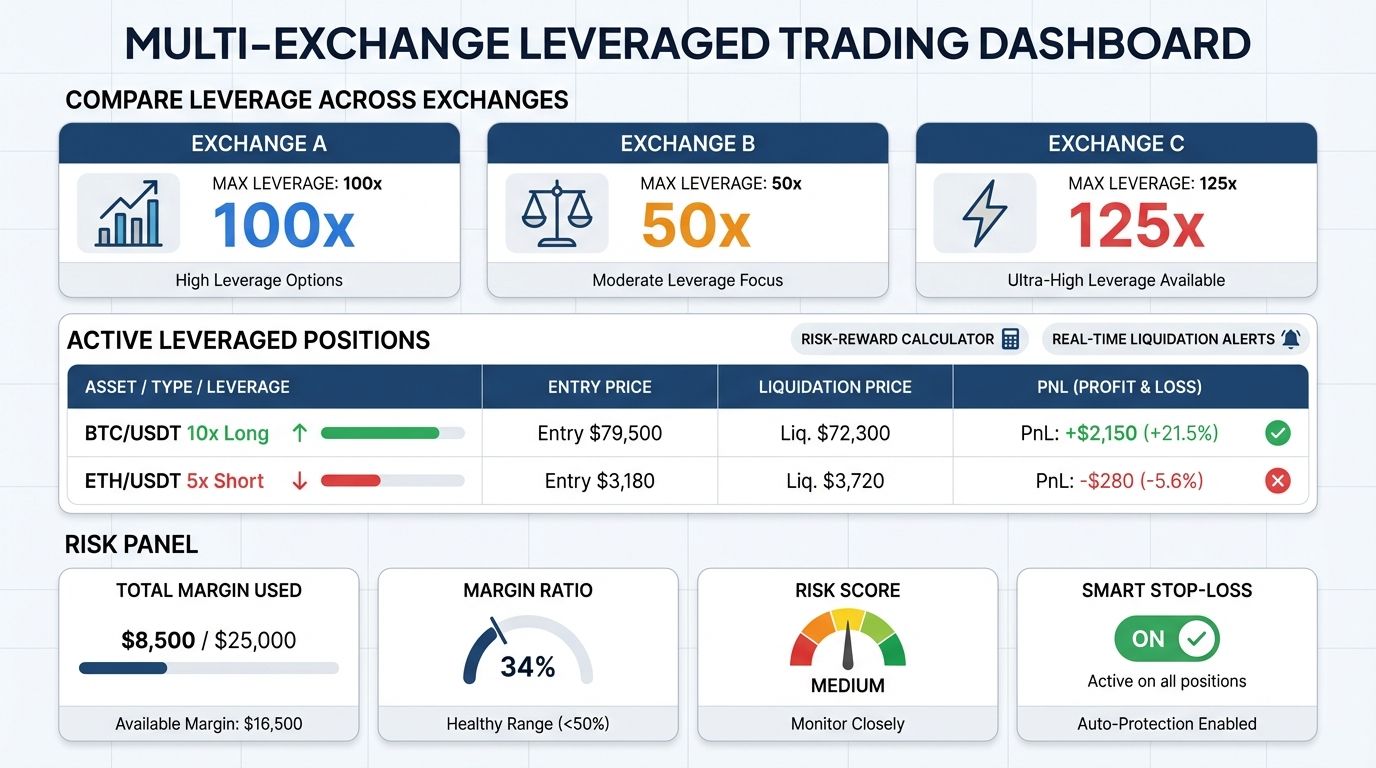
Execute Leveraged Trades with Altrady
Managing leveraged positions across multiple exchanges simultaneously is one of the most demanding challenges in active crypto trading. Altrady is built specifically for traders who need precision tools to handle that complexity.
With Altrady's multi-exchange dashboard, you can monitor and manage leveraged positions across 19 or more exchanges from a single interface. No more switching between tabs and losing track of open positions or margin balances.
Key features for leveraged traders include:
- Smart orders: Set your take-profit and stop-loss targets simultaneously at the moment you enter a trade. Your risk is defined before the position is open.
- Risk/reward calculator: Visualize the exact profit and loss at different price targets before committing capital. Understand your liquidation price and reward-to-risk ratio at a glance.
- Real-time alerts: Receive notifications when price approaches key levels, when funding rates spike, or when your margin ratio drops below a safe threshold. React before the market forces your hand.
- Portfolio overview: Track total margin exposure, unrealized profit and loss, and liquidation distances across all exchanges in one consolidated view.
Whether you are running a simple 3x swing trade or managing multiple perpetual positions across exchanges, Altrady gives you the infrastructure to trade with discipline rather than guesswork.
Start with a free trial and see how a professional-grade trading platform changes the way you manage risk.
Frequently Asked Questions
What is the difference between leverage and margin in crypto trading?
Margin is the collateral you deposit to open a leveraged position. It is the amount of your own capital at risk. Leverage is the multiplier that determines how large a position you can control relative to that margin. With $500 margin at 10x leverage, you control a $5,000 position. Margin is the input; leverage is the ratio applied to it.
Can you lose more than your initial deposit in crypto leverage trading?
On most major exchanges, no. Exchanges use automatic liquidation systems to close your position before your account goes negative. However, in rare cases of extreme volatility or liquidity gaps (known as "gapping"), the liquidation price may be skipped and losses can exceed the margin. Some exchanges socialize this loss across other traders via an insurance fund or auto-deleveraging mechanism.
What happens if I get liquidated?
When your account's margin ratio falls below the exchange's maintenance margin requirement, the exchange automatically closes your position at market price. You lose the collateral allocated to that position. The exchange keeps a small liquidation fee, and any remaining funds (after fees and the position is closed) may be returned to your account depending on the exchange's policy.
How do funding rates affect my leveraged position?
Funding rates apply specifically to perpetual swaps. Every 8 hours (on most exchanges), a payment is exchanged between long and short holders based on the difference between the perpetual price and the spot price. If funding is positive and you are long, you pay shorts. If funding is negative and you are short, you pay longs. Over days or weeks, high funding rates can significantly impact the profitability of a held position. Always check the funding rate before holding a perpetual position long-term.
What leverage level should a beginner start with?
Beginners should start with 2x to 3x leverage at most. At these levels, a significant price move is required to trigger liquidation, giving you time to learn how leverage mechanics work in practice without the constant risk of being wiped out by normal market volatility. Focus first on understanding how stop-losses interact with leveraged positions, how margin is consumed as price moves, and how fees accumulate. Increase leverage only after consistently profitable results at lower leverage over several months.