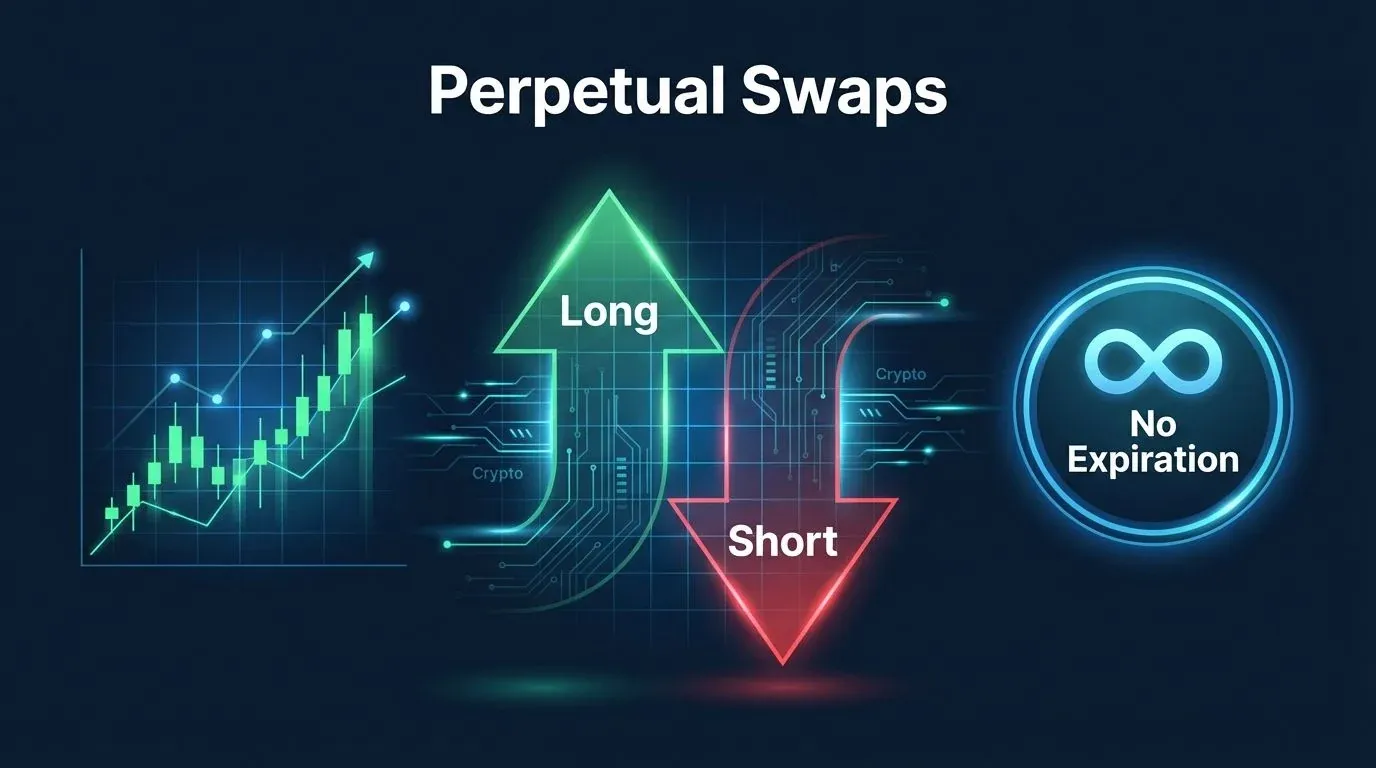

Perpetual swaps crypto contracts have become one of the most actively traded instruments in the digital asset market. Unlike traditional futures contracts that expire on a set date, perpetual swaps never settle, meaning traders can hold positions indefinitely as long as their margin holds. This unique structure has made them a favorite among crypto derivatives traders looking for flexible exposure to price movements without the hassle of rolling over contracts.
Originally pioneered by BitMEX back in 2016, perpetual swaps have since spread across every major crypto derivatives exchange. Today, they account for a significant portion of total crypto trading volume globally. Whether you are an experienced futures trader migrating from traditional markets or a crypto-native looking to step up from spot trading, understanding how perpetual swaps work is essential before putting real capital at risk.
1. What Are Perpetual Swaps in Crypto
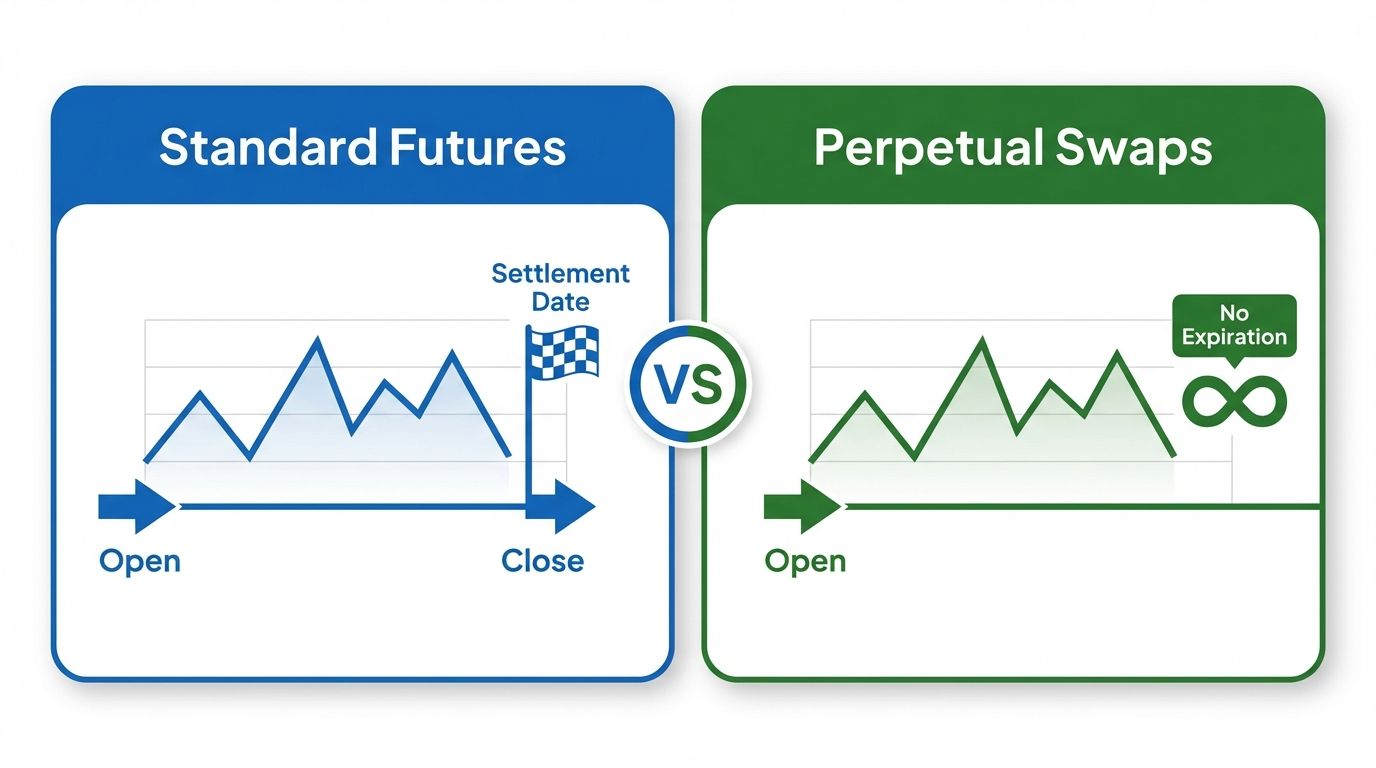
A perpetual swap is a type of derivative contract that allows traders to speculate on the price of a cryptocurrency without actually owning the underlying asset. The contract tracks the price of the underlying asset closely, and it has no expiration date, which is the defining feature that separates it from standard futures.
In a conventional futures contract, both parties agree to exchange an asset at a predetermined price on a specific date. When that date arrives, the contract settles and the position closes. With perpetual swaps, there is no such date. Positions can remain open for days, weeks, or even months, with the contract continuously adjusting to stay pegged to the spot price through a mechanism called the funding rate.
- No expiration date: Positions stay open until the trader chooses to close or until liquidation occurs
- Leverage available: Most exchanges offer anywhere from 5x to 125x leverage on perpetual contracts
- Margin-based: Traders only need to post a fraction of the total position value as collateral
- Bi-directional: Traders can go long (buy) or short (sell) depending on their market view
- Mark price: Exchanges use a mark price derived from multiple sources to prevent manipulation and trigger fair liquidations
Perpetual swaps are available on most major exchanges. They are denominated in stablecoins like USDT or in the base crypto asset (inverse contracts), giving traders flexibility in how they hold their collateral.
2. How Funding Rates Keep Perpetual Swaps Anchored to Spot Price
Since perpetual swaps never expire, exchanges use a funding rate mechanism to prevent the contract price from drifting too far from the actual spot price. This is the core innovation that makes perpetual swaps functional over long periods.
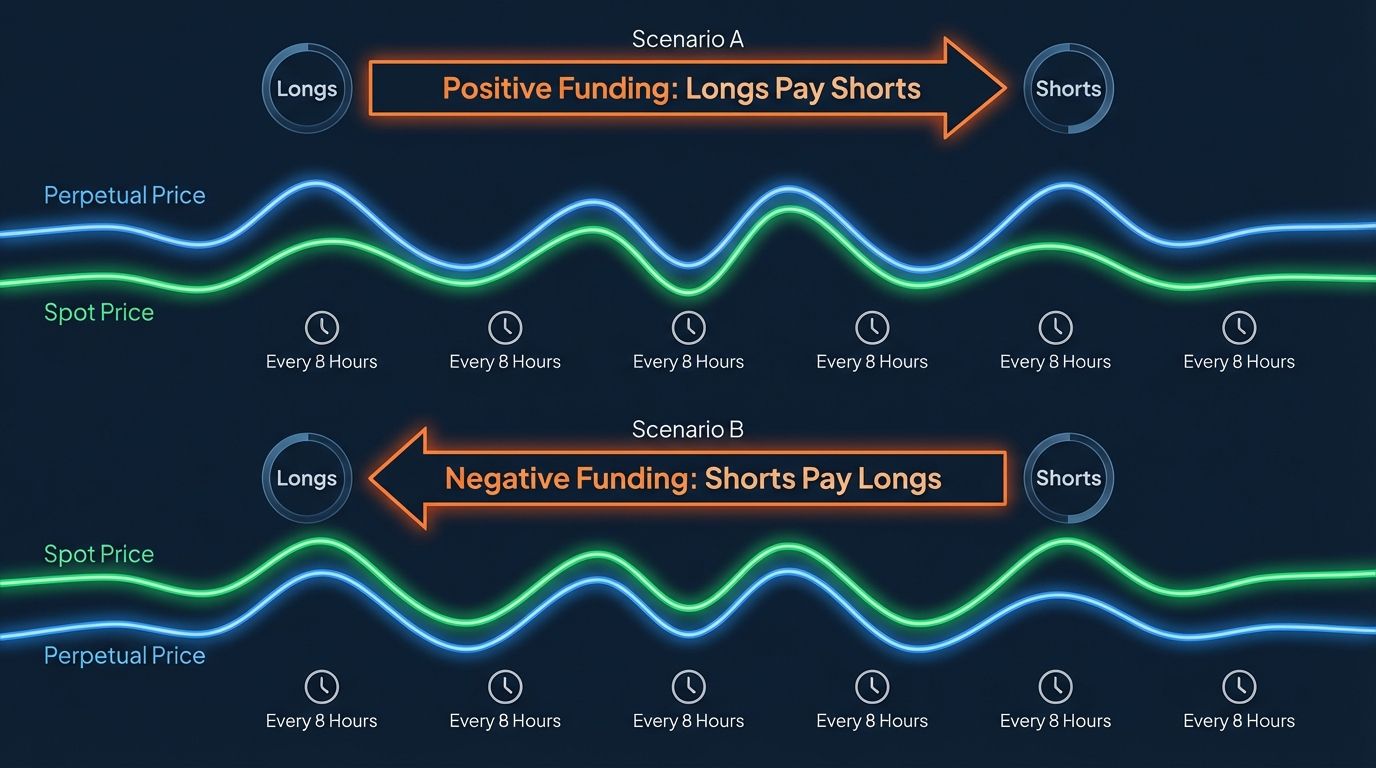
The funding rate is a periodic payment exchanged directly between long and short traders. It is typically calculated every eight hours on most exchanges, though some platforms calculate it hourly or even continuously. The direction and size of the payment depends on whether the perpetual contract price is trading above or below the spot price.
- Positive funding rate: When the perpetual price trades above spot (usually during bull markets), longs pay shorts. This incentivizes selling pressure to push the contract price back down toward spot.
- Negative funding rate: When the perpetual price trades below spot (often in bear markets), shorts pay longs. This incentivizes buying to pull the contract price back up.
- Neutral funding rate: When the contract price closely matches spot, funding rates approach zero and minimal or no payment occurs.
From a practical standpoint, traders need to account for funding rates in their position sizing and holding period calculations. During periods of extreme market sentiment, funding rates can spike significantly, turning what looks like a profitable trade into a losing one if held for extended periods. Monitoring funding rates in real time is a key habit for any active perpetual swap trader.
Funding rates also function as a sentiment indicator. Consistently high positive funding rates signal that the market is heavily long-leaning and potentially overheated, which experienced traders use as a contrarian signal. Extremely negative funding rates may indicate excessive pessimism and a possible short squeeze setup.
3. Going Long vs Going Short on Perpetual Swaps
One of the most powerful aspects of perpetual swaps is the ability to profit from both rising and falling markets. This two-sided nature gives traders flexibility that spot trading simply cannot provide.
Going long means you are buying a perpetual swap contract because you expect the underlying asset's price to increase. If Bitcoin is trading at $80,000 and you open a long position, you profit when the price rises above your entry point. Your profit and loss is calculated based on the difference between your entry price and the current mark price, multiplied by your position size and leverage.
Going short means you are selling a perpetual swap contract because you expect the price to decrease. If you short Bitcoin at $80,000 with 5x leverage and the price drops to $76,000, you profit from that $4,000 decline. This is particularly valuable during bear markets or when you want to hedge an existing spot holding.
- Long mechanics: Open by buying the contract, close by selling it back. Profit when price goes up, lose when price goes down.
- Short mechanics: Open by selling the contract, close by buying it back. Profit when price goes down, lose when price goes up.
- Partial closes: Traders can close only a portion of a position to lock in gains while keeping exposure open.
- Cross vs isolated margin: Cross margin uses the entire wallet balance as collateral, while isolated margin caps the risk to the amount allocated to that specific trade.
When entering either direction, the key variables to track are your entry price, liquidation price, position size, and the current funding rate direction. Many traders prefer isolated margin to ensure that a single losing trade cannot wipe out their entire account.
4. Leverage and Liquidation Risks Every Trader Must Understand
Leverage is the feature that attracts many traders to perpetual swaps, but it is also the mechanism that wipes out the majority of inexperienced participants. Understanding how leverage and liquidation interact is non-negotiable before trading perpetual contracts.
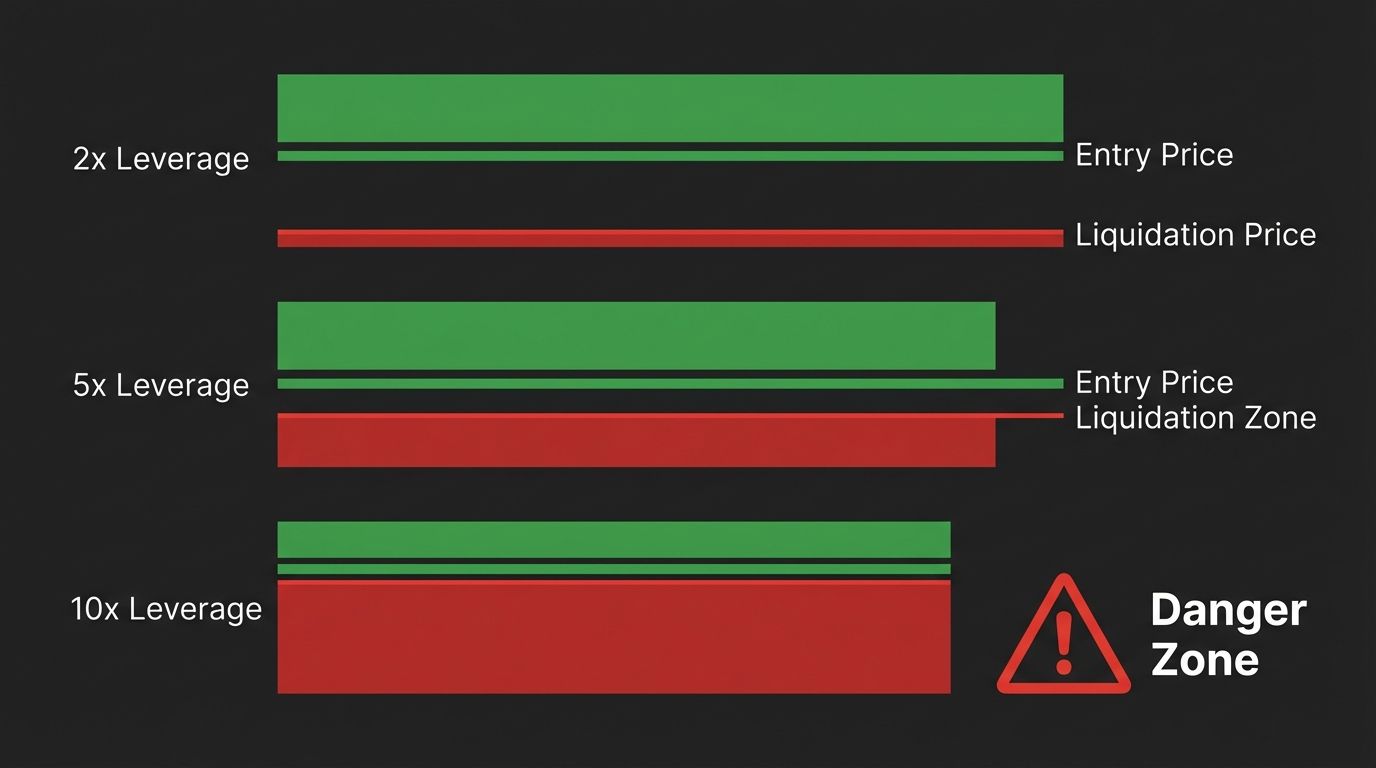
When you use leverage, you are essentially borrowing capital from the exchange to control a larger position than your margin alone would allow. With 10x leverage, a $1,000 margin controls a $10,000 position. A 10% move in your favor doubles your margin. But a 10% move against you liquidates your entire position.
- Liquidation price: The price level at which the exchange forcibly closes your position because your margin has been consumed by losses. The higher your leverage, the closer your liquidation price is to your entry.
- Maintenance margin: The minimum amount of margin required to keep a position open. If your balance falls below this threshold, liquidation is triggered.
- Auto-deleveraging (ADL): A system used by some exchanges to reduce positions of the most profitable traders if the insurance fund runs out, protecting the exchange from insolvency.
- Insurance fund: A reserve held by the exchange that covers losses from bankrupt positions before ADL is triggered.
A common mistake among new traders is using maximum available leverage. Professional traders typically use 2x to 5x leverage at most, keeping liquidation prices far from the current market price. They also set stop-loss orders well before the liquidation price to exit positions with a controlled loss rather than risking a full liquidation.
Market volatility in crypto is significantly higher than in traditional assets. A 20% intraday move in Bitcoin is unusual but not unheard of. At 10x leverage, that move can liquidate any position that did not have enough buffer built in. Risk management is not optional in perpetual swap trading, it is the foundation.
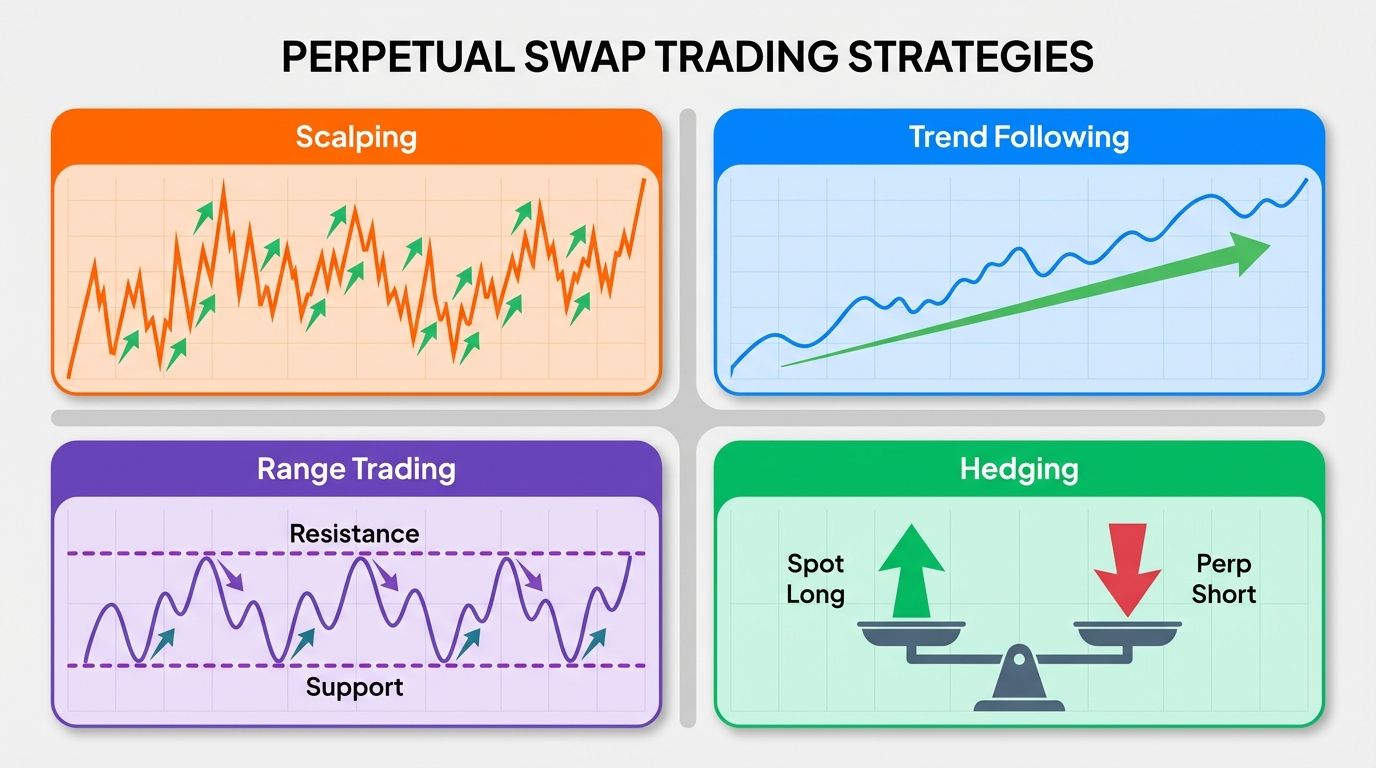
5. Trading Strategies for Perpetual Swaps
Experienced traders deploy a range of strategies on perpetual swaps depending on market conditions, time availability, and risk tolerance. Here are the most practical approaches that work specifically well in crypto perpetual markets.
Scalpers open and close multiple small positions throughout the day, capturing tiny price movements. With leverage, even a 0.2% price move can yield meaningful returns. Scalping requires fast execution, tight spreads, and disciplined stop-losses. It works best in liquid markets like BTC/USDT and ETH/USDT perpetuals where spreads are narrow and order books are deep.
Trend Following
Trend followers identify a directional move and ride it for as long as it continues. They use tools like moving averages, RSI, and volume analysis to confirm momentum. In crypto, strong trends can persist for weeks, making perpetual swaps the ideal vehicle because there is no expiration date to force a position close at an inopportune time.
Range Trading
During consolidation periods, prices oscillate between a support and resistance level. Range traders go long near support and short near resistance, closing each leg before the opposite boundary. This strategy works well when funding rates are neutral and volatility is low.
Hedging
Traders who hold a large spot position can use perpetual swaps to hedge downside risk. If you hold 1 BTC in spot and open a short position on a BTC perpetual, gains on the short offset losses on the spot position during a price decline. This is commonly used by miners, funds, and long-term holders who want to reduce short-term drawdown without selling their underlying asset.
Funding Rate Arbitrage
When funding rates are extremely positive, a market-neutral strategy involves going long spot while shorting the perpetual. The short position collects funding rate payments without taking on directional risk. This approach requires sufficient capital to maintain both positions and careful monitoring of the basis.
6. How to Trade Perpetual Swaps with Altrady
Having the right trading platform can make a substantial difference in how effectively you execute perpetual swap strategies. Altrady is a professional-grade crypto trading terminal designed to give traders a serious edge across multiple exchanges from a single interface.
With Altrady, you can connect to multiple exchanges simultaneously and monitor your perpetual swap positions, funding rate exposure, and portfolio performance all in one place. The platform supports advanced order types, real-time alerts, and automated trading bots that are particularly useful for strategies like scalping and trend following where speed and consistency matter.
- Multi-exchange support: Manage perpetual swap positions across multiple exchanges from a single dashboard
- Real-time alerts: Stay ahead of funding rate changes before they impact your holding costs
- Risk management tools: Set stop-losses, take-profits, and position size limits to protect your capital
- Trading bots: Automate your perpetual swap strategies to execute without needing to watch charts around the clock
- Portfolio analytics: Track your performance across all open and closed positions with detailed reports
Altrady offers a free trial so you can explore all the features before committing to a subscription. If you are serious about trading perpetual swaps crypto markets, testing the platform with your own strategy is the best way to see the value it brings to your workflow. Start your free trial today and experience how a professional crypto trading terminal changes the way you approach the markets.
Frequently Asked Questions
What is the difference between a perpetual swap and a futures contract?
The main difference is the expiration date. Standard futures contracts settle on a fixed date, forcing traders to close or roll their positions. Perpetual swaps have no expiration, allowing traders to hold positions indefinitely. To keep the perpetual price anchored to spot, exchanges use the funding rate mechanism, which is absent in traditional futures contracts.
How does the funding rate affect my perpetual swap trade?
The funding rate is a recurring payment between long and short traders, typically every eight hours. If the funding rate is positive, you pay a fee if you are long and receive a fee if you are short. If it is negative, the opposite applies. High positive funding rates increase the cost of holding long positions over time, which is why many traders factor this into their holding period and overall profitability calculations.
Is trading perpetual swaps riskier than spot trading?
Yes, perpetual swaps carry significantly higher risk than spot trading, primarily because of leverage. In spot trading, the worst outcome is losing your initial investment if the price drops to zero. In perpetual swap trading, leverage means losses can exceed your initial margin if you are not using stop-losses, and your position can be liquidated within a single large price candle. Proper risk management, conservative leverage use, and stop-loss discipline are essential safeguards.
What is a good leverage ratio for beginners trading perpetual swaps?
Most experienced traders recommend starting with 2x to 3x leverage when learning perpetual swaps. This keeps your liquidation price far enough from current market prices to give you room to be wrong without immediate liquidation. As you build confidence and a consistent track record, you can gradually increase leverage while maintaining strict position sizing rules.
Can I use perpetual swaps to hedge my crypto portfolio?
Yes, hedging is one of the most practical uses of perpetual swaps outside of pure speculation. If you hold Bitcoin in your spot wallet and are concerned about a short-term price correction, opening a short position on a BTC perpetual swap can offset losses on your spot holdings without requiring you to sell. Long-term holders and crypto miners frequently use this approach to manage downside risk while retaining their underlying asset exposure.
2026 Update: What to Check Before You Act
Perpetual swaps are powerful because they let traders take leveraged long or short exposure without expiry, but that same structure makes funding and liquidation risk central to every trade.
| Check | What to review | Why it matters |
|---|---|---|
| Funding rate | Check whether longs or shorts are paying funding and how extreme the rate is. | Crowded positioning can make the trade expensive even if direction is right. |
| Liquidation buffer | Calculate liquidation price, maintenance margin, and stop placement before entry. | A position can be liquidated before the thesis has time to play out. |
| Basis and liquidity | Compare spot price, perp price, order book depth, and volatility. | Thin liquidity can increase slippage and liquidation cascades. |
Quick trader checklist
- Use lower leverage when volatility expands.
- Do not ignore funding costs on multi-day trades.
- Set alerts for liquidation distance and major support/resistance levels.
FAQ
What makes perpetual swaps riskier than spot trading?
Perpetual swaps add leverage, funding payments, and liquidation risk. A trader can be directionally correct but still lose if funding, volatility, or margin management is poor.