
Making money in crypto does not always require prices to go up. Short selling crypto allows traders to profit from falling prices, turning bearish market conditions into potential opportunities. Whether you are dealing with a market correction, a prolonged downtrend, or simply hedging your existing portfolio, understanding how to short crypto is a skill every serious trader should develop.
In this guide, we break down everything you need to know about short selling crypto into six clear sections. From the basic mechanics to advanced strategies and risk management techniques, you will learn how experienced traders approach bearish markets and how you can do the same with confidence.
1. What Is Short Selling Crypto?
Short selling crypto is a trading strategy where you profit from a decline in the price of a cryptocurrency. Instead of the traditional "buy low, sell high" approach, short selling flips the script: you sell high first, then buy back lower. The difference between your sell price and your buy-back price becomes your profit.
In traditional finance, short selling involves borrowing shares from a broker, selling them on the open market, and then repurchasing them at a lower price to return to the lender. The crypto version follows a similar logic but uses different mechanisms, including margin trading, futures contracts, and options.
Key concepts to understand before shorting crypto:
- Bearish position: When you short, you are expecting the price of an asset to decrease.
- Leverage: Most crypto shorting involves leverage, which amplifies both potential gains and potential losses.
- Borrowed funds: Whether through margin or futures, you are typically using borrowed capital to open a short position.
- Closing the position: To realize your profit or loss, you must close (or "cover") your short position by buying back the asset.
Short selling is not exclusive to experienced traders, but it does carry unique risks that make education and preparation essential. Unlike buying and holding, where your maximum loss is limited to your initial investment, short selling can theoretically produce unlimited losses if the price rises instead of falling.
2. How Short Selling Works in Crypto: Margin Trading vs. Futures
There are two primary methods for short selling crypto: margin trading and futures contracts. Each has its own mechanics, advantages, and risk profiles. Understanding the difference is critical before placing your first short trade.
Margin Trading
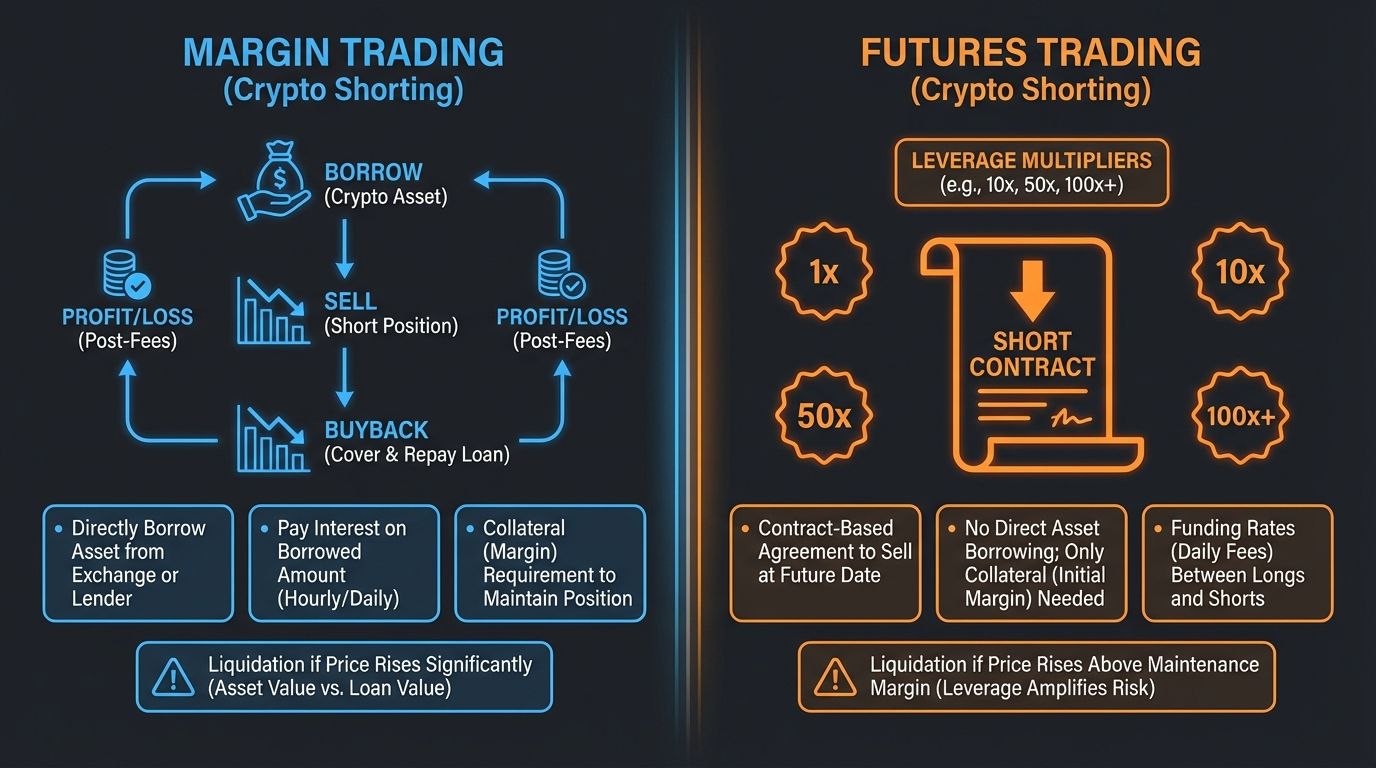
Margin trading allows you to borrow funds from an exchange or other users to open a larger position than your account balance would normally allow. When shorting on margin, you borrow the cryptocurrency itself, sell it at the current market price, and aim to buy it back cheaper.
How margin shorting works step by step:
- Deposit collateral (usually USDT, USDC, or BTC) into your margin account.
- Borrow the cryptocurrency you want to short from the exchange.
- Sell the borrowed crypto at the current market price.
- Wait for the price to drop.
- Buy back the same amount of crypto at the lower price.
- Return the borrowed crypto plus interest, and keep the difference as profit.
Margin trading typically offers leverage ranging from 2x to 10x, depending on the exchange and the trading pair. Higher leverage means greater profit potential but also significantly increased liquidation risk.
Futures Trading
Futures contracts are agreements to buy or sell an asset at a predetermined price on a future date. In crypto, perpetual futures (also called perpetual swaps) are the most popular instrument for shorting because they have no expiration date.
How futures shorting works step by step:
- Deposit margin (collateral) into your futures trading account.
- Open a short position on the perpetual futures contract for your chosen cryptocurrency.
- Select your leverage level (commonly 1x to 125x on major exchanges).
- If the price drops, your position gains value. If the price rises, your position loses value.
- Close the position to realize your profit or cut your loss.
Perpetual futures use a funding rate mechanism that periodically charges or pays traders based on the difference between the futures price and the spot price. When the market is bullish, short sellers often receive funding payments, which can add to overall returns.
Margin trading vs. futures at a glance:
- Leverage range: Margin offers lower leverage (2x to 10x), while futures can go much higher (up to 125x).
- Interest vs. funding rates: Margin traders pay borrowing interest; futures traders deal with funding rates.
- Settlement: Margin trades involve actual crypto borrowing, while futures are settled in stablecoins or crypto without physical delivery.
- Complexity: Futures trading involves more variables like funding rates and contract specifications.
3. Top Platforms and Methods for Short Selling Crypto
Choosing the right platform is a crucial decision when short selling crypto. Different exchanges offer varying levels of leverage, supported assets, fee structures, and trading tools. Here are the main methods and types of platforms available for crypto shorting.
Centralized exchanges (CEX) with margin and futures:
- Binance: Offers both margin and futures trading with up to 125x leverage on select pairs. One of the deepest liquidity pools available.
- Bybit: Known for its derivatives trading, Bybit provides perpetual and quarterly futures with up to 100x leverage.
- OKX: Supports margin, perpetual futures, and options trading with competitive fee structures.
- Kraken: A regulated exchange offering margin trading with up to 5x leverage on select crypto assets.
Decentralized exchanges (DEX) for shorting:
- dYdX: A decentralized perpetual futures exchange that allows short selling with up to 20x leverage without requiring KYC.
- GMX: Operates on Arbitrum and Avalanche, offering decentralized perpetual trading with up to 50x leverage.
- Hyperliquid: A high-performance decentralized exchange built on its own L1 chain, offering perpetual futures trading.
Other methods for gaining short exposure:
- Options trading: Buying put options gives you the right (but not the obligation) to sell crypto at a specific price, providing downside exposure with limited risk.
- Inverse ETFs and tokens: Some platforms offer leveraged tokens that inversely track crypto prices, allowing you to short without managing a position directly.
- Prediction markets: Platforms like Polymarket allow you to take positions on price outcomes, effectively creating a short position through a different mechanism.
Regardless of which platform you choose, always verify the fee structure, liquidation mechanics, and available trading pairs before committing capital. Managing multiple exchange accounts and tracking positions across platforms can be streamlined by using a multi-exchange trading terminal.
4. Proven Strategies for Short Selling Crypto
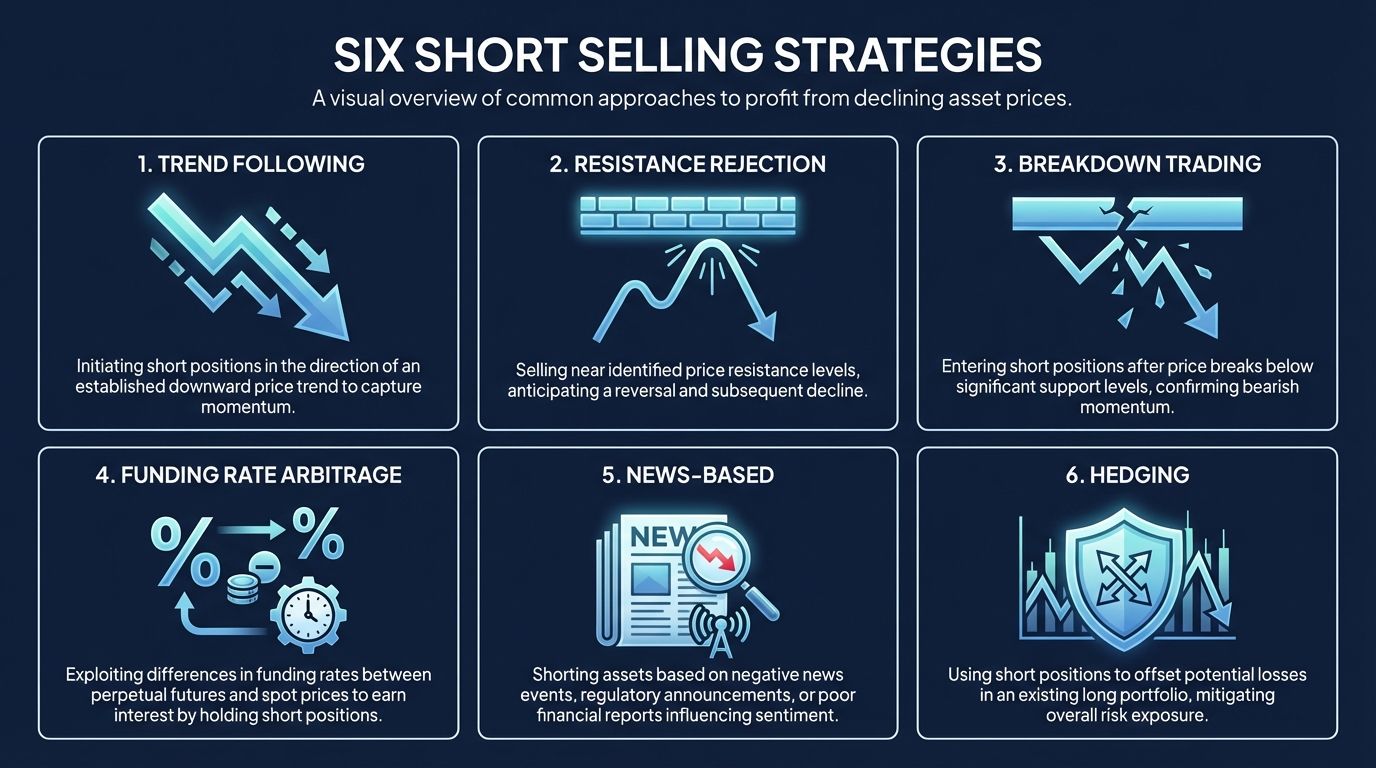
Successfully short selling crypto requires more than just clicking the "sell" button. Experienced short sellers rely on a combination of technical analysis, market sentiment evaluation, and strategic timing. Here are six strategies commonly used by profitable crypto short sellers.
Strategy 1: Trend following shorts
This strategy involves identifying established downtrends and opening short positions in the direction of the prevailing trend. Traders use moving averages (such as the 50-day and 200-day), trendlines, and the ADX indicator to confirm bearish momentum before entering. The key is to short during pullbacks within the downtrend rather than chasing the move after it has already extended.
Strategy 2: Resistance rejection shorts
When price approaches a well-established resistance level and shows signs of rejection (such as long upper wicks, bearish engulfing candles, or declining volume), traders open short positions anticipating a reversal. This strategy works best when the resistance level has been tested multiple times and coincides with other technical confluences like Fibonacci retracement levels.
Strategy 3: Breakdown trading
Breakdown trading involves waiting for the price to break below a key support level, trendline, or chart pattern (such as a descending triangle or head and shoulders). Once the breakdown is confirmed with increased volume, traders enter a short position targeting the next support level. False breakdowns are a risk, so many traders wait for a candle close below the level before entering.
Strategy 4: Funding rate arbitrage
When perpetual futures funding rates are extremely positive (meaning long traders are paying short traders), it often signals an overleveraged market ripe for a correction. Savvy traders open short positions during these periods, collecting funding payments while also positioning for a potential price drop. This strategy works best when combined with other bearish signals.
Strategy 5: News and event-based shorting
Major market events, regulatory announcements, exchange hacks, or protocol failures can trigger sharp price declines. Traders who stay informed about market developments can position themselves ahead of or during these events. However, this strategy requires fast execution and carries the risk of unexpected positive outcomes that could cause a short squeeze.
Strategy 6: Hedging with shorts
Not all short positions are purely speculative. Many traders and investors use shorts as a hedge to protect their long-term holdings during uncertain market conditions. For example, if you hold a significant amount of Bitcoin and expect short-term volatility, you can open a small short position on Bitcoin futures to offset potential losses without selling your spot holdings.
5. Risks of Short Selling Crypto: Liquidation and Beyond
Short selling crypto is inherently riskier than simply buying and holding. Understanding these risks is not optional. It is a prerequisite for survival in leveraged crypto markets.
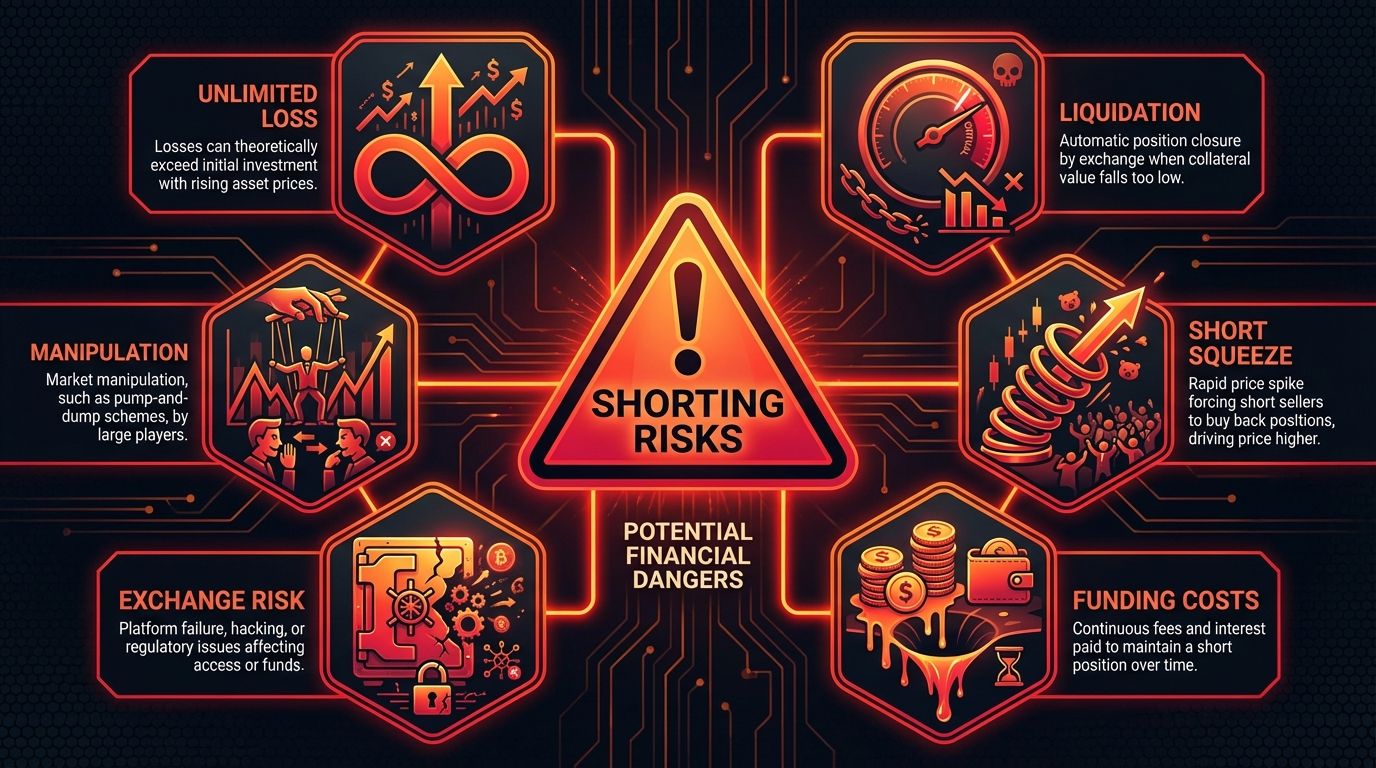
Risk 1: Unlimited loss potential
When you buy crypto, the most you can lose is your initial investment (if the price goes to zero). When you short, the price can theoretically rise infinitely, meaning your losses have no natural ceiling. A cryptocurrency that rallies 200% or 500% against your short position can wipe out your account and then some.
Risk 2: Liquidation
Liquidation occurs when the market moves against your position to the point where your margin (collateral) is no longer sufficient to maintain the trade. The exchange forcibly closes your position, and you lose your entire margin deposit. With high leverage, liquidation can happen with surprisingly small price movements. For example, a 10x leveraged short position can be liquidated with just a 10% price increase.
Risk 3: Short squeezes
A short squeeze happens when a heavily shorted asset experiences a rapid price increase, forcing short sellers to close their positions by buying back the asset. This buying pressure drives the price even higher, creating a cascading effect that can result in massive losses for remaining short sellers. The crypto market is particularly susceptible to short squeezes due to its relatively thin liquidity and high volatility.
Risk 4: Funding rate costs
When shorting through perpetual futures during bullish market conditions, you may be required to pay funding rates to long traders. Over time, these payments can significantly erode your profits or add to your losses, especially if you hold a position for an extended period.
Risk 5: Exchange and counterparty risk
Using centralized exchanges for short selling exposes you to counterparty risk. Exchange hacks, insolvency, withdrawal freezes, or sudden changes in margin requirements can affect your positions regardless of whether your trade analysis was correct.
Risk 6: Market manipulation
The crypto market is less regulated than traditional financial markets, making it more susceptible to manipulation. Large players (often called "whales") can engineer short squeezes, execute spoofing attacks, or manipulate prices around key liquidation levels to profit at the expense of retail short sellers.
6. Risk Management When Short Selling Crypto
Effective risk management is what separates profitable short sellers from those who blow up their accounts. Here are the essential risk management practices every crypto short seller should follow.
Always use stop-loss orders
A stop-loss order automatically closes your position when the price reaches a predetermined level, limiting your maximum loss on any single trade. When shorting, your stop-loss should be placed above a relevant resistance level or at a price point where your trade thesis is clearly invalidated. Never enter a short position without a stop-loss in place.
Manage position sizing carefully
Never risk more than 1% to 2% of your total trading capital on a single short trade. This rule ensures that even a string of losing trades will not significantly damage your account. Calculate your position size based on the distance between your entry price and stop-loss level.
Use conservative leverage
While exchanges may offer leverage up to 125x, professional traders rarely use more than 3x to 10x leverage. Higher leverage narrows your liquidation price, giving you less room for the natural price fluctuations that occur in volatile crypto markets. Start with low leverage and increase only as your experience and confidence grow.
Monitor liquidation price constantly
Always know your exact liquidation price before and during a trade. Many traders set alerts at price levels well before their liquidation point so they can add margin or close the position before forced liquidation occurs. Your liquidation price should have a comfortable buffer above the nearest resistance level.
Diversify your short positions
Avoid concentrating all your short exposure in a single cryptocurrency. If you are bearish on the overall market, consider spreading your shorts across multiple assets. This diversification reduces the impact of an unexpected rally in any single coin.
Keep a trading journal
Document every short trade you make, including your entry reason, technical setup, position size, leverage used, exit point, and outcome. Reviewing your journal regularly helps you identify patterns in your trading behavior, eliminate recurring mistakes, and refine your strategy over time.
Use a professional trading platform
Managing short positions across multiple exchanges, tracking liquidation prices, setting alerts, and executing trades efficiently requires robust tooling. A multi-exchange trading terminal consolidates all your trading activity into a single interface, reducing the chance of costly errors and improving your reaction time in fast-moving markets.

Start Short Selling Crypto with Confidence
Short selling crypto can be a powerful addition to your trading toolkit, but only when combined with proper education, disciplined risk management, and the right platform. Whether you are hedging your portfolio or actively trading bearish setups, having the right tools makes all the difference.
Altrady provides a professional multi-exchange trading terminal that allows you to manage your short positions across all major exchanges from one dashboard. With advanced charting, real-time alerts, portfolio tracking, and smart trading features, Altrady gives you the edge you need to execute short trades with precision and confidence.
Ready to take your short selling to the next level? Start your free trial with Altrady today and experience how a professional-grade trading terminal can transform your approach to bearish markets.
Frequently Asked Questions
Is short selling crypto legal?
Yes, short selling crypto is legal in most jurisdictions. However, regulations vary by country and exchange. Some regions restrict access to leveraged trading products, and certain exchanges may require identity verification (KYC) before allowing margin or futures trading. Always check the regulations in your jurisdiction and use compliant platforms.
Can you short sell Bitcoin?
Yes, Bitcoin is the most commonly shorted cryptocurrency. You can short Bitcoin through margin trading, perpetual futures, quarterly futures, options, and inverse ETFs on numerous centralized and decentralized exchanges. Bitcoin typically has the deepest liquidity and the tightest spreads for short selling.
What is the minimum amount needed to start short selling crypto?
The minimum amount varies by platform. Some exchanges allow you to open futures positions with as little as $10 to $50 in margin. However, starting with such small amounts and using high leverage is extremely risky. A more prudent approach is to start with at least $500 to $1,000 and use conservative leverage (2x to 5x) while you learn the mechanics of shorting.
What happens if you get liquidated while shorting crypto?
When you get liquidated, the exchange forcibly closes your short position because your margin (collateral) is no longer sufficient to cover the unrealized losses. You lose your entire margin deposit for that position. On some exchanges with cross-margin enabled, liquidation can affect your entire account balance, not just the margin allocated to the specific trade. This is why isolated margin mode and proper position sizing are essential.
How is short selling crypto different from short selling stocks?
The core concept is similar, but there are important differences. Crypto markets operate 24/7, meaning your short position is exposed to price movements around the clock. Crypto also tends to be significantly more volatile than stocks, increasing both profit potential and liquidation risk. Additionally, crypto shorting through perpetual futures uses a funding rate mechanism instead of traditional stock borrowing fees. Finally, crypto markets are less regulated, which means higher manipulation risk but also fewer restrictions on shorting.