
If you trade only the tokens already listed on Binance, Coinbase, and Kraken, you are seeing the result of someone else's research. By the time a token reaches major exchange listings, the early-stage repricing is done. The traders who captured most of the upside found it months earlier on decentralized exchanges.
Dexscreener became the default tool for that work. The platform tracks DEX activity across 100+ blockchains, surfaces newly launched pairs, and provides the data needed to filter signal from noise. By 2026, over 1.5 million traders open Dexscreener daily. Searches for "Dexscreener Crypto" jumped 170% on Google in the early-2026 trend cycle, reflecting how on-chain trading is moving from niche to mainstream.
This guide explains how to use Dexscreener effectively: the core features, filter configurations that work, alert and watchlist setups, and the risks you face when trading tokens that have not yet passed any exchange's listing review.
What Is Dexscreener?
Dexscreener is a real-time price chart and analytics tool for decentralized exchange (DEX) trading. The platform aggregates trading pair data across more than 100 blockchains including Ethereum, Solana, BNB Chain, Base, Arbitrum, and Polygon. Every new token pair that gets created on a major DEX appears on Dexscreener within minutes.
The basic interface shows trading pairs in a table. You can filter by chain, by DEX, by age, by liquidity, by volume, and by price change. Click any pair and you get a TradingView-style chart, transaction history, holder data, and contract details.
The platform is free to use. Most features (search, charts, transaction history, contract analysis) require no account. Watchlists and alerts require a free account. A premium tier exists for higher-frequency users who need more alerts or advanced analytics.
The tool's strength is breadth. Dexscreener does not curate which tokens it shows. Every new pair, including obvious scams, appears in the feed. This is both the power and the risk of the platform.
Why Dexscreener Matters for 2026 Trading
Three structural shifts pushed Dexscreener from niche tool to default screening platform.
First, memecoin and AI agent activity moved primarily on-chain. Solana, Base, and Polygon host thousands of new token launches per week. None of these tokens are listed on centralized exchanges initially. If you want exposure to early-stage moves, you trade them on DEX.
Second, the gap between DEX listing and CEX listing produces the largest percentage moves of any cycle. A token that launches on Solana at $50,000 market cap and reaches $5 million on a CEX listing has done 100x. The 100x happened on Dexscreener-tracked DEXs, not on the eventual exchange.
Third, transaction costs collapsed. Solana transactions cost less than a cent. Base and Arbitrum transactions cost a few cents to a dollar. Trading $100 positions makes economic sense on Layer 2s and on Solana in a way it never did on Ethereum mainnet.
The combination of more on-chain activity, larger early-stage moves, and lower transaction costs made on-chain trading viable for retail. Dexscreener became the screening layer that filters thousands of new pairs into the dozen worth attention each day.
How to Use Dexscreener Filters
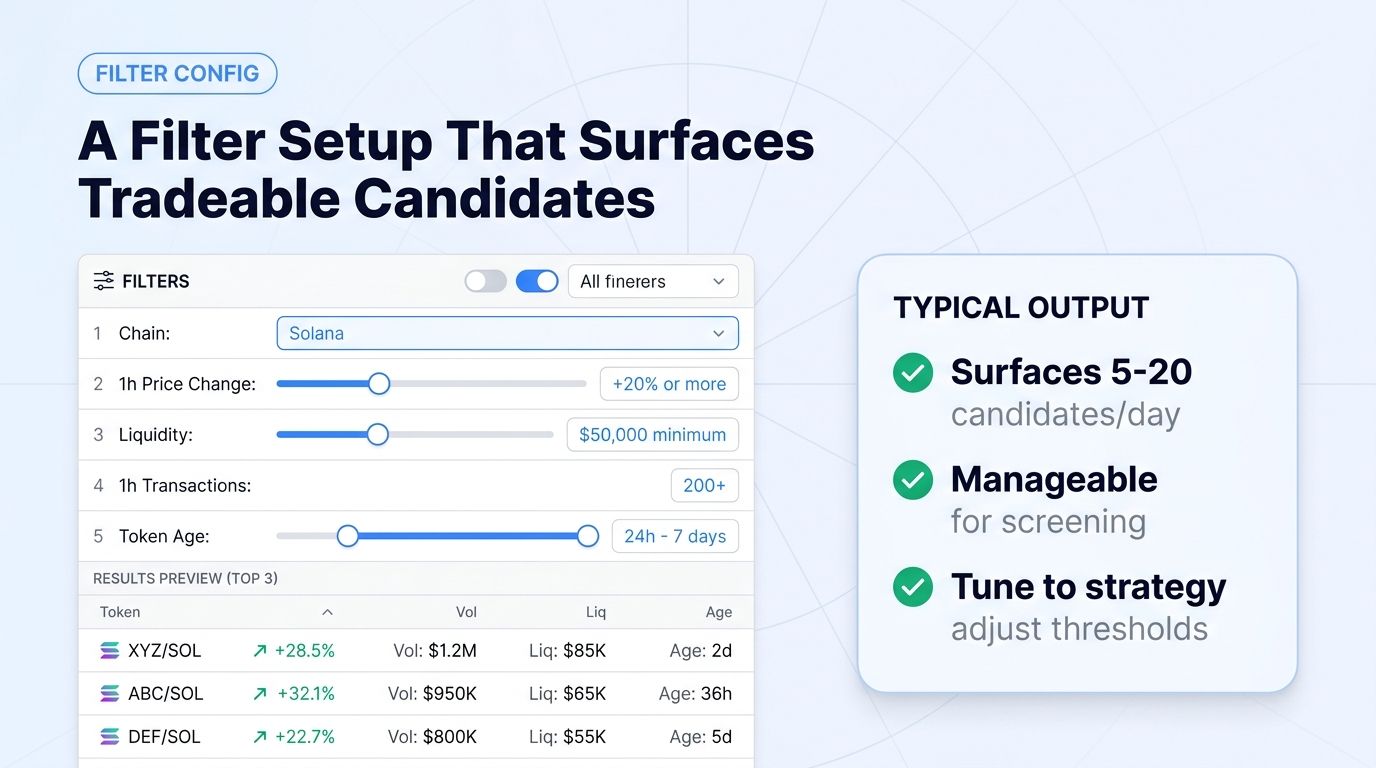
The filter system is the platform's main analytical tool. Defaults are too loose to be useful. Configure these settings to surface tradeable candidates.
Time-based price change filters. Dexscreener tracks 5-minute, 1-hour, 6-hour, and 24-hour price changes. The most useful filter for active trading: 1-hour price change above 20% with 24-hour volume above $100,000. This surfaces tokens with current momentum and minimum tradeable liquidity. Adjust the thresholds based on your strategy and the chain you are watching.
Liquidity filters. Set minimum liquidity at $30,000-$50,000 for tradeable size. Below $30,000, your trade is likely to move the price against you. The exact threshold depends on your position size, but liquidity below $30,000 is rarely worth the slippage on a typical $500-$2,000 entry.
Transaction count filters. Add a filter for transactions in the last hour (typically 200+). This indicates real buying activity, not just one or two large wallets. A token with high price change and only 20 transactions is usually a single wallet pumping its own bag.
Age filters. Filter for tokens 24 hours to 7 days old to focus on early-stage but not freshly launched tokens. Tokens under 24 hours have the highest survival risk. Tokens over 7 days have usually had their initial repricing.
A practical filter combination for catching mid-stage memecoin moves on Solana: - Chain: Solana - 1-hour change: +20% or more - Liquidity: $50,000 or more - 1-hour transactions: 200 or more - Age: 24 hours to 7 days
This surfaces 5-20 candidates per day, manageable for active screening.
Setting Up Alerts
Alerts let you watch positions and candidates without constantly checking charts.
Price alerts. Click the alert icon next to any pair. Set upper and lower price thresholds. Dexscreener notifies you via browser notification or email when the price crosses your levels. Use price alerts for two purposes:
- Entry triggers: set an alert at a price below current for tokens you want to buy on retrace.
- Exit triggers: set alerts at your predetermined profit-taking and stop-loss levels.
Alerts are tier-limited on free accounts. Active traders usually upgrade to the premium tier for more alert slots.
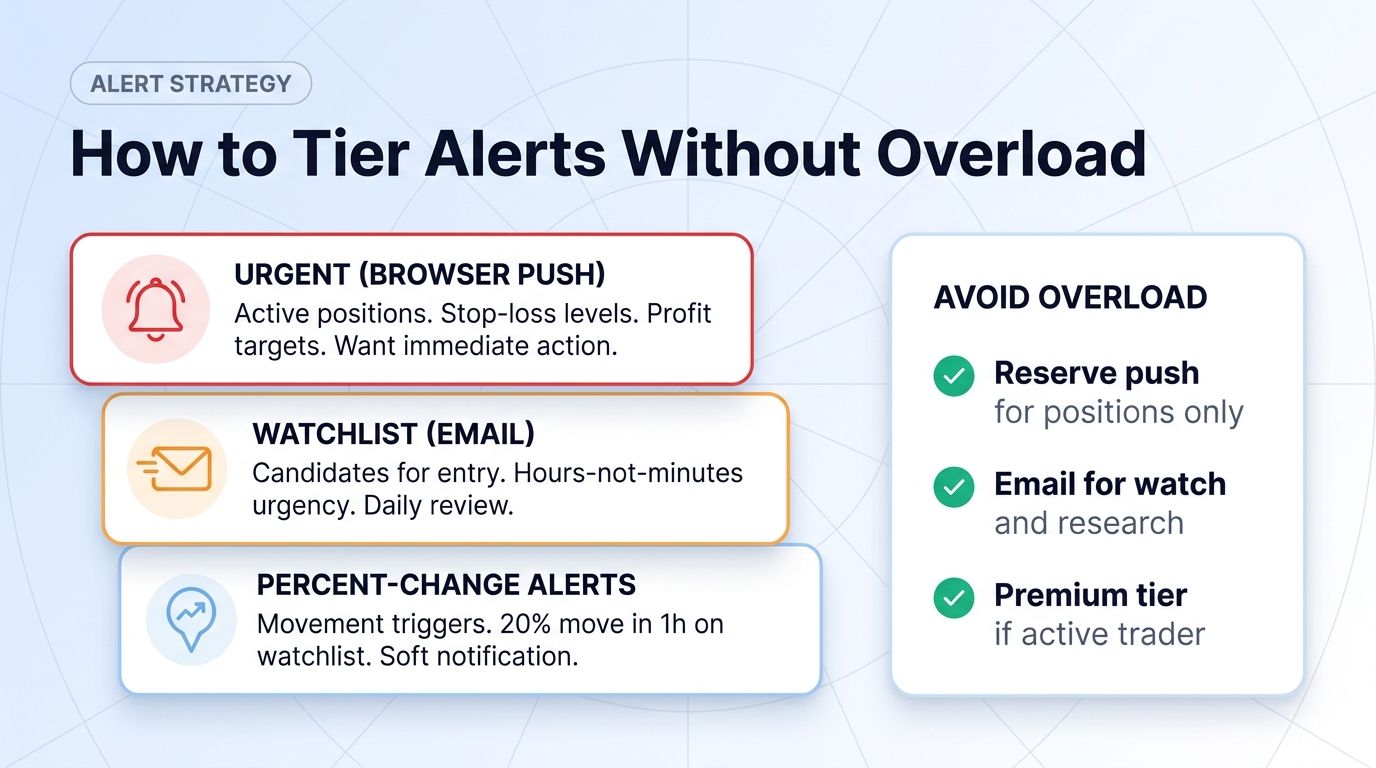
Percentage-change alerts. Beyond fixed price levels, you can set alerts that trigger when a token moves a percentage amount in a given time window. Useful for monitoring multiple positions where you do not want to set absolute prices for each.
Best practice: tier your alerts. Reserve urgent alerts (immediate browser notification) for positions you hold. Use email alerts for watchlist candidates where you can act within hours, not minutes.
Creating Effective Watchlists
Watchlists are the organizational layer that turns Dexscreener from a stream of noise into a focused tool.
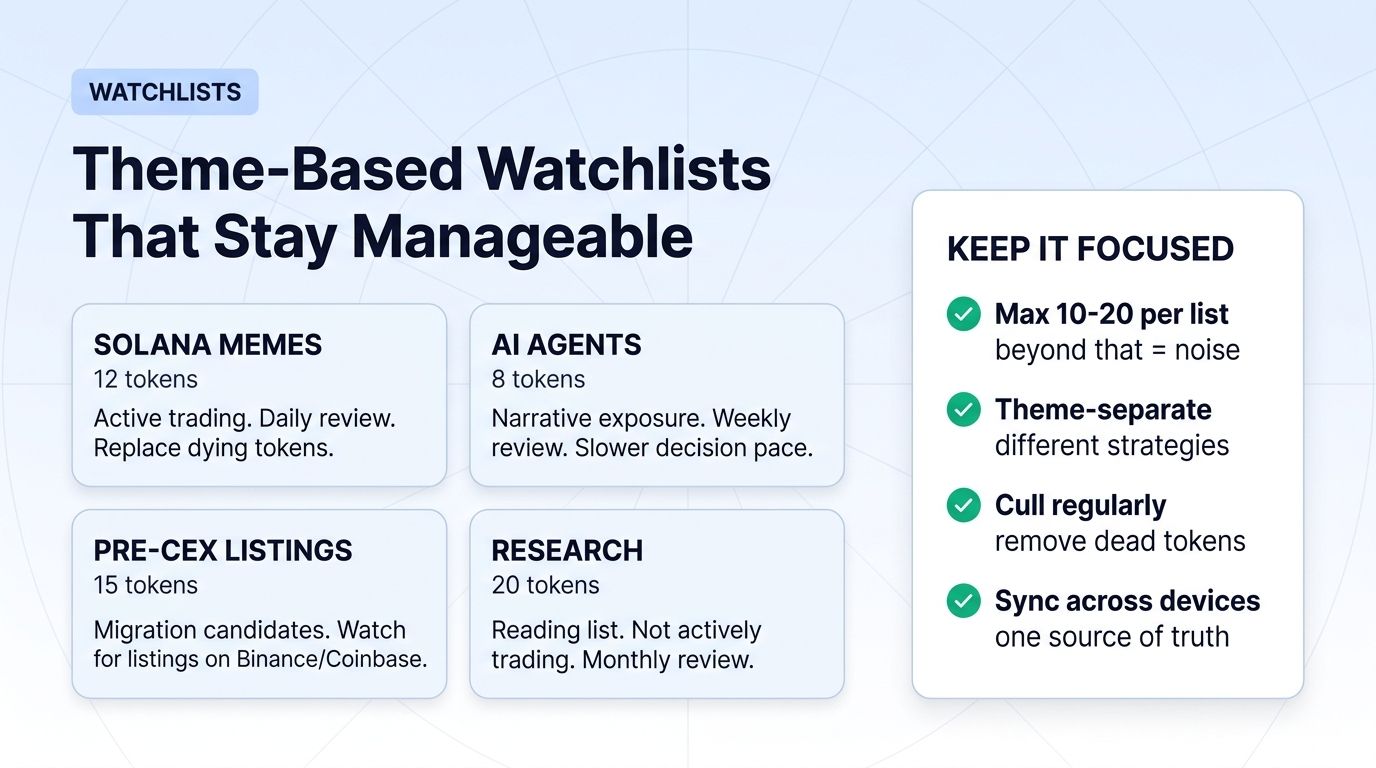
Theme-based watchlists. Create separate lists for the strategies you actually trade: - "Solana Memes" for active memecoin trading on Solana - "AI Agents" for tokens tied to the AI agent narrative - "Pre-CEX Listings" for tokens you expect might list on Binance, Coinbase, or Kraken soon - "Research" for tokens you are studying but not yet trading
Size limits. Keep each watchlist to 10-20 tokens. Beyond that, you cannot meaningfully monitor each. Trim regularly. Tokens that have not moved in a week or have died should come off the list.
Cross-device sync. Watchlists sync across devices when you sign in. Use one device for active trading and another for monitoring without trading temptation.
How to Use Dexscreener with Centralized Trading
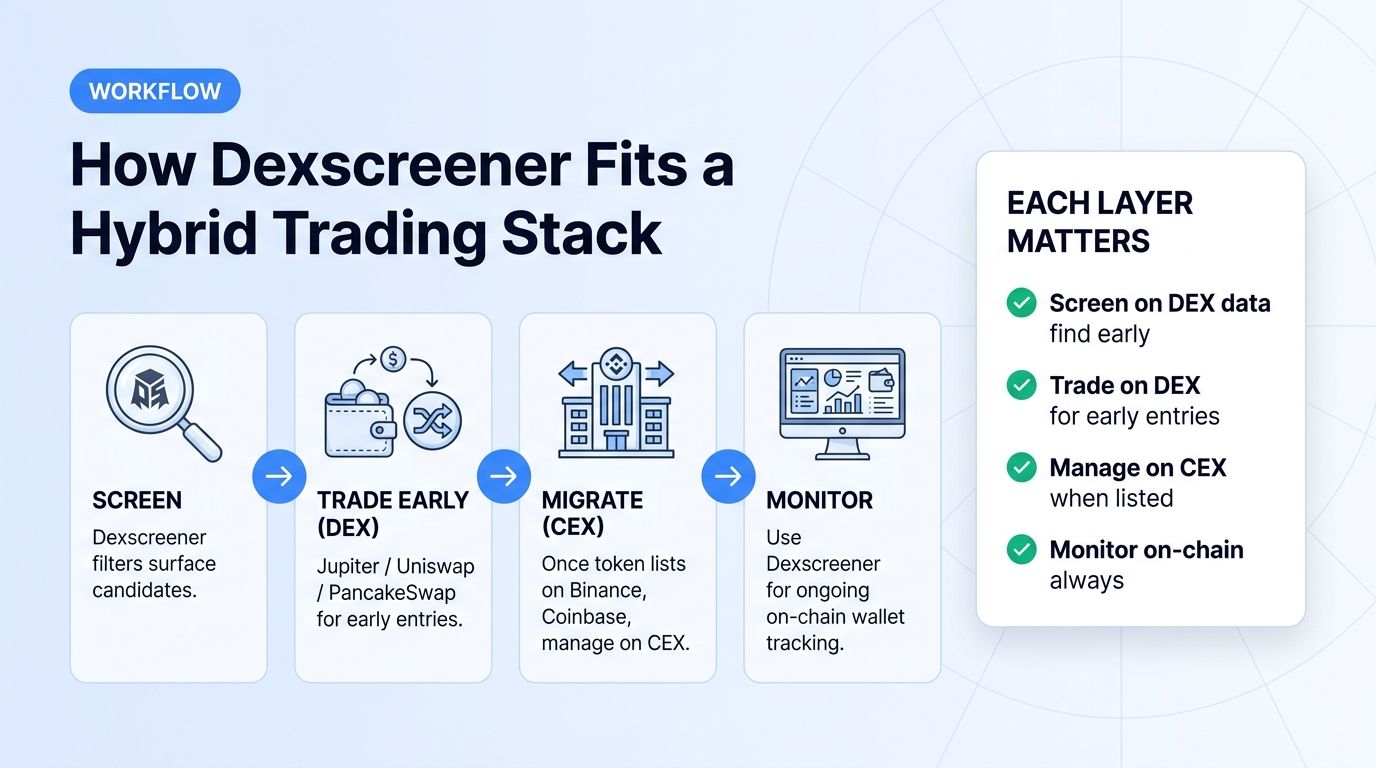
Dexscreener works best as the discovery layer in a hybrid trading workflow. The full workflow:
- Screen on Dexscreener. Configure filters, browse new pairs, identify candidates.
- Trade early entries on DEX. When a candidate matches your entry criteria and is only available on DEX, use Jupiter (Solana), Uniswap (Ethereum/Layer 2), or PancakeSwap (BNB Chain) to execute.
- Migrate to CEX when listings happen. When a token graduates to a centralized exchange listing on Binance, Coinbase, Kraken, or Bybit, you can move active management to a crypto trading platform like Altrady that integrates with those CEXs. Run automated strategies via the signal bot, set up grid trading, or manage positions across multiple exchanges from one dashboard.
- Use Dexscreener for ongoing monitoring. Even after a token lists on a CEX, Dexscreener often has cleaner on-chain data showing where smart-money wallets are accumulating or distributing.
The split between DEX discovery and CEX execution is the practical workflow most active traders adopt. Dexscreener handles the discovery. CEX integrations handle the execution and scaling.
The Risks of On-Chain Trading via Dexscreener
Dexscreener shows you everything. That includes obvious scams and not-so-obvious scams.
Honeypot tokens. Some tokens are coded to prevent selling. Buyers can enter but cannot exit. Always check that the token has both buy and sell transactions in its history. Specialized honeypot-detection tools (like Honeypot.is) can pre-check before you trade.
Rug pulls. Liquidity is added to bootstrap the token, then removed when enough buyers have entered. The price collapses instantly. Check whether liquidity is locked (you can verify this on Dexscreener's pair details page) and how long the lock lasts.
Mint authority and supply changes. On Solana especially, check whether the token's mint authority is renounced. If not, the developer can mint new tokens at will, diluting holders. This is often hidden in the contract details.
Sandwich attacks. Front-running bots monitor pending DEX transactions and extract value by trading before and after yours. Setting low slippage (2-5%) and using DEX routers with MEV protection (Jito on Solana, for example) reduces this risk.
Slippage and fees. Beyond exchange-level slippage, DEX trades incur swap fees and network fees. On Solana, fees are negligible. On Ethereum mainnet, fees can eat 5-15% of small trades. Use Layer 2s or Solana for sub-$1,000 trades.
How Dexscreener Fits Into a Trading Stack
For active crypto traders in 2026, the typical stack:
- Dexscreener: Discovery and screening layer for new on-chain opportunities
- Wallet (Phantom, Rabby, MetaMask): Execution for DEX trades
- DEX aggregators (Jupiter, 1inch, Matcha): Best-price routing across DEXs
- CEX accounts (Binance, Coinbase, Kraken, Bybit): Liquidity and listings for established tokens
- Crypto trading platform (Altrady or similar): Unified management of CEX positions across exchanges, automated strategies, multi-account oversight
Each layer has a different purpose. Dexscreener is not a replacement for CEX trading. It is the upstream tool for finding tokens before they reach the CEX stage.
2026 Update: What to Check Before You Act
Dexscreener can surface new on-chain opportunities quickly, but speed is only useful when paired with liquidity, contract, and execution checks.
| Check | What to review | Why it matters |
|---|---|---|
| Liquidity quality | Check pool liquidity, spread, volume consistency, and whether liquidity is locked or concentrated. | Thin pools can make entries and exits far worse than the chart suggests. |
| Token safety | Review contract age, holder concentration, tax settings, mint permissions, and verified links. | Many trending pairs are copycats or short-lived launches. |
| Execution plan | Decide entry size, slippage tolerance, stop area, and exit plan before swapping. | Keeps a fast scan from becoming an impulsive trade. |
Quick trader checklist
- Confirm the token address from official sources before trading.
- Compare volume spikes with holder growth and liquidity growth.
- Move promising pairs into a watchlist instead of entering every trending coin.
FAQ
Is Dexscreener free?
Yes. Most features (search, charts, transaction data, contract details) require no account. Free accounts unlock watchlists and a limited number of alerts. A premium tier exists for users who need more alerts or advanced features.
What chains does Dexscreener cover?
Over 100 blockchains. The most active for 2026 trading are Solana, Ethereum, Base, Arbitrum, BNB Chain, and Polygon. Smaller chains (Sui, Aptos, Avalanche, TON) are also indexed.
How do I know if a token is a scam on Dexscreener?
Several checks: transaction history shows both buys and sells (not just buys), liquidity is locked or significant, mint authority is renounced (for Solana tokens), and the contract has been verified or audited. Use specialized tools like Honeypot.is for additional pre-trade checks.
Can I trade directly from Dexscreener?
Dexscreener integrates with various DEX aggregators and wallets for one-click trading. You can also click through to the underlying DEX (Jupiter, Uniswap, PancakeSwap) and execute there. The platform itself is not an exchange.
Once a token lists on a CEX, can I manage it through Altrady?
Yes. When a token graduates from DEX-only to centralized exchange listings on Binance, Coinbase, Kraken, Bybit, or other CEXs that Altrady supports, you can manage that position alongside your other crypto holdings. Run automated strategies, set up the signal bot for systematic entries, and view your full portfolio across 19+ exchanges in one dashboard.
What should traders check first on Dexscreener?
Start with the token contract, liquidity depth, recent volume, holder distribution, and verified project links. A strong chart is not enough if liquidity is thin or the contract is unsafe.
Conclusion
Dexscreener earned its place by being the broadest, fastest, and most accessible window into on-chain trading activity. For traders who want exposure to early-stage moves before centralized exchange listings, the platform is essential. For traders who only trade tokens already on Binance or Coinbase, it is supplementary at most.
The practical takeaway: Dexscreener is a discovery and screening tool, not an execution platform. Use it to find candidates. Configure filters that match your strategy. Set tiered alerts. Build focused watchlists. Then execute on DEXs for early-stage trades and migrate to CEX-integrated platforms when tokens graduate to larger listings.
The 170% rise in searches for Dexscreener in early 2026 reflects how on-chain trading is no longer niche. The traders who learn the workflow now will be early to the next category of opportunities. The traders who avoid on-chain entirely will be late to most of the asymmetric trades that define crypto cycles.