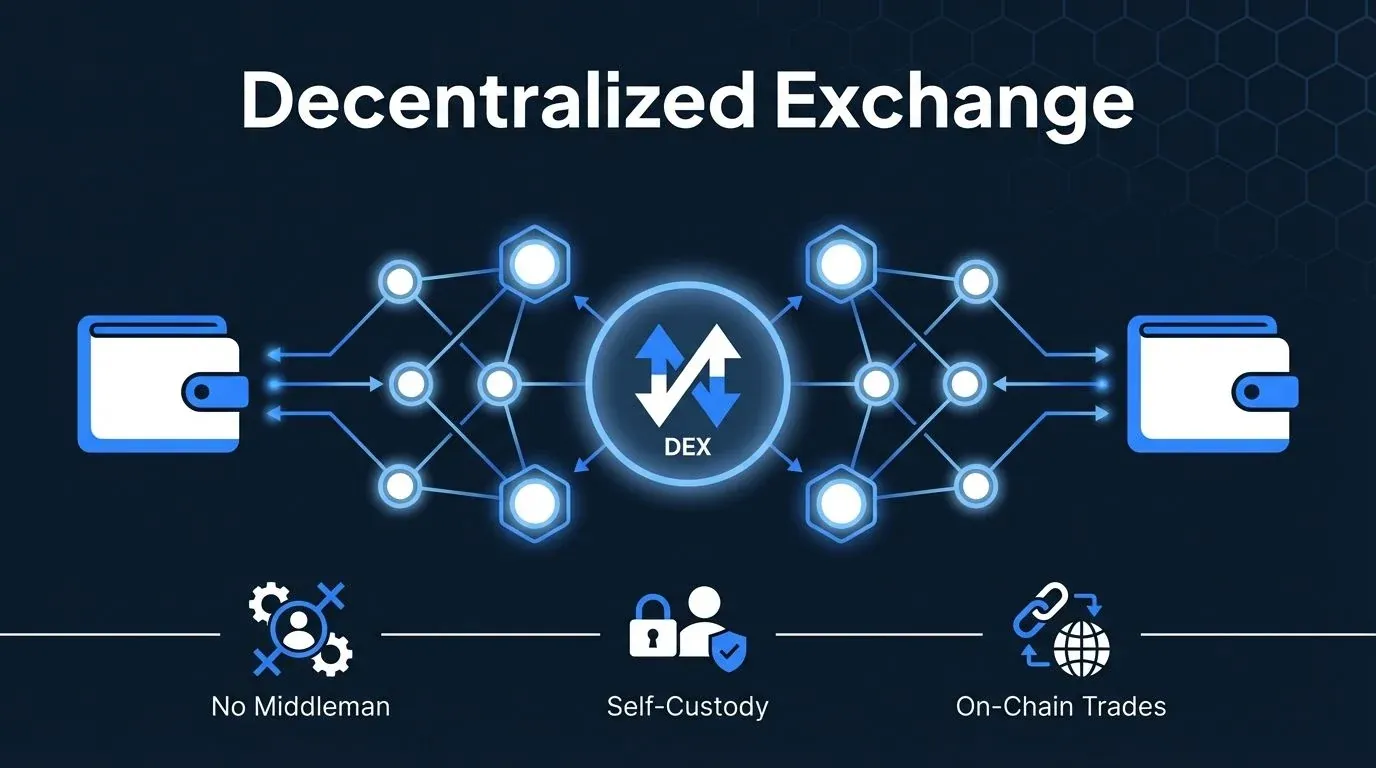

Decentralized exchange crypto platforms have fundamentally changed how traders access digital assets. Unlike traditional brokerages or centralized crypto exchanges, a decentralized exchange operates without a company holding your funds, controlling your account, or acting as an intermediary in every trade. You connect your wallet, swap tokens directly on-chain, and retain full custody of your assets at every step of the process.
Understanding how DEXs work is no longer optional for serious crypto participants. Whether you are a DeFi yield farmer, a spot trader looking to access new token launches, or simply a holder who wants to swap between assets without creating an account, DEX platforms are a core part of the modern crypto ecosystem. This guide breaks down everything you need to know, from the mechanics under the hood to the real risks you should manage carefully.
1. What Is a Decentralized Exchange
A decentralized exchange (DEX) is a peer-to-peer marketplace that runs on a blockchain through smart contracts. There is no central company operating as custodian, no sign-up form, no KYC verification in most cases, and no central server that can be taken offline. The exchange logic lives in code deployed on a public blockchain, and anyone with a compatible wallet can interact with it.
The first significant DEX models emerged around 2017 and 2018, but the sector exploded in 2020 with the rise of automated market makers and the broader DeFi movement. By 2025, daily trading volumes across major DEX platforms regularly exceeded several billion dollars, rivaling many centralized exchanges for specific asset pairs.
Key Characteristics of a DEX
- Non-custodial: Your private keys remain yours. The exchange never takes possession of your assets.
- Permissionless: Anyone with a crypto wallet can use a DEX without creating an account or passing identity verification.
- Transparent: All trades and liquidity pool balances are publicly visible on the blockchain.
- Censorship-resistant: No central authority can freeze your account or block specific wallets from trading.
- Composable: DEX smart contracts can be integrated with other DeFi protocols, enabling complex financial strategies in a single transaction.
The trade-off for these benefits is added complexity for users. You are responsible for your own security, transaction fees, and understanding what you are signing when interacting with smart contracts.
2. How DEXs Work: AMMs, Liquidity Pools, and Order Book Models
Not all DEXs operate the same way. The two primary architectures are the automated market maker model and the on-chain order book model. Each has distinct mechanics, advantages, and limitations.
Automated Market Makers (AMM)
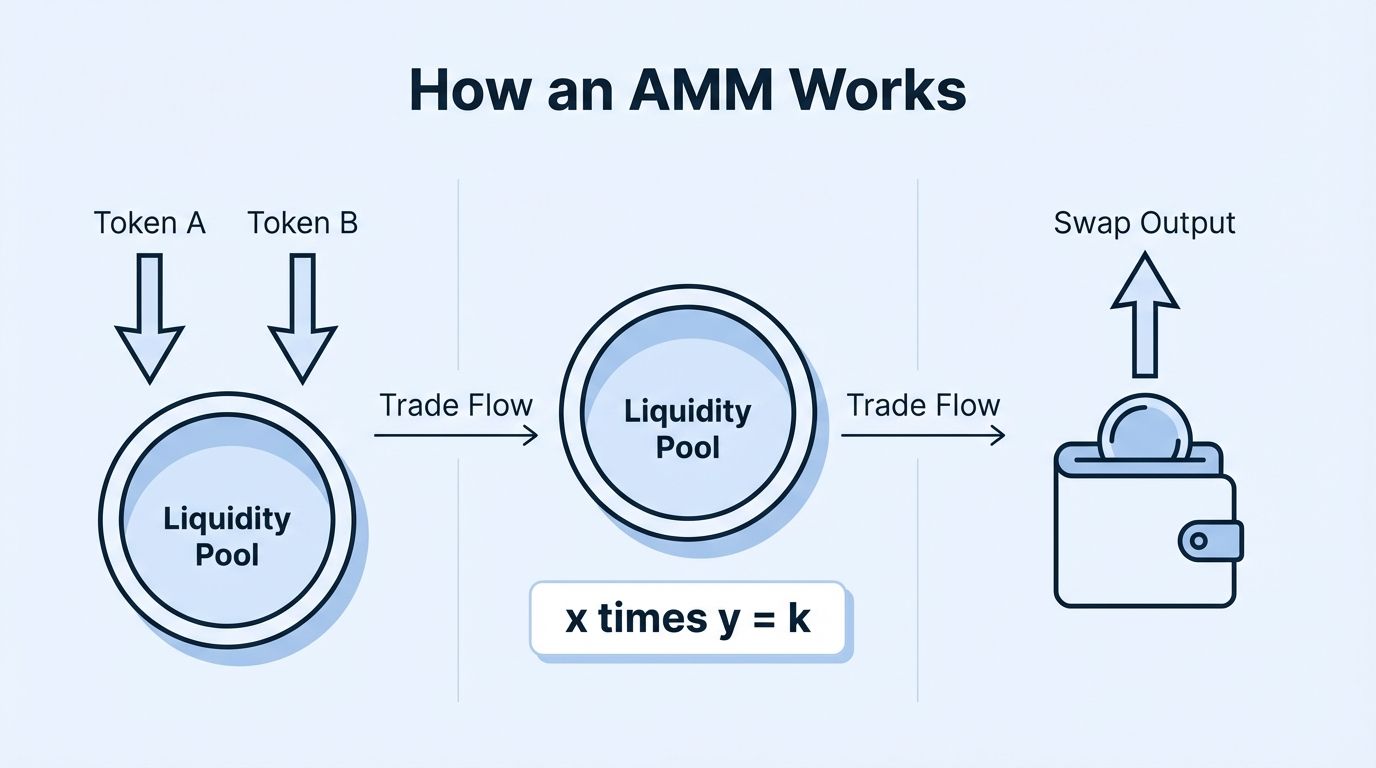
The AMM model replaced the traditional buyer-seller matching system with a mathematical formula that sets prices algorithmically. The most widely used formula is the constant product formula: x times y equals k, where x and y represent the quantities of two tokens in a pool, and k is a constant. As one token is bought, its price rises relative to the other, and vice versa.
Instead of matching a buyer with a seller, you are trading against a liquidity pool, a smart contract holding reserves of two or more tokens. The pool calculates the output amount based on the current ratio of reserves, applying the pricing formula automatically. There is no order book, no waiting for a counterparty, and no partial fills. The trade executes immediately at the formula-determined price.
Liquidity Pools and Liquidity Providers
Liquidity pools are funded by liquidity providers (LPs), individuals who deposit equal values of two tokens into a pool in exchange for LP tokens representing their share of the pool. LPs earn a percentage of all trading fees generated by the pool, proportional to their share. This fee income is the incentive that attracts capital to DEX pools.
When a trade is made, a small fee (commonly 0.3% on many platforms) is added to the pool, increasing the total value. As more trades happen, the accumulated fees grow the value of each LP's position over time, assuming no adverse price movements occur.
Concentrated Liquidity
More advanced DEX versions introduced concentrated liquidity, which allows LPs to provide liquidity only within a specific price range rather than across the entire price curve. This significantly improves capital efficiency: LPs can earn the same fees with far less capital deployed, but only while the market price stays within their chosen range. If the price moves outside the range, the LP earns no fees until it returns or they adjust their position.
Order Book DEXs
Some DEXs replicate the traditional order book model on-chain or through a hybrid approach. In a fully on-chain order book, every limit order placement and cancellation is a blockchain transaction, which makes this model expensive and slow on high-fee networks. Hybrid models solve this by processing order matching off-chain while settling trades on-chain, giving users the familiar limit order experience with non-custodial settlement. This architecture is more commonly seen on networks with low transaction costs.
3. DEX vs. CEX: Key Differences You Need to Know
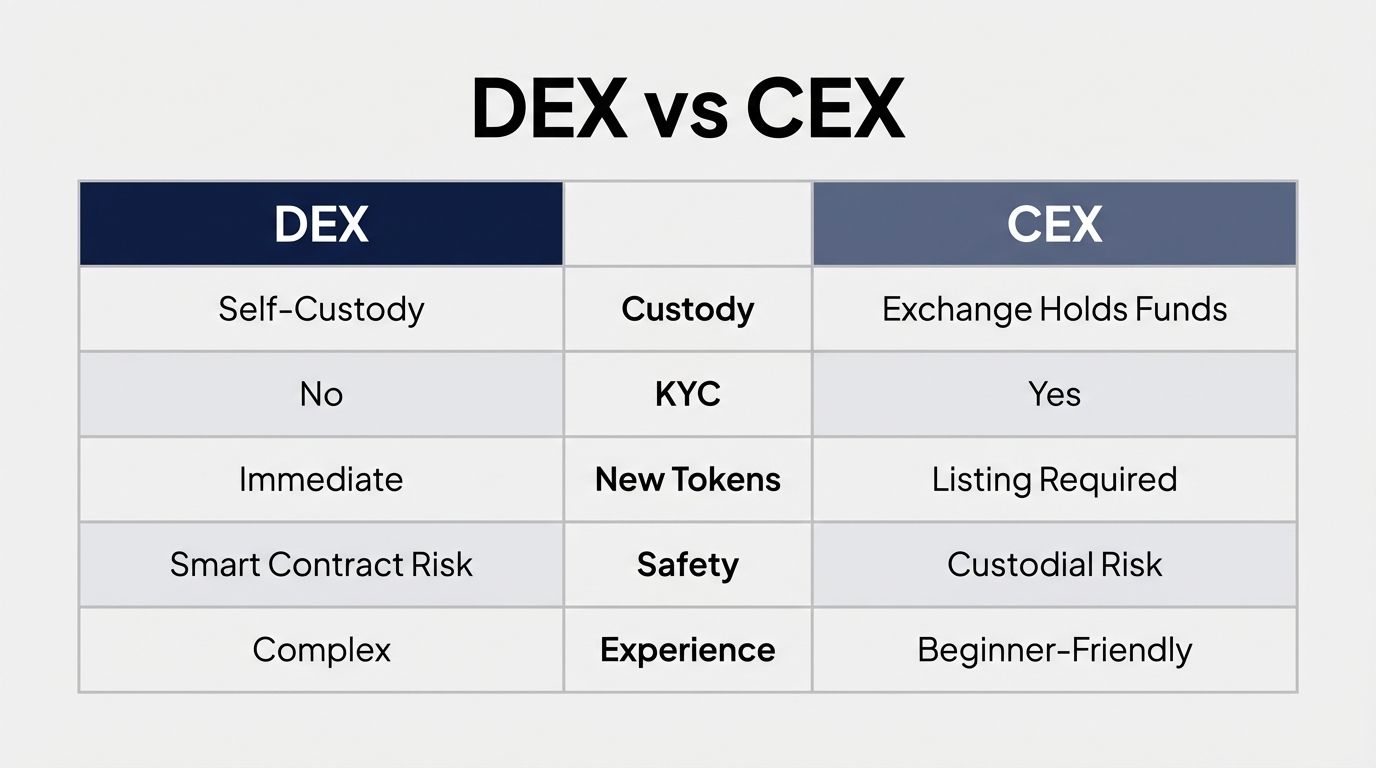
Choosing between a decentralized exchange and a centralized exchange (CEX) depends on your priorities. They are not mutually exclusive tools. Most active crypto participants use both, selecting the right venue for each situation.
Custody and Control
On a CEX, the exchange holds your funds. You have an account balance, but the exchange controls the underlying private keys. The phrase "not your keys, not your coins" exists because CEX failures, hacks, and freezes have wiped out user balances multiple times throughout crypto history. On a DEX, your wallet is always yours. The exchange never takes custody of your tokens at any point during a trade.
Asset Availability
CEXs list assets through a selective listing process. New tokens often take months to get listed, and some projects are never approved. DEXs have no listing gatekeepers. Any token that exists as a smart contract on a supported blockchain can be traded on a DEX the moment its liquidity pool is created, which is why new token launches almost universally debut on DEXs first.
Privacy and Verification
CEXs require identity verification (KYC) for most features. DEXs require only a wallet address. This has significant privacy implications, though regulatory trends are putting increasing pressure on DEX front-ends to implement compliance measures at the application layer.
User Experience and Fees
CEXs offer polished interfaces, customer support, fiat on-ramps, and trading features like margin and futures that most DEXs do not match. DEXs require users to manage their own wallets, understand gas fees, and navigate interfaces that are often less intuitive. On high-activity blockchains, DEX gas fees can make small trades economically inefficient compared to CEX trading fees.
Liquidity Depth
Major CEXs typically have deeper liquidity for large-cap pairs, resulting in tighter spreads and less slippage on large orders. DEX liquidity for major pairs has grown substantially but can still lag on less popular networks or for mid-cap tokens.
4. How to Use a DEX Step by Step
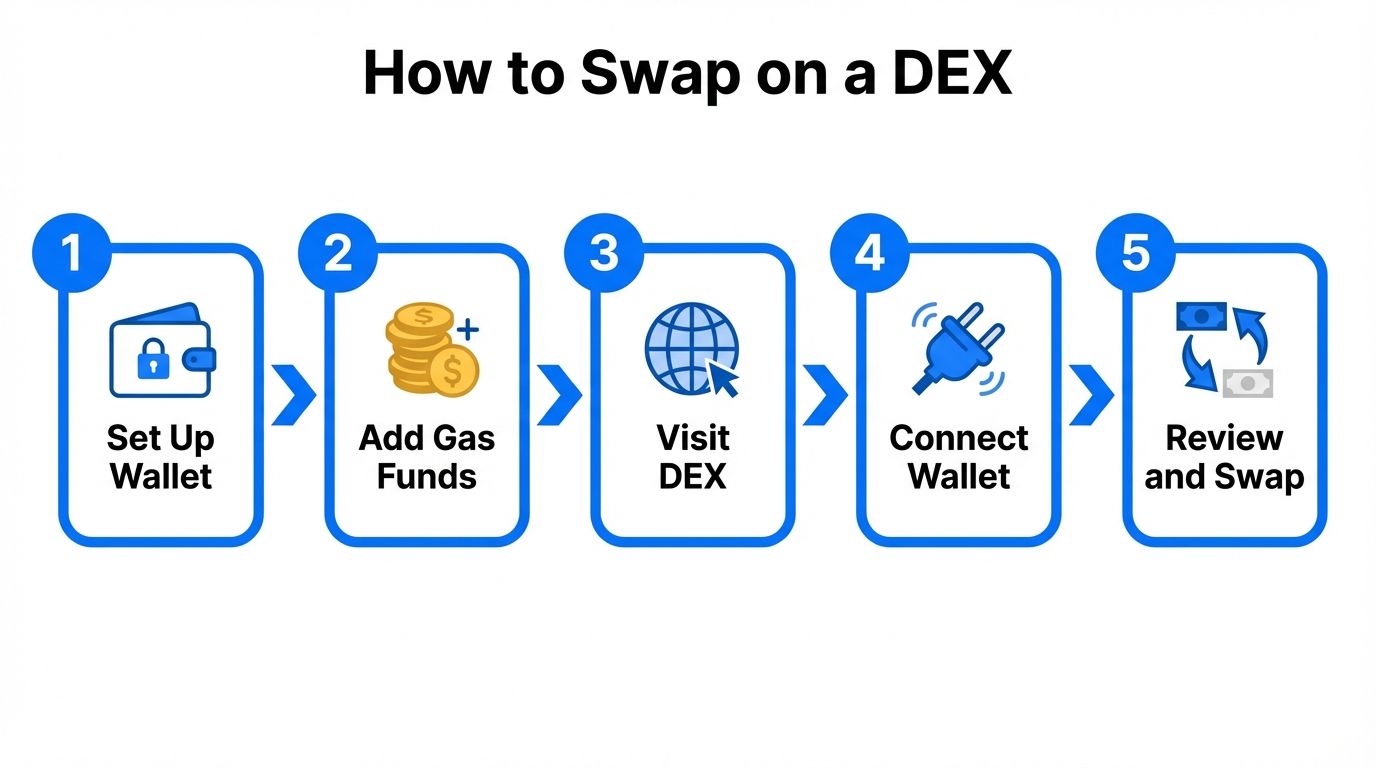
Using a DEX for the first time can feel unfamiliar if you are accustomed to centralized platforms. The following steps apply to most AMM-based DEXs on major EVM-compatible networks.
- Set up a non-custodial wallet. Download a browser extension wallet or a mobile wallet that supports the blockchain you want to use. Write down your seed phrase and store it securely offline. Never share it with anyone.
- Fund your wallet with the native token for gas. Every transaction on a blockchain requires gas fees paid in the network's native token. Before swapping, make sure your wallet holds enough of this token to cover fees, not just the tokens you want to trade.
- Navigate to the DEX interface. Open the official website of the DEX you intend to use. Always verify the URL carefully. Phishing sites mimicking popular DEXs are a significant threat. Bookmark the verified URL after your first visit.
- Connect your wallet. Click the connect wallet button, select your wallet provider, and approve the connection in your wallet extension. This does not give the DEX access to your funds. It only allows the site to read your wallet address and send unsigned transaction requests for you to approve.
- Select the token pair. Choose the token you are selling (From) and the token you want to receive (To). If the token you want is not in the default list, you can paste the contract address. Always verify the contract address from the official project source before trading.
- Review slippage tolerance. Slippage is the difference between the expected price and the executed price. For stablecoins or highly liquid pairs, the default 0.5% is usually fine. For low-liquidity tokens, you may need to increase slippage tolerance, but higher tolerance also increases exposure to front-running and sandwich attacks.
- Review the trade details and confirm. Check the estimated output, the price impact, and the network fee before clicking swap. Your wallet will prompt you to confirm the transaction. Review the details on your wallet screen before signing.
- Wait for confirmation. The transaction broadcasts to the blockchain and awaits inclusion in a block. Confirmation time varies by network and current congestion. You can monitor the transaction using the network's block explorer.
5. DEX Risks: Impermanent Loss, Smart Contract Risk, and Front-Running
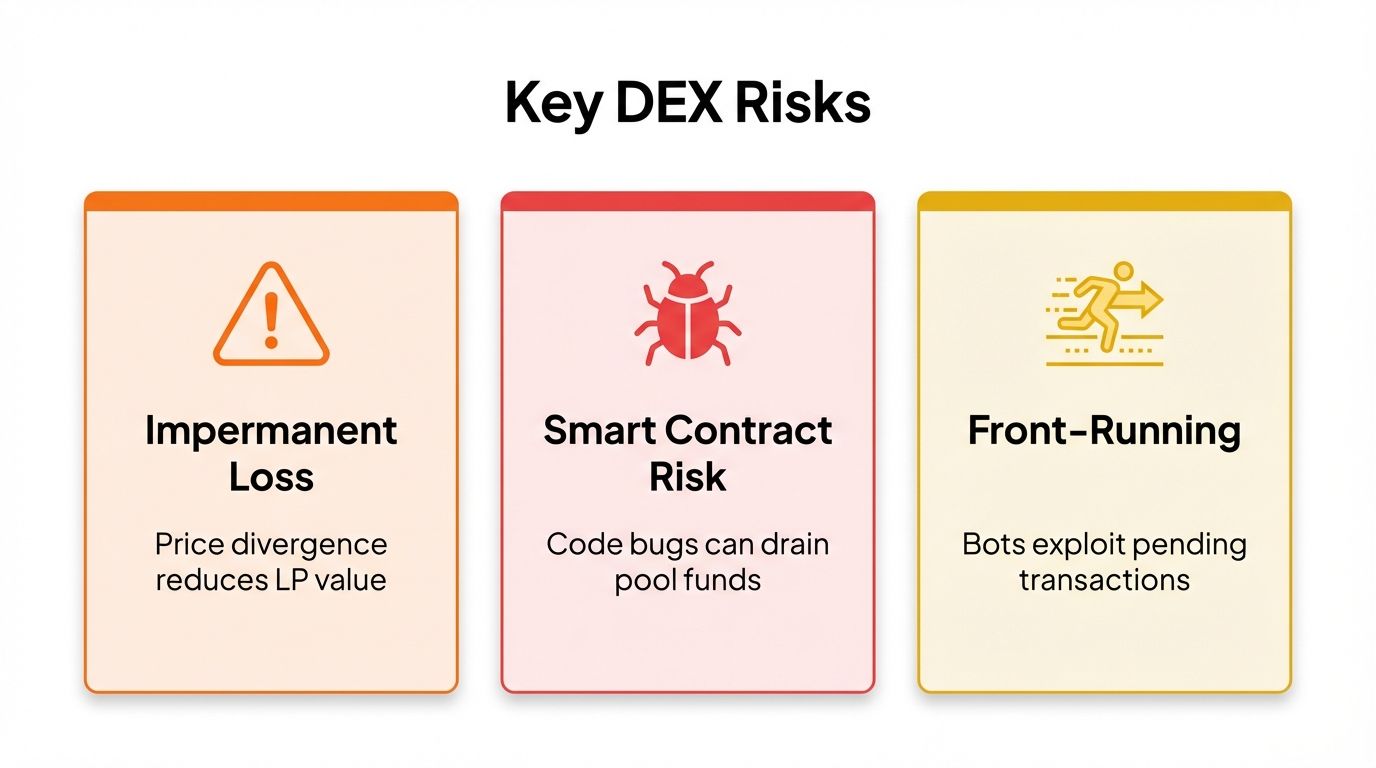
Decentralized exchanges carry risks that do not exist on centralized platforms, or that manifest very differently. Understanding these risks is essential before committing capital to DEX trading or liquidity provision.
Impermanent Loss
Impermanent loss affects liquidity providers, not regular traders. It occurs when the price ratio of the two tokens in a pool diverges from the ratio at the time of deposit. If Token A doubles in price relative to Token B after you deposited both into an equal-value pool, arbitrage traders will rebalance the pool, and you will end up with more of the cheaper token and less of the expensive one. When you withdraw your liquidity, the total value of your position may be lower than if you had simply held the two tokens in your wallet.
The loss is called "impermanent" because if prices return to the original ratio, the loss disappears. In practice, many LP positions experience permanent impermanent loss because prices rarely return exactly to the entry ratio. Fee income can offset impermanent loss, but this is not guaranteed, especially during periods of high price volatility.
Smart Contract Risk
DEXs run on smart contracts, and smart contracts can have bugs. A vulnerability in a DEX contract can allow an attacker to drain all funds from a liquidity pool. This has happened to multiple DeFi protocols, sometimes resulting in losses of hundreds of millions of dollars. While major, long-running DEXs have extensive audits and bug bounty programs, the risk cannot be completely eliminated. Newer or less audited protocols carry meaningfully higher risk.
The best risk management practice is to prioritize well-audited, battle-tested protocols with substantial track records. Spreading liquidity across multiple protocols rather than concentrating in a single contract also reduces single-point-of-failure exposure.
Front-Running and Sandwich Attacks
Because blockchain transactions are visible in the mempool (the queue of pending transactions) before they are confirmed, sophisticated bots scan for large pending swaps and execute strategies to profit at the expense of the original trader. A sandwich attack involves a bot placing a buy order just before your transaction and a sell order just after it, profiting from the price movement your trade causes.
To reduce exposure, use a low slippage tolerance when possible, use private transaction relays where available, and avoid trading extremely large amounts relative to pool size, as large trades have greater price impact and create more profitable sandwich opportunities.
Wallet and Interface Risk
Connecting to a malicious or compromised DEX front-end can expose your wallet to malicious approval requests. Always verify the URL, use hardware wallet confirmation for large transactions, regularly audit and revoke unnecessary token approvals, and be cautious of DEX aggregator sites that may route through unaudited contracts.
Take Your Crypto Trading Further with Altrady
Understanding decentralized exchange crypto platforms is one piece of a complete trading strategy. Executing that strategy efficiently, across multiple venues and market conditions, is where professional tools make the difference. Altrady is a multi-exchange crypto trading platform designed for traders who need real performance, not just basic dashboards.
With Altrady, you get consolidated portfolio tracking across your centralized exchange accounts, advanced order types including trailing stops and scaled orders, customizable alert systems, and automation tools that let you act on opportunities even when you are away from the screen. Altrady gives you the infrastructure to trade with discipline, manage risk methodically, and scale your approach as your strategy evolves.
Start your free trial today and experience why thousands of active crypto traders rely on Altrady to power their daily workflow. No credit card required to get started.
Frequently Asked Questions
What is a decentralized exchange in crypto?
A decentralized exchange (DEX) is a blockchain-based trading platform that allows users to swap cryptocurrencies directly from their own wallets through smart contracts, without any central company holding their funds or controlling the exchange. Trades are executed on-chain, all activity is publicly verifiable, and users retain custody of their assets throughout the entire process.
Is it safe to use a DEX?
DEXs eliminate custodial risk, meaning you are not exposed to an exchange hack or insolvency. However, they introduce different risks including smart contract vulnerabilities, phishing through fake front-ends, front-running bots, and impermanent loss for liquidity providers. Using only well-audited, reputable DEX protocols, verifying URLs carefully, and confirming transactions on a hardware wallet significantly reduces your overall exposure.
What is impermanent loss on a DEX?
Impermanent loss is the reduction in value that liquidity providers experience when the price ratio of the two tokens they deposited into a pool changes after their deposit. Arbitrage activity rebalances the pool toward the current market ratio, leaving LPs with proportionally more of the token that fell in value and less of the token that rose. The loss is impermanent if prices return to the original ratio, but becomes permanent if they do not. Trading fee income can partially or fully offset this loss depending on pool activity and volatility.
How does an automated market maker work?
An automated market maker (AMM) is the pricing mechanism used by most DEXs. Instead of matching buyers with sellers through an order book, an AMM uses a mathematical formula to calculate exchange rates based on the ratio of token reserves in a liquidity pool. The most common formula is the constant product model, where the product of the two token quantities in the pool must remain constant. As you buy one token, its supply in the pool decreases and its price rises automatically, with no human or algorithmic market maker involved.
What is the difference between a DEX and a CEX?
A centralized exchange (CEX) is operated by a company that holds your funds, requires identity verification, and processes trades through its own internal systems. A decentralized exchange (DEX) runs on a public blockchain through smart contracts, never holds your assets, requires no account creation, and executes trades transparently on-chain. CEXs typically offer better liquidity for major pairs, fiat on-ramps, and a more polished user experience. DEXs offer self-custody, permissionless access, and the ability to trade newly launched tokens that have not yet been listed on centralized platforms.