
Most crypto traders learned to trust centralized exchanges for one reason. Liquidity. The biggest order books, the tightest spreads, the fastest fills, all sat at Binance, OKX, and a handful of others. In 2026, that monopoly broke.
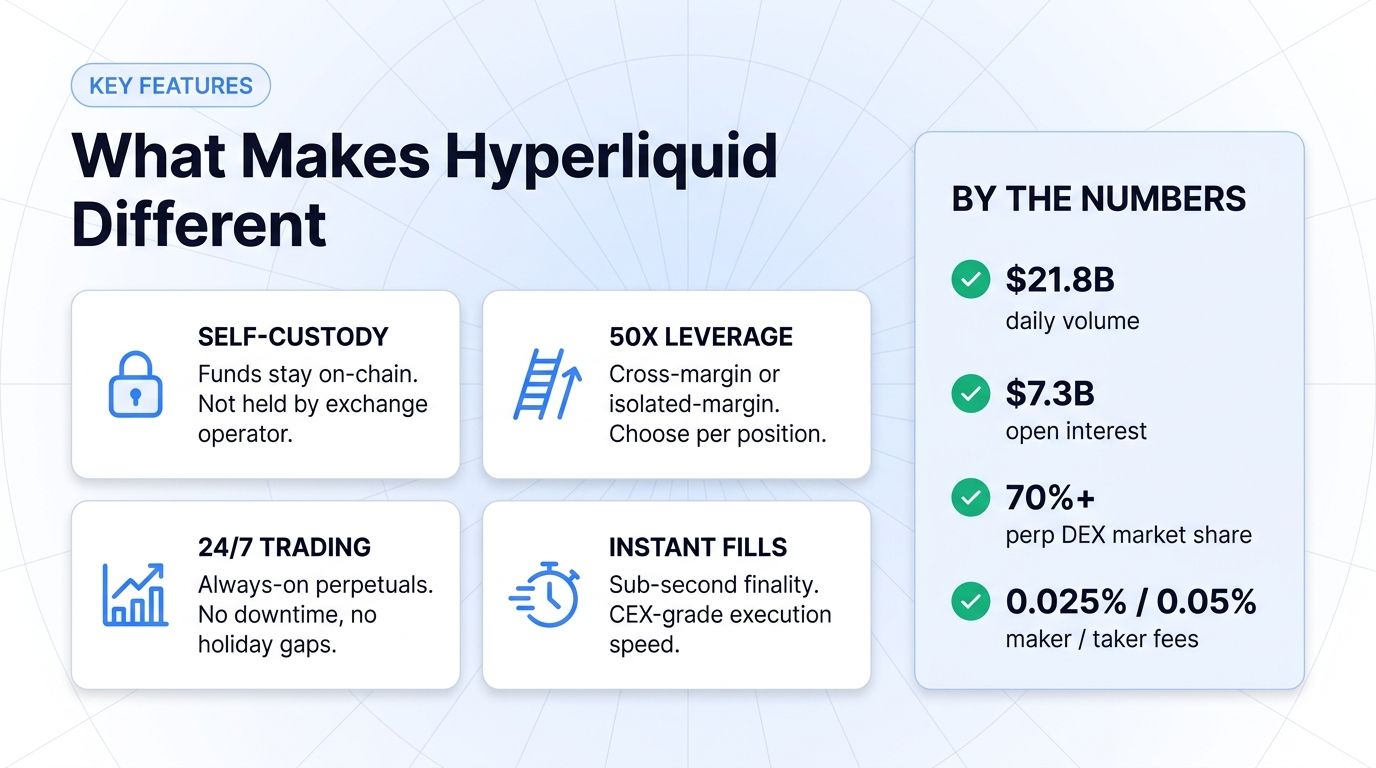
Hyperliquid runs its own Layer 1 blockchain, holds over 70% market share of perpetual DEX volume, processes around $21.8 billion in 24-hour trading, and carries open interest near $7.3 billion. It does this without taking custody of user funds. The trades happen on-chain, the order book lives on-chain, and the liquidity is real.
This guide explains what Hyperliquid is, how it works, how to trade it, the specific risks of perpetual DEX trading, and how to manage Hyperliquid positions alongside your other crypto holdings using a multi-exchange terminal like Altrady.
What Is Hyperliquid?
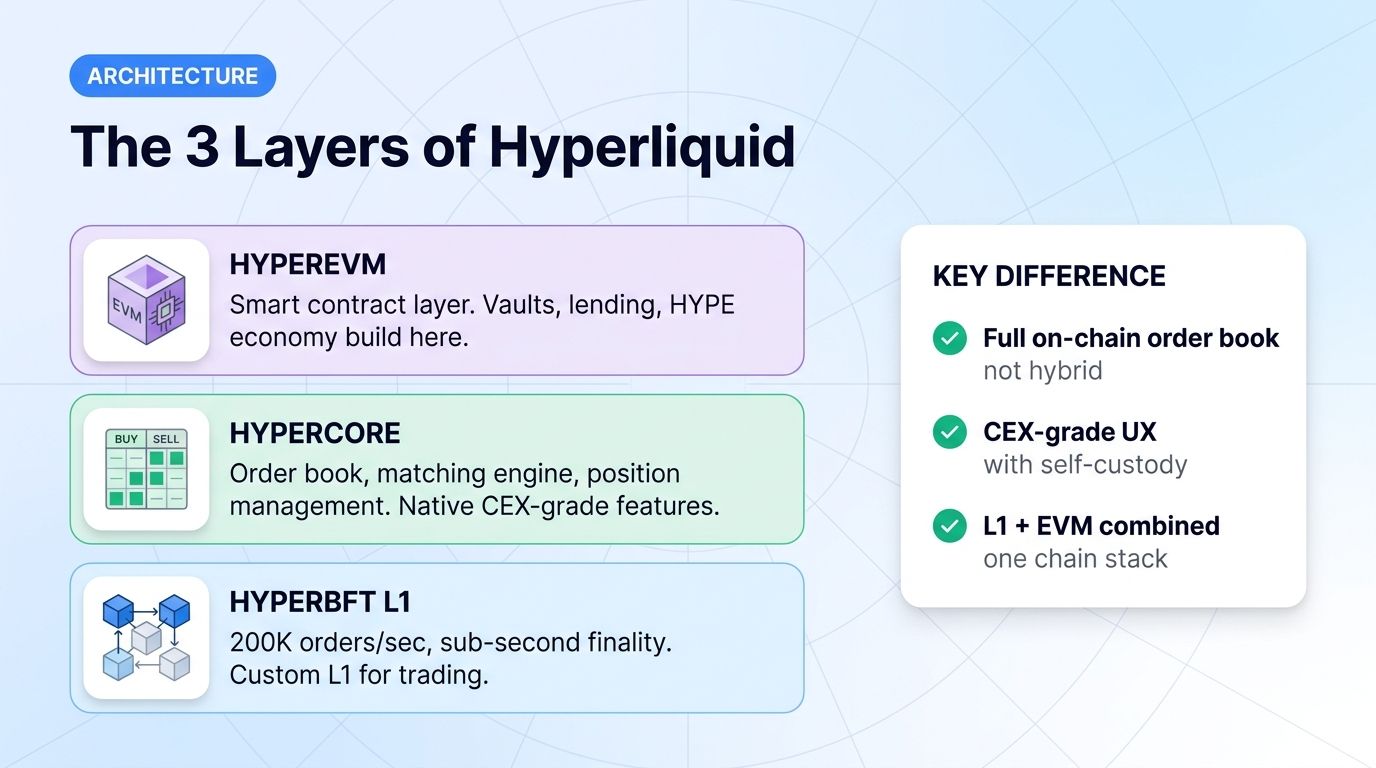
Hyperliquid is a decentralized perpetual futures exchange built on a custom Layer 1 blockchain optimized for trading. The chain processes around 200,000 orders per second with sub-second finality. The order book is fully on-chain, not just a hybrid model where orders sit off-chain and only settlements hit the blockchain.
Three components matter for traders.
First, the L1 chain runs HyperBFT consensus, specifically designed for high-frequency trading throughput. It handles the matching engine, order book, position management, and settlement in a single execution layer.
Second, HyperCore is the trading engine. Perpetual futures with up to 50x leverage, cross-margin or isolated-margin modes, stop-loss and take-profit orders, trailing stops, scaled orders, and TWAP execution are all native.
Third, HyperEVM is the smart contract layer that lets developers build on top of the trading engine. This is where the broader ecosystem lives: vaults, lending markets, prediction markets, and the HYPE token economy.
You hold a wallet, you connect, you deposit USDC, you trade. Your funds stay in the protocol's custody on-chain, not with a centralized operator. This is fundamentally different from depositing to a centralized exchange that holds your collateral on a custodial balance sheet.
Why Hyperliquid Matters in 2026
Three drivers converged. For traders who want exposure to the platform thesis without managing perp positions directly, the Hyperliquid HYPE token captures fee revenue through buyback and burn mechanisms.
First, the FTX collapse in November 2022 broke retail trust in centralized custody. Traders who lost funds there spent years looking for alternatives. By 2026, the answer was clear: trade on-chain when you can, custody on-exchange only as needed.
Second, Hyperliquid solved the perpetual DEX user experience problem. Earlier perp DEXs like dYdX, GMX, and Jupiter Perps had real liquidity but each had compromises: slow execution, limited features, expensive base-chain gas, or smaller markets. Hyperliquid combined deep books, low latency, and a CEX-grade trading interface.
Third, the HYPE token launch in November 2024 distributed real value to early users. The token captures fee revenue from the platform, which has translated into a fully diluted valuation comparable to mid-tier centralized exchanges. Real users, real revenue, real distribution.
By April 2026, Hyperliquid's 24-hour volume of around $21.8 billion exceeded most centralized perpetual exchanges. Open interest of $7.3 billion indicates serious capital deployed, not just wash trading.
How Hyperliquid Trading Works
Three core mechanics differentiate it from CEX perps.
Order Book and Matching
The order book operates fully on-chain. When you place a limit order, it sits in the public book visible to everyone. Market orders match against the best available limit order. Fills are deterministic and visible on-chain. There is no hidden orderflow, no internalization, no payment-for-orderflow conflicts.
Fees are 0.025% maker and 0.05% taker by default, with discounts for high-volume traders. Compared to Binance perps at 0.02% maker and 0.05% taker, Hyperliquid is competitive on cost.
Cross-Margin and Isolated-Margin
Cross-margin pools your entire balance as collateral across all positions. A profit on one position offsets a loss on another. Margin calls only happen when total equity drops below maintenance.
Isolated-margin assigns specific collateral to a single position. If the position liquidates, only that allocated margin is lost. Useful for high-conviction trades you want to firewall from your other exposure.
Most CEX perps default to cross-margin. Hyperliquid lets you choose per position. For active traders managing many positions, cross-margin is more capital-efficient. For aggressive single-position trades, isolated is safer.
Funding Rates
Like all perpetual futures, Hyperliquid charges or pays a funding rate every 8 hours. The rate balances long and short demand. When longs outweigh shorts, longs pay shorts. When shorts outweigh longs, shorts pay longs.
Funding rates on Hyperliquid often differ from centralized exchanges. This creates arbitrage opportunities: if BTC funding is 0.01% per 8 hours on Hyperliquid but 0.05% on Binance, you can short Binance and long Hyperliquid, collecting the funding differential while staying market-neutral.
How to Start Trading on Hyperliquid
Four steps.
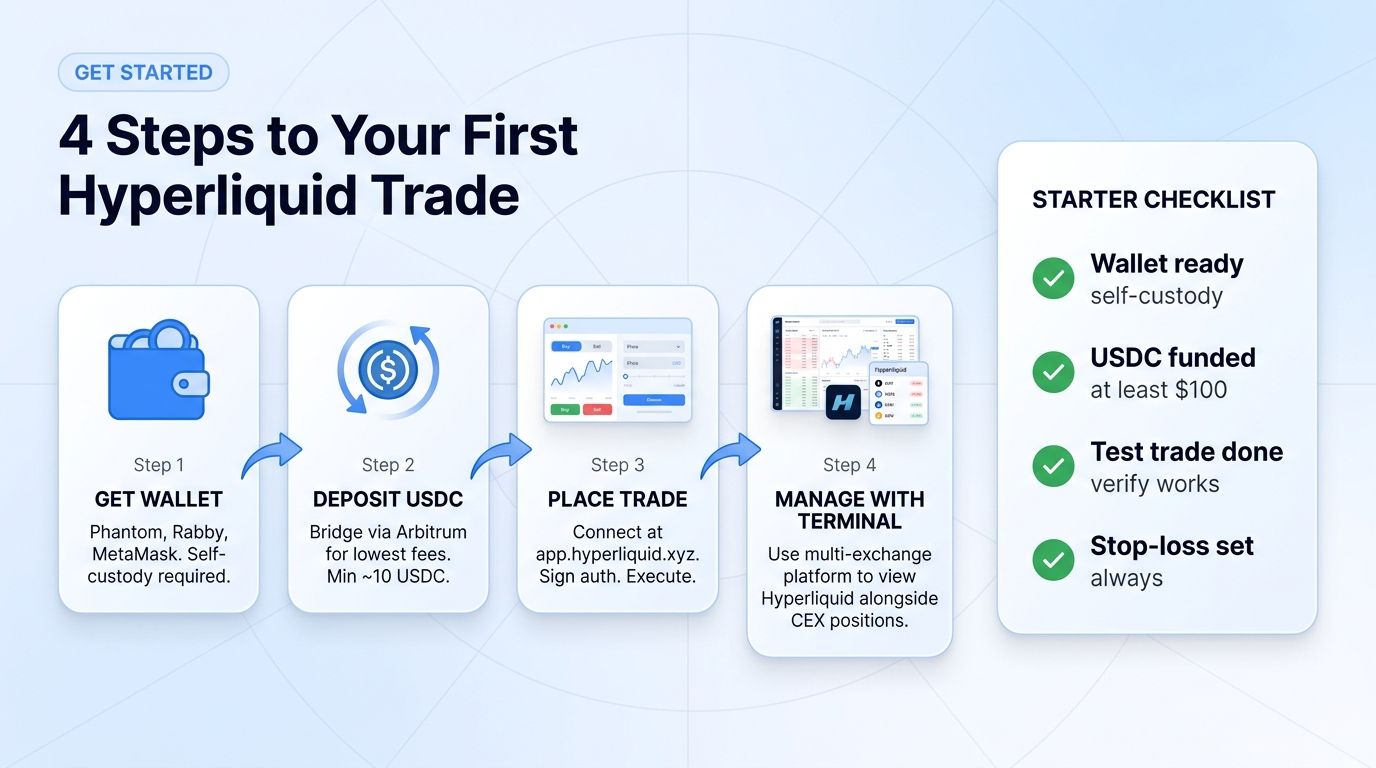
Step 1: Get a self-custody wallet. Phantom (Solana), Rabby (multichain), or MetaMask all connect. You need a wallet that supports the Arbitrum network or direct Hyperliquid L1 deposits.
Step 2: Deposit USDC. Bridge USDC from Ethereum, Arbitrum, or another supported chain. Deposits via Arbitrum are usually the cheapest path. The minimum deposit is small (10 USDC), but for meaningful trading you want at least 100 USDC.
Step 3: Place your first trade. Go to app.hyperliquid.xyz, connect wallet, sign the trading authorization. The interface looks like a CEX: order book on the side, chart in the middle, trade panel for size, price, and leverage. Execute a small test trade to confirm everything works.
Step 4: Manage positions across exchanges. If you also trade on Binance, Coinbase, Kraken, Bybit, KuCoin, or other CEXs, a crypto trading platform like Altrady connects all of them in one terminal. Altrady supports Hyperliquid alongside 19+ other exchanges, so you can see your Hyperliquid positions next to your CEX positions, run automated strategies via the signal bot, and use unified portfolio tracking across the entire stack.
The Risks of Trading Perpetual DEXs
Hyperliquid is technically excellent, but perpetual DEX trading carries risks that retail traders often underestimate.
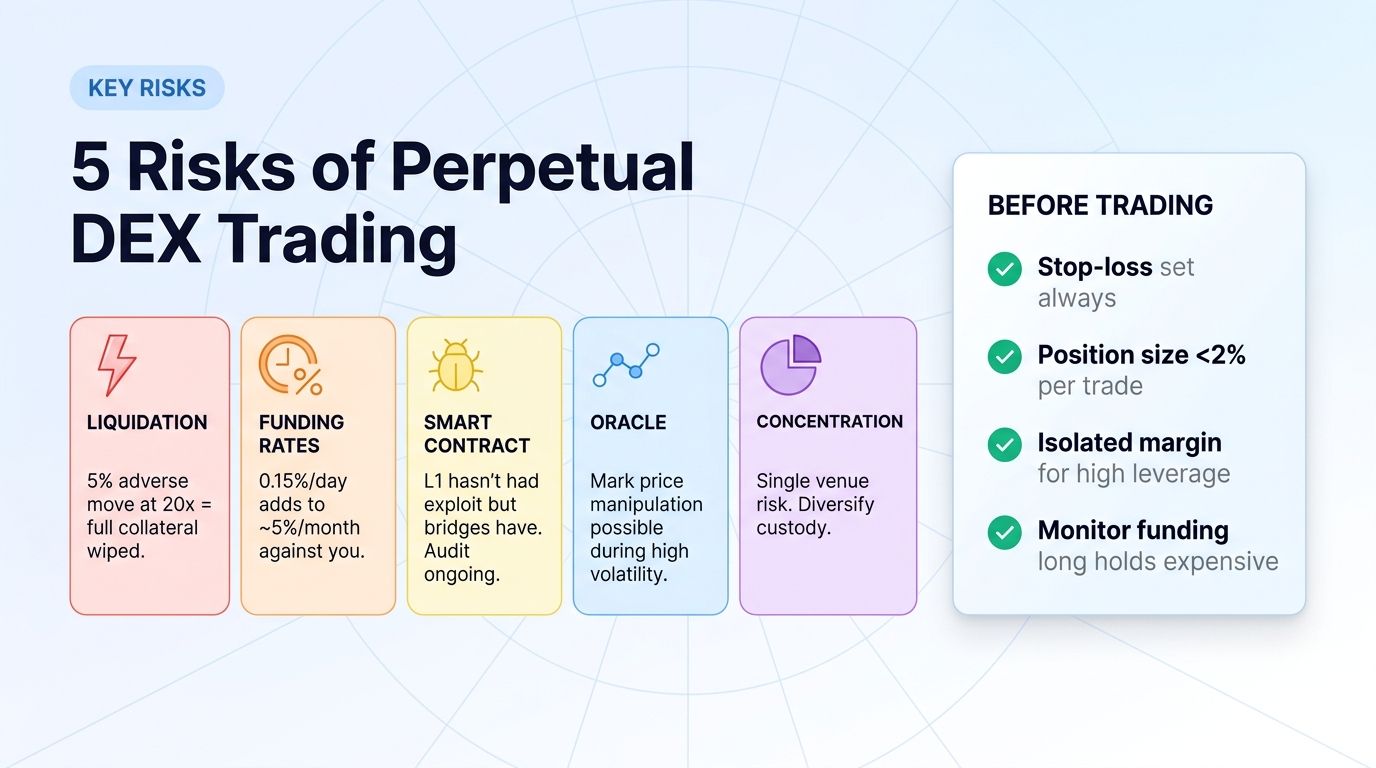
Liquidation risk. Leveraged perps liquidate fast. A 5% adverse move at 20x leverage wipes your collateral. Always set stop-loss orders before opening positions, and use isolated-margin for high-leverage single positions.
Funding rate risk. Holding a leveraged position long-term means paying funding every 8 hours. At 0.05% per period, a long-held position can lose 0.15% per day to funding alone, or roughly 5% per month. This compounds against profits.
Smart contract risk. Hyperliquid's L1 has not had a major exploit, but the protocol is still software. Bugs can happen. The platform also depends on external bridges (Arbitrum, etc.) which have been the largest single source of crypto losses historically.
Oracle risk. Hyperliquid uses on-chain oracles for mark prices. A manipulated oracle could trigger unfair liquidations. The platform has price-impact protections, but extreme volatility can still produce bad fills.
Concentration risk. Holding too much of your portfolio on one DEX is unwise. Diversify custody across CEX accounts, hardware wallets, and self-custody DeFi positions.
How Hyperliquid Fits Into a Trading Stack
A practical framework for active crypto traders in 2026:
- CEX accounts (Binance, Coinbase, Kraken, Bybit): 50-70% of trading capital. Deepest liquidity for spot, futures, and large positions.
- Hyperliquid: 20-30% for perpetual DEX exposure, on-chain transparency, and HYPE token participation.
- DeFi (Aave, Pendle, Maple): 10-20% for yield strategies and unique on-chain instruments.
Most professional traders run multiple venues in parallel. Hyperliquid's role is as the on-chain perp specialist, not the only place you trade.
2026 Update: What to Check Before You Act
Hyperliquid is useful for active perpetual traders, but the workflow should start with collateral, leverage, and liquidation planning before any entry signal.
| Check | What to review | Why it matters |
|---|---|---|
| Collateral and leverage | Decide margin size, leverage, and liquidation buffer before opening a position. | Perp DEX speed can magnify mistakes when leverage is set too high. |
| Market quality | Review funding, open interest, order book depth, and recent liquidation clusters. | Shows whether the setup is clean or crowded. |
| Operational safety | Use a secure wallet, verify URLs, and avoid signing transactions from unknown links. | Wallet-based trading adds a security layer that exchange logins do not cover. |
Quick trader checklist
- Check funding and liquidation levels before entering.
- Use smaller size when testing a new perp venue or market.
- Record entry thesis, invalidation, and exit plan before increasing leverage.
FAQ
Is Hyperliquid safe to use?
Hyperliquid has operated since 2023 without major incidents. The L1 chain, on-chain order book, and audited contracts make it one of the more robust perpetual DEXs. That said, all DeFi carries smart contract risk. Use position sizes you can afford to lose.
What is the minimum deposit?
The protocol minimum is around 10 USDC, but for active trading you want at least 100 USDC to handle reasonable position sizes without excessive fees relative to trade value.
Does Hyperliquid have spot trading?
Yes. While Hyperliquid is best known for perpetual futures, it added spot trading and HIP-1 native asset issuance in 2024. Spot volumes are smaller than perp volumes but growing.
Can I trade Hyperliquid through Altrady?
Yes. Altrady connects to Hyperliquid as one of 19+ supported exchanges. You can manage Hyperliquid positions alongside Binance, Coinbase, Kraken, Bybit, and other connected accounts in a single dashboard, run automated strategies, and use unified order management.
What is the HYPE token?
HYPE is Hyperliquid's native token, distributed primarily to early users via a major airdrop in November 2024. It captures protocol fee revenue and serves as the L1's gas and staking asset. As of 2026, HYPE holders participate in fee buybacks that have driven significant token value capture.
What is the biggest risk when trading on Hyperliquid?
The biggest practical risk is combining high leverage with weak risk controls. Traders should understand margin, liquidation price, funding, and wallet security before sizing up.
Conclusion
Hyperliquid changed what a perpetual DEX can look like. Real liquidity, real distribution, real on-chain transparency, and a user experience that matches centralized exchanges. By 2026, it commands the majority of the perpetual DEX market and operates at scale comparable to mid-tier centralized perps.
For traders, the practical takeaway is this: Hyperliquid is now one of the venues that belongs in your stack, not an experiment. Learn how it works, deposit a small amount to test, and decide based on your own trading whether to scale up.
The perpetual DEX category will continue to grow as institutional capital moves on-chain. The traders who learn Hyperliquid's mechanics in 2026 will be early to whatever the next phase of on-chain derivatives looks like.