
Account abstraction has quietly become one of the most consequential infrastructure shifts in crypto. By 2026, the combination of ERC-4337 smart contract accounts and EIP-7702 (activated in Ethereum's Pectra upgrade in May 2025) has pushed smart wallets into mainstream adoption, with industry estimates citing more than 200 million smart wallets across the ecosystem. The era of writing down a 12-word seed phrase and hoping never to lose it is gradually ending.
For traders and crypto users, account abstraction matters because it removes the operational friction that has historically made self-custody intimidating. Features like social recovery, passkey sign-in, gas sponsorship, paying transaction fees in stablecoins instead of native tokens, and batching multiple actions into a single transaction transform the user experience from crypto-native complexity toward Web2-like simplicity.
This guide explains what account abstraction is, the difference between ERC-4337 and EIP-7702, how smart wallets work, the practical benefits, the 2026 adoption landscape, and what it means for traders and the broader crypto ecosystem.
What Is Account Abstraction?
Account abstraction is a design approach that makes crypto wallet accounts programmable, allowing them to behave according to custom logic rather than the rigid rules of traditional accounts.
To understand it, consider the two traditional account types on Ethereum.
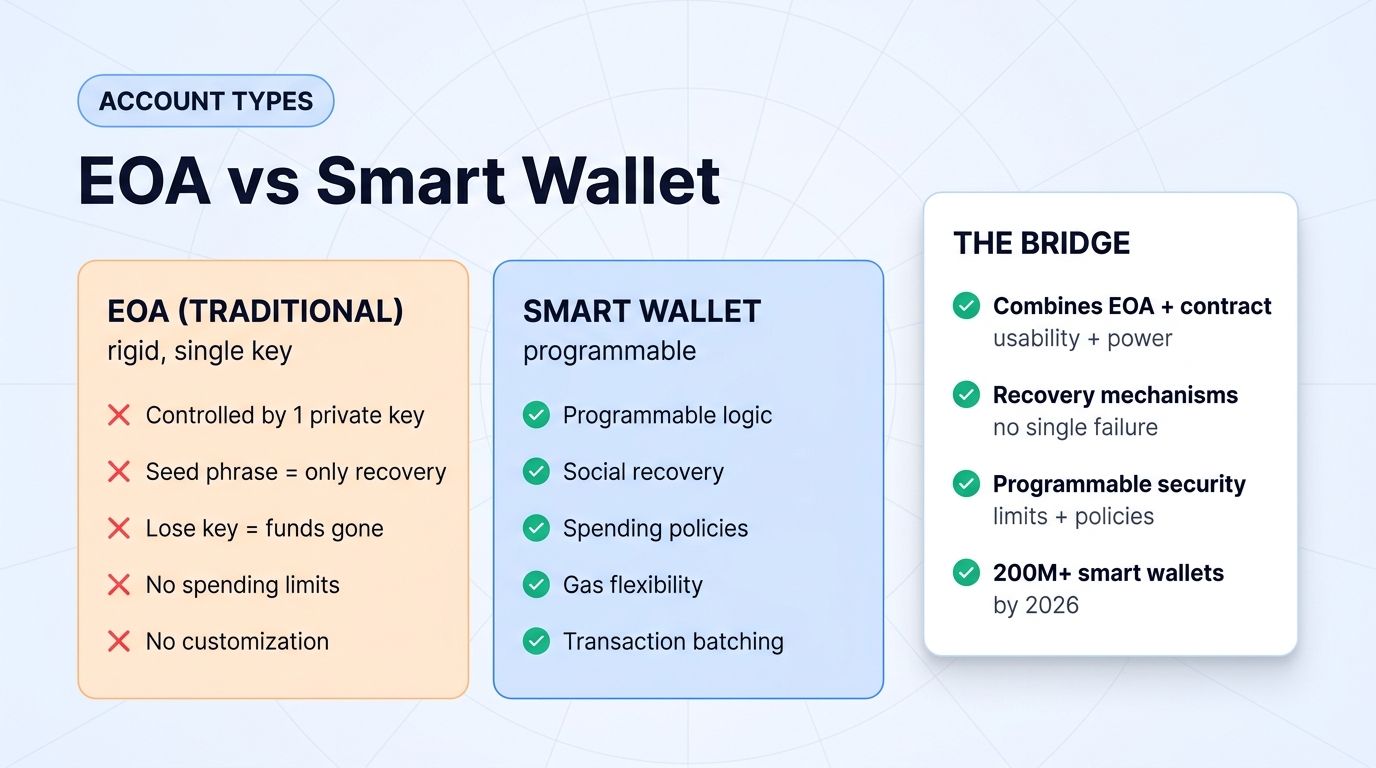
The first is an Externally Owned Account (EOA). This is the standard wallet most users have, controlled by a private key (and represented to users as a seed phrase). EOAs are simple but rigid: the private key is the single point of control and the single point of failure. Lose it, and funds are gone forever. There is no recovery, no spending limits, no customization.
The second is a Contract Account, which is a smart contract that can hold and manage funds with programmable logic. These are flexible but historically could not initiate transactions on their own.
Account abstraction bridges this gap. It allows accounts to combine the user-friendliness of EOAs with the programmability of smart contracts. The result is a smart wallet that can support recovery mechanisms, spending policies, multi-signature requirements, gas payment in any token, and many other features, while remaining easy to use.
ERC-4337 vs EIP-7702: The Two Paths
Account abstraction on Ethereum developed through two complementary standards.
ERC-4337: Smart Contract Accounts
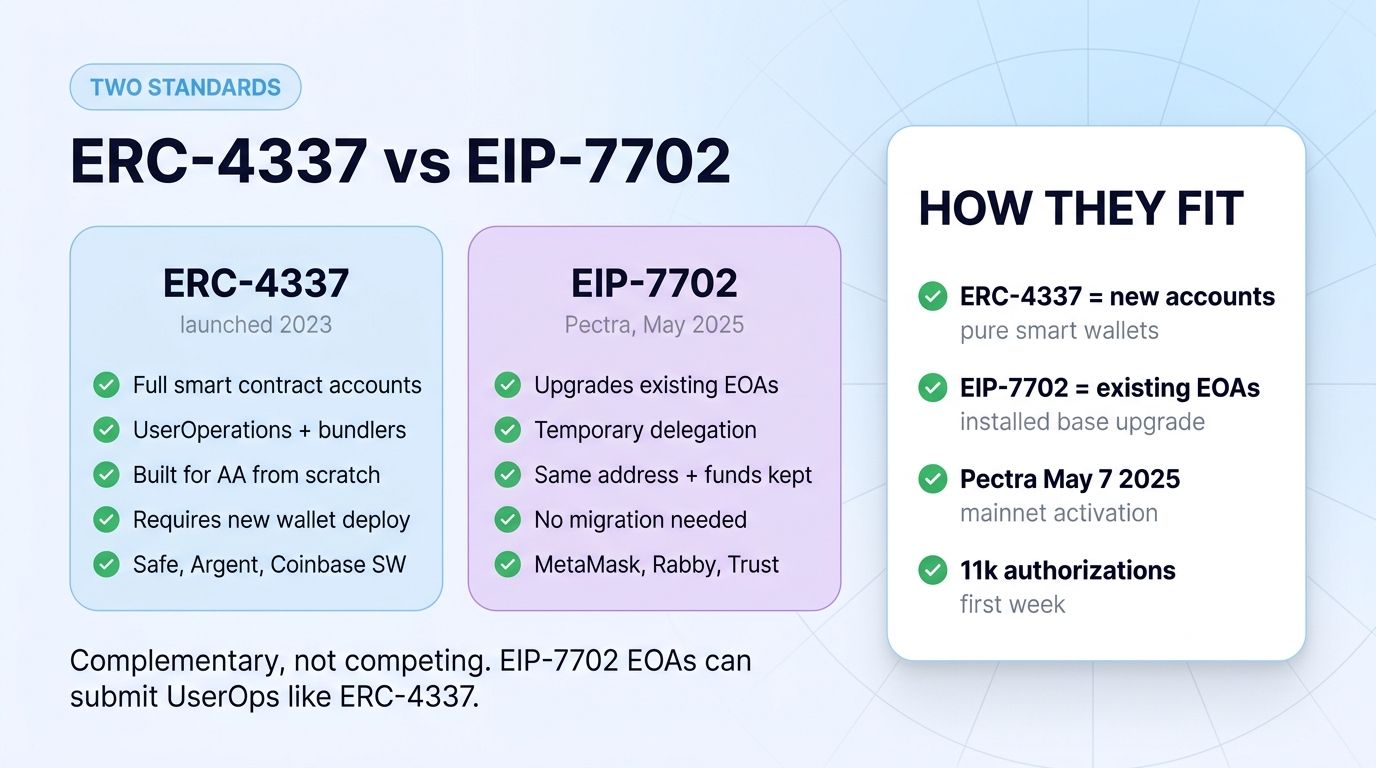
ERC-4337 launched in 2023 as the first major account abstraction standard that did not require changes to the Ethereum protocol itself. It introduced a separate system of "UserOperations" processed through a dedicated mempool and bundled by actors called bundlers.
ERC-4337 enables fully featured smart contract wallets from the ground up. Wallets like Safe, Argent, and various Coinbase Smart Wallet implementations use ERC-4337. The tradeoff is that users must create and deploy a new smart contract wallet, which involves some setup friction and gas costs.
EIP-7702: Upgrading Existing EOAs
EIP-7702 was introduced with Ethereum's Pectra upgrade, which launched on mainnet on May 7, 2025. It addresses a key limitation: the hundreds of millions of existing EOAs that could not easily access smart wallet features.
EIP-7702 adds a new transaction type where an existing EOA can temporarily point to a smart contract implementation. The user signs an authorization that delegates their EOA's behavior to a contract for the duration of that delegation. The address stays the same, the funds stay the same, but the account behaves like a smart wallet while the delegation is active.
The crucial advantage is that EIP-7702 brings smart wallet features to existing wallets without requiring users to migrate funds or create new accounts. An EOA created years ago can suddenly access gas sponsorship, batching, and other features.
How They Work Together
EIP-7702 is designed to complement ERC-4337, not replace it. ERC-4337 provides pure smart contract accounts built for account abstraction from the start. EIP-7702 makes those account abstraction features accessible to existing EOAs. EOAs upgraded via EIP-7702 can submit UserOperations just like ERC-4337 smart accounts. The two standards together cover both new smart wallets and the massive installed base of existing EOAs.
The Practical Benefits of Smart Wallets
Account abstraction delivers several concrete improvements to the crypto user experience.
Social Recovery
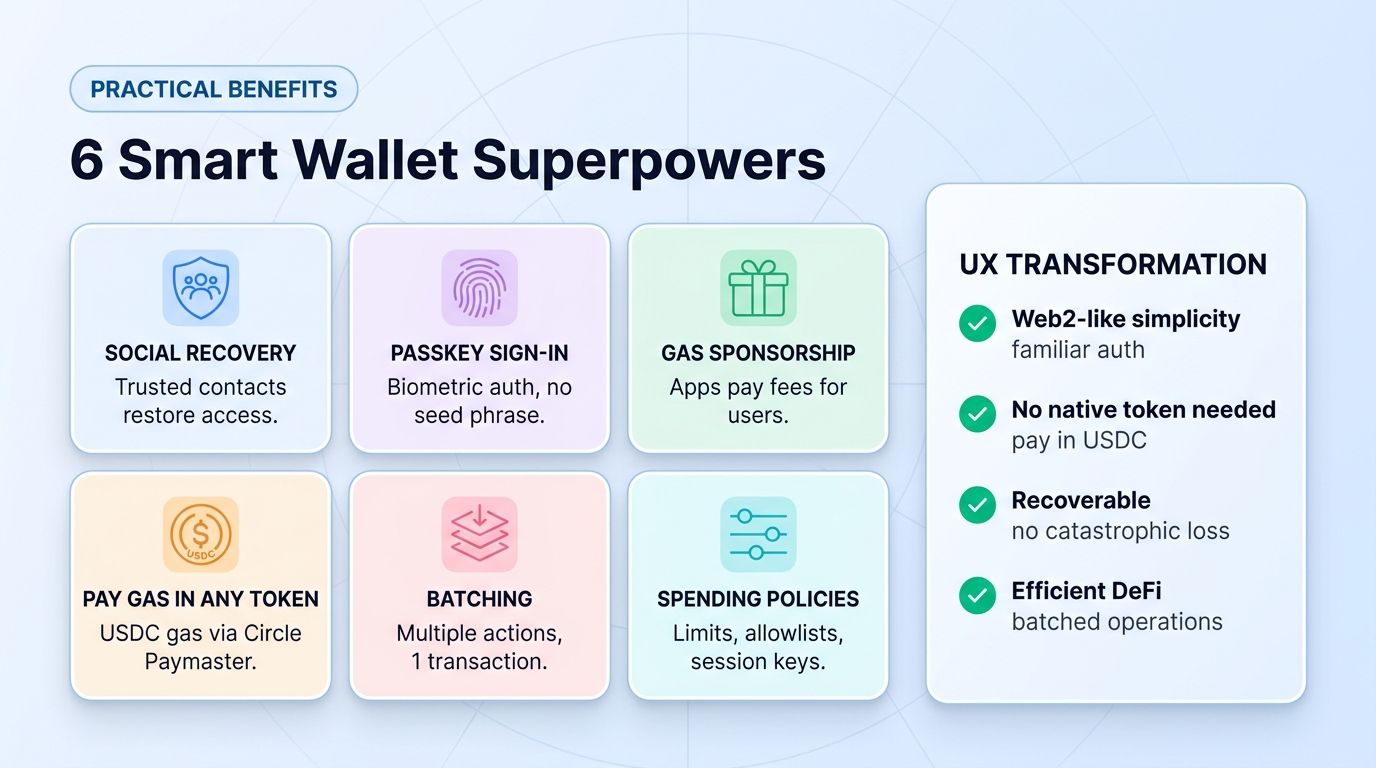
Instead of a single seed phrase as the only recovery method, smart wallets can implement social recovery, where trusted contacts or devices can help restore access if the primary key is lost. This addresses the single most catastrophic failure mode in self-custody.
Passkey Sign-In
Smart wallets can use passkeys (the same technology behind Face ID and fingerprint authentication on phones) for transaction signing. This replaces seed phrase management with familiar biometric authentication.
Gas Sponsorship
Applications can pay transaction fees on behalf of users (gas sponsorship), removing the requirement that users hold native tokens just to transact. A new user can interact with an application without first acquiring ETH for gas.
Pay Gas in Any Token
Smart wallets can pay gas fees in tokens other than the native chain token. For example, Circle Paymaster enables transactions where gas is paid in USDC instead of ETH. A user can transact with USDC from the moment they create a wallet, without ever holding ETH.
Transaction Batching
Multiple actions can be bundled into a single transaction. Instead of approving a token and then swapping it in two separate transactions (each requiring confirmation and gas), a smart wallet can batch both into one atomic operation.
Spending Policies
Smart wallets can implement spending limits, allowlists, time locks, and other policies. This enables more sophisticated security models, including session keys for applications that need limited, temporary permissions.
The 2026 Adoption Landscape
Account abstraction adoption accelerated significantly through 2025 and into 2026.
Within the first week of Pectra's launch in May 2025, more than 11,000 EIP-7702 authorizations were recorded on mainnet. Adoption grew rapidly from there. By 2026, industry estimates cite more than 200 million smart wallets across the ecosystem.
Major wallet providers integrated account abstraction features throughout 2025. MetaMask, Rabby, and Trust Wallet added EIP-7702 support. Exchanges including OKX and WhiteBIT were among the early leaders in adoption.
Infrastructure providers built out the supporting ecosystem. Circle's Paymaster enables gasless USDC transactions. Bundler and paymaster services from various providers handle the backend mechanics. Smart wallet SDKs from Coinbase, Alchemy, and others make it easier for developers to build account-abstraction-native applications.
The combination of protocol support (EIP-7702 in Pectra), wallet integration (MetaMask, Rabby, Trust), and infrastructure (paymasters, bundlers) created the conditions for mainstream adoption.
What Account Abstraction Means for Traders
For active traders, account abstraction has several practical implications.
First, smoother DeFi interaction. Transaction batching means complex DeFi operations (approve-and-swap, multi-step strategies) execute more efficiently with fewer confirmations and lower friction. This is particularly valuable for active on-chain traders.
Second, gas flexibility. Paying gas in stablecoins rather than native tokens simplifies treasury management. Traders no longer need to maintain small native-token balances on every chain just to transact.
Third, improved security. Spending policies, session keys, and social recovery reduce the risk of catastrophic loss from a single compromised key. For traders holding significant on-chain positions, these security improvements are meaningful.
Fourth, better automated trading. Session keys and programmable permissions enable more sophisticated automated and delegated trading setups, where a strategy can execute within defined limits without exposing the full wallet.
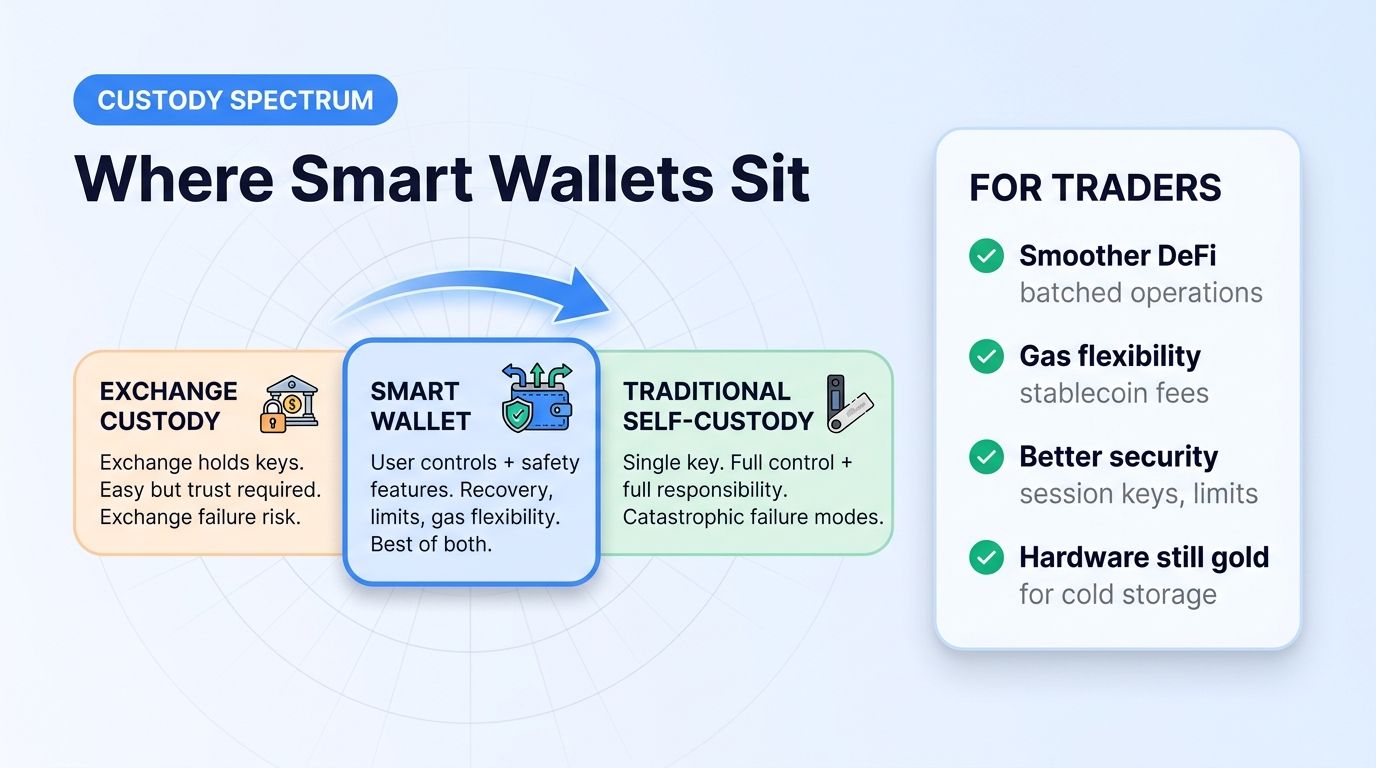
How Account Abstraction Compares to Centralized Custody
A useful framing is how smart wallets sit between traditional self-custody and exchange custody.
Exchange custody (CEX): The exchange holds the keys. Easy to use but requires trusting the exchange. Vulnerable to exchange failures (as history has repeatedly shown).
Traditional self-custody (EOA): The user holds a single private key. Full control but full responsibility, with catastrophic failure modes (lost seed phrase) and operational friction.
Smart wallet self-custody (account abstraction): The user retains control but with programmable safety features (recovery, spending limits, gas flexibility). This combines much of the usability of exchange custody with the sovereignty of self-custody.
For traders, account abstraction makes self-custody meaningfully more practical, reducing the usability gap that historically pushed users toward exchange custody.
The Risks and Limitations
Smart contract risk. Smart wallets rely on smart contract code. Bugs or vulnerabilities in the wallet implementation could be exploited. Established, audited implementations reduce but do not eliminate this risk.
Delegation risk with EIP-7702. When an EOA delegates to a contract via EIP-7702, it temporarily executes that contract's logic. Delegating to a malicious or buggy contract could result in loss. Users must trust the implementation they delegate to.
Complexity and new attack surfaces. Account abstraction introduces new components (bundlers, paymasters, delegation) that create new potential attack surfaces. The security model is more complex than a simple EOA.
Paymaster dependency. Gas sponsorship and pay-in-any-token features depend on paymaster services. If a paymaster fails or is unavailable, those features may not work.
Adoption fragmentation. Not all applications and chains support account abstraction equally. Users may encounter inconsistent experiences across the ecosystem.
How to Approach Account Abstraction as a User
For traders and crypto users considering smart wallets:
Conservative approach: Continue using established wallets (MetaMask, hardware wallets) but enable EIP-7702 features as they become available in your existing wallet. This captures benefits without changing your fundamental setup.
Moderate approach: Adopt a dedicated smart wallet (Coinbase Smart Wallet, Safe, others) for active on-chain trading and DeFi, while keeping a hardware wallet for cold storage.
Security-first approach: Use smart wallets specifically for their security features (social recovery, spending limits) on accounts holding significant value, accepting the smart contract risk tradeoff for the recovery benefits.
In all cases, hardware wallets remain the gold standard for large cold storage, and account abstraction complements rather than replaces them.
What to Watch in the Next 12 Months
Three indicators.
Indicator 1: Smart wallet adoption growth. Does the smart wallet count continue growing beyond 200 million? Continued growth signals mainstream account abstraction adoption.
Indicator 2: Application support. Do more DeFi protocols and applications build account-abstraction-native experiences? Broad application support is necessary for the benefits to be realized.
Indicator 3: Cross-chain standardization. Do other chains and L2s adopt compatible account abstraction standards? Standardization reduces fragmentation and improves the user experience.
If all three trend positively, account abstraction becomes the default crypto user experience. If adoption stalls or fragments, the seed phrase may persist longer than expected.
FAQ
What is the difference between ERC-4337 and EIP-7702?
ERC-4337 (launched 2023) enables fully featured smart contract wallets built for account abstraction from the start, but requires creating a new smart wallet. EIP-7702 (activated in the Pectra upgrade in May 2025) lets existing EOAs temporarily behave as smart wallets without migration. They are complementary: ERC-4337 for new smart accounts, EIP-7702 for upgrading the existing installed base of EOAs.
Does account abstraction eliminate seed phrases?
It can. Smart wallets support alternatives like social recovery and passkey sign-in that replace seed phrase management with more familiar and recoverable methods. However, many implementations still allow seed phrase backup as an option, and hardware wallets remain seed-phrase-based for cold storage.
When did EIP-7702 launch?
EIP-7702 was activated as part of Ethereum's Pectra upgrade, which launched on mainnet on May 7, 2025. Adoption accelerated through 2025 and into 2026, with major wallets like MetaMask, Rabby, and Trust integrating support.
Can I pay gas fees in USDC instead of ETH?
Yes, with smart wallets and paymaster services. For example, Circle Paymaster enables transactions where gas is paid in USDC rather than ETH. This means a new user can transact with USDC from the moment they create a wallet, without first acquiring ETH for gas.
How does account abstraction affect trading on Altrady?
Account abstraction primarily affects on-chain (DeFi) wallet interactions, not centralized exchange trading. Altrady connects to 19+ centralized exchanges for unified position management, automated strategies via the signal bot, grid bot, or DCA bot, and portfolio tracking. Smart wallet features matter most for the on-chain DeFi portion of a trader's activity.
Conclusion
Account abstraction represents one of the most important user-experience shifts in crypto's history. The combination of ERC-4337 smart contract accounts and EIP-7702 (activated in the Pectra upgrade in May 2025) has pushed smart wallets into mainstream adoption, with more than 200 million smart wallets across the ecosystem by 2026.
For traders, the practical takeaway is this: account abstraction makes self-custody meaningfully more usable through social recovery, gas flexibility, transaction batching, and improved security. The features reduce the operational friction that historically pushed users toward exchange custody.
The longer-term significance is that account abstraction may finally make self-custody accessible to mainstream users, reducing dependence on centralized custody and its associated risks. The seed phrase, long the symbol of crypto's usability problem, is gradually being supplemented by more forgiving recovery and authentication methods.
For traders and crypto users, the practical approach is to adopt account abstraction features as they become available in trusted wallets, use smart wallets for active on-chain activity, and maintain hardware wallets for large cold storage. The next 12 months will reveal whether account abstraction becomes the default crypto experience or remains one option among several.