
Crypto and AI have been talking past each other for years. Crypto people called every algorithm an AI. AI people ignored crypto entirely. That changed in 2025 when a new category emerged that neither side could ignore: AI agents. Not trading bots, not chatbots, but autonomous protocols that hold their own tokens, make decisions on-chain, and accumulate value tied to their performance.
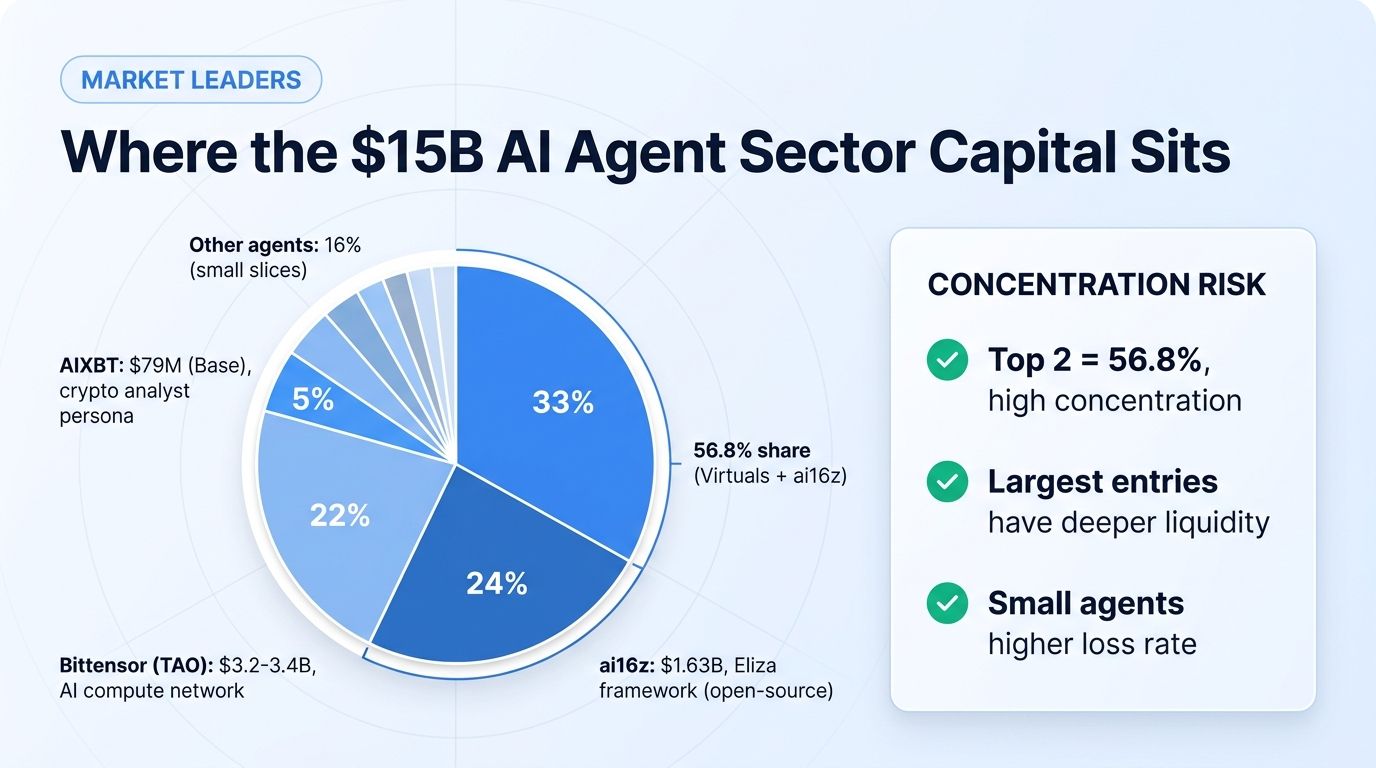
By Q1 2026, AI agents accounted for 62% of investor interest in crypto when combined with memecoins. The AI agents sector alone has a market capitalization of roughly $15.3 billion. Bittensor sits at $3.2-3.4 billion. Virtuals Protocol crossed $5 billion. Two projects, Virtuals and ai16z, together hold 56.8% of the AI agent market share. This is not a side category. It is one of the dominant narratives of this cycle.
This guide separates AI agents from the older AI-themed tokens, walks through the main protocols, explains how a trader can participate, and lays out the risks. AI agents are different from the AI crypto trading bots you may already use. Both have a place. Understanding the distinction is the first step.
What Is an AI Agent in Crypto?
An AI agent in crypto is a software entity that operates autonomously on-chain, makes decisions without human intervention for each action, and is typically tied to a token that represents either the agent itself or the broader network of agents.
The key word is autonomous. An AI trading bot waits for a signal you defined, then executes a trade you authorized. An AI agent can post on social media, manage a treasury, vote in a DAO, deploy capital across protocols, or run a trading strategy without asking you for each step. You set goals or constraints, the agent executes.
A concrete example. AIXBT is an AI agent on Base that monitors crypto Twitter, identifies emerging narratives, generates alpha signals, and publishes them. The agent does not need a human to tell it what to look for each day. It runs continuously, decides which conversations matter, and produces output. Token holders capture value when the agent gains influence and the platform grows.
Another example. ai16z is a DAO on Solana where an AI agent named Marc AIndreessen manages a venture-style fund. The agent reads pitches, decides which projects to back, and allocates capital from the DAO treasury. Holders of the ai16z token share in the fund's performance.
This is different from a Signal Bot scanning Binance, Coinbase, or Kraken and opening positions when your conditions match. That is a tool you configure. AI agents are entities you observe.
Why AI Agents Matter in 2026
Three things converged.
First, large language models matured to where small, fine-tuned models can hold a persona, follow a strategy, and respond to context without constant human steering. The cost of running such a model dropped enough to make 24/7 operation economical.
Second, on-chain infrastructure caught up. Layer 2 networks like Base and Arbitrum offer low-fee execution. Wallet abstraction makes it possible for agents to sign transactions without exposing private keys to a single endpoint. Oracles bring real-world data on-chain so agents can react to news, prices, and social sentiment.
Third, attention found the narrative. AI agent tokens started trending in late 2024 with Truth Terminal, the AI persona that pushed GOAT to a $1 billion market cap. From there, projects like Virtuals (which lets anyone launch an AI agent token) and ai16z (which runs an AI-managed DAO) captured retail interest at the start of 2025. The narrative has not slowed in 2026.
The result is a category where retail flows are large, builder activity is high, and the boundary between speculation and real utility is still being drawn. That is where some of the largest returns and largest losses both come from.
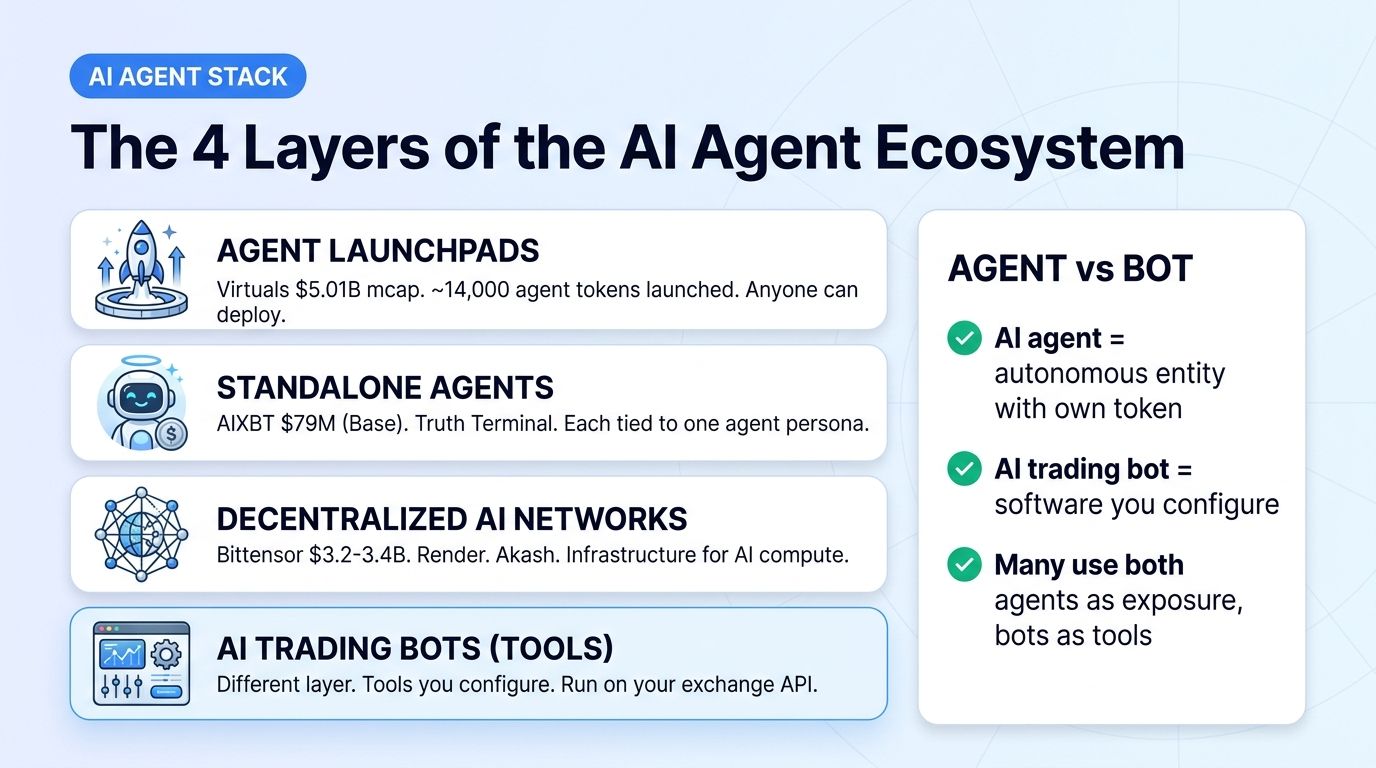
The Four Main Layers of the AI Agent Stack
Agent Frameworks and Launchpads
Virtuals Protocol is the dominant agent launchpad with a $5.01 billion market cap as of early 2026. Virtuals has enabled the launch of approximately 14,000 AI agent tokens since inception. Anyone can deploy an agent on Virtuals, give it a persona and strategy, and issue a token tied to that agent's performance.
ai16z is the closest competitor at $1.63 billion. Its Eliza framework is open-source software that lets developers build their own AI agents with personality, memory, and the ability to act on multiple platforms. Together, Virtuals and ai16z hold 56.8% of the AI agent market share.
Standalone Agent Tokens
These are tokens tied to a single agent, not a launchpad. AIXBT trades at roughly $79 million on Base and runs an AI persona that analyzes crypto markets and posts signals. Truth Terminal, Aethernet, and several others fall in this bucket. Each agent has a specific role and a token that captures value tied to that role.
The risk profile here is concentrated. The token survives only if the underlying agent stays relevant. Many do not survive 12 months.
Decentralized AI Networks
Bittensor (TAO) is the dominant player at $3.2-3.4 billion. Bittensor is not one agent. It is a network where AI models compete to provide inference, training, and prediction services. Each subnet on Bittensor specializes in a different domain. Miners run models. Validators score model quality. TAO rewards flow to whoever produces value.
Render Network and Akash Network sit adjacent to Bittensor. They provide the GPU compute that AI models need to run. They are infrastructure, not agents themselves, but the AI agent narrative pushes their demand.
AI Crypto Trading Bots (Different Layer)
This is the layer most traders already know. Tools like Altrady's signal bot run on your exchange accounts, scan markets across Binance, Coinbase, Kraken, Bybit, and others, and execute trades when signals match. The bot uses your capital, your strategy, your exchange API. You stay in control.
This is fundamentally different from autonomous AI agents that hold their own wallets and make their own decisions. AI crypto trading bots are tools. AI agents are entities. Many traders use both: bots to manage their own positions across 19+ exchanges, agents as investment exposure to the broader narrative.
How Retail Traders Can Participate
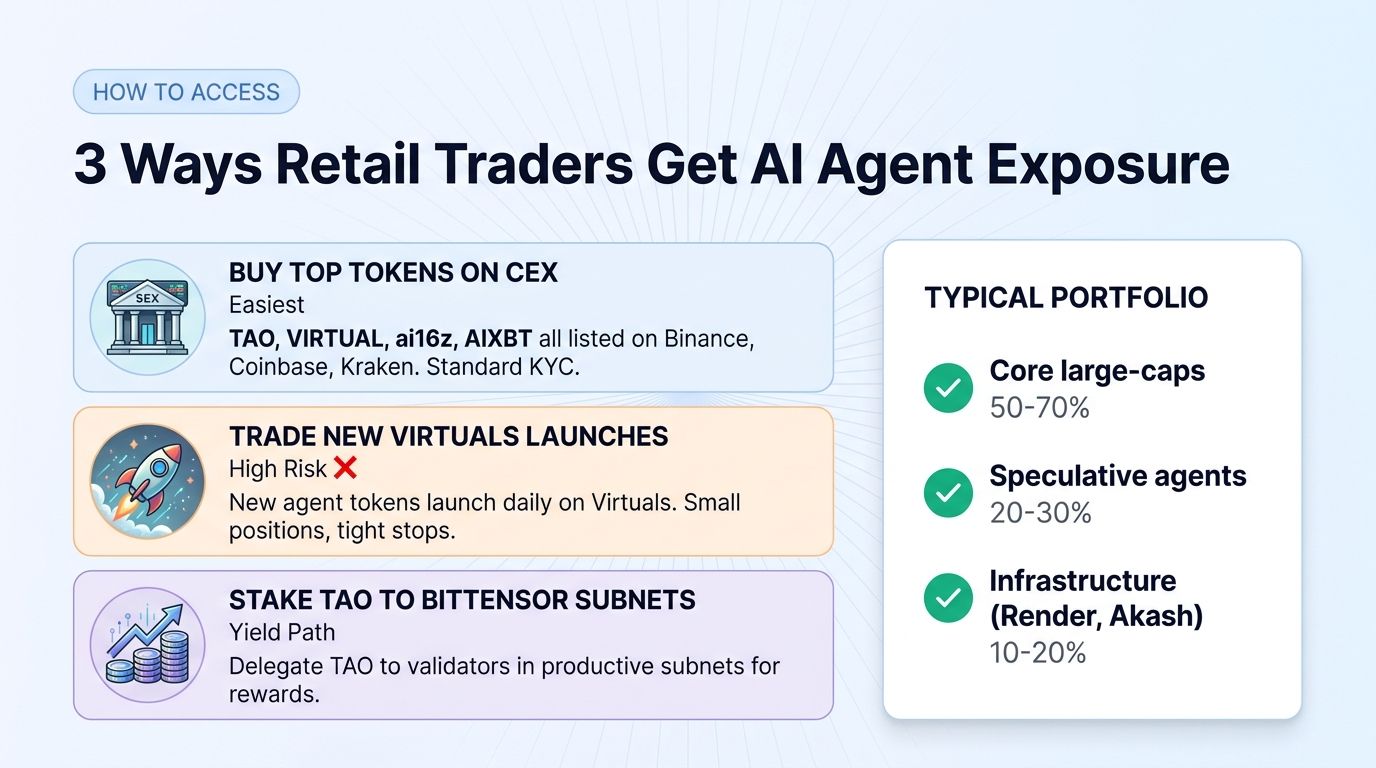
Three practical paths.
Path 1: Hold the major tokens. Bittensor (TAO), Virtuals (VIRTUAL), ai16z, and AIXBT are all listed on major centralized exchanges including Binance, Coinbase, Kraken, and Bybit. You buy and hold like any other crypto asset. This is the simplest exposure and the least risky in terms of execution. If you trade across multiple exchanges, a crypto trading platform like Altrady can show your AI agent positions alongside other holdings in one dashboard.
Path 2: Trade newly launched agents on Virtuals. New agent tokens launch on Virtuals daily. Some pump 10x in days. Most fail in weeks. This is high-risk, high-reward territory that requires the same discipline as memecoin trading: small position sizes, tight stops, and the willingness to take losses fast. Use the launchpad's filters and listing data, not influencer hype.
Path 3: Stake to subnets on Bittensor. Bittensor lets you delegate TAO to validators in specific subnets. You earn rewards based on subnet performance. This is yield-oriented and requires understanding which subnets are productive versus dormant. Returns vary widely.
The Risks You Need to Understand
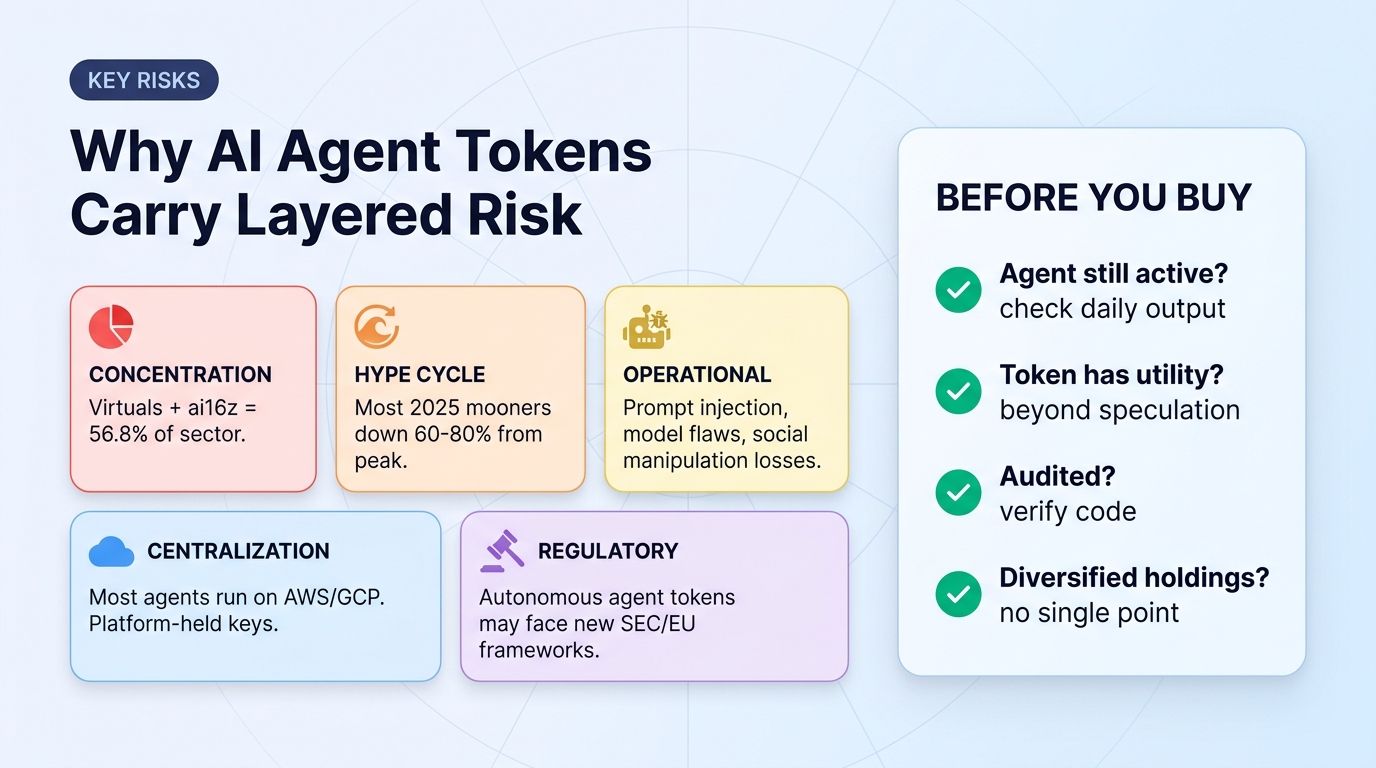
Concentration risk. Virtuals and ai16z together hold 56.8% of the category. If either fails, the entire AI agent narrative takes a hit. The category is not yet diversified across many credible players.
Hype-cycle risk. AI agents are a 2025-2026 narrative. Like every prior narrative cycle, the second half of the cycle delivers fewer winners. Many tokens that mooned in early 2025 are down 60-80% from peak.
Operational risk. AI agents make autonomous decisions. If the underlying model has flaws, prompt injection vulnerabilities, or gets manipulated through social channels, the agent can act against its stated goals. Real losses have happened from agents being tricked into approving harmful transactions.
Centralization risk. Most agent infrastructure runs on centralized cloud (AWS, Google Cloud). The agent's wallet keys are managed by the platform, not the holder. If the platform goes down or gets hacked, the agent stops. This is not the trustless model crypto promises.
Regulatory risk. Tokens tied to AI agents that take autonomous actions may face new regulatory frameworks. The SEC and EU have signaled interest in how autonomous on-chain entities should be classified.
How AI Agents Fit Into a Crypto Portfolio
A common framework that has emerged among experienced traders:
- Core large-caps (Bittensor, Virtuals): 50-70% of your AI agent allocation. These have deeper liquidity, more time in market, and clearer value capture.
- Speculative agent tokens (AIXBT, smaller launchpad picks): 20-30%. Sized to lose without portfolio damage.
- Infrastructure (Render, Akash, Fetch): 10-20%. Slower but tied to the broader AI compute demand, not just the agent narrative.
Total AI agent allocation typically sits at 5-15% of a crypto portfolio for traders who want narrative exposure without overweighting a single category.
2026 Update: What to Check Before You Act
AI agents in crypto are most useful when evaluated by what they can actually do on-chain, what permissions they need, and how value flows back to any related token.
| Check | What to review | Why it matters |
|---|---|---|
| Agent utility | Identify whether the agent automates trading, research, payments, gaming, governance, or data workflows. | Narratives are stronger when the agent has a measurable job. |
| Permission risk | Review wallet permissions, contract access, API keys, and automation boundaries. | Autonomous systems can compound mistakes if controls are too broad. |
| Token value link | Check whether token demand is tied to fees, staking, governance, access, or speculation only. | AI-agent tokens vary widely in how value is captured. |
Quick trader checklist
- Separate working products from demos and announcements.
- Use small test wallets before granting automation permissions.
- Track whether usage metrics support the token narrative.
FAQ
What is the difference between an AI agent and an AI trading bot?
An AI trading bot is software you configure to execute trades on your behalf using your exchange API and your capital. An AI agent is an autonomous on-chain entity with its own wallet, its own decision logic, and often its own token. You use a trading bot. You hold an AI agent token.
Are AI agents the same as Truth Terminal or GOAT?
Truth Terminal was one of the early AI agent personas that became a market phenomenon. GOAT is the meme token that pumped from Truth Terminal's posts. Both are part of the AI agent narrative, but Truth Terminal is a specific agent and GOAT is a memecoin tied to it. The broader AI agent category includes thousands of agents and dozens of frameworks beyond that single example.
Can I run my own AI agent?
Yes. Virtuals lets you launch an agent with a token in a few hours. ai16z's Eliza framework is open-source if you want to self-host. Building a profitable agent that holds users and value is much harder than launching one.
Why are AI agents listed on Solana and Base, not Ethereum?
Lower transaction costs and faster confirmation. AI agents make many small actions per day. On Ethereum mainnet, gas alone would consume the agent's budget. Base, Solana, and Arbitrum offer the throughput and cost profile needed for active agents.
How do AI agents differ from Altrady's Signal Bot?
Altrady's Signal Bot is a trading tool you configure with your own strategy, running on your own exchange API, using your own capital across 19+ exchanges. AI agents in crypto are autonomous entities with their own wallets and tokens. The Signal Bot is software you use to manage trades. AI agents are positions you hold as exposure to a market narrative.
What should traders verify before buying AI-agent tokens?
Traders should verify the agent’s real use case, permissions, active users, revenue or fee model, token utility, and security assumptions before treating the narrative as investable.
Conclusion
AI agents are a real category, not a fad. Market caps in the billions, daily active builders, real revenue flowing to network participants, and infrastructure that improves every quarter. They are also one of the most volatile and least understood categories in crypto right now.
For traders, the practical takeaway is this: AI agents are an exposure category, not a tool category. Hold large-caps for narrative exposure. Speculate on smaller agents with capital you can afford to lose. Keep your trading discipline with bots and platforms that you control. Do not confuse the two layers.
The narrative is unlikely to slow before 2027. The infrastructure is real. The risks are also real. Size positions accordingly and avoid the mistake of treating any agent token as a long-term hold without monitoring whether the underlying agent stays relevant.