
In May 2026, Aptos became the first major Layer 1 blockchain to offer a native encrypted mempool. The feature provides full transaction intent confidentiality at the protocol level, addressing one of the most persistent problems in blockchain trading: MEV (Maximal Extractable Value) extraction by sophisticated bots that observe pending transactions and exploit them.
For traders, the encrypted mempool represents a meaningful shift. Front-running, sandwich attacks, and other forms of MEV extraction have cost crypto traders billions of dollars over the past few years. A protocol that natively protects pending transactions changes the economics of on-chain trading.
This guide explains what Aptos is, how the encrypted mempool works, what MEV protection actually delivers, the broader Aptos technical positioning in 2026, and how traders should think about exposure to the network and the APT token.
What Is Aptos?
Aptos is a Layer 1 blockchain built using the Move programming language (originally developed for Meta's Diem project, now open source). The project launched mainnet in October 2022 and has grown into one of the more technically distinguished smart contract platforms.
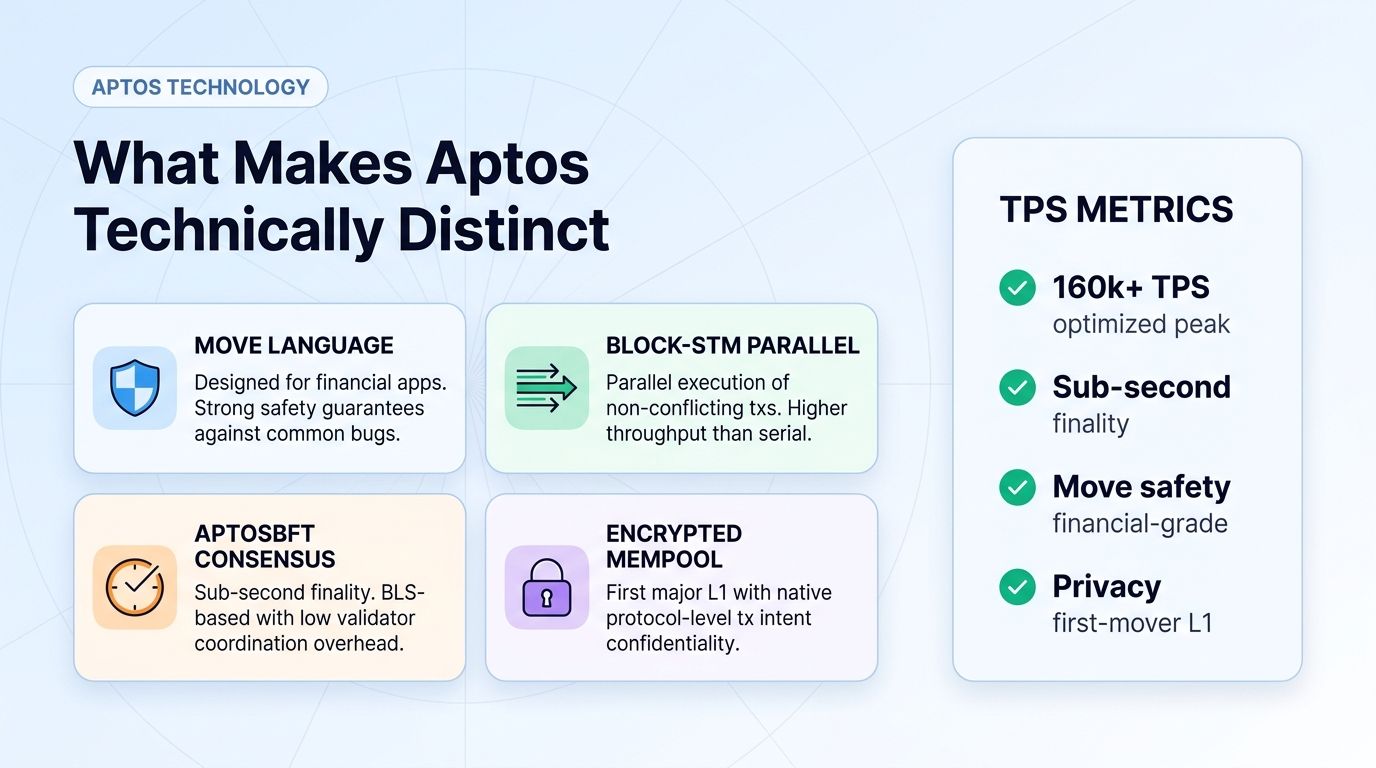
Three structural characteristics define Aptos.
First, Move language. Move is designed for safety in financial applications. The language has strong guarantees against common bugs (reentrancy, integer overflow, double-spend) that have caused major exploits on other chains. For developers building financial primitives, Move offers significant safety advantages.
Second, parallel execution. Aptos's runtime (Block-STM) executes transactions in parallel rather than sequentially. This produces higher throughput than serial execution chains, particularly for workloads with non-conflicting transactions.
Third, BLS-based consensus (AptosBFT). The consensus protocol provides fast finality with relatively low validator coordination overhead. Recent throughput claims have reached 160k+ transactions per second in optimized scenarios.
The native encrypted mempool announced in May 2026 adds privacy as a fourth defining characteristic.
Why the Encrypted Mempool Matters in 2026
Three forces drove the development.
First, MEV extraction reached scale. By 2026, MEV-related extraction across all major chains exceeds $1 billion annually. Trading bots that observe pending transactions and front-run them have become a tax on regular users. The problem has been particularly acute on Ethereum and EVM-compatible chains.
Second, existing solutions had tradeoffs. Privacy solutions like Flashbots, MEV-Share, and various private RPC services help but require users to opt in (and often pay fees). A protocol-level solution that protects all transactions by default is a different value proposition.
Third, competitive positioning matured. As Sui, Solana, and other L1s differentiate on specific technical capabilities, Aptos's encrypted mempool provides a distinctive feature that other major chains do not currently offer at the protocol level.
For traders, the encrypted mempool reduces invisible transaction costs. The savings on a per-transaction basis are small but compound over many transactions.
How the Encrypted Mempool Works
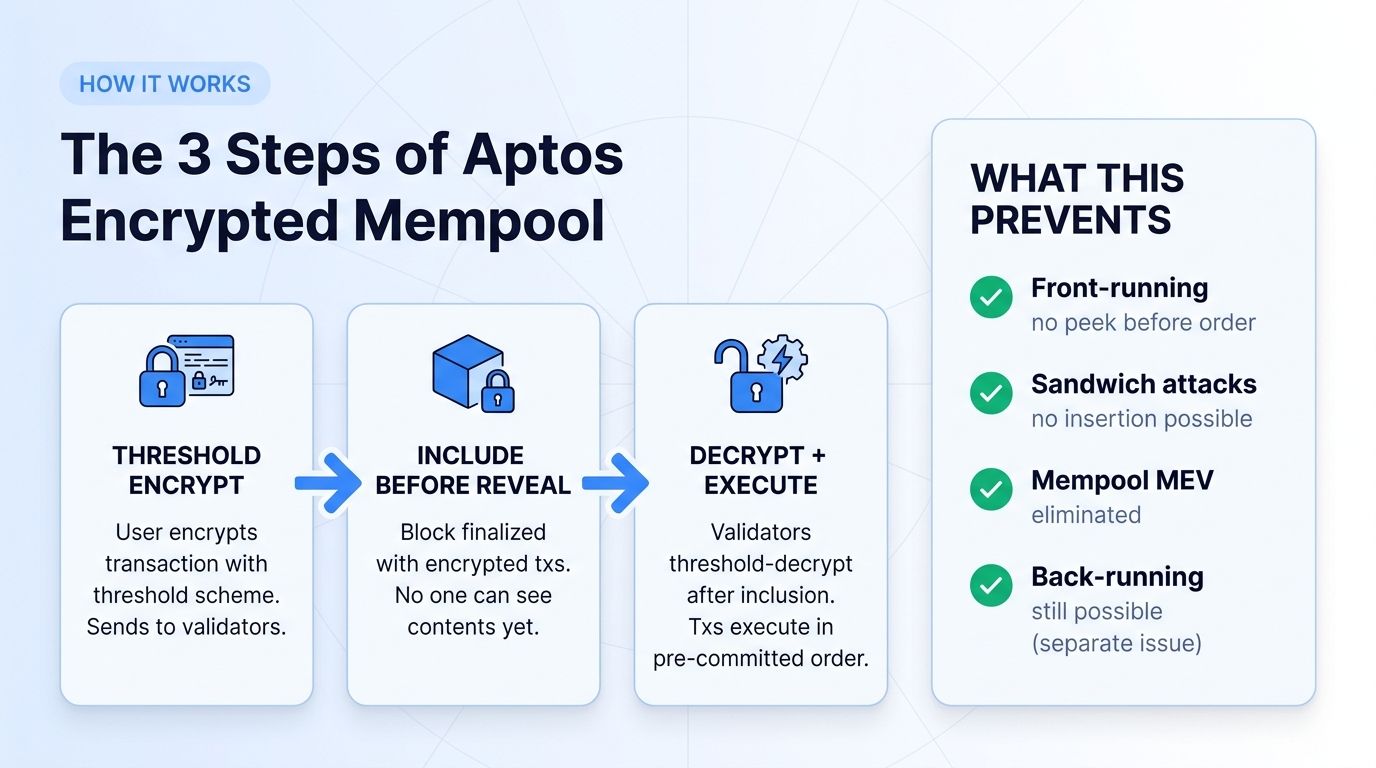
The technical implementation has three components.
Component 1: Threshold Encryption at Submission
When a user submits a transaction, the transaction is encrypted using a threshold encryption scheme. The encrypted transaction is broadcast to validators. The decryption key is split across validators, so no single validator can decrypt the transaction unilaterally.
Component 2: Inclusion Before Reveal
The encrypted transaction is included in a block before its contents are decrypted. This sequencing prevents validators from observing transaction content and reordering or inserting their own transactions in front of profitable trades.
Component 3: Threshold Decryption After Inclusion
After the block is finalized, the threshold of validators collectively decrypts the transactions. The transactions then execute in their pre-committed order.
The result: the transaction order is determined before anyone (including validators) can see what the transactions actually do. MEV-extracting strategies that rely on observing pending trades no longer work.
What the Encrypted Mempool Does Not Do
The encrypted mempool prevents one category of MEV: extraction based on observing pending transactions. It does not prevent:
- MEV based on observing already-executed transactions (back-running)
- Long-running arbitrage strategies that do not require pending transaction visibility
- Information leakage through other channels (off-chain communication, mempool side channels)
Encrypted mempools are a powerful tool but not a complete solution to all MEV problems.
How This Compares to Other Privacy Approaches
Several other privacy approaches exist on different chains.
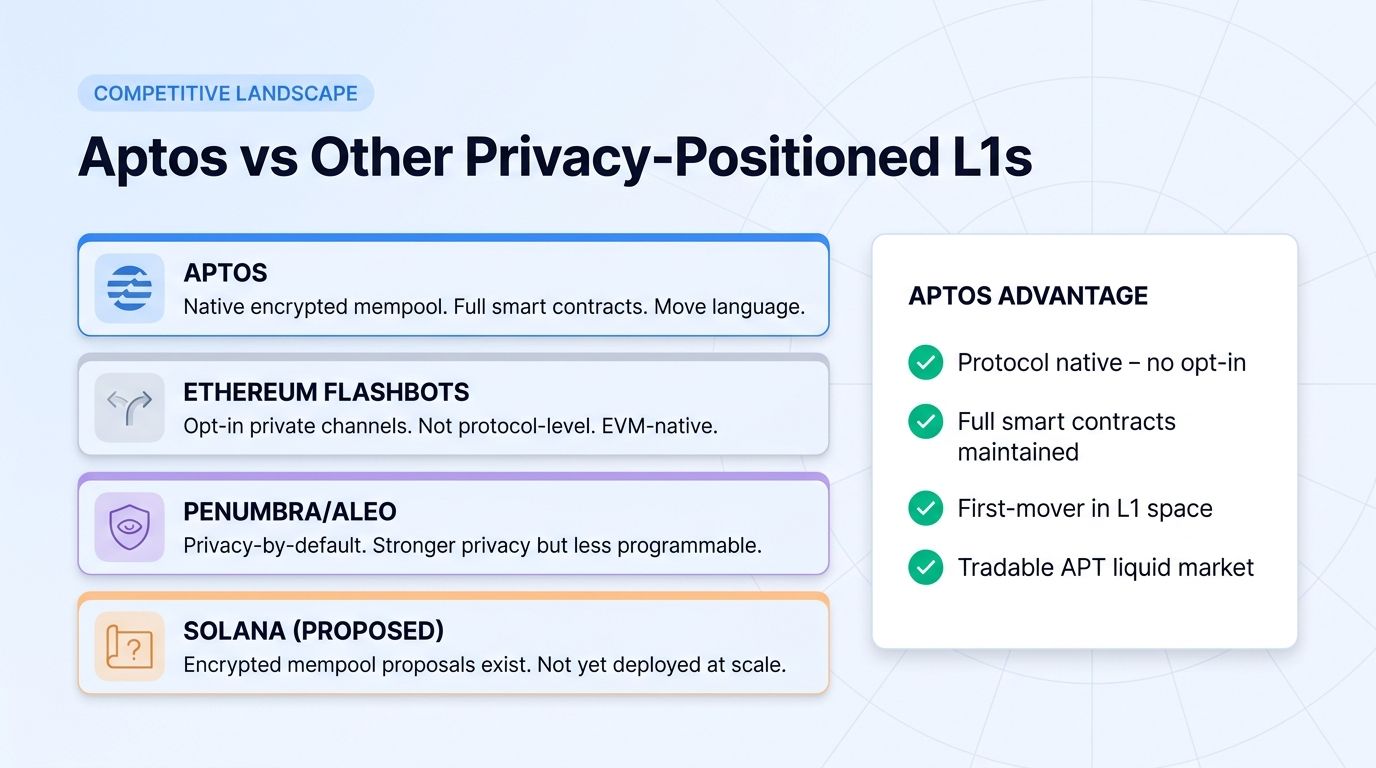
Ethereum Flashbots and MEV-Share: Opt-in services where users submit transactions through private channels. Reduces MEV for participating users but does not change the default protocol behavior.
Solana proposed encrypted mempool: Solana has explored encrypted mempool concepts but has not deployed a native protocol-level encrypted mempool as of mid-2026. Aptos's deployment is ahead of the curve in the L1 space.
Penumbra and Aleo (privacy-first chains): Penumbra and Aleo are privacy-by-default chains where all transaction details are private. They provide stronger privacy than Aptos's encrypted mempool but at the cost of execution flexibility and ecosystem maturity.
Monero (zk-style privacy): Bitcoin-style privacy chains use ring signatures and stealth addresses for transaction privacy. These chains do not support smart contracts directly.
The Aptos approach is balanced: protocol-level transaction intent confidentiality, while retaining full smart contract programmability and reasonable performance. For trading-focused applications, this balance is attractive.
The APT Token and Economics
APT is the native token of the Aptos blockchain. It serves three functions.
Gas and fee payment. All transactions on Aptos pay fees in APT. As network activity grows, APT demand grows.
Staking and security. Validators stake APT to participate in consensus. Stakers earn rewards from network emissions. The total staked APT secures the network.
Governance. APT holders participate in Aptos governance decisions, including protocol upgrades, fee structures, and ecosystem grants.
By 2026, APT's market capitalization is in the multi-billion dollar range, making it one of the larger L1 tokens. The token has experienced significant volatility through cycle conditions, with price action reflecting both broader crypto market conditions and Aptos-specific developments.
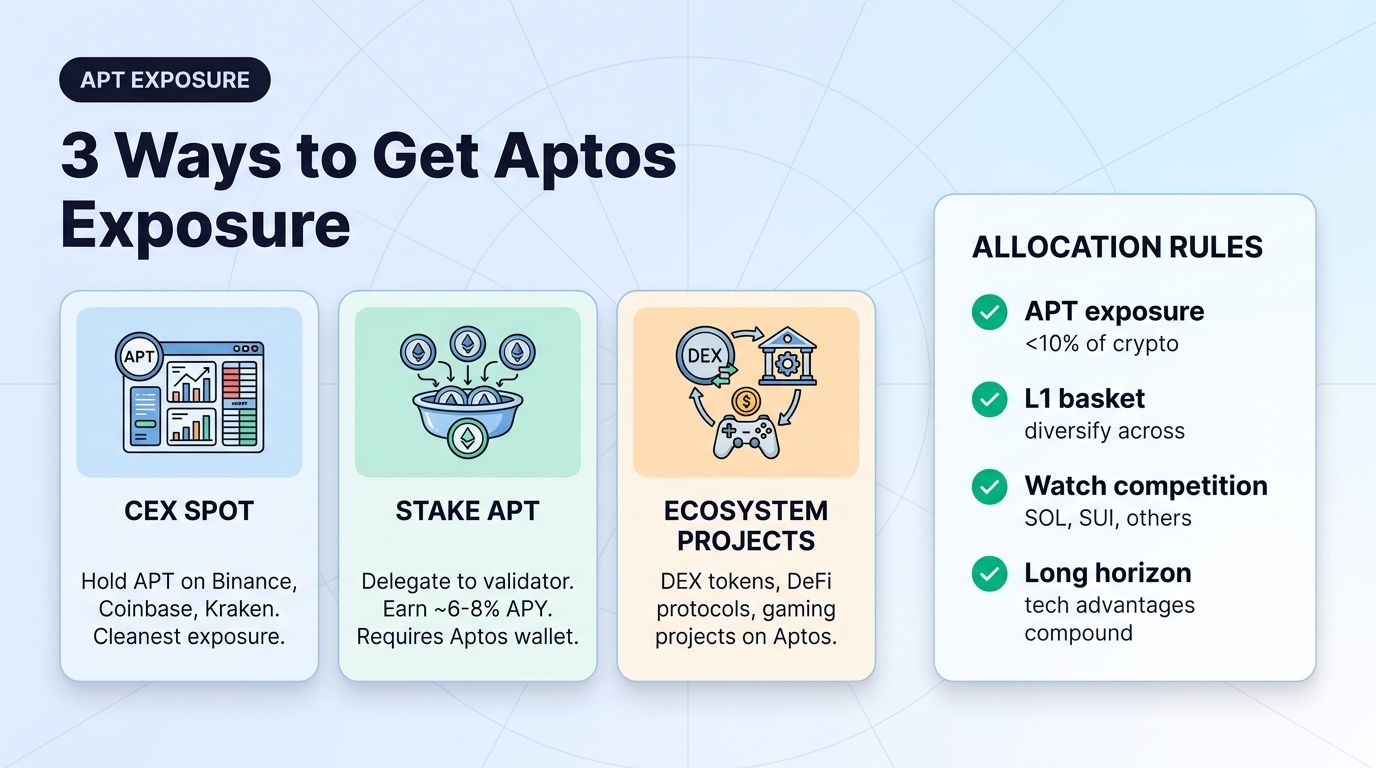
How Traders Can Get Aptos Exposure
Three practical paths.
Path 1: Hold APT on a centralized exchange. APT trades on Binance, Coinbase, Kraken, KuCoin, Bybit, OKX, and most major exchanges. This provides the cleanest exposure to the broader Aptos thesis. A platform like Altrady connects to 19+ exchanges, so you can manage APT positions alongside your other holdings.
Path 2: Stake APT to validators. Holding APT and delegating to a validator earns staking rewards. Yields are typically 6-8% APY. Requires using an Aptos-compatible wallet (Petra, Martian, others) and selecting a validator.
Path 3: Hold tokens of Aptos ecosystem projects. Various projects build on Aptos. DEX tokens (PancakeSwap on Aptos, others), DeFi protocols, NFT marketplaces, and gaming projects each have their own tokens. Concentrated positions in specific ecosystem winners can outperform broad APT exposure if you pick correctly.
The Risks of Aptos Investing
Competitive pressure. Sui (which uses the same Move language family) competes directly for the same Move-language developer community. Solana competes on the broader L1 narrative. The L1 category is structurally winner-take-most over long time frames.
Adoption risk. Despite strong technology, Aptos has not yet captured the developer mindshare of Solana, Ethereum, or even some smaller L1s. Adoption could remain slow if developer momentum stays elsewhere.
Token economic risk. APT has significant token unlocks through 2026-2027. Vesting unlocks can create supply pressure that affects price.
Centralization concerns. Like several other recent L1s, Aptos was originally launched with significant token allocations to investors and team. The progress toward broader decentralization is ongoing.
Technical risk. Despite Move's safety properties, complex L1 systems can have unforeseen issues. Bugs, network halts, or unexpected behavior could damage confidence.
Market timing risk. L1 narratives cycle in and out of favor. Holding APT through periods when the L1 narrative is out of favor can produce significant drawdowns.
How Aptos Fits Into a Crypto Portfolio
A practical framework:
- Core large-cap holdings (BTC, ETH): 50-65% of crypto allocation
- Large alt-L1 exposure (SOL, Aptos, Sui): 15-25%. APT typically holds a smaller slice within this category
- Ecosystem project tokens: 5-15%. Concentrated positions in specific ecosystem winners
- Cash reserves: 5-15%
APT allocation within total portfolio rarely exceeds 5-10% for most traders due to the competitive pressures in the L1 space. Concentration risk is higher for L1 allocations than for established largest-cap positions.
The Broader Privacy x L1 Trend
Aptos's encrypted mempool is part of a broader trend.
Other privacy-oriented L1 efforts: - Sui's similar exploration of mempool privacy (status: announced, not deployed at scale) - Solana's pending privacy proposals (various researchers have proposed schemes) - Cosmos chains with privacy modules (Penumbra, others in the ecosystem) - Ethereum L2 privacy efforts (Aztec, various others)
The category is competitive. Aptos's first-mover advantage on native encrypted mempool is real but not durable forever. Other L1s will likely add similar features in 2026-2027 if user adoption demonstrates the demand.
For traders, the privacy x L1 thesis is broader than just APT. Diversified exposure across multiple privacy-positioned L1s captures the broader thematic upside while reducing single-chain risk.
FAQ
Does the encrypted mempool protect against all MEV?
No. The encrypted mempool prevents MEV extraction based on observing pending transactions (front-running, sandwich attacks). It does not prevent MEV based on observing already-executed transactions, long-running arbitrage strategies, or other forms of value extraction. It is a meaningful protection but not a complete solution.
How fast is Aptos compared to other L1s?
Aptos has demonstrated throughput exceeding 160,000 transactions per second in optimized scenarios. Real-world throughput is lower (typically a few thousand TPS for general workloads). Latency to finality is sub-second. These specifications are competitive with Solana and Sui and better than most EVM-compatible chains.
What is Move and why does it matter?
Move is a programming language originally developed for Meta's Diem project, designed specifically for financial applications on blockchains. Move has strong safety guarantees against common bug categories (reentrancy, integer overflow). Aptos and Sui both use Move (with some variation). For developers building DeFi or financial primitives, Move offers significant safety advantages over Solidity.
Is APT a good buy at current prices?
This depends on your view of L1 competition and Aptos's specific technical advantages. Aptos has strong technology and now the encrypted mempool differentiator. Adoption is real but lagging Solana. Whether to buy depends on portfolio diversification needs, your time horizon, and your conviction on the broader L1 thesis. Sizing positions to a level where worst-case outcomes do not damage your portfolio is the standard approach.
Can I trade APT on Altrady?
Yes. APT is listed on Binance, Coinbase, Kraken, KuCoin, Bybit, OKX, and most major exchanges. Altrady connects to 19+ exchanges, so you can manage APT positions alongside other crypto holdings, run automated strategies via the signal bot, grid bot, or DCA bot, and use unified portfolio tracking.
Conclusion
Aptos's native encrypted mempool represents a meaningful technical advance in the L1 competitive landscape. By becoming the first major chain to offer transaction intent confidentiality at the protocol level, Aptos has differentiated itself in a specific way that matters to active traders and MEV-conscious users.
For traders, the practical takeaway is this: APT is a credible position in the L1 category with strong technology and now a differentiated privacy feature. The risks (competitive pressure, adoption lag, token unlocks) are real and require sizing positions appropriately. The upside is participation in L1 evolution if Aptos's technical advantages translate into adoption.
The next 12 months will produce decisive data on whether the encrypted mempool drives meaningful adoption. If trading-focused applications and DeFi protocols recognize the value and migrate to Aptos, the network effect could compound. If adoption stays slow, the encrypted mempool will remain an interesting technical feature without strong commercial impact.
Either way, the privacy x L1 trend is now firmly on the agenda. Aptos has positioned itself as a leading project in that direction, and the entire category bears watching for traders thinking about long-term L1 exposure.