
Babylon has emerged as the largest Bitcoin staking protocol of the 2024-2026 cycle. By Q2 2026, the protocol holds 56,853 BTC across its staking vaults, worth approximately $5.6 billion at current prices, with peaks above $7.1 billion earlier in 2026. The protocol enables Bitcoin holders to stake their BTC to secure proof-of-stake networks and earn yield, without wrapping their Bitcoin into a different asset or bridging to another chain.
The structural innovation matters. Bitcoin traditionally generated no yield. Holders who wanted return had two options: hold and hope for price appreciation, or wrap BTC into wrapped variants (WBTC, tBTC) and deploy in DeFi. Both approaches have drawbacks. Babylon's design lets BTC holders earn yield while maintaining their native Bitcoin holdings, opening up a new category broadly called BTCfi (Bitcoin DeFi).
This guide explains what Babylon is, how Bitcoin staking works without wrapping, the BTCfi narrative emerging in 2026, the integration plans with Aave V4 and other DeFi protocols, the risks, and how Bitcoin holders should think about Babylon exposure.
What Is Babylon?
Babylon is a Bitcoin staking protocol that lets BTC holders provide economic security to proof-of-stake networks while keeping their Bitcoin on the Bitcoin chain. The protocol uses Bitcoin's own scripting capabilities (specifically, timelock and signature aggregation features) to enable staking without bridging or wrapping.
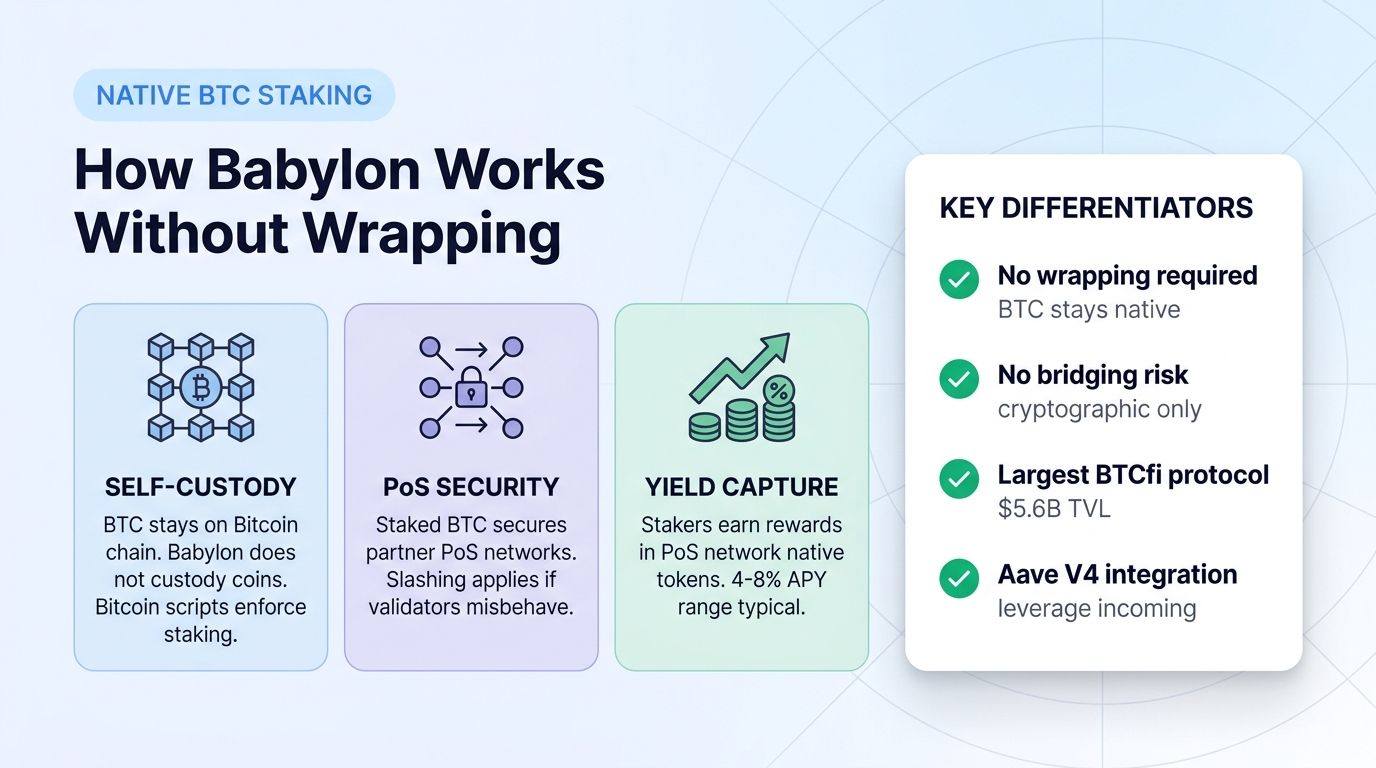
The architecture has three core components.
First, Bitcoin self-custody. Stakers' BTC remains on the Bitcoin blockchain in self-custodied wallets. Babylon does not custody the underlying Bitcoin; the protocol uses Bitcoin scripts to enforce staking conditions.
Second, PoS network security provision. Staked BTC provides economic security to participating proof-of-stake networks. If validators on those networks misbehave, the BTC backing them can be slashed.
Third, yield generation. Stakers earn rewards in the form of the networks they secure, typically the network's native token plus protocol fees. The yield rate varies by network and protocol design.
The result is a hybrid model: Bitcoin holders keep their BTC native and self-custodied while earning yield through providing security to PoS networks.
Why BTCfi Matters in 2026
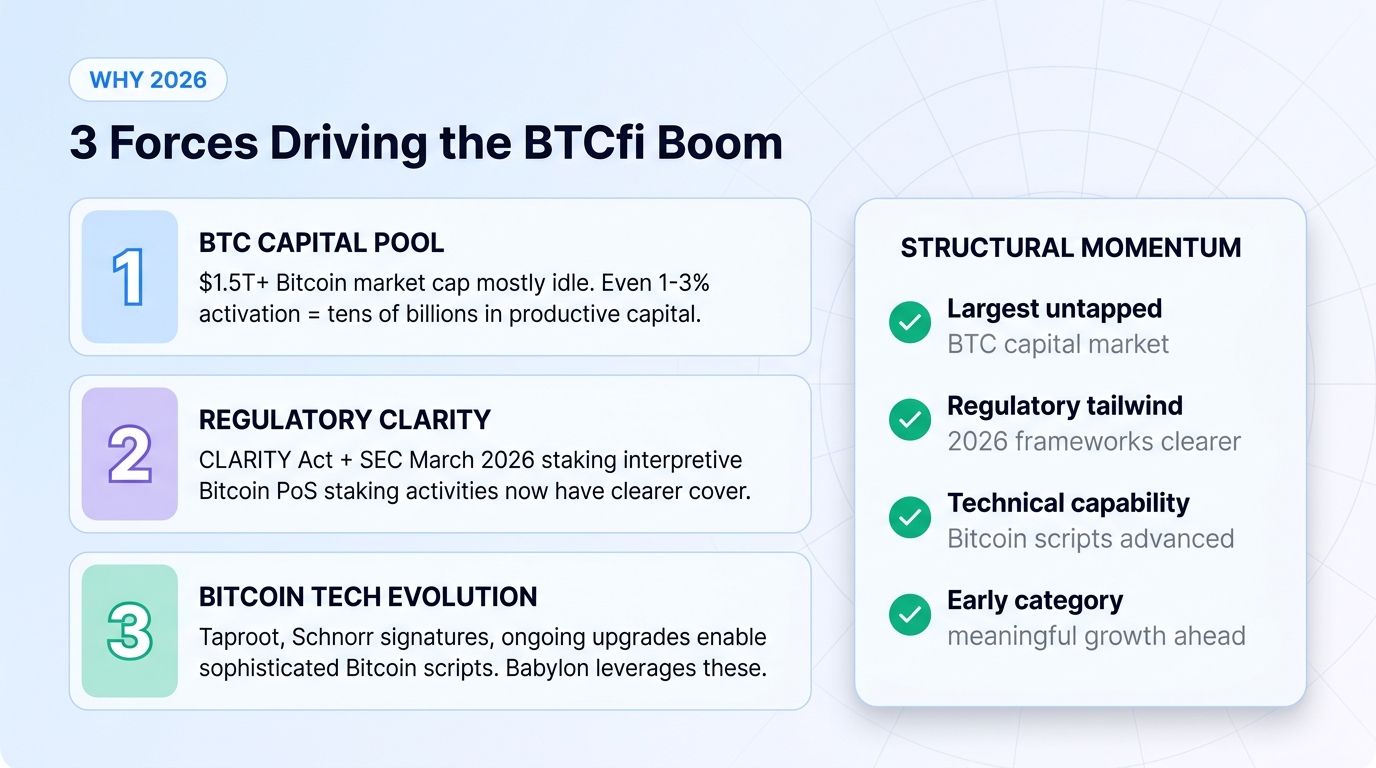
Three structural drivers explain the BTCfi narrative.
First, Bitcoin holds approximately $1.5 trillion in market cap, the vast majority of which sits idle. Even modest yield activation (1-3% of BTC supply earning yield) represents tens of billions of dollars in productive capital.
Second, the regulatory environment has improved. The CLARITY Act's clearer framework for Bitcoin and proof-of-stake activities, combined with the SEC and CFTC's March 2026 staking interpretation, provides regulatory cover that did not exist in earlier cycles.
Third, Bitcoin's evolving developer ecosystem. Bitcoin DeFi has been a desired category for years, but technical limitations of Bitcoin's scripting language constrained development. Recent advances (Taproot, Schnorr signatures, ongoing Bitcoin upgrades) have opened up more sophisticated possibilities. Babylon's design leverages these advances.
For traders, BTCfi represents one of the largest untapped opportunities in crypto. The category is in its early growth phase.
How Babylon's Staking Works
The Babylon protocol uses Bitcoin scripts to enforce staking conditions without requiring intermediaries to hold BTC.
The flow is:
- BTC holder creates a staking transaction on Bitcoin chain. The transaction locks the BTC in a special Bitcoin script with specific conditions.
- The script includes a timelock (minimum staking period) and slashing conditions (specific events that can be cryptographically proven against the staker's BTC).
- Babylon's validation infrastructure observes the staked BTC and includes it in the security budget for participating PoS networks.
- The PoS network's validators take economic responsibility for the staked BTC. If they misbehave, slashing transactions can be submitted that capture the BTC.
- Stakers earn rewards from the PoS networks they secure, typically distributed in the network's native token or stablecoin equivalent.
The technical elegance is that BTC never leaves the Bitcoin chain. The staking is purely cryptographic, using Bitcoin's existing capabilities rather than introducing new infrastructure.
The Aave V4 Integration Plan
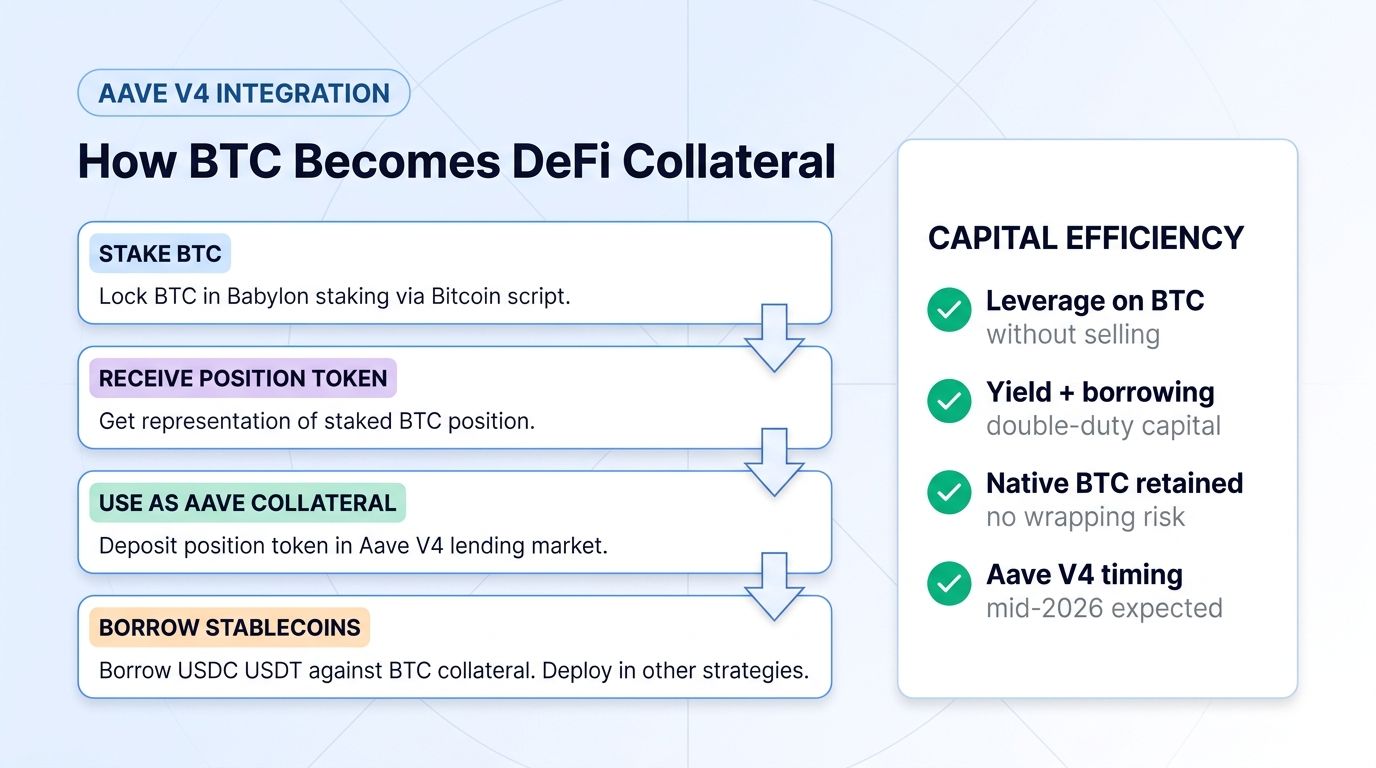
One of the most significant developments for Babylon in 2026 is the planned Aave V4 integration. Aave is the largest decentralized lending protocol by total value locked, and the integration would allow native Bitcoin (via Babylon's mechanism) to serve as collateral in Aave's lending markets.
Under the planned design:
- Users stake BTC through Babylon and receive a representation token or position record
- The Babylon position can be used as collateral in Aave V4
- Users borrow stablecoins (USDC, USDT, others) against their Babylon-staked BTC
- The borrowed stablecoins can be deployed in other strategies
The result is leverage on Bitcoin without selling BTC or wrapping it. This is particularly attractive for long-term Bitcoin holders who want capital efficiency without changing their underlying Bitcoin exposure.
The integration timeline depends on Aave V4 launch (expected mid-2026) and the security review process for the Babylon connector. If successful, this could substantially expand BTCfi capital flows.
The BABY Token
Babylon has its own native token (BABY) that supports the protocol's governance and economic mechanisms.
The token has multiple functions.
Governance: BABY holders vote on protocol parameters including which PoS networks are eligible to receive BTC staking security, slashing parameters, and economic adjustments.
Validator economics: Validators in Babylon's infrastructure stake BABY in addition to receiving BTC delegation. This provides economic alignment.
Fee distribution: Protocol fees flow partially to BABY stakers.
The token has experienced significant volatility through 2026. After reaching highs in early 2026, BABY dropped to lows around $0.0107 in March 2026 before recovering above $0.02 in May 2026 after positive news (TVL milestones, Aave integration announcements).
How Babylon Compares to Other BTCfi Protocols
The BTCfi landscape has multiple emerging protocols.
Babylon (native BTC staking): BTC stays on Bitcoin chain. Stakes via scripts. Largest TVL ($5.6B). First-mover in the category.
Solv Protocol (BTC LST aggregator): Aggregates multiple BTC-yielding strategies and issues a single yield-bearing BTC token. Different model but similar end goal.
Wrapped BTC variants (WBTC, tBTC, FBTC): Bridge-based wrapping. Higher counterparty risk than Babylon's native approach. Massive existing volume but different risk profile.
Stacks (Bitcoin L2): Smart contract platform with Bitcoin settlement. Different architecture. Tokens like ALEX provide BTC-related DeFi.
Babylon's competitive advantages: BTC self-custody, native Bitcoin script-based security, large TVL with major institutional partnerships. These provide significant moats against alternatives.
How Traders Can Get Babylon Exposure
Three practical paths.
Path 1: Stake BTC directly through Babylon. Bitcoin holders can stake their BTC through Babylon's interface, earning yield from secured PoS networks. Requires holding BTC and using Babylon's staking infrastructure.
Path 2: Hold BABY token. BABY tokens represent governance and economic exposure to Babylon. Available on major exchanges. Altrady connects to 19+ exchanges and supports unified BABY position management.
Path 3: Hold related BTCfi ecosystem tokens. Tokens of protocols building on or integrating with Babylon provide concentrated exposure to the category's growth.
The Risks of Babylon Investment
Smart contract risk. Babylon's Bitcoin script approach is novel. Bugs in the implementation could affect staked BTC. While the protocol has undergone audits, complex systems can have unforeseen issues.
Slashing risk. Staked BTC can be slashed if the validators on the secured PoS networks misbehave. While slashing is unlikely under normal operations, it represents a genuine downside risk.
Network-specific risk. Babylon stakes secure specific PoS networks. If those networks face problems (low adoption, validator issues, regulatory action), the staking yield may decline or operations may be affected.
BABY token volatility. The BABY token has been highly volatile, with significant drawdowns and recoveries. Token allocation should account for high volatility.
Smart contract on Bitcoin risk. Bitcoin's scripting capabilities are more limited than Ethereum's. While the Babylon protocol leverages existing Bitcoin features carefully, novel uses can introduce unexpected issues.
Aave integration timing risk. The planned Aave V4 integration is a significant catalyst but depends on Aave's launch and security review. Delays would affect Babylon's growth trajectory.
How Babylon Fits Into a Bitcoin Strategy
For Bitcoin holders considering yield generation:
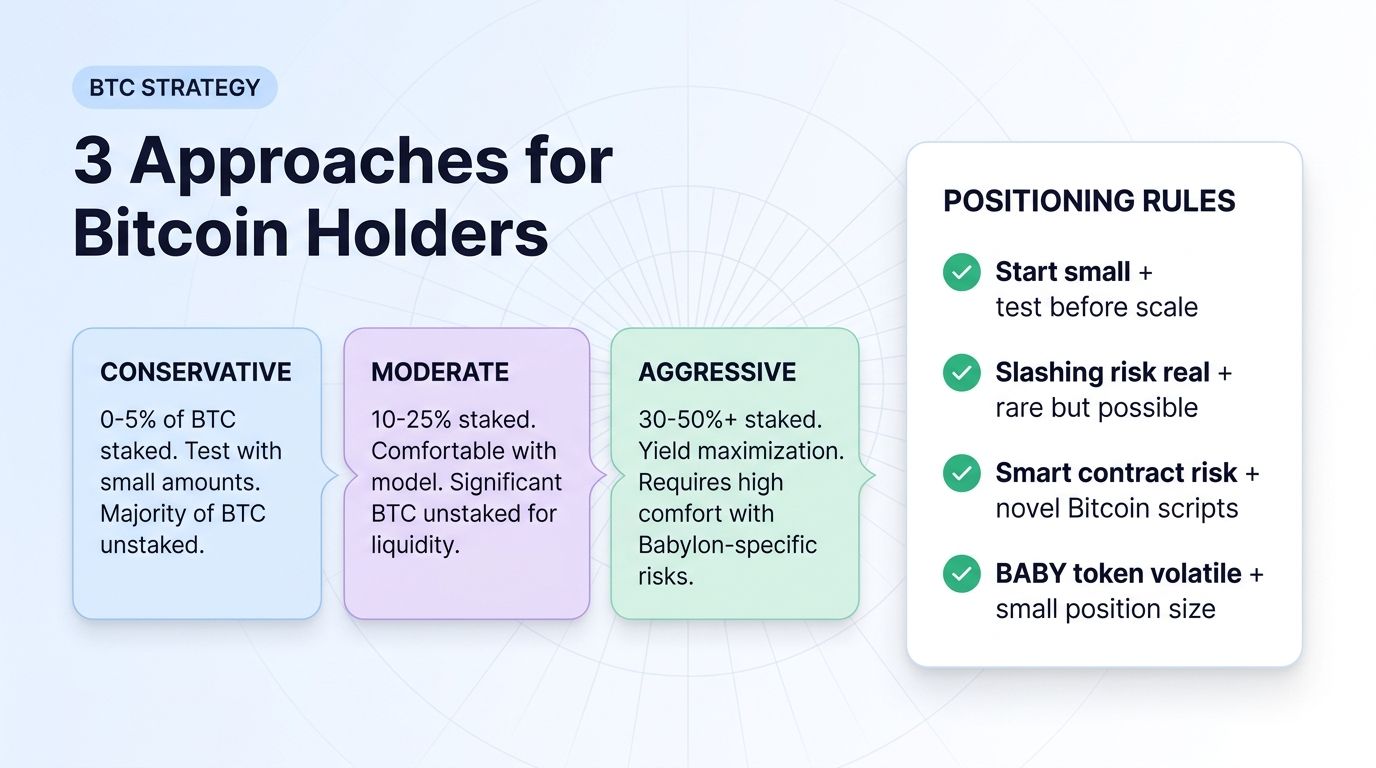
Conservative approach: 0-5% of BTC holdings staked through Babylon. Test the protocol with small amounts. Capture some yield while preserving the majority of BTC exposure in self-custody without staking.
Moderate approach: 10-25% of BTC holdings staked. Comfortable with the staking model but maintain significant unstaked BTC for liquidity and flexibility.
Aggressive approach: 30-50%+ of BTC holdings staked. Maximizes yield capture but requires high comfort with Babylon-specific risks.
For BABY token allocation specifically, position sizing should follow the general framework for high-volatility tokens: small absolute size, diversified across category.
What to Watch in the Next 12 Months
Three indicators.
Indicator 1: BTC TVL growth. Does Babylon's BTC staking TVL grow beyond current $5.6B? Strong growth signals category expansion. Stagnation suggests category limits.
Indicator 2: Aave V4 integration execution. Does the Aave V4 integration launch successfully? Strong execution unlocks significant new capital flows.
Indicator 3: BTCfi category development. Do additional major BTCfi protocols launch successfully? Category breadth strengthens the overall narrative.
If all three trend positively, Babylon establishes itself as core BTCfi infrastructure. If issues emerge, the category may grow more slowly than anticipated.
FAQ
What is Babylon Bitcoin staking?
Babylon is a Bitcoin staking protocol that lets BTC holders earn yield by providing economic security to proof-of-stake networks. The key innovation is that BTC stays on Bitcoin chain in self-custody, without wrapping or bridging. The protocol uses Bitcoin scripts to enforce staking conditions.
Is my BTC safe when staked through Babylon?
BTC stays on Bitcoin chain and is not custodied by Babylon. However, staked BTC is subject to slashing conditions if the secured PoS networks experience validator misbehavior. Smart contract risk in the Babylon implementation also applies. Slashing is rare but the risk is real.
What is the typical yield from Babylon staking?
Yield rates vary by which PoS networks are being secured. Current yields are in the 4-8% APY range, depending on specific network economics. As more networks integrate with Babylon, yield options will diversify.
What is BTCfi?
BTCfi (Bitcoin DeFi) refers to the emerging category of financial applications using Bitcoin natively rather than wrapped variants. This includes staking, lending, derivatives, and other DeFi activities. Babylon is one of the leading BTCfi protocols.
Can I trade BABY on Altrady?
BABY is listed on major exchanges including Binance, OKX, KuCoin, Bybit, and others. Altrady connects to 19+ exchanges, so you can manage BABY positions alongside other crypto holdings, run automated strategies via the signal bot, grid bot, or DCA bot, and use unified portfolio tracking.
Conclusion
Babylon represents one of the most significant developments in Bitcoin's evolution toward becoming productive capital. By enabling BTC holders to earn yield through native Bitcoin staking, the protocol has unlocked an entirely new category of Bitcoin economic activity.
For traders and Bitcoin holders, the practical takeaway is this: BTCfi is real and growing. Babylon at $5.6 billion TVL is meaningful scale, and the planned Aave V4 integration could substantially expand the category.
The longer-term significance is that Bitcoin may evolve from a passive store-of-value asset into productive capital that can participate in DeFi without abandoning its core properties. If Babylon and similar protocols continue scaling, the implications for Bitcoin's role in the broader financial system are substantial.
For diversified crypto portfolios, Babylon BTC staking deserves consideration as part of broader Bitcoin strategy, particularly for long-term holders comfortable with the novel staking model. BABY token allocation should follow standard high-volatility position sizing. The next 12 months will produce decisive data on category trajectory and on whether Aave V4 integration unlocks the next phase of BTCfi growth.