
Bitcoin used to be a thing you bought on Coinbase, sent to a hardware wallet, and prayed you did not lose the seed phrase. In 2024, that changed. Spot Bitcoin ETFs got SEC approval, BlackRock and Fidelity launched products that hold real BTC, and institutional money started flowing in at an unprecedented pace. If you trade crypto, understanding how Bitcoin ETFs work is no longer optional - the flows now drive significant short-term price action.

What Is a Bitcoin ETF?
A Bitcoin ETF (Exchange-Traded Fund) is a regulated investment product that trades on traditional stock exchanges and gives investors exposure to Bitcoin price without requiring them to hold BTC directly. You buy shares of the ETF in a brokerage account the same way you buy SPY or QQQ. The fund itself owns the underlying asset - either real Bitcoin (spot ETF) or Bitcoin futures contracts (futures ETF).
The wrapper matters because it solves three problems that kept institutions out of crypto for over a decade: custody risk, regulatory uncertainty, and operational complexity. Pension funds, family offices, and registered advisors cannot generally hold a hardware wallet or open a Coinbase account on behalf of clients. They can, however, buy a SEC-regulated ETF through any standard brokerage. That single change unlocked trillions of dollars of allocation potential.
Spot Bitcoin ETFs vs Bitcoin Futures ETFs
Two flavors of Bitcoin ETF exist, and the difference is non-trivial:
- Spot Bitcoin ETF: The fund owns actual BTC, custodied by a regulated custodian (typically Coinbase Custody, Fidelity Digital Assets, or BNY Mellon). Each share represents a fractional claim on real Bitcoin sitting in cold storage. Tracks BTC spot price almost 1:1 minus a small management fee. Approved in the US in January 2024.
- Bitcoin Futures ETF: The fund owns CME Bitcoin futures contracts, not Bitcoin itself. Tracks futures price, which can deviate from spot due to contango, backwardation, and roll costs. Approved in the US in October 2021 (BITO was first).
For long-term holders and institutional allocators, spot ETFs are almost always the better choice because they avoid the structural drag of constantly rolling futures contracts. Most net new institutional inflows since January 2024 have gone into spot products like IBIT, FBTC, and ARKB. The futures ETF category still has uses for tactical traders who want leverage or short exposure without rolling contracts themselves.
The Major Spot Bitcoin ETFs Approved
The January 2024 SEC approval cleared 11 spot Bitcoin ETFs simultaneously. The market quickly consolidated around a few large products:
- BlackRock iShares Bitcoin Trust (IBIT): The largest by assets under management. Annual fee around 0.25%. BlackRock's distribution network gave it an immediate institutional advantage.
- Fidelity Wise Origin Bitcoin Fund (FBTC): Second largest. Annual fee around 0.25%. Fidelity custodies the underlying BTC in-house.
- ARK 21Shares Bitcoin ETF (ARKB): Cathie Wood's product. Slightly higher fee (~0.21%). Smaller AUM but loyal retail following.
- Bitwise Bitcoin ETF (BITB): Founded by crypto-native Bitwise. Lowest fee tier. Marketed transparency on holdings and on-chain proof of reserves.
- Grayscale Bitcoin Trust (GBTC): Converted from a closed-end trust at conversion. Highest fee (~1.5%) due to legacy structure - has seen significant outflows as investors rotate to cheaper alternatives.
Fee compression continues. Most issuers waived or reduced fees for the first 6-12 months after launch to attract assets, and several products are now competing on cost basis below 0.20%.
How Institutions Buy Bitcoin Through ETFs
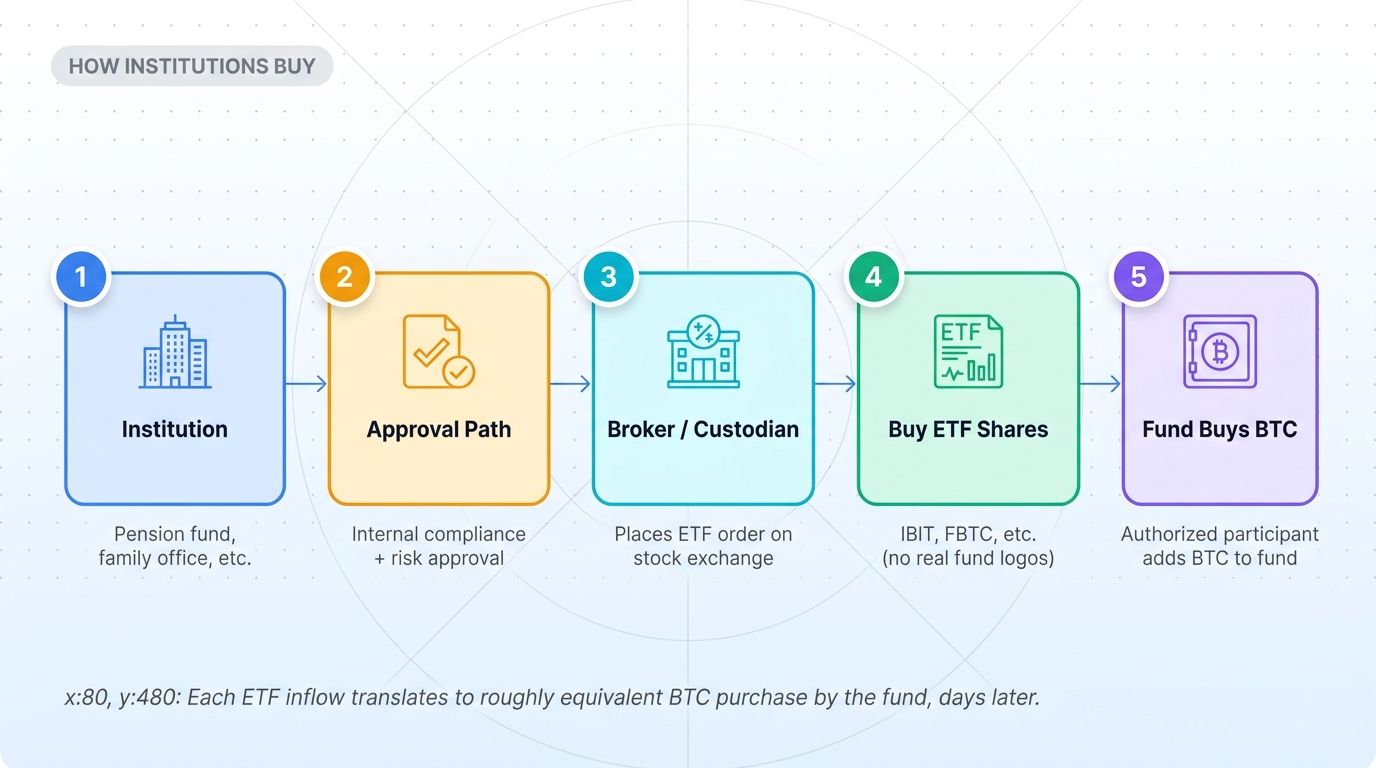
The mechanics of an institutional Bitcoin ETF purchase look nothing like a retail Coinbase trade. The flow involves multiple regulated entities:
- Institution decides allocation. A pension fund, RIA, or family office decides to allocate, say, 1% of portfolio to Bitcoin via ETF.
- Internal compliance and approval. The investment committee documents the rationale, runs through risk checks, and gets sign-off from compliance.
- Trade desk submits order. The order goes to the institution's broker (Goldman, Morgan Stanley, Bank of America, etc.) who routes it to the relevant stock exchange.
- ETF shares change hands. The institution receives ETF shares in their custody account. At small order sizes, this is a secondary-market transaction (existing shares change hands).
- Authorized Participant creates new shares. If demand is large, an Authorized Participant (typically a market maker like Jane Street) deposits actual BTC with the fund custodian and receives newly-created ETF shares to deliver. This is what causes ETF inflows to translate into actual BTC purchases.
The lag between ETF order and actual BTC purchase by the fund is typically 1-3 days. This delay matters for short-term price action because aggregated daily ETF flows act as a leading indicator for spot BTC demand.
Bitcoin ETF Inflows: What They Mean for Price
Daily net flows into Bitcoin ETFs have become one of the most-watched metrics in crypto. The logic is direct: net inflows = new BTC demand from a buyer base (institutional) that did not exist before 2024.

Patterns to watch:
- Sustained inflows above $200M/day for a week+ historically precede strong BTC rallies. The fund custodians need to acquire that BTC, putting bid pressure on spot markets.
- Single-day inflows above $500M are rare but tend to mark accumulation phases. Mid-2024 and late-2025 both had clusters of $500M+ inflow days that aligned with major BTC up-legs.
- Sustained outflows for 3+ days often precede 5-10% pullbacks. Funds need to sell BTC to redeem shares, putting bid-offer pressure in reverse.
- Net-zero days are noise. Daily flows fluctuate significantly with market sentiment; only multi-day patterns matter.
Aggregated daily flow data is published by Bitcoin ETF issuers and tracked by sites like Farside Investors and SoSoValue. Active crypto traders increasingly incorporate ETF flow data into their setup scans.
Bitcoin ETF vs Buying BTC Directly
The decision between holding BTC directly and buying a Bitcoin ETF depends on your goals:
- Buy ETF shares if: you want BTC exposure inside a tax-advantaged account (IRA, 401k), you cannot or do not want to manage a wallet, you trade through a traditional brokerage, or you have compliance/reporting requirements that complicate direct crypto ownership.
- Hold BTC directly if: you want self-custody, you plan to use BTC for on-chain activity (Lightning, DeFi, payments), you want 24/7 liquidity (ETFs only trade during US market hours), or you want to avoid annual management fees.
Many active traders do both - holding direct BTC for trading and on-chain use, while putting longer-term retirement allocations into spot ETFs.
Tax and Custody Considerations
Bitcoin ETF tax treatment is generally simpler than direct BTC ownership in most jurisdictions:
- US: standard 1099-B reporting. Capital gains follow normal short-term/long-term rules. No need to track wallet-level cost basis.
- EU: ETF gains follow national capital gains rules. Some countries treat ETFs more favorably than direct crypto.
- UK: ETFs in ISAs may be tax-advantaged. Direct crypto is fully taxable.
Custody risk shifts from "you" (managing seed phrases) to "the custodian" (Coinbase, Fidelity, BNY Mellon). This is generally seen as lower risk for non-technical investors but introduces concentration risk - most spot Bitcoin ETF assets are held by 2-3 custodians, creating systemic concentration that did not exist when retail held their own coins.
Risks of Bitcoin ETFs
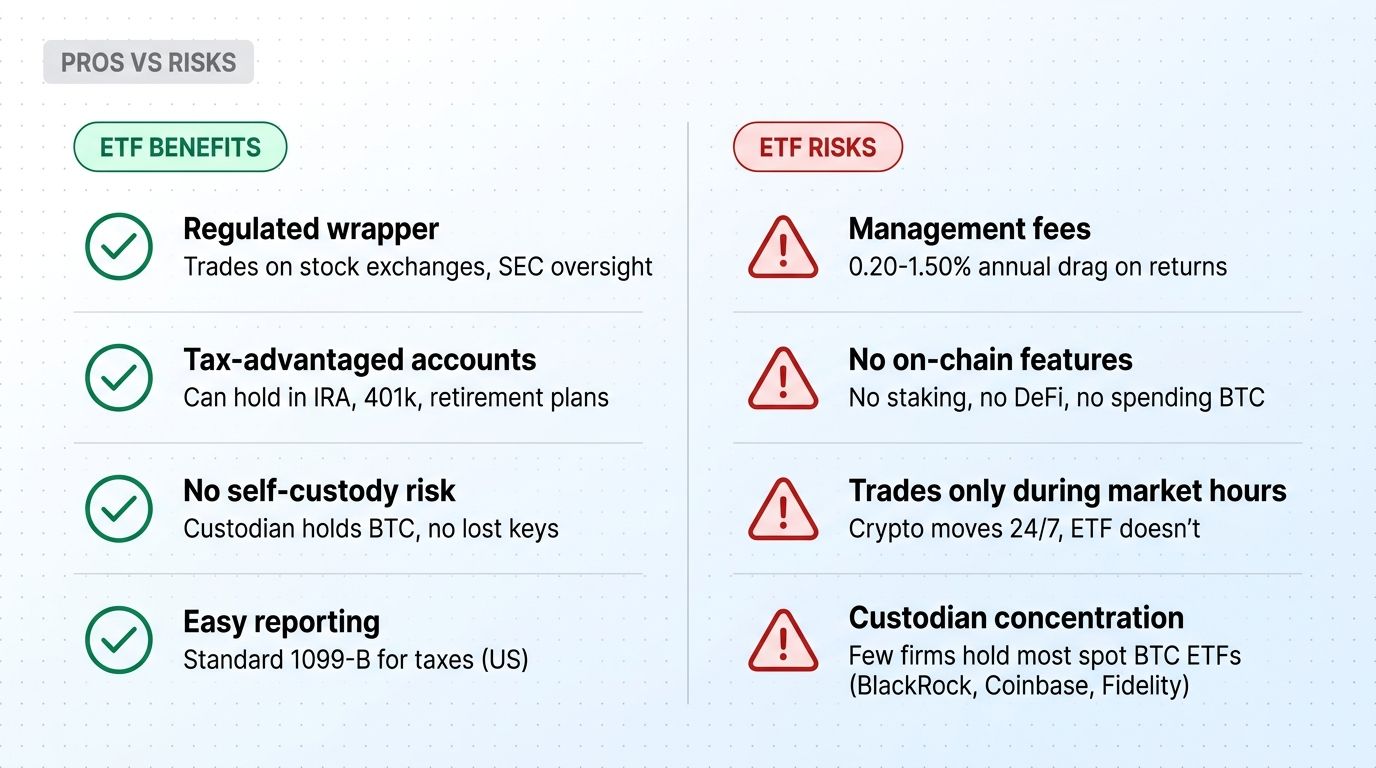
The wrapper solves problems but introduces new ones:
- Management fees create drag. Even at 0.20-0.25%, fees compound. Over 10 years at 0.25%, that is roughly 2.5% of total return given up.
- No on-chain optionality. Cannot stake (post-merge ETH ETFs face the same issue), cannot use BTC in DeFi, cannot spend it directly via Lightning.
- Limited trading hours. ETFs trade during US market hours (9:30 AM-4:00 PM ET) plus extended hours. BTC moves 24/7. Major weekend price moves cannot be acted on through the ETF until Monday open.
- Custodian concentration. Most spot Bitcoin ETF AUM is custodied by Coinbase Custody. A breach or operational failure at one custodian could affect billions in BTC.
- Counter-party risk on issuer. While the underlying BTC is segregated, issuer bankruptcy could complicate share redemption procedures.
How Active Crypto Traders Use ETF Flow Data
For traders who hold BTC directly and want signal from ETF activity, three integrations work well:
- Daily flow as a sentiment overlay. Three-day rolling net flow above +$500M aggregate = bullish backdrop. Three-day net flow below -$300M = bearish backdrop.
- Premium/discount tracking. When a spot ETF's market price diverges meaningfully from its NAV, it signals retail (or institutional) sentiment - a premium suggests aggressive buying, a discount suggests outflows.
- Cross-fund concentration shifts. Money rotating from GBTC (high-fee legacy) into IBIT/FBTC reflects active allocation rebalancing, not necessarily new buying.
Combine ETF flow signals with traditional technical analysis (Donchian breakouts, support/resistance, volume) for a more complete picture of where institutional and retail capital are moving.
Conclusion
Bitcoin ETFs are not just a wrapper - they are a structural shift that brings institutional capital into BTC for the first time at scale. For passive investors and tax-advantaged accounts, spot ETFs (IBIT, FBTC, BITB) are the cleanest way to own Bitcoin. For active crypto traders who hold BTC directly, ETF flow data has become an essential leading indicator of demand.
The key takeaways: spot ETFs are better than futures ETFs for most use cases. Daily ETF flows lead BTC price by 1-3 days. The wrapper trades convenience and regulation for fees and lost on-chain functionality. And whether you hold BTC directly or via ETF, understanding the institutional plumbing now driving crypto markets is non-optional for any serious trader.
Frequently Asked Questions
What is a Bitcoin ETF?
A Bitcoin ETF is a regulated investment product that trades on stock exchanges and gives investors exposure to Bitcoin price without holding BTC directly. The fund itself owns the underlying Bitcoin (spot ETF) or Bitcoin futures contracts (futures ETF), and investors buy shares through standard brokerage accounts.
What is the difference between spot Bitcoin ETF and Bitcoin futures ETF?
A spot Bitcoin ETF holds actual BTC in custody and tracks Bitcoin's spot price almost 1:1. A futures Bitcoin ETF holds CME Bitcoin futures contracts and tracks the futures price, which can drift from spot due to roll costs and contango. Spot ETFs are generally better for long-term exposure; futures ETFs serve tactical short-term purposes.
When were spot Bitcoin ETFs approved?
The SEC approved 11 spot Bitcoin ETFs in the United States in January 2024. Major issuers including BlackRock (IBIT), Fidelity (FBTC), ARK 21Shares (ARKB), Bitwise (BITB), and Grayscale (GBTC, converted from a trust) launched simultaneously. Several other countries (Canada, Brazil, Hong Kong) had approved spot products earlier.
How do Bitcoin ETF inflows affect BTC price?
Net inflows into spot Bitcoin ETFs translate into actual BTC purchases by fund custodians (typically with a 1-3 day lag). Sustained inflows of $200M+ per day for a week or more historically precede BTC price rallies. Sustained outflows often precede pullbacks. ETF flow data has become one of the most-watched short-term price drivers in crypto.
Should I buy a Bitcoin ETF or buy BTC directly?
Buy an ETF if you want BTC exposure in a tax-advantaged account, you cannot or do not want to manage a wallet, or you trade through a traditional brokerage. Buy BTC directly if you want self-custody, plan to use BTC on-chain (DeFi, Lightning, payments), or want 24/7 trading access. Many traders hold both for different purposes.
What are the fees on Bitcoin ETFs?
Most spot Bitcoin ETFs charge annual management fees between 0.20% and 0.25%. The exception is Grayscale's GBTC at around 1.5% (legacy structure). Fee waivers and reductions are common during the first 6-12 months after launch. Lower fees are generally better, but issuer reputation, AUM, and liquidity also matter.
Is my BTC safe in a Bitcoin ETF?
The underlying BTC is custodied by regulated custodians (typically Coinbase Custody, Fidelity Digital Assets, or BNY Mellon) in segregated cold storage. SEC oversight requires regular audits. The risks are concentration (a few custodians hold most ETF BTC) and standard institutional counter-party risk on the issuer, but operational risk is generally lower than self-custody for non-technical holders.
Watching ETF flows alongside on-chain technical setups is one of the highest-leverage workflows for active crypto traders today. Altrady gives you the multi-exchange charting, alert system, and paper trading environment to integrate ETF-driven signal into your setup. Sign up for a free trial and run the workflow on a real exchange feed.