
Bitcoin halving is one of the most anticipated events in the entire cryptocurrency market. Scheduled into the Bitcoin protocol itself, the halving cuts the rate at which new BTC enters circulation, creating a predictable supply shock that has historically preceded massive bull runs. For traders, investors, and miners alike, understanding how the halving works, what it has done to price in the past, and how to position around it is essential knowledge.
With the most recent halving having taken place in April 2024, the market is now in the post-halving cycle that has historically been the most rewarding for long-term holders. Whether you are new to crypto or a seasoned trader, this guide breaks down everything you need to know about bitcoin halving, from the technical mechanics to actionable trading strategies.
1. What Is Bitcoin Halving
Bitcoin halving is a pre-programmed event in the Bitcoin blockchain where the reward miners receive for validating transactions and adding new blocks to the chain is cut in half. This event is not decided by any company, government, or individual. It is written directly into Bitcoin's source code by its pseudonymous creator, Satoshi Nakamoto, as a core part of the monetary policy.
The halving exists to control the total supply of Bitcoin. Unlike fiat currencies that central banks can print at will, Bitcoin has a hard cap of 21 million coins. The halving mechanism is designed to release those coins gradually over time, mimicking the scarcity dynamics of precious metals like gold. As fewer new coins enter circulation, and assuming demand stays constant or grows, basic economic theory suggests the price should rise.
- Hard cap: Bitcoin's maximum supply is capped at 21 million BTC, forever.
- Controlled issuance: New BTC is only created as a reward for miners who validate blocks.
- Deflationary design: Every halving reduces the rate of new supply, making Bitcoin increasingly scarce over time.
- Transparency: Anyone can verify when the next halving will occur by checking the current block height.
2. How the Halving Mechanism Works Technically
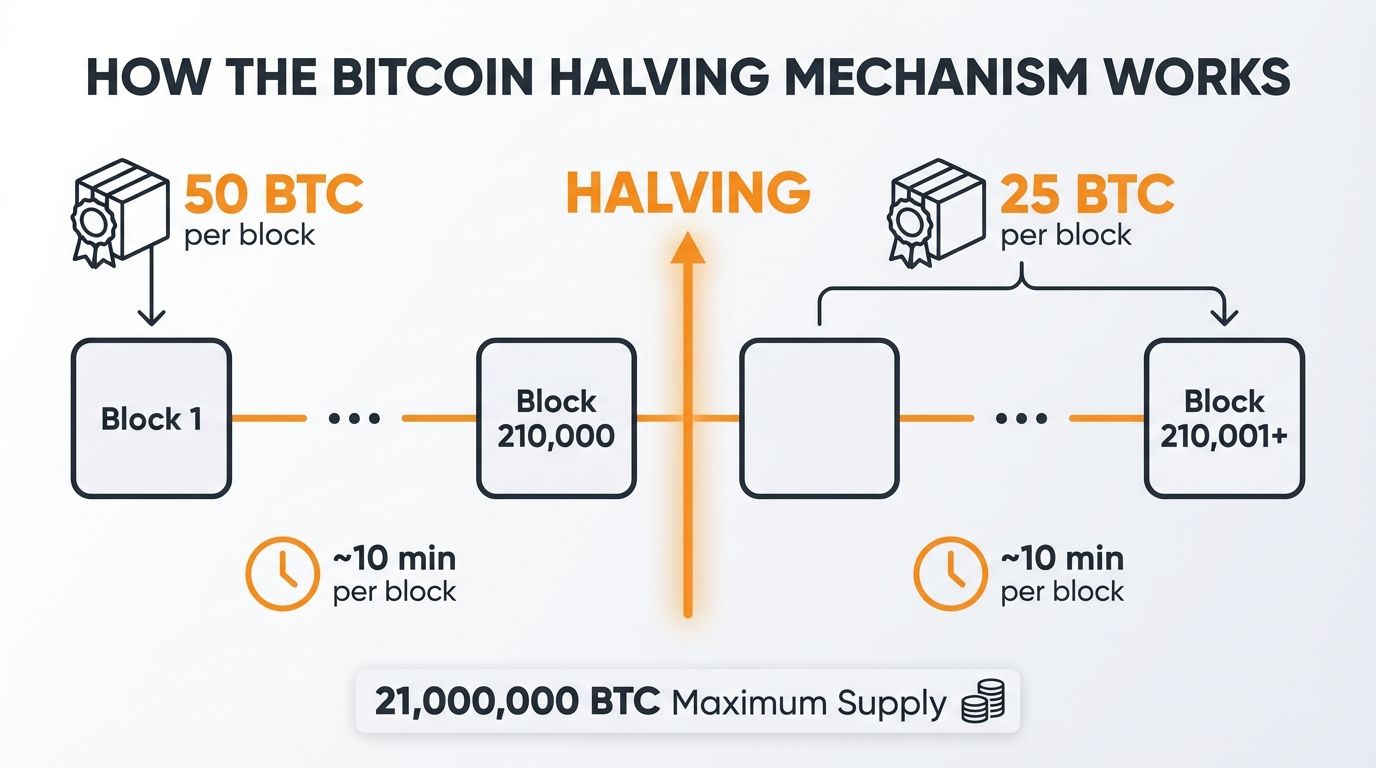
To understand the halving, you need a basic grasp of how Bitcoin's blockchain is structured. Every transaction on the Bitcoin network is bundled into a block. Miners compete to solve a computationally difficult puzzle, and the first to solve it gets to add the next block and claim the block reward. This reward is newly created Bitcoin, and it is the only way new BTC enters the market.
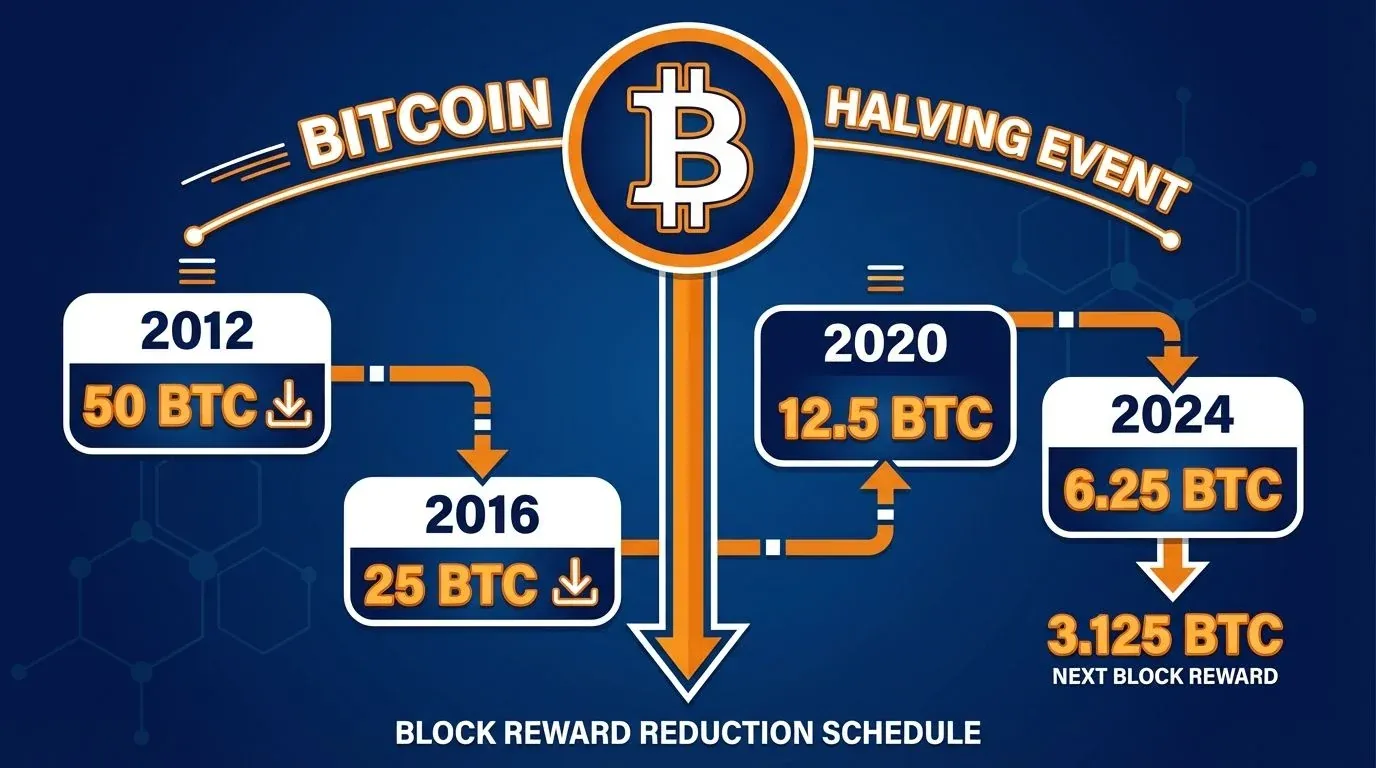
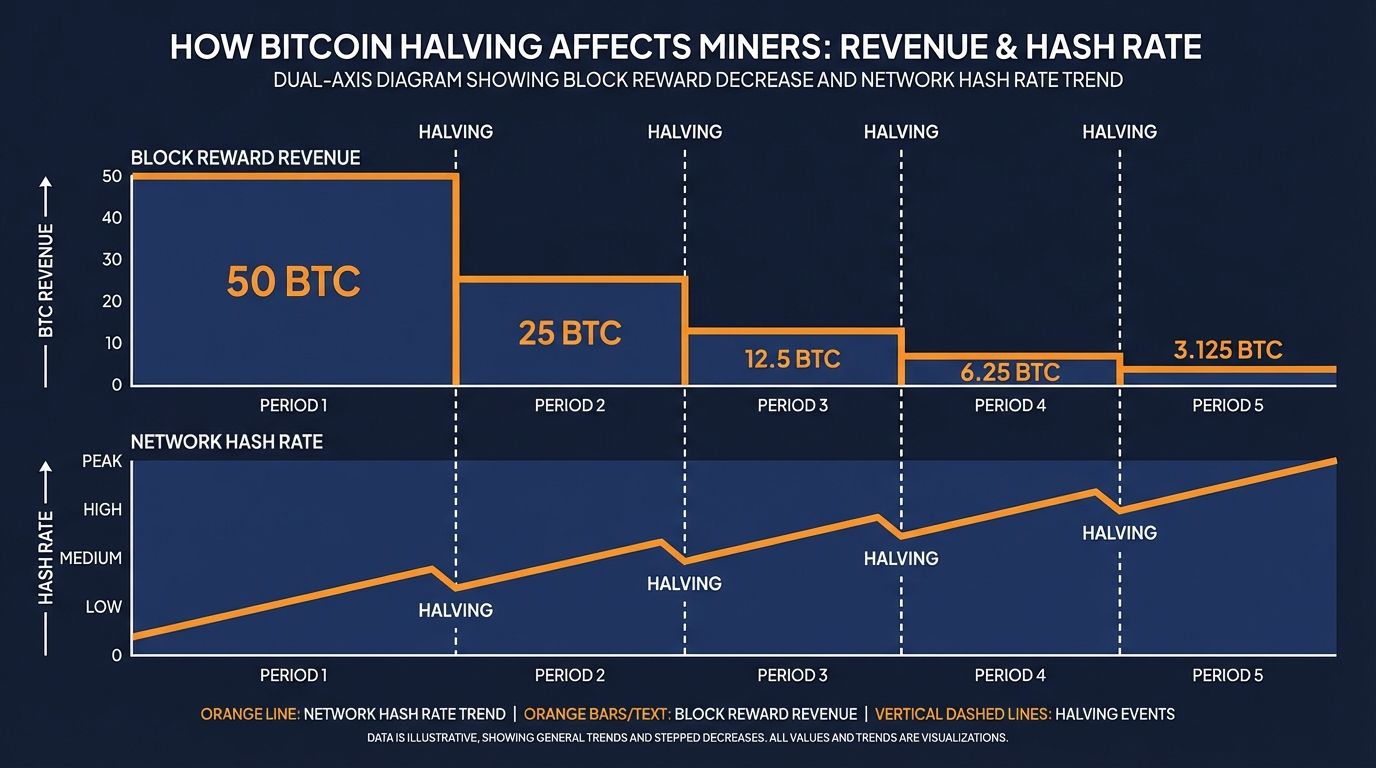
The halving is triggered automatically every 210,000 blocks. At an average block time of approximately 10 minutes, this works out to roughly every four years. When block 210,000 was mined in 2012, the reward dropped from 50 BTC to 25 BTC. At block 420,000 in 2016 it dropped to 12.5 BTC. At block 630,000 in 2020 it fell to 6.25 BTC. The most recent halving in April 2024 at block 840,000 brought the reward down to 3.125 BTC.
- Block reward: The amount of BTC miners earn for each successfully mined block.
- 210,000 blocks: The exact interval at which each halving is triggered.
- ~10 minutes per block: The target time for each block, kept stable by difficulty adjustments.
- ~4 years between halvings: The result of 210,000 blocks at 10 minutes each.
- Final halving: The last Bitcoin is expected to be mined around the year 2140, after approximately 33 halvings total.
After each halving, the Bitcoin network's difficulty adjustment algorithm recalibrates to maintain the ~10 minute block time, regardless of how many miners are active. This ensures the halving schedule remains predictable even as computing power fluctuates across the network.
3. A History of All Four Bitcoin Halvings
There have been four bitcoin halvings to date. Each one has left a distinct mark on the market, and each one has been followed, with varying delay, by a significant price increase. Studying this history gives traders a useful framework for thinking about future cycles, though past performance is never a guarantee of future results.
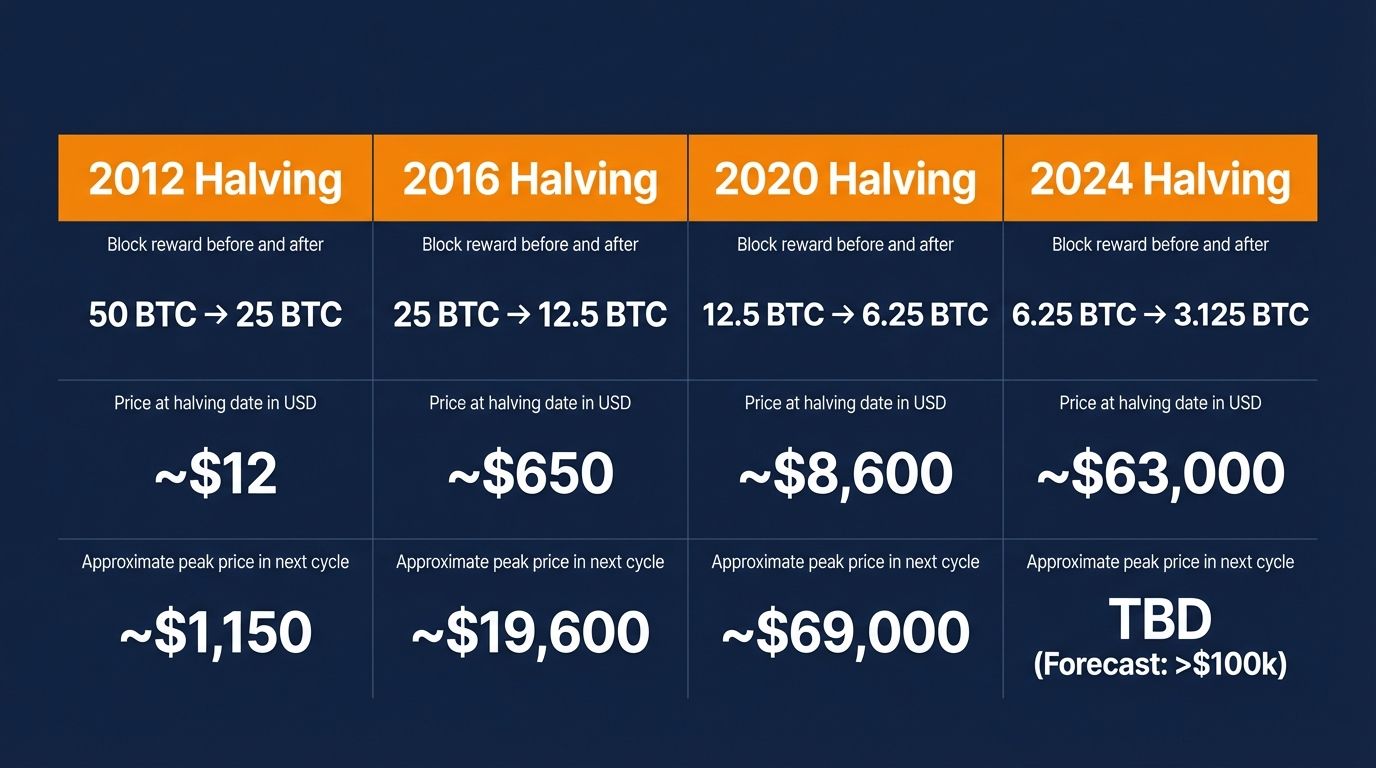
First Halving, November 28, 2012. The reward dropped from 50 BTC to 25 BTC. At the time of the halving, Bitcoin was trading at approximately $12. Twelve months later, Bitcoin reached a then-record high of around $1,000, a gain of more than 8,000%. This was Bitcoin's first proof-of-concept bull run for the halving narrative.
Second Halving, July 9, 2016. The reward dropped from 25 BTC to 12.5 BTC. Bitcoin was priced around $650 at the time of the halving. The price remained relatively flat for several months before beginning a historic climb that peaked near $20,000 in December 2017. The cycle gain was roughly 3,000% from the halving price.
Third Halving, May 11, 2020. The reward dropped from 12.5 BTC to 6.25 BTC. Bitcoin was trading around $8,500 at the time. The subsequent bull run was amplified by massive institutional interest, with companies like MicroStrategy and Tesla adding Bitcoin to their balance sheets. Bitcoin reached an all-time high of approximately $69,000 in November 2021, representing a gain of over 700% from the halving price.
Fourth Halving, April 19, 2024. The reward dropped from 6.25 BTC to 3.125 BTC. Bitcoin was already trading near its previous all-time high at around $63,000 at the time of the halving, which made this cycle unique compared to its predecessors. By January 2025, Bitcoin had surpassed $100,000 for the first time, validating the halving cycle thesis once more.
4. Why Bitcoin Halving Matters for Price
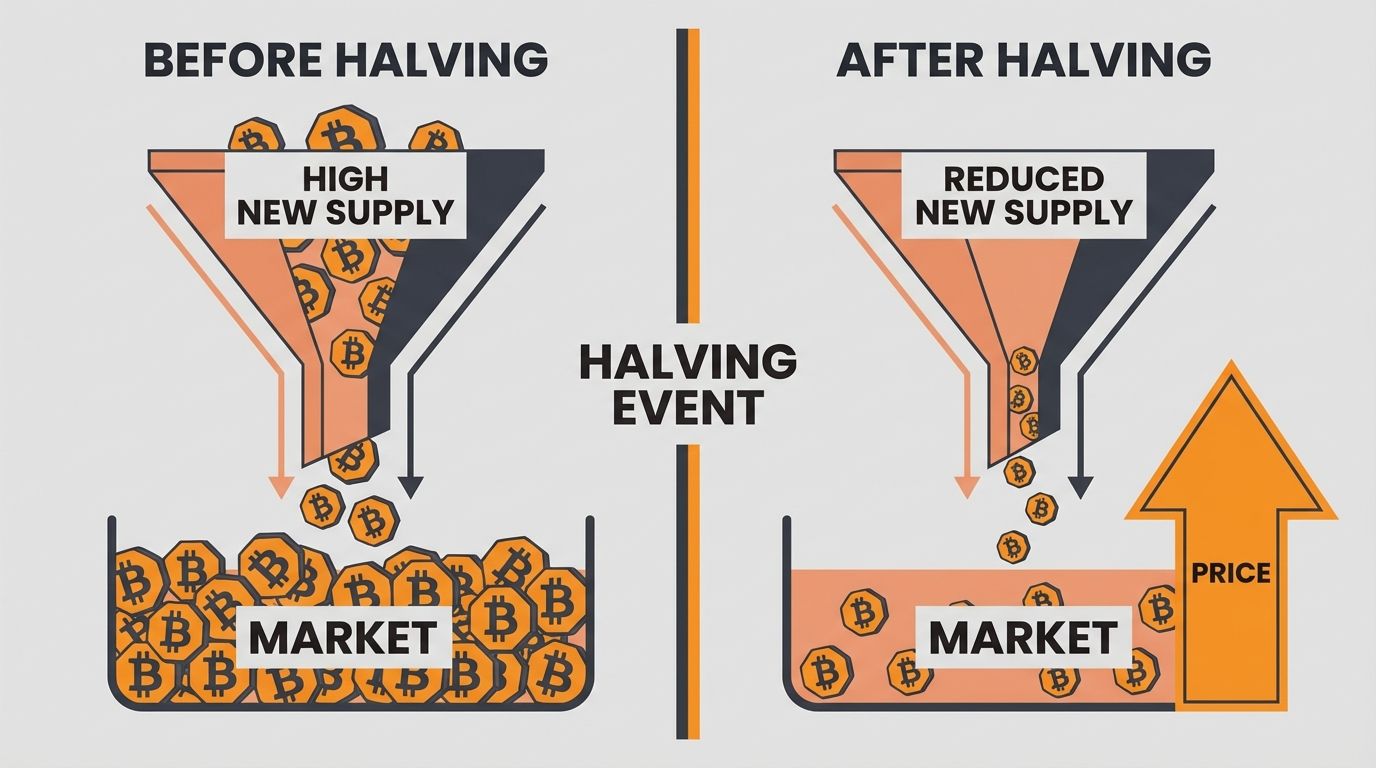
The core argument for why bitcoin halving drives price upward is rooted in supply and demand economics. When the rate of new Bitcoin entering the market is cut in half, and assuming demand remains steady or increases, the price must rise to reach a new equilibrium. This is known as the supply shock theory, and it has been the dominant narrative in crypto markets for over a decade.
The stock-to-flow model, popularized by the analyst known as PlanB, formalizes this idea. It compares the existing stock of Bitcoin to the annual flow of newly mined coins. After each halving, the stock-to-flow ratio doubles, making Bitcoin increasingly comparable to gold in terms of scarcity. While the model has faced criticism for over-precision, it remains a widely cited framework among Bitcoin investors.
- Supply shock: Miners suddenly earn half as much BTC per block, reducing the daily amount of new coins entering the market.
- Miner selling pressure: Miners typically sell a portion of their rewards to cover operating costs. After the halving, they sell less, reducing constant selling pressure on exchanges.
- Narrative momentum: The halving generates significant media attention and retail interest, which itself can drive demand.
- Institutional anticipation: Large funds often build positions in the months leading up to a halving, creating a "buy the anticipation" effect.
- Reflexivity: Higher prices attract more buyers, which pushes prices higher, creating self-reinforcing cycles.
It is important to note that the relationship between halvings and price is not instantaneous. Historically, the biggest gains have arrived six to eighteen months after the halving, not on the day itself. This delayed response likely reflects the time it takes for reduced supply to translate into visible market scarcity.
5. How Bitcoin Halving Affects Miners
Note: Post-halving Bitcoin economics now interact with the emerging BTCfi narrative, where protocols like Babylon enable BTC holders to earn yield through native staking rather than wrapped variants.
While investors focus on the price implications of the halving, miners face the most direct and immediate impact. A miner's revenue is calculated by multiplying the block reward by the price of Bitcoin. When the reward is halved, a miner earns half as many coins per block. If the price does not increase to compensate, mining becomes significantly less profitable, or even unprofitable for miners with high operating costs.
This dynamic creates a natural selection event in the mining industry. The 2026 cycle has added a new survival strategy beyond raw efficiency: the Bitcoin miners AI pivot, where major operators repurpose part of their compute capacity for AI infrastructure rental to diversify revenue. Efficient miners with access to cheap electricity and modern hardware can weather the reduced reward. Less efficient operations, particularly those running older machines or paying high energy costs, are forced to shut down, at least temporarily. When miners shut down, the network's total computing power (hash rate) drops, which triggers a downward difficulty adjustment, making it easier and more profitable for remaining miners.
- Revenue compression: Miners earning 3.125 BTC per block after the 2024 halving earn half what they did before April 2024.
- Hash rate volatility: Hash rate often dips in the weeks following a halving as unprofitable miners go offline.
- Difficulty adjustment: Bitcoin's protocol automatically recalibrates mining difficulty roughly every two weeks to maintain the 10-minute block target.
- Transaction fees: As block rewards shrink over time, transaction fees become an increasingly important source of revenue for miners.
- Long-term sustainability: Bitcoin's security model relies on miners remaining profitable enough to keep the network secure, which is why the price must eventually catch up to the reduced supply.
For traders, monitoring miner health metrics such as hash rate trends, miner outflows to exchanges, and miner revenue data can provide early signals about market stress or strength around halving events.
6. How to Trade Around the Bitcoin Halving Cycle
Understanding the halving cycle is one thing. Translating it into a trading strategy requires discipline, the right tools, and a clear framework. The halving does not guarantee profits, and markets are increasingly efficient at pricing in known events. That said, the cycle still produces identifiable patterns that informed traders can work with.
Pre-halving accumulation is the most widely discussed strategy. Historically, Bitcoin tends to trend upward in the six to twelve months before a halving as anticipation builds. After the halving, there is often a period of consolidation before the main bull phase begins. Recognizing these phases and using tools to manage entries, exits, and risk is critical.
- Define your cycle phase: Use on-chain data to determine whether the market is in accumulation, markup, distribution, or markdown.
- Set price alerts: Monitor key resistance and support levels that align with historical cycle patterns.
- Use stop-losses: Even in a bull cycle, Bitcoin regularly corrects 20 to 40% during its uptrend. Protecting capital is essential.
- Diversify within crypto: Altcoins often outperform Bitcoin later in the cycle. A portfolio approach can capture broader market gains.
- Avoid over-leveraging: High leverage during volatile halving periods can wipe out positions on temporary dips.
- Track miner signals: Miner capitulation events, where hash rate drops sharply, have historically marked cycle bottoms.
Managing multiple assets across different exchanges while following complex cycle signals is extremely difficult without proper tooling. This is where a dedicated crypto trading platform becomes invaluable.
Trade Smarter Through Every Bitcoin Halving Cycle with Altrady
Bitcoin halving cycles create some of the most significant trading opportunities in the crypto market, but capturing those opportunities requires more than just knowing the theory. You need a platform that gives you real-time data, powerful automation, and portfolio management tools that work across every major exchange.
Altrady is built exactly for this. With Altrady, you can set automated price alerts keyed to halving cycle milestones, run bots that execute your strategy around the clock, and manage your entire crypto portfolio from a single dashboard, whether you are holding through the accumulation phase or actively trading the markup. The platform supports grid bots, signal bots, and SMART orders that help you stay disciplined when markets get volatile.
Ready to trade the next phase of the Bitcoin halving cycle with a real edge? Start your free trial with Altrady today and see why thousands of crypto traders trust it to manage their portfolios through every market cycle.
Frequently Asked Questions About Bitcoin Halving
What happens to Bitcoin's price after the halving?
Historically, Bitcoin's price has increased significantly in the 12 to 18 months following each halving. However, the gains are not immediate. There is typically a period of consolidation after the halving before the main bull phase begins. The 2012 halving was followed by a gain of over 8,000%, the 2016 halving preceded a 3,000% gain, and the 2020 halving was followed by a gain of over 700% before the cycle peaked. The 2024 halving has already seen Bitcoin break above $100,000 for the first time.
How often does Bitcoin halving happen?
Bitcoin halving occurs every 210,000 blocks. Since blocks are mined approximately every 10 minutes, this works out to roughly once every four years. The exact date cannot be predicted precisely because the actual time between blocks varies slightly, but the block-based trigger makes the schedule highly predictable well in advance.
Will Bitcoin halvings continue forever?
No. Bitcoin halvings will continue until all 21 million coins have been mined, which is projected to happen around the year 2140. After that point, miners will earn no block reward and will rely entirely on transaction fees for their revenue. There are approximately 33 halvings scheduled in total before the supply is fully exhausted.
Does the halving affect altcoins?
Yes, indirectly. Bitcoin tends to set the tone for the entire cryptocurrency market. When Bitcoin rallies after a halving, it often pulls the broader market up with it. Historically, the altcoin market has tended to outperform Bitcoin later in the cycle, once Bitcoin has already established a new all-time high. This pattern is sometimes called "altcoin season" and represents a rotation of capital from Bitcoin into smaller cap assets.
Is the bitcoin halving already priced in by the market?
This is a common debate in the crypto community. The efficient market hypothesis suggests that any known future event should already be reflected in the current price. However, the repeated post-halving bull runs suggest that the market does not fully price in the effects of reduced supply in advance. This may be because the real-world impact on miner selling pressure, combined with narrative-driven retail demand, creates effects that unfold over months rather than being front-run entirely before the event.