
In early 2020, MicroStrategy made the first major corporate bitcoin purchase: $250 million worth of BTC for its treasury reserve. By May 2026, the corporate crypto treasury category has grown into one of the most significant institutional buy programs in the market. Strategy (the rebranded MicroStrategy) holds 600,000+ BTC. Ethereum treasury company Bitmine Immersion holds 5.078 million ETH, roughly 4.21% of total circulating supply, after a recent $241 million purchase. Dozens of smaller companies have followed the playbook.
The corporate treasury narrative is one of the most important market dynamics of 2025-2026. Treasury companies are buying crypto at a pace that often exceeds new issuance, creating structural demand that did not exist in earlier cycles.
This guide explains what bitcoin treasury companies are, the strategies they use, the leading examples in 2026, the risks of the model, and how traders can use treasury company flows as part of broader market analysis.
What Is a Bitcoin Treasury Company?
A bitcoin treasury company (also called a crypto treasury company) is a publicly traded or private company that uses corporate balance sheet capacity to accumulate bitcoin or other cryptocurrencies as a strategic reserve asset.
The model has several variations.
Type 1: Operating company with crypto reserve. The company has a real underlying business (software, services, manufacturing) and holds crypto as a portion of its treasury. Strategy (formerly MicroStrategy) is the prototype: its underlying business is enterprise software, but the bitcoin reserve dominates investor attention.
Type 2: Pure-play crypto holding company. The company exists primarily to acquire and hold crypto. Operating cash flows are minimal or zero. Investors buy the stock as a leveraged proxy for the underlying crypto. Several smaller bitcoin treasury companies follow this model.
Type 3: Crypto-native operating company. Crypto exchanges, miners, and infrastructure companies hold significant crypto on balance sheet as a consequence of operations. They are not "treasury companies" in the strict sense but contribute to overall corporate holdings.
Type 4: Token-specific treasury companies. Companies like Bitmine Immersion focus on ethereum rather than bitcoin. Newer entrants are positioning around solana, sui, or other large-cap tokens.
Why Treasury Companies Matter in 2026
Three forces drive the narrative.
First, the model produces structural buying demand. Strategy buys bitcoin every quarter. Bitmine buys ethereum every quarter. The dozens of smaller treasury companies follow similar patterns. Cumulative buying often exceeds new token issuance, creating supply-demand imbalance that supports prices.
Second, the model provides retail and institutional investors with leveraged exposure to crypto through public stock markets. Investors who cannot or do not want to hold crypto directly can buy treasury company shares. The shares trade as leveraged proxies for the underlying crypto, often with significant premium to net asset value.
Third, the model has produced extraordinary returns. Strategy's stock has compounded at rates that have made early shareholders multi-millionaires. The visible success has encouraged dozens of imitators, creating a cohort effect.
For traders, treasury company flows are now a significant component of market analysis. Quarterly buying announcements, equity raises, and convertible debt issuances all signal future buying that affects market dynamics.
The Three Treasury Company Playbooks
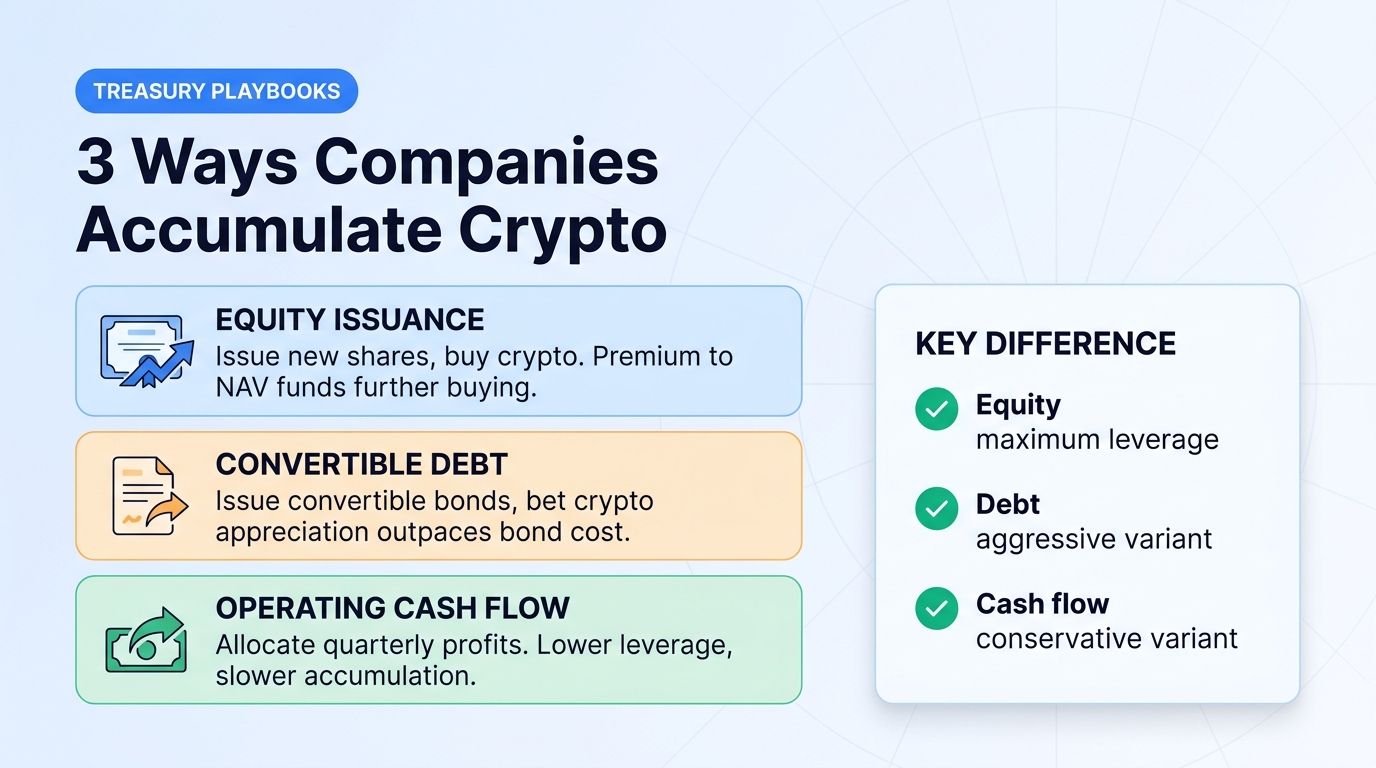
Playbook 1: Equity Issuance to Buy Crypto
The original Strategy playbook. The company issues new shares (or uses existing capital) to buy crypto. Bitcoin holdings per share grows over time as the company buys more. The stock trades at a premium to net asset value, which provides accretive capital for additional buying.
This playbook works when: - The stock trades at premium to NAV - Equity markets are receptive to new issuance - Underlying crypto thesis remains compelling
The risks emerge when premium compresses or when broader equity markets sour on crypto exposure.
Playbook 2: Convertible Debt for Crypto
A more aggressive variation. The company issues convertible bonds, uses the proceeds to buy crypto, and anticipates that crypto appreciation will exceed the bond's interest cost and dilution from eventual conversion. Strategy has issued multiple convertible bonds totaling billions of dollars.
This playbook works when: - Crypto appreciation outpaces the bond's effective cost (typically 4-8% all-in) - The company can refinance bonds at maturity if needed - Bondholders accept dilution at conversion
The risks include forced selling if bonds mature during crypto bear markets and dilution to common shareholders.
Playbook 3: Operating Cash Flow Reinvestment
A more conservative variation. The company allocates a portion of operating profits each quarter to crypto purchases. Cash flow funds the buying, so there is no equity dilution or debt obligation. This model has lower leverage but slower accumulation.
This playbook works when: - The underlying operating business is profitable and stable - Management has long-term conviction in crypto - Board and shareholders accept slower accumulation
Many smaller treasury companies follow this model.
The Leading Treasury Companies in 2026
Strategy (formerly MicroStrategy)
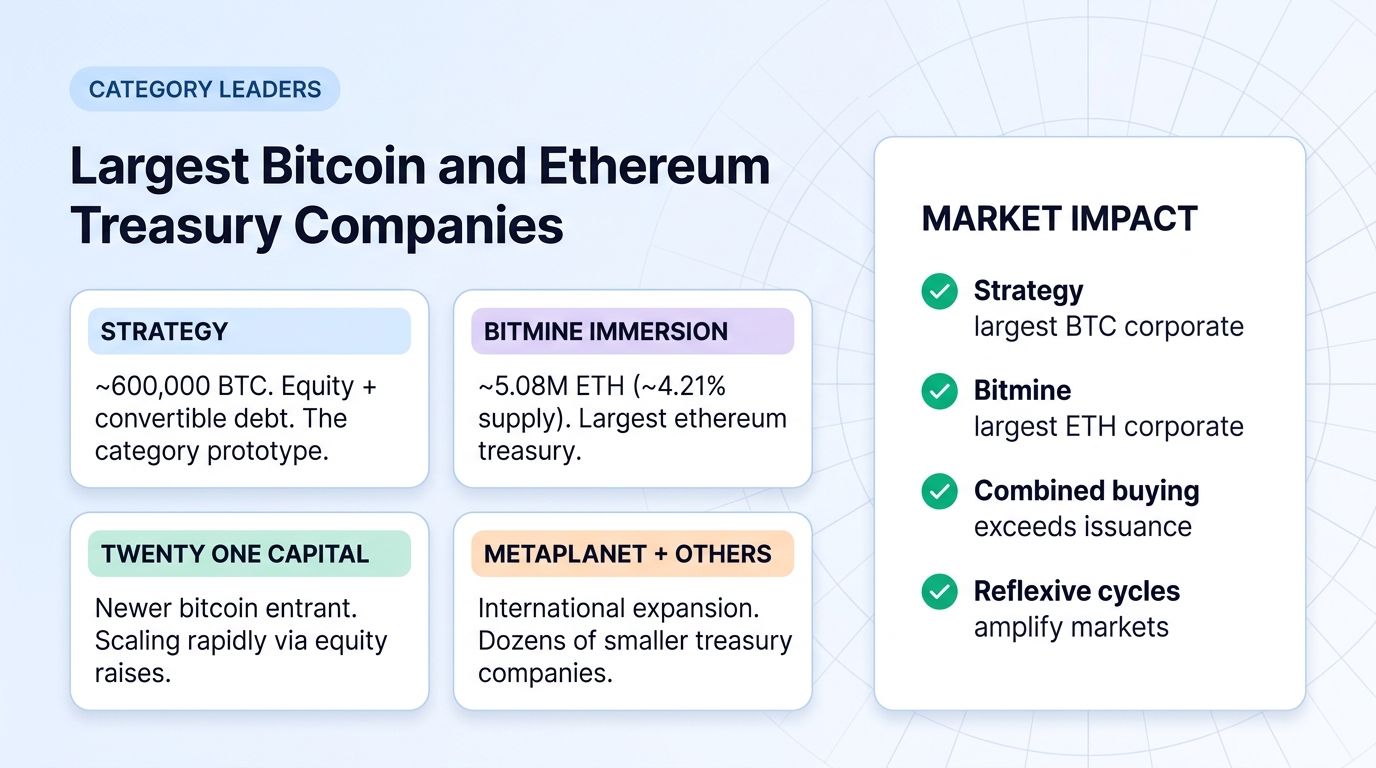
The category leader. By May 2026, Strategy holds approximately 600,000 BTC, making it the largest corporate bitcoin holder. The company has used both equity and convertible debt to fund acquisitions. Strategy's stock has been one of the best-performing publicly traded equities of the 2020s, with multi-thousand-percent returns since the original 2020 announcement.
Strategy's quarterly bitcoin buying announcements move markets. Its convertible bond issuances are watched by institutional investors as proxies for institutional crypto demand.
Bitmine Immersion Technologies
The largest ethereum treasury company. By May 2026, Bitmine holds approximately 5.078 million ETH (~4.21% of total supply) after a recent $241 million purchase that added 101,901 ETH. The company has positioned itself as the ethereum equivalent of Strategy.
Bitmine's buying has been particularly significant for ethereum's supply dynamics. The company's holdings combined with other large ETH treasuries reduces effective circulating supply.
Twenty One Capital (formerly Twenty One Capital LLC)
A newer entrant focused on bitcoin treasury accumulation. The company is positioning to scale rapidly through a combination of equity raises and partnership deals. By May 2026, it holds tens of thousands of BTC and is targeting hundreds of thousands.
Block (formerly Square)
A diversified payments and crypto operating company. Block holds bitcoin on its balance sheet but is not a pure-play treasury company. Its bitcoin holdings are large but represent a smaller fraction of total balance sheet than Strategy or Bitmine.
Tesla
Tesla still holds bitcoin on balance sheet from its 2021 purchases, though it has trimmed positions periodically. Tesla is not actively accumulating but remains a major corporate holder.
Smaller and International Treasury Companies
Dozens of smaller treasury companies (Metaplanet in Japan, Semler Scientific in the US, multiple European entities) follow variations of the playbook. Cumulatively, these smaller holders represent significant additional demand.
How Treasury Companies Affect Markets
Three observable effects.
Effect 1: Structural buying pressure. When Strategy buys $1-2 billion of bitcoin in a quarter, that buying must be sourced from sellers. The cumulative effect of all treasury companies often exceeds new bitcoin issuance (currently ~3 BTC per block), producing net supply absorption.
Effect 2: Equity market signaling. Treasury company stock prices and capital-raising announcements signal institutional appetite for crypto exposure. Strong demand for Strategy convertible bonds indicates institutional capital flowing into crypto-adjacent investments.
Effect 3: Reflexive narrative reinforcement. As treasury company stocks rise, they attract more capital, which funds more crypto buying, which supports crypto prices, which lifts treasury company stocks. The reflexive loop can produce powerful upside in bull markets and matching downside in bear markets.
How Traders Can Use Treasury Company Flows
Three practical applications.
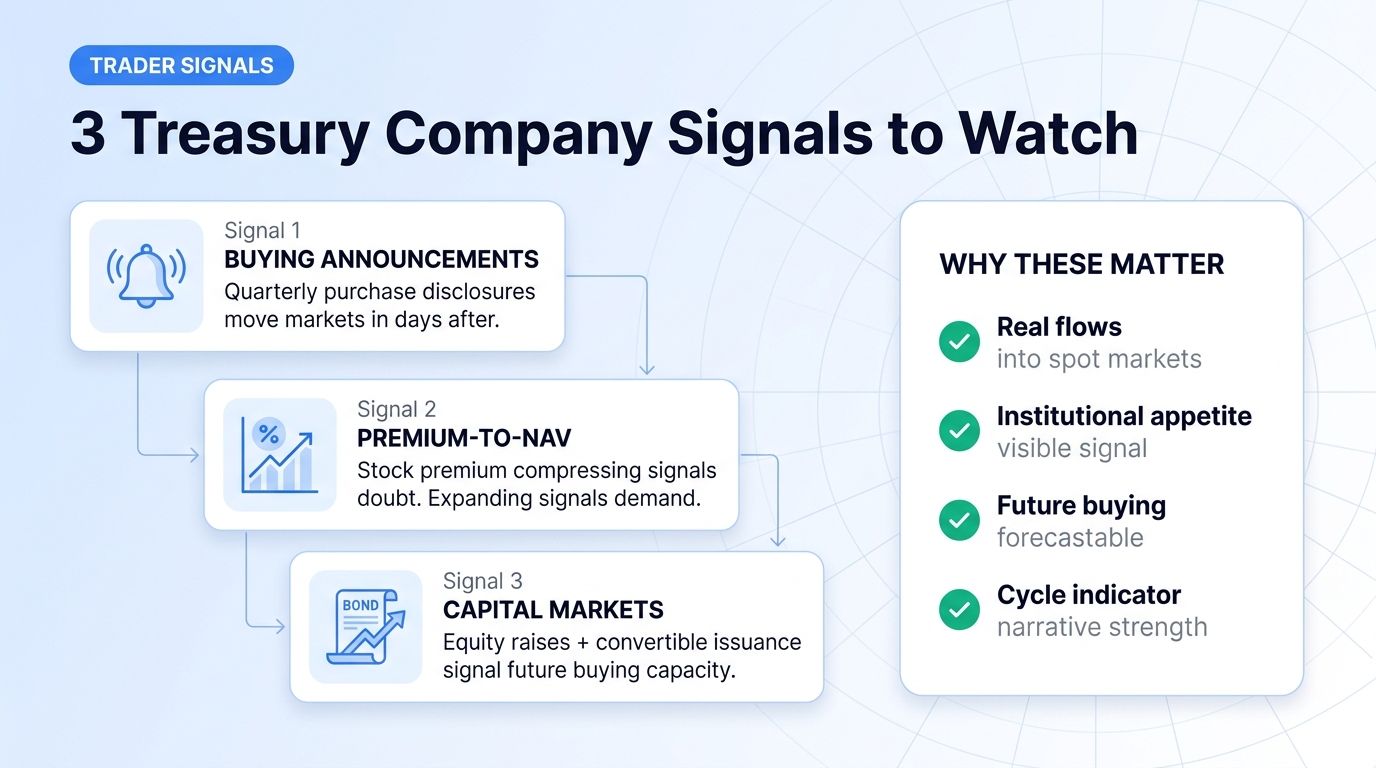
Watching for Buying Announcements
Treasury companies typically announce quarterly purchases. The announcements can move markets in the days following. Traders following treasury company news flows can position for the buying impact.
Tracking Premium-to-NAV
Treasury company stock prices typically trade at premium to net asset value (the dollar value of the underlying crypto per share). When premium compresses (e.g., from 50% to 10%), it often signals investor doubt about future accumulation. When premium expands, it signals strong demand.
Monitoring Capital Markets Activity
Equity raises, convertible bond issuances, and other capital-markets transactions by treasury companies signal future buying capacity. A successful $1 billion equity raise typically translates into $1 billion of crypto buying over the following months.
For traders managing positions on multiple exchanges, the ability to track and respond to treasury company news quickly is valuable. A unified portfolio platform like Altrady (19+ exchanges supported) allows positions to be adjusted across venues as news emerges.
The Risks of the Treasury Company Model
Volatility risk. Treasury companies are leveraged crypto exposure. When bitcoin or ethereum drops 30-40%, treasury company stocks often drop 50-70%. The leverage works in both directions.
Forced selling risk. Companies that borrowed against bitcoin (convertible bonds, term loans) may face forced selling if covenants are breached during crypto bear markets. The 2022 bear market produced several near-misses among smaller treasury companies.
Premium compression risk. Treasury company stock premiums to NAV can compress rapidly. A stock trading at 200% of NAV can re-rate to 110% of NAV in months, producing significant equity losses even if the underlying crypto holdings are flat.
Concentration risk. Many treasury companies hold one asset class (bitcoin or ethereum) with significant concentration. Drawdowns in the underlying asset are not diversified.
Regulatory and accounting risk. Crypto accounting rules evolve. New rules can affect how holdings are valued and reported, sometimes producing forced markdowns that affect equity prices.
Founder or CEO concentration. Several treasury companies are closely associated with charismatic CEOs (Michael Saylor at Strategy is the prototype). Founder departure, scandal, or health events create equity risk that does not exist for diversified companies.
How to Get Exposure to the Treasury Company Theme
Three paths.
Path 1: Direct ownership of treasury company stocks. Buy Strategy, Bitmine Immersion, Twenty One Capital, or similar stocks. This provides leveraged exposure to underlying crypto with the additional risk and reward of premium-to-NAV dynamics.
Path 2: Treasury-company-themed ETFs. Several ETFs aggregate treasury company exposure. These provide diversified exposure to the theme without single-stock concentration. The expense ratios are typically higher than broad market ETFs.
Path 3: Direct crypto holding plus selective stock exposure. Hold the underlying crypto directly while taking smaller positions in selected treasury company stocks. This balances direct exposure with leverage. The crypto can be managed across exchanges using a platform like Altrady, which connects to 19+ exchanges with automated bots (signal, grid, DCA) for active strategies.
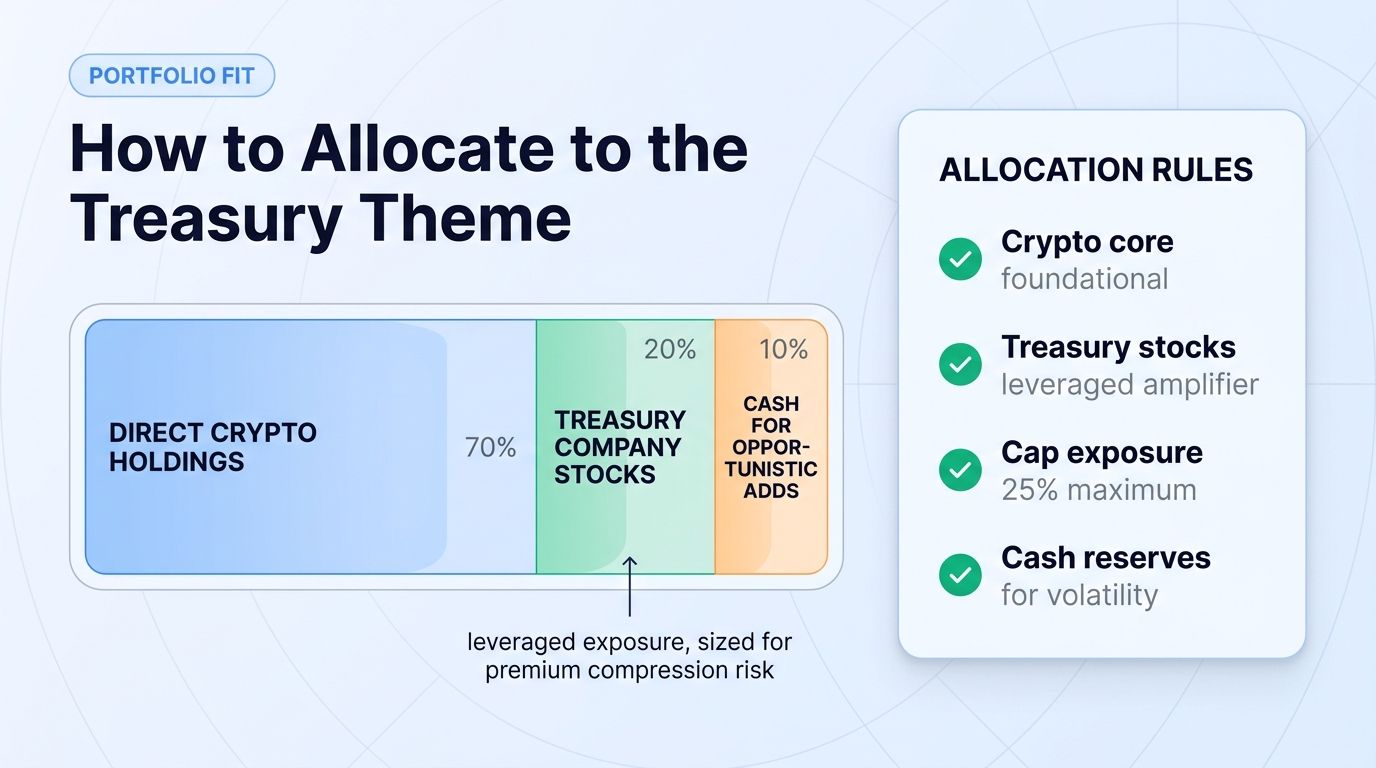
How Treasury Company Exposure Fits Into a Portfolio
A practical framework:
- Direct crypto holdings: 60-80% of crypto allocation. Foundational exposure to the underlying assets.
- Treasury company stocks: 10-25% of crypto allocation. Leveraged exposure to the same thesis with additional return potential and risk.
- Treasury company convertible bonds (institutional): For sophisticated investors, convertible bonds provide hybrid debt/equity exposure with bond floor.
- Cash for opportunistic adds: 5-15% in liquid stables for opportunistic buying during volatility.
Total treasury-company-stock allocation rarely exceeds 25% of crypto allocation for most investors due to the leveraged dynamics and premium compression risks.
FAQ
Is Strategy still a good buy in 2026?
Strategy remains the category leader and the most-watched treasury company. Whether it is a good buy at any given price depends on the premium-to-NAV and your view on future bitcoin appreciation. Premiums have historically compressed during bear markets and expanded during bull markets. Sizing discipline matters more than the entry decision.
How does Bitmine Immersion compare to Strategy?
Bitmine focuses on ethereum rather than bitcoin. The two stocks provide different underlying exposure. Both are leveraged plays on their respective tokens, but ethereum and bitcoin have different price dynamics, so the stocks do not move in lockstep.
Can a small company become a treasury company?
Yes. Any public company can adopt a crypto treasury strategy with board approval. Dozens of smaller companies have done so in 2024-2026. The challenge for smaller companies is access to capital markets and convincing public investors that the strategy is durable.
What happens to treasury companies in a crypto bear market?
Treasury company stocks typically fall more than the underlying crypto due to premium compression and leverage. Companies that issued convertible debt face forced selling pressure if covenants are breached. Diversified treasury companies with strong operating cash flows weather bear markets better than pure-play accumulators.
Can I trade these crypto positions on Altrady?
Yes. Altrady connects to 19+ exchanges where you can hold and trade bitcoin, ethereum, and other major cryptocurrencies. The treasury company stocks themselves trade on traditional equity exchanges (NASDAQ, NYSE), so they are not on Altrady. But you can manage the underlying crypto positions across exchanges, run automated strategies via the signal bot, grid bot, or DCA bot, and use unified portfolio tracking.
Conclusion
Bitcoin and crypto treasury companies have emerged as one of the most important institutional buyer categories in the 2024-2026 market. The cumulative buying from Strategy, Bitmine Immersion, Twenty One Capital, and dozens of smaller treasury companies often exceeds new token issuance, producing structural demand that supports prices and amplifies cycles.
For traders, the treasury company theme provides three things: leveraged exposure through public stocks, a signal source for institutional capital flows, and a meaningful market dynamic to incorporate into broader strategy.
The model has risks. Premium compression, convertible debt mechanics, founder concentration, and crypto volatility all produce equity outcomes that diverge from the underlying asset. Sizing positions accordingly is critical.
The longer-term trajectory looks structural. Treasury companies provide one of the cleanest mechanisms for traditional equity capital to flow into crypto markets. As long as the underlying thesis (crypto as a treasury reserve asset) holds, the model will continue attracting new entrants and new capital.
For 2026 specifically, the combination of regulatory clarity (CLARITY Act expected July signing), institutional acceptance (FHFA crypto-as-asset directive), and continued treasury company accumulation positions the category for continued growth, with the standard caveats about cyclical volatility.