
The phrase "AI crypto" gets used loosely. Most projects with AI branding are wrappers around centralized APIs or marketing-heavy retail tokens. Bittensor is different. It is a working decentralized network where machine learning models compete, get scored, and earn rewards based on the value they produce.
By April 2026, Bittensor's native token TAO held a market capitalization between $3.2 and $3.4 billion, making it the largest pure-play decentralized AI project in crypto. The network supports 80+ specialized subnets, each focused on a different machine learning task. Real compute, real model output, real economic rewards.
This guide explains what Bittensor is, how the subnet architecture works, how TAO captures value, the realistic paths for investors and traders, and the specific risks that separate Bittensor from typical AI-themed crypto plays.
What Is Bittensor?
Bittensor is a decentralized protocol that incentivizes participants to produce useful machine learning. The network is built around two roles.
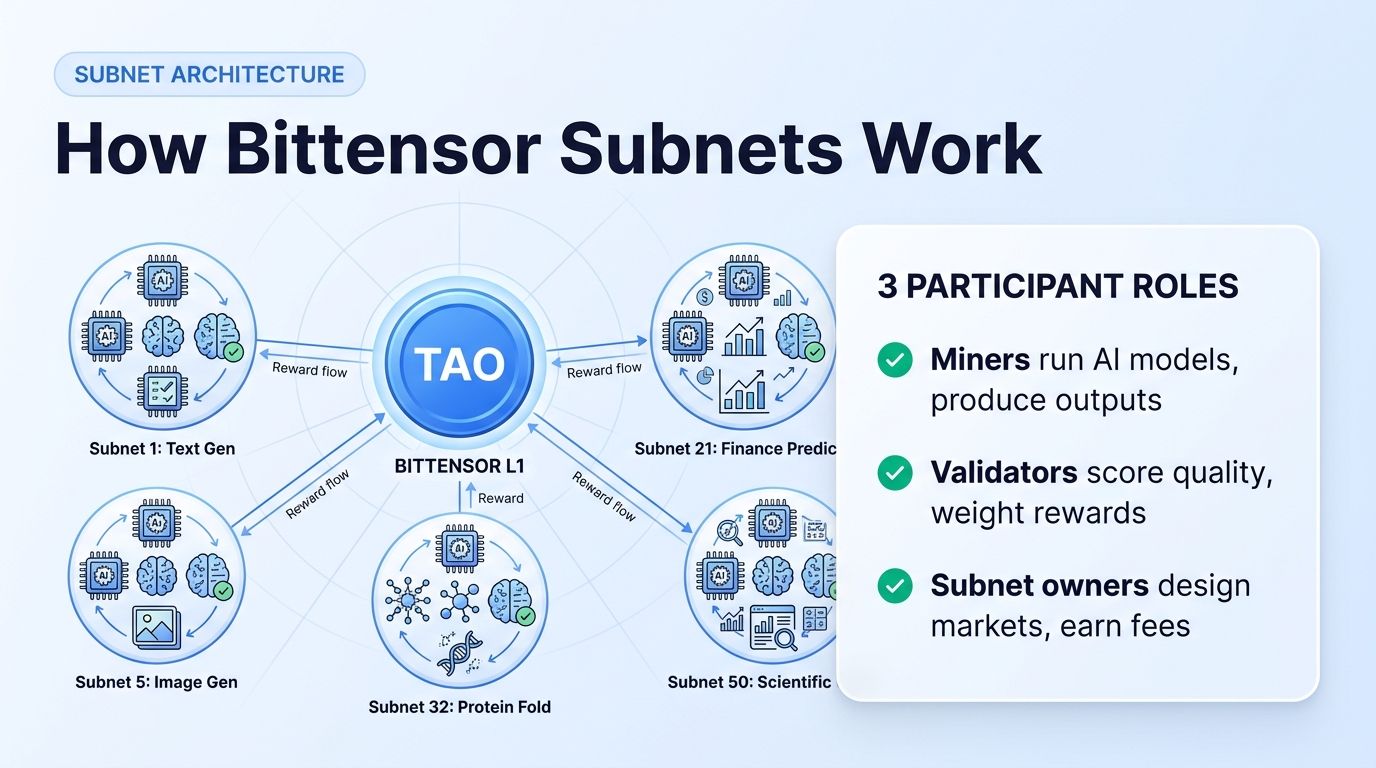
Miners run AI models and submit predictions, completions, or other outputs in response to queries. Different subnets focus on different model types: text generation, image synthesis, financial forecasting, protein folding, and others.
Validators evaluate the miner outputs and assign scores. Validators are weighted by their stake in TAO. The higher a validator's stake, the more influence they have over which miners get rewarded.
The protocol pays out TAO emissions every block, distributed across subnets based on their performance and importance. Within each subnet, rewards flow to the miners producing the best outputs, as scored by validators.
The result is a market for machine learning. Useful models earn more. Useless models earn less. Validators who score well also earn TAO. The economic incentive aligns the network toward producing real value.
Why Bittensor Matters in 2026
Three forces converged.
First, the AI buildout accelerated demand for distributed compute and inference. Centralized AI providers (OpenAI, Anthropic, Google) dominate large-model training, but inference, fine-tuning, and specialized tasks need geographically distributed, market-priced compute. Bittensor's network architecture fits this demand.
Second, regulatory pressure on centralized AI raised the value of decentralized alternatives. Concerns about AI safety, data privacy, and concentrated control made decentralized AI networks more attractive to certain users and use cases. Bittensor became the reference architecture for this thesis.
Third, the subnet model matured. Early Bittensor was monolithic, with all miners producing similar outputs. The subnet upgrade (Dynamic TAO, late 2024) let specialized subnets emerge, each focused on a specific machine learning task. By 2026, the network supported text, image, prediction markets, scientific compute, and dozens of other specializations.
TAO's price reflects this. From early 2024 lows, the token recovered through 2025-2026 to its current $3.2-3.4 billion market cap range, making it a serious component of the AI crypto category alongside Render, Akash, and the broader AI agent narrative.
The Subnet Architecture
Subnets are the core innovation of Bittensor 2.0.
How Subnets Work
Each subnet is a specialized market for one machine learning task. Subnet 1 might focus on text generation. Subnet 5 might focus on image synthesis. Subnet 21 might focus on financial prediction. The full list includes 80+ active subnets by 2026.
Within each subnet: - Miners stake compute and TAO to participate - Miners submit outputs in response to queries from the subnet's specific task - Validators score outputs based on quality - Top-scoring miners earn the bulk of that subnet's TAO emissions
Subnet Emissions and Dynamic TAO
Total TAO emissions per block are fixed. The protocol distributes emissions across subnets based on their performance and demand. Subnets that produce more value (more queries, higher-quality outputs, more user demand) receive more emissions.
Subnet owners (the team that created the subnet) earn a portion of emissions. This creates an incentive to build subnets that actually solve real problems, not just spin up empty markets.
Subnet Tokens (Alpha Tokens)
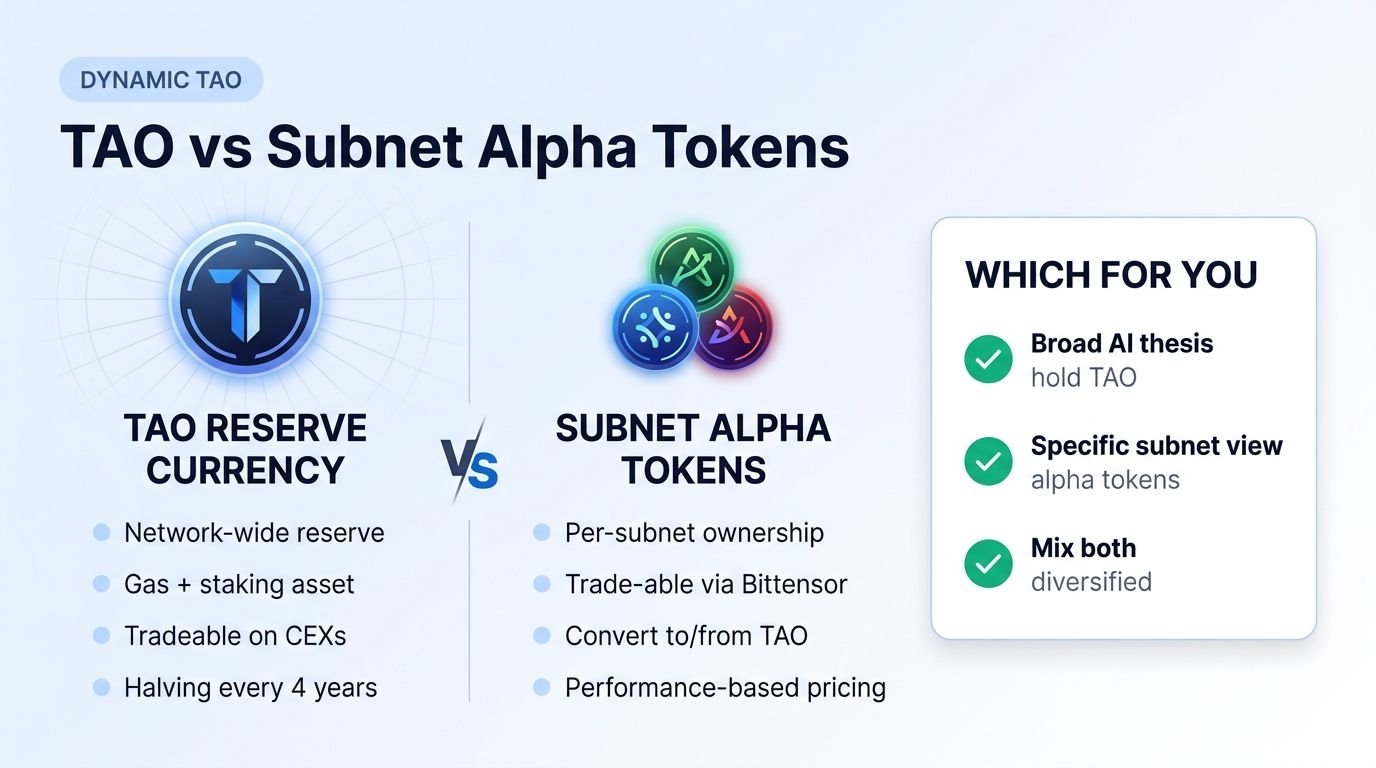
With Dynamic TAO, each subnet has its own alpha token. The alpha token represents staking and ownership in that specific subnet. TAO can be converted to alpha tokens (and back) at a rate determined by the subnet's relative performance.
This creates a meta-market: which subnets will outperform? Investors can express conviction on individual subnets by holding their alpha tokens, similar to investing in specific protocols within the broader Ethereum ecosystem.
How TAO Captures Value
Three economic flows.
Emissions to miners and validators. TAO is paid out as compensation for productive work. Miners earn for producing useful AI outputs. Validators earn for scoring quality. This is the largest single value flow in the network.
Demand for subnet alpha tokens. As more users want exposure to specific subnets, they buy alpha tokens, which requires converting TAO. This creates buy pressure on TAO indirectly.
Halving mechanics. Bittensor follows a Bitcoin-style halving schedule. TAO emissions halve every 4 years approximately. This creates supply scarcity over time, similar to Bitcoin's economic model.
The combination produces a token with real utility (must hold to stake, to validate, to participate) and real scarcity (capped supply, halving emissions). Whether this translates into long-term price appreciation depends on demand for the AI services Bittensor produces.
How Retail Traders Can Get TAO Exposure
Four paths, from simplest to most involved.
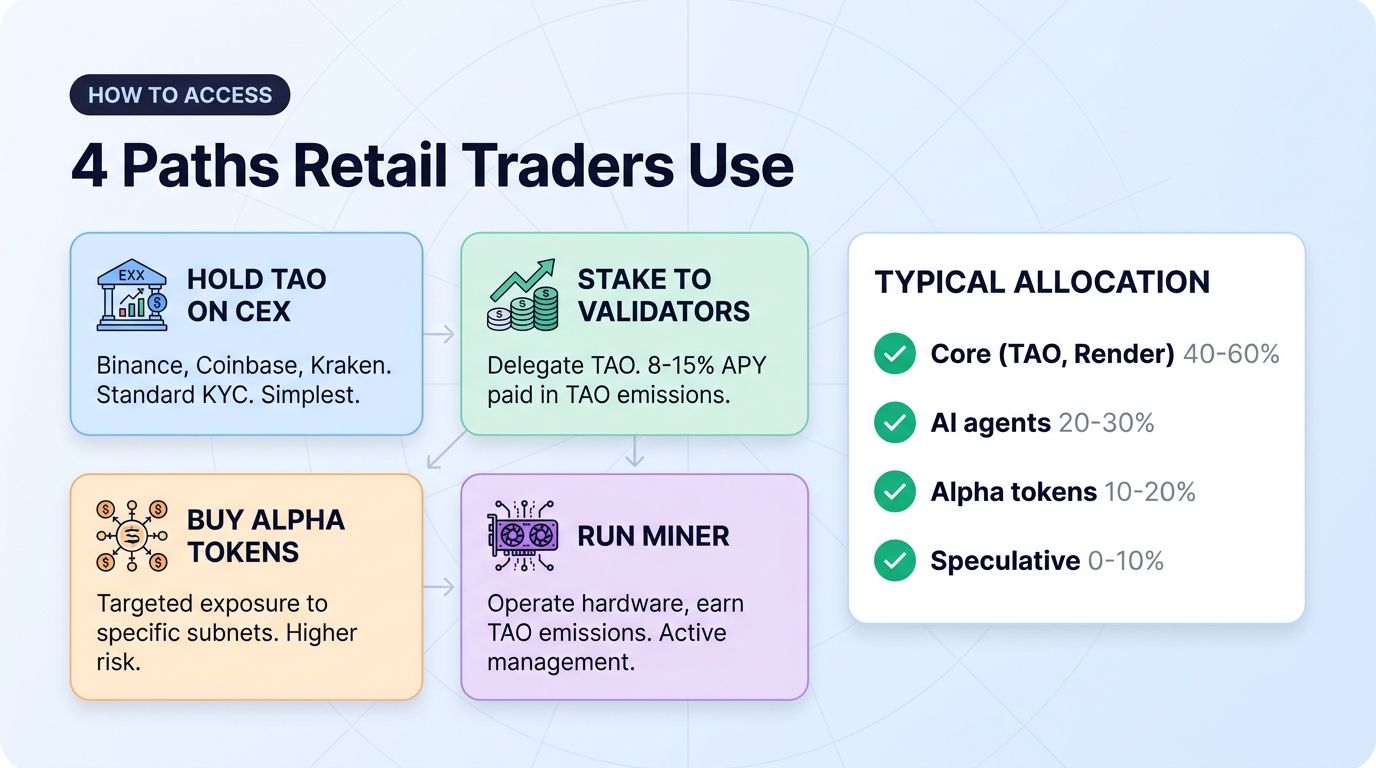
Path 1: Hold TAO on a centralized exchange. TAO trades on Binance, Coinbase, Kraken, KuCoin, Bybit, and most major exchanges. You buy with USDT, USDC, or fiat. This is the cleanest exposure to the broader Bittensor thesis. If you trade across multiple exchanges, a crypto trading platform like Altrady provides unified position management across 19+ exchanges including ones that list TAO.
Path 2: Stake TAO to validators. Holding TAO and delegating it to a validator earns you a portion of the validator's emissions. Yields typically range 8-15% APY depending on the validator and subnet performance. This requires using a Bittensor wallet (like the official Bittensor wallet or Tao Wallet).
Path 3: Buy alpha tokens for specific subnets. If you believe a specific subnet (e.g., text generation, financial prediction) will outperform, you can convert some TAO into that subnet's alpha token. This is higher-risk than holding TAO, since individual subnets can fail or be deprecated.
Path 4: Run a miner. Operating mining hardware (GPUs) in a Bittensor subnet earns TAO emissions directly. This requires technical knowledge, capital investment in GPUs ($5,000-50,000+), and active management. Returns vary widely by subnet and hardware. Most retail investors stay in Paths 1-3.
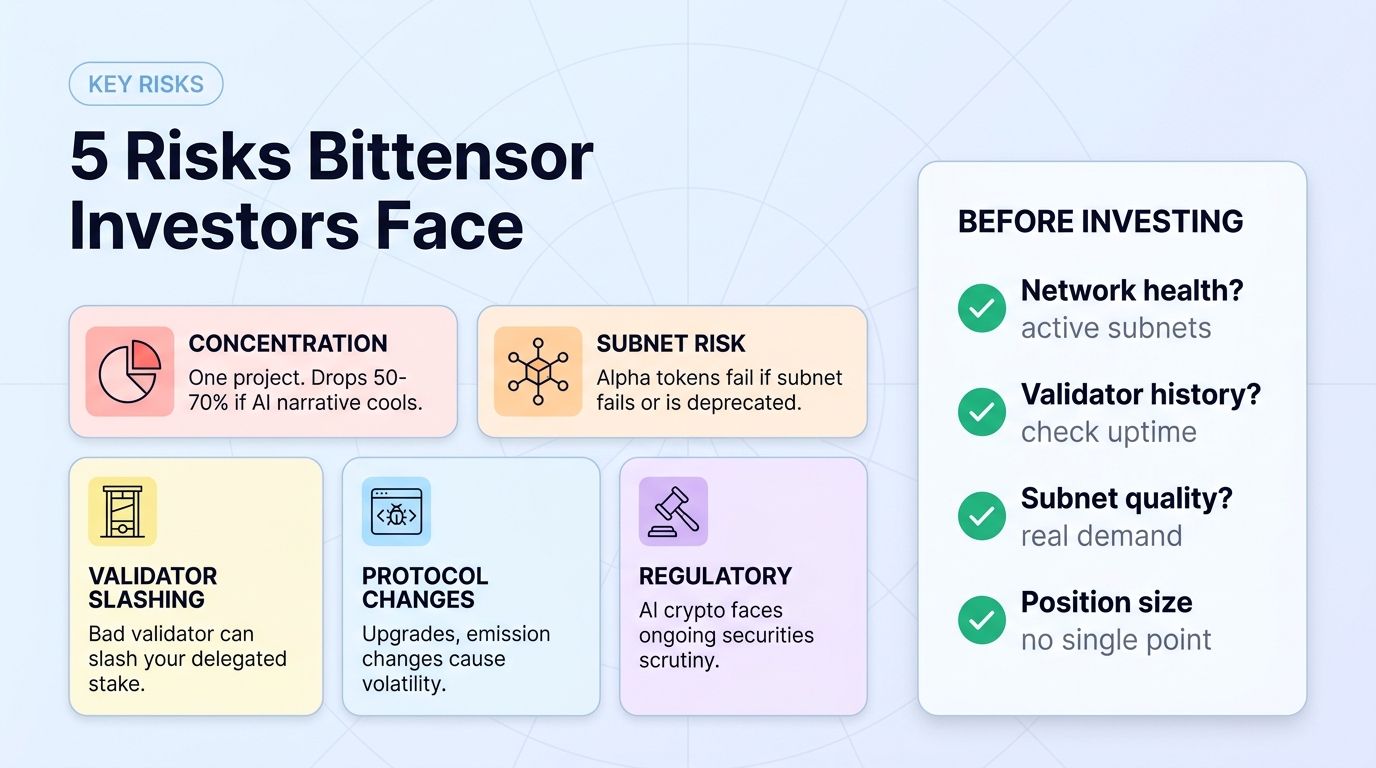
The Risks of Bittensor Investing
Concentration risk. Bittensor is one project. AI crypto as a category has high correlation. If the AI narrative cools, TAO can drop 50-70% from peak even without project-specific bad news.
Subnet risk. If you hold alpha tokens for a specific subnet, you concentrate on that subnet's performance. Subnets can fail, be deprecated, or simply underperform.
Validator and operator risk. When you stake TAO to a validator, you trust their honesty and uptime. A malicious validator can slash your stake. A poorly-managed validator can underperform and reduce your yield.
Smart contract and protocol risk. Bittensor is a complex protocol. Subnet upgrades, dynamic TAO mechanics, and emission schedules can change. Major upgrades have historically caused short-term volatility.
Regulatory risk. AI crypto, like all crypto, faces ongoing regulatory uncertainty. Tokens that closely resemble securities or that distribute network revenue could face additional scrutiny.
Centralization within decentralization. Despite the decentralized branding, some subnets are dominated by a few large miners or validators. Concentration metrics vary by subnet. Check the actual distribution before assuming a subnet is truly decentralized.
How Bittensor Fits Into a Crypto Portfolio
A framework that has emerged among narrative-aware traders:
- Core large-cap AI crypto (TAO, RNDR/Render): 40-60% of AI allocation. Largest tokens, most liquidity, multi-year operating history.
- AI agent tokens (Virtuals, ai16z, AIXBT): 20-30%. Different category from infrastructure but related narrative.
- Specific subnet alpha tokens: 10-20%. Targeted exposure to particular Bittensor subnets.
- Speculative new AI tokens: 0-10%. Sized for total loss tolerance.
Total AI crypto allocation typically runs 5-15% of a crypto portfolio for traders who want narrative exposure without overweighting one theme.
FAQ
Is Bittensor actually decentralized?
The network architecture is decentralized in principle. Miners and validators are distributed globally, anyone can participate, and no single entity controls the protocol. In practice, some subnets are dominated by a few large operators, and the foundation that develops the protocol has significant influence. It is more decentralized than centralized AI projects but less decentralized than Bitcoin.
What is the realistic ROI for staking TAO?
In 2026, typical staking yields run 8-15% APY when delegating to a competitive validator in a healthy subnet. This is paid in TAO emissions, so the dollar value depends on TAO price. Real-world after-fee yield is often 6-12% net.
How is Bittensor different from Render or Akash?
Render and Akash are GPU compute marketplaces. They provide raw hardware. Bittensor is an AI services market. It rewards specific machine learning outputs (predictions, completions, model performance), not just raw compute. The three projects are complementary: Render and Akash provide the underlying compute that Bittensor miners use to produce AI outputs.
What is the relationship between TAO and alpha tokens?
TAO is the network's reserve currency. Alpha tokens represent stake and ownership in specific subnets. You can convert TAO to alpha tokens at rates determined by subnet performance. Alpha tokens give you exposure to one subnet's success; TAO gives you exposure to the whole network.
Can I trade TAO on Altrady?
Yes. Bittensor's TAO token is listed on most major centralized exchanges including Binance, Coinbase, Kraken, KuCoin, and Bybit. Altrady connects to 19+ exchanges, so you can manage TAO positions alongside your other crypto holdings, run automated strategies via the signal bot, and view your full portfolio in one dashboard.
Conclusion
Bittensor is one of the few "AI crypto" projects with real architecture, real utility, and real value flowing through the network. With $3.2-3.4 billion in market cap, 80+ active subnets, and a multi-year operating history, it has earned its position as the reference decentralized AI project in crypto.
For traders, the practical takeaway is this: TAO is an exposure category for the broader AI crypto thesis, with specific upside if decentralized AI services capture demand from centralized providers. Hold TAO for the core thesis. Use staking for yield. Speculate on subnet alpha tokens if you have a specific view on which subnets will outperform. Size positions to a level where worst-case loss does not damage your overall portfolio.
The AI crypto narrative will continue through 2026 and likely beyond. Bittensor's position as the largest decentralized AI network gives it both the upside of category leadership and the risk of being the highest-profile target if the thesis disappoints.