
For three years, crypto traders in the United States operated under regulatory ambiguity. The SEC and CFTC fought over which agency had authority. Lawsuits against major exchanges produced contradictory rulings. Token classifications remained inconsistent across jurisdictions. By April 2026, that long stalemate finally began breaking.
The CLARITY Act is the United States' most significant crypto legislation in history. The Senate Banking Committee released its updated text in May 2026, and the bill now faces over 100 amendments before a critical vote. The White House has targeted July 4, 2026 as the signing date.
This guide explains what the CLARITY Act is, how it affects retail and institutional traders, the open questions still being debated, and the specific changes traders should prepare for as the bill moves through Senate debate.
What Is the CLARITY Act?
The Clarity for Lawful Application of Regulation to Investments and Transactions in Yield (CLARITY) Act is the Senate's framework for resolving the SEC versus CFTC jurisdictional dispute and providing clear rules for crypto market participants.
The bill does three structural things.
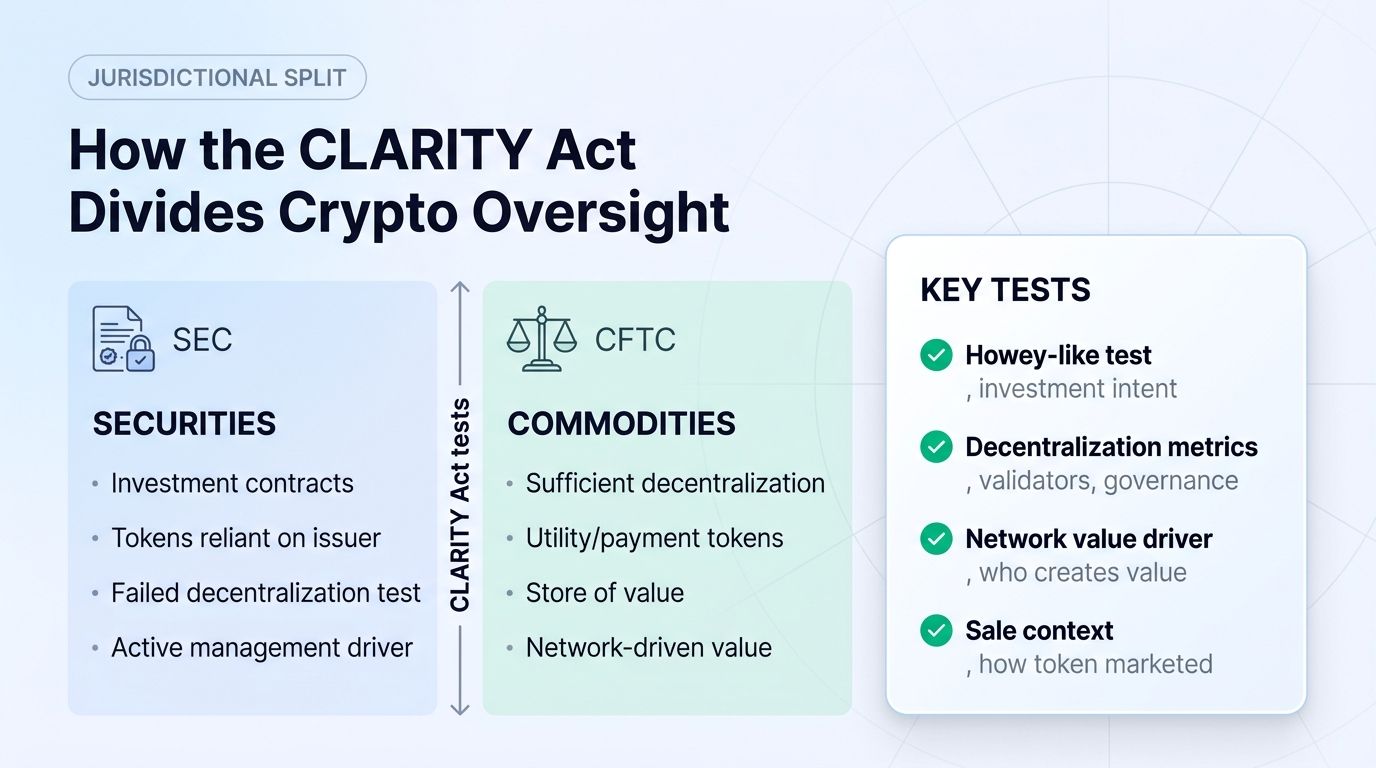
First, it splits jurisdiction between the two agencies based on token characteristics. Tokens that meet the bill's "investment contract" definition fall under SEC oversight as securities. Tokens that function as commodities or payment instruments fall under CFTC oversight. The bill provides specific tests for classification, removing much of the case-by-case ambiguity.
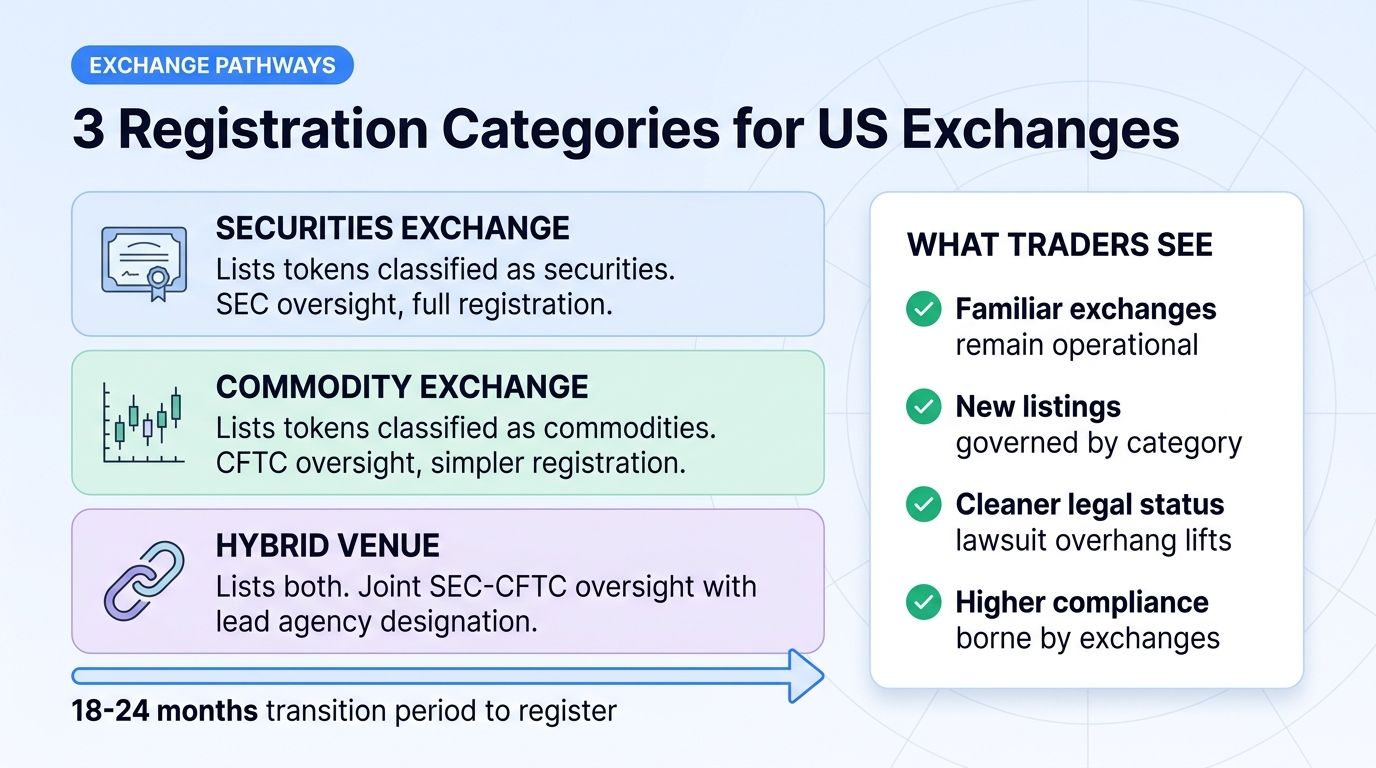
Second, it creates a federal registration pathway for crypto exchanges. Centralized exchanges operating in the US can register as either securities exchanges, commodity exchanges, or hybrid venues depending on which assets they list. The pathway formalizes what had been a patchwork of state money-transmitter licenses.
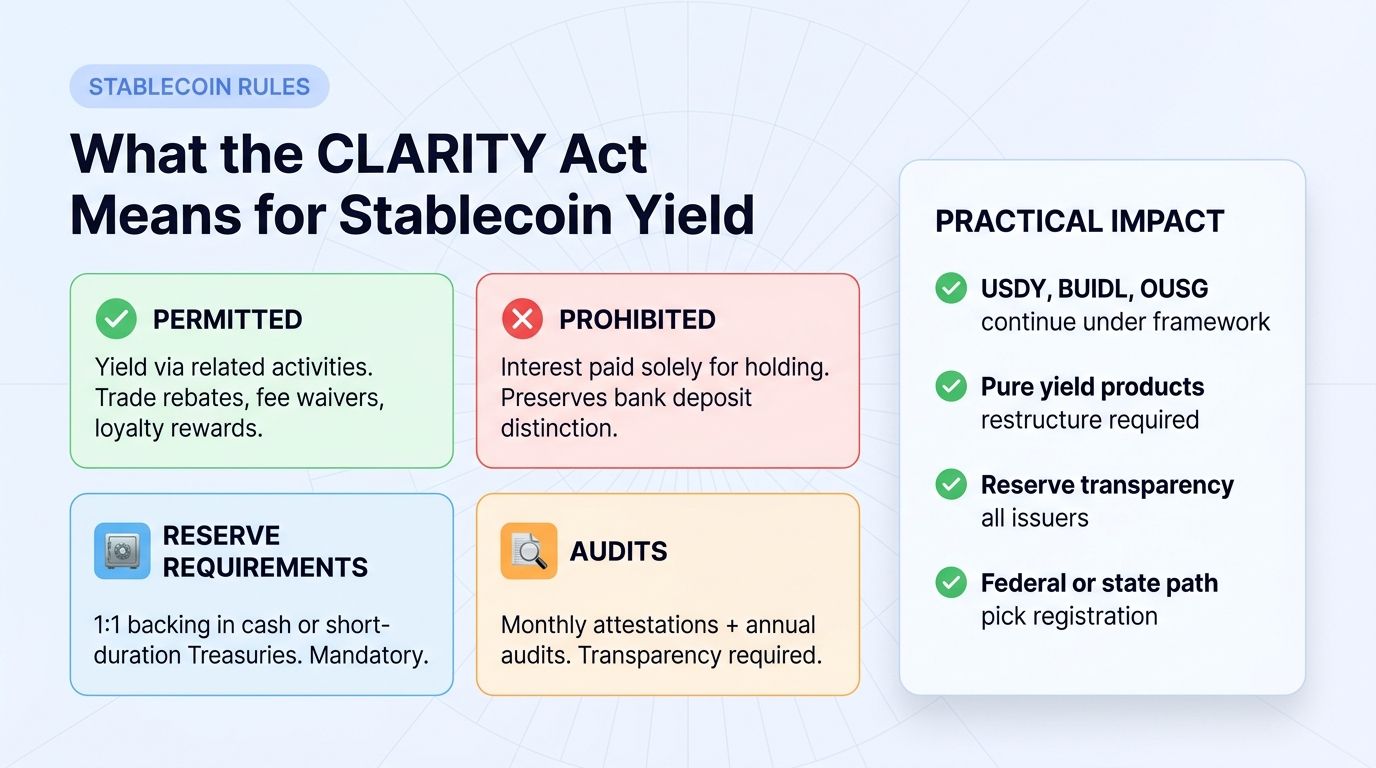
Third, it addresses yield-bearing stablecoins, which have been the most heated point of debate. The compromise allows issuers to share yield with users through related activities, but prohibits paying interest solely for holding a stablecoin balance.
Why the CLARITY Act Matters in 2026
Three forces converged to produce political momentum.
First, the 2024-2025 enforcement era produced expensive, inconsistent results. The SEC sued multiple exchanges, won some cases, lost others, and produced no coherent rulebook. Industry and lawmakers from both parties pushed for legislative resolution.
Second, the rise of yield-bearing stablecoins, prediction markets, and tokenized real-world assets created new product categories that did not fit cleanly into existing securities or commodities law. The CLARITY Act addresses each.
Third, institutional adoption accelerated. With 67 million Americans now holding crypto and major banks offering custody services, regulatory clarity became a precondition for further growth. The pressure on Congress reached a tipping point in early 2026.
For traders, the immediate impact is jurisdictional certainty. The lawsuit overhang against major US exchanges begins to lift. The specific token classifications determine which platforms can list which assets. And the registration pathway changes the competitive landscape for exchanges operating in the US.
The Three Pillars of the CLARITY Act
Pillar 1: Token Classification Tests
The bill provides explicit tests for classifying each token as a security, commodity, or hybrid.
A token is generally treated as a security if it represents an investment contract under the Howey test, particularly when: - The issuing entity continues to drive value through active management - Token holders rely on the entity for returns rather than network participation - Sales involve marketing as an investment
A token is generally treated as a commodity if it functions as: - A medium of exchange or store of value - A utility token whose value derives from network use - A payment or settlement asset on a sufficiently decentralized network
The bill includes a "sufficient decentralization" test. Once a network meets specific criteria for distributed validators, governance, and developer activity, the token is reclassified from security to commodity. This addresses one of the most-criticized gaps in current law.
Pillar 2: Exchange Registration
The bill creates three registration categories for crypto exchanges: - Securities exchanges: Trading platforms for tokens classified as securities. SEC oversight. - Commodity exchanges: Trading platforms for tokens classified as commodities. CFTC oversight. - Hybrid venues: Platforms listing both. Joint SEC-CFTC oversight with a lead agency designation.
Existing US-licensed exchanges are given a transition period (typically 18-24 months in the current draft) to register under the new framework. Foreign exchanges serving US customers are required to register before the transition deadline ends.
Pillar 3: Stablecoin Provisions
The yield-bearing stablecoin question produced the most amendments. The compromise text: - Permits issuers to share yield with users through related activities (e.g., trading rebates, fee waivers, loyalty rewards) - Prohibits paying interest solely for holding a stablecoin balance (preserving the bank-deposit distinction) - Requires reserve backing at 1:1 with cash or short-duration Treasuries - Mandates monthly attestations and annual audits
Stablecoin issuers are required to register under either federal or state pathways. Federal registration provides interstate operation. State registration limits operations to participating states.
The Open Debates
Several issues remain contested as the bill moves toward final vote.
Senator Warren's Amendments
Senator Warren leads a bloc of progressive amendments targeting consumer protection. Her proposals include: - Stricter capital requirements for stablecoin issuers - Limits on retail leverage on crypto derivatives - Enhanced disclosure rules for token sales - Restrictions on political donations from crypto industry actors
Approximately 40 of the 100+ amendments come from this bloc. Industry observers expect 5-10 to pass in some form.
DeFi Protocol Treatment
The bill is less clear on decentralized finance protocols than on centralized exchanges. Software developers who publish DeFi protocols are generally not considered "exchanges" under the bill, but front-end operators and liquidity providers may face registration depending on their role.
Privacy Coin Status
Privacy-preserving tokens (Monero, Zcash, Dash) face additional scrutiny. The bill does not ban them, but it creates higher KYC and reporting requirements for exchanges listing privacy coins, which may reduce their availability on US platforms.
How the CLARITY Act Affects Different Trader Types
Retail Spot Traders
For retail traders buying and selling crypto on US-licensed exchanges, the changes are mostly invisible. The exchanges handle the registration and compliance. The visible impact is which tokens get listed: assets that fail the sufficient-decentralization test may be delisted by some platforms or moved to securities-licensed venues.
Trading workflow does not fundamentally change. Spot purchases of Bitcoin, Ethereum, and most major tokens continue as before.
Derivatives and Leveraged Traders
The CFTC's expanded role over commodities-classified tokens means more leveraged products are available through US-registered venues. Perpetual futures, options, and structured products may launch on more platforms once the bill passes.
Senator Warren's leverage restrictions, if they pass, would cap retail leverage at lower levels than currently available on offshore venues. This could push some leveraged trading offshore.
Yield-Seeking Traders
Yield-bearing stablecoin holders see the most direct impact. Products that paid interest for holding (like some offshore tokenized yields) need to restructure. Yield sharing through related activities remains permitted, so most yield-bearing products will adapt rather than disappear.
Tokenized Treasuries (USDY, BUIDL, OUSG) are explicitly accommodated in the bill and continue to operate.
Institutional and Treasury Holders
For institutions holding crypto on their balance sheets, the CLARITY Act provides legal certainty for custody, accounting, and reporting. This unlocks additional institutional adoption that had been waiting for regulatory clarity.
What Traders Should Prepare For
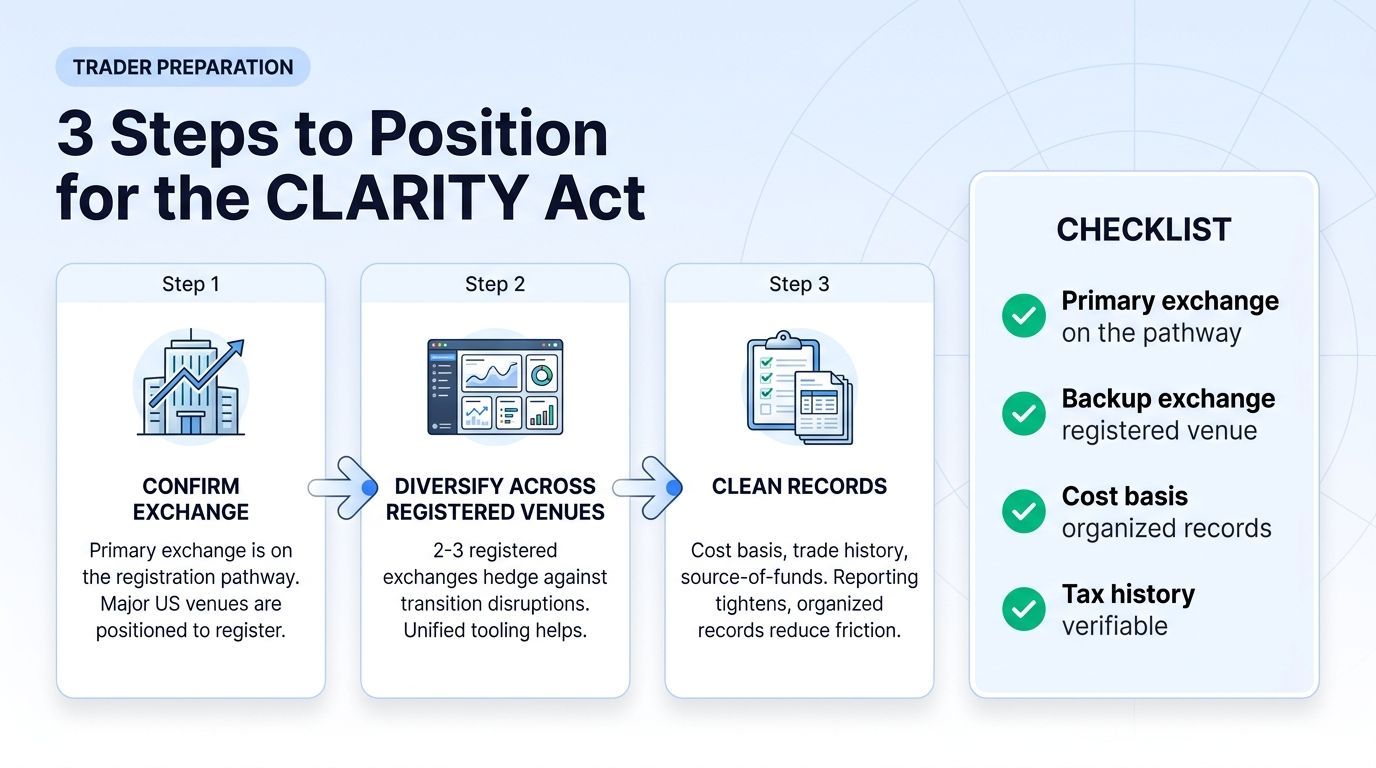
Three practical steps.
Step 1: Confirm your primary exchange is on the registration pathway. Most major US-licensed exchanges (Coinbase, Kraken, Gemini, Bitstamp) are positioned to register quickly. Some smaller platforms may exit the US market rather than register.
Step 2: Diversify across registered venues. Concentration risk on any single exchange increases during transition periods. Holding accounts on 2-3 registered exchanges hedges against transition disruptions. A crypto trading platform like Altrady connects to 19+ exchanges, allowing unified portfolio management even if you redistribute holdings across platforms during the transition.
Step 3: Document your cost basis and trading history. As reporting requirements tighten, having clean records of acquisition dates, prices, and disposals reduces tax and compliance friction. Most traders already do this, but the CLARITY Act may add additional reporting obligations that benefit from organized records.
The Risks and Uncertainties
Vote risk. The bill has bipartisan support but final passage is not guaranteed. Amendments could materially change the text. The Senate vote is the next major hurdle.
Implementation risk. Even if signed, the bill creates a 12-24 month implementation period during which the SEC and CFTC must write detailed rules. The rulemaking process can produce friction, delays, and unexpected interpretations.
State law conflicts. Several states have their own crypto frameworks (New York BitLicense, California licensing, etc.). The federal bill preempts some state law but not all. Multi-state operators face additional complexity.
Litigation risk. Industry groups, individual companies, or state attorneys general may challenge specific provisions in court. Legal uncertainty persists during litigation.
Political reversal. Future Congresses or administrations could revisit the framework. The current bill includes some sunset provisions and review requirements that create future legislative opportunities.
How the CLARITY Act Fits Into a Trading Strategy
A practical framework:
- US-registered exchanges become the default: Hold the bulk of trading capital with registered venues for legal clarity.
- Diversify across jurisdictions for derivatives: If you trade leveraged products, maintain accounts with at least one CFTC-registered venue plus possibly offshore alternatives.
- Stay current on amendments: The final bill text differs from the introduced version. Subscribe to one or two industry-newsletter sources to track changes.
- Maintain compliance records: Acquisition data, trade history, tax basis. The CLARITY Act will require more of this, not less.
FAQ
When does the CLARITY Act take effect?
The Senate vote is expected in June 2026, with House reconciliation following. The White House has targeted July 4, 2026 for signing. After signing, the bill triggers a 12-24 month implementation period during which the SEC and CFTC write detailed rules. Most provisions take full effect 18-24 months after signing.
Does the CLARITY Act ban any specific tokens?
The bill does not ban any specific tokens. It classifies tokens by characteristic. Tokens that fail the sufficient-decentralization test may be classified as securities, which restricts where they can be sold but does not ban them. Privacy coins face additional reporting requirements but are not banned.
How does the bill treat yield-bearing stablecoins like USDe and sUSDS?
Yield-bearing stablecoins that pay interest solely for holding a balance face restructuring. Products that share yield through related activities (trading rebates, fee waivers) remain permitted. Most major yield-bearing stablecoin issuers are restructuring their offerings to comply with the new framework rather than exiting the US market.
Will the CLARITY Act increase or decrease crypto regulation?
Both. It increases regulation in specific areas (exchange registration, stablecoin reserves, reporting requirements) while decreasing regulation in others (jurisdictional clarity reduces lawsuit risk, sufficient-decentralization test removes uncertainty for many tokens). Net effect is more clarity, with mixed compliance burden depending on the activity.
Can I trade these tokens on Altrady?
Yes. Altrady connects to 19+ exchanges, most of which are positioned to register under the CLARITY Act framework. You can manage spot and derivatives positions across these exchanges, run automated strategies via the signal bot, grid bot, or DCA bot, and use unified portfolio tracking. Altrady is a software platform that connects to your existing exchange accounts; the underlying regulatory compliance is handled by each exchange.
Conclusion
The CLARITY Act is the most consequential crypto legislation in US history. The Senate's path forward in May and June 2026 will determine the final shape of the bill, but the broad outline (jurisdictional split, exchange registration, stablecoin framework) is now established.
For traders, the practical takeaway is this: regulatory clarity is largely a positive development. Lawsuit overhang lifts. Legitimate venues gain protection. Institutional adoption accelerates. The compliance burden does increase, but for most retail traders it is handled by the exchanges they already use.
The next 6 months will produce significant news as the bill moves through final vote, signing, and the start of implementation. Traders who follow the changes and maintain accounts on registered venues will be best positioned to operate in the new framework.
The regulatory uncertainty that defined US crypto from 2023 to 2025 is ending. The CLARITY Act, in whatever final form it takes, marks the start of a more mature, more institutional, and more rule-based US crypto market.