
On January 22, 2026, the 21Shares Dogecoin ETF began trading on Nasdaq under the ticker TDOG, becoming the first US spot Dogecoin ETF to receive explicit approval from the Securities and Exchange Commission. The launch marked a milestone for one of crypto's most culturally significant assets: the meme coin that started as a joke in 2013 now has a regulated, exchange-traded investment vehicle backed by the Dogecoin Foundation itself.
The approval carried broader significance. By clearing the 21Shares product, the SEC effectively signaled for the first time that it does not classify Dogecoin as a security, a regulatory clarification that matters for the entire DOGE ecosystem. The ETF tracks the CF Dogecoin Dollar US Settlement Price Index to mirror spot DOGE valuations and carries a management fee of 0.50 percent.
This guide explains what the Dogecoin spot ETF is, the path to approval, how it compares to earlier DOGE ETF products, the significance for DOGE's regulatory status, the comparison to other crypto ETFs, and how traders should think about DOGE exposure in the new institutional era.
What Is the Dogecoin Spot ETF?
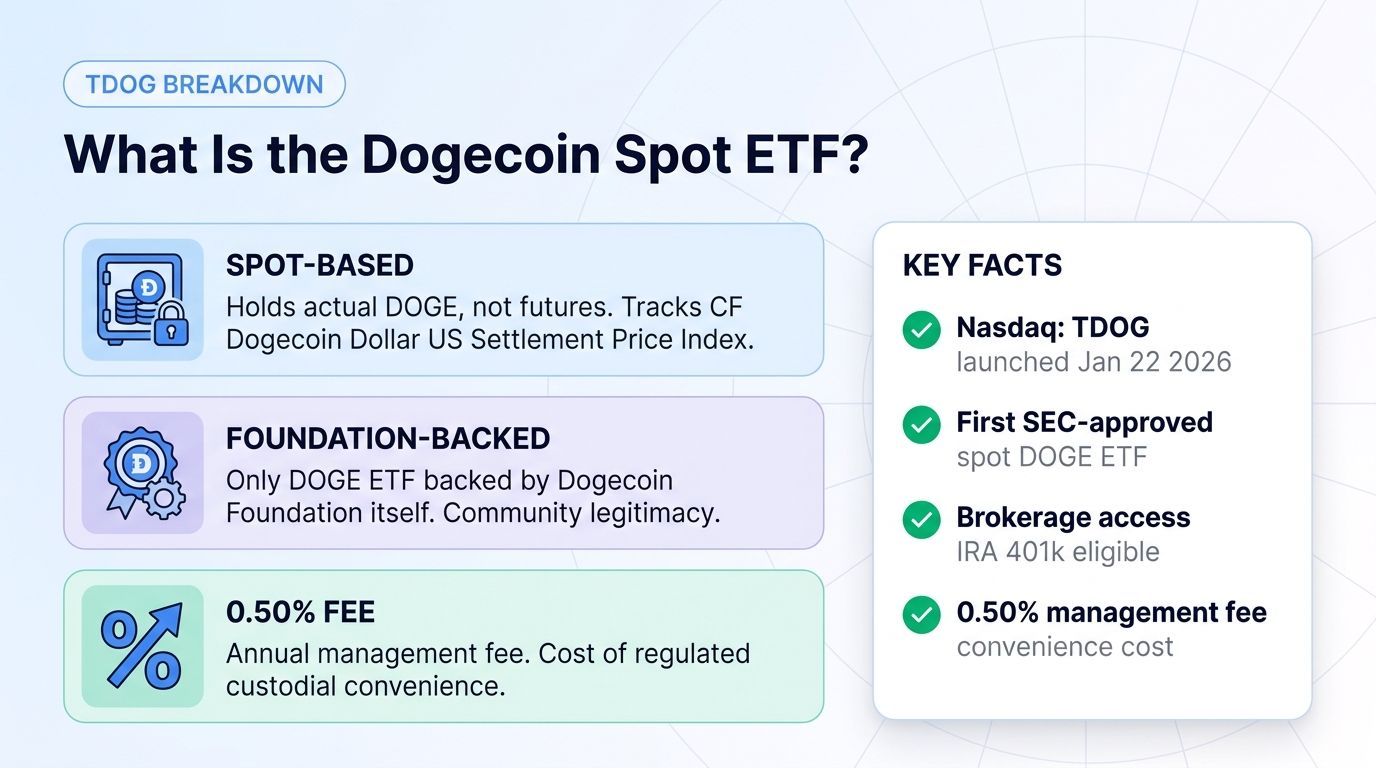
The 21Shares Dogecoin ETF (Nasdaq: TDOG) is an exchange-traded fund that holds actual Dogecoin and provides investors with regulated exposure to DOGE price movements through standard brokerage accounts. Rather than buying and storing DOGE in a crypto wallet, investors can buy and sell shares of TDOG like any other ETF.
The product has several specific characteristics.
First, it is spot-based. The ETF holds actual DOGE tokens rather than DOGE futures contracts or other derivatives. The fund's share price tracks the spot price of Dogecoin via the CF Dogecoin Dollar US Settlement Price Index.
Second, it is backed by the Dogecoin Foundation. The 21Shares product is notable as the only DOGE ETF backed by the Dogecoin Foundation itself, lending it a degree of legitimacy within the DOGE community.
Third, it carries a 0.50 percent management fee. This is the annual fee charged to investors for the convenience of regulated, custodial exposure.
For investors, the practical benefit is access to DOGE through any standard brokerage account, including tax-advantaged accounts like IRAs, without managing wallets, private keys, or crypto exchanges directly.
The Path to Approval
The Dogecoin ETF approval followed a multi-stage process that distinguishes the 21Shares product from earlier DOGE-related funds.
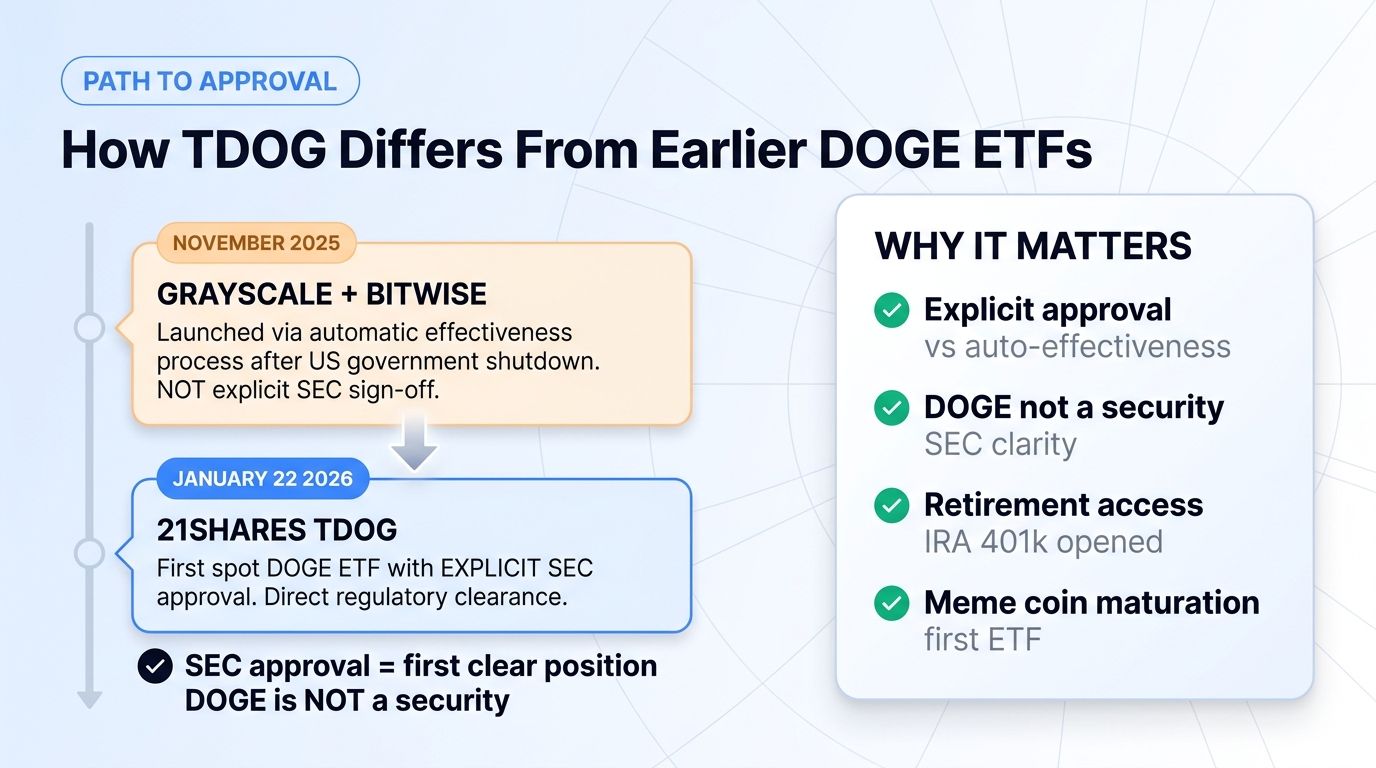
Earlier Dogecoin ETFs from Grayscale and Bitwise launched in November 2025 following the US government shutdown. These products became available through an automatic effectiveness process rather than through a formal, explicit sign-off from the SEC. In other words, they reached the market through a regulatory mechanism that allowed registration statements to become effective automatically after a waiting period, rather than through direct SEC approval.
The 21Shares Dogecoin ETF, by contrast, received explicit SEC approval. When TDOG began trading on January 22, 2026, it became the first spot Dogecoin ETF to receive direct regulatory clearance. This distinction matters because explicit approval represents a clearer regulatory endorsement than automatic effectiveness.
The approval also required the SEC to take a position on Dogecoin's classification. By approving a spot DOGE ETF, the agency effectively signaled that it does not consider Dogecoin to be a security, an important clarification given the years of regulatory ambiguity around many crypto assets.
Why the Approval Matters
Three structural impacts.
First, regulatory clarity on DOGE classification. The SEC's approval of a spot DOGE ETF represents its first clear position that Dogecoin is not a security. This clarity reduces a significant overhang for the DOGE ecosystem and aligns DOGE with Bitcoin and Ethereum, which also have spot ETFs and clearer regulatory status.
Second, institutional and retirement-account access. Spot ETF approval opens DOGE to traditional brokerage clients, including retirement accounts (IRAs, 401ks) that cannot easily hold crypto directly. This expands the potential buyer base substantially.
Third, legitimacy for meme coins broadly. DOGE was the original meme coin, and a regulated ETF for a meme coin marks a notable maturation. It signals that even culturally driven, non-utility-focused crypto assets can achieve mainstream financial product status if they meet liquidity and market-structure requirements.
For traders, the approval means DOGE is now an institutionally accessible asset, though the meme-driven volatility that defines DOGE remains.
How DOGE Spot ETFs Compare to Other Crypto ETFs
The crypto ETF landscape expanded significantly through 2024-2026.
Bitcoin Spot ETFs (January 2024): The first and largest category. Multi-billion-dollar funds from BlackRock, Fidelity, and others. Bitcoin's institutional adoption template.
Ethereum Spot ETFs (July 2024): Second major category. Later expanded to include staking variants (like BlackRock ETHB) that capture staking yield.
XRP Spot ETFs (March 2026): Payment-focused crypto ETF category with strong early inflows.
Solana Spot ETFs (late 2025): High-performance L1 ETF exposure.
Dogecoin Spot ETFs (January 2026): The first meme coin ETF category. 21Shares TDOG is the first SEC-approved product, with Grayscale and Bitwise products having launched earlier via automatic effectiveness.
For traders, the DOGE ETF sits in a different category from the others: it is the first meme-driven asset to receive an ETF, distinct from the utility or store-of-value theses behind BTC, ETH, XRP, and SOL ETFs.
Understanding DOGE as an Asset
For investors considering DOGE exposure, it is important to understand what Dogecoin is and is not.
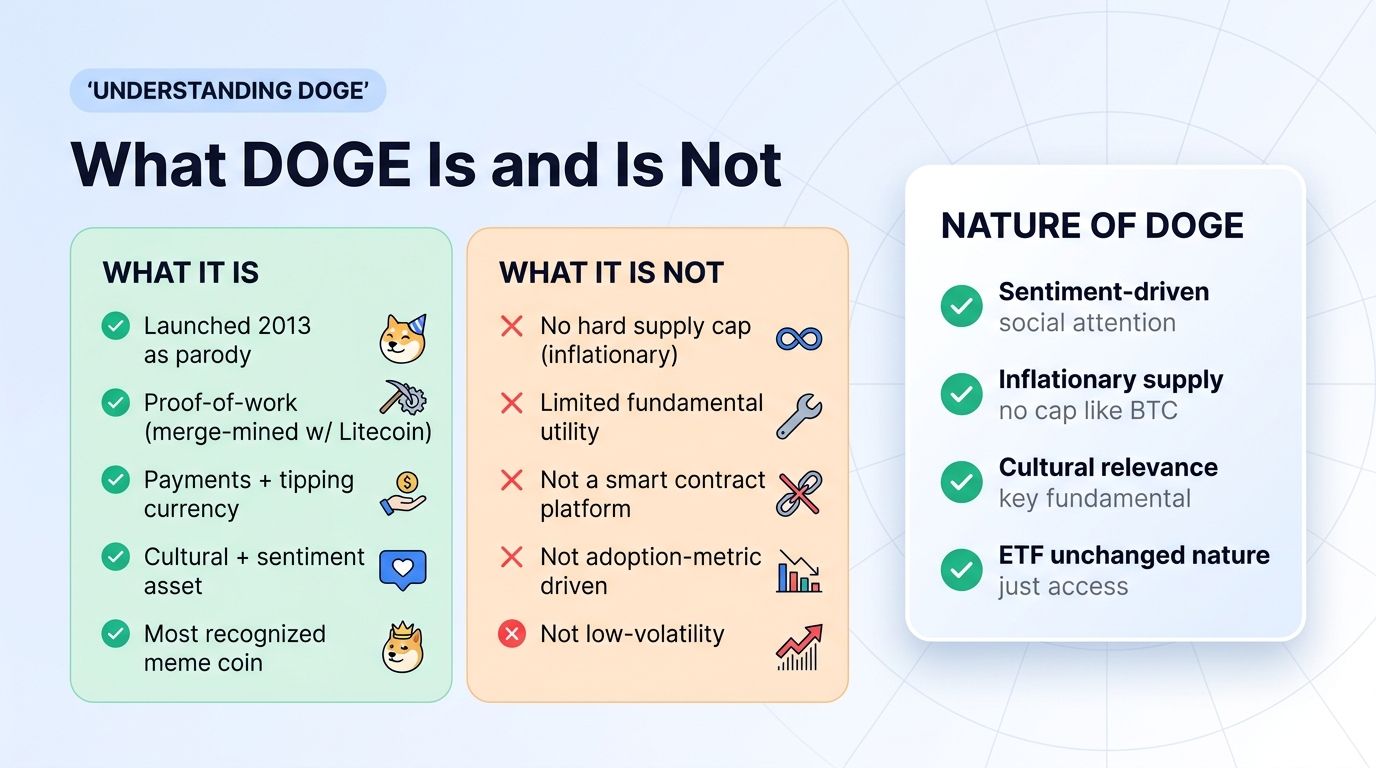
Dogecoin launched in 2013 as a lighthearted parody of the speculative crypto frenzy. It uses a proof-of-work consensus mechanism (merge-mined with Litecoin) and has no hard supply cap, with a fixed number of new DOGE issued annually, creating modest ongoing inflation.
DOGE has limited fundamental utility compared to smart contract platforms. It functions primarily as a payments and tipping currency and, more significantly, as a cultural and speculative asset. Its price has historically been driven by social media attention, celebrity endorsements, and broad retail sentiment rather than fundamental adoption metrics.
This means DOGE exposure, whether through the ETF or directly, is primarily a position anchored to continued cultural relevance and retail demand rather than to technological adoption. The ETF wrapper does not change DOGE's underlying nature; it only changes the access mechanism.
How Traders Can Get DOGE Exposure
Three practical paths.
Path 1: Hold the DOGE spot ETF (TDOG or others). For investors who prefer traditional brokerage exposure, especially in tax-advantaged accounts, the ETF provides regulated DOGE exposure without wallet management. The 0.50 percent management fee is the cost of this convenience.
Path 2: Hold DOGE directly on a crypto exchange. DOGE trades on virtually every major exchange (Binance, Coinbase, Kraken, Bybit, and others). Direct holding avoids management fees and enables on-chain use, but requires managing exchange or wallet security. A platform like Altrady connects to 19+ exchanges for unified DOGE position management.
Path 3: Hold a diversified crypto basket. For investors who want DOGE as part of broader crypto exposure rather than a concentrated position, holding DOGE alongside BTC, ETH, and other assets reduces single-asset risk.
The Risks of DOGE Investment
Extreme volatility. DOGE is among the most volatile major crypto assets, driven by social sentiment and capable of large, rapid price swings in either direction. The ETF wrapper does not reduce this volatility.
Limited fundamental value. DOGE has minimal fundamental utility compared to smart contract platforms. Its value depends heavily on cultural relevance and retail demand, which can shift quickly.
Inflationary supply. Unlike Bitcoin's fixed 21 million cap, DOGE has no supply cap, with a fixed amount of new DOGE issued annually. This ongoing inflation is a structural headwind.
ETF fee drag. The 0.50 percent annual management fee compounds over time and is a cost not incurred by holding DOGE directly.
Sentiment-driven reversals. DOGE rallies driven by social media or celebrity attention can reverse sharply when attention fades. Timing risk is significant.
Concentration risk. A meaningful portion of DOGE supply is held by large wallets, creating the potential for outsized impact from large holders' actions.
How DOGE Fits Into a Crypto Portfolio
A practical framework:
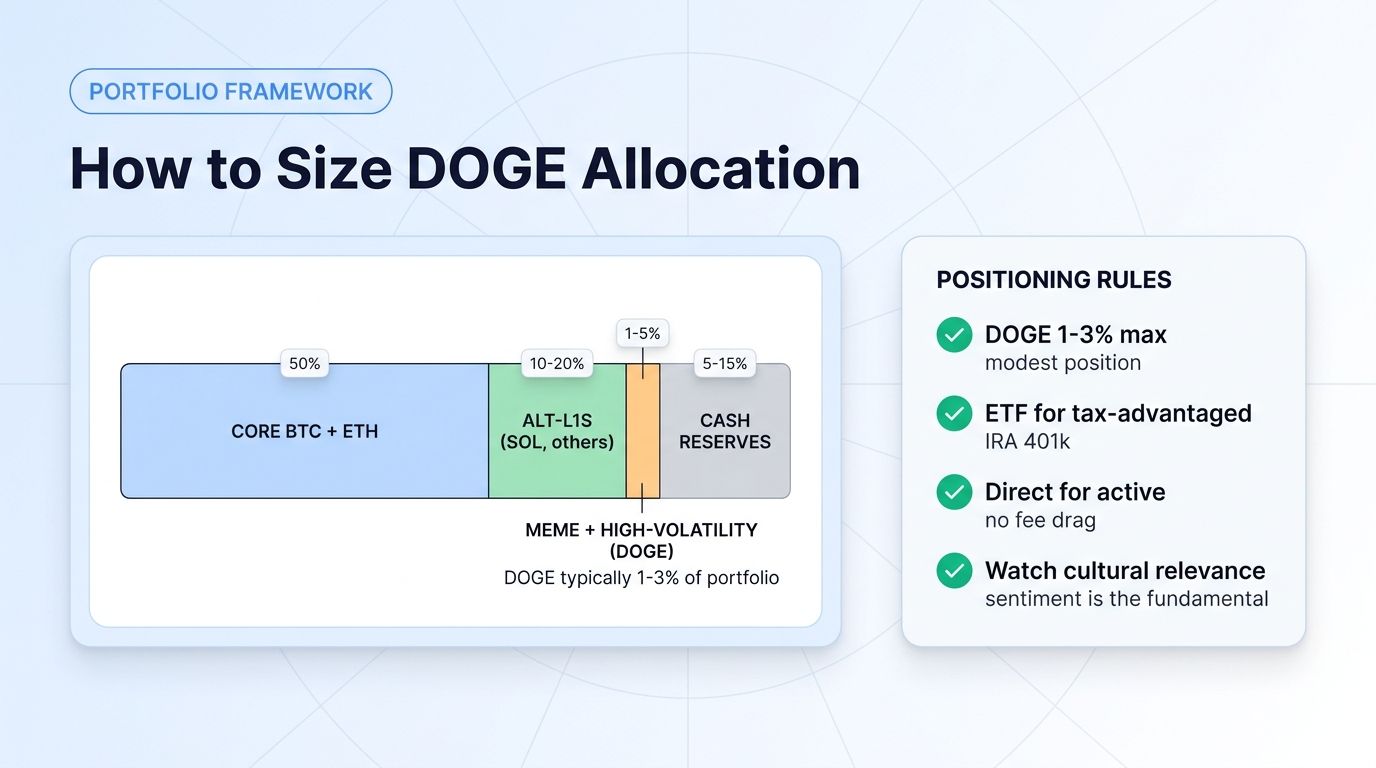
- Core large-cap holdings (BTC, ETH): 50-65% of crypto allocation
- Major alt-L1 exposure (SOL, others): 10-20%
- Meme and high-volatility assets (DOGE, others): 1-5% maximum. DOGE typically 1-3% of total portfolio.
- Cash reserves: 5-15%
DOGE allocation should be small relative to fundamentally driven assets, given its sentiment-driven volatility and limited fundamental value. The ETF wrapper makes DOGE easier to access but does not change the appropriate position sizing, which should remain modest.
What to Watch in the Next 12 Months
Three indicators.
Indicator 1: ETF inflow trajectory. Do DOGE spot ETFs attract meaningful AUM? Strong inflows would signal genuine institutional and retail demand through the ETF channel.
Indicator 2: Additional ETF approvals. Do more issuers receive explicit SEC approval for DOGE products? Broader approval would deepen the category.
Indicator 3: DOGE cultural relevance. Does DOGE maintain its social media presence and retail mindshare? Since DOGE value is sentiment-driven, cultural relevance is the key fundamental to monitor.
If ETF inflows grow and DOGE maintains cultural relevance, the asset could see sustained institutional participation. If attention fades, the ETF channel alone is unlikely to support the price.
FAQ
What is the ticker for the Dogecoin spot ETF?
The 21Shares Dogecoin ETF trades on Nasdaq under the ticker TDOG. It began trading on January 22, 2026, as the first spot Dogecoin ETF to receive explicit SEC approval. It is backed by the Dogecoin Foundation and tracks the CF Dogecoin Dollar US Settlement Price Index.
Is the DOGE ETF the same as holding Dogecoin directly?
Not exactly. The ETF holds actual DOGE on your behalf and provides price exposure through a brokerage account, with a 0.50 percent management fee. Holding DOGE directly avoids the fee and enables on-chain use, but requires managing exchange or wallet security. The ETF is better for tax-advantaged accounts and brokerage convenience; direct holding is better for active trading and avoiding fees.
Why did the SEC approving a DOGE ETF matter beyond the ETF itself?
By approving a spot DOGE ETF, the SEC effectively signaled for the first time that it does not classify Dogecoin as a security. This regulatory clarification reduces a significant overhang for the entire DOGE ecosystem and aligns DOGE with BTC and ETH in regulatory standing.
Were there DOGE ETFs before TDOG?
Yes. Grayscale and Bitwise launched DOGE ETF products in November 2025, but those became available through an automatic effectiveness process rather than explicit SEC approval. The 21Shares TDOG product, launched January 22, 2026, was the first to receive direct SEC approval.
Can I trade DOGE on Altrady?
Yes. DOGE is listed on Binance, Coinbase, Kraken, Bybit, KuCoin, and virtually all major exchanges. Altrady connects to 19+ exchanges, so you can manage DOGE positions alongside other crypto holdings, run automated strategies via the signal bot, grid bot, or DCA bot, and use unified portfolio tracking. The DOGE ETF (TDOG) trades through traditional brokerages rather than crypto exchanges.
Conclusion
The launch of the 21Shares Dogecoin ETF (TDOG) on January 22, 2026, brought the original meme coin to Wall Street as the first SEC-approved spot DOGE product. Backed by the Dogecoin Foundation and tracking the spot price of DOGE, the ETF gives traditional investors regulated access to one of crypto's most culturally significant assets.
For traders, the practical takeaway is this: the DOGE ETF makes Dogecoin institutionally accessible, particularly for tax-advantaged accounts, and the SEC approval clarifies that DOGE is not classified as a security. However, the ETF wrapper does not change DOGE's fundamental nature as a sentiment-driven, highly volatile asset with limited fundamental utility.
The longer-term trajectory depends on ETF inflow growth, additional approvals, and most importantly DOGE's continued cultural relevance, since its value is driven by social attention rather than fundamental adoption. For diversified crypto portfolios, DOGE deserves only a modest allocation (1 to 3 percent), accessed through whichever channel (ETF or direct) best fits the investor's situation. Sizing positions to a level where worst-case volatility does not damage the overall portfolio remains the standard discipline for an asset as sentiment-driven as Dogecoin.