
On March 12, 2026, BlackRock launched ETHB, the iShares Staked Ethereum Trust ETF, with $107 million in seed capital. The product followed the SEC and CFTC joint interpretive release of March 17, 2026, which explicitly stated that protocol staking of non-security digital commodities, including ETH, does not trigger Securities Act registration requirements. For the first time in US regulated markets, an ETF wrapper could capture staking yield from the underlying network and pass it to investors.
The combination is structurally significant. ETHB generates approximately 3.1-3.3% annualized staking yield on top of ETH price exposure. After fees, investors receive roughly 2.6% gross yield, which is a meaningful enhancement over non-staking ETH ETFs. Q2 2026 will see additional staking ETF approvals from Fidelity, Franklin Templeton, Invesco, 21Shares, and VanEck, expanding the category to the major asset managers.
This guide explains what ETH Staking ETFs are, the SEC March 2026 decision that enabled them, how ETHB and competitors work, the yield mechanics, the comparison to direct ETH staking, and how traders should think about this new institutional product.
What Is an ETH Staking ETF?
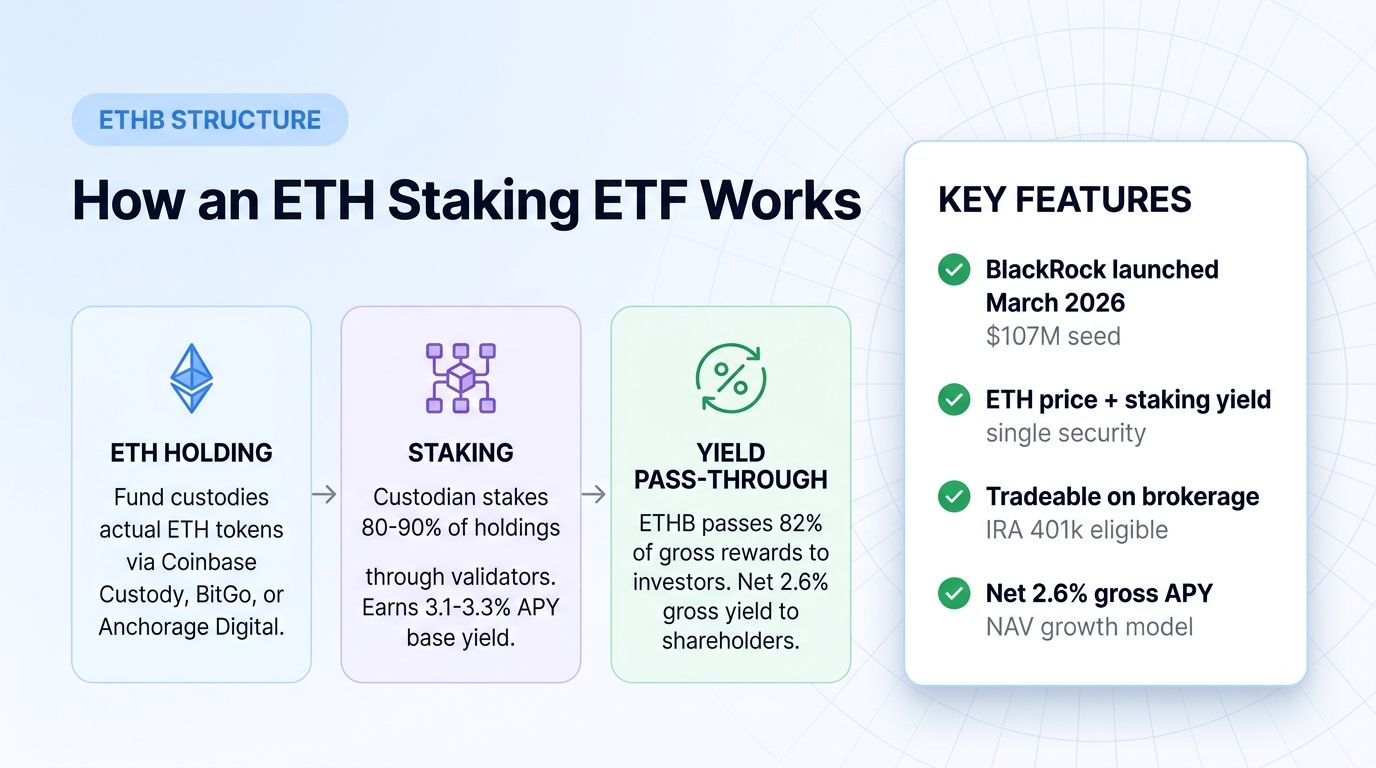
An ETH Staking ETF is an exchange-traded fund that holds ETH and stakes a portion of those holdings to earn validation rewards on the Ethereum network. Investors gain both price exposure to ETH and a share of the staking yield through a single regulated security tradable on traditional brokerages.
The structure has three core components.
First, the underlying asset is ETH. The fund custodies actual ETH tokens through qualified institutional custodians (typically Coinbase Custody, BitGo, or Anchorage Digital).
Second, the fund participates in Ethereum network validation. The custodian stakes the held ETH through validator operations, earning native Ethereum staking rewards (currently approximately 3.1-3.3% APY).
Third, a portion of the staking yield is passed to ETF investors. ETHB specifically passes 82% of gross staking rewards to shareholders, with the remainder used for the fund's expense ratio and operational costs.
For investors, the result is a single security that captures both ETH price movement and staking yield, accessible through any standard brokerage account.
The SEC March 2026 Decision That Enabled It
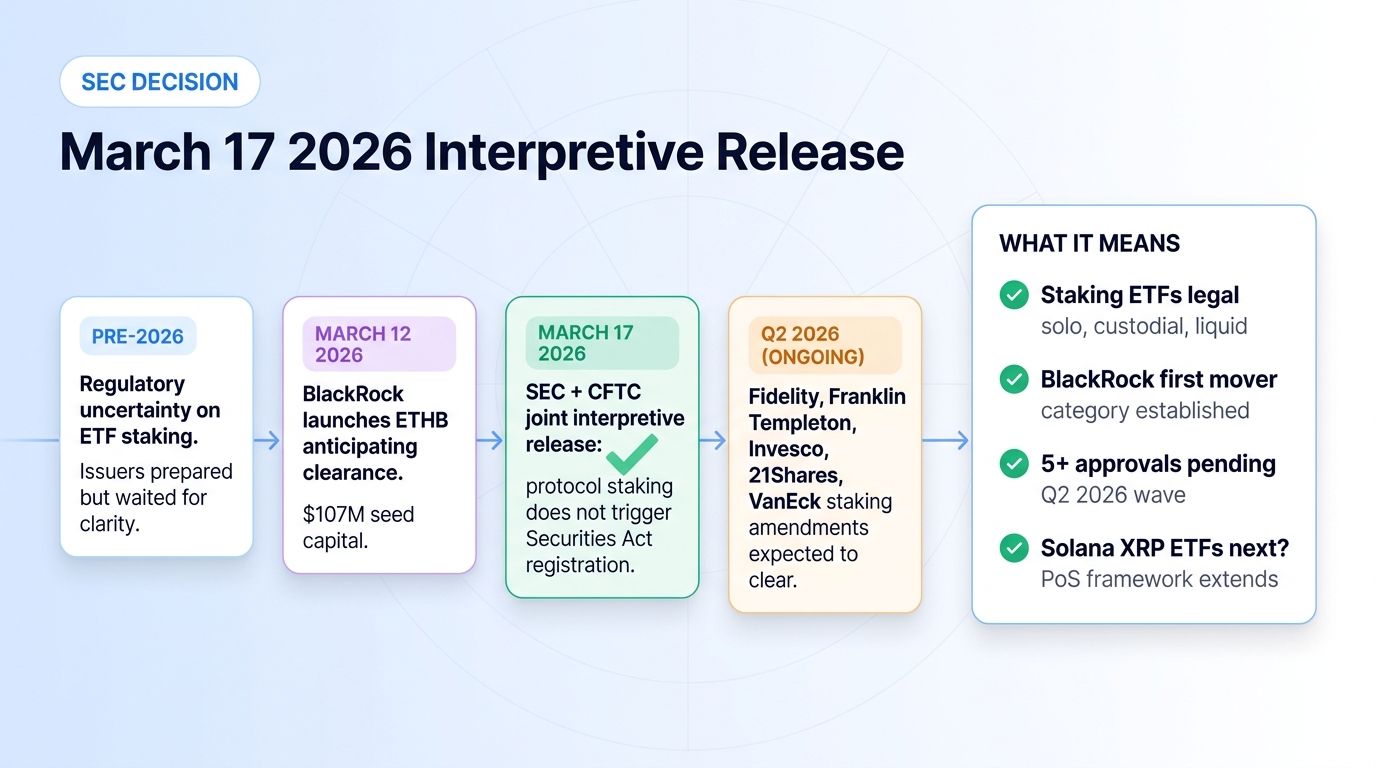
The path to ETH Staking ETFs required regulatory clarity that previously did not exist. The breakthrough came on March 17, 2026, when the SEC and CFTC issued a joint interpretive release on protocol staking.
The release stated explicitly that protocol staking of non-security digital commodities, including ETH, does not trigger Securities Act registration requirements. This applies to solo staking, custodial staking, and liquid staking models. The interpretation effectively removed the regulatory barrier that had previously prevented ETF issuers from staking the underlying ETH in their funds.
For BlackRock, the timing was strategic. ETHB had been filed and prepared for months. The March 17 interpretive release cleared the final regulatory uncertainty, and BlackRock launched ETHB on March 12 with $107 million in seed capital, anticipating the broader regulatory permission.
For competing issuers (Fidelity, Franklin Templeton, Invesco, 21Shares, VanEck), the release also opened the path forward. Their staking ETF amendments are expected to clear final SEC review windows in Q2 2026.
The interpretive release matters beyond ETH. The same logic applies to other proof-of-stake networks. Solana ETFs, XRP-related staking, and other PoS staking ETFs may follow once regulators address the specific products.
ETHB Token Economics and Yield Mechanics
BlackRock's ETHB has specific structural details traders should understand.
The fund holds ETH in qualified custody and stakes a portion through approved validators. The percentage staked varies based on liquidity requirements (some ETH must be kept liquid for redemptions) but typically targets 80-90% of holdings in active staking.
The yield distribution structure is the key feature. ETHB passes 82% of gross staking rewards to investors. At a 3.2% gross staking yield, this translates to roughly 2.6% gross to investors. The fund's expense ratio (typically 0.25-0.35% for BlackRock crypto ETFs) is deducted from the remaining portion.
The yield is reflected in the fund's net asset value (NAV) growth, not as separate dividend distributions. ETHB shares appreciate (or depreciate) based on both ETH price movement and accumulated staking yield. This makes ETHB structurally similar to a total-return product rather than a yield-distribution product.
For tax purposes, the yield accumulates as part of the fund's NAV. Tax treatment varies by jurisdiction and individual circumstance.
How ETH Staking ETFs Compare to Direct ETH Staking
Direct ETH staking and ETH Staking ETFs have different cost structures, operational requirements, and use cases.
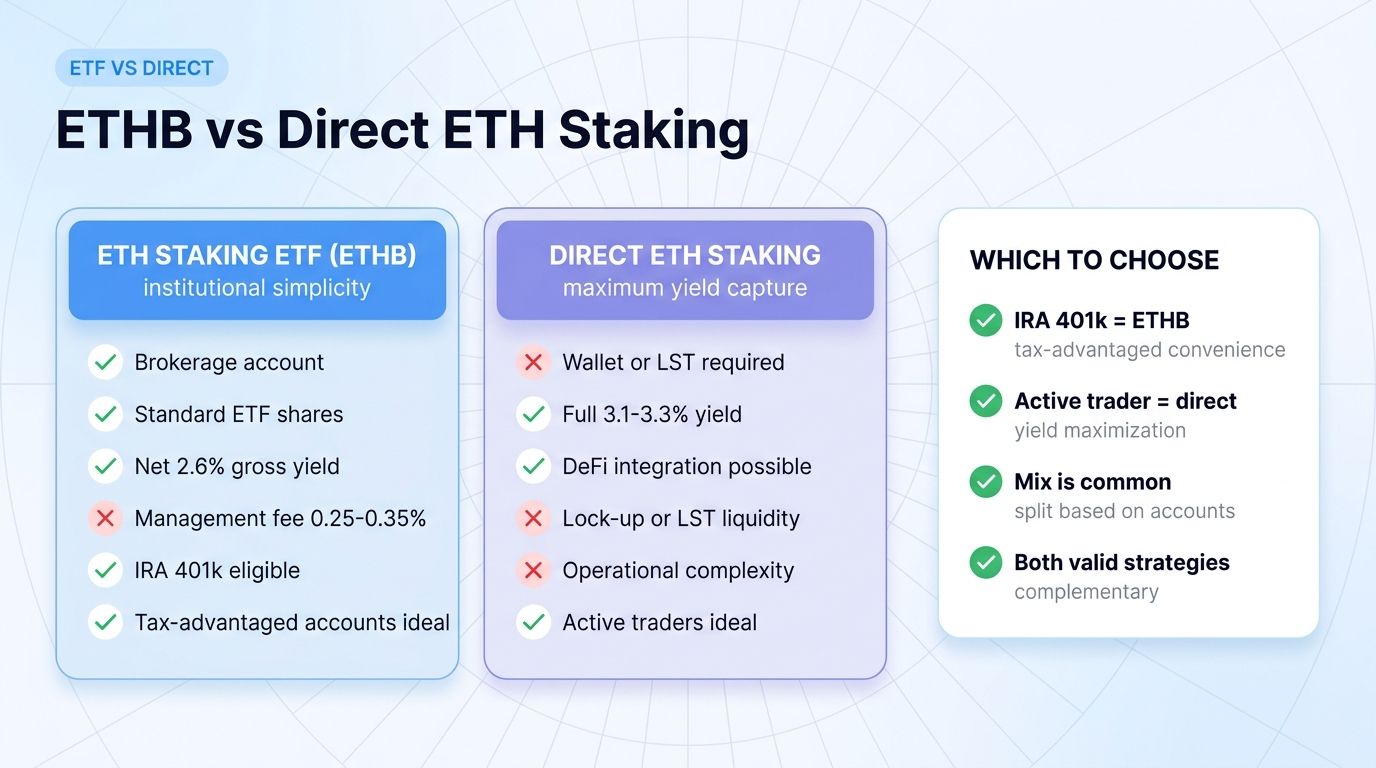
Direct ETH staking requires holding ETH in a wallet (or with a custodian) and participating in validation. Yield is 3.1-3.3% APY currently. No management fees. However, requires:
- Running a validator (32 ETH minimum) OR
- Using a staking pool / liquid staking provider (Lido, Rocket Pool, ether.fi, others) with their associated fees
- Managing private keys and operational security
- Locked or illiquid for periods (varies by approach)
ETH Staking ETF (ETHB and competitors) requires only:
- Standard brokerage account
- Purchase of ETF shares
- Yield earned automatically through NAV growth
The trade-off is operational simplicity vs. yield optimization. Direct staking captures full yield (minus operator fees if pooled). ETF yields are reduced by 18-20% (passed through 82%) plus management fees.
For tax-advantaged accounts (IRA, 401k) where direct ETH staking is operationally difficult, the ETF is significantly more convenient. For DeFi-active users who can capture ETH staking yield through liquid staking tokens and then deploy those tokens in other yield strategies, direct staking remains more capital-efficient.
Comparison to Other Crypto ETFs
The crypto ETF landscape now includes multiple categories.
Bitcoin Spot ETFs: Pure BTC price exposure. No yield (Bitcoin has no native staking). Established category since January 2024.
Ethereum Spot ETFs (non-staking): ETH price exposure without staking yield. Established since July 2024.
ETH Staking ETFs (ETHB): ETH price exposure plus staking yield through ETF wrapper. New category since March 2026.
XRP Spot ETFs: XRP price exposure. Established March 2026.
Solana Spot ETFs: SOL price exposure. Established late 2025.
Tokenized Treasury Products (BUIDL, others): Different category - regulated investment products generating Treasury yield through tokenization.
For diversified crypto exposure through ETFs, holding a basket across BTC, ETH (Staking variant), and possibly XRP or SOL provides comprehensive crypto access through traditional brokerage.
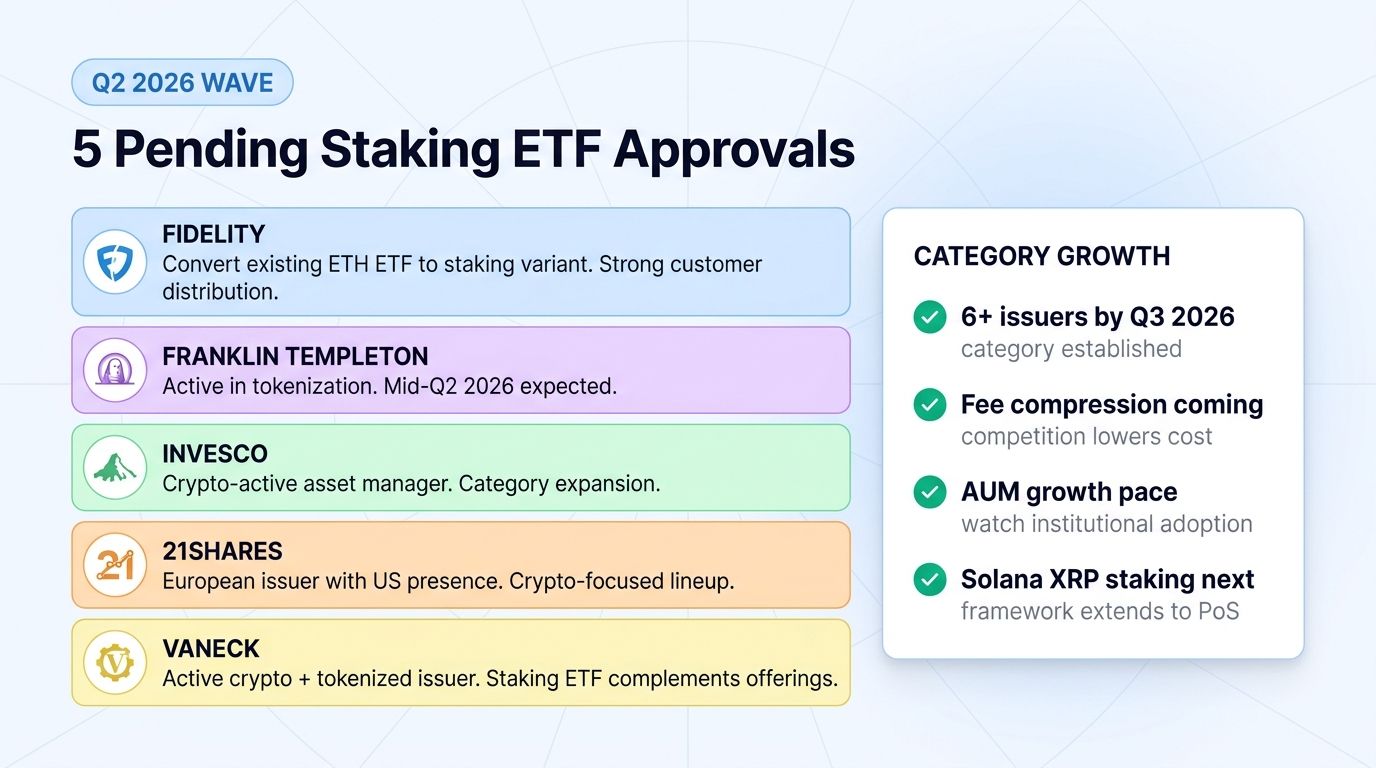
Q2 2026 Final Approval Wave
ETHB launched first in March 2026 but is not the only product. Five additional issuers have ETH Staking ETF amendments awaiting SEC review.
Fidelity: Expected to convert their existing Ethereum spot ETF to a staking-enabled variant. Strong distribution and existing customer base.
Franklin Templeton: Active in tokenized asset and crypto ETF space. Expected mid-Q2 2026 approval.
Invesco: Crypto-active asset manager. Their staking ETF would expand category coverage.
21Shares: European-domiciled issuer with US ETF presence. Staking ETF expansion fits their crypto-focused product lineup.
VanEck: Active issuer of crypto and tokenized products. Staking ETF complements existing offerings.
By the end of Q2 2026, the category is likely to include 6+ approved staking ETFs from major issuers. Competition will drive fee compression and product differentiation.
The Risks of ETH Staking ETF Investing
Smart contract risk on underlying staking infrastructure. The validator infrastructure used by the ETF is subject to slashing risk, technical risk, and consensus risk. Issues affecting validators directly affect the ETF.
Yield reduction vs direct staking. ETF investors capture 82% of gross yield. The remaining 18%+ flows to operational and management costs. Direct stakers capture more of the underlying yield.
ETF tracking error. ETFs aim to track NAV but premiums and discounts can develop during volatile periods. Spreads in less-liquid ETFs can create execution costs.
Management fee compound effect. Annual fees of 0.25-0.35% compound over time. For long-term holders, total fee impact is meaningful (5-10% over a decade).
Regulatory risk. While the March 2026 interpretive release clarified staking, future regulatory developments could affect the product. Changes to staking economics, validator requirements, or fund structure are possible.
Concentration risk. Each ETH Staking ETF depends on the issuer's operations, custodian reliability, and validator infrastructure. Issuer-specific events affect product-specific outcomes.
How ETH Staking ETFs Fit Into a Portfolio
A practical framework:
- Core large-cap holdings (BTC, ETH): 50-65% of crypto allocation
- ETH exposure breakdown: ETHB (or staking ETF equivalent) and direct ETH split based on operational preference and tax situation
- Tax-advantaged account allocation: ETH Staking ETF preferred for IRA, 401k, brokerage accounts
- Active trading account allocation: Direct ETH or LSTs preferred for DeFi integration and active strategies
- Cash reserves: 5-15%
For most investors, holding ETH exposure partially through ETH Staking ETFs (for tax-advantaged accounts) and partially through direct ETH (for active trading flexibility) provides operational balance.
What to Watch in the Next 12 Months
Three indicators.
Indicator 1: Q2 2026 approval wave execution. Do Fidelity, Franklin Templeton, Invesco, 21Shares, and VanEck launch their staking ETFs? Speed and breadth of approvals signals category establishment.
Indicator 2: Cumulative AUM growth. Does the ETH Staking ETF category attract significant assets? Strong inflows signal investor demand and validate the category.
Indicator 3: Yield evolution. Does Ethereum staking yield remain at 3.1-3.3%, or does it shift significantly? Network changes (more validators, MEV changes, protocol upgrades) affect yield economics.
If all three trend positively, ETH Staking ETFs establish as a major category. If approval delays or low adoption emerge, the category may remain niche.
FAQ
What is the difference between an ETH ETF and an ETH Staking ETF?
A standard ETH ETF holds ETH and provides pure price exposure. An ETH Staking ETF holds ETH but also stakes a portion through validators, generating staking yield (currently 3.1-3.3% APY) that flows to investors. ETH Staking ETFs typically have slightly higher fees but capture significantly more value through yield accumulation.
Can I convert my existing ETH ETF to a staking ETF?
Some issuers (Fidelity, Grayscale) are filing amendments to convert existing ETH ETFs to staking-enabled variants. The conversion does not require investors to take action; their existing shares are upgraded. Other issuers launch separate staking ETF products that investors must purchase separately.
Is ETHB the only ETH Staking ETF?
ETHB launched first in March 2026. By Q2 2026, additional staking ETFs from Fidelity, Franklin Templeton, Invesco, 21Shares, and VanEck are expected to enter the market. The category is in active competitive expansion.
How is ETHB yield reported for tax purposes?
ETHB yield accumulates as part of the fund's NAV growth rather than as separate distributions. Tax treatment varies by jurisdiction and account type. Tax-advantaged accounts (IRA, 401k) may receive favorable treatment compared to taxable brokerage accounts.
Can I trade ETH and ETHB on Altrady?
ETH is listed on Binance, Coinbase, Kraken, Bybit, KuCoin, and most major exchanges. Altrady connects to 19+ exchanges, so you can manage ETH positions alongside other crypto holdings, run automated strategies via the signal bot, grid bot, or DCA bot, and use unified portfolio tracking. ETHB and other staking ETFs trade through traditional brokerages.
Conclusion
The launch of BlackRock ETHB in March 2026 and the SEC March 17 interpretive release on protocol staking represent a structurally significant development for Ethereum investing. For the first time, institutional investors can capture ETH price exposure plus staking yield through a single regulated product tradable on traditional brokerages.
For traders, the practical takeaway is this: ETH Staking ETFs are a credible institutional product for ETH exposure, particularly in tax-advantaged accounts where direct ETH staking is operationally difficult. The yield reduction (82% pass-through) is a meaningful cost, but the operational simplicity is significant.
The longer-term trajectory depends on the Q2 2026 approval wave and on whether cumulative AUM grows sustainably. The current setup (March 2026 SEC clarity + competitive product launches) supports continued category growth.
For diversified crypto portfolios, ETH exposure can now be allocated across direct ETH, liquid staking tokens (Lido stETH, ether.fi eETH, others), and ETH Staking ETFs based on individual circumstance and operational preference. The next 12 months will produce decisive data on which approach captures the most institutional and retail capital. Sizing positions appropriately and choosing the right wrapper based on your specific situation remains the standard discipline.