
What Are Meme Coins?
Meme coins are cryptocurrency tokens that originate from internet jokes, viral images, or cultural moments rather than from a technical whitepaper or a problem they aim to solve. They are community-driven, speculative assets that often have no underlying utility, no product roadmap, and no team with a stated mission beyond making the coin go viral.
The category was born in December 2013 when software engineer Billy Markus and product manager Jackson Palmer created Dogecoin (DOGE) as a parody of Bitcoin. They slapped the popular "Doge" Shiba Inu meme on a coin and expected it to be forgotten in weeks. Instead, it became one of the most recognized crypto assets in history, eventually reaching a market cap of over $88 billion during the 2021 bull run.
That origin story defines everything about meme coins: they thrive on irony, community enthusiasm, and the internet's capacity to amplify anything it finds funny or relatable. Some meme coins stay jokes forever. Others evolve. Dogecoin, for instance, is now accepted as payment by several merchants and has a dedicated developer community. Shiba Inu launched its own decentralized exchange (ShibaSwap) and Layer 2 blockchain (Shibarium) years after it started as a DOGE copycat.
What makes meme coins fundamentally different from most cryptocurrencies is their supply structure: they typically have enormous circulating supplies, sometimes in the trillions of tokens, which keeps the price per token extremely low. That low nominal price is not a coincidence. It is a feature designed to attract retail investors who perceive a token priced at $0.00001 as more accessible than Bitcoin at $80,000.
As of March 2026, meme coins represent one of the most active and volatile segments of the crypto market. New ones launch daily, most fail within weeks, but the few that capture cultural momentum can generate returns that dwarf anything in traditional finance.
Why Meme Coins Pump (and Crash)
Understanding the mechanics behind meme coin price movements is essential before putting any capital at risk. The volatility is not random. It follows predictable patterns driven by specific catalysts.
Social Media and Viral Momentum
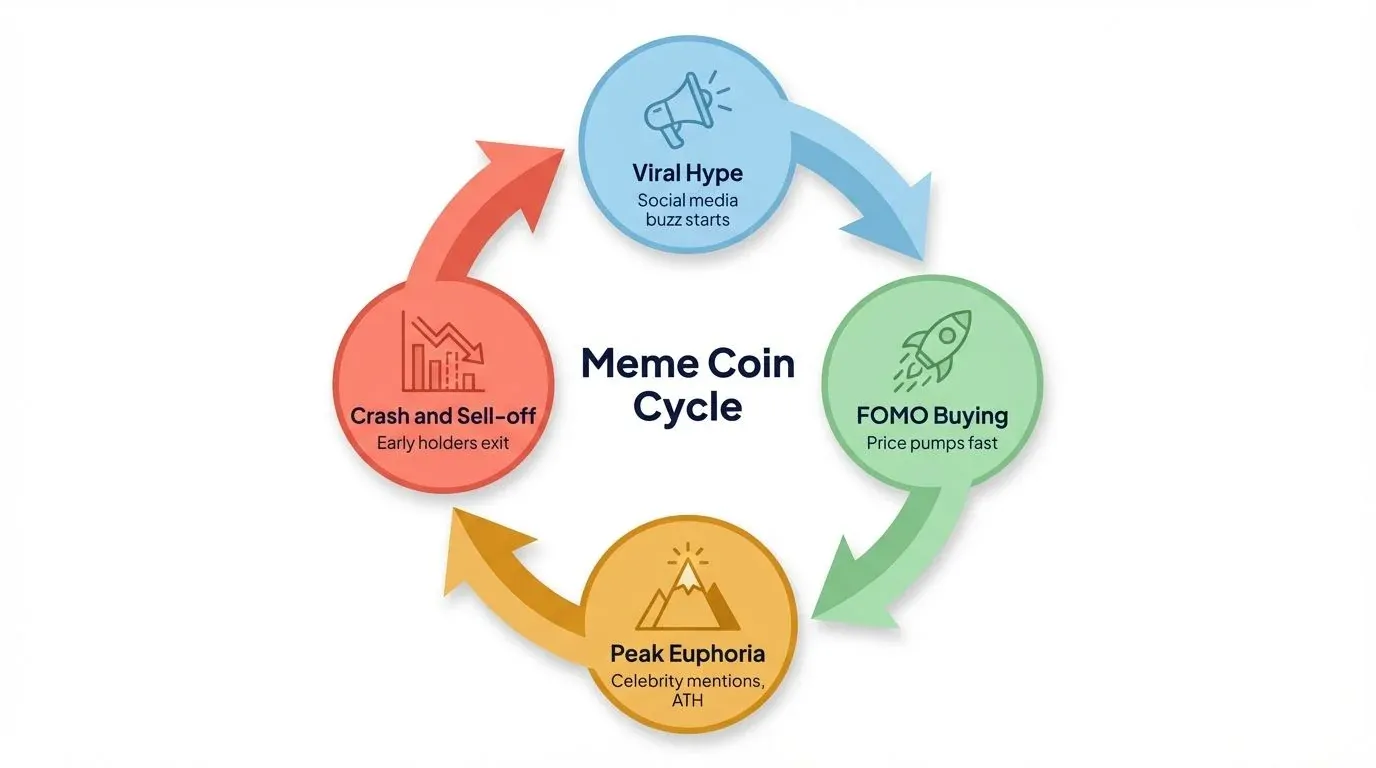
Meme coins live and die on Twitter/X, Reddit, Telegram, and TikTok. A single tweet from a large account, a trending hashtag, or a Reddit post that goes viral on r/CryptoCurrency can send a coin up 300% in hours. The cycle works because social attention drives new buyers into a thinly traded market, pushing price up, which generates more social attention, which brings in more buyers. This feedback loop can run for days or even weeks before it reverses. When the trend fades, the same mechanism works in reverse: volume dries up, early buyers sell, price drops, sentiment turns negative, and latecomers are left holding losses.
Celebrity and Influencer Effect
No force has shaped the meme coin market more dramatically than celebrity endorsement. Elon Musk's tweets about Dogecoin between 2020 and 2021 are the defining case study. A single post from Musk could move DOGE's price by 20 to 50% within the hour. In 2024, several new meme coins were explicitly tied to celebrities or political figures, including coins referencing Donald Trump and other public personalities. These tokens saw explosive initial pumps but equally violent corrections once the hype cycle ended. The pattern repeats consistently: celebrity association creates asymmetric short-term upside, but it is not a substitute for organic community growth.
Low Price Per Token Psychology
Retail investors frequently confuse a low token price with being "cheap." A coin trading at $0.000001 with a trillion tokens in circulation has the same market cap as a coin trading at $1 with a million tokens in circulation. But the psychological appeal of owning millions of tokens for a small dollar amount is real and powerful. It drives buying behavior in meme coin markets that would not occur in equities or in higher-priced crypto assets. Marketers and project launchers exploit this deliberately, designing tokenomics with absurdly large supplies to keep nominal prices low and create the illusion of affordability.
Liquidity and Thin Markets
Most meme coins, especially new ones, have extremely low liquidity. The total value locked in their trading pools on decentralized exchanges might be $50,000 to $500,000. In thin markets, even a modest buy order of $5,000 to $10,000 can push the price up by double digits in seconds. This makes meme coins attractive to traders looking for outsized moves, but it also means that a single large seller can collapse the price just as quickly. Liquidity is the mechanism that amplifies every other factor: social momentum, celebrity tweets, and FOMO all hit harder when there is little depth in the order book.
The Biggest Meme Coins in 2026
The meme coin landscape has evolved significantly since the early Dogecoin days. A small number of coins have survived multiple market cycles and built genuine communities, while thousands of others have come and gone.
Dogecoin (DOGE): The Original
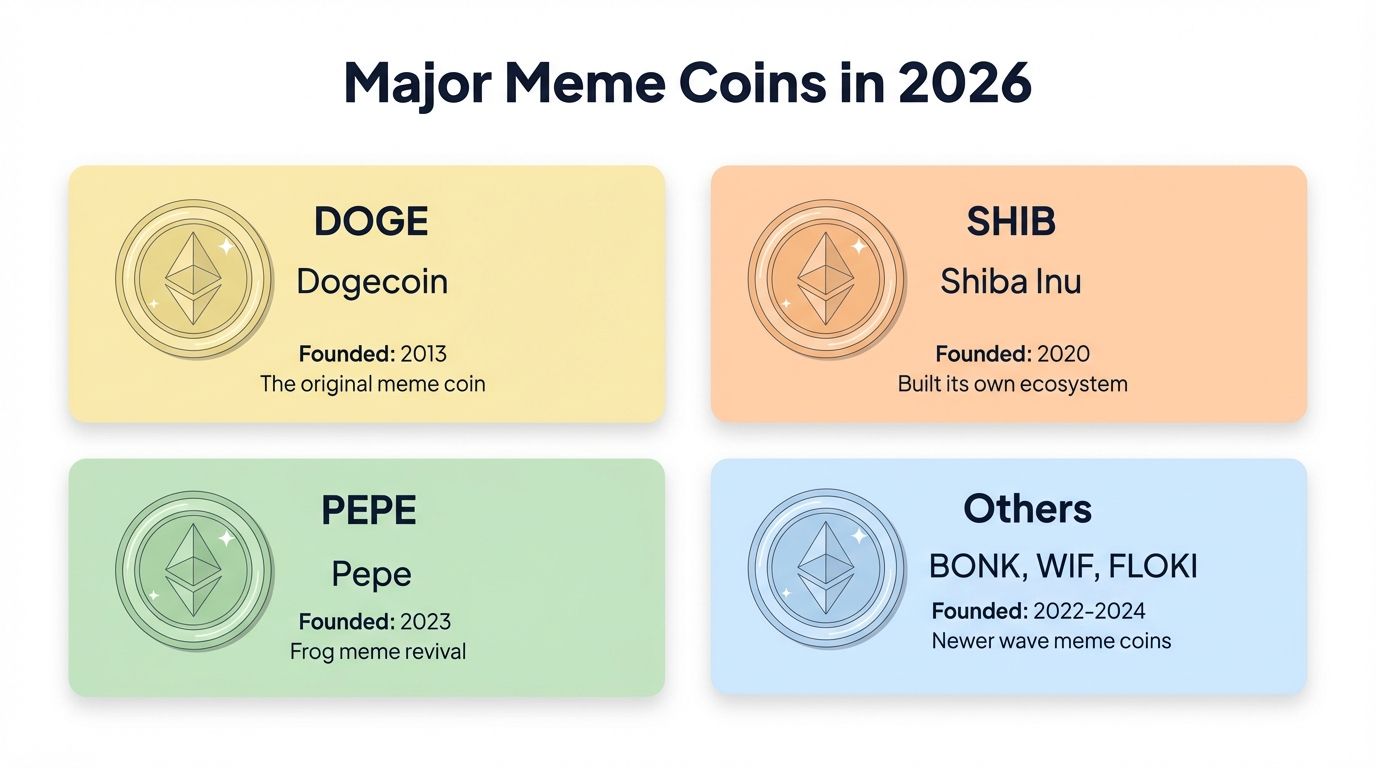
Dogecoin remains the benchmark for the entire meme coin category. As of March 2026, DOGE maintains a market cap in the range of $20 to $30 billion, making it a top-15 crypto asset by market cap. It has survived three major bear markets, accumulated a developer community that keeps the protocol updated, and earned acceptance as payment from a growing list of merchants. DOGE trades on every major centralized exchange. Its price history is dramatic: it launched at fractions of a cent, hit $0.74 in May 2021, crashed below $0.05 during the 2022 bear market, and has since oscillated in a wide range. For many traders, DOGE is the low-risk end of meme coin exposure, the coin least likely to go to zero overnight.
Shiba Inu (SHIB): The Dogecoin Killer That Survived
Launched in August 2020 by an anonymous developer known only as "Ryoshi," Shiba Inu was explicitly marketed as the "Dogecoin killer." It peaked at a market cap exceeding $40 billion in October 2021 and became one of the most widely held crypto assets on Coinbase. SHIB has a supply in the quadrillions, keeping the token price in fractions of a cent, which fueled the "one cent dream" narrative that drew millions of retail investors. The Shiba ecosystem has expanded meaningfully: ShibaSwap is a functional DEX, Shibarium is a live Layer 2 network with real transaction volume, and BONE serves as the ecosystem's governance token. SHIB has proven that a meme coin can develop genuine infrastructure without abandoning its community roots.
Pepe (PEPE) and the New Wave
PEPE launched in April 2023 as a tribute to the Pepe the Frog meme and became one of the fastest crypto assets to reach a $1 billion market cap, achieving that milestone in under three weeks. By mid-2024, PEPE had entered the top 20 coins by market cap and was listed on Binance, Coinbase, and OKX. It represents a newer generation of meme coins: no formal team, no utility promises, pure community speculation. Its success inspired dozens of copycat "frog coins" and validated the thesis that cultural iconography could sustain a meme coin beyond its initial launch hype. As of early 2026, PEPE remains one of the most actively traded meme coins by volume.
Others Worth Knowing: BONK, WIF, FLOKI
BONK, the Solana-native meme coin airdropped to the Solana community in December 2022, became a symbol of the Solana ecosystem's recovery and at its peak reached a market cap above $2 billion. dogwifhat (WIF), another Solana meme coin featuring a dog wearing a hat, surged past $4 billion market cap in early 2024. FLOKI, branded around the Shiba Inu dog breed and Elon Musk's dog's name, built a gaming and metaverse project called Valhalla around its token. These coins illustrate the range within the meme coin category: some remain pure speculation, others are building ecosystems of varying credibility.
Meme Coins vs Utility Tokens
Understanding the distinction between meme coins and utility tokens matters for risk assessment, not moral judgment. Both exist on the same blockchains and trade on the same exchanges, but they are fundamentally different instruments.
Utility tokens are issued by projects with a defined purpose: they grant access to a platform, pay for network services, or represent governance rights in a protocol. Examples include UNI (Uniswap governance), LINK (Chainlink oracle payments), and FIL (Filecoin storage). Their value is theoretically anchored to the demand for the underlying service. When adoption grows, demand for the token may grow with it.
Meme coins have no such anchor. Their value is entirely sentiment-driven. There is no revenue model, no protocol fee distribution, and no functional reason to hold the token beyond speculation and community belonging. This makes them higher risk in every measurable dimension: they can drop 90% in days during a sentiment shift, liquidity can evaporate overnight, and there is no "fundamental floor" to prevent a price from going to zero.
However, the risk-reward profile is also asymmetric. A utility token for a solid project might realistically 3x to 10x in a bull cycle. A meme coin that catches the right wave can do 100x or more in weeks. The tradeoff is that for every meme coin that 100x, hundreds of others go to zero. Utility tokens are not immune to failure either, but the failure modes are different: poor product-market fit, competition, or team execution, rather than the sudden collapse of a joke that nobody finds funny anymore.
A balanced approach treats meme coins as high-risk, high-reward speculative positions sized accordingly, not as a substitute for exposure to fundamentally sound projects.
How to Trade Meme Coins
Trading meme coins successfully requires a different mindset and different tools than trading large-cap crypto assets. The market moves faster, the information environment is noisier, and the margin for error is smaller.
Finding Early Meme Coins (DEXScreener, Dextools, Twitter/X)
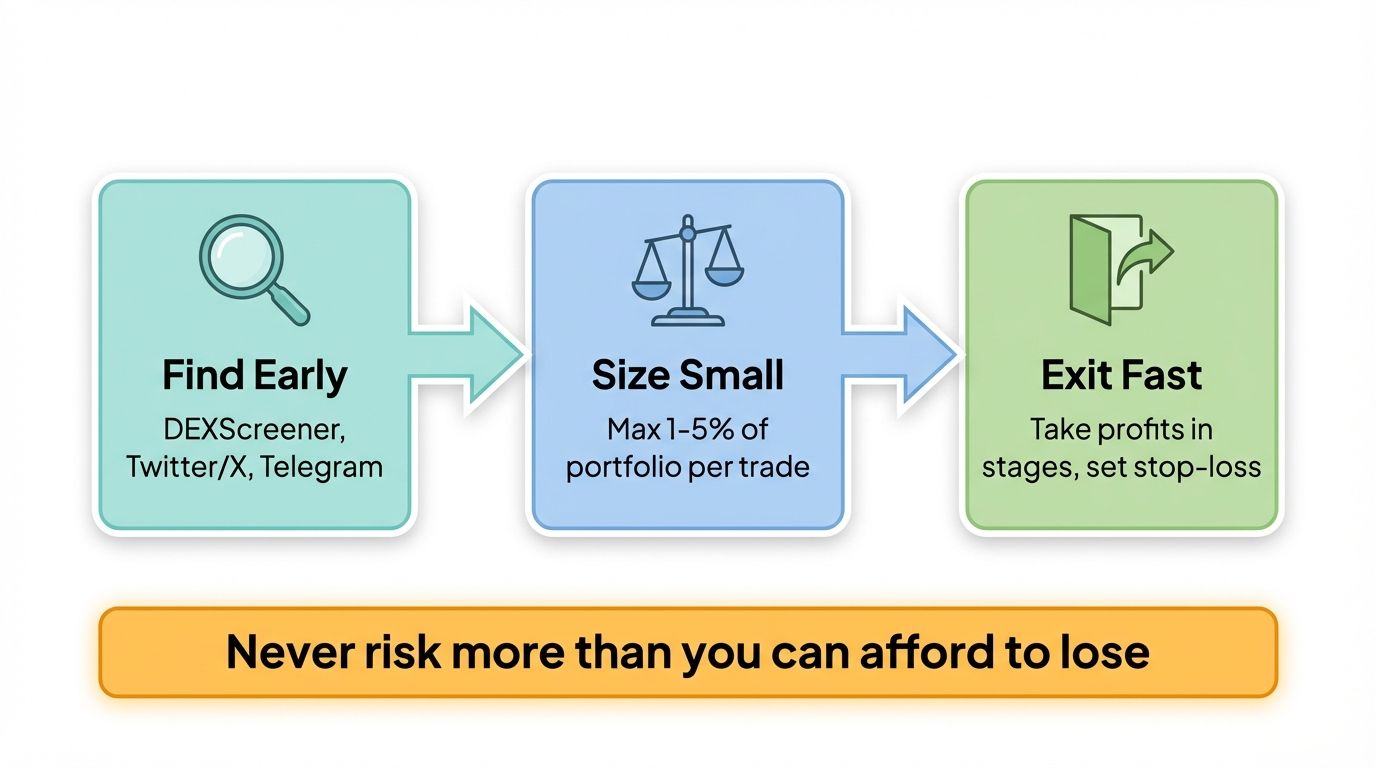
The best returns in meme coins come from finding them early, before they hit major exchange listings. DEXScreener and Dextools are the primary tools for monitoring new token launches on decentralized exchanges across Solana, Ethereum, Base, and BNB Chain. Both platforms show real-time price action, liquidity depth, transaction volume, and wallet concentration data. Filtering for tokens with growing volume, rising transaction counts, and liquidity above a minimum threshold (typically $50,000 to $100,000) helps screen out obvious scams from genuine early movers. Twitter/X remains the fastest signal: following crypto influencers with strong track records, monitoring trending tickers, and watching for coordinated community activity can surface coins hours before they hit mainstream attention.
Entry and Exit Strategy for Meme Coin Trades
The most common mistake in meme coin trading is holding too long. Meme coin pumps are typically short-lived: most of the gains happen in the first 24 to 72 hours of viral momentum. A disciplined approach is to set partial exit targets before entering: for example, selling 25% of a position at 2x, another 25% at 4x, and letting the remainder ride with a stop-loss or trailing exit. This locks in profit while maintaining upside exposure. Chasing a coin after it has already pumped 500% is almost always a losing trade. Entries should ideally be at accumulation, not at peak social attention. Exits should be planned before entering, not decided in the heat of a pump.
Position Sizing and Risk Management
No single meme coin position should exceed 1 to 5% of a total crypto portfolio. This is not a conservative suggestion: it is a mathematical requirement given the asset class's failure rate. If nine out of ten meme coin trades go to zero and one goes 20x, the portfolio outcome depends entirely on position size. With 1% allocations, a 20x win on one position adds 19% to the portfolio, while nine losses each cost only 1%. With 10% allocations, the same scenario results in a net loss despite winning the big trade. Meme coin trading is probabilistic. Managing position size is what separates it from reckless speculation.
Red Flags to Avoid
The meme coin space has an extremely high concentration of scams, and the most dangerous ones are designed to look exactly like legitimate projects. Recognizing the warning signs before putting money in is a non-negotiable skill.
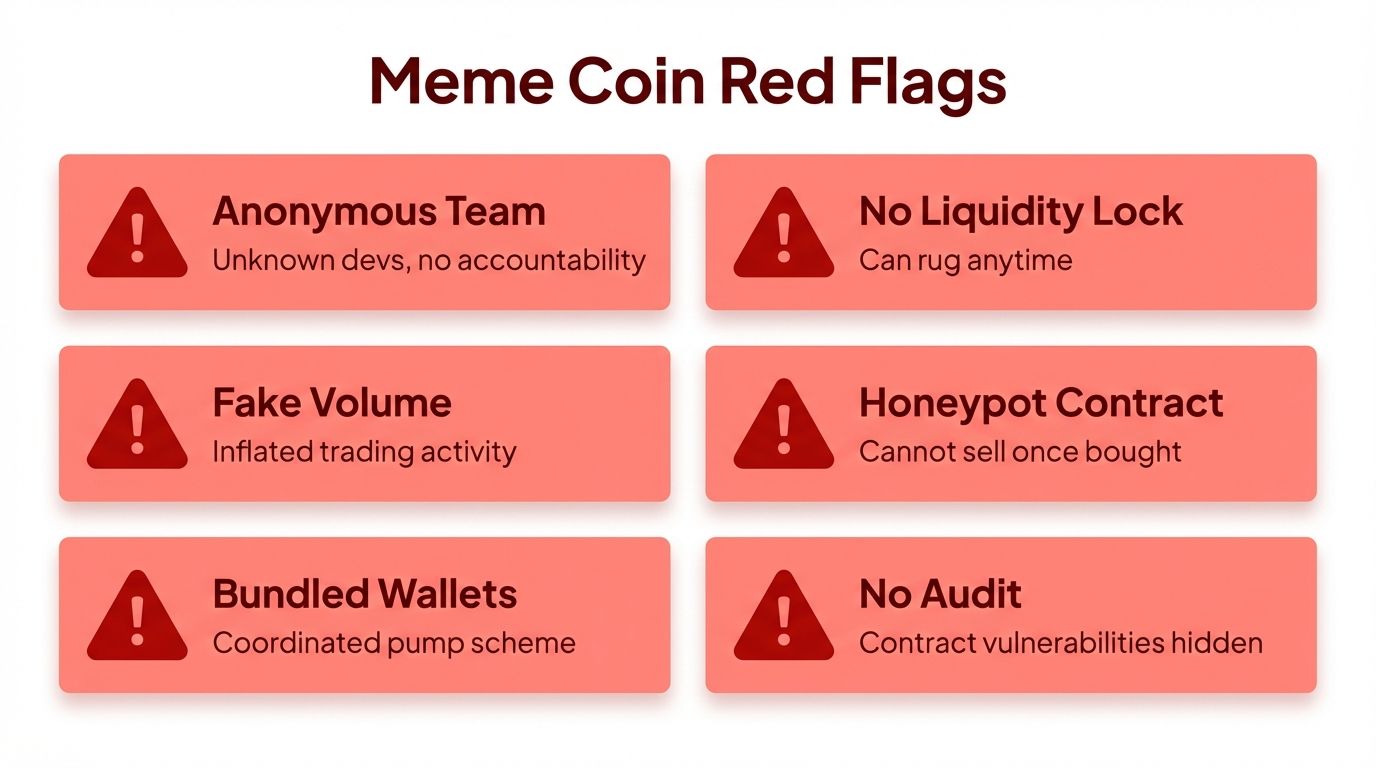
Rug pulls occur when developers drain the liquidity pool after attracting investment, leaving holders with worthless tokens. The primary defense is checking whether liquidity is locked, meaning the developers cannot withdraw it for a defined period, typically six months to two years. Tools like Token Sniffer and Rugcheck provide automated audits of contract code and liquidity lock status for free.
Honeypot contracts are coded to allow buys but block sells. A trader can watch the price go up, but when they try to sell, the transaction fails. Token Sniffer and DEXScreener both flag suspected honeypot contracts, but always simulate a sell transaction before committing significant capital.
Bundled wallets and insider accumulation: on Solana in particular, tools like Bubblemaps visualize wallet clustering. If 20 to 30 wallets that all transacted together own 40% of the supply, they are almost certainly coordinated insiders waiting to dump on retail buyers. Any token where the top 10 wallets collectively hold more than 20 to 30% of supply warrants caution.
Fake volume is common on new tokens. High transaction counts with very small trade sizes, often called wash trading, artificially inflate the appearance of activity. Genuine organic volume comes from wallets of varied sizes making transactions of varied amounts. Uniform micro-transactions from dozens of wallets are a manipulation signal.
Anonymous teams are not automatically a red flag in meme coins (Satoshi was anonymous), but anonymous teams with no locked liquidity, no audit, and no verifiable community history represent a combination of red flags that should stop any serious consideration of the trade.
Trade Meme Coins Smarter with Altrady
Meme coins move at a pace that punishes hesitation. A coin can go from obscure to trending to crashing in under 24 hours, and the traders who capture the gains are the ones with systems in place before the move happens, not the ones reacting manually after seeing a tweet.
Altrady is built for exactly this kind of fast-moving, multi-position trading environment. Its real-time price alerts let you set precise entry and exit triggers across dozens of coins simultaneously, so you are notified the moment a setup activates without having to watch every chart manually. The portfolio tracking dashboard consolidates positions across multiple exchanges and wallets, giving you a clear picture of total exposure and individual position performance at any moment.
For meme coin traders managing several open positions across Binance, Coinbase, and Solana-based DEXs, Altrady's unified interface removes the coordination overhead that leads to missed exits and oversized positions. The built-in risk management tools help enforce the position sizing discipline that separates profitable meme coin trading from costly speculation.
You can explore all of these features with a free trial. No commitment required. Whether you are tracking your first meme coin position or managing a diversified speculative portfolio, Altrady gives you the infrastructure to trade with precision rather than instinct.
Frequently Asked Questions
Are meme coins a good investment?
Meme coins are high-risk, speculative assets with a high failure rate. A small number generate extraordinary returns, but the majority go to zero. They can be a part of a diversified crypto portfolio when position sizes are kept small (1 to 5%) and trades are approached with a defined entry and exit plan.
What was the first meme coin?
Dogecoin, launched in December 2013 by Billy Markus and Jackson Palmer, is universally recognized as the first meme coin. It was created as a parody of Bitcoin using the "Doge" Shiba Inu meme and has since grown into one of the top cryptocurrency assets by market capitalization.
Can meme coins reach $1?
It depends entirely on the token's supply. Dogecoin, with roughly 145 billion tokens in circulation, would require a market cap of $145 billion to hit $1, which is in the range of historical precedent. Shiba Inu, with hundreds of trillions of tokens, would need a market cap in the quadrillions to reach $1, making it mathematically implausible without a significant supply burn.
How do I find new meme coins early?
The most effective tools are DEXScreener and Dextools for monitoring new token launches with growing volume, and Twitter/X for tracking early social momentum. Setting alerts for new token pairs with minimum liquidity thresholds helps filter signal from noise. Community platforms like Telegram and Discord often surface coins before they trend on social media.
What is a rug pull in meme coins?
A rug pull is a scam where a token's developers remove all liquidity from the trading pool after attracting investor capital, leaving holders with tokens that have no buyers and effectively no value. Rug pulls can happen within hours of a token launch. Checking liquidity lock status on Token Sniffer or Rugcheck before buying is the most reliable protection.