
Monad's mainnet launched in late November 2025. Within six months, the network has become one of the most-watched Layer 1 launches of the cycle. May 2026 brought significant catalysts: FalconX expanded its tokenized credit facility to Monad, TownSquare launched a $100 million liquidity program for the USD1 stablecoin on the network, and developer activity continues accelerating.
For crypto traders, Monad represents one of the cleanest expressions of the "high-performance EVM" thesis. The chain delivers Ethereum-compatible smart contracts at radically higher throughput than the parent network, addressing the longstanding tradeoff between performance and ecosystem compatibility.
This guide explains what Monad is, the technical architecture that delivers 10,000+ TPS, the MON token economics, how Monad compares to other high-performance L1s, the institutional adoption signals, and how traders should think about MON exposure.
What Is Monad?
Monad is a high-performance Layer 1 blockchain that is fully EVM-compatible. The project was founded by Keone Hon, James Hunsaker, and Eunice Giarta, all former Jump Trading engineers with deep backgrounds in high-frequency trading and low-latency systems.
The project raised $225 million in venture funding across multiple rounds, making it one of the best-funded L1 projects of its generation. Major investors include Paradigm, Electric Capital, and other top-tier crypto VCs.
Mainnet launched in late November 2025 after extensive testnet phases. By May 2026, the network has processed billions of transactions, attracted hundreds of developers, and onboarded multiple institutional partnerships.
Why Monad Matters in 2026
Three structural advantages.
First, Monad delivers true EVM compatibility. Smart contracts written for Ethereum run unchanged on Monad. Developers can port existing projects without rewrites. Tooling (Hardhat, Foundry, MetaMask) works identically. The compatibility removes a major friction in attracting Ethereum-trained developers and existing protocols.
Second, the performance is genuinely high. Monad targets 10,000 transactions per second with 1-second block times and single-slot finality. Most EVM-compatible chains achieve a fraction of this. The performance gap addresses Ethereum's longstanding bottleneck while preserving the developer ecosystem.
Third, the architecture is built from scratch for performance. Rather than retrofitting existing chains, Monad's team built the L1 ground-up with optimizations like superscalar pipelining (borrowed from CPU architecture), parallel execution, and efficient consensus. The result is performance that emerges from architectural choices, not incremental optimizations.
For traders, Monad's combination of high performance and EVM compatibility positions it as a credible challenger to Solana for high-frequency DeFi applications while remaining accessible to the Ethereum developer community.
The Technical Architecture
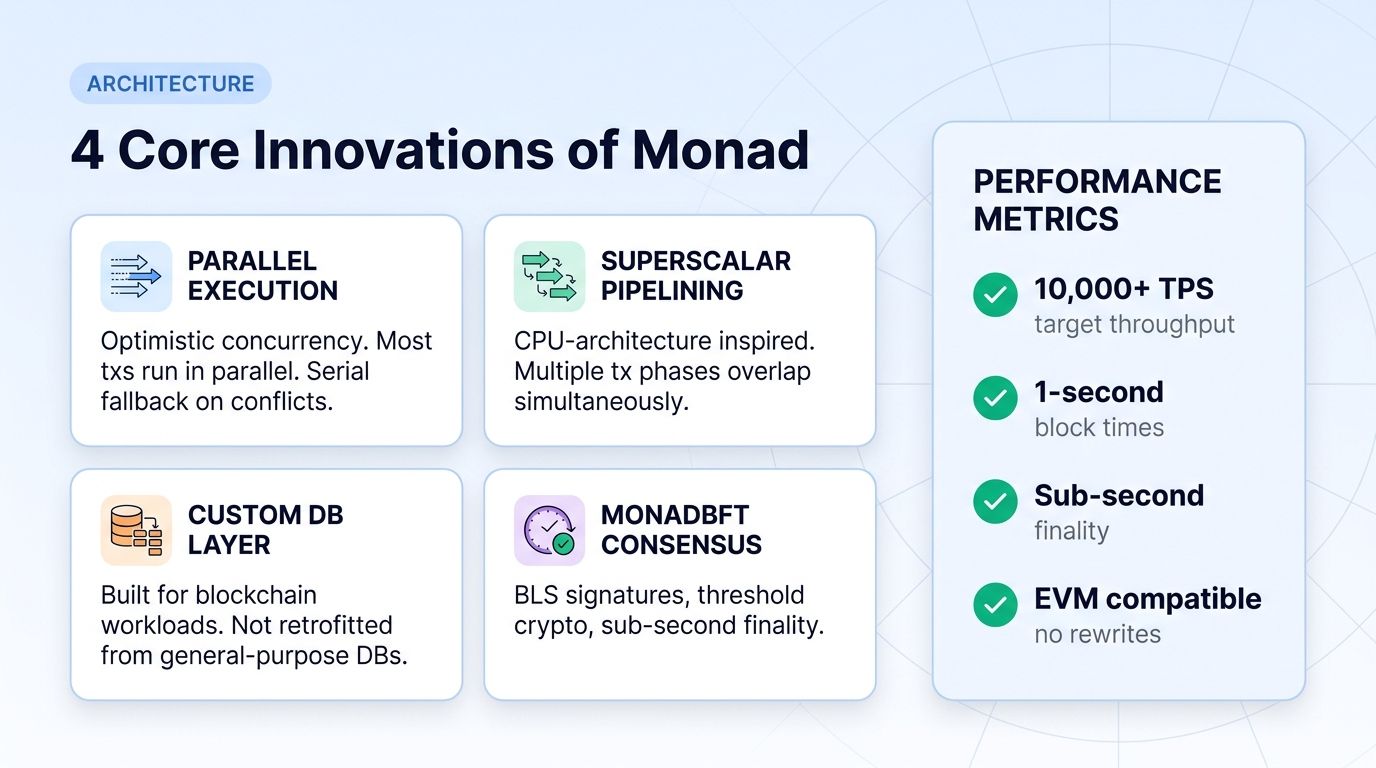
Four core innovations enable Monad's performance.
Innovation 1: Optimistic Parallel Execution
Most blockchains execute transactions sequentially. Monad uses optimistic parallel execution: transactions are executed in parallel where possible, with conflict detection and rollback mechanisms for cases where parallel execution produces inconsistent results.
The approach is similar to optimistic concurrency control in databases. It assumes most transactions do not conflict (which is true for most workloads) and falls back to serial execution only when conflicts are detected. The result is dramatically higher throughput for typical workloads.
Innovation 2: Superscalar Pipelining
Borrowed from modern CPU architecture, superscalar pipelining executes multiple instructions per cycle. Applied to blockchain execution, this means multiple transaction phases (signature verification, state access, state update, finalization) can overlap rather than waiting for each to complete sequentially.
The technique is well-understood in computer architecture but novel in blockchain design. Implementing it requires careful coordination between the consensus, execution, and state management layers.
Innovation 3: Custom Database Layer
Most EVM chains use general-purpose key-value databases (LevelDB, RocksDB) that were not designed for blockchain workloads. Monad uses a custom database optimized for blockchain access patterns: heavy reads, append-only writes, specific data structures.
The custom database produces meaningful performance gains during high-throughput operation.
Innovation 4: MonadBFT Consensus
The consensus protocol (MonadBFT) is optimized for high throughput and low latency. It uses BLS signatures, threshold cryptography, and other modern primitives to achieve sub-second finality with relatively low validator coordination overhead.
The combination of these four innovations produces Monad's headline performance numbers.
The MON Token Economics
MON is the native token of the Monad blockchain. It serves multiple functions.
Gas and fee payment. All transactions on Monad pay fees in MON. As network activity grows, MON demand grows.
Staking and security. Validators stake MON to participate in consensus. The total staked MON secures the network. Stakers earn rewards from network emissions.
Governance. MON holders participate in protocol governance for upgrades, fee parameters, and ecosystem decisions.
Liquidity for DeFi protocols. As more DeFi protocols launch on Monad, MON serves as the base trading and liquidity asset for many pools.
The exact token economics (total supply, vesting schedules, validator emissions) were established at mainnet launch. By May 2026, MON has been trading on major exchanges for several months, with price discovery still in early stages.
The May 2026 Catalysts
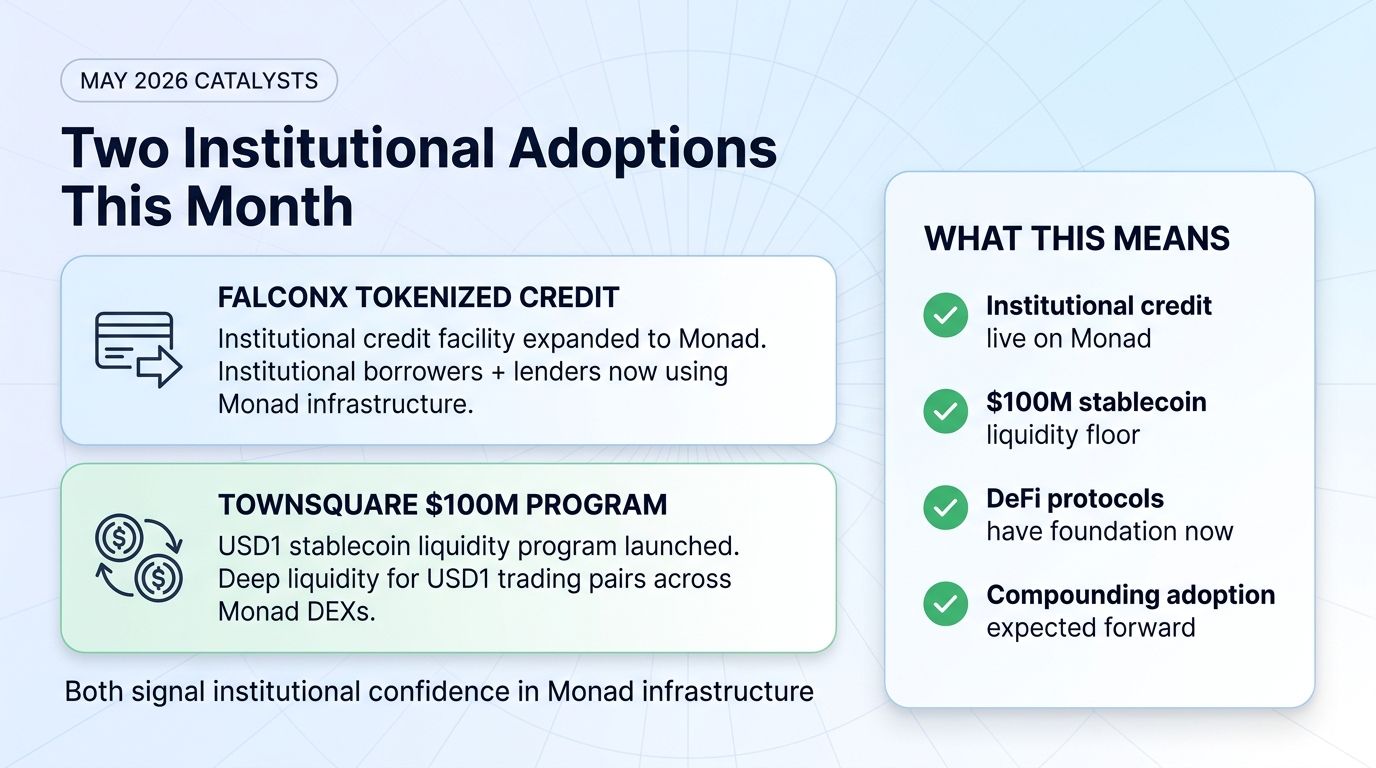
Two specific developments in May 2026 are worth attention.
Catalyst 1: FalconX Tokenized Credit Facility
FalconX, a major institutional crypto trading firm, expanded its tokenized credit facility to Monad in May 2026. This means institutional borrowers and lenders can use Monad-based tokenized credit instruments through FalconX's platform.
The significance: institutional credit infrastructure is now operational on Monad. This validates the network for institutional-scale activity and opens additional use cases for DeFi protocols building on top.
Catalyst 2: TownSquare $100M USD1 Liquidity Program
TownSquare launched a $100 million liquidity program for the USD1 stablecoin on Monad in May 2026. The program provides deep liquidity for USD1 trading pairs across Monad DEXs.
The significance: deep stablecoin liquidity is a prerequisite for serious DeFi activity. The $100M program addresses one of the gaps that has historically limited new L1 ecosystems.
Together, these catalysts represent institutional commitment to Monad infrastructure. As more institutional partnerships launch, the network's credibility and activity should compound.
How Monad Compares to Other High-Performance L1s
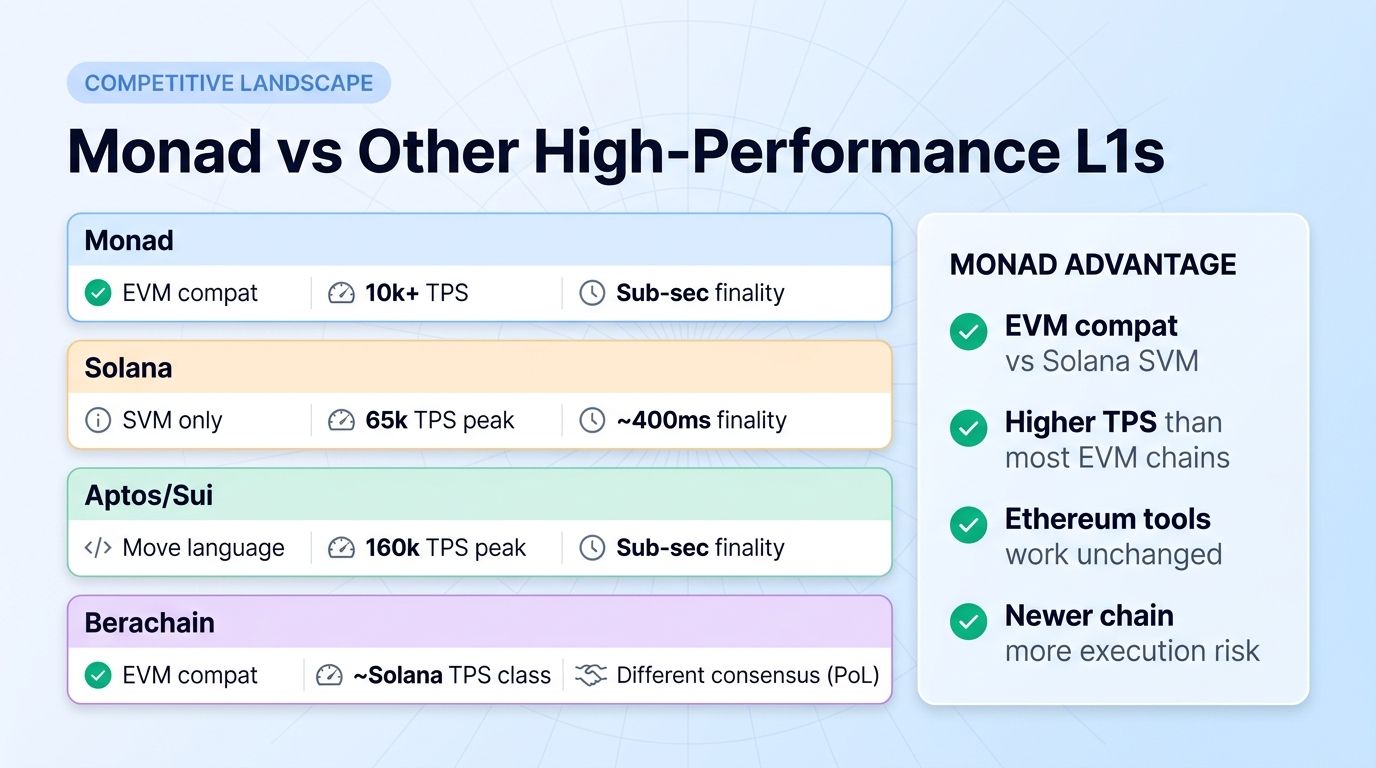
The high-performance L1 landscape includes several major competitors.
Monad vs Solana
Solana is the dominant high-performance L1 by activity. SOL has years of operating history, billions in TVL, massive memecoin and trading ecosystems, and broad developer adoption.
Monad differs in two key ways: - EVM compatibility: Monad runs unchanged Ethereum smart contracts. Solana uses Rust-based Sealevel runtime. This makes Monad more accessible to existing Ethereum developers. - Architecture: Solana uses Proof of History (PoH) and various other innovations. Monad uses parallel execution + pipelining. Different design philosophies, similar performance goals.
For traders, both networks are credible. SOL has more mature ecosystem; MON has stronger Ethereum-compatibility story.
Monad vs Aptos and Sui
Aptos and Sui both use the Move programming language (originally developed for Meta's Diem project). They focus on safety-oriented financial applications.
Monad's EVM compatibility versus Aptos/Sui's Move language is the key trade-off. EVM has larger existing ecosystem; Move has stronger safety guarantees.
Monad vs Ethereum L2s
Ethereum L2 rollups (Arbitrum, Optimism, Base, ZKsync, others) provide scaling while remaining tightly coupled to Ethereum. They share Ethereum's security but inherit some performance constraints.
Monad provides full L1 sovereignty with comparable EVM compatibility. The trade-off is security model: L2s inherit Ethereum security; Monad has its own validator set.
Monad vs Berachain
Berachain (covered in another article in this series) is another EVM-compatible high-performance chain that launched in early 2025. Berachain uses a unique proof-of-liquidity consensus mechanism.
Monad and Berachain are direct competitors for the "EVM-compatible high-performance L1" position. Monad has more raw performance focus; Berachain has more novel economic design. Both target similar developer audiences.
How Traders Can Get Monad Exposure
Three practical paths.
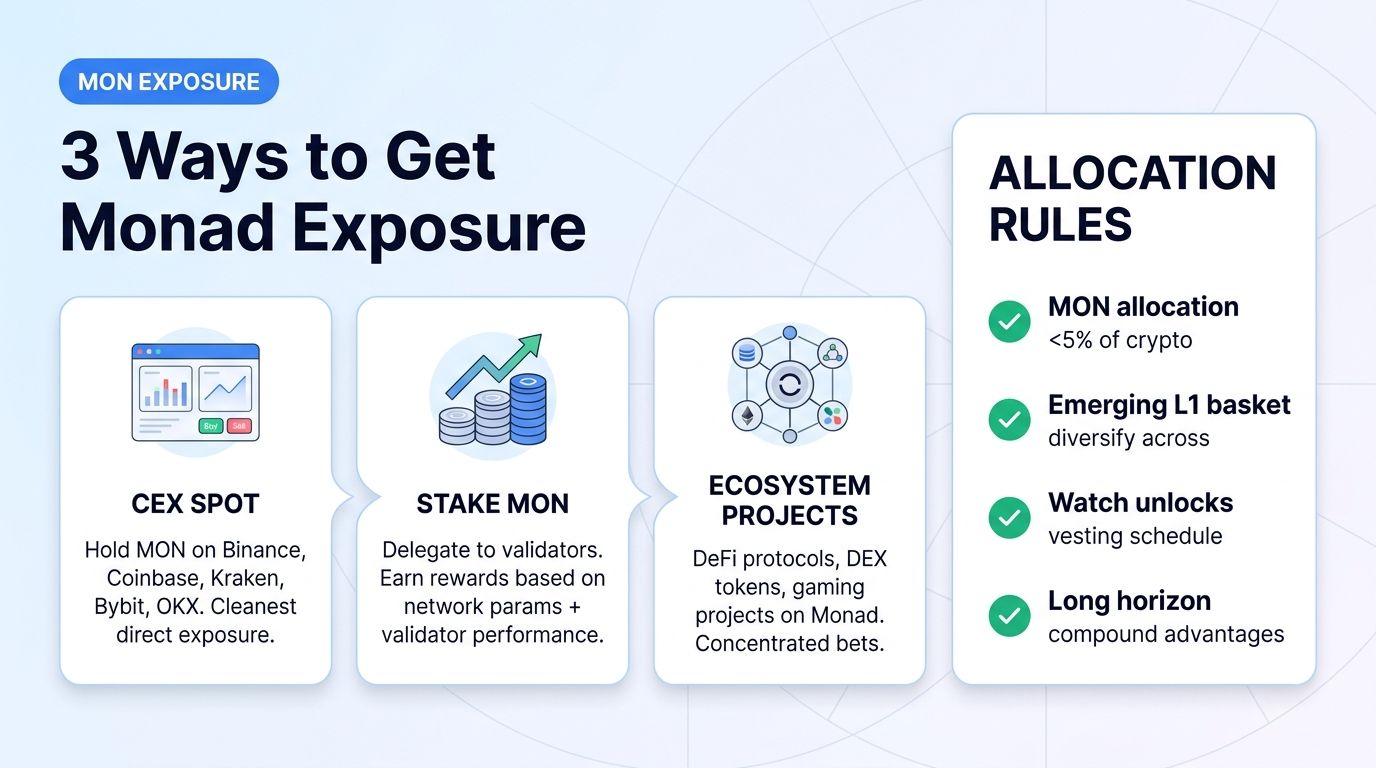
Path 1: Hold MON on a centralized exchange. MON trades on major CEXs including Binance, Coinbase, Kraken, Bybit, OKX. This provides clean direct exposure to Monad. A platform like Altrady connects to 19+ exchanges, allowing unified MON position management across venues.
Path 2: Stake MON to validators. Holding MON and delegating to a validator earns staking rewards. Specific yields depend on validator performance and network parameters.
Path 3: Hold tokens of Monad ecosystem projects. As DeFi protocols, DEXs, and other projects launch on Monad, their tokens provide concentrated exposure to specific ecosystem segments. Early ecosystem tokens often have higher upside but higher risk than MON itself.
The Risks of Monad Investing
Competitive pressure. The high-performance L1 category is crowded: Solana, Aptos, Sui, Berachain, multiple Ethereum L2s. Even with strong technology, Monad faces sustained competitive pressure.
Adoption timing. Mainnet launched in November 2025. By May 2026, the ecosystem is still building. Adoption may take 12-24 months to mature. Investing too early carries the risk of holding through extended consolidation periods.
Token unlock pressure. MON has multi-year vesting schedules. Unlocks can create supply pressure that affects price during the unlock periods.
Technical risk. Despite strong engineering, complex L1 systems can experience bugs, network halts, or unexpected behavior during initial high-load conditions.
Macro sensitivity. As a higher-beta asset, MON is more sensitive to broader crypto market conditions than BTC or ETH. In risk-off environments, MON typically falls more than the largest tokens.
Ecosystem dependence. Monad's value depends heavily on which DeFi protocols and applications choose to deploy. If major protocols stay on Ethereum or migrate elsewhere, network usage stagnates.
How Monad Fits Into a Crypto Portfolio
A practical framework:
- Core large-cap holdings (BTC, ETH): 50-65% of crypto allocation
- Large alt-L1 exposure (SOL primarily): 10-20%
- Emerging high-performance L1 basket (MON, BERA, Aptos, Sui): 5-15%. Diversify across multiple emerging L1s rather than concentrating in one.
- Ecosystem project tokens: 5-10%. Concentrated positions on specific protocols.
- Cash reserves: 5-15%.
MON allocation within total portfolio rarely exceeds 5% for most traders due to the competitive pressures and execution risks in the L1 space.
The 2026 Outlook for Monad
Three factors will determine Monad's trajectory in 2026.
Factor 1: DeFi protocol launches. If major DeFi protocols (DEXs, lending, derivatives) launch on Monad, network usage compounds. The institutional catalysts (FalconX, TownSquare) are positive signals.
Factor 2: Developer adoption. Monad's EVM compatibility is a major advantage, but actual developer migration takes time. Hackathons, grants, and ecosystem programs accelerate this.
Factor 3: Performance proof points. Real high-throughput applications need to demonstrate that Monad's performance claims translate to user experience. If applications struggle with on-chain performance, the thesis weakens.
If these factors trend positively, MON could outperform broader crypto in 2026. If they stagnate, MON underperforms.
FAQ
Is Monad a good investment in 2026?
This depends on your view of the high-performance L1 thesis and Monad's specific positioning. MON has strong technology and growing institutional support, but the competitive landscape is crowded. Sizing positions to a level where worst-case outcomes do not damage your portfolio is the standard approach.
How is Monad different from Ethereum?
Ethereum is the original EVM-compatible L1 with the largest ecosystem and strongest security model. Monad is a newer EVM-compatible L1 with higher throughput and lower latency. Monad sacrifices some decentralization and security maturity in exchange for performance. The two networks compete for different use cases but share the same developer toolchain.
What is the realistic ROI for staking MON?
Staking yields depend on validator performance, network parameters, and total MON staked. Typical yields for newer high-performance L1s range 5-12% APY in the first year, with rates moderating as network usage matures.
Will Monad replace Solana?
Unlikely in the near term. Solana has years of operating history, billions in TVL, massive developer momentum, and broad user base. Monad and Solana more likely coexist, serving overlapping but different developer communities (EVM developers gravitating to Monad, Rust developers to Solana).
Can I trade MON on Altrady?
Yes. MON is listed on Binance, Coinbase, Kraken, Bybit, OKX, and other major exchanges. Altrady connects to 19+ exchanges, so you can manage MON positions alongside other crypto holdings, run automated strategies via the signal bot, grid bot, or DCA bot, and use unified portfolio tracking.
Conclusion
Monad has emerged as one of the most credible high-performance L1 launches of the 2025-2026 cycle. The combination of 10,000+ TPS, full EVM compatibility, strong institutional backing ($225M raised), and growing partnership network (FalconX, TownSquare, others) positions the network for sustained relevance.
For traders, the practical takeaway is this: MON is a legitimate position in the emerging-L1 basket, with specific upside if the EVM-compatible high-performance thesis plays out. The risks are real (competitive pressure, adoption timing, token unlocks) but the architectural foundation is sound and the institutional signals are constructive.
The longer-term question is whether Monad can capture meaningful share of the EVM developer ecosystem from Ethereum and existing L2s. The combination of compatibility (no developer retraining required) and performance (10x+ higher throughput) creates a compelling pitch. Whether developers and protocols actually migrate determines the ultimate outcome.
The next 12 months will produce decisive data. Continued institutional partnerships, increased DeFi TVL, growing transaction counts, and major protocol deployments would all validate the thesis. Slowing momentum on any of these would suggest the competitive pressure is winning. Either way, Monad is one of the most important L1 launches to watch in the current cycle.