
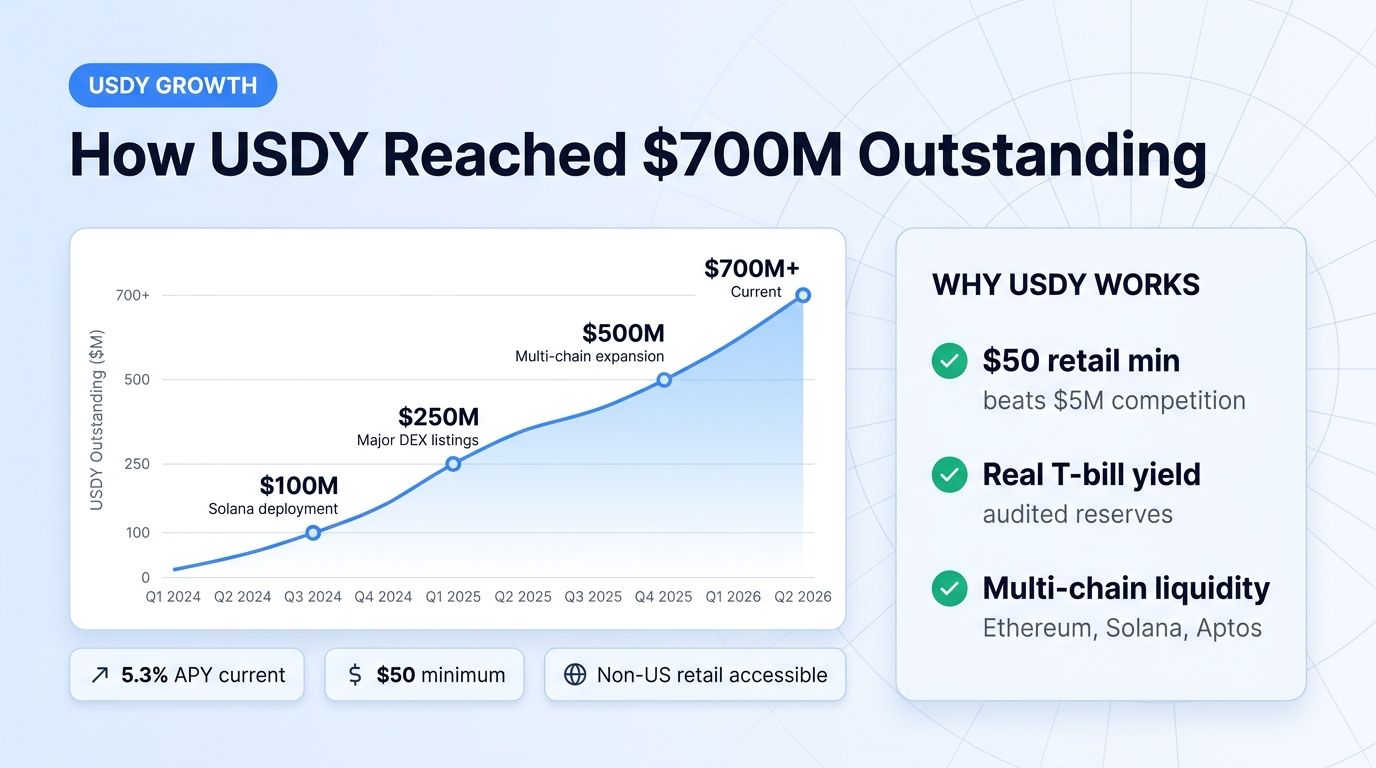
Tokenized US Treasuries grew from a curious experiment to an $8.7 billion category in less than two years. The largest single product in the space, by tokens distributed to retail and accessible globally, is Ondo Finance's USDY. By April 2026, USDY had crossed $700 million in tokens outstanding, with the broader Ondo ecosystem managing well over $1.4 billion in tokenized real-world assets.
Ondo built the bridge that retail crypto traders had been waiting for. T-bill yields paid directly to a token in your wallet, with no brokerage account, no settlement delays, no minimum deposits beyond $50, and 24/7 trading on global DEXs and CEXs.
This guide explains what Ondo Finance does, the difference between USDY and OUSG, the ONDO governance token, how Ondo Chain fits in, and the practical paths for traders to use Ondo products as yield-bearing capital.
What Is Ondo Finance?
Ondo Finance is a financial technology company building tokenized versions of traditional securities. The flagship products are USDY (yield-bearing US dollar) and OUSG (Ondo Short-Term US Government Treasuries Fund).
Both products represent claims on portfolios of short-duration US Treasury bills, with the interest passing through to token holders. The difference is in eligibility and structure.
USDY is designed for non-US retail holders. Anyone outside the United States with a wallet and KYC clearance can hold USDY. The token earns yield from the underlying T-bills automatically, distributed through a daily-rebasing token model where the redemption value of each USDY increases over time.
OUSG is designed for accredited investors. It requires US securities accreditation, higher minimum sizes, and provides direct exposure to BlackRock's BUIDL fund (which holds Treasury bills). OUSG is more institutional in orientation.
By April 2026, USDY had grown to over $700 million outstanding, with OUSG holding several hundred million more in institutional assets.
Why Ondo Matters in 2026
Note: Beyond tokenized treasuries, the broader tokenized RWA category includes tokenized equity (publicly traded stocks as blockchain tokens), which faces ongoing US regulatory uncertainty under the delayed SEC Innovation Exemption framework.
Three structural advantages.
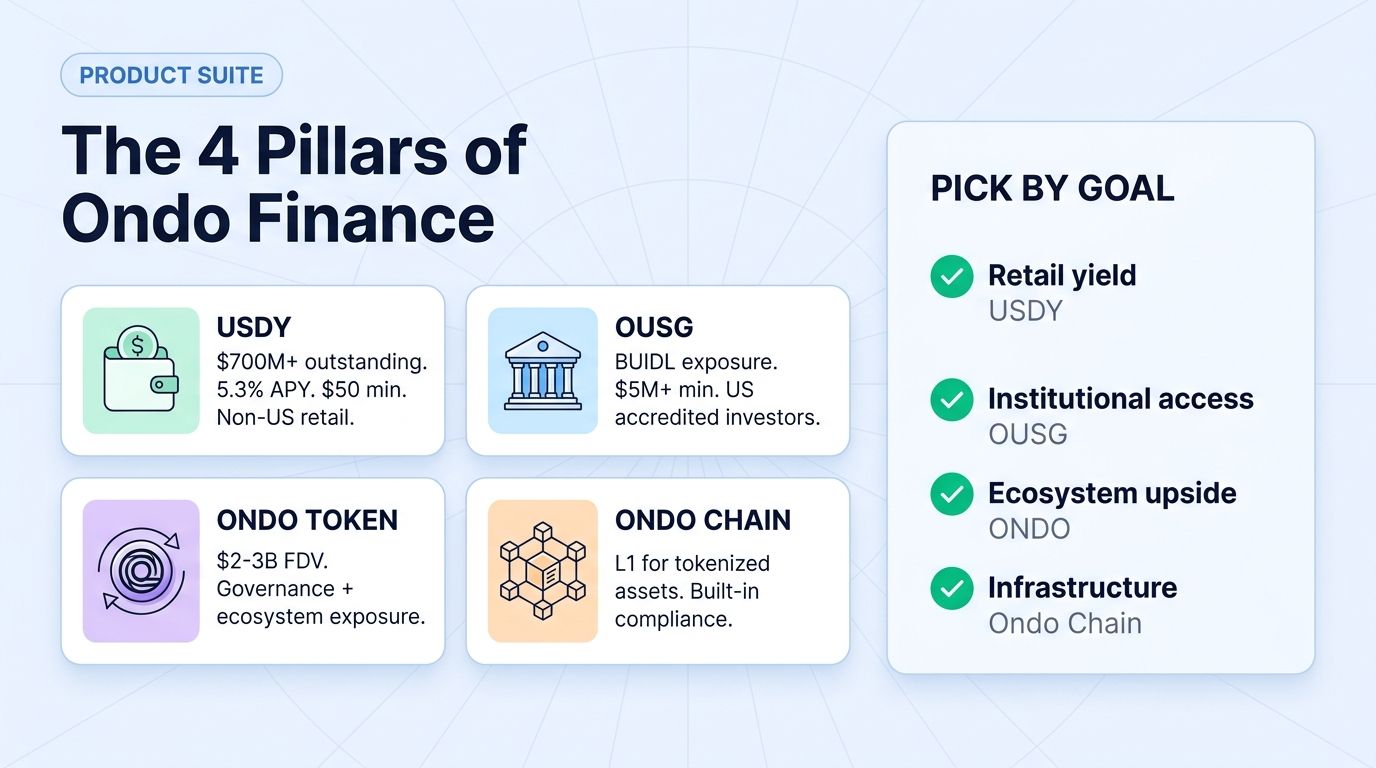
First, USDY is retail-accessible. With a $50 minimum and KYC requirements that work for most non-US jurisdictions, the product opens tokenized Treasury yield to a global audience. Competitors like BlackRock BUIDL require $5 million minimums and US accreditation, locking out 99% of retail.
Second, the yield is real. USDY pays approximately 5.3% APY as of late 2025, with the rate moving in lockstep with short-duration T-bill yields. Compared to USDC (0% to holders) or money market funds in retail banking (often 4-5% with friction), USDY's tokenized format is competitive.
Third, the infrastructure is robust. Ondo partners with Ankura Trust as the custodian for the underlying Treasuries. The legal structure separates customer assets in segregated trusts. Third-party audits confirm reserves. Compared to many tokenized RWA experiments, Ondo's structure is one of the most institutionally credible.
By 2026, Ondo had also launched Ondo Chain, a Layer 1 blockchain optimized for institutional-grade tokenized assets, expanding the company's strategic position beyond just issuing tokens.
The Ondo Product Suite
USDY (Yield-Bearing US Dollar)
USDY represents a claim on short-duration US Treasuries. The token's value grows daily as Treasury interest accrues. Token holders can: - Hold USDY in any wallet supporting the token - Transfer it peer-to-peer - Use it as collateral on DeFi protocols (where supported) - Redeem it 1:1 for USDC at any time during business hours, subject to issuer minimums
USDY launched in mid-2023 and grew to over $700 million by April 2026. It is available on Ethereum, Solana, Aptos, and several other chains. The token requires KYC for direct minting but trades freely on secondary markets once issued.
OUSG (Ondo Short-Term Government)
OUSG is designed for institutional and accredited investor use. The product gives direct exposure to BlackRock's BUIDL fund, which holds short-duration Treasury bills.
OUSG holders earn the same Treasury yield as USDY but in a structure designed for US-eligible institutional participants. Minimum sizes are higher (typically $100,000+), and the legal structure is registered as a security in the relevant jurisdictions.
ONDO Governance Token
ONDO is the governance token of the Ondo Finance protocol. Holders participate in protocol governance, including decisions about new products, fee structures, and Ondo Chain parameters.
ONDO is not a yield-bearing token. It does not pay holders Treasury interest. The token's value depends on the future success of the Ondo ecosystem: more tokenized RWAs issued, more transaction volume, more services running on Ondo Chain.
By April 2026, ONDO had grown to approximately $2-3 billion in fully diluted market cap, making it one of the larger RWA-themed governance tokens in crypto.
Ondo Chain
Ondo Chain is a Layer 1 blockchain optimized for institutional tokenized assets. The chain features: - Built-in compliance tooling (KYC, transfer restrictions, regulatory reporting) - Native support for tokenized securities - Permissioned validator set in some configurations - Integration with traditional financial infrastructure
Ondo Chain launched mainnet in late 2025 and serves as the foundation for the next generation of Ondo's products. It positions the company beyond just issuing tokens to being a full infrastructure provider for tokenized RWAs.
How to Access Ondo Products
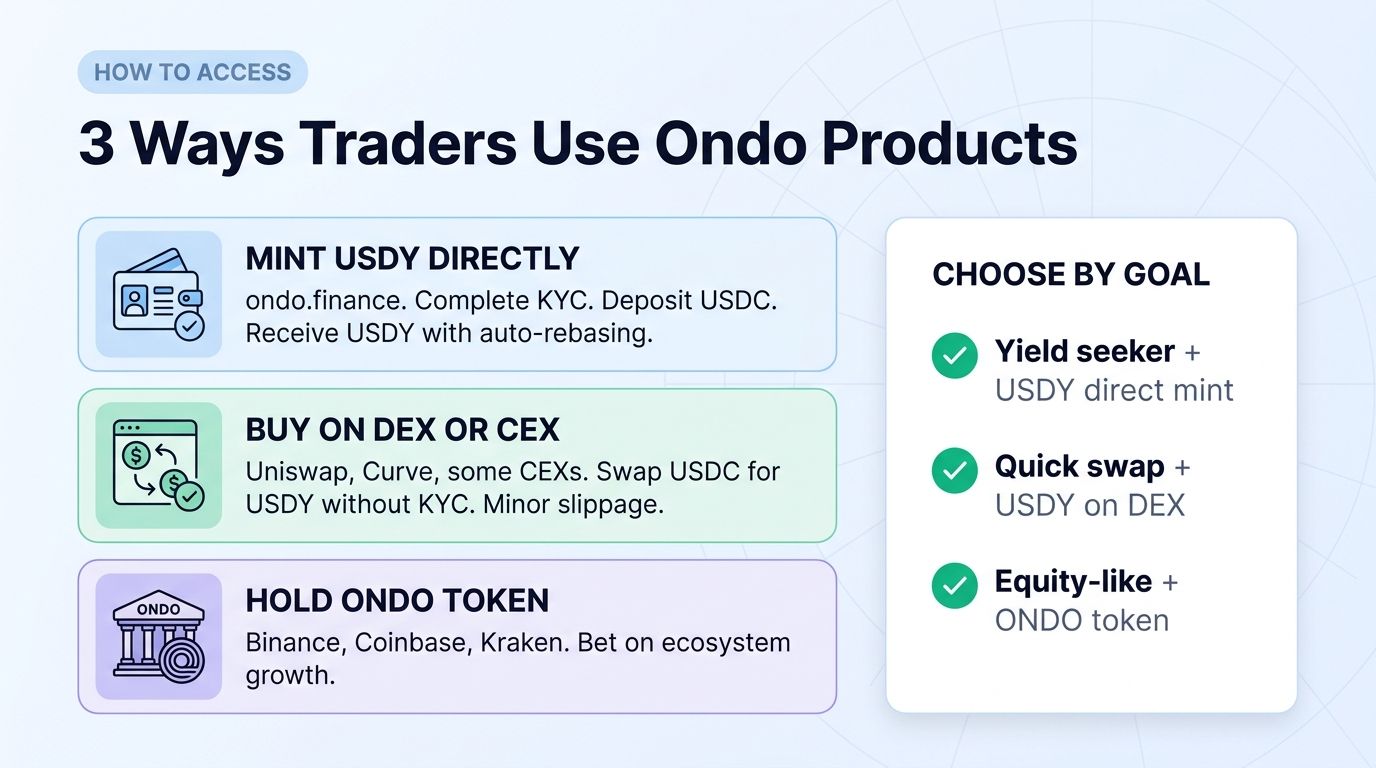
Three practical paths.
Path 1: Mint USDY directly from Ondo. Go to ondo.finance, complete KYC, deposit USDC. Receive USDY in your wallet. Yield accrues automatically through daily rebasing. Redemption back to USDC happens during business hours, typically within 24 hours of request.
Path 2: Buy USDY on a DEX or CEX. USDY trades on Uniswap, Curve, Aerodrome, and various other DEXs. It is also listed on some CEXs. You can swap USDC directly for USDY without going through KYC, though large amounts may benefit from direct minting.
Path 3: Hold ONDO governance token for ecosystem exposure. If your thesis is on the future growth of Ondo Finance as a company, holding ONDO gives you direct exposure to that thesis. ONDO trades on Binance, Coinbase, Kraken, and most major exchanges. A crypto trading platform like Altrady connects to 19+ exchanges, so you can manage ONDO positions alongside your other crypto holdings, run automated strategies, and view your full portfolio in one dashboard.
The Risks of Ondo Products
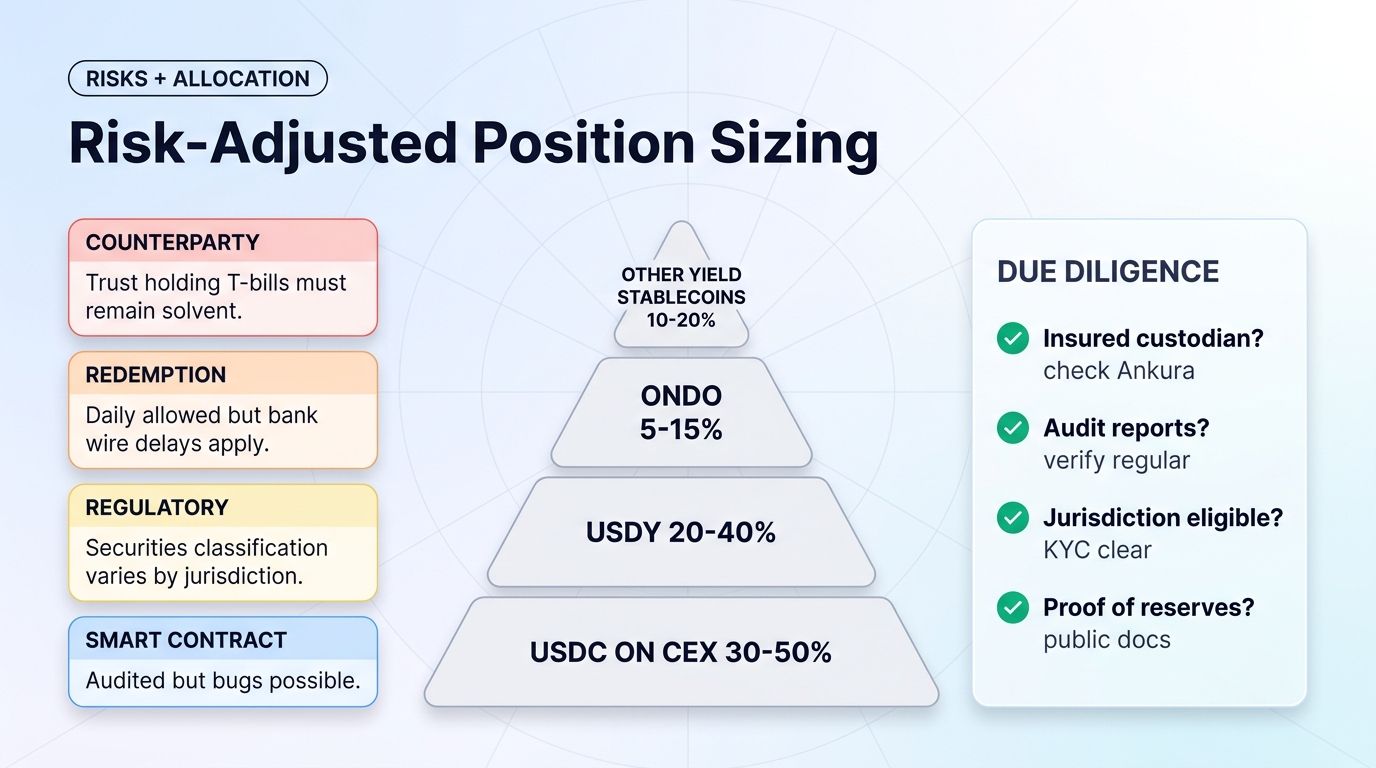
Counterparty risk. USDY's value depends on the trust holding the underlying Treasuries (Ankura Trust). If the trust fails or is misadministered, token holders are unsecured creditors. Always verify the latest published proof-of-reserves and audit reports before committing significant capital.
Redemption risk. While USDY allows daily redemption, the process is not instant. Bank wire delays, business-hour limits, and minimum redemption sizes can slow exits. In normal markets, redemption is straightforward. In stressed markets, gates could be activated.
Regulatory risk. Tokenized Treasuries are securities in most jurisdictions. The current SEC and EU MiCA frameworks accommodate them, but regulatory changes could affect eligibility, taxation, or availability in specific countries.
Smart contract risk. USDY exists as smart contracts on multiple chains. Bugs in those contracts, or in the bridges that move USDY between chains, could affect token holders. Audits help but do not eliminate this risk.
ONDO token risk. ONDO is a governance token, not yield-bearing. Its value depends on Ondo Finance's continued success and the broader RWA narrative. ONDO can lose significant value even if USDY continues to function correctly.
How Ondo Products Fit Into a Trading Strategy
A practical framework:
- Active trading capital (USDC on CEX): 30-50%. Immediate availability for trades.
- Yield-bearing reserve (USDY): 20-40%. Earn 5%+ APY on capital waiting for opportunities. Slight friction to redeem but easy to swap to USDC.
- RWA narrative exposure (ONDO): 5-15%. Equity-like exposure to the Ondo ecosystem growth.
- Other yield-bearing stablecoins (sUSDS, USDe): 10-20%. Diversification across yield sources.
Most professional traders run multiple yield-bearing positions in parallel rather than concentrating in one product. USDY's role is as the conservative Treasury-backed leg of the portfolio, complementing higher-yield products like delta-neutral stablecoins or lending-based tokens.
FAQ
What is the yield on USDY?
In 2026, USDY pays approximately 5.3% APY, tracking short-duration US Treasury bill yields minus a small protocol fee. The rate moves with Treasury yields, so it can rise or fall depending on Federal Reserve policy and money market conditions.
Is USDY available in the US?
USDY is designed for non-US holders. US residents typically cannot directly mint USDY. Instead, US-eligible investors can use OUSG, which is structured for accredited US participants.
What is the difference between USDY and BlackRock BUIDL?
BUIDL is BlackRock's tokenized money market fund. It pays Treasury yield similarly to USDY but requires $5 million minimum investments and is restricted to qualified investors. USDY is retail-accessible with $50 minimums and serves non-US individual investors.
How does Ondo verify reserves?
Ondo partners with Ankura Trust as the custodian and publishes regular third-party audit reports verifying the underlying Treasury holdings. The reports show the specific T-bills held, total face value, and any associated cash. This is the closest thing to proof-of-reserves available for tokenized Treasuries.
Can I trade ONDO on Altrady?
Yes. ONDO is listed on Binance, Coinbase, Kraken, KuCoin, Bybit, and most major exchanges. Altrady connects to 19+ exchanges, so you can manage ONDO positions alongside other crypto holdings, set up automated trading via the signal bot or DCA bot, and use unified portfolio tracking.
Conclusion
Ondo Finance built the most retail-accessible tokenized Treasury product in crypto. USDY's $700+ million outstanding, the OUSG institutional product, the ONDO governance token, and Ondo Chain together make the company one of the dominant players in the broader RWA tokenization category.
For traders, the practical takeaway is this: USDY is the simplest way to earn 5%+ APY on stablecoin capital without complex strategies or accreditation requirements. ONDO is a higher-risk position tied to the company's continued growth. Together they offer a clear way to participate in the RWA narrative that has driven much of 2025-2026's institutional crypto adoption.
The tokenization narrative will continue to compound as more traditional assets move on-chain. Ondo's position as a category leader in tokenized Treasuries gives it both the upside of being first and the risk of facing increasing competition from BlackRock, Franklin Templeton, and the next generation of fintech entrants.