
Most crypto traders know two states. Either they hold volatile tokens and watch the chart, or they park stablecoins and earn yield that depends on demand for borrowing. There is a third option that most retail traders ignore until it shows up in their feed: tokenized real-world assets, or RWAs.
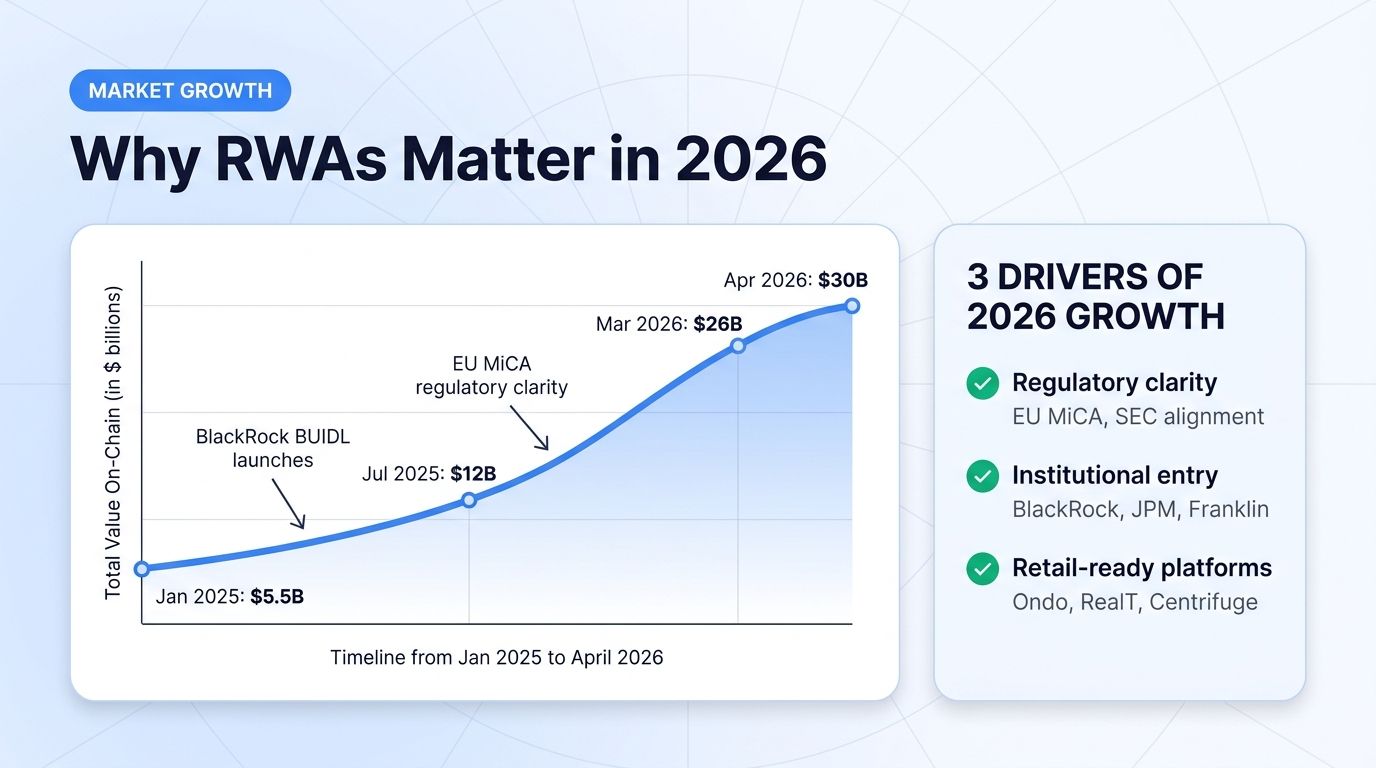
RWAs are not a small experiment anymore. By April 2026, on-chain tokenized assets crossed $30 billion in total value, up from roughly $5.5 billion at the start of 2025. BlackRock, Franklin Templeton, JP Morgan, and Goldman Sachs are all running tokenized products. US Treasury bills alone now sit at $8.7 billion on-chain, which is around 45% of the entire RWA market.
If you trade crypto and you do not understand RWAs, you are skipping a category that delivered 185% in average price returns through 2025 and is now drawing institutional flows. This guide explains what RWAs are, the main categories, how retail traders can access them, and the specific risks you need to think about before you commit capital.
What Is an RWA in Crypto?
A real-world asset, in crypto context, is a token on a blockchain that represents legal ownership or claim to something off-chain. The off-chain thing can be a US Treasury bill, a kilogram of gold sitting in a London vault, a fractional share of a rental property in Detroit, or a private credit loan to a small business.
The token is the digital wrapper. The underlying asset stays in the traditional system, custody and legal framework intact. What changes is how you access it: instead of a brokerage account, a wire transfer, and settlement delays, you hold the token in a crypto wallet and trade it on a DEX or a centralized exchange that lists it.
A simple example. Ondo Finance issues USDY, a token backed by short-duration US Treasuries. When you hold 1,000 USDY, you have a claim on roughly $1,000 worth of T-bills sitting with a custodian, and you earn the yield those T-bills generate. That yield was around 5.3% APY as of late 2025. You can move USDY to another wallet, send it to a friend, or use it as collateral, all without touching the underlying Treasury system.
Why RWAs Matter in 2026
Note: SEC Chair Paul Atkins tokenized stocks Innovation Exemption framework was one of 2026's most-watched RWA milestones before being delayed in May 2026 following pushback from incumbent exchanges.
Three forces converged this cycle.
First, regulatory clarity arrived. The SEC has settled on treating most tokenized securities under existing securities law. The EU's MiCA framework, the eWpG in Germany, and Singapore's regime all give institutions a path to issue tokenized products without legal limbo. That alone unblocked billions in institutional capital.
Second, institutional issuers entered. BlackRock's BUIDL fund hit $520 million in 40 days after launch and now holds approximately $2.8-2.9 billion in AUM. The fund's swift rise to about 45% market share signaled to every other asset manager that on-chain Treasury exposure has demand.
Third, retail platforms matured. Ondo, RealT, Maple, and Centrifuge built front-ends and KYC flows that work for non-institutional capital. Real estate fractions start at $50 on RealT. USDY entry is similar. Gas costs dropped because most RWA issuers moved to Polygon, Arbitrum, or Stellar for retail tiers.
The market reflects this. The RWA narrative was the most profitable crypto narrative of 2025 by average return. Token prices in the category are correlated with TVL growth, not with broader crypto sentiment, which makes them useful for portfolio diversification.
The Four Main Categories of RWA
Tokenized Treasuries and Money Market Funds
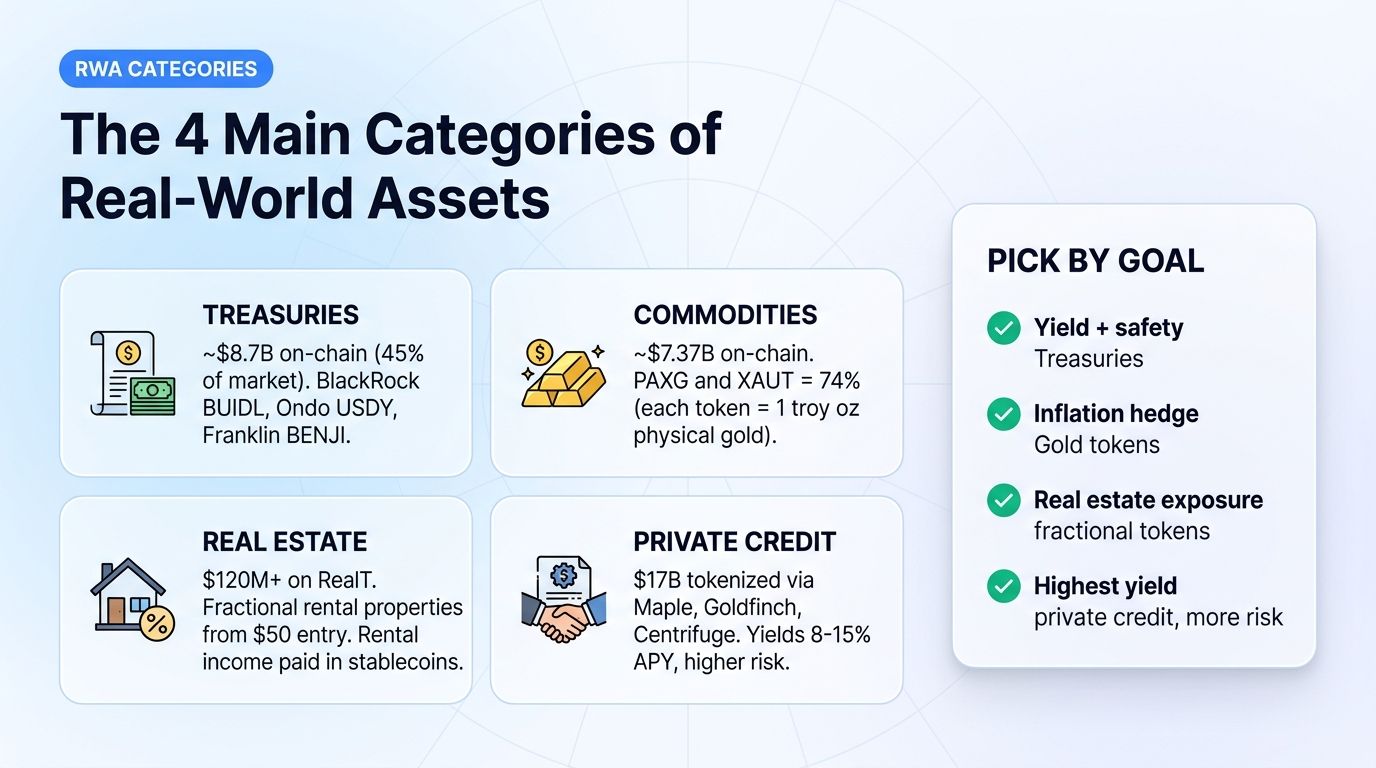
This is the largest category, around $8.7 billion on-chain. Products include BlackRock BUIDL, Franklin Templeton's BENJI, Ondo USDY, and Hashnote USYC. The economics are simple: hold the token, earn the yield that the underlying T-bills generate, redeem to USDC or USD on demand.
For retail, the key entry points are Ondo USDY ($50 minimum, no accreditation required in most jurisdictions) and Ondo OUSG (US-only, accredited investors only). BlackRock BUIDL requires $5 million minimum, so retail is locked out.
Tokenized Commodities
The commodity category reached approximately $7.37 billion in early April 2026. Almost all of it is gold. Tether Gold (XAUT) and Paxos Gold (PAXG) together hold about 74% of the category, with XAUT at $2.7 billion and PAXG at $2.4 billion. Each token represents one troy ounce of physical gold stored in vaults.
For traders, PAXG and XAUT are the cleanest way to hold gold exposure in crypto, with the bonus that they trade 24/7 on major exchanges. Altrady already covers the broader topic in its tokenized gold guide.
Tokenized Real Estate
Smaller in size, around $120 million on-chain via RealT alone, but the fastest-growing in retail accessibility. RealT has tokenized over $120 million in US rental properties, with each property fractionalized into tokens starting at $50. Investors receive rental income in stablecoins, distributed automatically via smart contracts on Gnosis Chain.
Lofty, Tangible, and Propy run similar models on Algorand, Polygon, and Ethereum respectively. Real estate is the hardest RWA category because the underlying asset is illiquid, redemption is rare, and you are trusting the issuer to manage the property.
Tokenized Private Credit
Private credit, meaning loans to businesses outside the traditional banking system, has been tokenized at roughly $17 billion across protocols like Maple Finance, Goldfinch, and Centrifuge. Borrowers are typically fintech companies, emerging market businesses, or trade finance operations. Lenders are crypto-native or institutional pools chasing higher yields than Treasuries offer.
Yields run from 8% to 15% APY depending on the borrower's risk tier. Defaults happen, and recovery is slow. Private credit is the highest-yield RWA category and also the highest-risk.
How Retail Traders Can Access RWAs
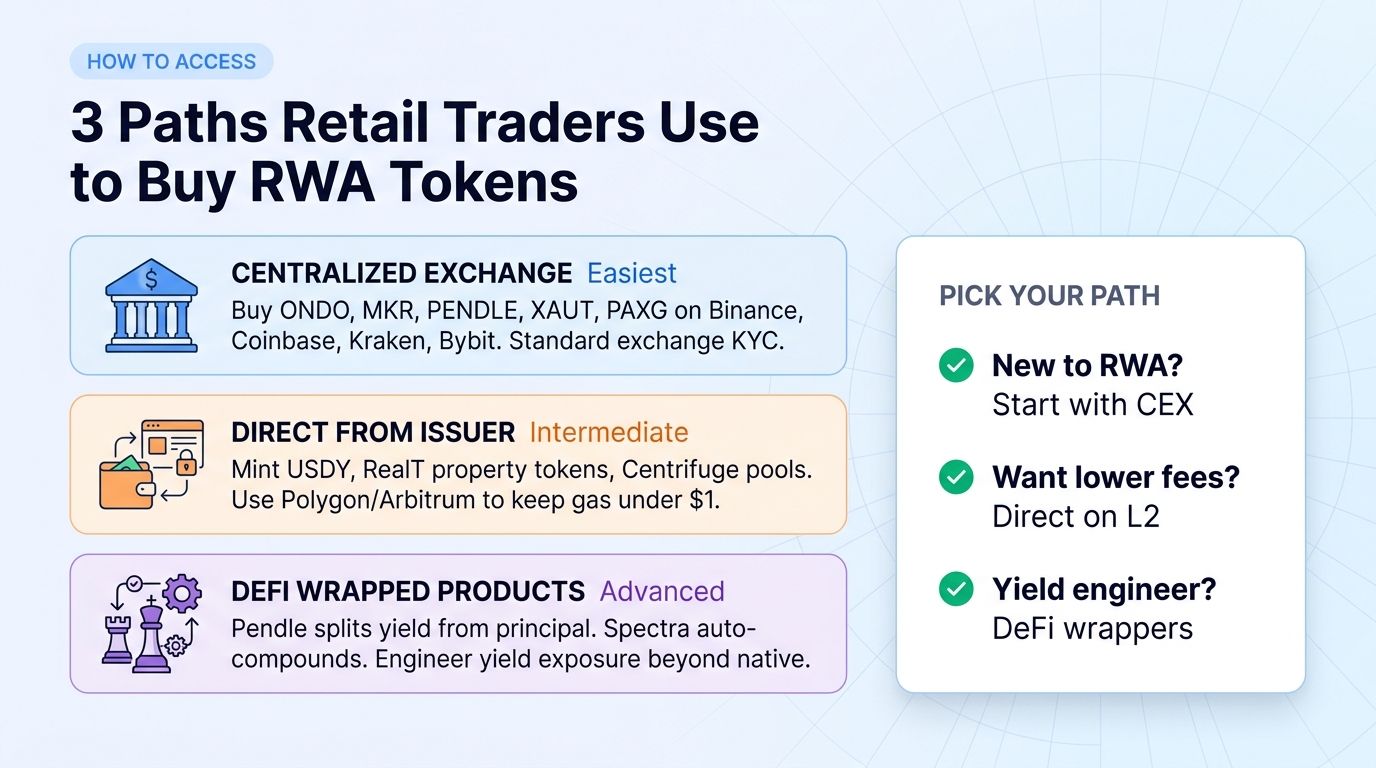
Three paths, ranked from easiest to most involved.
Path 1: Buy RWA tokens on a centralized exchange. Binance, Coinbase, Kraken, and Bybit list the most liquid RWA tokens, including ONDO, MKR, PENDLE, XAUT, and PAXG. You buy with USD or USDT. No KYC beyond the exchange's standard onboarding. This is the same as buying any other crypto asset. If you already manage your trades across multiple exchanges, a crypto trading platform like Altrady lets you see your RWA positions alongside your other holdings in one dashboard, and run automated strategies on liquid RWA tokens through native bots like the signal bot or DCA bot.
Path 2: Mint RWA tokens directly from the issuer. Ondo, RealT, and Centrifuge accept stablecoins from your wallet, run their own KYC, and mint tokens to you. This is the pure on-chain path. Use Polygon or Arbitrum to keep gas under a dollar. Ethereum mainnet transfers can cost $10 to $30, which kills the math on small entries.
Path 3: DeFi-native exposure via wrapped products. Pendle splits yield-bearing tokens into principal and yield components, letting you trade either separately. Spectra and Beefy offer auto-compounding strategies on top of RWA primitives. This path is for experienced DeFi users who want to engineer yield exposure beyond what the issuer offers natively.
The Risks You Need to Understand
RWAs introduce risks that pure crypto-native tokens do not have, plus all the risks crypto already has.
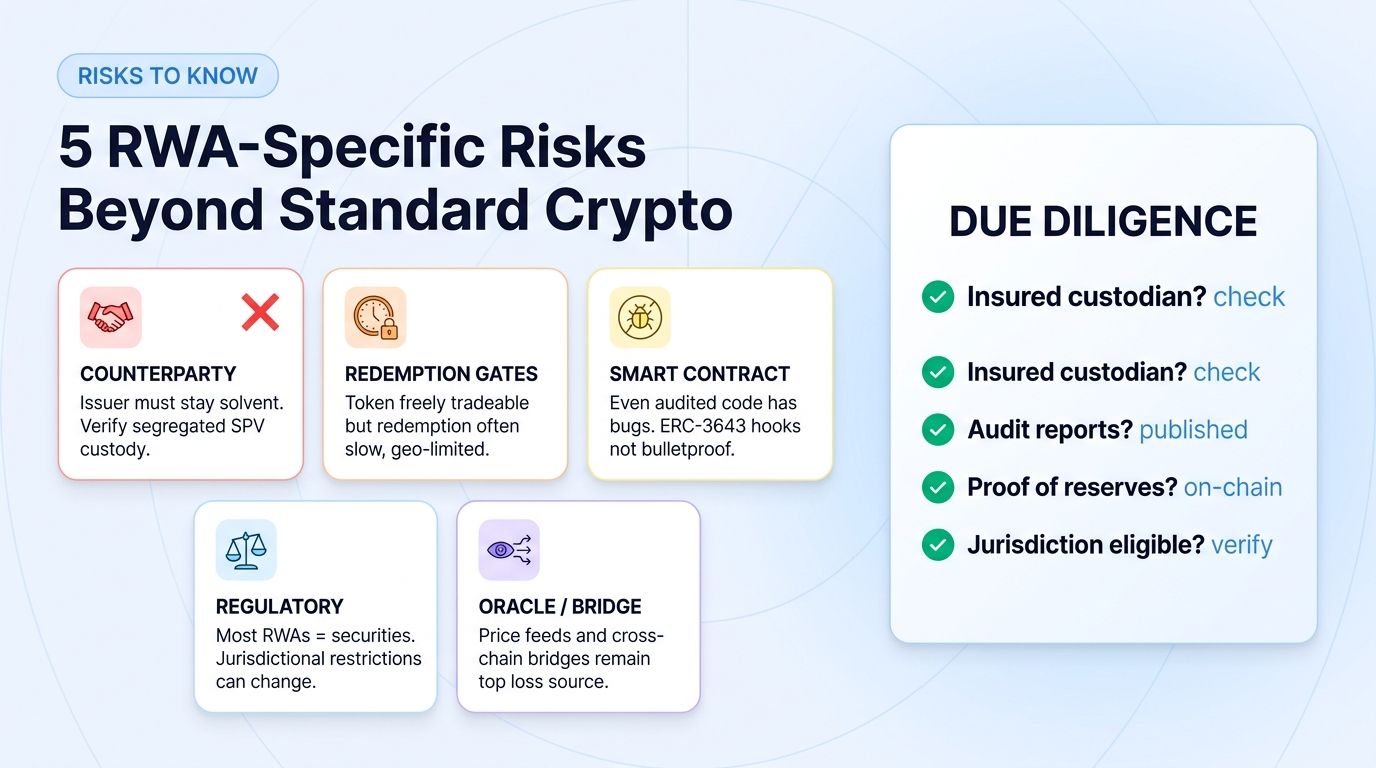
Counterparty and custody risk. The token only matters if the entity holding the underlying asset stays solvent and honest. If the SPV holding the Treasury bills disappears, the token holders are unsecured creditors in a court case, not on-chain claimants. Check whether the issuer uses regulated, insured custodians, whether assets are held in segregated SPVs, and whether there is published proof-of-reserves backed by third-party audits.
Redemption and liquidity risk. Most RWA tokens have redemption gates. You can hold and trade the token freely, but redeeming it for the underlying asset typically requires going through the issuer, hitting minimum sizes, and waiting for business hours. Secondary market liquidity can dry up fast. A tokenized real estate share might trade at a 20% discount to NAV during stressed markets because nobody wants to wait six months to redeem.
Smart contract risk. Even audited contracts have bugs. The standard for permissioned RWA tokens is ERC-3643, which has transfer rules and compliance hooks baked in. Bugs in those hooks have frozen assets in past incidents. Use products that publish audit reports, run bug bounties, and have a track record beyond 12 months.
Regulatory risk. Most RWA tokens are treated as securities. That means jurisdictional restrictions, eligibility checks, and changing rules as regulators in the EU, US, UAE, and Singapore continue to refine their frameworks. A token that is freely tradeable today might be restricted to your jurisdiction tomorrow.
Oracle and bridge risk. Tokens that price against off-chain assets rely on oracles. Bridges that move tokens between chains have been the largest single source of crypto losses. Read which oracle the issuer uses and whether the token is bridge-dependent for the chain you plan to trade on.
How RWAs Fit Into a Crypto Portfolio
RWAs are not a replacement for spot crypto. They are a different layer in the same portfolio. A common framework that experienced traders use:
- Liquidity reserve: 10 to 20% in stablecoins or tokenized Treasuries (USDY, BENJI). Earns yield, redeems fast.
- Core conviction crypto: 50 to 60% in BTC, ETH, and a small basket of large-cap altcoins.
- Higher-yield RWA: 5 to 10% in private credit or real estate tokens. Slower to exit but better risk-adjusted return than chasing memecoins.
- Speculative: 10 to 20% for short-term swings, narrative plays, or new launches.
This is a framework, not investment advice. Your allocation depends on your time horizon, your jurisdiction, and how much volatility you tolerate.
FAQ
Are RWA tokens the same as stablecoins?
No. Stablecoins like USDT and USDC are pegged to fiat through reserves held by the issuer. They generally do not pass yield through to the holder. RWA tokens like USDY or BUIDL are claims on yield-bearing assets, so the holder earns the underlying interest.
Do RWA tokens count as securities?
In most jurisdictions, yes. The SEC has stated that most tokenized assets representing claims on traditional securities are themselves securities and must be registered or qualify for an exemption. The EU's MiCA framework and similar regimes in the UAE and Singapore treat them as regulated crypto-assets. This is why most RWA platforms require KYC.
What is the minimum to invest in RWA?
It depends on the issuer. Ondo USDY accepts entries from $50. RealT real estate fractions start at $50 per token. BlackRock BUIDL requires $5 million minimum. Always check the issuer's docs for your jurisdiction.
Can I trade RWA tokens on Altrady?
Yes, indirectly. Altrady connects to 19+ exchanges including Binance, Coinbase, Kraken, and Bybit, all of which list major RWA tokens like ONDO, PAXG, and PENDLE. You manage positions, run bots, and view your RWA exposure alongside other crypto in the same multi-exchange dashboard.
What is the biggest risk with RWA tokens?
For most retail traders, counterparty risk is the biggest. The token is only as good as the entity holding the off-chain asset and managing the redemption process. Smart contract bugs are a real but secondary concern compared to issuer solvency and legal segregation of the underlying assets.
Conclusion
The RWA category is past the experimental phase. With $30 billion on-chain, institutional issuers entering, and retail platforms accepting $50 entries, this is the bridge between traditional yield products and crypto-native rails that the market has been promising since 2017.
For traders, the practical takeaway is this: RWAs are not a speculative narrative play. They are a tool for building yield-bearing positions, diversifying away from pure crypto volatility, and accessing asset classes that retail used to be locked out of. Understand the four main categories, pick an entry path that matches your jurisdiction and capital size, and read the issuer's risk disclosures before you commit.
The category will keep growing. By 2030, McKinsey projects $2 trillion in tokenized assets, with other estimates ranging higher. The traders who learn the mechanics now will have an edge when the next wave of capital enters.