
Railgun has emerged as one of the most-searched crypto privacy protocols of 2026. As regulatory clarity advances and institutional adoption accelerates, the demand for legitimate privacy infrastructure has grown in parallel. Railgun's zero-knowledge approach addresses that demand while remaining compatible with existing wallets, tokens, and DeFi protocols.
By May 2026, Railgun ranks among the top three trending crypto projects on CoinGecko in the United States. The protocol's growth reflects a broader market thesis: privacy is becoming infrastructure, not a niche feature.
This guide explains what Railgun is, how its zero-knowledge architecture works, the use cases it enables, the regulatory considerations, and how traders should think about privacy-protocol exposure in 2026.
What Is Railgun?
Railgun is a privacy protocol built using zero-knowledge cryptography that allows users to make private transactions on Ethereum, Polygon, Binance Smart Chain, and other major networks. Unlike privacy-focused base-layer blockchains (Monero, Zcash), Railgun operates as a smart contract layer on top of existing public chains.
Three structural characteristics define Railgun.
First, it is non-custodial. Users retain control of their private keys throughout. Funds enter and exit Railgun's privacy pool through smart contracts, but the user remains the owner.
Second, it works with existing tokens. ERC-20 tokens (USDC, USDT, ETH, and others) can be sent into the Railgun privacy pool, then transferred privately between users, and withdrawn back to public addresses. The same applies to BEP-20 tokens on BSC, ERC-20 tokens on Polygon, and others.
Third, it uses zero-knowledge proofs to verify transaction validity without revealing transaction details. Senders, receivers, and amounts can all be kept private while the network confirms that the transaction is valid.
Why Privacy Matters in 2026
Three forces drive demand.
First, on-chain analytics has matured. Chainalysis, Elliptic, and other on-chain analytics firms now provide detailed transaction graph analysis for governments, exchanges, and institutional users. Public blockchains have become surveillance infrastructure for participants who do not want their full financial history exposed.
Second, institutional users need privacy. Hedge funds, market makers, and corporate treasuries do not want their trading strategies visible on-chain. Order flow exposure leads to front-running and competitive disadvantage. Privacy protocols enable institutional adoption that fully-public chains would otherwise discourage.
Third, regulatory clarity is enabling privacy. The CLARITY Act, the broader US regulatory framework, and similar EU frameworks acknowledge legitimate privacy use cases. The earlier conflation of "privacy = criminal" is being replaced by nuanced regulatory thinking that recognizes legitimate privacy demand from legal users.
For Railgun specifically, the combination of these forces has produced rapid adoption. Total value locked in Railgun's privacy pools has grown substantially through 2025-2026.
How Railgun's Zero-Knowledge Architecture Works
Three core mechanisms.
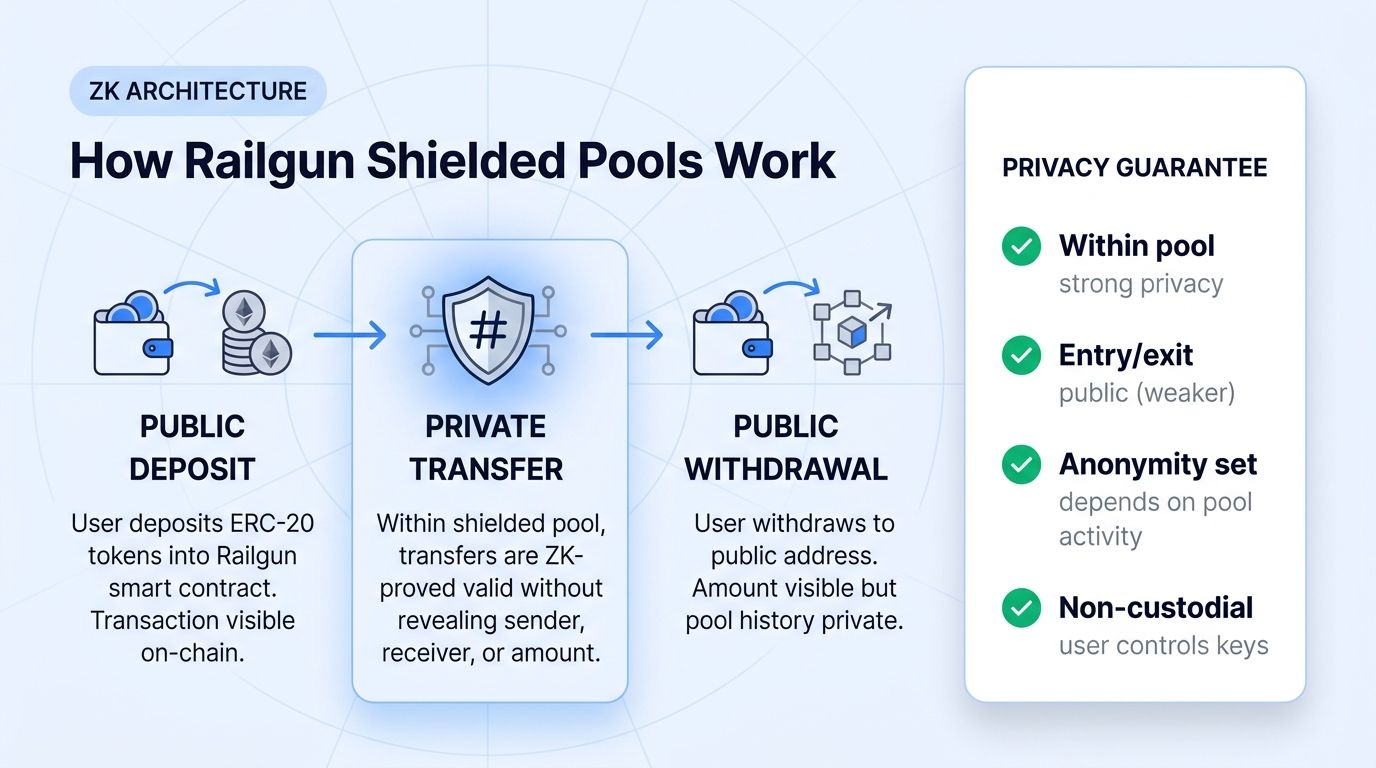
Mechanism 1: Shielded Pools
When a user wants to make a private transaction, they first deposit tokens into a Railgun shielded pool. The deposit is a public transaction (visible on-chain) that adds tokens to the pool. After deposit, the user's claim on the tokens is represented privately within the pool.
Mechanism 2: Private Transfers Within the Pool
Within the shielded pool, users can transfer balances to other users. The transfer is verified by zero-knowledge proof: the network confirms the sender has sufficient balance and the recipient is a valid recipient, without revealing identities or amounts.
Mechanism 3: Withdrawal to Public Addresses
When a user wants to use their balance outside the privacy pool, they withdraw to a public address. The withdrawal is a public transaction. The amount becomes visible, but the user's history within the pool remains private.
The privacy guarantee is strong within the pool: as long as multiple users are active in the pool (creating an "anonymity set"), individual transactions cannot be traced. The privacy guarantee is weaker at deposit and withdrawal points (those are public).
The Use Cases
Several legitimate use cases drive adoption.
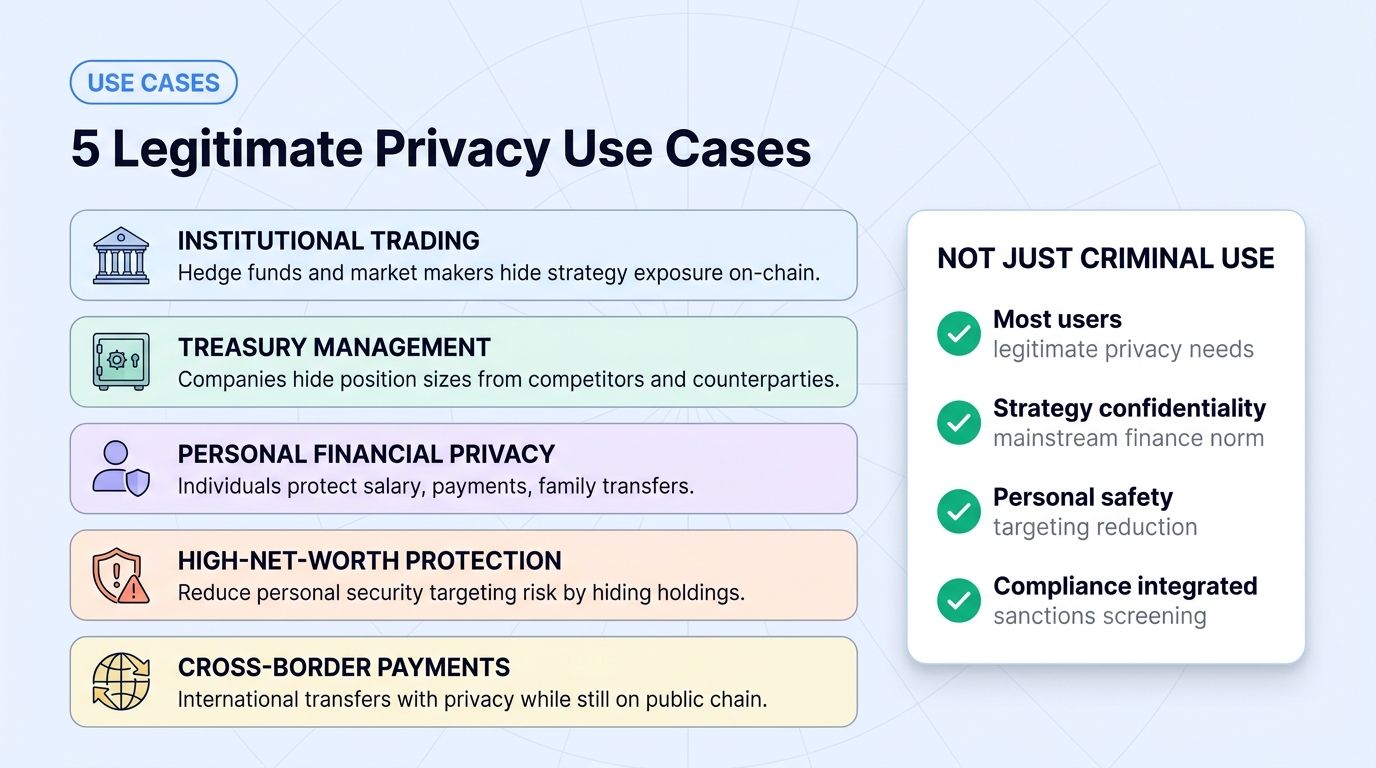
Use Case 1: Institutional Trading
Hedge funds and market makers using DeFi protocols don't want their trading strategies exposed on-chain. Railgun allows them to enter and exit positions privately, maintaining strategy confidentiality.
Use Case 2: Treasury Management
Corporate treasuries holding crypto don't want competitors or counterparties seeing their full position size. Railgun provides the privacy layer for treasury operations.
Use Case 3: Personal Financial Privacy
Individual users who don't want their entire financial history exposed publicly. Salary received in crypto, payments to merchants, transfers to family, and other personal financial activity benefits from privacy.
Use Case 4: High-Net-Worth Individual Privacy
Wealthy individuals holding significant crypto positions face personal security risks if their holdings are publicly visible. Privacy reduces targeting risk.
Use Case 5: Cross-Border Payments
International transfers benefit from privacy. The transaction value, sender, and receiver remain private, while still settling on a public blockchain.
The Regulatory Considerations
Railgun's design specifically addresses legitimate privacy use cases while incorporating compliance features.
Compliance integration: Railgun supports KYC/AML compliance through Privacy Compliance Protocol (PCP) integrations. Compliance-focused users can prove transaction history to auditors or regulators using zero-knowledge proofs without exposing the underlying data.
Sanctions screening: Railgun's smart contracts include screening for sanctioned addresses, preventing the protocol from being used by OFAC-listed entities.
Voluntary disclosure: Users can voluntarily disclose specific transactions to specific parties (auditors, tax authorities) using zero-knowledge proof generation.
The combination of strong default privacy plus voluntary compliance features positions Railgun as a "compliant privacy" protocol , distinct from earlier privacy tools that prioritized absolute anonymity over compliance.
Railgun vs Other Privacy Approaches
The privacy ecosystem includes several different approaches.
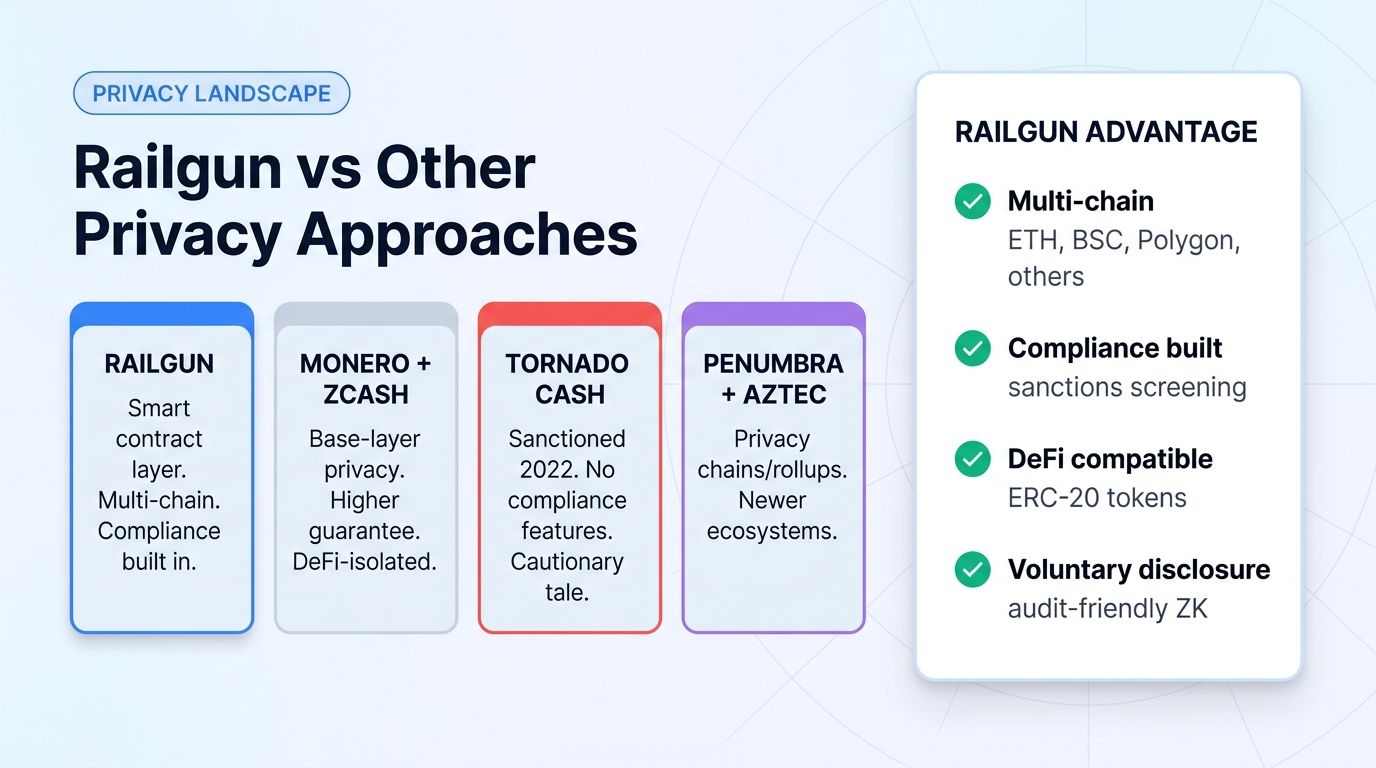
Monero (XMR): Base-layer privacy. All transactions are private by default. Higher privacy guarantee but isolated from broader DeFi ecosystem and faces ongoing exchange delisting pressure.
Zcash (ZEC): Base-layer privacy with optional public transactions. Z-addresses provide privacy; T-addresses are public. Similar to Monero in design philosophy.
Tornado Cash (sanctioned): Previous-generation privacy mixer. Sanctioned by OFAC in 2022 due to alleged money laundering use. Tornado Cash sanctions remain a cautionary tale for privacy protocol design.
Aztec: Layer 2 privacy network on Ethereum. Privacy at the L2 level rather than smart contract level.
Railgun: Smart contract privacy layer on top of public chains. Maintains compatibility with existing tokens, wallets, DeFi protocols. Compliance features integrated.
For traders, Railgun's positioning as a smart-contract privacy layer with compliance integration makes it the most actively-adopted privacy protocol in 2026.
How to Use Railgun
Three practical steps.
Step 1: Get a Railgun-compatible wallet. Several wallets support Railgun including Railway Wallet (built specifically for Railgun) and integrations with MetaMask via the Railway extension.
Step 2: Deposit funds into a shielded pool. Choose the network (Ethereum, BSC, Polygon, etc.) and the token. Deposit funds via the wallet interface. The deposit is a public transaction.
Step 3: Use the private balance. Send privately to other Railgun users by their privacy address (a different format from standard public addresses). Or withdraw back to public addresses when needed.
For active traders managing positions across exchanges and DeFi, a platform like Altrady (19+ exchanges supported) provides unified portfolio tracking for your public positions, while Railgun handles the privacy layer for specific use cases.
The Risks of Privacy Protocols
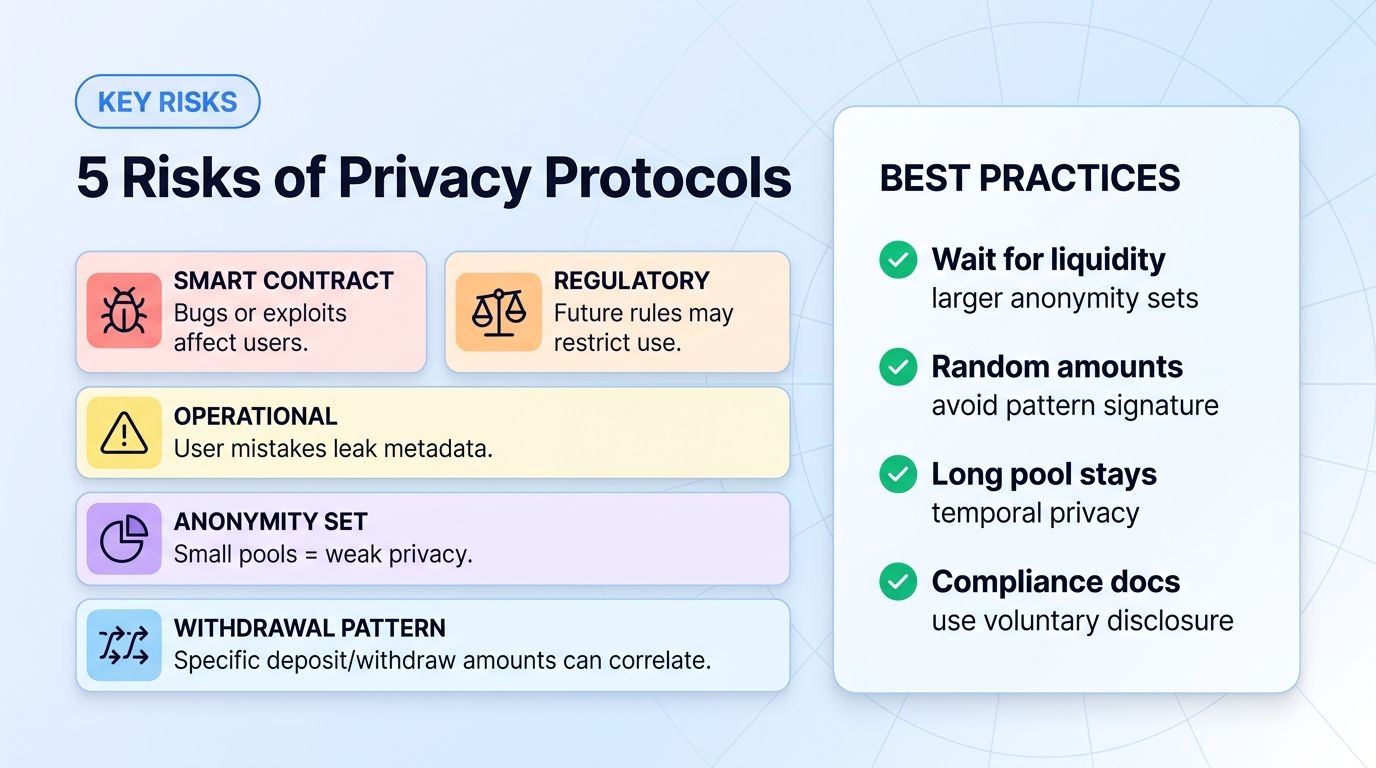
Smart contract risk. Railgun's smart contracts handle significant value. Bugs, exploits, or governance issues could affect users.
Regulatory risk. Despite Railgun's compliance features, regulatory treatment of privacy protocols continues to evolve. Future regulations could impose additional restrictions or requirements.
Operational risk. Privacy protocols require careful operational practices. Mistakes (using the wrong address, leaking metadata through wallet behavior) can undermine the privacy guarantee.
Anonymity set risk. Privacy effectiveness depends on the size of the anonymity set (how many other users are active in the pool). Smaller pools provide weaker privacy guarantees.
Withdrawal pattern risk. If you deposit specific amounts and withdraw the same specific amounts, transaction graph analysis can correlate deposit and withdrawal even with the privacy layer.
How Privacy Protocols Fit Into a Portfolio
A practical framework:
- Core holdings (BTC, ETH): 50-65% of crypto allocation. Standard non-private storage.
- Active trading + DeFi: 20-30%. Can use privacy protocols selectively for specific positions.
- Privacy protocol tokens (if any): 0-10%. Railgun does not have a single ticker token but related protocols may.
- Privacy infrastructure usage: Not a portfolio category per se, but use Railgun for specific privacy-required transactions rather than as a long-term holding category.
The Broader Privacy Trend
Railgun is one project in a broader privacy renaissance.
Other notable privacy projects in 2026: - Penumbra: Cosmos-based privacy chain with built-in DEX - Aztec Network: Ethereum L2 with privacy by default - Manta Network: Privacy-focused L1 with EVM compatibility - Nillion: Decentralized private compute infrastructure - Privacy-preserving rollups: Multiple Ethereum L2 rollups integrating privacy
The trend reflects growing demand for privacy as crypto adoption matures. Public-by-default chains are increasingly recognized as suboptimal for many use cases. Privacy as opt-in feature is becoming standard.
FAQ
Is Railgun legal?
In most jurisdictions, yes. Railgun is designed with compliance features integrated, and the protocol has not been sanctioned. Always verify the specific legal treatment in your jurisdiction before use. The CLARITY Act and similar frameworks accommodate legitimate privacy use cases.
How does Railgun differ from Tornado Cash?
Tornado Cash was a privacy mixer with no compliance features. Railgun integrates compliance from the protocol level: sanctions screening, voluntary disclosure, KYC/AML compatibility. The compliance integration is the key architectural difference that has kept Railgun operating while Tornado Cash was sanctioned.
Can my exchange tell I used Railgun?
Yes. Deposits to Railgun shielded pools are public transactions. Your exchange can see funds leaving to a Railgun contract address. Withdrawals back to your exchange are also public. The privacy guarantee applies to what happens within the pool, not to entry and exit points.
What's the cost of using Railgun?
Gas fees plus a small protocol fee. Exact costs depend on the network (Ethereum mainnet vs Polygon vs BSC) and current gas conditions. Polygon and BSC are significantly cheaper than Ethereum mainnet for Railgun transactions.
Can I trade Railgun-related tokens on Altrady?
Altrady connects to 19+ exchanges where various privacy-related tokens trade. If Railgun introduces a governance or utility token in the future, it would likely list on major exchanges and be accessible through Altrady. Currently, Railgun is a protocol without a primary tradable token, but related privacy protocol tokens are tradable.
Conclusion
Railgun represents one of the most-adopted privacy protocols of 2026, sitting at the intersection of zero-knowledge cryptography, compliance-aware design, and broad DeFi compatibility. The growth reflects a structural market need: as regulatory clarity advances and institutional adoption accelerates, legitimate privacy infrastructure becomes increasingly valuable.
For traders, the practical takeaway is this: privacy protocols are now part of the mature DeFi stack. They serve specific use cases (institutional trading privacy, treasury management, personal financial privacy) rather than being a niche feature for criminal actors. Understanding how Railgun and similar protocols work expands your operational toolkit.
The longer-term trajectory looks structural. Public-by-default chains will continue to dominate for most use cases, but opt-in privacy via smart contract layers like Railgun will become standard for many institutional and personal financial use cases. The privacy renaissance is one of the more important under-noticed trends in 2026 crypto, and Railgun is at the leading edge.
The next 12 to 24 months will produce decisive data on which privacy approaches scale most effectively. Smart contract layers like Railgun, L2 privacy rollups, base-layer privacy chains, and hybrid models all have advocates. The winners will be those that best balance strong privacy guarantees with practical compliance integration and broad ecosystem compatibility.