
What Is Tokenized Gold?
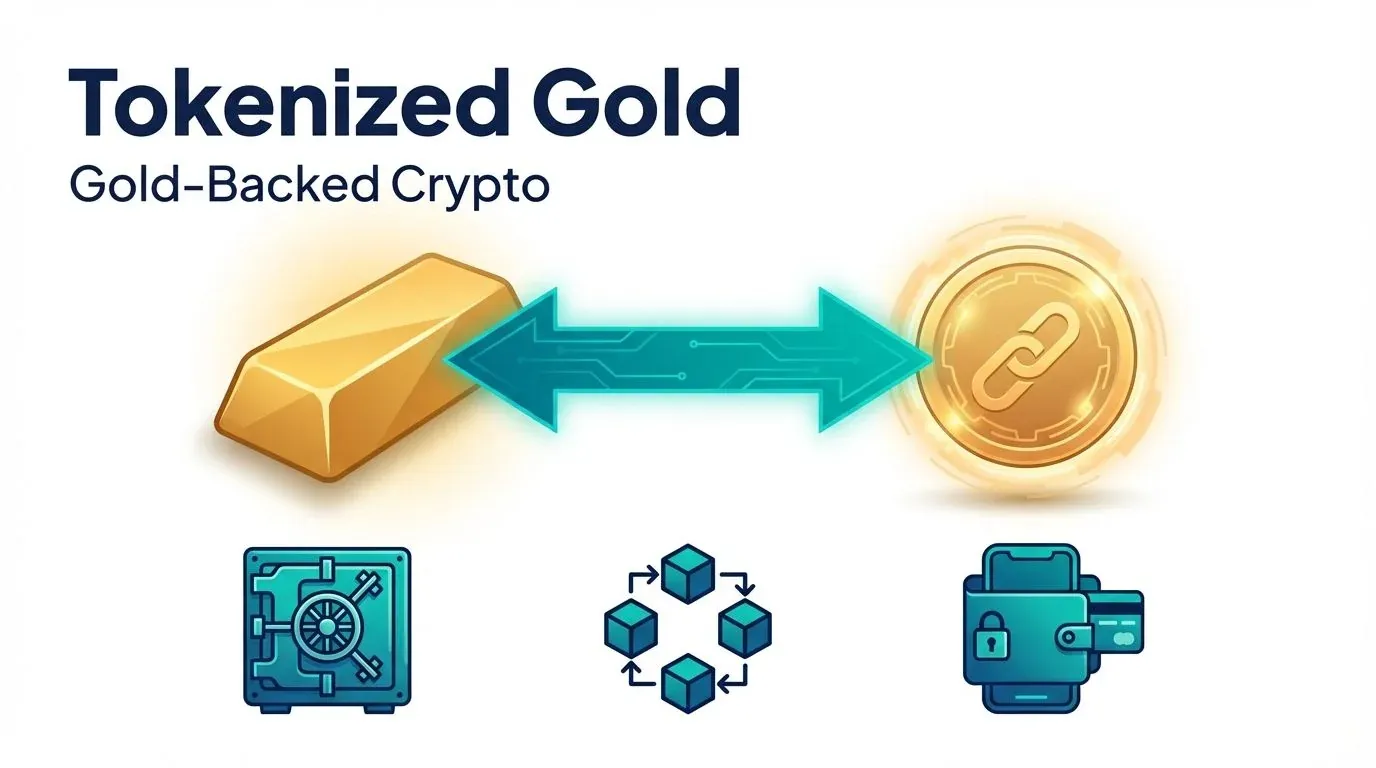
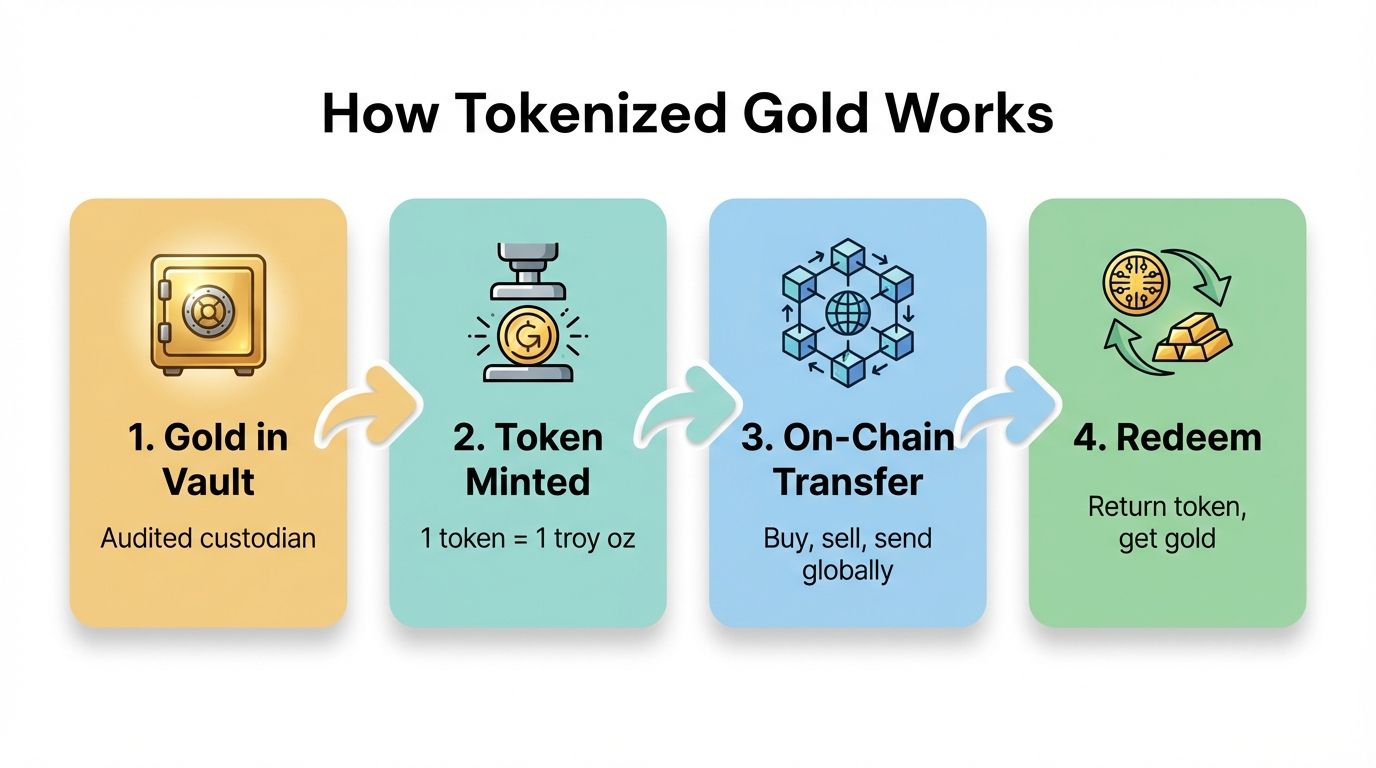
Tokenized gold is a digital asset where each token represents a specific quantity of physical gold held in custody by a regulated vault operator. The standard peg is one troy ounce per token. When you hold a tokenized gold token, you hold a blockchain-based claim on real, allocated gold bars sitting in a secure vault, audited by a third party on a regular basis.
This is fundamentally different from synthetic gold exposure, such as gold futures ETFs or contracts for difference, where you gain price exposure without any claim on physical metal. With tokenized gold, the metal exists, it is segregated, and it is auditable on-chain. The token is the receipt, not a speculative position on the price.
The concept gained traction in 2019 when two major players launched competing products. Paxos introduced PAX Gold (PAXG) in September 2019, backed by gold held in Brink's vaults in London and regulated by the New York Department of Financial Services (NYDFS). Around the same time, Tether launched Tether Gold (XAUT), backed by gold held in Swiss vaults. Both products proved that institutional-grade gold custody could be brought on-chain in a compliant way. Since then, the tokenized gold market has grown significantly, with total market capitalization exceeding $1.5 billion by early 2026.
How Tokenized Gold Works
Custodians and Vault Storage
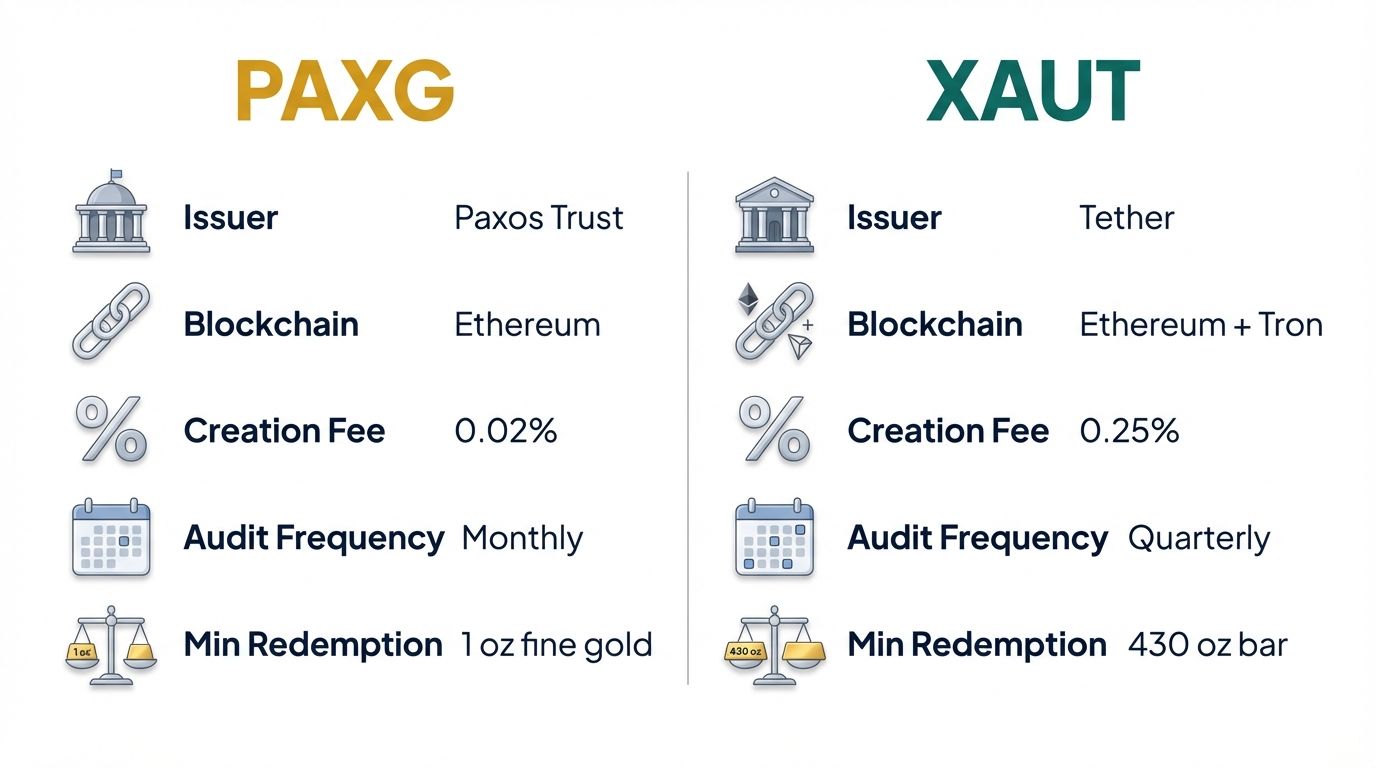
The foundation of every tokenized gold product is a custodian, a licensed entity responsible for storing the physical gold. For PAXG, the custodian is Paxos Trust Company, which holds allocated gold in Brink's London vaults. "Allocated" means each PAXG holder can, in theory, identify specific gold bars linked to their holdings via a serial number lookup tool on the Paxos website. Tether Gold uses a Cayman Islands entity to hold gold in professional Swiss vaulting facilities. Both issuers publish regular proof-of-reserve attestations: Paxos conducts monthly third-party audits, while Tether provides quarterly attestations. The audit frequency matters because it determines how quickly discrepancies, if they ever arose, would surface.
Minting and Redemption Process
New tokens are created through a minting process. An investor sends fiat currency (or sometimes crypto) to the issuer, the issuer purchases physical gold, deposits it into the vault, and then issues a corresponding number of tokens to the investor's wallet. For PAXG, the minimum creation amount is one fine troy ounce (approximately $3,200 at March 2026 spot prices). Tether Gold has a higher redemption threshold: a minimum of 50 XAUT tokens (around $160,000) to redeem for physical delivery in Switzerland. Redemption below that threshold for XAUT is possible only by selling on secondary markets. Paxos charges a 0.02% on-chain transaction fee (collected at the smart contract level) plus creation and redemption fees of around 0.15%. Tether Gold charges approximately 0.25% per year as a storage and management fee, embedded in the token economics.
On-Chain Transfers and Divisibility
Once minted, tokenized gold tokens behave like any ERC-20 token. They can be sent peer-to-peer, traded on decentralized exchanges, used as collateral in DeFi protocols, or held in self-custody wallets. One of the most powerful features is divisibility. A single PAXG token represents one fine troy ounce of gold, but it can be transferred in fractional amounts down to 18 decimal places. This means a user can hold $10 worth of gold-backed tokens, something impossible with physical gold bars. Transfers settle in minutes rather than days, and there are no shipping or insurance costs associated with moving ownership from one wallet to another.
Top Tokenized Gold Tokens in 2026
The tokenized gold market is relatively concentrated. Two tokens dominate by market cap and liquidity, with a handful of smaller alternatives occupying niche positions.
Paxos Gold (PAXG)
PAXG remains the market leader in 2026, with a market cap consistently above $700 million and deep liquidity on both centralized and decentralized venues. It is regulated by the NYDFS under a trust company charter, making it one of the most compliant tokenized commodity products available. Each PAXG is backed by one fine troy ounce of a London Good Delivery gold bar. The on-chain transaction fee of 0.02% is collected automatically by the smart contract and goes to Paxos. Monthly third-party audits from a Big Four-adjacent accounting firm are published on the Paxos website. PAXG is available on Ethereum and trades on Binance, Kraken, Gemini, and Uniswap. Its regulatory status makes it a preferred choice for institutional and U.S.-based retail investors.
Tether Gold (XAUT)
Tether Gold is the second-largest tokenized gold product, with a market cap typically in the $500 to $600 million range. Unlike PAXG, XAUT is available both on Ethereum (as an ERC-20) and on the Tron network (as a TRC-20), giving it broader reach in markets where Tron is popular. Each XAUT token corresponds to one fine troy ounce of gold on a specific gold bar stored in Swiss vaults. Tether publishes a quarterly proof-of-reserves attestation, a lower frequency than PAXG's monthly audits. The annual management fee is approximately 0.25%, and physical redemption requires a minimum of 50 XAUT, creating a high barrier to physical delivery for smaller holders. XAUT is issued by TG Commodities Limited, a Cayman Islands entity, which places it outside the direct reach of U.S. financial regulators.
Other Gold-Backed Tokens
Beyond the two dominant products, a few alternative gold tokens operate in the market. Perth Mint Gold Token (PMGT) was issued in partnership with the government-backed Perth Mint in Australia, offering the backing of a sovereign guarantee, though liquidity has historically been thin. Digix Gold (DGX) was one of the earliest gold tokens on Ethereum, backed by gold stored in Singapore and Canada, but it has seen significantly reduced activity since its peak in 2018 and 2019. These smaller tokens generally carry higher liquidity risk and require more careful due diligence before purchase.
Tokenized Gold vs Physical Gold vs Bitcoin
Investors often evaluate tokenized gold against two alternatives: physical metal and Bitcoin, sometimes called "digital gold." Each carries distinct tradeoffs across five key dimensions.
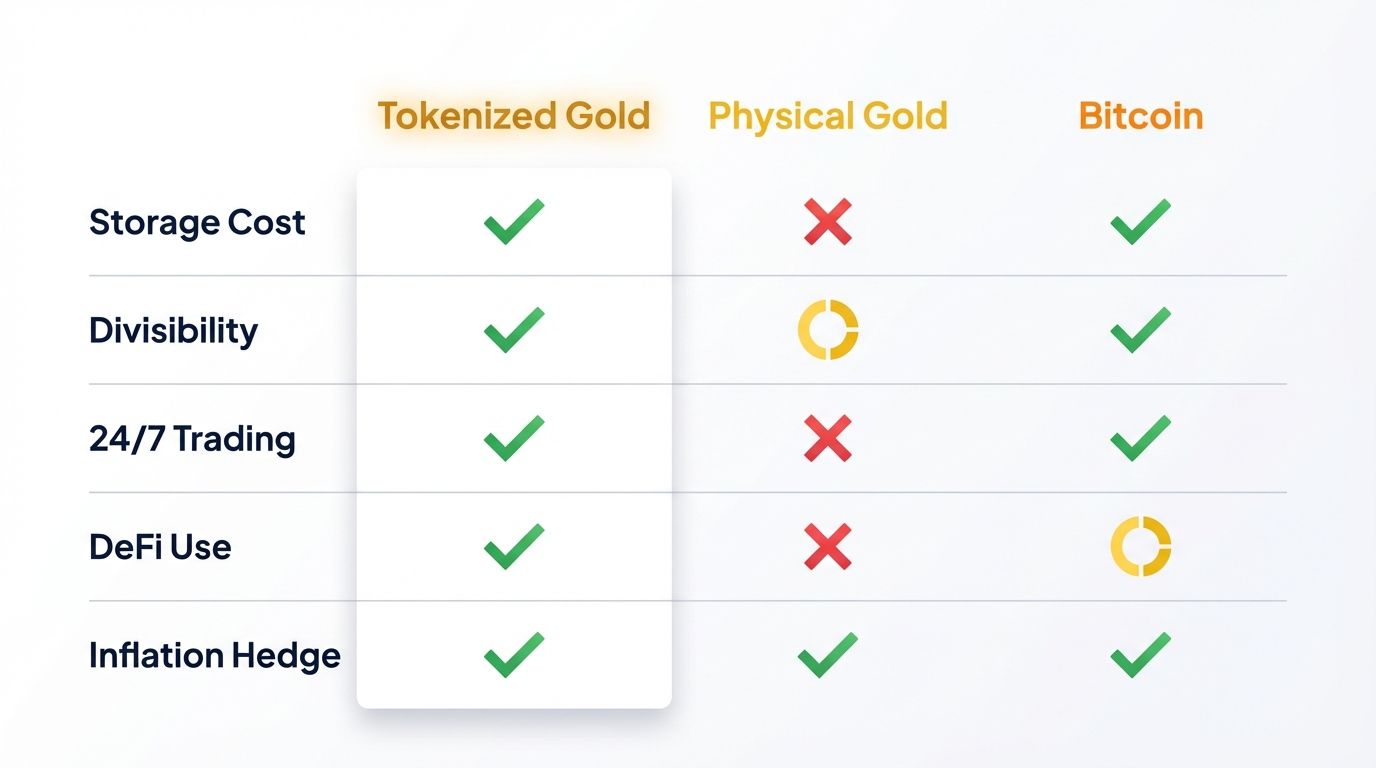
Liquidity: Tokenized gold trades 24/7 on global markets with no settlement delays. Physical gold requires finding a dealer, paying spreads, and waiting for settlement. Bitcoin also trades around the clock with high global liquidity, though its market depth varies by venue.
Storage costs: Physical gold requires paid vaulting, insurance, and sometimes transportation. Tokenized gold embeds modest annual fees (0.15 to 0.25%) in its fee structure, which are far lower than typical home safe or professional vault arrangements. Bitcoin has negligible storage costs beyond the hardware wallet.
Counterparty risk: Physical gold held personally has zero counterparty risk. Tokenized gold introduces custodian risk and smart contract risk. Bitcoin, held in self-custody, also has near-zero counterparty risk.
Inflation hedge properties: Gold has a multi-century track record as a store of value during inflationary periods. Tokenized gold inherits this property directly, since it is backed by the metal. Bitcoin's inflation-hedge thesis is newer and more contested.
Portability: Both tokenized gold and Bitcoin can be moved globally in minutes. Physical gold is difficult and expensive to transport across borders.
Benefits of Tokenized Gold
Tokenized gold offers a combination of properties that neither physical gold nor traditional gold ETFs can replicate.
24/7 trading: Gold markets traditionally close on weekends, but tokenized gold trades continuously on crypto exchanges and DEXs. This is particularly valuable during geopolitical events that occur outside traditional market hours, when gold prices often move sharply.
Fractional ownership: Physical gold bars are priced in thousands of dollars. Even gold coins carry premiums and minimum purchase sizes. With tokenized gold, an investor can buy $10 or $50 worth of gold exposure, opening the asset class to retail investors with limited capital.
DeFi composability: Because PAXG and XAUT are ERC-20 tokens, they can be used natively in DeFi protocols. Investors can deposit PAXG as collateral on Aave to borrow stablecoins, provide liquidity in PAXG/USDC pools on Uniswap, or use gold tokens as collateral in decentralized lending markets. This composability creates yield opportunities unavailable to physical gold holders.
Low storage cost: Annual fees on the leading tokenized gold products range from roughly 0.15% to 0.25%. Professional gold vault storage and insurance for physical metal can run significantly higher, particularly for smaller quantities. The cost advantage compounds over time for long-term holders.
Instant settlement: Transferring ownership of physical gold involves logistics, paperwork, and cost. Tokenized gold transfers settle on-chain in minutes, with no geographic restrictions.
Risks and Limitations
Despite its advantages, tokenized gold carries a specific set of risks that investors must understand before allocating capital.
Custodian and Counterparty Risk
The core risk in tokenized gold is that a token is only as good as the custodian behind it. If the issuing company were to face insolvency, fraud, or operational failure, token holders would be exposed to losses even if the gold physically exists. Regulatory oversight mitigates this risk for products like PAXG, which operates under NYDFS supervision, but it does not eliminate it entirely. Smart contract bugs represent an additional risk layer, where a vulnerability in the token contract could potentially freeze or expose funds before any human intervention is possible.
Regulatory Uncertainty
Tokenized gold occupies an ambiguous regulatory space in many jurisdictions. In the United States, the CFTC has asserted jurisdiction over gold-linked digital assets in certain contexts, while the SEC has also signaled interest in commodity-backed tokens. In the European Union, the MiCA framework that took full effect in 2025 introduced new compliance obligations for issuers of asset-referenced tokens. Regulatory changes could impose new restrictions on trading, custody, or redemption, and could affect which platforms are permitted to list these tokens.
Liquidity and Premium Risk
While PAXG and XAUT are the most liquid tokenized gold products, their liquidity still trails that of gold ETFs like GLD by a large margin. During periods of market stress, bid-ask spreads on DEX pools can widen significantly, and large orders may move the price away from spot. Tokenized gold can also trade at a modest premium or discount to spot gold depending on market conditions and venue. Smaller gold tokens like PMGT and DGX carry substantially higher liquidity risk and should be approached with caution.
How to Buy and Store Tokenized Gold
Acquiring tokenized gold is straightforward through both centralized and decentralized channels.
Centralized exchanges (CEX): PAXG is listed on major exchanges including Binance, Kraken, and Gemini. XAUT is available on Bitfinex and several other platforms. Buying on a CEX is familiar, involves fiat on-ramps, and benefits from customer support. The tradeoff is that the exchange holds the tokens on your behalf unless you withdraw to a personal wallet.
Decentralized exchanges (DEX): Both PAXG and XAUT have liquidity pools on Uniswap and other Ethereum-based DEXs. Buying on a DEX requires an existing crypto balance (typically ETH or a stablecoin) and a connected web3 wallet. There is no KYC, but gas fees apply.
Self-custody: Tokenized gold can be held in any ERC-20-compatible wallet, including MetaMask, Ledger, and Trezor. Self-custody eliminates exchange counterparty risk but places full responsibility for key security on the holder. Hardware wallets are strongly recommended for meaningful holdings.
Portfolio tracking: Because tokenized gold sits alongside other crypto holdings, using a portfolio tracker that supports ERC-20 tokens is important for accurate performance monitoring. A good tracker lets you see your gold allocation in the context of your broader portfolio and set price alerts for key levels.
Tracking Tokenized Gold in Your Portfolio with Altrady
Managing a portfolio that includes both crypto assets and tokenized commodities like gold requires tools that can handle multi-asset tracking without forcing you to switch between platforms. Altrady is a professional crypto trading and portfolio management platform built for traders who need real-time data, consolidated views, and smart alerting across all their positions.
With Altrady, you can connect your exchange accounts (Binance, Kraken, and others that list PAXG) and wallet addresses to get a unified view of your holdings, including gold-backed tokens alongside Bitcoin, Ethereum, and altcoins. Price alerts let you set notifications when PAXG or XAUT move past your defined thresholds relative to spot gold, so you never miss a significant premium or discount opportunity. Altrady also supports portfolio performance analytics, helping you track how your tokenized gold allocation is performing over time compared to the rest of your portfolio.
Whether you are using tokenized gold as a hedge, a DeFi collateral asset, or a long-term savings vehicle, having a single dashboard that reflects your full holdings is essential for informed decisions. Altrady offers a free trial so you can explore all these features before committing to a paid plan. Start your free trial today and see how professional-grade portfolio tracking changes the way you manage your crypto and tokenized assets.
Frequently Asked Questions
Is tokenized gold the same as owning physical gold?
Not exactly. Tokenized gold gives you a legal claim on physical gold held in a vault, which means you have beneficial ownership of allocated metal. However, you do not have direct physical possession, and your rights depend on the issuer's legal structure, custodial arrangements, and jurisdiction. For most practical purposes the exposure is equivalent, but the legal and operational risks differ from holding a gold bar in your own safe.
Is tokenized gold a good investment?
Tokenized gold inherits the investment characteristics of physical gold: it is widely regarded as an inflation hedge and a safe-haven asset during market stress, but it does not generate yield on its own. Its suitability depends on your investment goals, time horizon, and risk tolerance. As with any asset, diversification and position sizing matter more than the asset class itself.
Can I redeem tokenized gold for physical gold?
Yes, but the practical requirements vary by issuer. PAXG holders can redeem for physical delivery starting at one troy ounce, with delivery in London. XAUT holders face a higher bar, requiring a minimum of 50 XAUT (roughly $160,000 at current prices) for physical delivery in Switzerland. Below those thresholds, selling on secondary markets is the only practical exit.
Is tokenized gold taxable?
In most jurisdictions, yes. Tokenized gold is typically treated as a commodity or a digital asset for tax purposes, meaning capital gains taxes apply on disposal. In the United States, the IRS treats gold tokens as property, subject to short-term or long-term capital gains rates depending on the holding period. Tax treatment varies significantly by country, so consulting a qualified tax advisor for your specific situation is strongly recommended.
What is the difference between PAXG and XAUT?
Both tokens are backed 1:1 by one fine troy ounce of physical gold, but they differ on several dimensions. PAXG is regulated by the NYDFS and undergoes monthly third-party audits, making it the more transparent option. XAUT is issued offshore (Cayman Islands), publishes quarterly attestations, and is available on both Ethereum and Tron. PAXG charges a 0.02% on-chain transaction fee plus issuance fees, while XAUT charges approximately 0.25% annually. PAXG has a lower minimum for physical redemption, making it more accessible for smaller holders who want the option to take delivery.