

Big crypto price targets are search magnets. When Tom Lee's Ethereum forecast started circulating again in 2026, Google Trends US interest followed because traders wanted to know whether the number was a serious thesis, a sentiment marker, or just another headline in a volatile market.
The right way to read a bold ETH target is not to accept it or mock it instantly. The better approach is to translate the target into market cap, supply, ETH/BTC ratio, demand assumptions, and timing. Once the forecast becomes math, traders can decide whether the setup deserves attention.
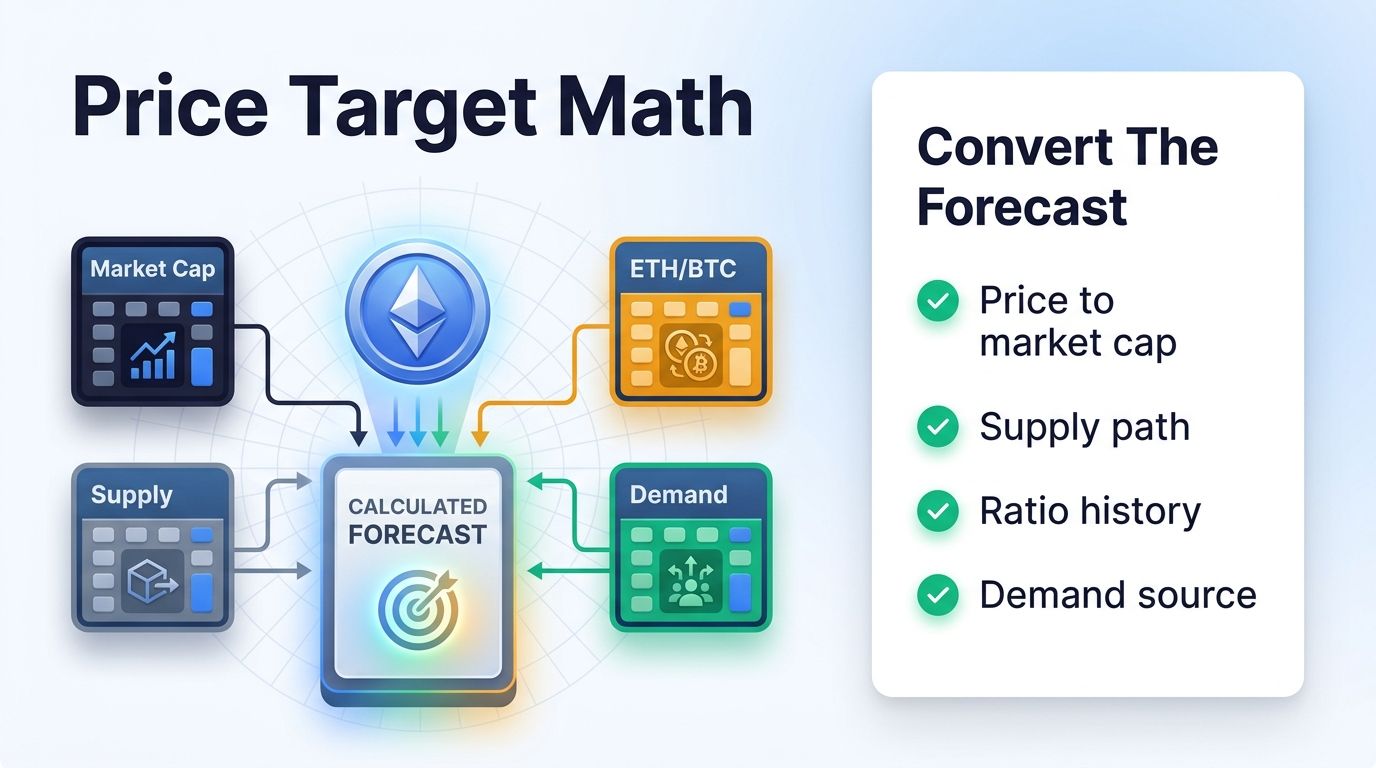
What the Forecast Implies
CoinDesk analyzed a $250,000 ether target in early June 2026 and noted that it would value Ethereum around $30 trillion. The same analysis said that such a move would require roughly a 50x increase from then-current levels, plus a dramatic change in how ETH trades against Bitcoin.
That does not mean Ethereum cannot grow. It means the forecast is not a normal extension of current conditions. A target that large requires a very different market structure: more demand, stronger fee economics, much deeper institutional ownership, and a bigger role for Ethereum in global settlement.
- Translate price targets into market capitalization.
- Compare the target with current supply.
- Check whether ETH/BTC assumptions are realistic.
- Ask what demand source would support the move.
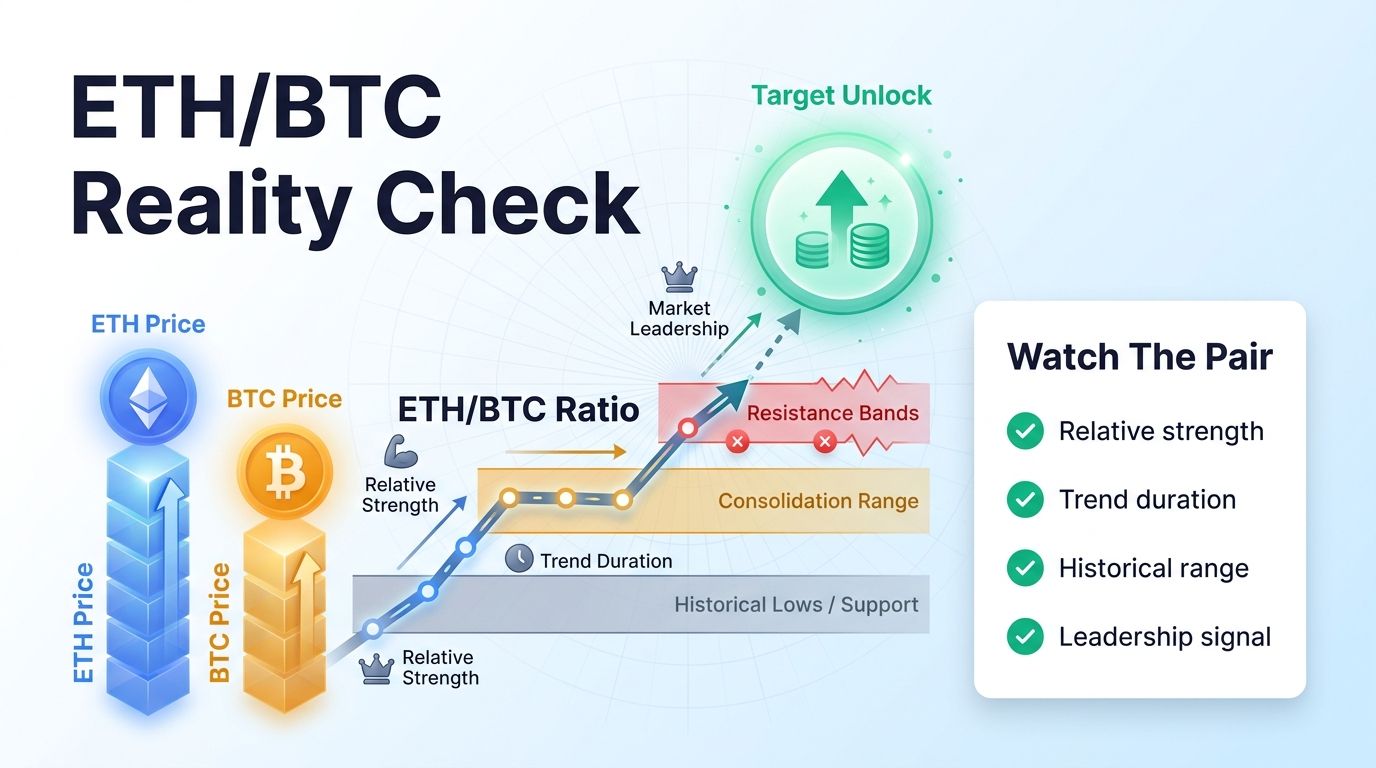
Why ETH/BTC Is the Key Reality Check
A USD price target can look clean because it is one number. The ETH/BTC ratio makes it harder to hide the assumption. If ETH rises far faster than Bitcoin, the ratio must break above historical ranges. If Bitcoin rises with ETH, the whole crypto market has to expand dramatically.
That is why ETH/BTC is a useful filter for traders. If Ethereum is supposed to enter a new leadership phase, the ratio should begin proving it before the most aggressive USD targets become plausible. Without relative strength, a huge ETH forecast remains mostly a story about what might happen later.
- ETH/BTC shows relative strength against Bitcoin.
- A massive ETH target needs either ratio expansion or a huge BTC rally.
- Ratio trend matters more than one green week.
- Weak ETH/BTC makes aggressive targets harder to defend.
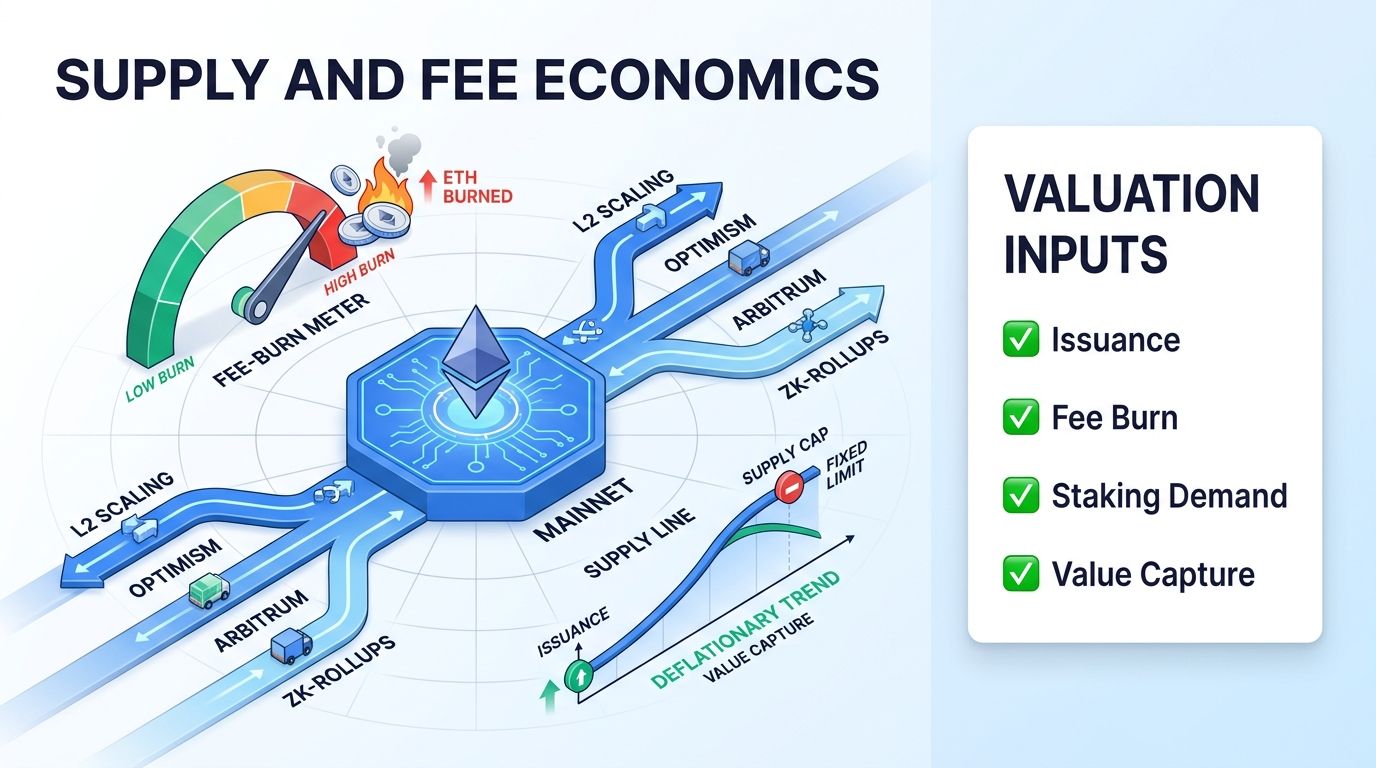
Supply and Fee Economics Still Matter
Ethereum's valuation story also depends on supply and fee capture. CoinDesk's analysis noted that ETH supply was modestly inflationary after Dencun reduced fee burning by pushing more activity to cheaper layer-2 networks. That changes the old deflationary narrative that many traders used after the Merge.
Layer-2 growth is not bad for Ethereum by itself. It can improve user experience and increase ecosystem reach. The question is how much value returns to ETH holders through fees, staking demand, settlement demand, and institutional ownership. A large target needs those channels to become stronger, not just popular in theory.
- Supply growth changes the valuation equation.
- Layer-2 activity can help users while reducing mainnet fee burn.
- Staking demand is useful but not enough alone.
- Value capture matters as much as ecosystem activity.
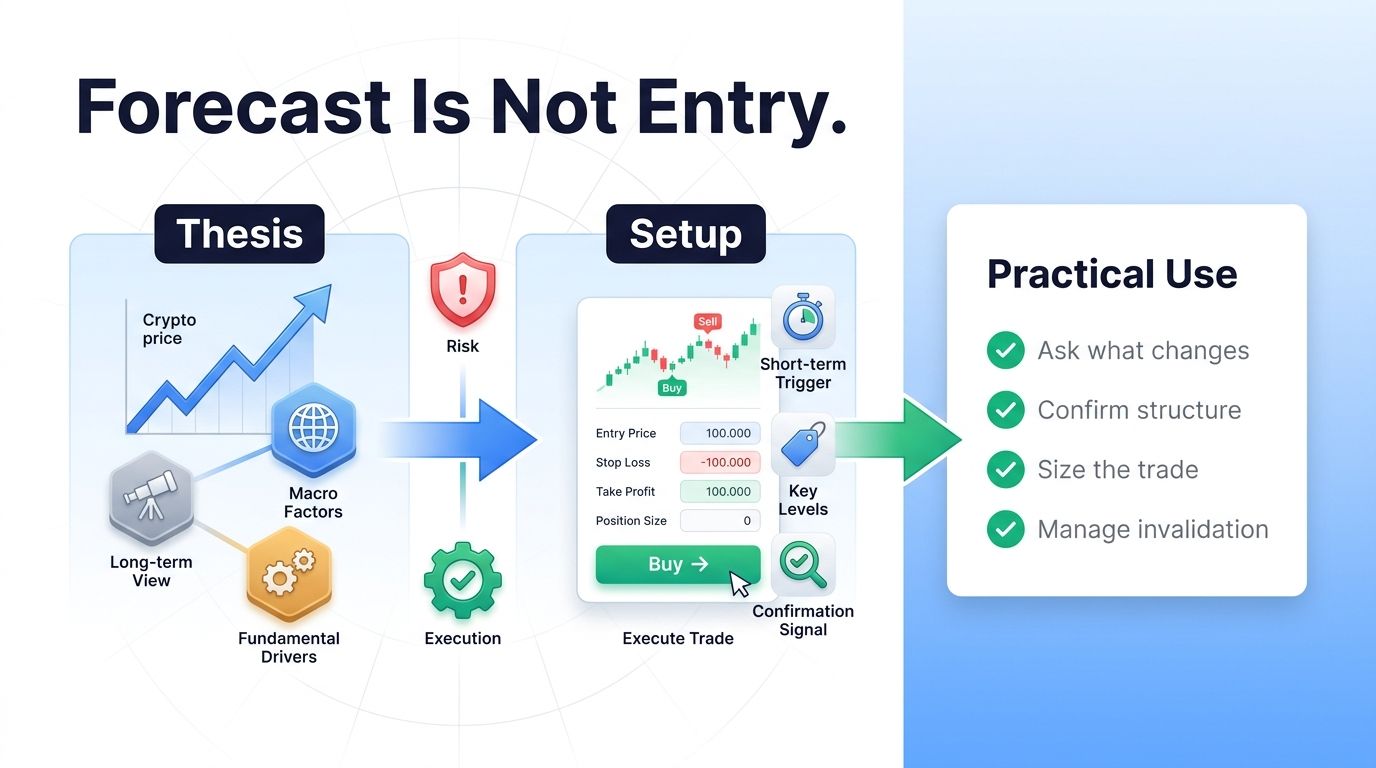
How Traders Should Use Big Targets
A big target can be useful even if it is not immediately tradable. It forces the market to discuss what would need to change. For ETH, that means corporate treasury demand, validator participation, settlement volume, stablecoin usage, layer-2 economics, and the ETH/BTC trend.
The trading mistake is turning a long-range target into a short-term entry. A forecast does not define support, resistance, stop level, or position size. Those still come from the chart and the trader's risk plan.
- Use big targets as thesis prompts.
- Do not confuse forecast horizon with trade horizon.
- Wait for market structure to confirm the thesis.
- Separate valuation debate from execution.
A Simple ETH Target Scorecard
A practical scorecard starts with five questions. First, what market cap does the target imply? Second, what supply path is assumed? Third, what ETH/BTC ratio is required? Fourth, what demand source is expected to buy or hold ETH at that valuation? Fifth, what evidence would prove the thesis is starting to work?
This scorecard keeps traders from treating a headline as analysis. It also helps compare different Ethereum forecasts. A smaller target with clear assumptions may be more useful than a larger target that depends on several unlikely conditions happening at the same time.
The same scorecard works for Bitcoin, Solana, XRP, and other large assets. Price targets are not magic numbers. They are compressed assumptions.
- Market cap implied by target.
- Supply and issuance path.
- Required ETH/BTC ratio.
- Demand source and timing.
Bottom Line
Tom Lee's Ethereum target is useful because it gives traders a reason to test Ethereum's strongest bull case. It is not useful if it becomes a shortcut around actual market evidence.
For now, traders should watch whether Ethereum can regain relative strength, whether value capture improves, and whether institutional demand becomes visible in flows, staking, treasury holdings, and settlement usage. Those signals matter more than the target itself.
The cleanest takeaway is simple: respect the thesis, verify the math, and trade only the setup in front of you.
- A forecast is a thesis, not a trading plan.
- ETH/BTC is the most important reality check.
- Supply and value capture shape valuation.
- Execution needs its own rules.
How to Track the Thesis Without Getting Distracted
A large ETH target can create noise because every short-term move starts to look like proof or failure. A cleaner approach is to build a small evidence board. Put ETH/BTC, total ETH staked, mainnet fees, layer-2 activity, stablecoin settlement, and ETF or treasury flows on the same page.
Then review the board on a fixed schedule, not every few minutes. Weekly review is usually enough for a multi-year valuation thesis. Intraday monitoring should be reserved for actual trades, where levels, volatility, and risk size matter more than the long-range target.
This separation helps keep conviction and execution from fighting each other. A trader can believe Ethereum has a strong long-term role while still rejecting a poor short-term entry. The opposite is also true: a short-term bounce can be tradable even if the largest target still looks unrealistic.
It also makes review easier after the trade. If the thesis improved but the entry failed, the trader learns about execution. If the entry worked but the thesis did not improve, the trader learns not to confuse a bounce with validation.
- Create a fixed ETH thesis dashboard.
- Review long-term evidence weekly.
- Use intraday data only for active trades.
- Separate conviction from execution quality.
FAQ
What is Tom Lee's Ethereum price target?
CoinDesk analyzed a widely discussed $250,000 ETH target attributed to Tom Lee in June 2026.
Why is the target controversial?
It implies a very large Ethereum market capitalization, major ETH/BTC expansion, and much stronger demand than current conditions show.
What should traders watch first?
ETH/BTC, supply trends, fee burn, staking demand, institutional flows, and confirmed price structure.
Should traders buy ETH because of a price target?
No. A price target can inform a thesis, but entries, exits, and risk size must come from a defined trading plan.