
Crypto whales can move entire markets with a single transaction. When a wallet holding tens of thousands of Bitcoin suddenly transfers coins to an exchange, prices can swing within minutes. For retail traders, understanding how to track crypto whale wallets is no longer optional. It is a critical edge that separates informed traders from those constantly reacting to price moves they never saw coming. In this guide, you will learn exactly what whale tracking involves, which tools to use, what signals to watch for, and how to integrate whale intelligence into your trading strategy.
What Are Crypto Whales and Why Do They Matter?
A crypto whale is any individual or entity that holds a large enough position in a cryptocurrency to influence its market price. While there is no universal threshold, the term generally applies to wallets holding at least 1,000 BTC, 10,000 ETH, or equivalent value in other tokens.
Whales matter because their trading decisions create outsized market impact. When a whale accumulates a position, it can absorb sell pressure and push prices upward. When a whale dumps tokens, it can trigger cascading liquidations and panic selling among smaller holders.
Why Retail Traders Should Pay Attention
Retail traders often find themselves on the wrong side of a trade because they rely solely on lagging indicators. Whale tracking provides a leading signal. By monitoring what large holders are doing before price moves fully materialize, you can position yourself ahead of the crowd rather than chasing momentum after it has already played out.
On-chain analytics consistently show that wallets holding over 1,000 BTC tend to accumulate during fear and distribute during euphoria. This counter-cyclical behavior is why tracking whale wallets offers a significant informational advantage.
Types of Crypto Whales You Should Know
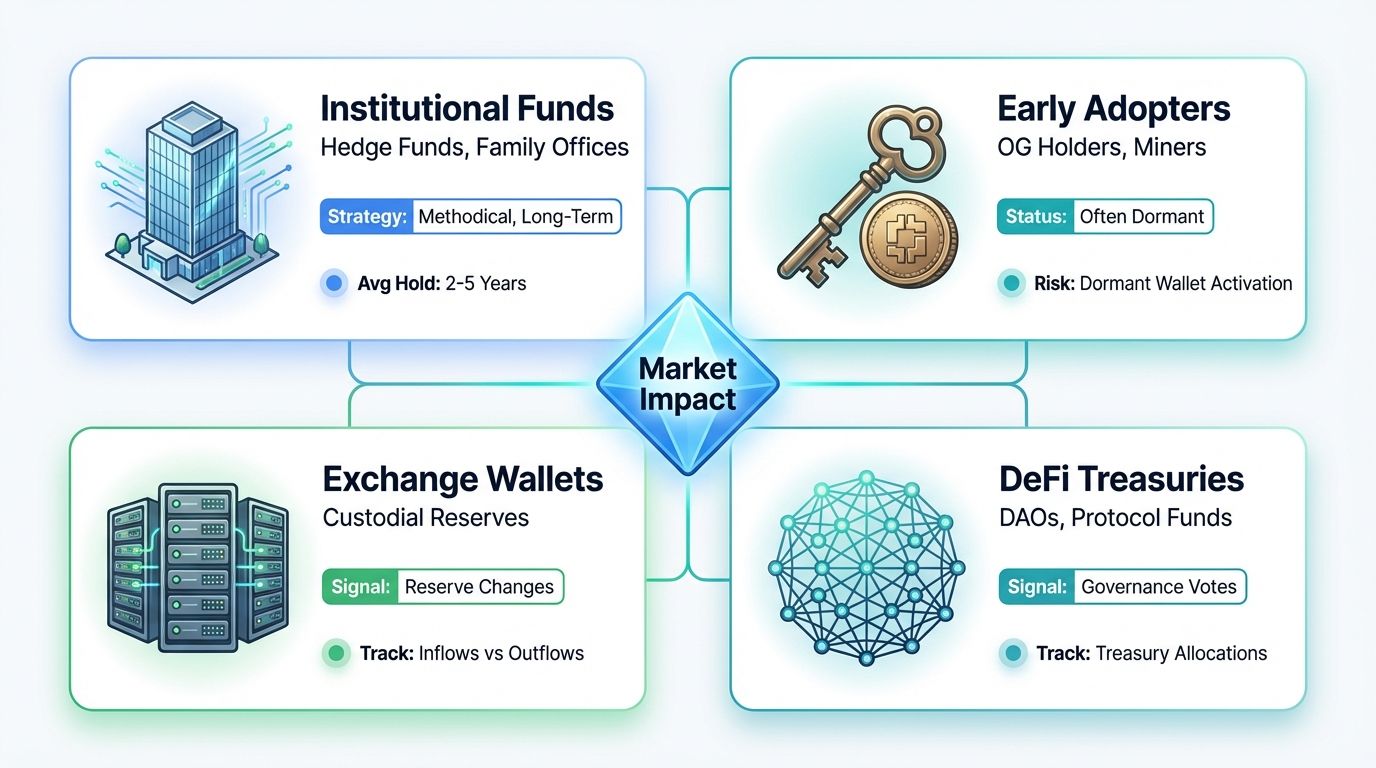
Not all whales behave the same way. Understanding the different categories helps you interpret their on-chain activity more accurately.
Institutional Funds and Corporate Treasuries
These include hedge funds, family offices, and publicly traded companies that hold crypto on their balance sheets. Their transactions are typically large, methodical, and driven by long-term investment theses. When institutional wallets accumulate, it often signals sustained bullish conviction.
Early Adopters and OG Holders
These are individuals or entities that acquired Bitcoin or Ethereum in the earliest days at very low prices. Their wallets are often dormant for years, so any movement from these addresses triggers significant market attention and is often interpreted as a potential sell signal.
Exchange and Custodial Wallets
Exchanges hold massive amounts of crypto on behalf of their users. Tracking exchange reserve balances provides insight into aggregate market sentiment. Declining exchange reserves suggest holders are moving assets to cold storage (bullish), while rising reserves suggest preparation for selling (bearish).
DeFi Protocol Treasuries and DAOs
Decentralized protocols and DAOs control significant treasuries. When governance votes allocate funds for development or token buybacks, the resulting on-chain transactions signal the protocol's health and direction.
How to Track Crypto Whale Wallets: Tools and Methods
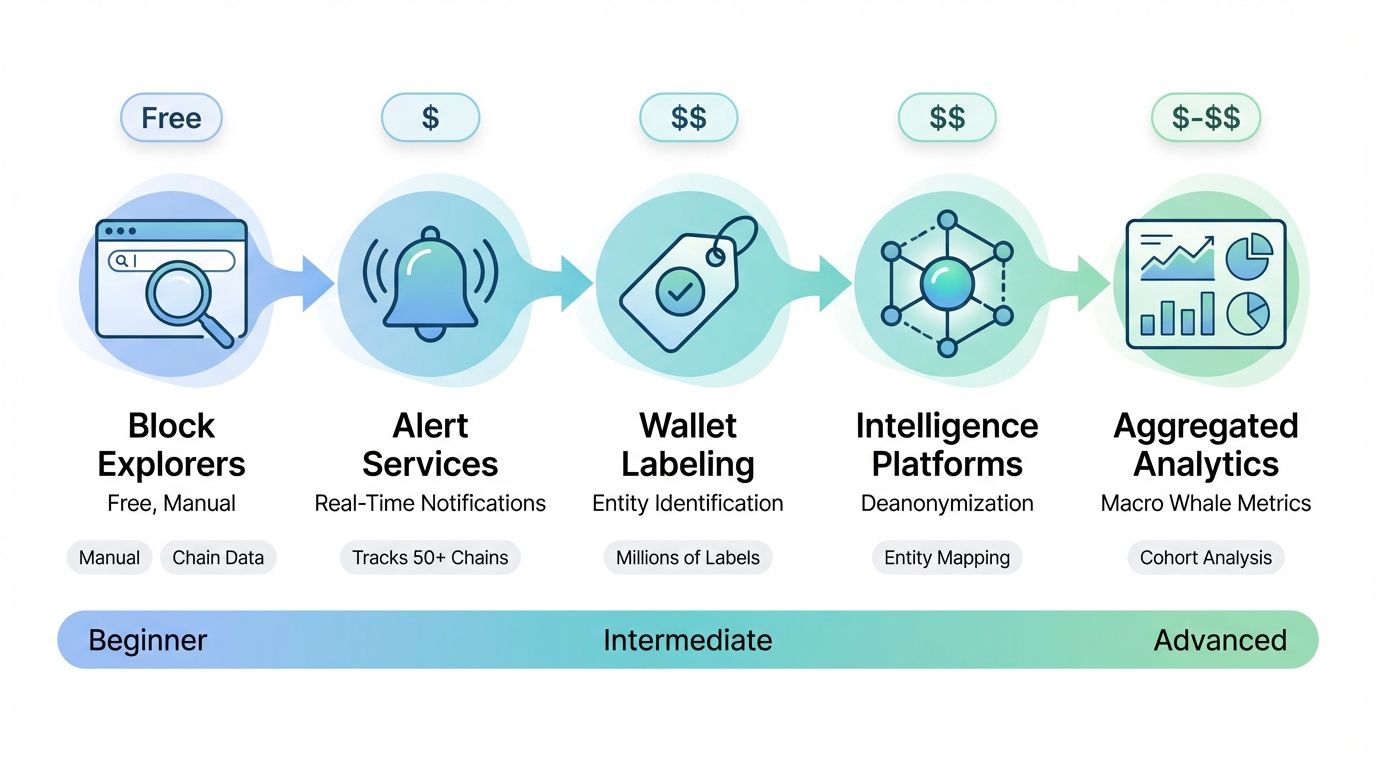
Learning how to track crypto whale wallets has become increasingly accessible thanks to a growing ecosystem of on-chain analytics platforms. Here are the most effective tools and methods available today.
Blockchain Explorers
The most fundamental approach is using blockchain explorers like Etherscan, BscScan, or Blockchain.com. These free tools let you look up any public wallet address and view its complete transaction history. You can monitor known whale addresses by bookmarking them, though this manual method is time-consuming.
Key features to use on explorers include:
- Token holdings and balances
- Transaction history with timestamps
- Internal transactions and contract interactions
- Token transfer tracking for specific wallets
Whale Alert
Whale Alert is one of the most popular real-time whale tracking services. It monitors multiple blockchains and automatically flags large transactions, posting alerts on social media and through its API. The service covers Bitcoin, Ethereum, and dozens of other networks, making it a broad surveillance tool for detecting large movements as they happen.
Nansen
Nansen is a professional-grade analytics platform that labels millions of wallet addresses with identifying tags. This means you can see not just that a large transaction occurred, but who is behind it (e.g., a known venture capital fund, a specific DeFi protocol, or a centralized exchange). Nansen's Smart Money dashboard tracks wallets with historically profitable trading patterns, letting you follow the money that consistently wins.
Arkham Intelligence
Arkham Intelligence takes a similar approach to Nansen but emphasizes wallet deanonymization and entity mapping. Its intelligence engine connects wallet addresses to real-world entities, providing context that raw blockchain data alone cannot offer. The platform's alert system lets you set custom triggers for specific wallets or transaction thresholds.
On-Chain Aggregators and Dashboards
Platforms like Glassnode, CryptoQuant, and Santiment provide aggregated whale metrics rather than individual wallet tracking. These include:
- Exchange inflow and outflow volumes
- Whale transaction count (transactions above $100,000 or $1,000,000)
- Accumulation and distribution trends by wallet size cohort
- Supply held by top addresses as a percentage of total supply
These aggregate metrics help you understand macro-level whale behavior without needing to track individual wallets.
Key Whale Signals Every Trader Should Watch
Knowing how to track crypto whale wallets is only half the equation. You also need to understand what the signals mean in context.
Large Exchange Deposits
When a whale sends a significant amount of crypto to an exchange, it often signals intent to sell. Inbound transfers to exchange hot wallets generally indicate incoming sell pressure. However, context matters: the whale might also be depositing collateral for margin trading or repositioning into another cryptocurrency.
Large Exchange Withdrawals
The opposite signal, large withdrawals from exchanges to private wallets, typically indicates accumulation and long-term holding intent. When whales pull assets off exchanges and into cold storage, they are reducing available supply on the market, which is generally a bullish signal.
Accumulation Patterns
When multiple whale wallets begin accumulating the same token within a short time frame, it suggests coordinated conviction. This pattern is especially meaningful during market downturns, as it indicates that large holders view current prices as undervalued. Tools like Nansen and Santiment can help you identify accumulation trends across wallet cohorts.
Wallet Clustering
Sophisticated analysts use wallet clustering techniques to identify multiple addresses controlled by the same entity. If an entity splits its holdings across 50 wallets but all 50 begin moving simultaneously, it reveals a coordinated strategy that a single wallet analysis would miss. Arkham Intelligence excels at this type of entity-level analysis.
Dormant Wallet Activation
When wallets that have been inactive for years suddenly move funds, it draws intense market scrutiny. For Bitcoin specifically, the activation of wallets from the 2009 to 2012 era can trigger volatility simply from the attention it generates, regardless of the holder's actual intent.
How Whale Activity Affects Crypto Prices
Understanding the mechanics of how whale transactions impact prices helps you react more strategically.
Direct Market Impact
A whale placing a $50 million market buy order on a token with $200 million in daily volume will significantly move the price. The order eats through the order book, filling progressively higher ask levels and creating a visible price spike. Conversely, a large sell order crashes through bid levels, causing a sharp price drop.
Psychological and Sentiment Impact
Even when whale transactions occur off-exchange (over-the-counter deals or wallet-to-wallet transfers), the on-chain visibility of these moves influences market sentiment. Traders who see a whale move 10,000 BTC to an exchange may front-run the expected selling, causing the price to drop before the whale even places an order.
Liquidity Cascades
In leveraged markets, whale-driven price moves can trigger liquidation cascades. A sharp drop caused by whale selling can liquidate long positions, forcing additional selling that liquidates more positions in a chain reaction. The actual market impact of a whale trade can be several times larger than the trade itself.
Reading Whale Movements: Bullish vs. Bearish Signals
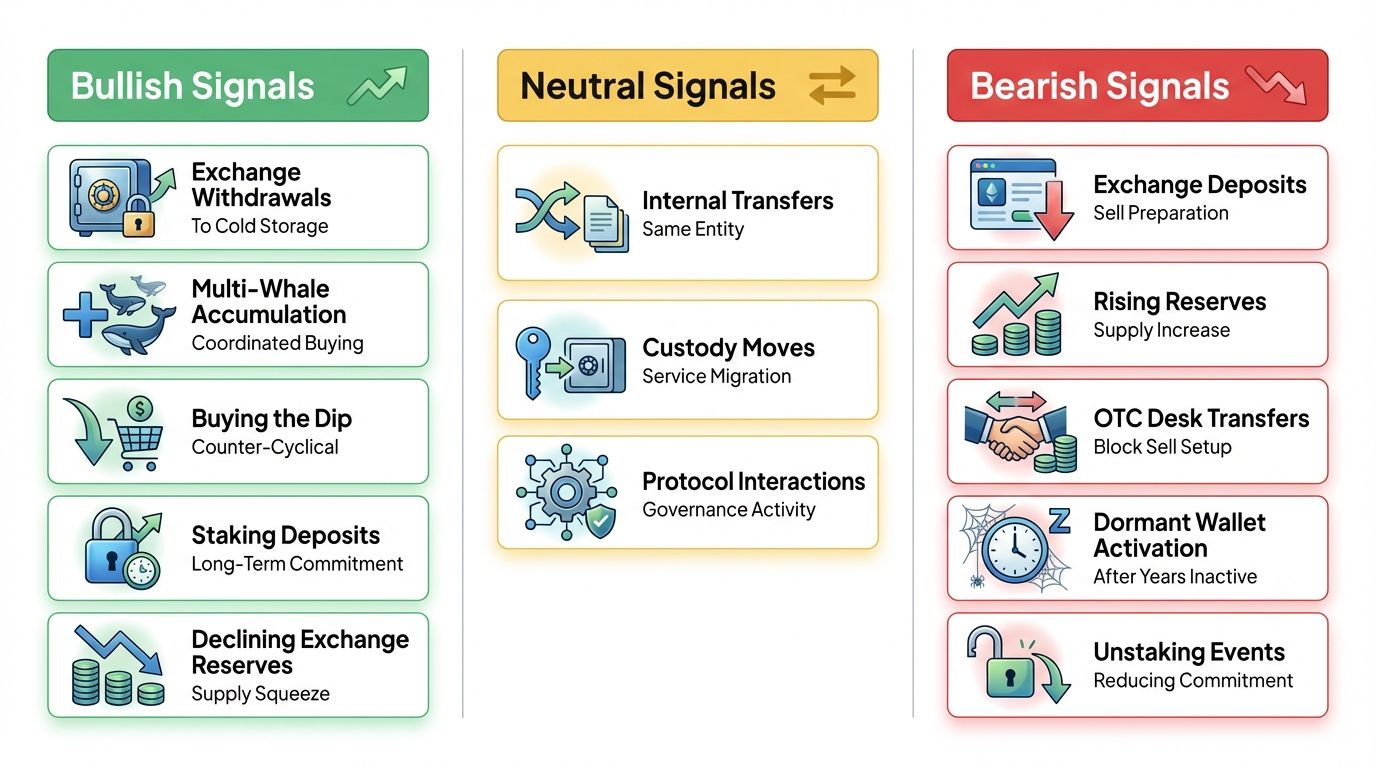
Here is a practical framework for interpreting whale activity.
Bullish Whale Signals
- Large and sustained exchange withdrawals to cold storage
- Accumulation of a specific token by multiple unrelated whale wallets
- Whale wallets adding to positions during price dips or corrections
- Declining exchange reserves across major platforms
- Whale wallets interacting with staking contracts (signaling long-term commitment)
Bearish Whale Signals
- Large exchange deposits from known whale wallets
- Rising exchange reserves, especially for Bitcoin and Ethereum
- Whale wallets moving tokens to over-the-counter desks (often precedes large sells)
- Early adopter wallets becoming active after years of dormancy
- Whale wallets withdrawing from staking or DeFi positions
Neutral or Ambiguous Signals
Not every whale movement has a clear directional implication. Wallet-to-wallet transfers between addresses owned by the same entity (internal reshuffling), transfers to and from custodial services, and movements related to protocol upgrades or governance participation may not carry any trading signal at all.
Risks of Blindly Following Whales
While whale tracking is a powerful tool, it comes with significant pitfalls that every trader should understand.
Wash Trading and Misleading Activity
Some entities deliberately create misleading on-chain signals by moving large amounts between their own wallets or between exchanges. This generates the appearance of accumulation or distribution without any genuine change in positioning, manipulating retail traders who follow whale alerts uncritically.
Delayed and Incomplete Data
Blockchain transactions are public, but the intent behind them is not. By the time you see a whale alert and react, the whale may have already completed their strategy through other channels. OTC trades, derivatives positions, and cross-chain movements can obscure the full picture.
Different Time Horizons
A whale accumulating a token might plan to hold for three years, while you trade on a daily time frame. Following their accumulation signal might be sound at their horizon but devastating at yours if the token drops 40% over the next month before recovering.
Information Asymmetry Still Exists
Even with advanced analytics tools, whales have access to information, networks, and resources that retail traders do not. Their on-chain activity is only one piece of a larger strategic puzzle that includes private negotiations and institutional relationships.
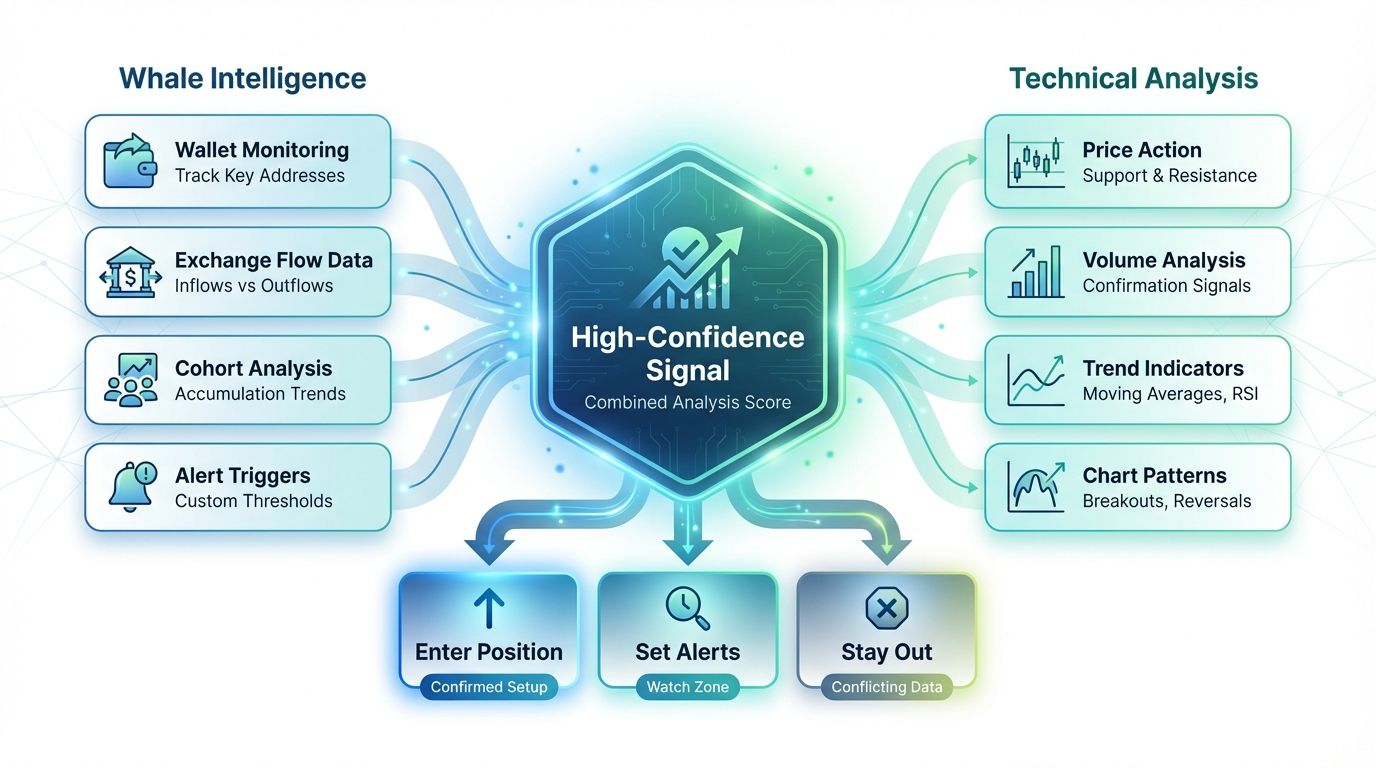
How to Combine Whale Tracking with Technical Analysis
The most effective approach to whale tracking is combining it with traditional technical analysis rather than using it in isolation.
Confirming Breakouts and Breakdowns
When a token approaches a key technical level, whale activity can serve as confirmation. If a token is testing resistance and whale wallets are accumulating, the probability of a breakout increases. Whale selling near support makes a breakdown more likely.
Volume Validation
Whale transactions contribute to on-chain volume. When a technical setup requires volume confirmation, checking whether whale activity is driving that volume adds an extra layer of validation.
Divergence Detection
Detecting divergences between whale behavior and price action is especially powerful. If price is making new highs but whale wallets are quietly distributing, the rally may be on borrowed time. If price is making new lows but whales are accumulating, it may signal a bottom.
Setting Alerts at Key Levels
Rather than monitoring whale alerts constantly, set technical levels where whale activity would change your thesis. For example: "If BTC reaches $58,000 support AND whale exchange withdrawals spike, I will enter a long position." This conditional approach keeps you disciplined and reduces noise.
How Altrady Helps Traders React Quickly to Whale Movements
Knowing what whales are doing is only valuable if you can act on it fast enough. This is where having the right trading infrastructure becomes essential.
Altrady is a multi-exchange crypto trading platform built for speed and precision. When whale alerts hit and markets move, Altrady gives you the edge to respond decisively.
Multi-Exchange Execution from One Dashboard
Whale movements often affect multiple exchanges simultaneously. Altrady connects to all major exchanges from a single interface, allowing you to execute trades instantly without switching between tabs or logging into separate platforms. When a whale alert triggers and you need to act, every second counts.
Smart Trading Features
Altrady's smart order types, including take-profit, stop-loss, and trailing stops, let you set up conditional trades that activate automatically. You can prepare your positions in advance based on whale tracking intelligence and let the platform execute when price reaches your target levels.
Real-Time Portfolio Tracking
When whale activity creates sudden market volatility, you need a clear view of your entire portfolio across all exchanges. Altrady's portfolio tracker updates in real time, helping you make informed rebalancing decisions without scrambling to check each exchange individually.
Try It Risk-Free
If you want to combine whale tracking intelligence with professional-grade trading tools, start with Altrady's free trial. Experience multi-exchange trading, advanced order types, and real-time portfolio management without any upfront commitment.
Frequently Asked Questions
What is the best way to learn how to track crypto whale wallets?
Start with free blockchain explorers like Etherscan to understand how on-chain data works. Then move to aggregated platforms like Whale Alert for real-time notifications. As you become more comfortable reading on-chain data, consider professional tools like Nansen or Arkham Intelligence that provide labeled wallets and entity mapping. Combine this with a multi-exchange platform like Altrady so you can act quickly on the signals you identify.
Can whale tracking predict exact price movements?
No. Whale tracking provides probabilistic signals, not certainties. A whale depositing tokens to an exchange might signal intent to sell, but it could also mean repositioning into another asset or posting collateral. Always combine whale signals with technical analysis, market context, and proper risk management.
How do whales avoid detection when making large trades?
Sophisticated whales use several techniques to minimize visibility: splitting transactions across multiple wallets, using OTC desks for block trades, routing through mixing services, executing through DEX aggregation routers, and timing transactions during high network activity. This is why relying on a single tracking tool is insufficient. Cross-referencing multiple data sources gives you a more complete picture.
Is it legal to track crypto whale wallets?
Yes. All blockchain transactions on public networks are, by design, visible to anyone. Tracking wallet activity is simply analyzing publicly available data. There are no legal restrictions on monitoring blockchain transactions or using on-chain analytics tools. However, acting on material non-public information (such as insider knowledge about a company's crypto plans) remains subject to securities regulations in many jurisdictions.
How quickly should I react to whale alerts?
Speed matters, but hasty reactions are dangerous. When you receive a whale alert, take a moment to verify the context. Check which wallet is involved, where the funds are going, and whether the movement aligns with your existing technical analysis. Having your trading setup ready on a platform like Altrady means you can execute quickly once you have confirmed the signal, rather than scrambling to log in and place orders while the opportunity passes.