
In 2026, the question of how humans prove they are human (not AI bots) on the internet has become urgent. With AI agents producing convincing text, images, audio, and video, distinguishing authentic human activity from automated content is increasingly difficult. Worldcoin, the project founded by Sam Altman (OpenAI CEO) and Alex Blania, has positioned itself as the most ambitious answer to that question.
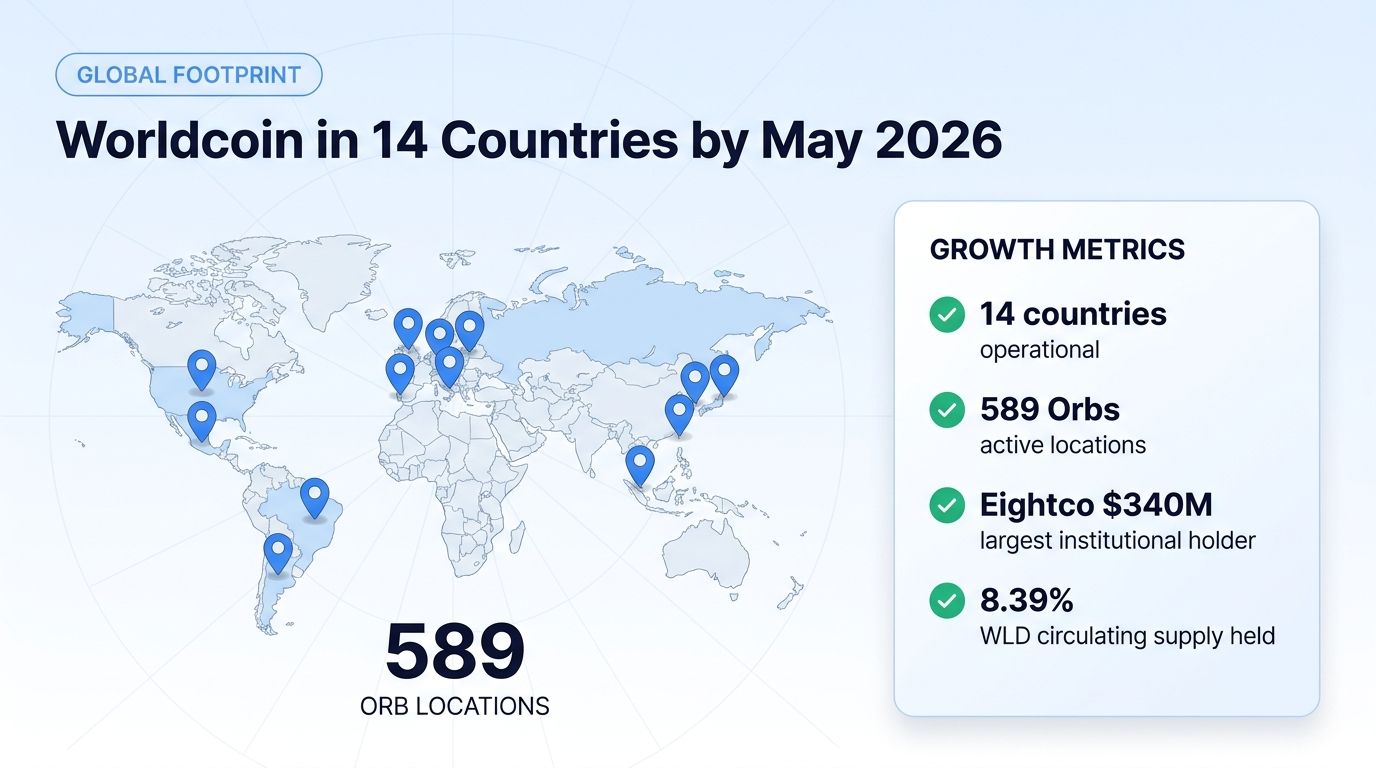
By May 2026, Worldcoin has expanded to 589 Orb scanner locations across 14 countries (Argentina, Austria, Brazil, Germany, Italy, Japan, South Korea, Mexico, Poland, Portugal, Singapore, Taiwan, the United Kingdom, and the United States). Eightco Holdings (NASDAQ: ORBS) holds 283.45 million WLD tokens (8.39% of circulating supply, ~$340 million), making it the largest publicly disclosed institutional holder. The WLD token trades at approximately $0.23 with significant institutional accumulation underway.
This guide explains what Worldcoin is, how World ID works, the role of the Orb biometric device, the WLD token economics, the risks and controversies, and how traders should think about exposure to the World ecosystem.
What Is Worldcoin?
Worldcoin (also called World, since the project's broader rebrand) is a decentralized identity and financial network built around three components.
First, World ID. A privacy-preserving digital identity credential that proves a person is unique and human, without revealing personal details. It uses zero-knowledge cryptography to verify "this is a unique human" without sharing names, emails, or government IDs.
Second, the Orb. A specialized biometric hardware device that scans a person's iris to generate the cryptographic credential. The iris scan is processed locally, with only the cryptographic proof (not the biometric data) leaving the device. Orbs are deployed in physical locations across the 14 supported countries.
Third, the WLD token and World Chain. WLD is the project's native token, distributed to verified humans as part of the onboarding incentive. World Chain is the project's Layer 2 (Ethereum-based) blockchain optimized for human-verified transactions and applications.
Why Worldcoin Matters in 2026
Three forces converged.
First, the AI explosion accelerated demand for proof-of-personhood. With ChatGPT, Claude, Gemini, and other AI systems producing convincing content, social platforms, marketplaces, voting systems, and financial services need to distinguish humans from bots. World ID provides that distinction at scale.
Second, the institutional thesis matured. Eightco Holdings' $340 million WLD position represents the largest single corporate commitment to the project. Other institutional investors have followed at smaller scales. The "World as proof-of-personhood infrastructure" thesis has moved from speculation to investable position.
Third, Sam Altman's broader influence amplified the project. OpenAI's exploration of biometric verification integrations, reported social network projects, and Altman's general visibility in the AI conversation create gravitational pull. Worldcoin sits at the intersection of AI and crypto in a uniquely visible way.
For traders, Worldcoin represents both a long-term thesis (digital identity infrastructure for the AI era) and shorter-term catalysts (unlock schedule changes, institutional accumulation, partnership announcements).
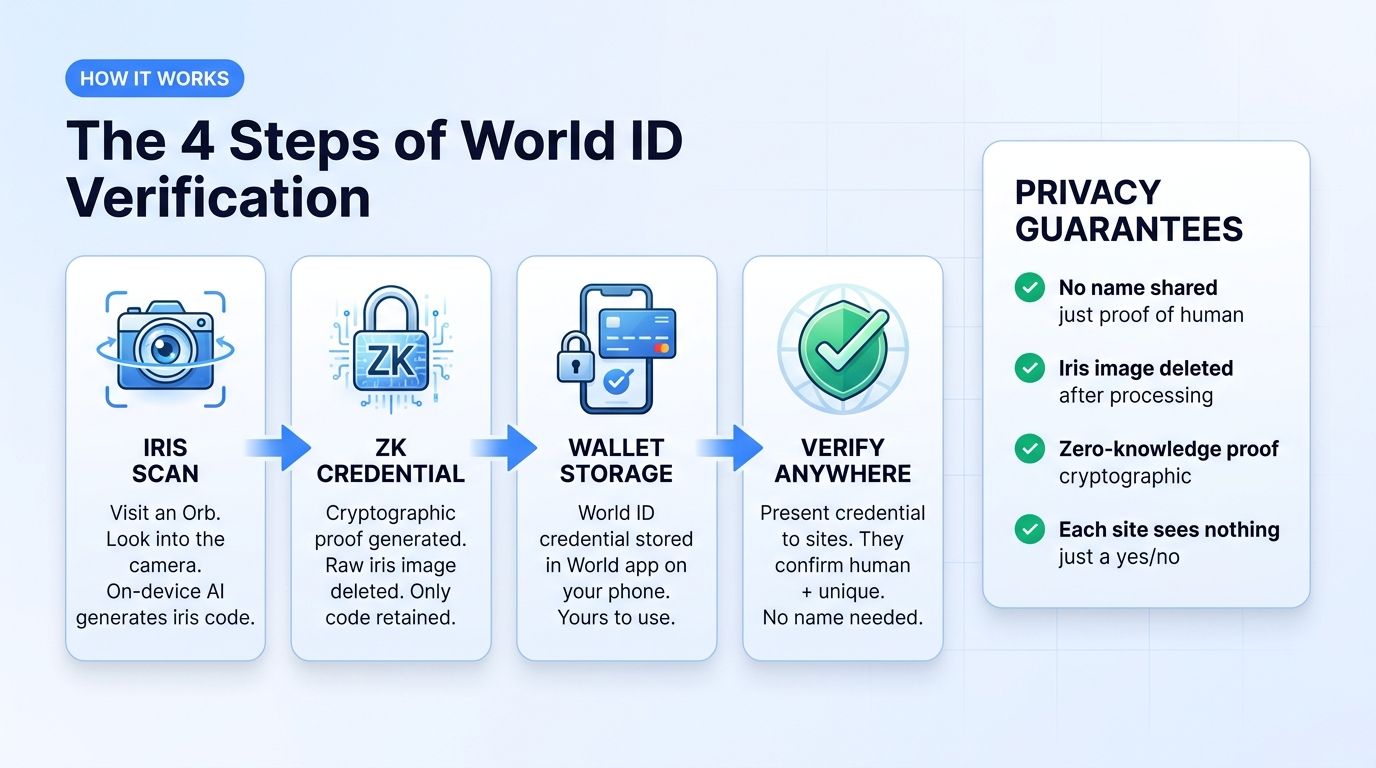
How World ID Actually Works
The cryptographic mechanics behind World ID are sophisticated but the user experience is simple.
Step 1: Iris Scan at an Orb
A person visits an Orb location and looks into the device. The Orb captures a high-resolution image of the person's iris. The image is processed locally on the device using on-device AI to generate an "iris code", a numerical representation that uniquely identifies the iris pattern.
The raw iris image is deleted from the Orb. Only the iris code (a compact numerical representation) is retained, and even that is processed cryptographically to produce the final World ID credential.
Step 2: Zero-Knowledge Credential
The Orb generates a unique cryptographic credential (a zero-knowledge proof) that proves "this iris was scanned at an Orb" without revealing the iris data or any personally identifying information. The credential is stored on the person's mobile device in the World app.
Step 3: Verification Without Exposure
When the person wants to prove they are human (e.g., to a website, app, or platform), they present their World ID credential. The verifier can confirm:
- The credential is valid (issued by a legitimate Orb)
- The credential is unique (this person has not previously verified at this platform)
- The person is a human (the Orb verified them in person)
The verifier cannot see:
- The person's name, email, or identifying details
- Their iris data
- Other places they have verified
Step 4: WLD Token Receipt
As part of the onboarding incentive, verified humans receive WLD tokens. The exact amount has varied over the project's history. The tokens serve both as compensation for participation and as a stake in the broader World ecosystem.
The WLD Token Economics
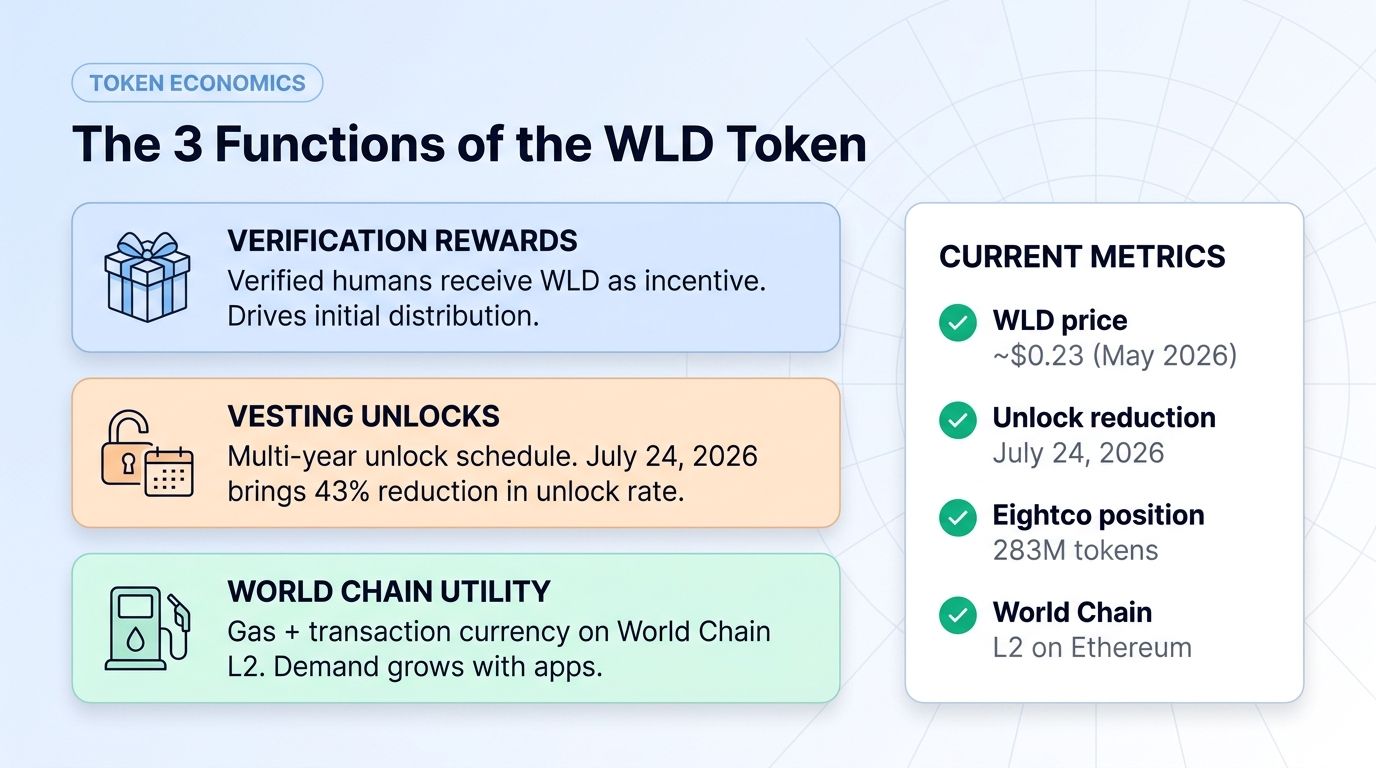
Three economic mechanisms.
Verification rewards. Verified humans receive WLD as they sign up. This drives initial distribution.
Vesting and unlocks. WLD has a multi-year unlock schedule. The project announced a planned 43% decrease in the unlock rate beginning July 24, 2026, which reduces future supply pressure.
Utility on World Chain. WLD serves as gas and transactional currency on World Chain. As more applications launch on World Chain, demand for WLD increases.
The token has been volatile through its history. From above $11 in March 2024, WLD declined significantly before stabilizing in the sub-$1 range during 2025-2026. The decline reflected aggressive vesting unlocks combined with relatively early-stage utility. The 2026 unlock rate reduction is designed to reduce ongoing supply pressure.
The Institutional Position: Eightco Holdings
Eightco Holdings Inc. (NASDAQ: ORBS) represents the most prominent institutional position on the World thesis.
Eightco's positioning:
- $340 million WLD portfolio
- 283.45 million WLD tokens (8.39% of circulating supply)
- Largest publicly disclosed institutional holder
- NASDAQ ticker ORBS (referencing the Orb device)
For traders, Eightco's position serves multiple functions:
- Validation of the World thesis at institutional scale
- A publicly traded stock proxy for World exposure
- A demand sink (Eightco continuing to add to position would consume circulating supply)
Eightco's quarterly disclosures and capital-markets activity are now watched as catalysts for WLD trading.
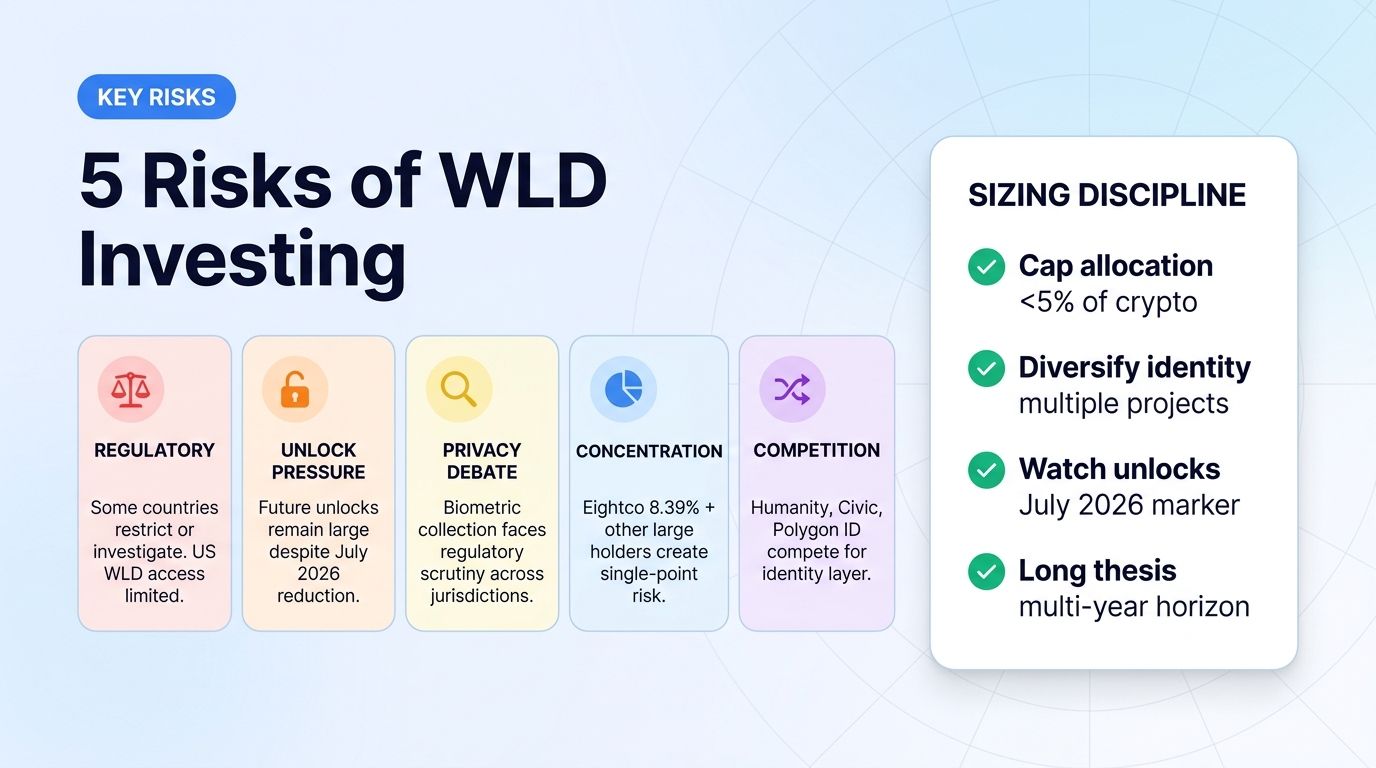
The Risks of Worldcoin
Privacy concerns and regulatory pushback. Biometric data collection (even processed cryptographically) faces regulatory scrutiny. Several countries (Spain, Portugal, Argentina, Brazil, India among others) have at various points investigated or restricted Worldcoin operations. Continued regulatory friction could slow adoption.
Geographic restrictions. Worldcoin is not available everywhere. US residents face restrictions on direct WLD acquisition. Several countries either restrict or prohibit Orb operations. The addressable market is smaller than total internet population.
Unlock schedule pressure. Despite the planned 43% reduction in unlock rate, WLD has substantial future unlocks. Token-holding investors face dilution risk during the multi-year vesting period.
Concentration risk. Eightco's 8.39% holding creates concentration. Large sales by Eightco (or other major holders) could produce significant price impact. The institutional accumulation can reverse.
Centralization questions. Despite the decentralized branding, the World project is closely associated with Sam Altman, Alex Blania, and Tools for Humanity (the development company). Concentrated leadership and dependency on Orb hardware create centralization vectors.
Competitor risk. Other proof-of-personhood projects exist (Civic, Polygon ID, Humanity Protocol, others). Worldcoin's first-mover advantage is real but not absolute.
How to Get WLD Exposure
Three practical paths.
Path 1: Buy WLD on a centralized exchange. WLD is listed on Binance, OKX, Bybit, Kraken, KuCoin, and most major exchanges (US access varies). You buy with USDT, USDC, or fiat. This is the cleanest exposure to the WLD thesis. A crypto trading platform like Altrady connects to 19+ exchanges, so you can manage WLD positions alongside other crypto holdings.
Path 2: Hold ORBS stock (Eightco). For investors who prefer equity exposure, Eightco Holdings (NASDAQ: ORBS) provides a leveraged proxy to the World thesis. The stock's premium to NAV varies and adds equity-market risk on top of WLD risk.
Path 3: Get verified at an Orb and receive WLD directly. If you live in one of the 14 supported countries and want to participate, visit an Orb location to verify and receive your initial WLD distribution. This requires you to undergo iris scanning, which is a personal decision worth careful consideration.
How World Fits Into a Crypto Portfolio
A practical framework:
- Core large-cap holdings (BTC, ETH): 50-70% of crypto allocation
- AI x crypto exposure (TAO, RNDR, WLD): 10-20% combined. WLD is one of several AI-narrative tokens.
- Speculative new tokens: 5-15%. Higher-risk positions where you accept significant volatility
- Cash reserves: 5-15%. For opportunistic accumulation during weakness
WLD allocation rarely exceeds 5% of total crypto portfolio due to the early-stage nature and unlock schedule risks. Diversification across the broader AI x crypto theme (alongside TAO, RNDR, AI agent tokens) is common.
The Broader Identity x AI Trend
Worldcoin is the most visible project in a broader trend.
Other identity projects include: - Humanity Protocol (palmprint-based proof-of-personhood) - Civic (KYC-based identity layer) - Polygon ID (zero-knowledge identity framework) - Idena (proof-of-personhood through anti-AI tests)
These projects compete on technical approach (biometric vs. behavioral vs. social verification), geographic accessibility, and privacy guarantees. The winner (or winners) of the identity layer will define how humans interact with AI systems in the coming decade.
For traders, the identity theme provides multiple tradable positions. WLD remains the leader by network effect, but the category as a whole is still early.
FAQ
Is Worldcoin legal in the US?
Worldcoin operates Orbs in the US, but direct WLD token acquisition by US persons is restricted. The token can be obtained through certain exchanges with appropriate KYC, but the project's full incentive structure (initial token distribution to verified humans) is not available to US residents. Regulatory clarity is expected to evolve, particularly as the CLARITY Act progresses.
Is iris scanning safe?
The Orb's iris scan is processed locally on the device. The raw image is deleted after processing. Only a cryptographic representation (iris code) is retained, and even that is processed further before becoming the World ID credential. Tools for Humanity (the development company) has published technical documentation explaining the privacy architecture. Personal comfort with biometric collection varies; this is a decision each individual makes based on their own privacy preferences.
What is the difference between Worldcoin and World?
The project broadly rebranded from "Worldcoin" to "World" in 2024. WLD is still the token ticker, but the project name is generally "World" with sub-products: World ID (the credential), World App (the mobile app), World Chain (the L2 blockchain), and the Orb (the verification hardware).
Should I buy WLD now or wait for the unlock rate reduction?
The July 24, 2026 unlock rate reduction reduces ongoing supply pressure. Some traders prefer to wait for the reduction to take effect before adding to positions. Others position before the reduction to capture potential post-reduction price appreciation. Both approaches are defensible; the right choice depends on your view of timing and your conviction level.
Can I trade WLD on Altrady?
Yes. WLD is listed on multiple exchanges that Altrady supports including Binance, OKX, Bybit, KuCoin, and Kraken. Altrady connects to 19+ exchanges, so you can manage WLD positions alongside other crypto holdings, run automated strategies via the signal bot or DCA bot, and use unified portfolio tracking.
Conclusion
Worldcoin and World ID represent one of the most ambitious crypto projects of the AI era. The combination of Sam Altman's influence, working biometric verification at scale, increasing institutional adoption (Eightco's $340M position), and the broader AI x identity trend positions the project as a serious infrastructure play rather than a pure speculation.
For traders, the practical takeaway is this: WLD is a legitimate AI x crypto position with real network effect, real adoption (589 Orbs in 14 countries), and real institutional interest. The risks (regulatory pushback, unlock pressure, centralization questions) are also real and require sizing positions appropriately.
The longer-term thesis is straightforward. As AI continues to make distinguishing humans from bots harder, infrastructure for proof-of-personhood becomes more valuable. Worldcoin is the most visible and best-funded project addressing that need. If the thesis plays out, the upside is significant. If it does not, the downside is also significant.
The next 12 months will produce decisive information. The July 2026 unlock rate reduction, additional country expansions, institutional adoption announcements, and potential US regulatory clarity will all shape whether WLD becomes a foundational AI-era asset or remains a high-conviction position on an early thesis.