
In March 2026, the US Securities and Exchange Commission approved multiple spot XRP exchange-traded funds, ending a years-long regulatory uncertainty for one of crypto's most contested assets. Within the first sixty days, cumulative inflows into XRP spot ETFs exceeded $1.5 billion, making them the fastest crypto ETF category to reach the $1 billion threshold since the Ethereum ETF launch in 2024.
For traders and investors familiar with the XRP story, the approval represents the institutional validation phase. After years of legal battles with the SEC, regulatory clarification through the CLARITY Act, and the emergence of XRP as a payments-focused settlement layer, the ETF approvals confirm XRP's institutional acceptability and unlock significant new capital pools.
This guide explains the path to XRP spot ETF approval, the institutional adoption trajectory, how XRP compares to BTC and ETH in the ETF context, and how traders should think about XRP exposure in the new institutional era.
What Are the XRP Spot ETFs?
XRP spot ETFs are exchange-traded funds that hold actual XRP tokens (rather than XRP-related derivatives or futures contracts) and provide investors with regulated exposure to XRP price movements through traditional brokerage accounts.
The approved ETFs were launched by multiple major issuers, including Bitwise, 21Shares, Grayscale (converting their existing XRP product), and several other crypto-focused asset managers. Each ETF charges management fees typically ranging from 0.2% to 0.7% annually, with competitive pressure expected to drive fees lower over time.
The structure follows the now-established pattern from Bitcoin and Ethereum spot ETFs. The fund holds XRP in qualified custody (typically through Coinbase Custody or BitGo). Daily creations and redemptions allow the ETF's market price to track the underlying XRP price closely. Holdings are reported transparently and audited regularly.
For investors, the practical benefit is access through any standard brokerage account (Schwab, Fidelity, Vanguard, retirement accounts including 401k and IRA) without managing wallets, exchanges, or private keys directly.
The Path to Approval
XRP's path to ETF approval was longer and more contentious than Bitcoin's or Ethereum's.
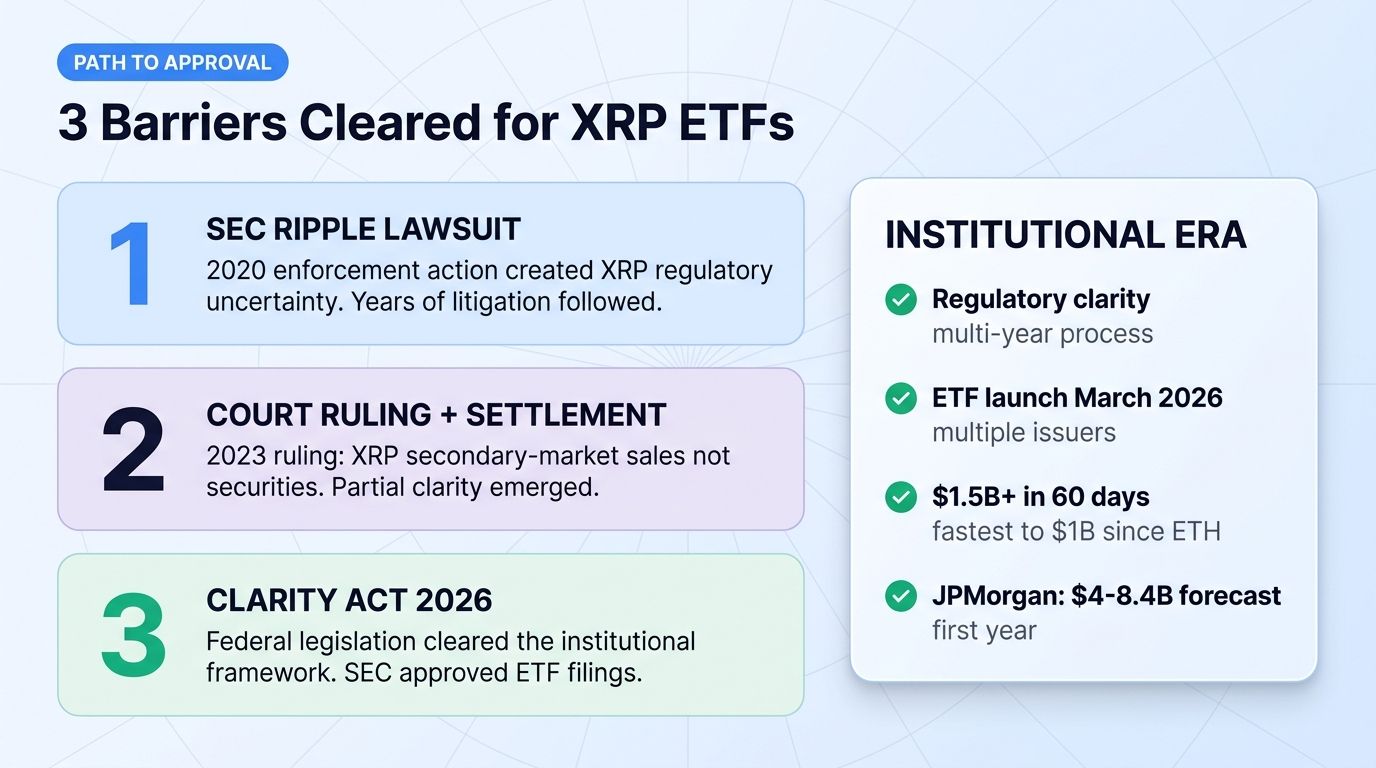
Three structural barriers had to be cleared.
First, the SEC's 2020 enforcement action against Ripple Labs (XRP's primary developer) created direct uncertainty about XRP's regulatory status. The case alleged XRP was an unregistered security. Years of litigation followed.
Second, the partial settlement and court rulings created some clarity but left ambiguity. The 2023 court ruling that XRP itself (when sold on secondary markets to retail investors) was not a security removed the primary barrier, but additional questions about institutional sales persisted.
Third, the regulatory framework needed to evolve. The CLARITY Act passing in early 2026 provided the legislative framework that gave the SEC institutional comfort to approve XRP-related products.
By Q1 2026, all three barriers had cleared sufficiently for ETF applications to be approved. The SEC's evaluation of individual ETF filings then progressed normally, with approvals coming in waves.
Why the Approval Matters Structurally
Three structural impacts.
First, capital pool expansion. Traditional brokerage clients (the vast majority of US investors) can now access XRP through familiar channels. This was previously difficult or impossible for many retirement-account and IRA investors.
Second, institutional legitimacy. ETF approval is widely interpreted as institutional validation. Pension funds, family offices, and large advisory firms can now consider XRP allocations with regulatory cover.
Third, market structure improvement. ETF-driven flows tend to be steadier than retail crypto flows. The presence of large institutional capital with ETF intermediation may reduce overall XRP price volatility over time.
For traders, the implications are mixed. Long-term, more institutional capital generally supports price. Short-term, ETF approval was widely anticipated and may have already been priced in to some extent. The actual long-term performance depends on whether sustained inflows develop or whether initial enthusiasm fades.
XRP Spot ETF Inflows Compared to BTC and ETH
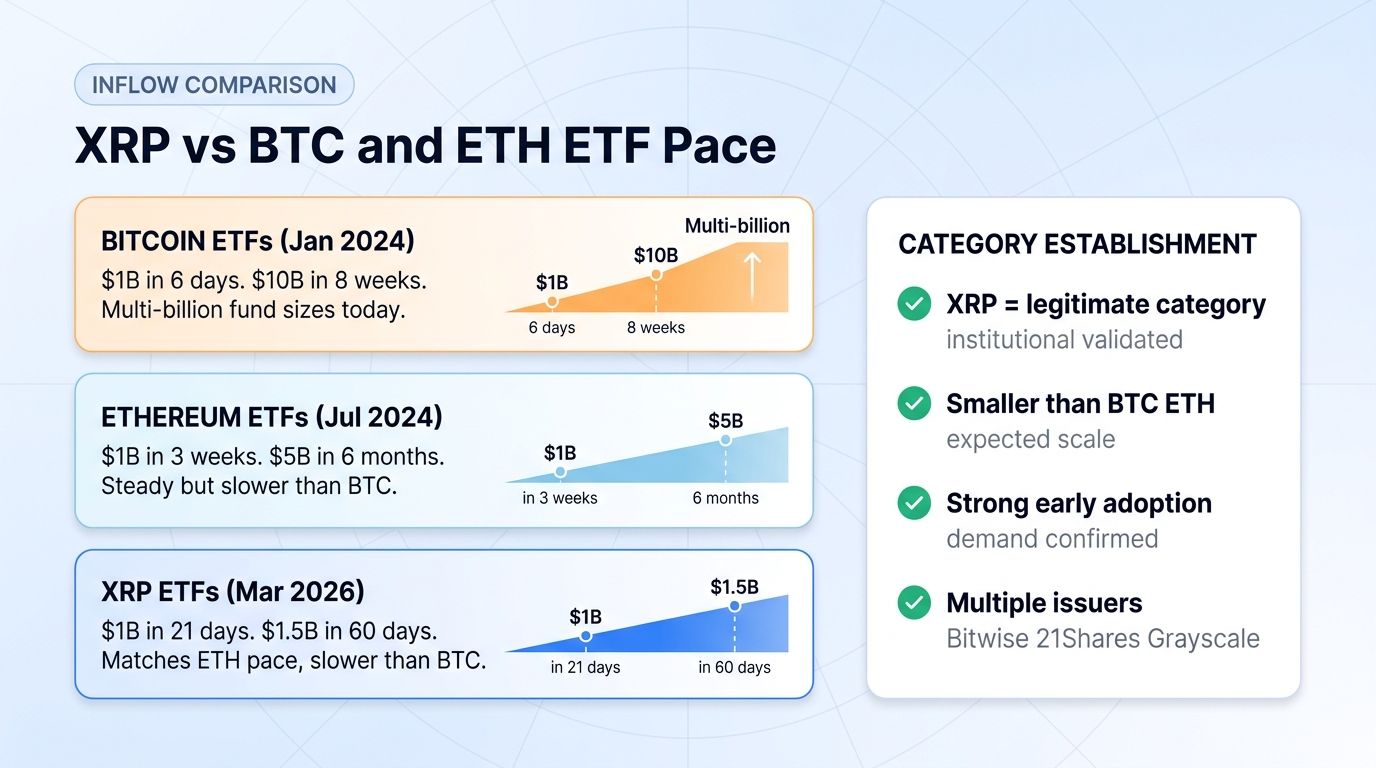
The early inflow trajectory provides comparison.
Bitcoin Spot ETFs (January 2024 launch): Reached $1 billion within 6 days. Reached $10 billion within 8 weeks. Have continued at consistent pace through 2024-2026.
Ethereum Spot ETFs (July 2024 launch): Reached $1 billion within 3 weeks. Reached $5 billion within 6 months. Slower pace than Bitcoin but consistent.
XRP Spot ETFs (March 2026 launch): Reached $1 billion within ~21 days. Reached $1.5 billion within 60 days. Pace matches Ethereum's early days but is slower than Bitcoin's.
For perspective, JPMorgan's research team published a forecast suggesting XRP spot ETFs could attract $4-8.4 billion in cumulative inflows within the first year, depending on broader market conditions and competitor positioning.
The trajectory suggests XRP spot ETFs are establishing as a legitimate but smaller category than BTC or ETH ETFs.
How XRP Compares to Other Major Crypto ETFs
The crypto ETF landscape now includes multiple major categories.
Bitcoin Spot ETFs: The dominant category. Multi-billion dollar fund sizes, deep liquidity, comprehensive coverage by major asset managers (BlackRock, Fidelity, Bitwise, Grayscale, others). Often serves as default crypto exposure for institutional portfolios.
Ethereum Spot ETFs: Established second category. Significant fund sizes, growing institutional acceptance. Serves both as ETH-specific exposure and as broader smart contract platform exposure.
XRP Spot ETFs: New category. Strong initial inflows. Strategic positioning as payment-focused crypto exposure. Smaller scale than BTC or ETH ETFs but growing rapidly.
Other crypto ETFs: Solana ETFs (launched late 2025) have established as a fourth category. Litecoin ETFs received approval in early 2026. Dogecoin ETFs are pending. The landscape continues expanding.
For traders, the practical question is allocation strategy. Holding a basket across BTC, ETH, XRP, and potentially Solana ETFs provides diversified crypto exposure within the ETF wrapper.
How Traders Should Think About XRP Spot ETFs
For traders, the ETF launch creates several considerations.
First, ETF exposure is operationally simpler than direct XRP. For traders managing tax-advantaged accounts (IRA, 401k) or who prefer brokerage-only exposure, ETFs are the preferred path.
Second, ETF holdings vs. direct XRP have different cost structures. ETFs charge management fees (0.2-0.7%) annually. Direct XRP has no recurring fees but requires exchange or wallet infrastructure costs.
Third, the ETF launch may produce price catalysts but is not a guarantee of price appreciation. Bitcoin price was relatively flat in the first months after spot BTC ETF approval before later appreciation. XRP price dynamics may follow similar patterns.
Fourth, active traders may benefit from holding both ETF (for tax-advantaged accounts) and direct XRP (for active trading flexibility). The two are complementary positions rather than competing alternatives.
XRP Use Cases Beyond Price Speculation
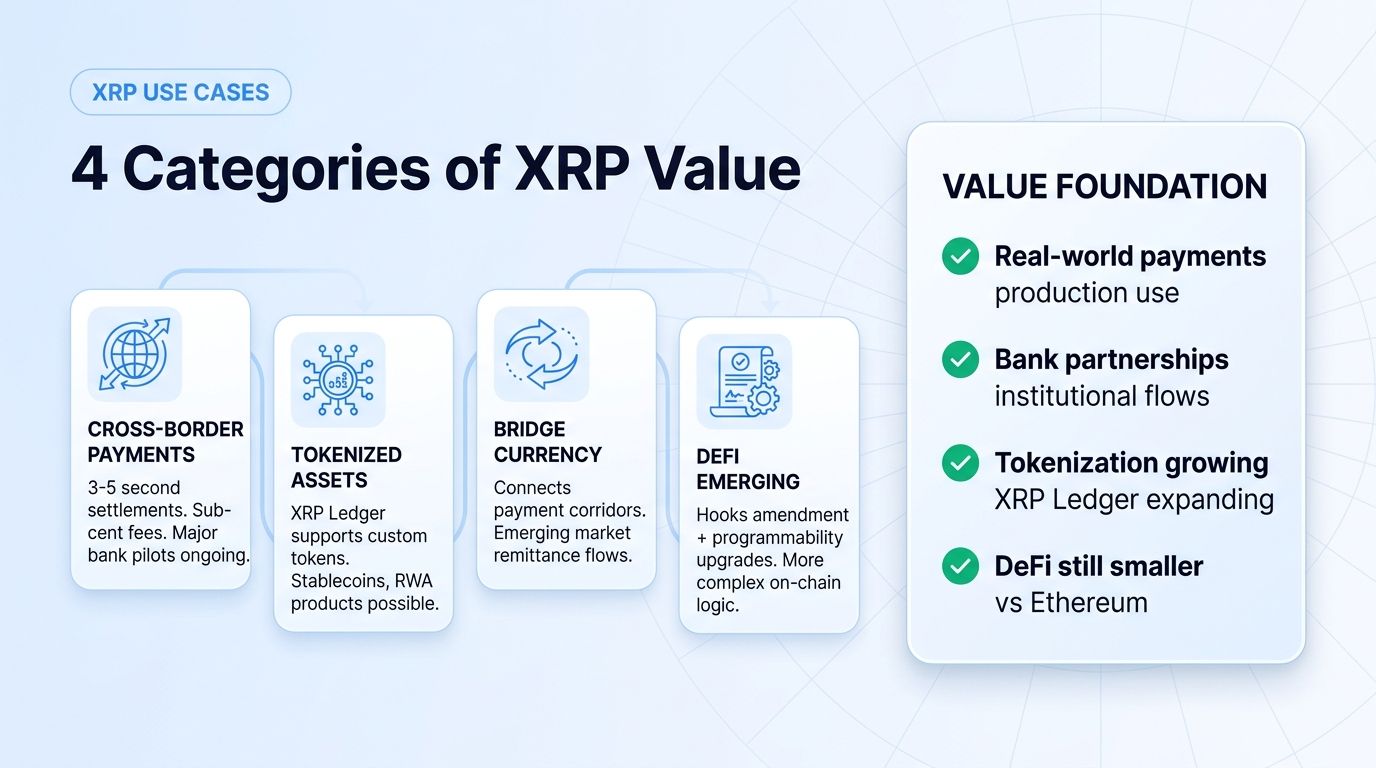
Beyond price exposure, XRP has specific use cases that drive long-term value.
Cross-border payments: XRP's original use case. The XRP Ledger settles transactions in 3-5 seconds with sub-cent fees. Several major financial institutions use XRP-based products for cross-border settlement.
Tokenized assets: The XRP Ledger supports issuance of custom tokens, enabling tokenized stablecoins, RWA products, and other use cases.
Liquidity provision: XRP serves as a bridge currency in some payment corridors, particularly for emerging market remittance flows.
DeFi (emerging): XRP's smart contract capabilities have been more limited than Ethereum's. However, the XRP Ledger has been adding new programmability features. The Hooks amendment and similar upgrades enable more complex on-chain logic.
These use cases provide fundamental support for XRP value beyond pure speculation, though the relative weight of each varies.
The Risks of XRP Investment
Regulatory risk. Despite the ETF approval and CLARITY Act, regulatory uncertainty has historically affected XRP more than BTC or ETH. Future regulatory developments could affect operations.
Technical risk. The XRP Ledger has functioned reliably but is technologically distinct from Ethereum and other major chains. Specific bugs or exploits could affect the network.
Concentration risk. Ripple Labs continues holding significant XRP supply. Escrow releases and Ripple's strategic decisions affect supply dynamics.
Competition risk. XRP's payments use case faces competition from stablecoins (USDC, USDT, USDPT) increasingly used for cross-border settlement. New TradFi entries (Western Union USDPT) may displace XRP in some corridors.
ETF-specific risks. Management fees compound over time. ETF tracking error can exist. Spreads in less liquid ETFs can be wider than direct XRP trading.
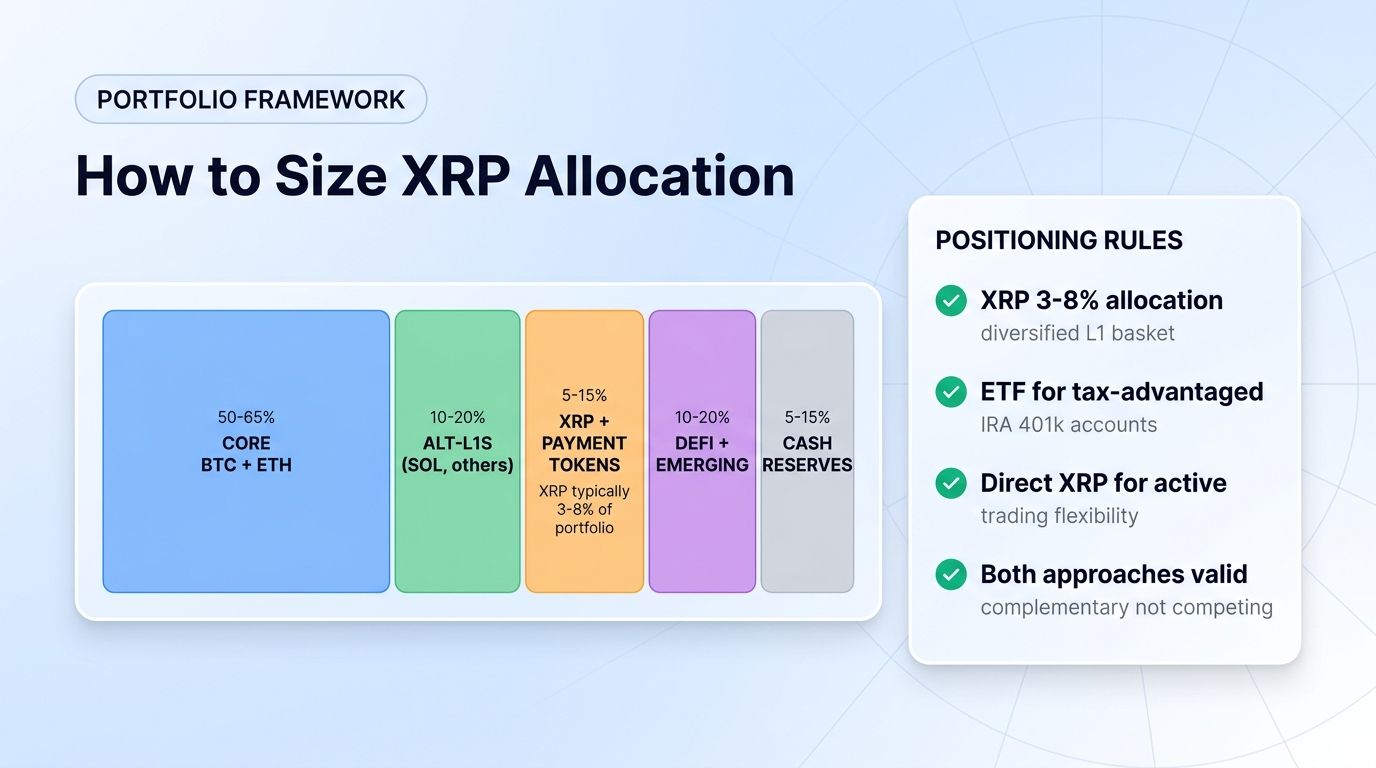
How XRP Fits Into a Crypto Portfolio
A practical framework:
- Core large-cap holdings (BTC, ETH): 50-65% of crypto allocation
- Major alt-L1 exposure (SOL, others): 10-20%
- XRP and payment-focused tokens: 5-15%. XRP typically 3-8% of total portfolio.
- Other DeFi and emerging tokens: 10-20%
- Cash reserves: 5-15%
XRP allocation rarely exceeds 8-10% of total portfolio due to category-specific risks. The thesis is real but the risk profile suggests sizing as one component of a diversified crypto allocation.
What to Watch in the Next 12 Months
Three indicators.
Indicator 1: ETF inflow trajectory. Do cumulative inflows continue growing? Does the pace accelerate or decelerate? JPMorgan's $4-8.4B forecast provides a benchmark.
Indicator 2: Use case adoption. Are new payment corridors, tokenized asset projects, or DeFi applications launching on XRP Ledger? Growing real-world utility supports long-term value.
Indicator 3: Competitive positioning. How does XRP perform against alternative payment-focused assets (stablecoins, other L1 payments tokens)? Maintaining or growing market share signals continued relevance.
If all three trend positively, XRP could outperform broader crypto. If ETF inflows slow and use case adoption stagnates, XRP could underperform.
FAQ
What is an XRP spot ETF?
An XRP spot ETF is an exchange-traded fund that holds actual XRP tokens and tracks XRP's price. Investors can buy and sell shares of the ETF through standard brokerage accounts, gaining XRP price exposure without managing crypto wallets or exchanges directly.
Are XRP spot ETFs better than holding XRP directly?
It depends on the use case. ETFs are better for tax-advantaged accounts (IRA, 401k), traditional brokerage convenience, and reduced operational complexity. Direct XRP is better for active trading, DeFi participation, and avoiding management fees. Many investors hold both.
How do XRP ETF fees compare to BTC and ETH ETFs?
XRP ETF fees range from 0.2% to 0.7% annually, broadly similar to BTC and ETH ETFs. Competitive pressure may drive fees lower over time as the category matures.
Will more XRP ETFs be approved?
Multiple issuers have approved XRP spot ETFs. Additional issuers may launch competing products. The category is in active competitive expansion.
Can I trade XRP and XRP ETFs on Altrady?
XRP is listed on Binance, Coinbase, Kraken, Bybit, KuCoin, and most major exchanges. Altrady connects to 19+ exchanges, so you can manage XRP positions alongside other crypto holdings, run automated strategies via the signal bot, grid bot, or DCA bot, and use unified portfolio tracking. XRP ETFs trade through traditional brokerages.
Conclusion
The XRP spot ETF approval represents the institutional validation phase for one of crypto's most-watched assets. After years of regulatory uncertainty, the approval clears the path for traditional brokerage and retirement account exposure to XRP.
For traders, the practical takeaway is this: XRP is now a credible institutional position alongside BTC and ETH. The ETF wrapper provides operational convenience for tax-advantaged accounts and for investors who prefer brokerage-only exposure. Direct XRP remains the preferred path for active traders.
The longer-term trajectory depends on whether sustained institutional inflows materialize and whether XRP's use cases (cross-border payments, tokenized assets) develop into meaningful real-world utility. The next 12 months will produce decisive data on both questions.
For diversified crypto portfolios, allocating a modest position (3 to 8%) to XRP makes sense as part of broader crypto exposure. The ETF approval provides additional access channels but does not change the fundamental investment thesis. Sizing positions to a level where worst-case scenarios do not damage your portfolio is the standard approach.