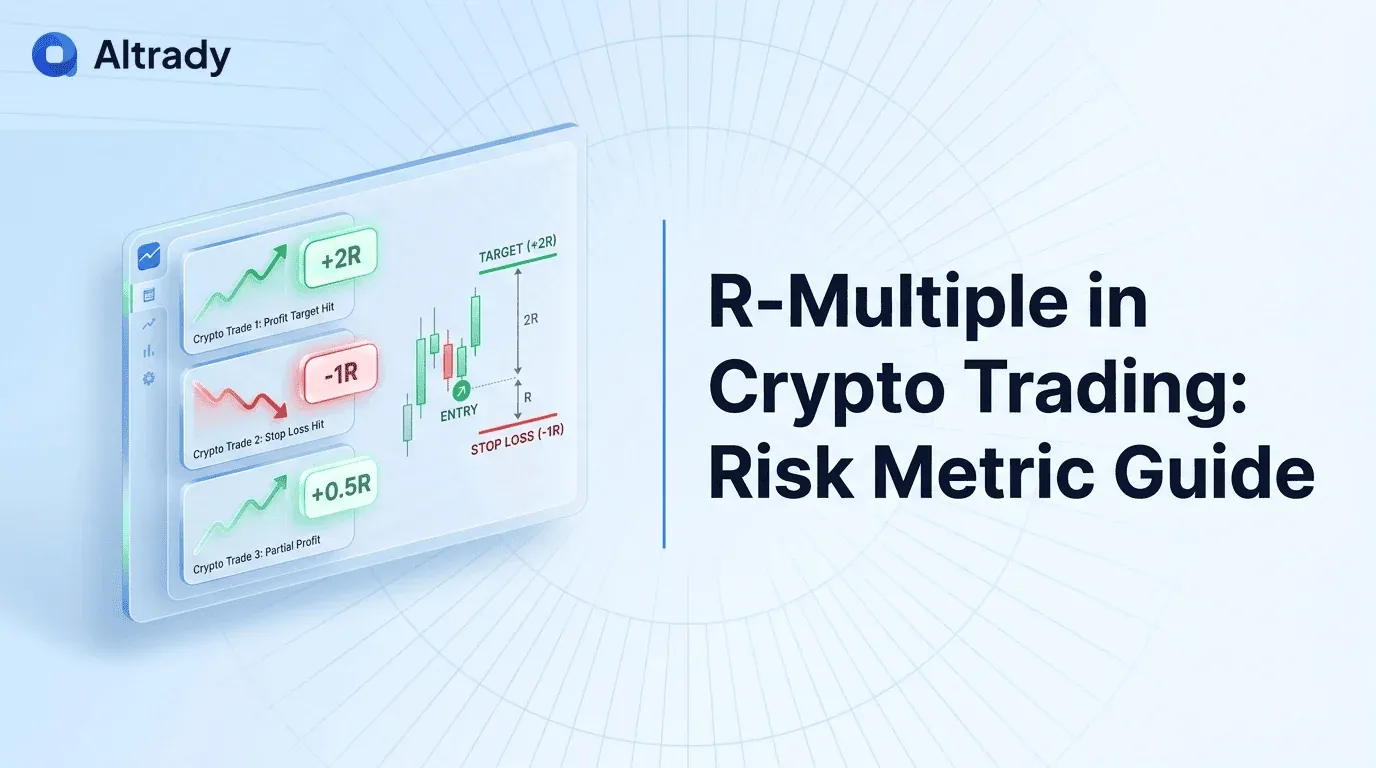

Most traders review profit and loss in dollars, euros, or percentage terms. That view is useful, but it can hide the real question: how much did the trade earn or lose compared with the amount risked?
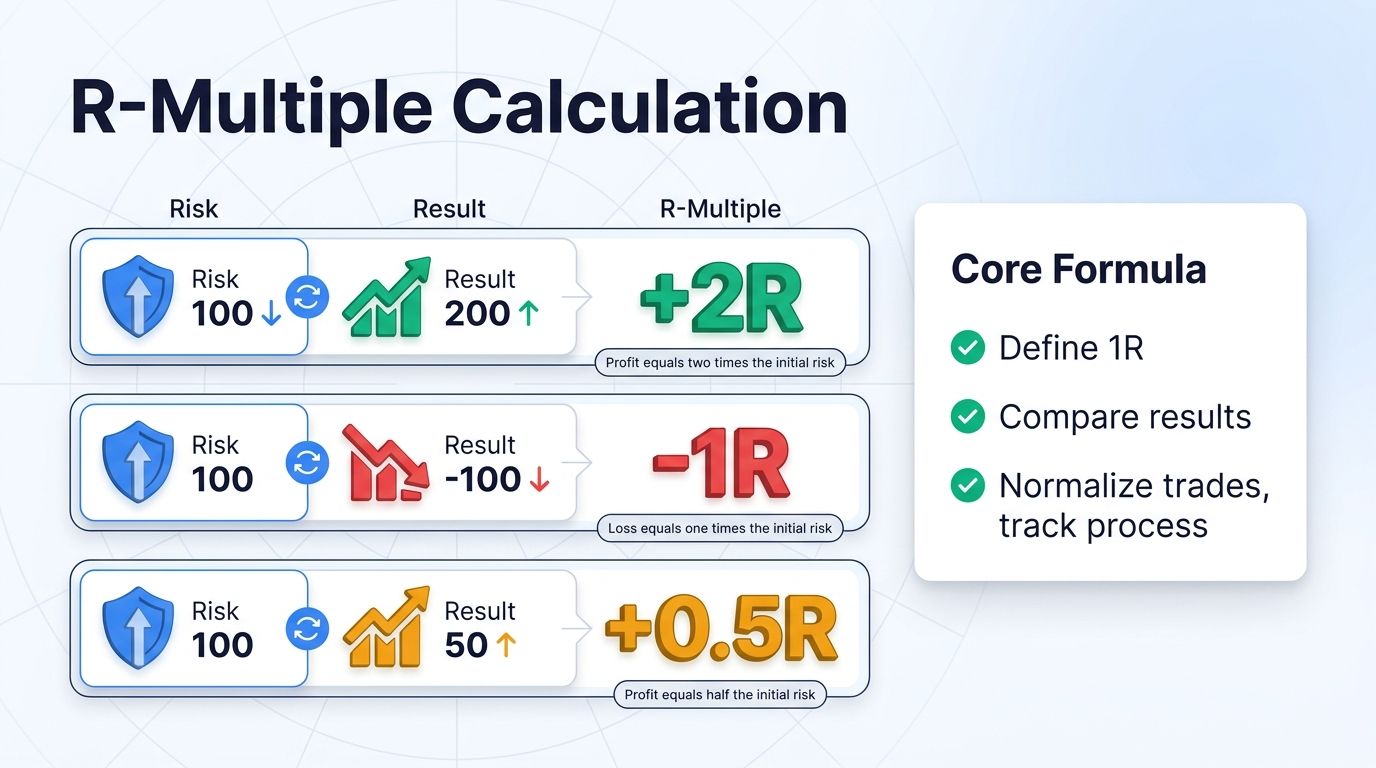
R-Multiple answers that question. It expresses each trade result as a multiple of initial risk. A trade that risks 100 and makes 200 is plus 2R. A trade that risks 100 and loses 100 is minus 1R. The currency can change, but the risk unit stays comparable.
For crypto traders, this is useful because assets move at very different speeds. A 4 percent move on BTC, a 12 percent move on SOL, and a 25 percent move on a small altcoin may not mean the same thing. R-Multiple puts the result back into risk language.
What R-Multiple Measures
R-Multiple measures trade outcome relative to initial risk. The initial risk is the planned loss if the trade reaches the stop level. Once that number is fixed, every outcome can be expressed in R.
If a trader risks 100 and earns 250, the result is plus 2.5R. If the trader risks 100 and loses 50 after reducing exposure early, the result is minus 0.5R. The metric focuses attention on process quality instead of raw account size.
This matters because raw profit can be misleading. A 300 gain might be strong if the trader risked 100, but weak if the trader risked 1,000. R-Multiple makes the relationship visible.
- 1R equals the planned risk on one trade.
- Positive R means the trade earned more than it lost.
- Negative R means the trade lost part or all of planned risk.
- The metric makes trades comparable across markets.
How to Calculate R-Multiple Before and After a Trade
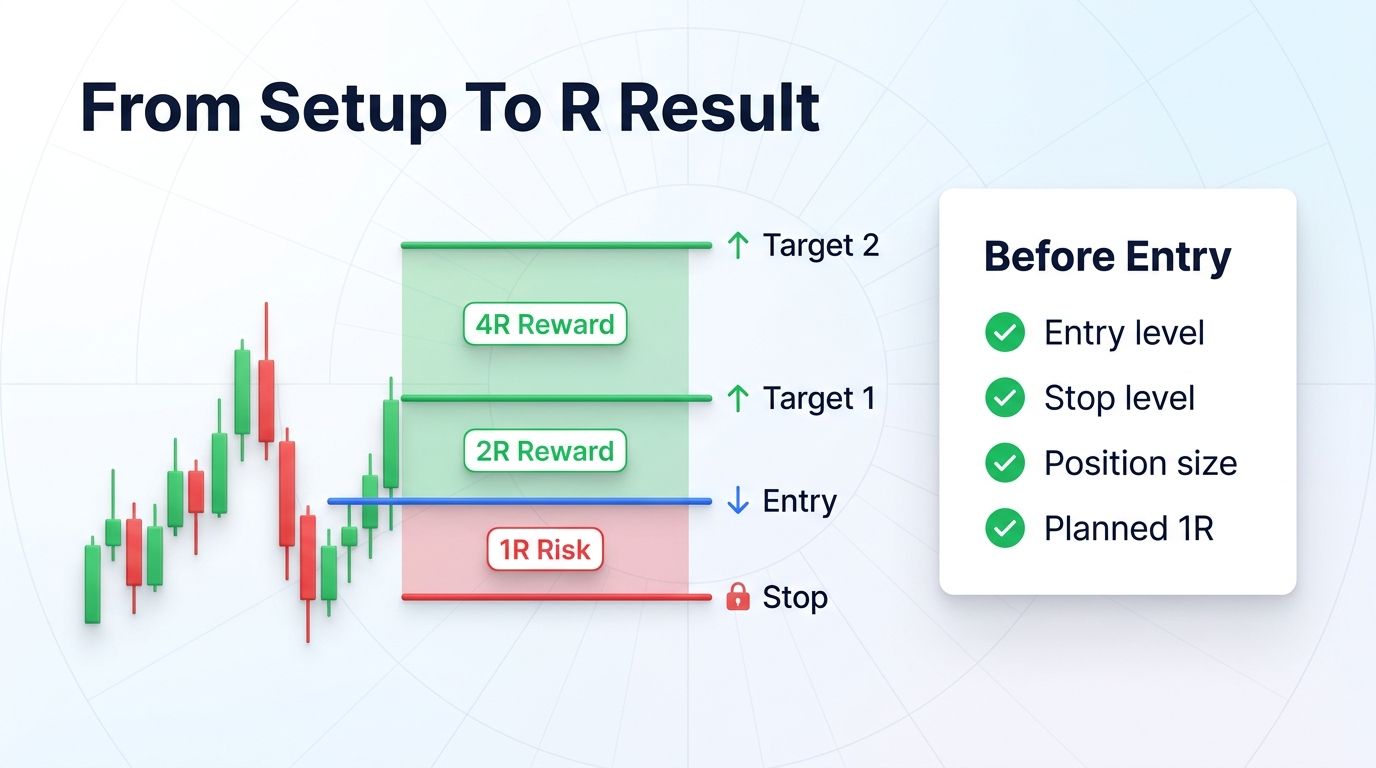
Before entry, calculate the distance between the entry and stop. That distance, multiplied by position size, is the planned risk. This is the 1R value.
After exit, compare the final result with 1R. If the planned risk was 80 and the trade earned 160, the result is plus 2R. If it lost 40, the result is minus 0.5R. If it hit the full stop, the result is minus 1R.
The key is consistency. Do not move the stop first and then pretend the original risk was different. Record the planned risk at entry, then record what happened.
- Set entry, stop, and size before execution.
- Record planned risk as 1R.
- Divide final result by planned risk.
- Journal the R result with the trade reason.
Why R-Multiple Helps Crypto Traders
Crypto volatility makes emotional review easy and structured review hard. A trader may feel good about a large gain, then ignore that the trade risk was too large. Another trader may feel bad about a small loss, even though the loss was planned and controlled.
R-Multiple separates outcome from account size. It helps a trader ask whether the strategy is producing enough average reward for each unit of risk. That is more useful than asking whether one trade looked impressive.
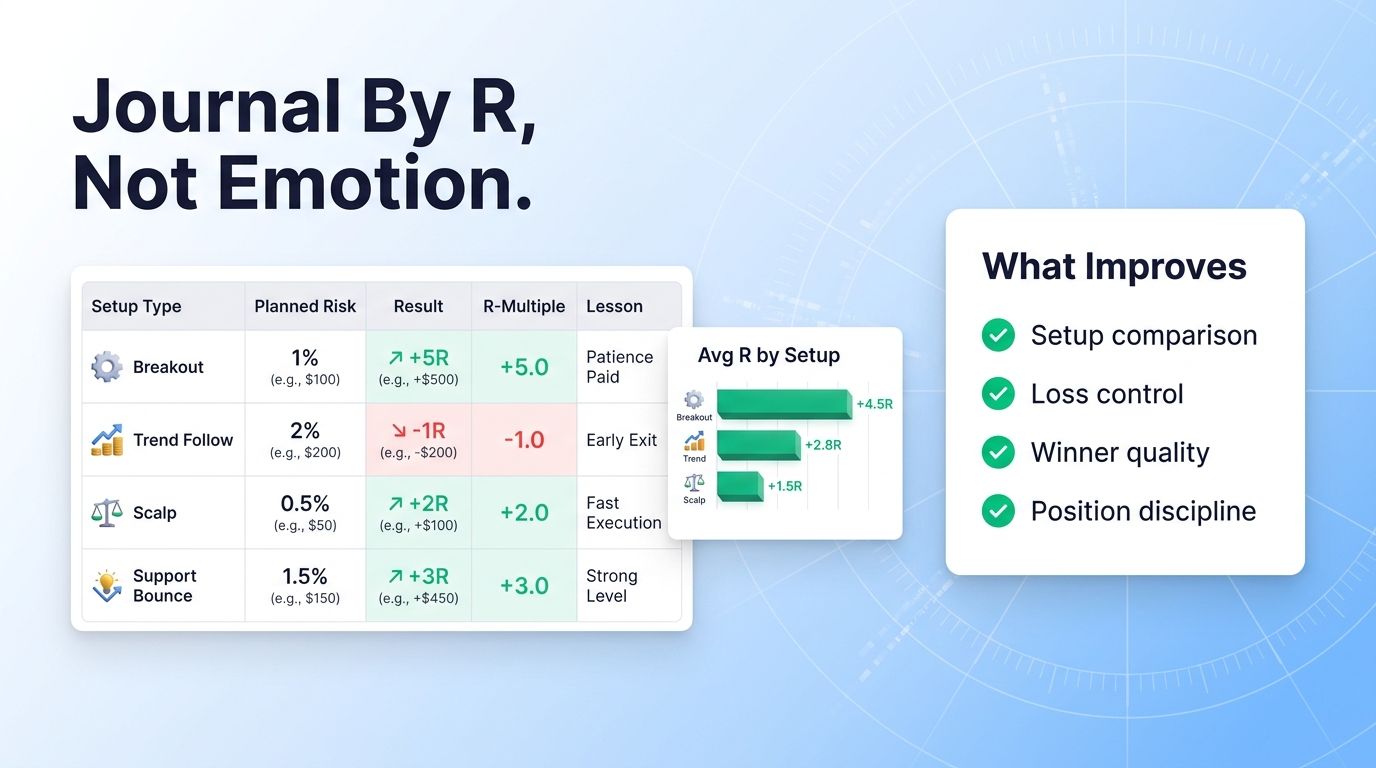
It also helps compare setups. Breakout trades, pullback trades, range trades, and news-driven trades can all be logged in the same R format. Over time, the trader can see which setup type actually deserves more attention.
- Compare setups without account-size bias.
- Find whether winners are large enough.
- Review losses as planned risk events.
- Improve position sizing discipline.
Using R-Multiple With Altrady Tools
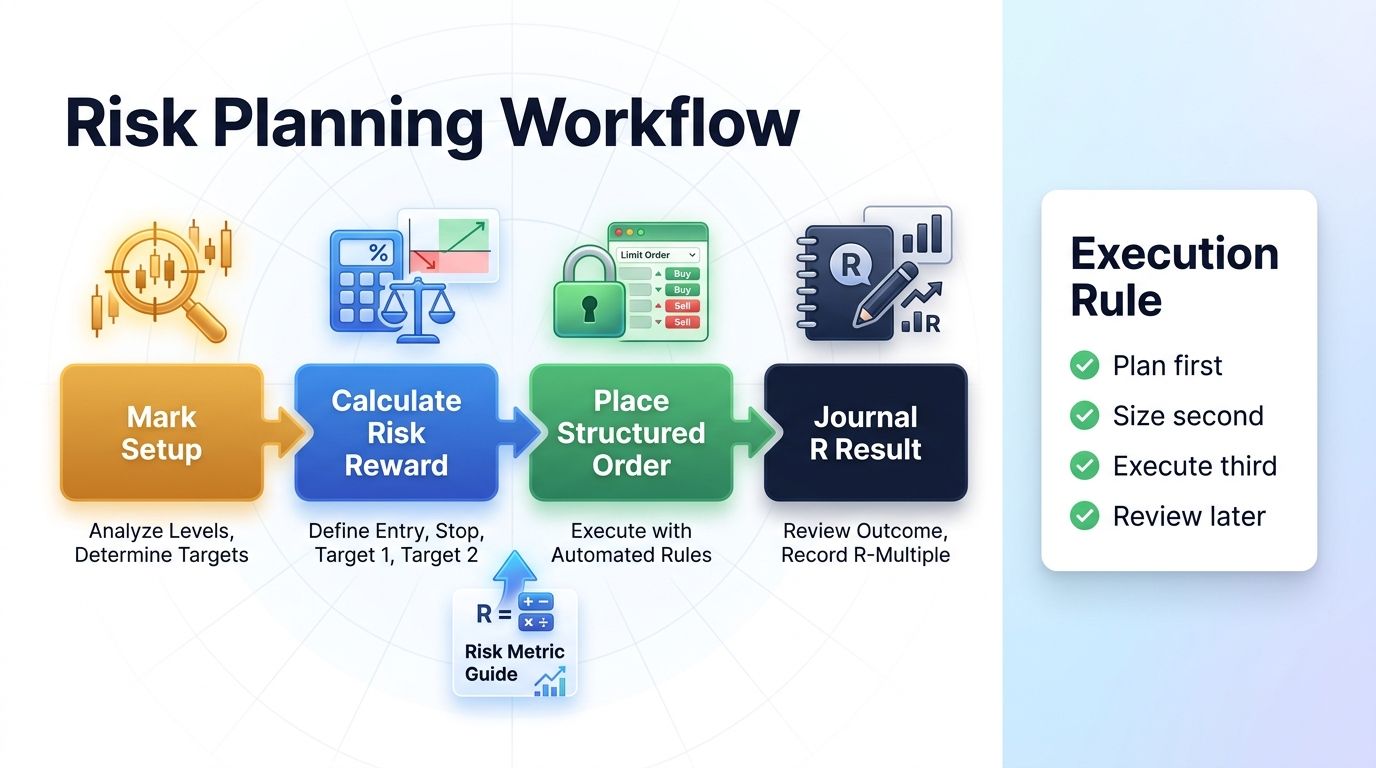
A practical Altrady workflow starts before execution. Mark the entry, stop, and target on the chart. Use the Risk Reward Calculator to understand the relationship between risk and potential reward before sending the order.
Smart Trading can then help manage the order structure, but the risk plan should already exist. The tool should execute a plan, not replace the plan. If the trade does not have a clear 1R value, it is not ready for serious review.
After the trade closes, log the R result. Over 30 to 50 trades, the pattern becomes more useful than any single outcome. You can then ask whether a setup has a positive average R, whether stops are too wide, or whether targets are unrealistic.
- Use the calculator before execution.
- Plan entry, stop, and target first.
- Record every closed trade in R terms.
- Review average R by setup type.
Common R-Multiple Mistakes
The first mistake is calculating R after the trade instead of before it. If the stop was not planned, the R result is not reliable. The trader is only recreating the trade in hindsight.
The second mistake is changing position size without updating the risk. Adding to a position, reducing a position, or moving the stop can change the effective risk. The journal should show those adjustments clearly.
The third mistake is using R-Multiple alone. R helps measure trade quality, but it does not replace win rate, drawdown, fees, slippage, liquidity, and sample size. A strategy with high average R but only five trades is still unproven.
- Do not calculate risk only after exit.
- Log size changes and stop changes.
- Include fees and slippage in review.
- Use sample size before trusting conclusions.
A Simple R-Multiple Review Routine
Once per week, export or review your closed trades and mark each result in R terms. Then group trades by setup type, timeframe, pair, and market condition. This turns a messy list of trades into a decision tool.
Look for three patterns. Which setups produce the highest average R? Which setups create repeated minus 1R losses? Which trades were closed early and missed planned targets? Those answers are often more useful than one big winner.
The goal is not perfection. The goal is to build a feedback loop where risk planning, execution, and review all use the same unit.
- Review closed trades weekly.
- Group by setup and market condition.
- Find repeated minus 1R patterns.
- Use one risk unit from plan to review.
FAQ
What does R-Multiple mean in trading?
R-Multiple shows the result of a trade compared with the initial risk. If 1R is 100 and the trade earns 200, the result is plus 2R. If the same trader loses the full planned risk, the result is minus 1R. This makes trade review proportional, so a small account and a large account can review execution quality with the same unit.
How do you calculate R-Multiple in crypto?
Define the planned risk between entry and stop, then divide the final trade result by that risk. If the planned risk is 80 and the trade closes with 160 profit, the result is plus 2R. The same formula works across spot and derivatives as long as fees, funding, slippage, and final position size are included.
Is R-Multiple the same as risk reward ratio?
No. Risk reward ratio describes the planned relationship before entry, such as risking 1 to target 3. R-Multiple describes the actual result after the trade closes. A setup can start with a 3:1 plan but finish at plus 1.2R if the trader exits early, scales out, or changes the stop.
Why is R-Multiple useful for crypto traders?
It helps compare trades across different coins, timeframes, and position sizes because every result is measured against planned risk. This is helpful in crypto because volatility varies widely across BTC, ETH, major altcoins, and smaller tokens. R-Multiple keeps the review focused on whether the trade paid enough for the risk taken.
Can Altrady help with R-Multiple planning?
Yes. Altrady's Risk Reward Calculator can help define the planned risk and reward before execution, while Smart Trading can help structure the order after the plan is clear. The important habit is to define 1R first, then use the platform tools to execute and monitor that plan instead of deciding the risk after the trade is already open.