The most expensive lesson in crypto trading is not technical. It is psychological. Two Israeli psychologists, Daniel Kahneman and Amos Tversky, mapped exactly why human brains break under risk back in 1979, and their framework, called Prospect Theory, predicts almost every dumb decision you have ever made on a chart. Once you see it, you cannot unsee it.
What Is Prospect Theory?
Prospect Theory is a behavioral finance model that describes how people actually make decisions under risk, as opposed to how classical economics assumes they should. Kahneman and Tversky published the original paper in 1979, and the work eventually earned Kahneman a Nobel Prize in Economics in 2002 (Tversky had passed away by then).
The classical model assumed humans are "rational utility maximizers." Faced with a choice between a guaranteed $50 and a 50% chance at $100, a rational person should be indifferent: both have the same expected value.
Prospect Theory shows that real humans are not indifferent at all. They strongly prefer the guaranteed $50, even though the math is identical. And when the same setup is reframed as losses (guaranteed loss of $50 vs 50% chance to lose $100), real humans flip the other way and gamble on the 50% chance, hoping to dodge the loss entirely.
The implications for trading are massive. Markets are pure expected-value math. Human brains are not built to play that game. Prospect Theory is the gap.
The Two Findings That Matter for Traders
Prospect Theory has many components, but for crypto traders, two stand out.
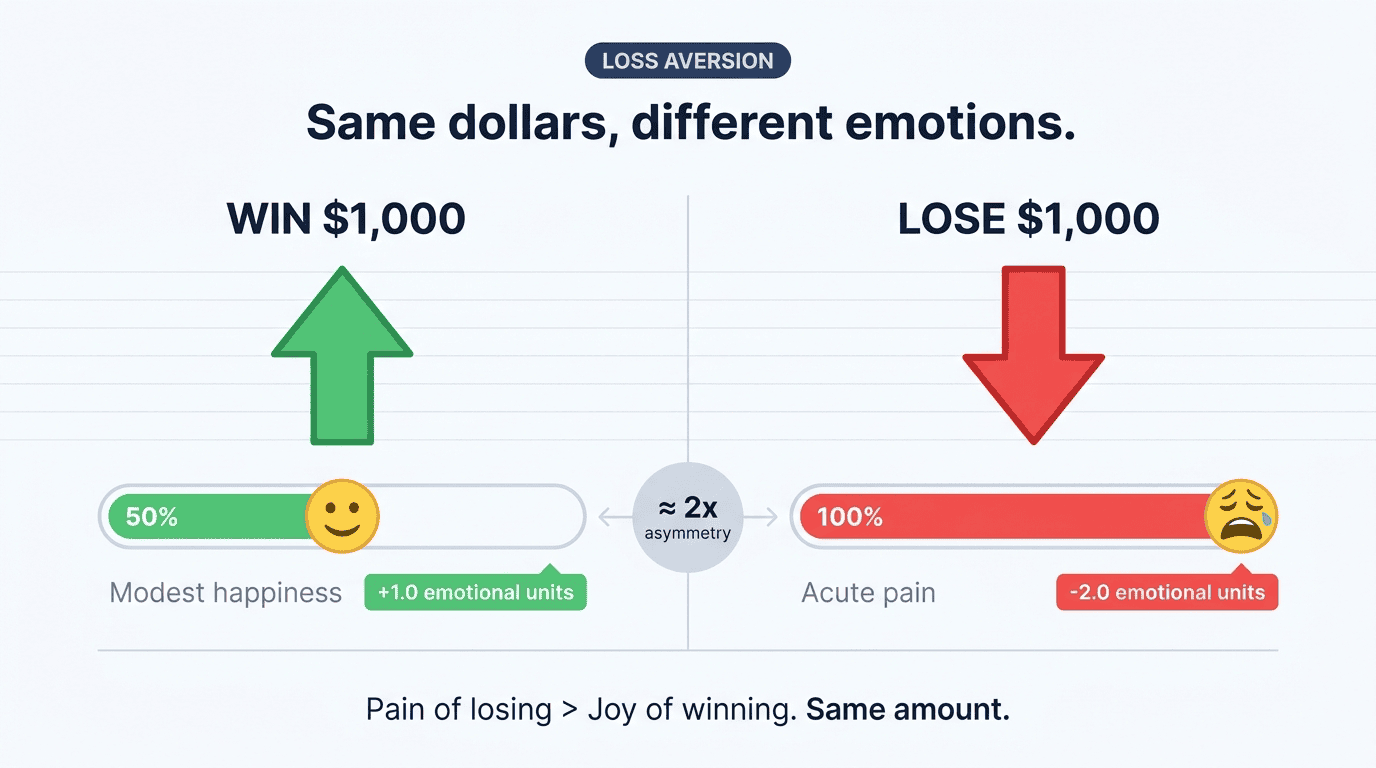
1. Loss aversion: losses hurt about twice as much as equivalent gains feel good.
The pain of losing $1,000 is roughly equivalent to the joy of winning $2,000. This asymmetry is hard-coded in the brain, partly evolutionary (losing a food source mattered more for survival than gaining one). It is not a bias you can argue with by being smart. It just is.
2. Reference dependence: gains and losses are measured from a reference point, not absolute values.
Your brain does not care that BTC is at $42,000. It cares whether $42,000 is above or below the price you bought at. If you bought at $40,000, you feel a $2,000 gain. If you bought at $44,000, you feel a $2,000 loss. Same price, different psychology, different decisions.
These two findings combine to produce most of the bad behavior on a trading screen.
Why Crypto Traders Hold Losers Too Long
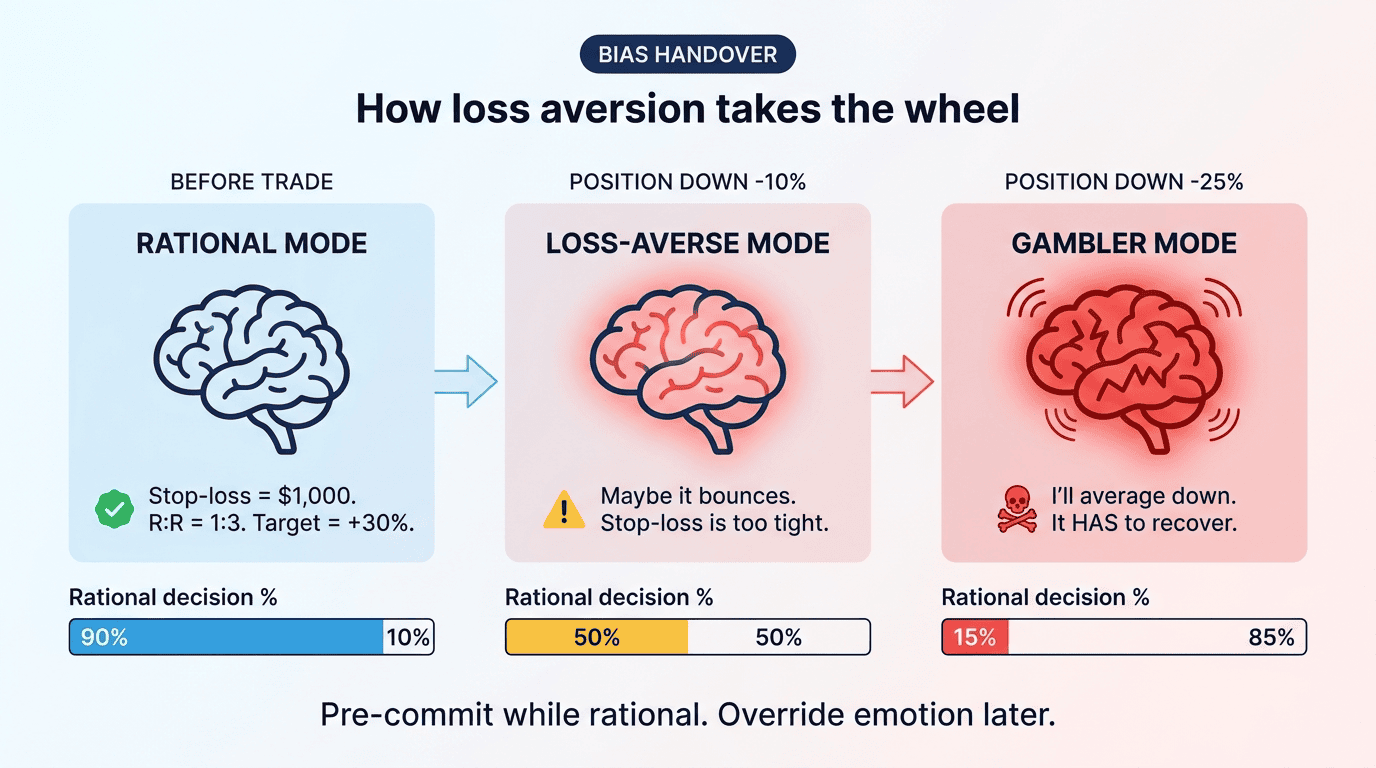
Imagine you bought ETH at $3,000. It drops to $2,400. You are down 20%.
Classical economics says: re-evaluate. Is ETH a good buy at $2,400? If yes, hold or add. If no, sell and redeploy capital. The price you paid is irrelevant to the future.
Prospect Theory predicts you will hold and pray. Because:
- The $600 paper loss is your reference point now. Selling makes it real.
- Loss aversion makes that realization feel twice as bad as a $600 gain would feel good.
- A 50% chance ETH bounces back to $3,000 (no loss) is more attractive than a guaranteed $600 loss, even if the bounce is unlikely.
- You shift into "gambler mode" because losses make humans risk-seeking, not risk-averse.
This is why the worst trades are the ones traders ride from "small drawdown" to "catastrophic loss." Each step down, the brain calculates: "I am already in a loss; the rational expected-value math no longer matters; let me hope for a recovery."
The result: hold a -20% position into -50% into -80%. Common scenario in 2022 with LUNA, FTT, and a hundred altcoins.
Why Crypto Traders Sell Winners Too Early
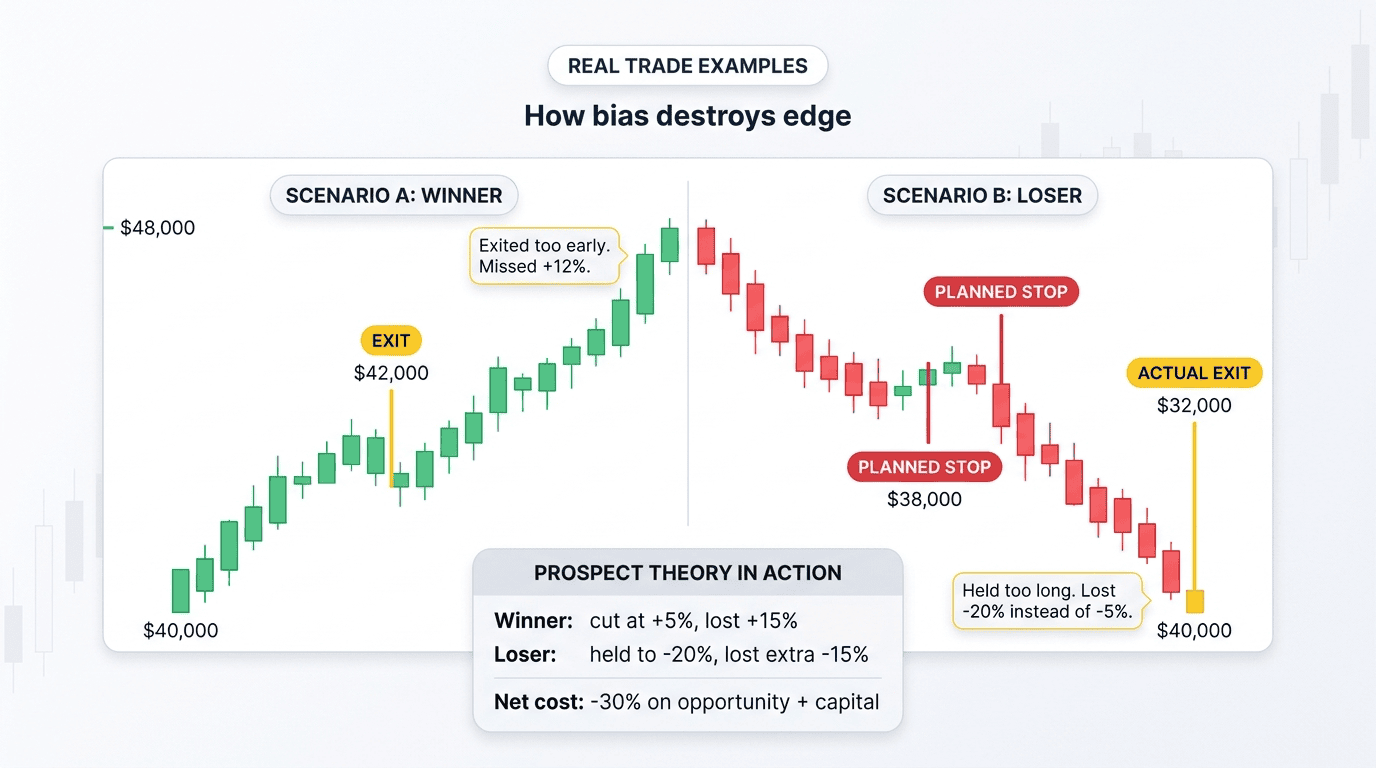
Same setup reversed. You bought ETH at $3,000. It rallies to $3,600. You are up 20%.
Classical economics says: re-evaluate. Is ETH still a good hold at $3,600? If yes, keep going.
Prospect Theory predicts you snap take-profit. Because:
- The $600 gain is now your reference point. You are "ahead."
- Loss aversion kicks in: losing the $600 you "have" feels twice as bad as another $600 gain would feel good.
- Risk preference flips to risk-averse on the gain side. You want to lock it in.
- A guaranteed $600 win feels safer than a 50% chance at $1,200.
The result: you sell at +20% on a coin that goes on to do +200%. Every veteran trader has cut a 10x position at 1.2x because the brain refused to let them ride.
This is the cruel asymmetry: Prospect Theory pushes traders to take small wins quickly and let losses run, which is the exact opposite of what profitable trading requires (small losses, big wins, asymmetric risk-reward).
The S-Shaped Value Function
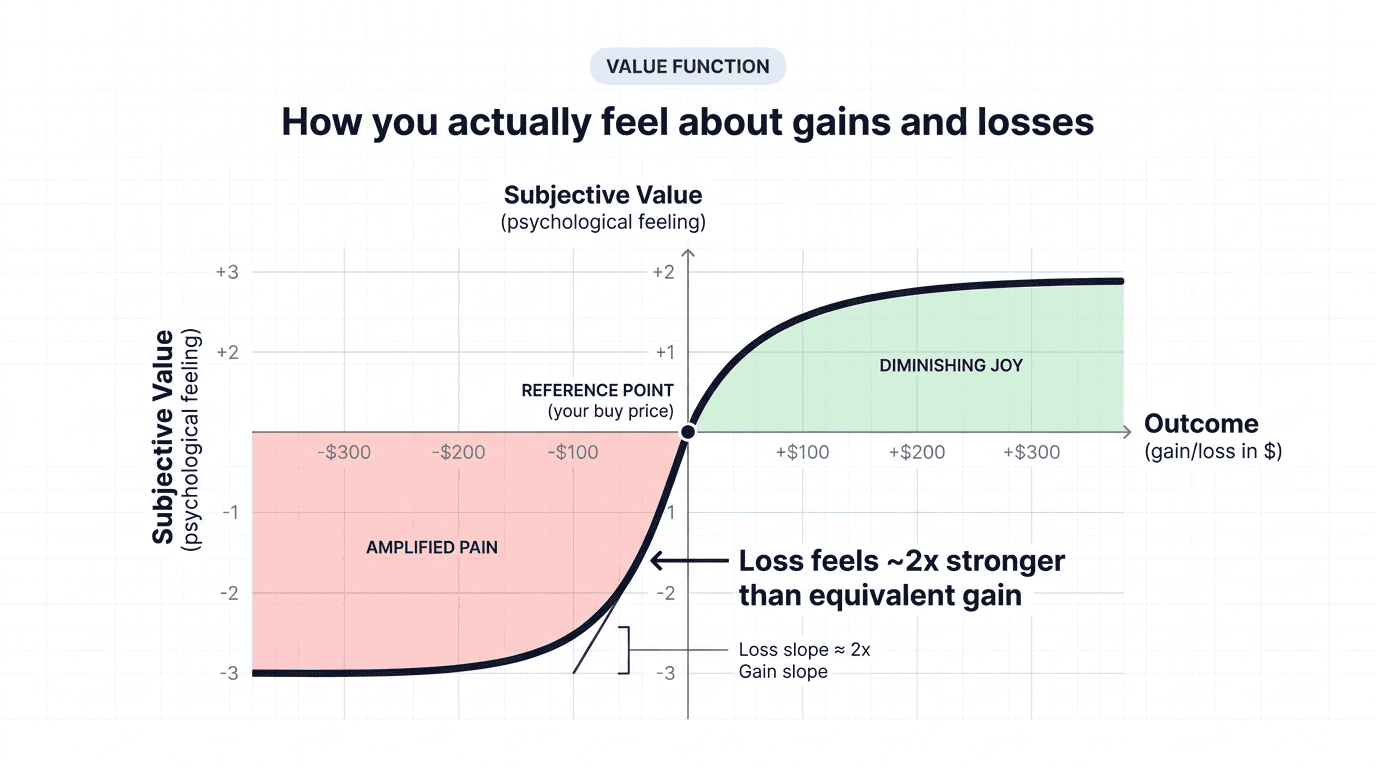
Kahneman and Tversky drew a curve to show what humans actually feel about gains and losses. It is S-shaped:
- Above the reference point (gains): the curve flattens fast. The first $100 of gain feels great. The hundredth $100 of gain feels meh. Diminishing emotional returns.
- Below the reference point (losses): the curve drops sharply. The first $100 of loss hurts. The hundredth $100 of loss still hurts (less per dollar than the first, but the slope is steeper than the gain side).
Two things to notice:
The loss side is steeper. That is loss aversion. Same dollar amount produces more emotion below zero than above.
Both sides flatten at the extremes. This is why traders who are deep in profit get reckless ("house money effect") and why traders who are deeply underwater take wild bets to break even.
If you are wondering why your 30R position made you cut at 5R but your -3R position somehow grew to -15R before you stopped out, the S-curve is the answer.
Probability Weighting: Why Memecoins Sell
Prospect Theory has a third component called probability weighting. Humans systematically overweight low-probability events and underweight high-probability ones.
A 1% chance to make 100x feels much more attractive than the math says it should. A 99% chance to keep your existing capital feels less safe than the math says it is.
This is why memecoins, leverage, and lottery tickets sell so well. The expected value is often negative, but the brain's distorted probability lens makes the "shot at glory" feel much closer than it actually is.
A trader who buys a memecoin "for fun" is not being irrational in their own frame. They are being predictably biased in a way Kahneman and Tversky measured 45 years ago.
How Pro Traders Beat Prospect Theory
You cannot turn off your brain's bias. You can build systems that override it. Here is what professional discretionary traders and systematic funds actually do.
1. Pre-commit to exits before entering.
Set the stop-loss and take-profit at order entry, not after the position is open. Your rational brain decides while emotion is low. Once the position is open, your rational brain hands the wheel to your loss-averse brain, and you will second-guess.
2. Define risk in R, not dollars or percentages.
R is your maximum acceptable loss per trade (typically 1-2% of account). Then judge every position in multiples of R: this is +2R, this is -1R, target is +3R. Switching to R units strips away the dollar amount that triggers loss aversion. A -1R loss feels like "the cost of doing business," not "I lost $400."
3. Trade size such that any single loss is invisible to your bank account.
If a -1R loss makes your stomach drop, your size is too big. The S-curve gets steeper as the dollar amount grows. Reduce position size until -1R is emotionally neutral.
4. Use trailing stops to let winners run.
The take-profit instinct is hard to fight in the moment. A trailing stop forces the position to keep running until the market itself reverses. You give up the temptation to lock in.
5. Journal every exit decision.
Every time you close a position, write down: did I close because the system said so, or because the position was emotionally uncomfortable? After 100 trades you will see the pattern. Most discretionary traders find 60-70% of their early exits were emotional, not analytical.
6. Separate "checking the chart" from "deciding."
Brains in real-time price view make different decisions than brains in once-a-day review. If you are a swing trader, do not check the chart every hour. The more you stare, the more reference-point shifts happen, and the more Prospect Theory bites.
Applying It in Altrady
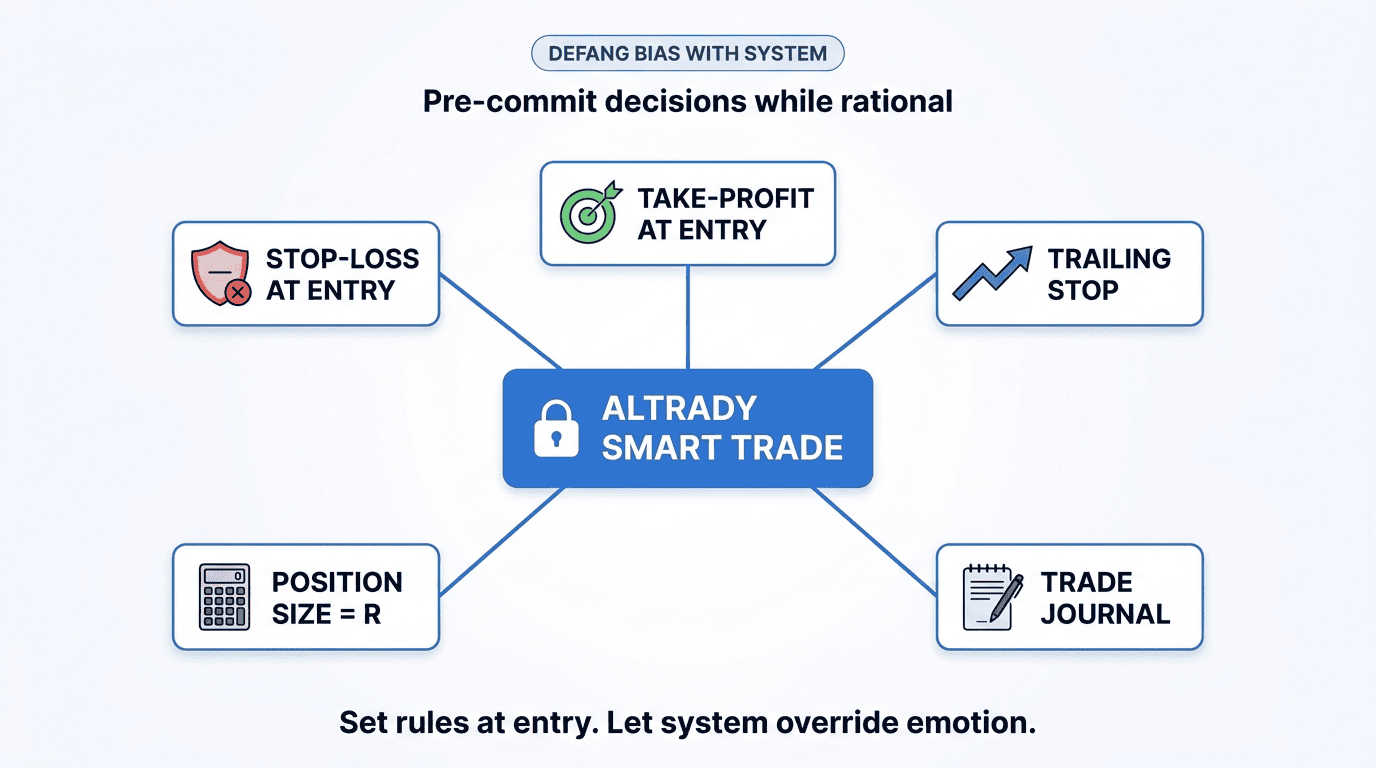
Inside Altrady, the workflow that defangs Prospect Theory looks like this:
- Smart Trading with built-in stop and take-profit. Set both at entry. They sit on the exchange until triggered. No manual override under emotional pressure.
- Trailing stop-loss. Lock in profit while letting the position keep running. Beats the early-exit instinct.
- Multiple take-profit levels. Scale out in tranches instead of all-or-nothing. Captures partial gains without forcing you to call the top.
- Risk Reward Calculator. Translate every trade into R-multiples before entry. If 1R is more than you can stomach losing, the calculator tells you to size down.
- Trade journal export. Export your closed trades to CSV, sort by exit reason. Identify the trades where you bailed early or held too long. Pattern-recognize your own bias.
The point is not to suppress your psychology. It is to make pre-committed decisions while your rational brain has the wheel, then hand the rest over to the system.
Frequently Asked Questions
What is Prospect Theory in simple terms?
Prospect Theory says humans feel losses about twice as strongly as equivalent gains, and they make decisions relative to a reference point (usually the price they paid) rather than the absolute price level. Both effects produce systematic mistakes in trading, especially holding losers and selling winners early.
Who created Prospect Theory?
Daniel Kahneman and Amos Tversky published it in 1979 in the journal Econometrica. Kahneman won the Nobel Prize in Economics in 2002 for the work, and Tversky would have shared it but passed away in 1996. Kahneman's bestselling book "Thinking, Fast and Slow" expands the framework.
How does loss aversion affect crypto traders specifically?
Crypto's high volatility and 24/7 markets amplify loss aversion. Frequent reference-point shifts (price moves fast) keep the brain in emotion mode rather than analysis mode. Leverage compounds the problem because small price moves trigger large dollar swings, which makes the S-curve steeper.
Can you eliminate Prospect Theory bias?
No. It is hard-wired. You can mitigate it with pre-commitment (set stops/targets at entry), system-based trading (rules over feel), position sizing that keeps emotional stakes low, and reflection through journaling. Even professional traders feel the bias. They just have systems that override it.
What is the practical first step to apply Prospect Theory to my trading?
Set stop-loss and take-profit on every position at entry, not after. This single habit defeats most loss-aversion mistakes because the decision is made while you are calm and rational, not while you are watching a position move.
Final Thoughts
Prospect Theory is not just an academic curiosity. It is the operating manual for the part of your brain that is making your trading decisions, whether you know it or not. The traders who profit consistently are not the ones with the best chart-reading skills. They are the ones who built systems that defang loss aversion, reference-point shifting, and probability distortion before those biases hit the trade.
You cannot will yourself out of the bias. You can build a workflow that takes the wheel from your loss-averse brain at the moment it matters most, which is when a position is open and the screen is moving.
Ready to build that workflow? Start your Altrady free trial and use Smart Trading, trailing stops, scaled take-profits, and position sizing tools to make pre-committed decisions before emotion shows up.