
Contracts for Difference (CFD) trading may appear to be a purely numerical exercise, yet it also challenges a trader's psychology. You are too familiar with the way to push the buttons if you have spent months perfecting entries and exits on a risk-free simulator. The first time those same buttons move real money, the emotional landscape can change dramatically. This article offers an educational overview of the psychological factors that often accompany the move from demo to live trading.
The Reasons Why the Brain Shifts When You Fund a CFD Account
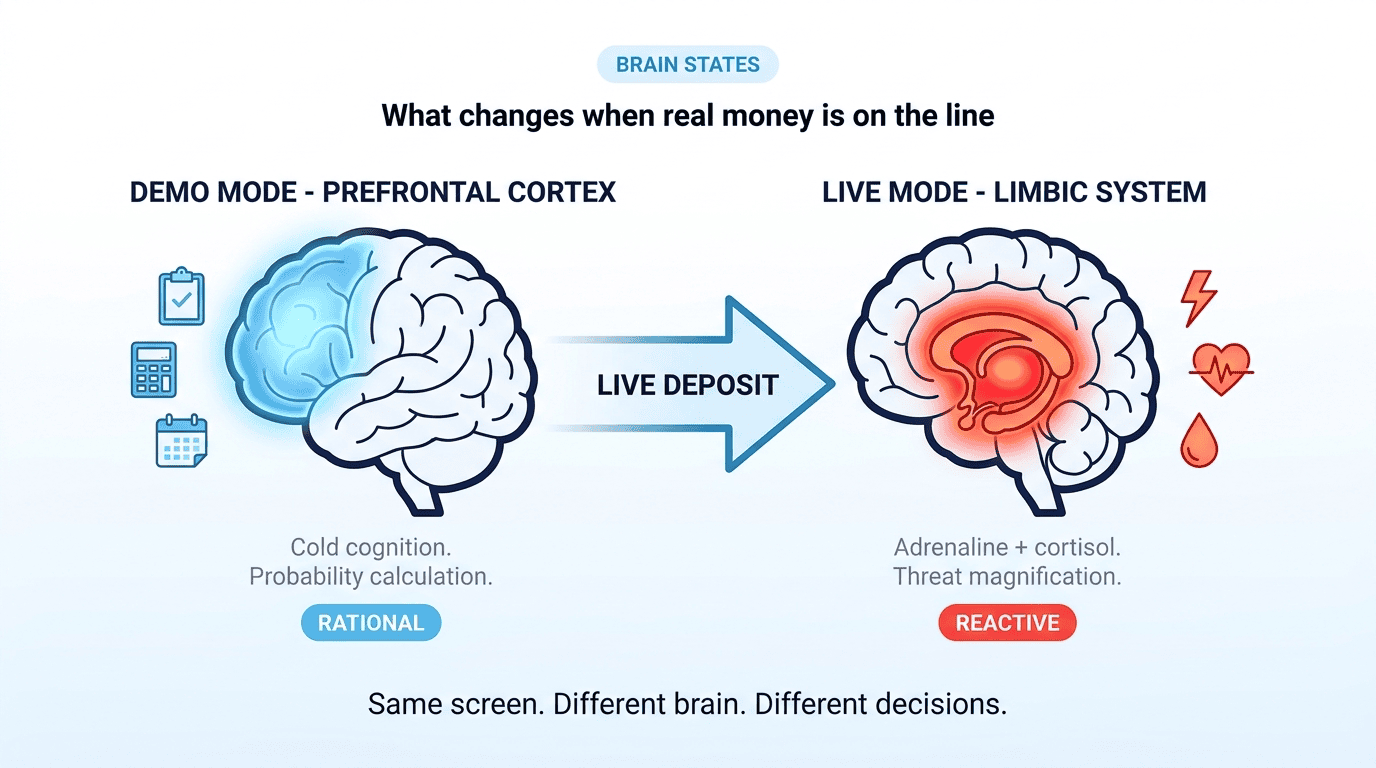
The initial live deposit throws a non-evident switch. Your prefrontal cortex on a demo platform is in cold mode: probabilities are checked, the economic calendar is scanned, and the plan of action which you coded into your strategy sheets over the past hours is executed. With real capital at stake, the limbic system floods the body with adrenaline and cortisol, magnifying every price tick, and a minus-20-pip "lesson" suddenly feels like a personal threat.
There are three cognitive traps that will really clamor in the background of a live CFD account:
- Loss Aversion. The psychological sting of a loss, in the quantification of Kahneman and Tversky, is roughly twice the emotional intensity of an equivalent gain. The loss of $100 hits about as hard as the thrill of a $200 gain. You see a red position hanging around you and think it will come back, while green positions are taken off at moderate gains.
- Fear of Missing Out. One spike in crude oil or NASDAQ futures can lead you to abandon your premeditated plan and chase the candle. You enter late, your timing window is gone, and you start to declare the platform unfair.
- Overconfidence Bias. Ten consecutive wins in demo mode may transform into oversized leverage on the first live trade. If conditions slip and that original ticket becomes a preemptive loser, panic replaces patience.
Recognising these biases early is the first step toward managing them.
The Psychological Checklist: Five Doorways to Live-Trade Preparedness
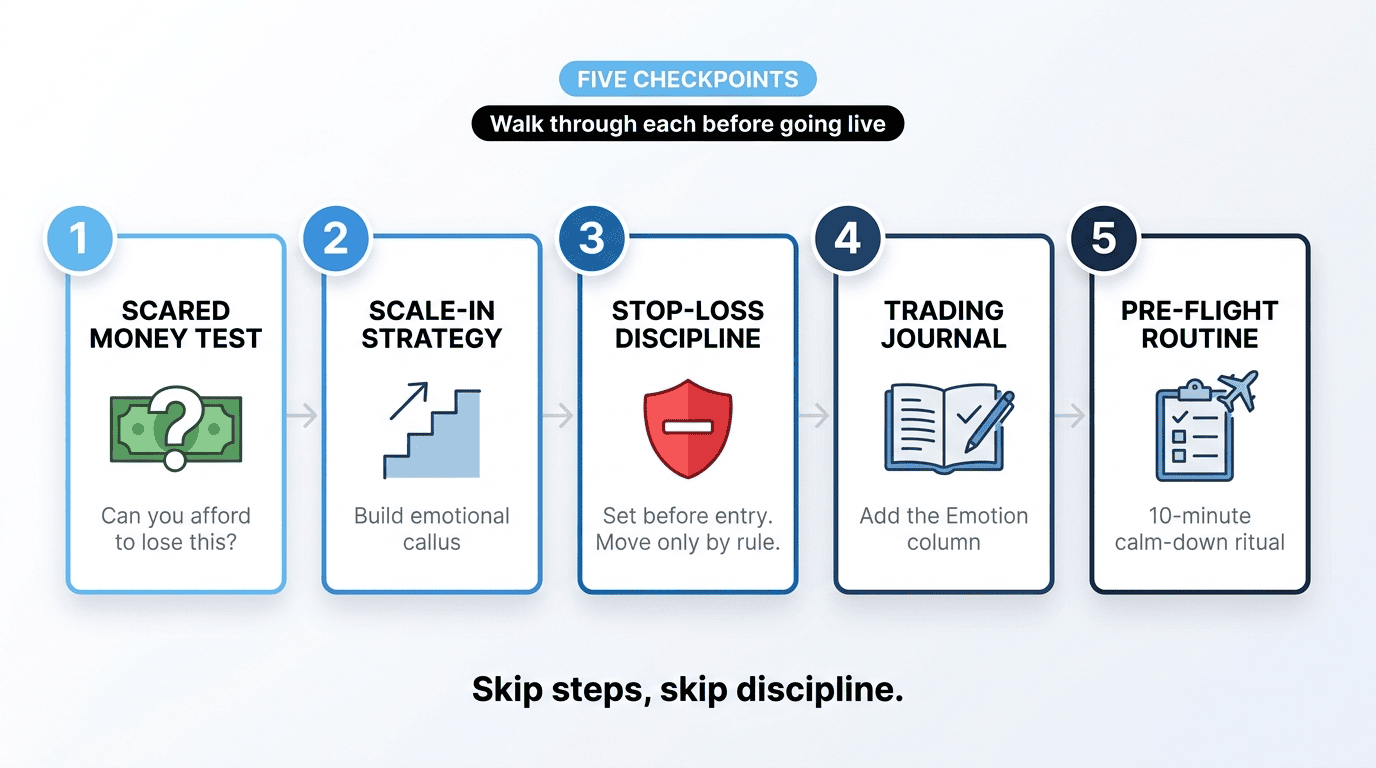
Transitioning from simulation to live markets is rarely a single jump. It is a progression through several mental checkpoints. Walk through each of them and you significantly improve the odds that when your first live month ends, you will have your account and your self-respect intact.
1. The Scared Money Test
Ask yourself whether the deposit at risk represents money you can genuinely tolerate losing without compromising essentials such as rent or food. Funds that feel "scared" tend to amplify stress and cloud decision-making. Frightened money decays discipline because every variation becomes existential. Market noise that would be background on a demo screen transforms into alarms.
You should only put in what you can afford to lose, and not just mathematically. Many traders begin by depositing a sum that stings if lost but does not cripple. Such tension keeps the mind alert without hijacking it.
2. Scale-In Strategy: Develop an Emotional Callus
Many traders find it helpful to begin with smaller real positions and gradually increase exposure only after monitoring both performance and emotional responses. The aim is to build emotional resilience under controlled stress rather than to scale in mechanically. Apply the same concept to capital exposure:
- Begin with the platform minimum, which can be 0.01 lots or a micro contract equivalent.
- Record a minimum of 20 trades in which the dollar change is small but real. Feel the mini pulse of adrenaline, note the change in your breathing, and do not lose sight of the strategy.
- When you reach predetermined performance and emotional targets (for example, 10 consecutive trades executed exactly as planned), step up to the next level.
The aim is to build an emotional callus by repeatedly exposing the nervous system to small amounts of real-money uncertainty, teaching the nervous system that trading is uncomfortable but endurable.
3. Compulsory Stop-Loss Discipline
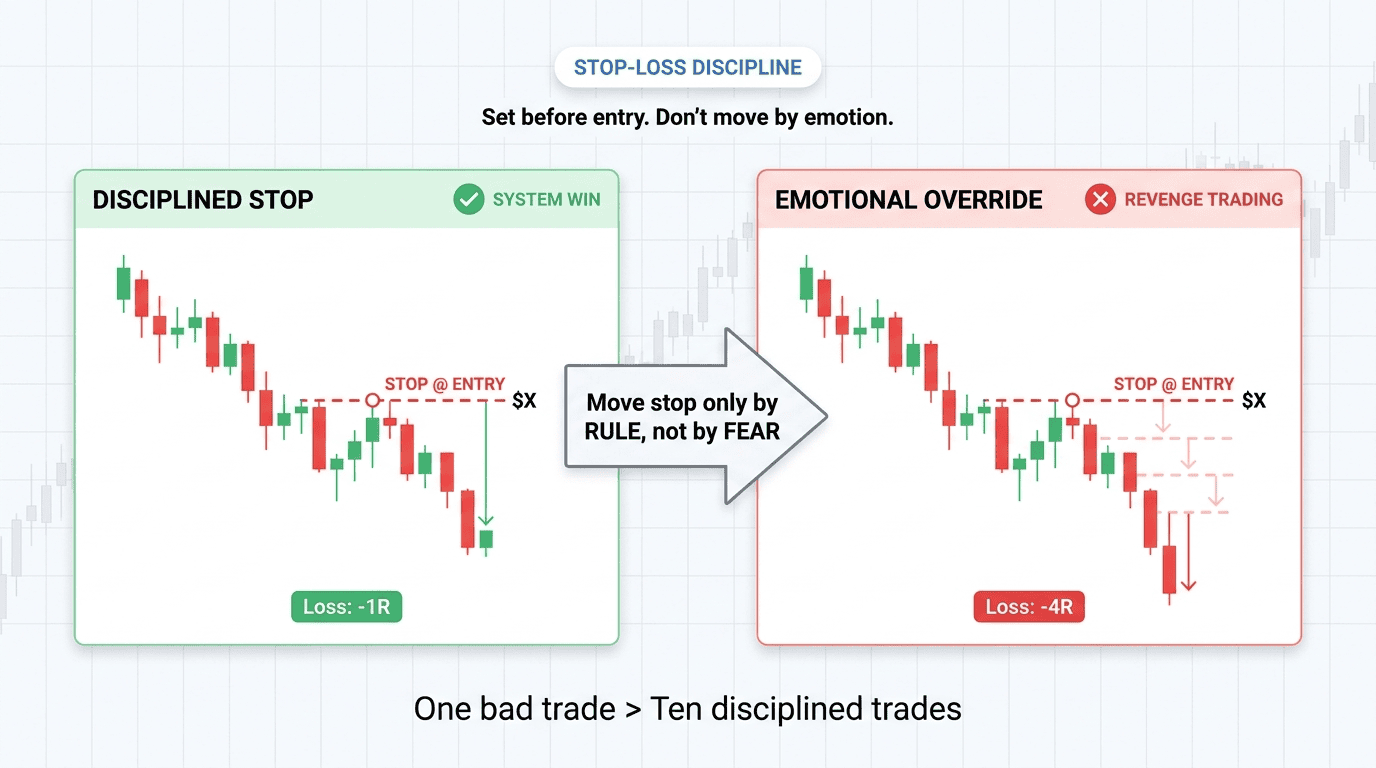
Stop-loss orders are a common risk-management tool, yet they do not guarantee execution at the exact price specified. Slippage, widening spreads, and fast markets can lead to fills at less favourable levels. Where a guaranteed stop-loss is offered, an additional cost usually applies. Commit to the following rules:
- A stop is set before you click Buy or Sell.
- Only pre-written rules cause you to move the stop, never the fact that price has gotten close and you feel nervous.
- You accept the risk that volatile markets between sessions may gap through your stop. This is the cost of being involved in leveraged products.
Slippage will occur, spreads will widen with news releases, and sometimes a clean chart pattern will fail. With a hard stop in place, a single trade does not turn into a spiral of doubling down, sometimes called revenge trading.
4. The Trading Journal Requirement
Most intermediate traders already keep a demo journal of entry prices and technical notes. For live trading, add a third column called Emotion. Record:
- Physical responses (tight jaw, increased heart rate)
- Mental dialogue ("I will break even and leave"; "I knew I should have stopped at eight")
- Triggering factors (reading social media, trading while tired)
Raw feeling data is unpleasant to review, but it reveals behavioural patterns faster than any indicator. If you discover you pay double on trades driven by news rather than boredom, you have factual evidence you can act on to improve your routine.
5. The Ten-Minute Pre-Flight Routine
Pilots rely on checklists to reduce error. Many traders adopt a short routine, for example stretching, reviewing the economic calendar, and confirming a maximum daily drawdown threshold to ground themselves before the first order ticket. Design your pre-flight ritual and execute it before opening the order window:
- Stretch or take deep breaths to slow your heart rate.
- Scan the macro calendar for high-impact events.
- Re-establish the maximum daily loss or drawdown limit.
- Visualise one trade from entry through exit.
- Open the platform only after the mind is calm.
When this process becomes automatic, it is working. Ritual turns discipline into a habit that runs without conscious effort.
Closing the Execution Gap: From Ideal Fills to Real Slippage
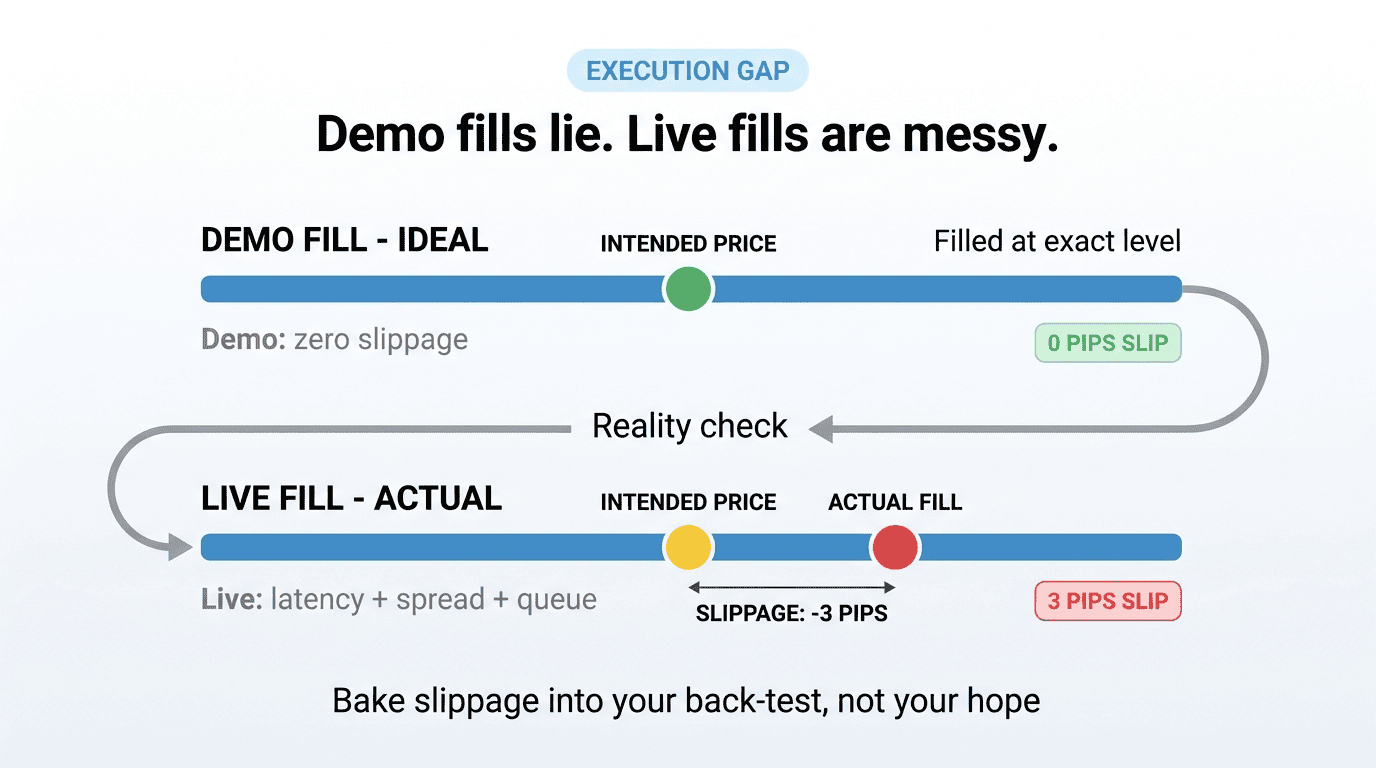
Live platforms route orders through servers and liquidity providers, introducing latency and slippage that demo fills rarely replicate. Setting realistic expectations about fill quality can reduce the sense of surprise or betrayal when a stop triggers a few pips beyond its on-screen level. In a volatile market, an EUR/USD stop-loss could fire three pips below the screen level. You may have intellectual clarity that slippage exists, but emotionally still feel betrayed.
The solution is expectation management:
- Add a realistic slippage allowance (for example, two ticks on majors, five on minors) when back-testing.
- Stop trading or sit flat during scheduled news releases.
- Treat positive slippage as a windfall, not as an average.
By building friction into your mental model, you eliminate the kind of surprise fill that can derail an entire session.
Building Resilience Through Hard Experience
A sudden losing streak can feel disproportionately personal because money itself is personal. Some traders pre-define a "circuit-breaker" loss level for the day, after which they step away to reset rather than chase losses.
Separate Identity from Outcome
Write on a sticky note: "This trade is not my career. This day is not my life." Pin it on one side of your monitor. The reason losses feel personal is that money is personal, and it is easy to forget that a single trading performance is one data point, not a verdict on your worth.
Install a Drawdown Circuit-Breaker
Establish a percentage, usually 4 to 6 percent of account equity, as the maximum allowed daily loss. Reach that figure, pull the plug, and step back. The doctrine is binary; no argument. Circuit breakers transform a possible meltdown into a planned debrief.
Use Downtime, Not Screen Time
Counter-intuitively, the easiest path to restoring psychological capital is usually to step away from the screen. Take a 15-minute walk after three consecutive losing trades. Physical movement clears adrenaline, and the analytical mind can then regain dominance over the emotional mind.
A Realistic Transition Timeline
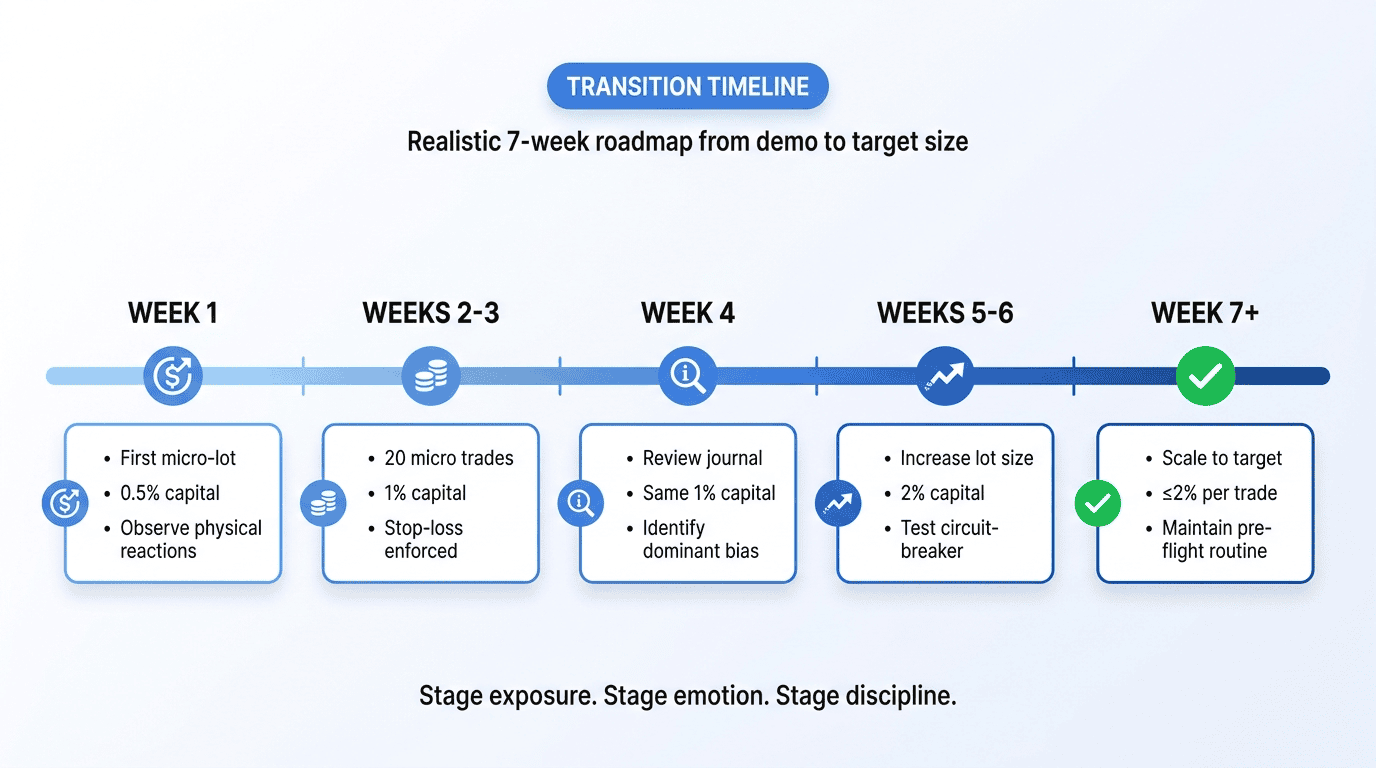
The following is a brief, realistic program that can work for many traders. Adjust time and measurements to your situation.
| Week | Objective | Capital at Risk | Psychological Focus |
|---|---|---|---|
| 1 | Open live account, place first micro lot trade | 0.5% | Observe physical reactions |
| 2-3 | Execute 20 micro trades | 1% | Enforce stop-loss rule, log emotions |
| 4 | Review journal, adjust strategy parameters | 1% | Identify dominant bias (e.g., FOMO) |
| 5-6 | Increase lot size after meeting performance criteria | 2% | Test the drawdown circuit breaker |
| 7+ | Gradually scale toward target position size | up to 2% per trade | Maintain pre-flight routine |
After a staged roadmap, impulsivity is brought under control. The mind is still feeling, but action is determined by plan.
Pre-Trade Engineering, Not In-Trade Engineering
Moving from demo to live CFD trading involves more than operational know-how; it tests emotional discipline. By examining capital comfort, pacing exposure, understanding the limits of stop-losses, recording feelings, and entering each session with a deliberate routine, traders may better navigate the psychological hurdles inherent in leveraged derivatives.
Frequently Asked Questions
Why do live trading and demo trading feel so different even with the same setup?
The brain processes simulated money and real money very differently. Real capital activates the limbic system, releasing adrenaline and cortisol that amplify every price tick. The strategy may be identical, but the emotional context is not.
How much money should I deposit on my first live CFD account?
Only what you can afford to lose without affecting essentials. Many traders start with a sum that stings on a full loss but does not endanger their lifestyle. The amount is less important than the feeling: nervous focus, not panic.
Why is loss aversion so dangerous for CFD traders?
Loss aversion makes losses feel about twice as intense as equivalent gains. It pushes traders to hold losing positions hoping for recovery and to close winning positions early to lock in gains. Both behaviours invert the asymmetry that profitable trading requires.
What is a drawdown circuit-breaker?
A pre-set maximum daily loss, typically 4 to 6 percent of account equity, after which you stop trading for the day. It prevents single-session meltdowns by converting the decision to stop into a rule rather than an in-the-moment judgment call.
Are stop-loss orders guaranteed?
No. Standard stop-loss orders may execute at prices worse than the level specified due to slippage or gapping. Some platforms offer guaranteed stop-loss orders for an extra cost.
Risk Warning
CFDs are complex derivative products that are traded on margin. Leverage can amplify both gains and losses, and more than your initial investment may be lost. You should consider whether you understand how CFDs work and whether you can afford to take the high risk of losing your money. Past performance is not a reliable indicator of future results.
Stop-Loss Disclaimer
Stop-loss orders are not guaranteed. They may be executed at prices worse than your stop level due to slippage or gapping. Guaranteed stop-loss orders, where available, incur additional charges.