

What Is a Crypto Bear Market?
A crypto bear market is a prolonged period where prices decline by 20% or more from recent highs, accompanied by widespread pessimism and sustained selling pressure across the market. Unlike a simple correction that recovers within days or weeks, a bear market persists for months, sometimes stretching beyond a year.
Understanding the difference between a correction and a bear market is critical for traders. Corrections are short, sharp pullbacks within an ongoing uptrend. Bear markets, on the other hand, fundamentally shift market sentiment from greed to fear. Trading volume often drops as retail participants exit the market, while experienced traders adjust their strategies to capitalize on new opportunities.
For crypto traders specifically, bear markets present unique characteristics. Altcoins tend to suffer disproportionately, often losing 60 to 90% of their value while Bitcoin may decline 40 to 50%. Funding rates on perpetual futures flip negative, indicating that short sellers dominate positioning. The Fear and Greed Index drops below 20, entering "Extreme Fear" territory.
Despite the pain, every crypto bear market in history has been followed by new all-time highs. Traders who purchased Bitcoin at the December 2018 bottom saw returns exceeding 2,000%. Those who entered at the November 2022 bottom captured gains of nearly 600%. The key is having the right strategies in place before the downturn hits and the discipline to execute them when emotions run high.
How to Identify a Bear Market Early
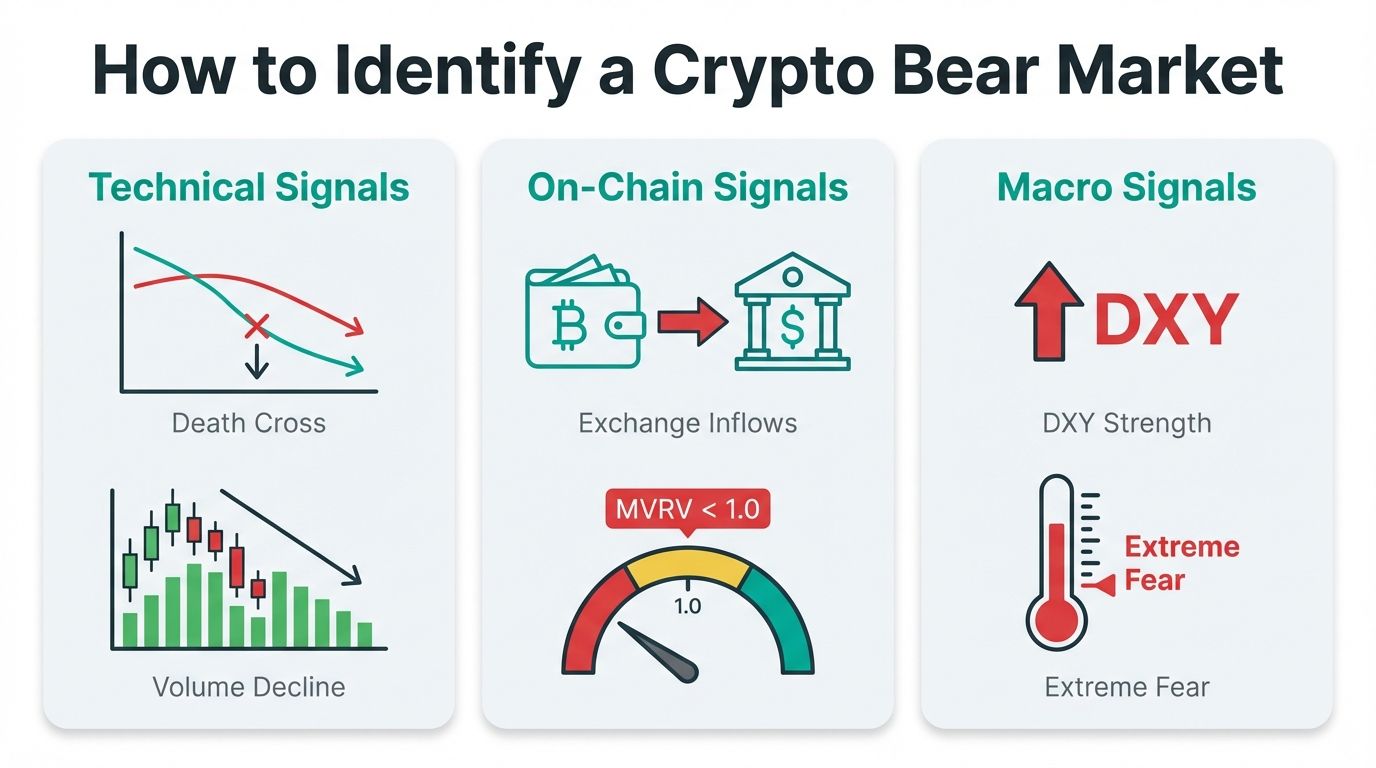
Recognizing a bear market before it fully develops gives traders a significant advantage. Several indicators can signal that a sustained downturn is underway rather than a temporary pullback.
Technical Indicators
The 200-day moving average is one of the most reliable tools for identifying market regime changes. When Bitcoin's price crosses below the 200-day moving average and the moving average itself begins sloping downward, this confirms a shift in the long-term trend. Additionally, the death cross, where the 50-day moving average crosses below the 200-day moving average, has historically preceded extended downtrends in crypto markets.
Volume analysis provides another layer of confirmation. In a bear market, rallies tend to occur on declining volume while selloffs happen on increasing volume. This pattern reveals that sellers are more aggressive than buyers, even during temporary bounces.
On-Chain Signals
On-chain data offers insights that traditional technical analysis cannot. Exchange inflows increasing sharply suggest that holders are moving coins to exchanges to sell, which is bearish. Meanwhile, declining network activity, such as fewer active addresses and lower transaction counts, confirms weakening demand.
The MVRV ratio (Market Value to Realized Value) provides another powerful signal. When the MVRV drops below 1.0, it means the average holder is underwater on their position, which historically marks the deepest phases of bear markets.
Macro and Sentiment Indicators
The Federal Reserve's monetary policy heavily influences crypto markets. Rising interest rates and quantitative tightening reduce liquidity across all risk assets, including cryptocurrencies. Monitoring the U.S. Dollar Index (DXY) is equally important since a strengthening dollar typically pressures crypto prices downward.
The Fear and Greed Index serves as a contrarian indicator. When it drops below 20, the market is in extreme fear. While this signals danger for undisciplined traders, it often marks the zone where the best buying opportunities emerge for those with a plan.
Social media sentiment is another useful gauge. When mainstream crypto influencers shift from bullish price predictions to survival advice, and when engagement on crypto forums drops significantly, these behavioral shifts often confirm that the bear market is well established. Conversely, when "crypto is dead" narratives dominate headlines, contrarian traders recognize this as a potential accumulation zone.
10 Proven Crypto Bear Market Strategies
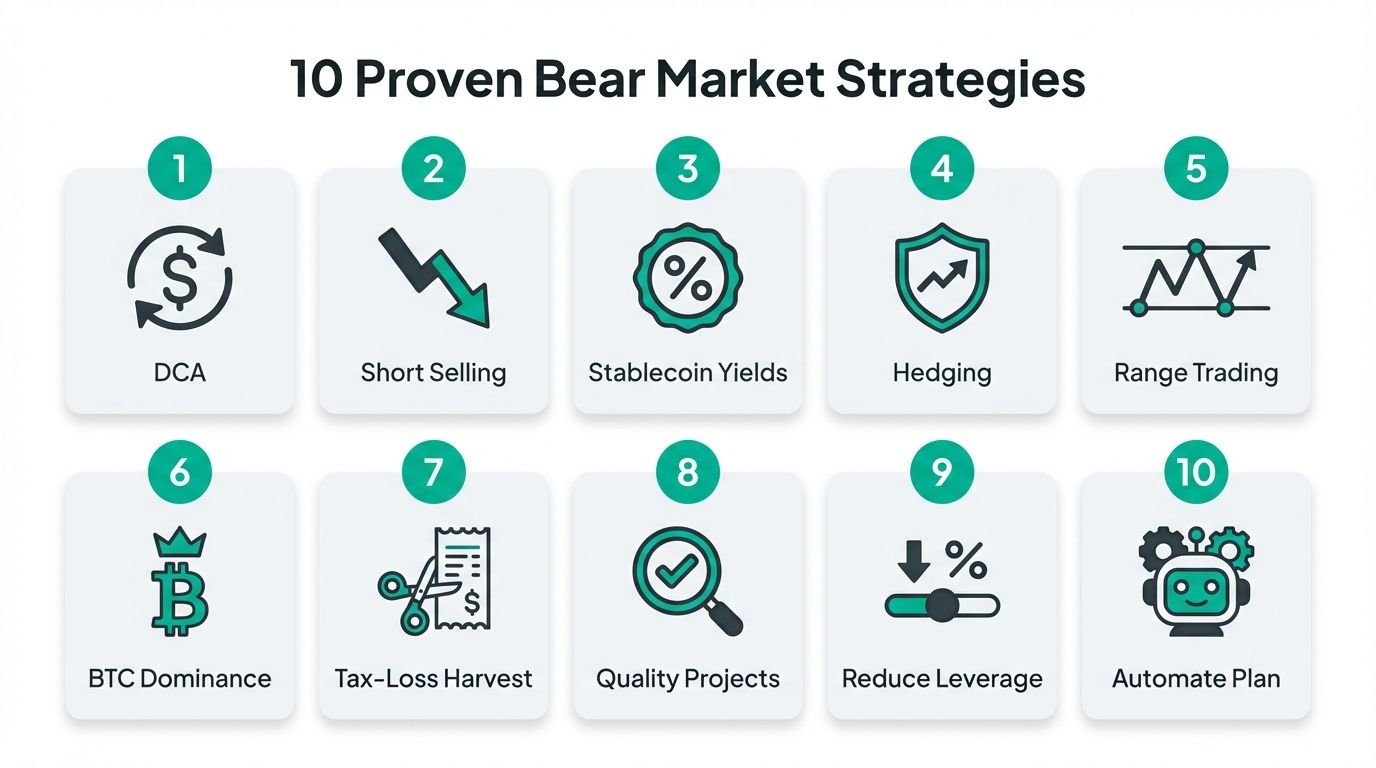
Bear markets reward traders who shift from aggressive profit-seeking to capital preservation and strategic accumulation. The following strategies have proven effective across multiple crypto market cycles.
Strategy 1: Dollar-Cost Averaging (DCA)
Dollar-cost averaging involves investing a fixed amount at regular intervals regardless of price. This removes the emotional burden of trying to time the bottom perfectly. During a bear market, DCA works in your favor because you purchase more units when prices are low, effectively reducing your average cost basis over time.
A fear-weighted DCA approach takes this further. Instead of investing the same amount every week, you increase your purchase amount when the Fear and Greed Index drops below 25. Historical backtesting over seven years showed that this approach delivered cumulative returns of over 1,100%, outperforming simple buy-and-hold by nearly 100 percentage points.
To implement DCA effectively, choose a schedule (weekly or biweekly), select your target assets (Bitcoin and Ethereum are common bear market accumulation choices), and set up automated purchases through your trading platform. The key is consistency and removing emotion from the equation.
Strategy 2: Short Selling with Risk Controls
Short selling allows traders to profit from declining prices by borrowing an asset, selling it at the current price, and buying it back later at a lower price. In a confirmed bear market, shorting during sustained downtrends can generate significant returns.
However, shorting crypto carries substantial risk because of the market's volatility. A sudden short squeeze, where prices rapidly reverse upward, can liquidate short positions quickly. To manage this risk, always use stop-loss orders, keep position sizes small (never risk more than 2% of your portfolio on a single short), and avoid shorting during periods of extreme oversold conditions where a relief rally is likely.
Perpetual futures contracts on exchanges connected to your trading platform make short selling accessible without needing to borrow the underlying asset. Monitor funding rates closely since consistently negative funding rates confirm bearish sentiment, while a sudden flip to positive rates may signal a trend reversal.
Strategy 3: Stablecoin Yield Generation
Converting a portion of your portfolio to stablecoins during a bear market serves two purposes: it preserves capital from further decline and opens opportunities to earn passive yield. Stablecoin lending rates in early 2026 range from 4% to 12% APY depending on the platform and risk level.
Major lending platforms offer yields on USDT, USDC, and DAI through various mechanisms including overcollateralized lending, liquidity provision, and institutional lending pools. While 12% yields come with higher platform risk, conservative options offering 4 to 6% provide a meaningful return on otherwise idle capital.
Keep in mind that platform risk is real. Diversify your stablecoin positions across multiple platforms rather than concentrating everything in one place. The collapse of several lending platforms during previous bear markets serves as a reminder that yield comes with risk.
Strategy 4: Hedging with Futures and Options
Hedging protects your existing long positions without requiring you to sell them. If you hold Bitcoin for the long term but expect short-term downside, you can open a short futures position equal to a portion of your holdings. If prices drop, the futures profit offsets the loss on your spot position.
Options provide another hedging mechanism. Purchasing put options gives you the right to sell at a specific price, acting as insurance against a decline. The cost of the option (the premium) is the maximum you can lose, making it a defined-risk strategy.
For traders who want to hedge without the complexity of derivatives, simply reducing position sizes and increasing stablecoin allocation achieves a similar effect. The goal is not to eliminate exposure entirely but to reduce the impact of further downside on your portfolio.
Strategy 5: Range Trading in Sideways Markets
Bear markets are not straight lines down. They typically feature periods of sideways consolidation where prices bounce between established support and resistance levels. Range trading exploits these predictable bounces by buying near support and selling near resistance.
Identify the range by marking clear horizontal levels where price has reversed multiple times. Use RSI and Stochastic indicators to confirm oversold conditions near support and overbought conditions near resistance. Set tight stop-losses just outside the range boundaries to protect against a breakdown or breakout.
Range trading works best when volatility compresses and Bitcoin enters a multi-week consolidation pattern. The strategy becomes less effective when a new leg down begins, so always monitor volume for signs of a range breakdown.
Strategy 6: Focus on Bitcoin Dominance
Bitcoin dominance, the percentage of total crypto market capitalization held by Bitcoin, typically rises during bear markets. This happens because altcoins fall harder and faster, causing capital to flow from alts into the relative safety of Bitcoin.
Monitoring Bitcoin dominance helps inform allocation decisions. When dominance is rising sharply, it signals that altcoins will likely continue underperforming. During these periods, concentrate holdings in Bitcoin and stablecoins rather than diversifying across altcoins. Only begin rotating back into altcoins when dominance peaks and begins declining, which historically occurs as the market transitions from late bear to early bull.
Track dominance trends alongside price action to build a clearer picture. A rising dominance paired with falling Bitcoin price means altcoins are collapsing even faster, which is the most dangerous environment for altcoin holders. A rising dominance paired with stable or rising Bitcoin price, however, suggests a flight to quality within crypto rather than a full market exodus.
Strategy 7: Tax-Loss Harvesting
Bear markets create opportunities to reduce your tax burden through tax-loss harvesting. This involves selling crypto assets at a loss to offset capital gains from profitable trades earlier in the year or in previous years.
Unlike stocks, cryptocurrency is not subject to wash sale rules in many jurisdictions, meaning you can immediately repurchase the same asset after selling at a loss. This allows you to maintain your market exposure while booking the tax deduction. Consult a tax professional to understand the specific rules in your jurisdiction, as regulations vary by country.
Even small portfolios benefit from this strategy. Deducting losses against ordinary income can save hundreds or thousands of dollars annually, and unused losses can often be carried forward to offset future gains.
Strategy 8: Build Positions in Quality Projects
Bear markets separate strong projects from weak ones. Tokens backed by teams that continue building, shipping updates, and growing their user base during downturns are the ones most likely to thrive in the next bull cycle. Meanwhile, projects with no real utility or development activity often fade into irrelevance.
Research fundamentals before accumulating. Look for projects with strong developer activity (check GitHub commits), growing total value locked (TVL) for DeFi protocols, consistent partnerships and integrations, and transparent roadmaps with delivered milestones. Focus your bear market accumulation on the top 10 to 20 projects by fundamental strength rather than spreading thin across dozens of speculative tokens.
Pay attention to how a project's team communicates during the downturn. Teams that remain transparent about challenges, continue shipping product updates, and maintain community engagement demonstrate the resilience needed to survive the bear market and capitalize on the next cycle. Conversely, teams that go silent, reduce development activity, or pivot their narrative frequently are red flags that the project may not survive.
Strategy 9: Reduce Leverage and Position Size
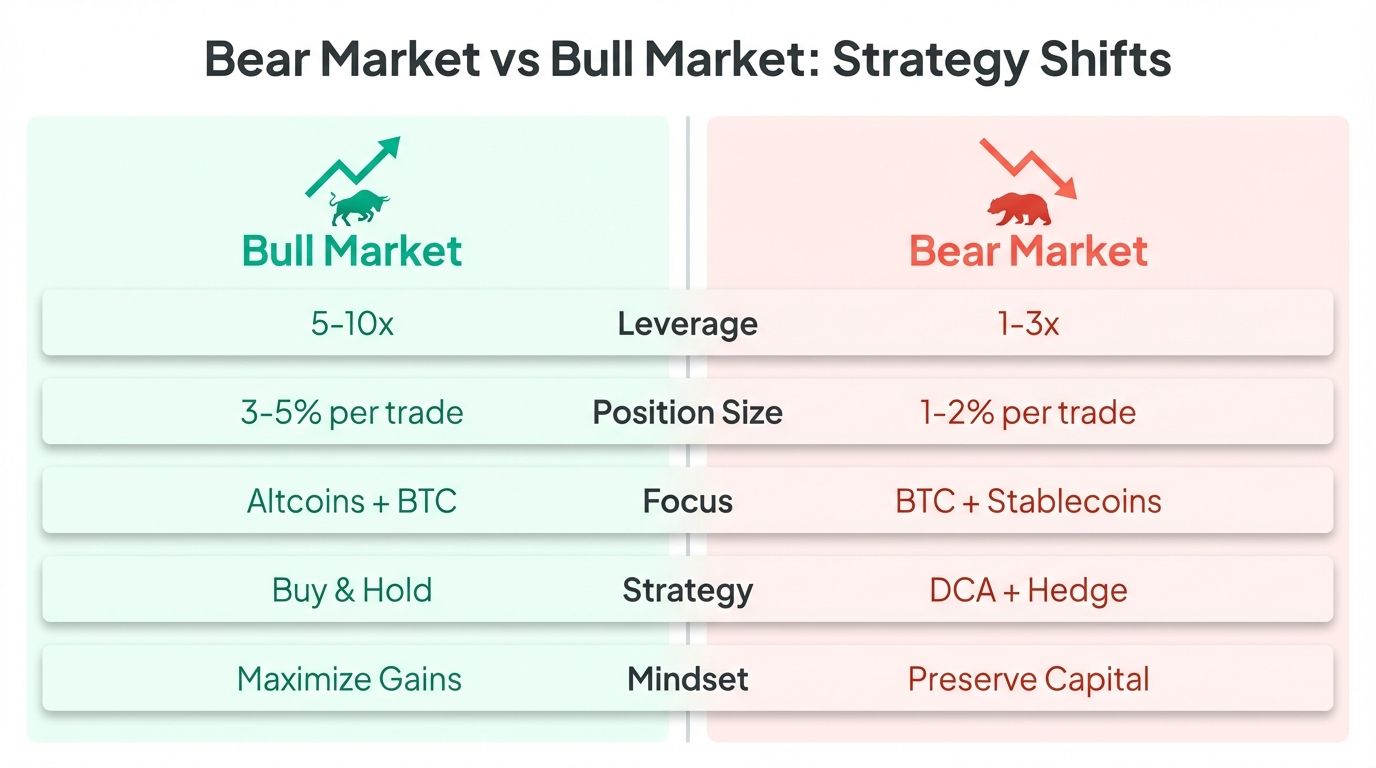
One of the most common mistakes traders make during a bear market is maintaining the same leverage and position sizes they used during the bull market. Volatility in bear markets tends to spike dramatically, and leveraged positions that might have survived a 5% move in a bull market can get liquidated by a 10% wick in a bear market.
Reduce leverage to a maximum of 2 to 3x during bear markets, compared to the 5 to 10x that some traders use during bullish conditions. Similarly, reduce individual trade sizes to 1 to 2% of your portfolio per trade. Capital preservation is the priority since you need to survive the bear market with enough capital to take advantage of the eventual recovery.
Strategy 10: Set Alerts and Automate Your Plan
Emotional decision-making destroys portfolios during bear markets. The constant barrage of negative news, price alerts, and social media panic creates pressure to sell at the worst possible times. Counteract this by automating as much of your strategy as possible.
Set price alerts at key technical levels so you only check the market when something actionable occurs. Configure automated DCA orders to execute on schedule without your intervention. Use trading bots with predefined parameters for range trading or grid strategies so that your plan executes regardless of how you feel in the moment.
A multi-exchange trading platform with built-in automation tools, price alerts, and portfolio tracking becomes essential during these periods. Having all your positions visible in one dashboard prevents the fragmentation and confusion that leads to poor decisions.
Common Mistakes to Avoid in a Crypto Bear Market
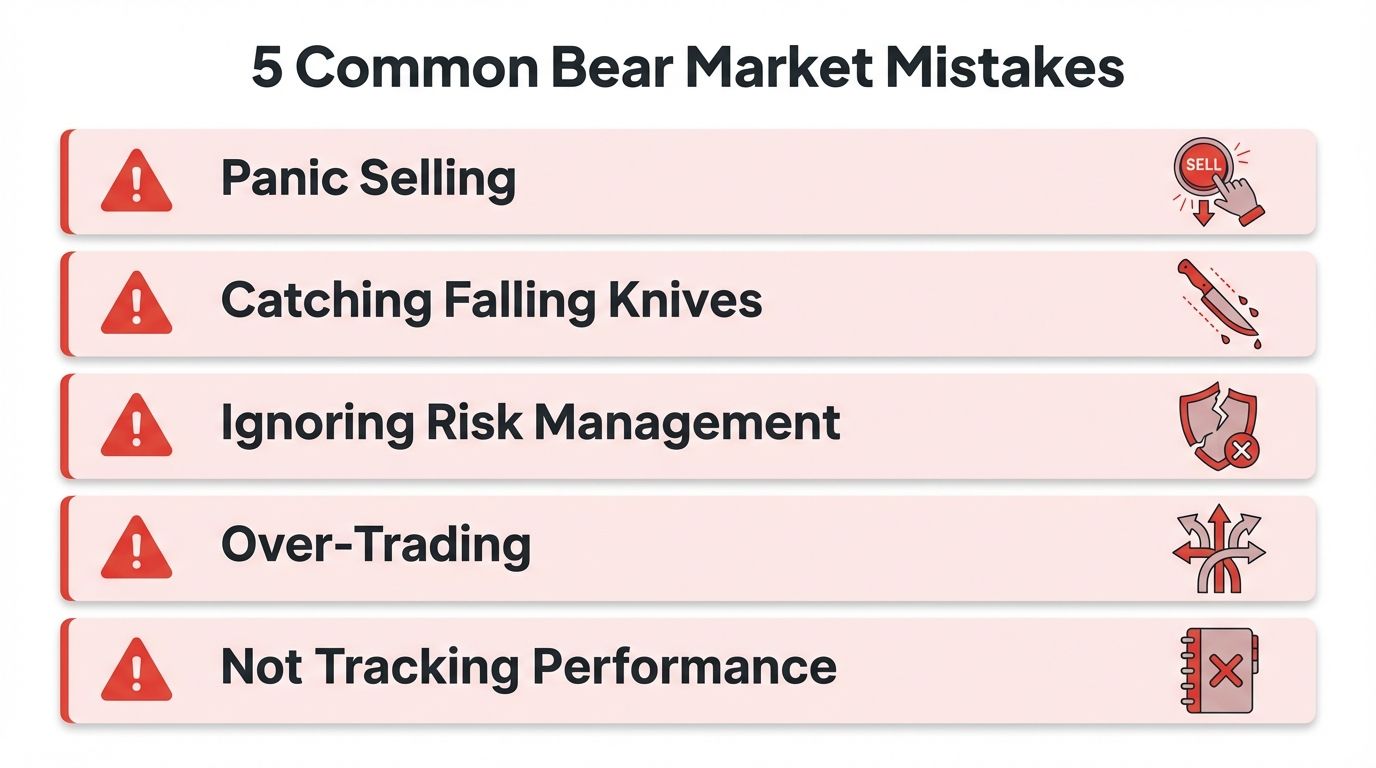
Knowing what not to do is equally important as knowing the right strategies. The following mistakes have cost traders significant capital in previous bear cycles.
Panic Selling at the Bottom
The overwhelming urge to sell everything after a major crash is the single most destructive behavior in a bear market. Historically, the days with the highest selling volume often mark or closely precede market bottoms. Selling after a 50% decline locks in losses that could have been recovered with patience.
If you feel the urge to panic sell, reduce position size instead of exiting completely. Selling 20 to 30% of your holdings to reduce stress while maintaining exposure is a reasonable compromise between emotional relief and financial prudence.
Catching Falling Knives
Buying aggressively on every dip without confirming that the trend has reversed is another costly mistake. In a bear market, what looks like the bottom often becomes the top of the next leg down. Wait for confirmation signals such as a break above the 50-day moving average, increasing volume on up days, or a sustained move above a key resistance level before committing significant capital.
Ignoring Risk Management
Traders who abandon stop-losses, over-leverage, or concentrate their entire portfolio in a single altcoin during a bear market often experience devastating losses. Maintain strict risk management regardless of how confident you feel about a particular trade. No single trade should risk more than 2% of your total portfolio.
Over-Trading
The anxiety of a bear market drives many traders to over-trade, constantly entering and exiting positions in an attempt to recover losses. Each trade incurs fees and spreads, and emotional trading typically results in a negative expectancy. Reduce your trading frequency during bear markets and only take setups that meet your predefined criteria.
Neglecting to Track Performance
Many traders stop tracking their trades during bear markets because looking at losses is painful. However, this is precisely when detailed record-keeping matters most. Maintaining a trading journal helps you identify which strategies are working in the current market conditions, which setups to avoid, and how your overall risk management is holding up. Without data, you are making decisions based on emotion rather than evidence. Review your journal weekly and adjust your approach based on what the numbers tell you, not what your gut says.
How Altrady Helps You Navigate Bear Markets
Trading across multiple exchanges during a bear market requires tools that consolidate your view and automate your execution. A platform that brings all your exchange accounts into a single dashboard gives you the clarity needed to make rational decisions when the market is chaotic.
Portfolio tracking across exchanges lets you see your total exposure, unrealized P&L, and asset allocation in real time. Smart trading features like automated stop-losses, take-profit orders, and trailing stops execute your risk management plan even when you are not watching the screen. Price alerts notify you only when actionable levels are reached, reducing the urge to constantly monitor prices.
For DCA strategies, automated recurring purchases remove the emotional component entirely. Grid bots can capture profits from range-bound markets without manual intervention. Break-even calculators help you understand exactly where your average entry sits so you can make informed decisions about adding to positions or cutting losses.
Whether you are hedging with futures, range trading sideways markets, or simply DCA-ing into quality assets, having the right tools makes the difference between surviving a bear market and thriving through one. Start your free trial to see how these tools can strengthen your bear market trading plan.
Frequently Asked Questions
How long do crypto bear markets typically last?
Historical crypto bear markets have lasted between 9 and 18 months, with a median duration of approximately 12 months. The 2018 bear market lasted about 12 months from the January peak to the December bottom. The 2022 bear market extended roughly 13 months from November 2021 to November 2022. However, individual altcoins may take significantly longer to recover, and some never return to previous highs.
Should I sell everything during a crypto bear market?
Selling everything at the onset of a confirmed bear market can preserve capital, but timing both the exit and the re-entry correctly is extremely difficult. Most traders who sell during a bear market fail to re-enter before prices recover, missing the early and most profitable phase of the next bull cycle. A more balanced approach is to reduce position sizes, increase stablecoin allocation, and maintain a DCA plan for high-conviction assets like Bitcoin and Ethereum.
What is the best strategy for beginners during a bear market?
For beginners, dollar-cost averaging into Bitcoin and Ethereum is the simplest and most historically effective strategy. Set a fixed amount to invest weekly or biweekly, automate the purchases, and resist the urge to check prices daily. Avoid leverage, avoid altcoins with small market caps, and focus on learning technical and fundamental analysis during the bear market so you are better prepared for the next cycle.
Can you make money in a crypto bear market?
Yes. Short selling, range trading, stablecoin yield generation, and grid trading strategies can all generate profits during declining or sideways markets. However, these strategies require more skill and discipline than simply buying and holding during a bull market. Start with paper trading or small position sizes to test your bear market strategies before committing significant capital.
How do I know when the bear market is over?
Several signals historically indicate a bear market bottom: Bitcoin's price holding above the 200-week moving average, the MVRV ratio dropping below 1.0 and then recovering, a sustained decrease in exchange reserves (indicating accumulation), the Fear and Greed Index reaching extreme fear followed by a gradual recovery, and Bitcoin dominance peaking and beginning to decline. No single indicator is perfect, so look for a confluence of multiple signals confirming the transition.