
What Is Crypto Passive Income?
Crypto passive income refers to earnings generated from cryptocurrency holdings without actively trading or monitoring markets on a daily basis. Instead of buying low and selling high, passive income strategies put your crypto assets to work, generating returns through mechanisms like staking rewards, lending interest, and liquidity provision.
The appeal of passive income in crypto is straightforward. While active trading demands constant attention, technical analysis skills, and emotional discipline, passive strategies can generate consistent returns with minimal ongoing effort. For traders who already hold long-term positions in Bitcoin, Ethereum, or other assets, earning additional yield on those holdings is essentially free money that compounds over time.
In 2026, the crypto passive income landscape has matured significantly compared to earlier market cycles. Regulatory clarity in major jurisdictions has reduced platform risk, institutional-grade lending protocols have improved security, and liquid staking innovations have made earning yield more accessible than ever. Annual percentage yields (APYs) across the ecosystem range from conservative 3 to 5% on major assets to aggressive 15 to 30% on higher-risk DeFi strategies.
However, passive does not mean risk-free. Every yield source carries its own risk profile, from smart contract vulnerabilities and impermanent loss to platform insolvency and regulatory changes. Understanding these risks before committing capital is what separates profitable passive income strategies from costly mistakes.
10 Best Crypto Passive Income Strategies in 2026
 10 proven strategies to earn crypto passive income in 2026
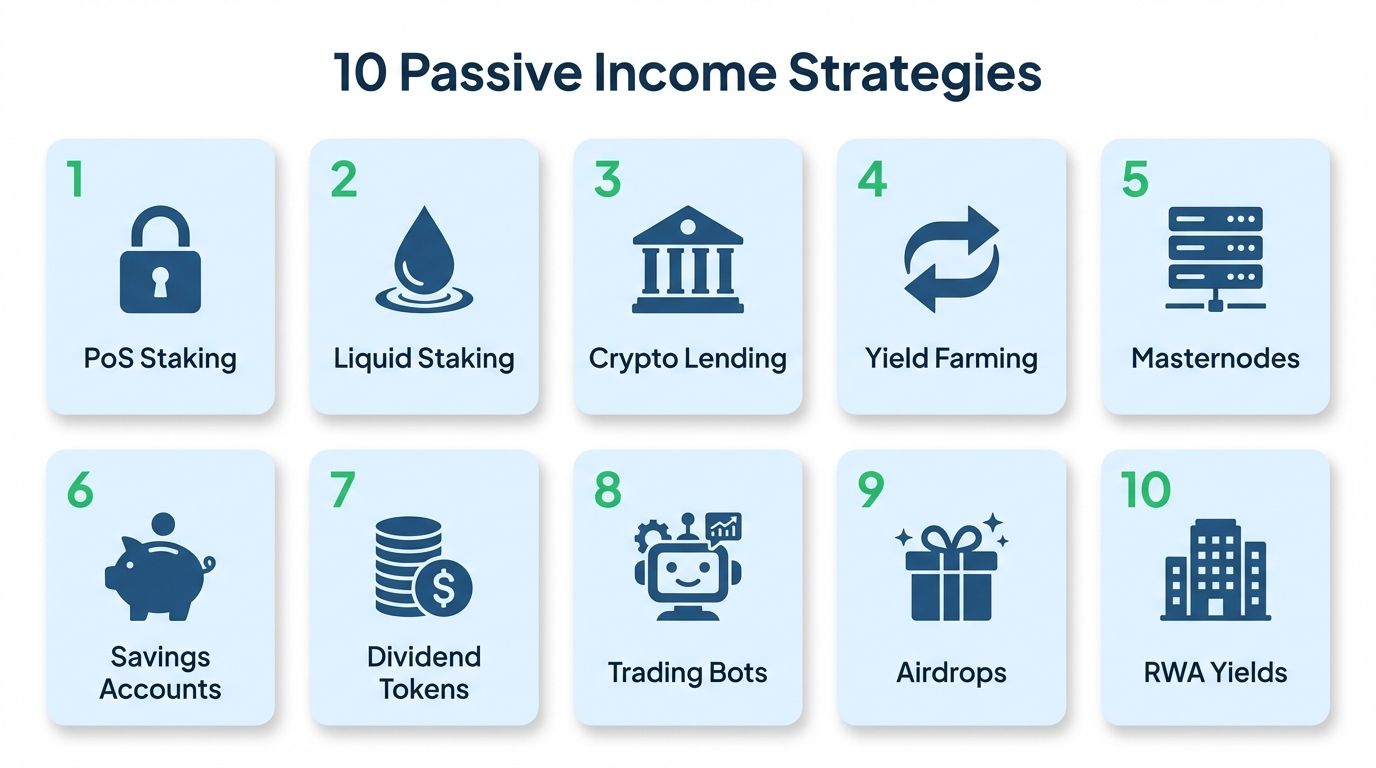
The following strategies represent the most reliable and accessible ways to earn passive income with cryptocurrency in 2026. Each strategy is ranked by a combination of accessibility, risk level, and realistic return potential.
1. Proof-of-Stake (PoS) Staking
Staking is the most straightforward crypto passive income method. By locking your tokens in a Proof-of-Stake blockchain network, you help validate transactions and secure the network. In return, the protocol rewards you with newly minted tokens, typically distributed every few days or weeks.
Major stakeable assets in 2026 include Ethereum (ETH) with yields around 3 to 4% APY, Solana (SOL) at 6 to 7% APY, Cardano (ADA) at 3 to 5% APY, and Polkadot (DOT) at 10 to 14% APY. These yields fluctuate based on network participation rates and protocol economics, but they have remained relatively stable compared to other passive income sources.
To start staking, you can either run your own validator node (requiring significant technical knowledge and minimum token thresholds) or delegate your tokens to an existing validator through your wallet or exchange. Most major exchanges offer one-click staking with no minimum requirements, though they take a small commission (typically 5 to 15%) from your staking rewards.
The primary risks of staking include slashing (penalties for validator misbehavior), lock-up periods that prevent you from selling during market downturns, and the opportunity cost of holding a token that declines in value faster than your staking rewards accumulate.
2. Liquid Staking
Liquid staking solves the biggest drawback of traditional staking: illiquidity. When you stake through a liquid staking protocol like Lido (stETH), Rocket Pool (rETH), or Jito (JitoSOL), you receive a derivative token that represents your staked position plus accrued rewards. This derivative token can be freely traded, used as collateral in DeFi, or deposited into yield farming strategies for additional returns.
In 2026, liquid staking has become the dominant form of ETH staking, with over 35% of all staked Ethereum flowing through liquid staking protocols. The yields mirror native staking rates (3 to 4% APY for ETH) minus a small protocol fee, but the added flexibility makes this the preferred approach for most investors.
The compounding potential is significant. By depositing your liquid staking token (like stETH) into a lending protocol as collateral, you can borrow stablecoins against it and deploy those stablecoins into additional yield strategies. This layered approach, sometimes called recursive staking or looping, can boost effective yields to 6 to 10% APY, though it introduces liquidation risk if the underlying asset drops sharply in price.
3. Crypto Lending
Crypto lending allows you to earn interest by lending your digital assets to borrowers through centralized or decentralized platforms. Borrowers pay interest on their loans, and a portion of that interest flows to you as the lender.
Decentralized lending protocols like Aave and Compound have proven their resilience through multiple market cycles. In 2026, lending rates for stablecoins (USDT, USDC, DAI) typically range from 4 to 10% APY depending on market demand for leverage. Lending volatile assets like ETH or BTC generally yields lower rates of 1 to 3% APY, since fewer borrowers seek these assets.
Centralized lending platforms offer potentially higher rates but carry additional platform risk. The collapses of Celsius, BlockFi, and Voyager during the 2022 bear market remain cautionary tales. If you choose centralized lending, diversify across multiple platforms and never lend more than you can afford to lose on any single platform.
The key advantage of DeFi lending over centralized options is transparency. You can verify the protocol's collateralization ratios, outstanding loans, and smart contract health in real time. Over-collateralized lending protocols, where borrowers must deposit more value than they borrow, provide an additional safety buffer.
4. Yield Farming and Liquidity Provision
Yield farming involves providing liquidity to decentralized exchanges (DEXs) and earning a share of trading fees plus bonus token rewards. When you deposit a pair of tokens into a liquidity pool (for example, ETH and USDC), traders who swap between those tokens pay fees that are distributed proportionally to all liquidity providers.
The returns from yield farming can be substantially higher than staking or lending, with some pools offering 15 to 50% APY during periods of high trading activity. However, these elevated returns come with proportionally higher risks, most notably impermanent loss.
Impermanent loss occurs when the price ratio between your deposited tokens changes. If ETH rises 50% while USDC stays stable, you would have been better off simply holding both tokens separately rather than providing liquidity. The trading fees you earn need to exceed the impermanent loss for the strategy to be profitable.
Concentrated liquidity protocols like Uniswap v3 and v4 allow you to specify a price range for your liquidity, which can dramatically increase fee earnings but also amplifies impermanent loss if price moves outside your range. For passive income seekers, wider ranges or stablecoin pairs (USDT/USDC) offer lower but more predictable returns with minimal impermanent loss.
5. Running Masternodes and Validator Nodes
Running a masternode or validator node involves operating dedicated server infrastructure that supports a blockchain network. In exchange for providing this service, node operators receive regular block rewards and transaction fees.
Masternode requirements vary significantly by project. Dash requires 1,000 DASH (a substantial capital commitment), while other networks have lower barriers to entry. Validator nodes for Proof-of-Stake networks like Ethereum require 32 ETH for solo staking, though this threshold has made distributed validator technology (DVT) an increasingly popular alternative that allows smaller holders to participate.
The potential returns are attractive, often ranging from 5 to 20% APY depending on the network. However, running a node requires technical expertise in server administration, uptime management, and security. Downtime or misconfiguration can result in slashing penalties that reduce your staked capital. For most individuals, delegating to professional validators or using staking pools is more practical than running nodes directly.
6. Crypto Savings Accounts
Crypto savings accounts function similarly to traditional bank savings accounts but for digital assets. You deposit your crypto (usually stablecoins or BTC/ETH) into a platform, and the platform lends your assets to institutional borrowers or deploys them into yield-generating strategies, passing a portion of the returns back to you.
In 2026, regulated crypto savings products have emerged as a middle ground between DeFi protocols and traditional finance. Platforms that comply with local regulations offer deposit insurance or segregated custody, providing an additional layer of protection that pure DeFi protocols lack.
Typical rates for stablecoin savings accounts range from 4 to 8% APY, while BTC and ETH savings accounts offer 1 to 3% APY. These rates are lower than aggressive DeFi strategies but come with significantly less complexity and risk. For newcomers to crypto passive income or conservative investors, savings accounts provide the simplest entry point.
7. Dividend-Paying Crypto Tokens
Certain cryptocurrency tokens distribute a portion of the project's revenue or fees to token holders, functioning similarly to dividend-paying stocks. These distributions may come in the form of the native token, stablecoins, or other cryptocurrencies.
Examples include exchange tokens like BNB (Binance) that offer fee discounts and periodic burns that increase scarcity, DeFi protocol tokens that distribute protocol revenue to stakers (such as GMX, which shares 30% of platform fees with staked GMX holders), and real-world asset (RWA) tokens that pass through yield from tokenized treasuries or real estate.
The advantage of dividend tokens is that your income stream is directly tied to the project's actual usage and revenue, not just inflationary token emissions. However, dividends are only as reliable as the underlying project. Thoroughly research the project's revenue model, token distribution schedule, and team track record before investing based on dividend yields alone.
8. Automated Trading Bots
While not purely passive in the traditional sense, automated trading bots can generate consistent returns with minimal daily intervention once configured. Grid bots, DCA bots, and arbitrage bots execute predefined strategies around the clock, capturing profits from market volatility, price ranges, or cross-exchange price differences.
Grid bots are particularly effective for generating passive income in sideways or ranging markets. By placing a grid of buy and sell orders at preset intervals, the bot automatically buys when price drops and sells when price rises, capturing small profits with each completed grid cycle. Returns vary widely based on market conditions and grid settings, but 1 to 5% monthly returns are achievable in favorable conditions.
DCA bots automate dollar-cost averaging, systematically purchasing crypto assets at regular intervals. While the income is realized only when you eventually sell at higher prices, the automated nature and reduced emotional decision-making qualify this as a passive strategy. A multi-exchange trading platform with built-in bot functionality lets you run these strategies across multiple exchanges from a single dashboard.
9. Airdrops and Token Distributions
Airdrops are free token distributions given to wallet holders who meet specific criteria, such as holding a particular token, using a protocol, or participating in governance. While airdrops are not a reliable or predictable income stream, they can be extremely lucrative when they occur.
Major airdrop events in recent years have distributed thousands of dollars in value to eligible wallets. The Uniswap (UNI), Arbitrum (ARB), and Jito (JTO) airdrops each rewarded early users with significant token allocations. In 2026, many emerging Layer 2 networks, DeFi protocols, and cross-chain bridges still hint at future token launches that may include airdrops for early adopters.
To maximize airdrop eligibility, actively use promising protocols across multiple chains, participate in testnet activities, provide liquidity, and engage in governance. However, avoid protocols that charge fees for "guaranteed" airdrops, as these are almost always scams. Legitimate airdrops are free by definition.
10. Real-World Asset (RWA) Tokenization Yields
Real-world asset tokenization is one of the fastest-growing segments of crypto passive income in 2026. RWA protocols tokenize traditional financial instruments like U.S. Treasury bonds, corporate bonds, real estate, and commodities, making their yields accessible to crypto holders without leaving the blockchain ecosystem.
Tokenized Treasury products from protocols like Ondo Finance (USDY) and Mountain Protocol (USDM) offer 4 to 5% APY backed by short-term U.S. government securities. These yields carry minimal credit risk since they are backed by sovereign debt, though smart contract and protocol risks still apply.
Tokenized real estate platforms allow fractional ownership of income-generating properties, distributing rental yields and potential appreciation to token holders. While still early in adoption, the total value locked in RWA protocols exceeded $12 billion in early 2026, signaling strong institutional and retail demand for this hybrid approach to passive income.
How to Choose the Right Strategy for You
 Risk versus return comparison for passive income strategies
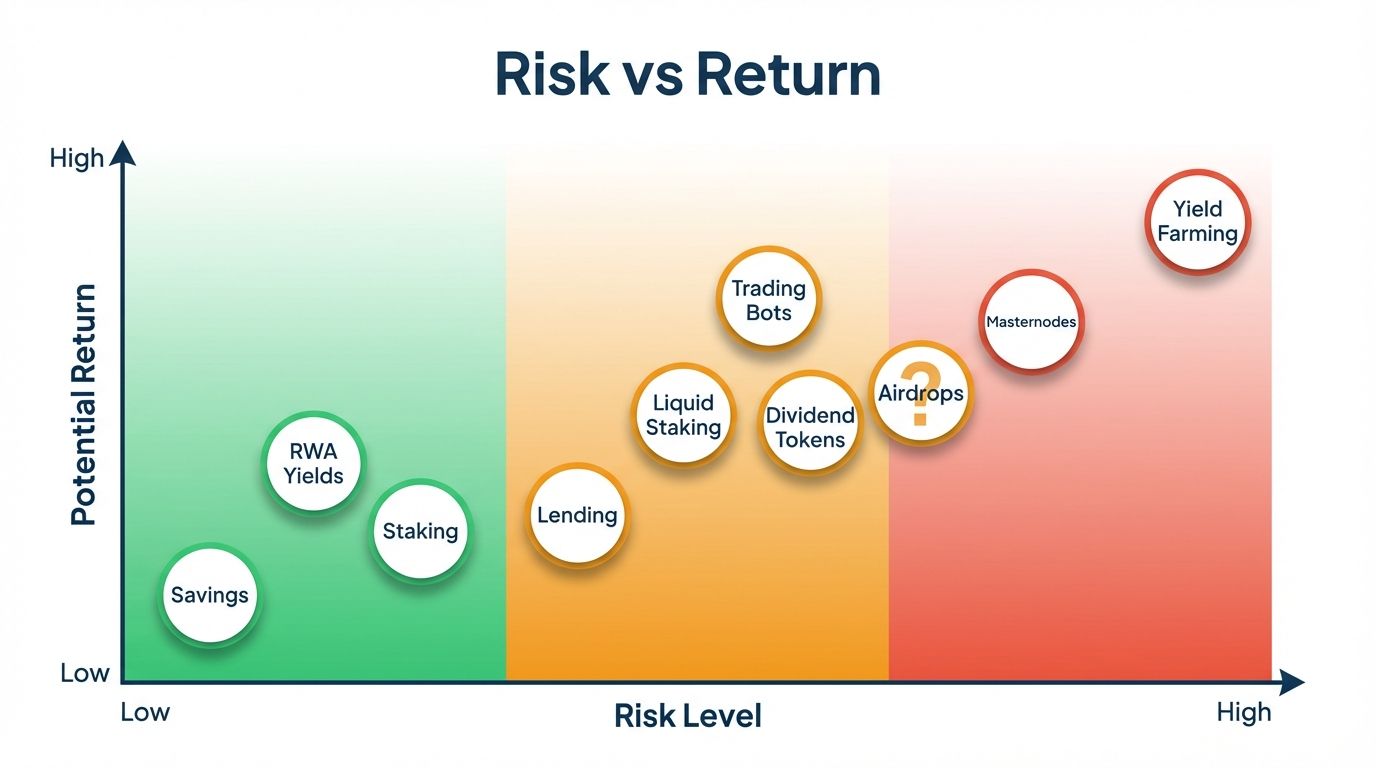
Selecting the best crypto passive income strategy depends on your risk tolerance, capital size, technical expertise, and time horizon. Understanding how these factors interact helps you build a portfolio approach rather than relying on a single income stream.
Risk Tolerance Assessment
Conservative investors should focus on staking major Proof-of-Stake assets (ETH, SOL), regulated savings accounts, and RWA tokenization yields. These strategies offer lower returns (3 to 8% APY) but carry relatively lower risk profiles. Moderate risk tolerance opens the door to crypto lending on established DeFi protocols and liquid staking derivatives. Aggressive investors willing to accept higher risk for higher potential returns can explore yield farming, leveraged liquid staking strategies, and smaller-cap staking opportunities.
Capital Requirements
Many strategies have no minimum capital requirement. You can stake as little as a few dollars worth of SOL or provide liquidity to a DeFi pool with any amount. However, strategies like running validator nodes (32 ETH for Ethereum) or masternodes (1,000 DASH) require significant upfront capital. For smaller portfolios, delegated staking, lending, and savings accounts offer the most accessible entry points.
Diversification Across Strategies
 Recommended allocation for a balanced passive income portfolio
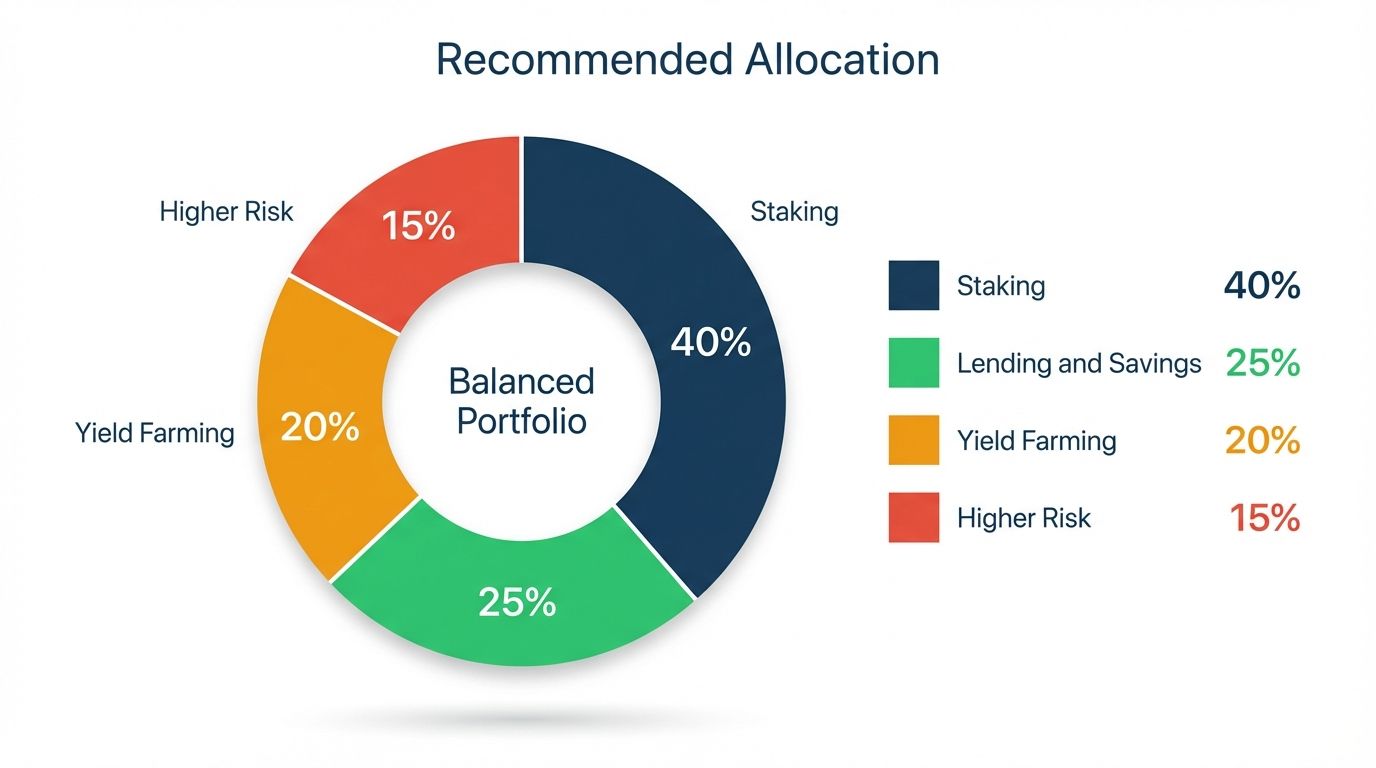
The safest approach to crypto passive income is diversification across multiple strategies and platforms. A balanced passive income portfolio in 2026 might allocate 40% to staking (including liquid staking), 25% to lending and savings accounts, 20% to yield farming on established protocols, and 15% to higher-risk opportunities like dividend tokens or airdrop farming. This distribution ensures that no single point of failure can wipe out your entire passive income stream.
Risks and How to Manage Them
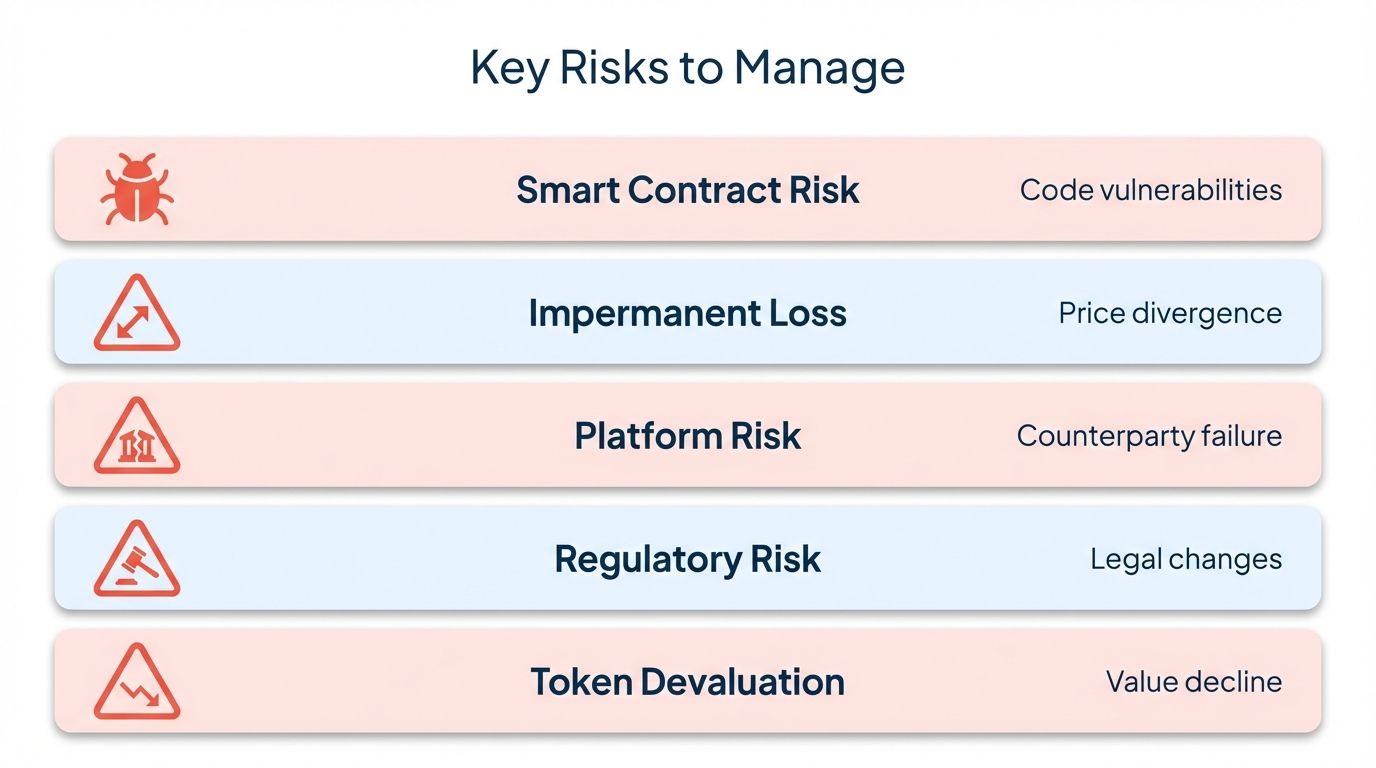 Key risks to manage in your crypto passive income portfolio
Every crypto passive income strategy carries risks that must be understood and managed. Ignoring these risks in pursuit of higher yields is the fastest path to losing capital.
Smart Contract Risk
DeFi protocols operate on smart contracts, and bugs or vulnerabilities in these contracts can result in total loss of deposited funds. Mitigate this risk by using only protocols that have undergone multiple professional security audits, have substantial total value locked (TVL) indicating community trust, and have operated without incident for at least one full market cycle. Checking audit reports on platforms like Certik, Trail of Bits, or OpenZeppelin before depositing is essential due diligence.
Impermanent Loss
Liquidity providers face impermanent loss when asset prices diverge from their entry ratio. This risk is highest in volatile asset pairs and concentrated liquidity positions. To minimize impermanent loss, provide liquidity in correlated pairs (wBTC/ETH) or stablecoin pairs (USDC/USDT) where price divergence is minimal. Monitor your positions regularly and withdraw if impermanent loss exceeds accumulated fee income.
Platform and Counterparty Risk
Centralized platforms can freeze withdrawals, become insolvent, or exit scam. The 2022 collapse of multiple lending platforms demonstrated this risk clearly. Protect yourself by diversifying across platforms, preferring decentralized protocols where you retain custody of your keys, and never depositing more than 20% of your total portfolio on any single centralized platform.
Regulatory Risk
Cryptocurrency regulations continue evolving in 2026, and activities that are legal today may face restrictions tomorrow. Staking-as-a-service products, lending platforms, and yield-bearing stablecoins have all faced regulatory scrutiny in various jurisdictions. Stay informed about regulations in your country, use compliant platforms when available, and maintain records of all passive income activities for tax reporting purposes.
Inflation and Token Devaluation
High staking yields mean nothing if the underlying token loses value faster than rewards accumulate. A token offering 20% APY staking rewards but declining 50% in price leaves you with a net loss. Focus your passive income strategies on tokens with strong fundamentals, real utility, and sustainable tokenomics rather than chasing the highest headline APY numbers.
Tax Implications of Crypto Passive Income in 2026
Crypto passive income is taxable in most jurisdictions, and understanding your obligations is critical to avoiding penalties. The specific treatment varies by country and income type, but general principles apply broadly.
Staking rewards are typically treated as ordinary income at the fair market value when received. This means you owe income tax on your staking rewards even if you do not sell the tokens. When you eventually sell staked tokens, you also owe capital gains tax on any appreciation since the time you received them.
Lending interest follows similar treatment, taxed as ordinary income when received. Yield farming rewards, airdrops, and dividend distributions are also generally taxable events upon receipt. The complexity increases when you receive rewards in tokens that do not have readily available market prices.
Keep detailed records of all passive income transactions, including dates, amounts, token types, and fair market values at the time of receipt. Tax software designed for crypto, such as Koinly, CoinTracker, or TokenTax, can automate much of this record-keeping by connecting directly to your wallets and exchange accounts.
How Altrady Supports Your Passive Income Strategy
Building and managing a crypto passive income portfolio across multiple platforms and strategies requires tools that provide a unified view of your positions. Tracking staking rewards on one chain, lending yields on another, and bot performance across multiple exchanges quickly becomes overwhelming without the right infrastructure.
A multi-exchange portfolio tracker gives you real-time visibility into your total passive income performance. Instead of logging into five different platforms to check yields, you can see all positions, unrealized gains, and accumulated rewards in a single dashboard. This consolidated view helps you identify which strategies are performing well and which need adjustment.
For automated trading strategies, built-in grid bots and DCA bots execute your passive income plan without requiring constant manual intervention. Set your grid parameters once, and the bot trades 24/7 across supported exchanges, capturing profits from market movements while you focus on other priorities.
Portfolio alerts notify you when important thresholds are reached, such as a token dropping below a key price level or your lending position approaching liquidation. These proactive notifications let you maintain a truly passive approach while staying informed about events that require attention.
Whether you are staking ETH, running grid bots on sideways markets, or DCA-ing into long-term positions, having the right platform makes the difference between scattered, hard-to-track passive income and a well-organized strategy that compounds over time. Start your free trial to see how these tools can streamline your crypto passive income approach.
Frequently Asked Questions
How much can you realistically earn from crypto passive income?
Realistic returns depend on your chosen strategies and risk tolerance. Conservative approaches using staking and lending on major assets typically yield 3 to 8% APY. Moderate strategies combining liquid staking with DeFi lending can achieve 6 to 12% APY. Aggressive yield farming strategies may reach 15 to 30% APY or higher, but with proportionally greater risk. A diversified portfolio across multiple strategies commonly targets 5 to 10% blended annual returns in 2026.
Is crypto passive income safe?
No passive income strategy in crypto is completely risk-free. Staking on major networks like Ethereum carries relatively low risk but is still subject to smart contract vulnerabilities and market price fluctuations. DeFi yield farming carries higher risks including impermanent loss and smart contract exploits. Centralized platforms introduce counterparty risk. Managing these risks through diversification, using audited protocols, and never investing more than you can afford to lose makes crypto passive income significantly safer.
What is the minimum amount needed to start earning crypto passive income?
Many crypto passive income strategies have no minimum requirement. You can start staking with as little as a few dollars on most exchanges and DeFi platforms. Lending and savings accounts often accept any deposit size. However, running a full Ethereum validator requires 32 ETH, and certain masternode networks require substantial token holdings. For most beginners, starting with exchange-based staking or lending with whatever amount you are comfortable risking is the most practical approach.
Do I need to pay taxes on crypto passive income?
Yes, in most jurisdictions. Staking rewards, lending interest, yield farming returns, and airdrops are generally treated as taxable income at the fair market value when received. Additionally, selling tokens received as passive income may trigger capital gains taxes. Tax treatment varies by country, so consult a qualified tax professional familiar with cryptocurrency regulations in your jurisdiction. Using crypto tax software to automatically track and report passive income transactions can simplify compliance significantly.
Can I earn passive income during a bear market?
Yes. Several passive income strategies generate returns regardless of market direction. Stablecoin lending and savings accounts earn interest that is unaffected by crypto price movements. Staking rewards continue to accrue in bear markets, though the fiat value of those rewards may decline. Grid bots can be particularly effective during bear market sideways periods, capturing profits from price oscillations within a range. The key during bear markets is focusing on strategies denominated in stablecoins or using assets you plan to hold long-term regardless of short-term price action.