
What Makes a Cryptocurrency Good for Long-Term Investment?
Long-term crypto investing means holding assets for one year or more, riding through market cycles rather than chasing short-term price swings. While thousands of cryptocurrencies exist, only a handful possess the characteristics that make them suitable for a buy-and-hold strategy spanning multiple years.
The strongest long-term candidates share several key traits. First, they solve a real problem or serve a genuine use case that creates sustained demand for the token. Second, they have active development teams that continue shipping updates and improving the protocol. Third, they demonstrate network effects where growing adoption creates a flywheel that attracts more users and developers. Fourth, they maintain transparent governance and clear tokenomics that align incentives between the project and its holders.
Market capitalization matters for long-term holdings. Large-cap cryptocurrencies (above $10 billion market cap) offer more stability and liquidity, making them safer for portfolio allocations meant to be held for years. Mid-cap projects ($1 billion to $10 billion) offer higher growth potential but carry more risk. Small-cap tokens below $1 billion can deliver explosive returns but have a high failure rate, making them unsuitable as core long-term positions.
Understanding these fundamentals helps you evaluate each cryptocurrency on this list and determine which ones align with your investment goals and risk tolerance.
10 Best Cryptocurrencies for Long-Term Investment in 2026
 Top 10 cryptocurrencies for long-term investment in 2026
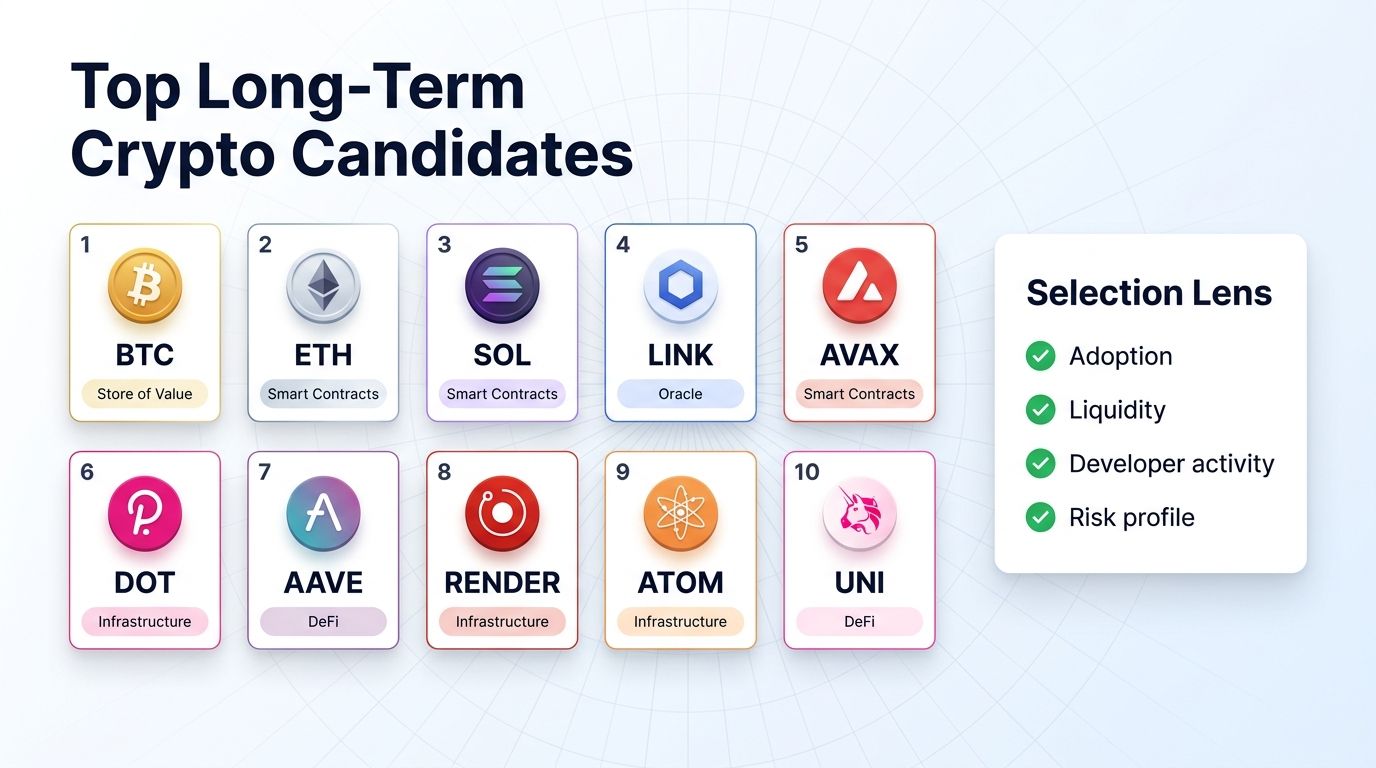
The following cryptocurrencies represent the strongest candidates for long-term investment based on fundamentals, adoption trends, developer activity, and institutional interest. Each entry includes the key reasons it qualifies as a long-term hold and the risks you should consider.
1. Bitcoin (BTC)
Bitcoin remains the foundation of any long-term crypto portfolio. As the first and most widely recognized cryptocurrency, Bitcoin benefits from unmatched network effects, the strongest brand recognition in the industry, and growing institutional adoption through spot ETFs and corporate treasury allocations.
Bitcoin's fixed supply of 21 million coins creates a deflationary dynamic that becomes more pronounced after each halving event. The April 2024 halving reduced the block reward to 3.125 BTC, further constraining new supply at a time when demand from ETFs and institutional buyers continues to grow. Historically, Bitcoin has reached new all-time highs within 12 to 18 months following each halving.
For long-term investors, Bitcoin serves as the anchor asset. Financial advisors increasingly recommend allocating 1% to 5% of a diversified portfolio to Bitcoin. Its correlation with traditional markets has decreased over time, strengthening its case as a portfolio diversifier alongside gold and other alternative assets.
2. Ethereum (ETH)
Ethereum powers the vast majority of decentralized applications, DeFi protocols, and NFT marketplaces. Its transition to Proof of Stake reduced energy consumption by over 99% and introduced staking yields that provide passive income to long-term holders.
The Ethereum ecosystem hosts more developers than any other blockchain. This developer dominance creates a self-reinforcing cycle: more developers build more applications, which attract more users, which attract more developers. Layer 2 scaling solutions like Arbitrum, Optimism, and Base have dramatically reduced transaction costs while maintaining Ethereum's security guarantees.
Ethereum's burn mechanism (EIP-1559) removes ETH from circulation with every transaction, creating deflationary pressure during periods of high network usage. For long-term investors, ETH offers exposure to the entire smart contract economy through a single asset. The combination of staking yields, deflationary tokenomics, and dominant developer ecosystem makes ETH a core long-term holding alongside Bitcoin.
3. Solana (SOL)
Solana has established itself as the leading high-performance blockchain, processing thousands of transactions per second at costs below one cent. Its speed and low fees have made it the preferred platform for consumer-facing applications, mobile crypto wallets, and high-frequency DeFi trading.
The Solana ecosystem experienced remarkable growth through 2025 and into 2026, with daily active addresses and transaction volume reaching new highs. The Saga smartphone and mobile-first strategy differentiated Solana from competitors by bringing crypto directly to everyday users. The Firedancer validator client, developed by Jump Crypto, promises to further improve network reliability and throughput.
Risks include occasional network congestion during peak demand periods and a more concentrated validator set compared to Ethereum. However, the vibrant developer community, strong venture capital backing, and growing institutional interest support Solana's position as a top long-term investment candidate in the Layer 1 space.
4. Chainlink (LINK)
Chainlink provides the oracle infrastructure that connects blockchains to real-world data, making it an essential component of the entire DeFi ecosystem. Without reliable oracles, smart contracts cannot access price feeds, weather data, sports scores, or any other external information needed to function correctly.
Chainlink's Cross-Chain Interoperability Protocol (CCIP) positions the project as the standard for cross-chain communication, enabling secure data and token transfers between different blockchains. Major financial institutions including Swift, DTCC, and several global banks have partnered with Chainlink to explore tokenized asset settlement.
The LINK token secures the oracle network through staking, with node operators required to stake LINK as collateral. As more protocols and institutions adopt Chainlink's services, demand for LINK grows proportionally. This direct relationship between ecosystem adoption and token demand makes LINK a strong infrastructure play for long-term investors.
5. Avalanche (AVAX)
Avalanche combines high throughput with unique subnet architecture that allows institutions and enterprises to create custom blockchains with their own rules while still connecting to the broader Avalanche ecosystem. This flexibility has attracted real-world asset tokenization projects and institutional DeFi applications.
The subnet model solves a key problem for institutional adoption: compliance. Financial institutions can create permissioned subnets that satisfy regulatory requirements while still benefiting from blockchain interoperability. Several major financial firms have launched tokenization pilots on Avalanche subnets, signaling growing institutional confidence in the platform.
AVAX token serves multiple functions: paying transaction fees, staking to secure the network, and participating in subnet validation. The token's burn mechanism reduces supply over time, and staking rewards provide yield to long-term holders. Avalanche's focus on enterprise adoption and real-world asset tokenization positions it well for the growing trend of traditional finance moving on-chain.
6. Polkadot (DOT)
Polkadot's architecture enables specialized blockchains (parachains) to operate in parallel while sharing security through the central Relay Chain. This design allows each parachain to optimize for specific use cases without compromising the security or scalability of the overall network.
The introduction of async backing and the roadmap toward Polkadot 2.0 has improved throughput and reduced latency across the network. Coretime, the new model for allocating blockspace, provides more flexible and cost-effective access to Polkadot's shared security compared to the previous parachain auction system.
Polkadot's governance system is one of the most sophisticated in crypto, allowing DOT holders to directly influence protocol upgrades, treasury spending, and network parameters. For long-term investors, Polkadot represents a long-term play on the multi-chain future where specialized blockchains need to communicate and share security. Staking rewards of approximately 14% to 16% APY provide attractive passive income while waiting for the ecosystem to mature.
7. Aave (AAVE)
Aave is the largest decentralized lending protocol by total value locked, enabling users to lend and borrow crypto assets without intermediaries. The protocol has operated continuously since 2020 without a security breach on its core contracts, demonstrating the reliability that long-term investors value.
Aave's expansion into institutional DeFi through Aave Arc and its deployment across multiple blockchains (Ethereum, Polygon, Arbitrum, Optimism, Avalanche, and others) diversifies the protocol's revenue sources and user base. The GHO stablecoin, launched by Aave, generates additional protocol revenue and deepens the ecosystem's utility.
The AAVE token captures value through fee sharing and governance rights. As DeFi lending volume grows, protocol revenue increases, which supports the token's fundamental value. For long-term investors, AAVE provides direct exposure to the growth of decentralized lending, one of the most proven and sustainable sectors within DeFi.
8. Render Network (RENDER)
Render Network connects artists, studios, and AI developers who need GPU computing power with node operators who have idle GPUs available. As demand for GPU rendering and AI inference computing explodes, Render provides a decentralized marketplace that offers lower costs and greater accessibility than centralized cloud providers.
The convergence of AI and blockchain creates a massive addressable market for Render. Training and running AI models requires enormous GPU resources, and Render's decentralized network can serve this demand more cost-effectively than building dedicated data centers. Strategic partnerships with Apple (through Metal integration) and major entertainment studios validate the technology's real-world utility.
For long-term investors, RENDER represents exposure to the intersection of two megatrends: AI computing demand and decentralized infrastructure. The token's utility is directly tied to network usage, creating a clear relationship between adoption and value. As AI computing needs continue to grow exponentially, Render's decentralized GPU marketplace becomes increasingly valuable.
9. Cosmos (ATOM)
Cosmos pioneered the app-chain thesis, the idea that every major application should have its own dedicated blockchain optimized for its specific needs. The Cosmos SDK has become the most widely used framework for building custom blockchains, powering major projects including Celestia, dYdX, Osmosis, and the BNB Chain.
The Inter-Blockchain Communication (IBC) protocol enables seamless asset and data transfers between Cosmos chains, creating an interconnected ecosystem of specialized blockchains. Over 100 chains are connected through IBC, making it one of the most actively used interoperability protocols in crypto.
ATOM's role in the Cosmos ecosystem has expanded with interchain security, where the Cosmos Hub provides security to smaller chains in exchange for a share of their revenue. Staking ATOM earns rewards from multiple sources, including hub validation and interchain security fees. For long-term investors, ATOM provides exposure to the growing multi-chain ecosystem built on Cosmos technology.
10. Uniswap (UNI)
Uniswap is the most widely used decentralized exchange, consistently handling more trading volume than many centralized exchanges. The protocol's automated market maker model revolutionized token trading by eliminating the need for traditional order books and market makers.
Uniswap V4 introduces hooks, a modular system that allows developers to customize pool behavior for specific use cases. This extensibility transforms Uniswap from a simple DEX into a platform for building custom trading infrastructure. The introduction of the fee switch, which would direct a portion of trading fees to UNI holders, has been a key governance discussion that could fundamentally change the token's value proposition.
Uniswap's deployment across 20+ chains ensures that it captures trading volume regardless of which blockchain gains the most traction. For long-term investors, UNI provides exposure to the growth of decentralized trading, a sector that continues to gain market share from centralized exchanges as users prioritize self-custody and transparency.
How to Build a Long-Term Crypto Portfolio
Selecting the right cryptocurrencies is only half the equation. How you structure your portfolio and manage your positions over time determines your actual returns.
Portfolio Allocation Framework
 Recommended portfolio allocation for long-term crypto investment
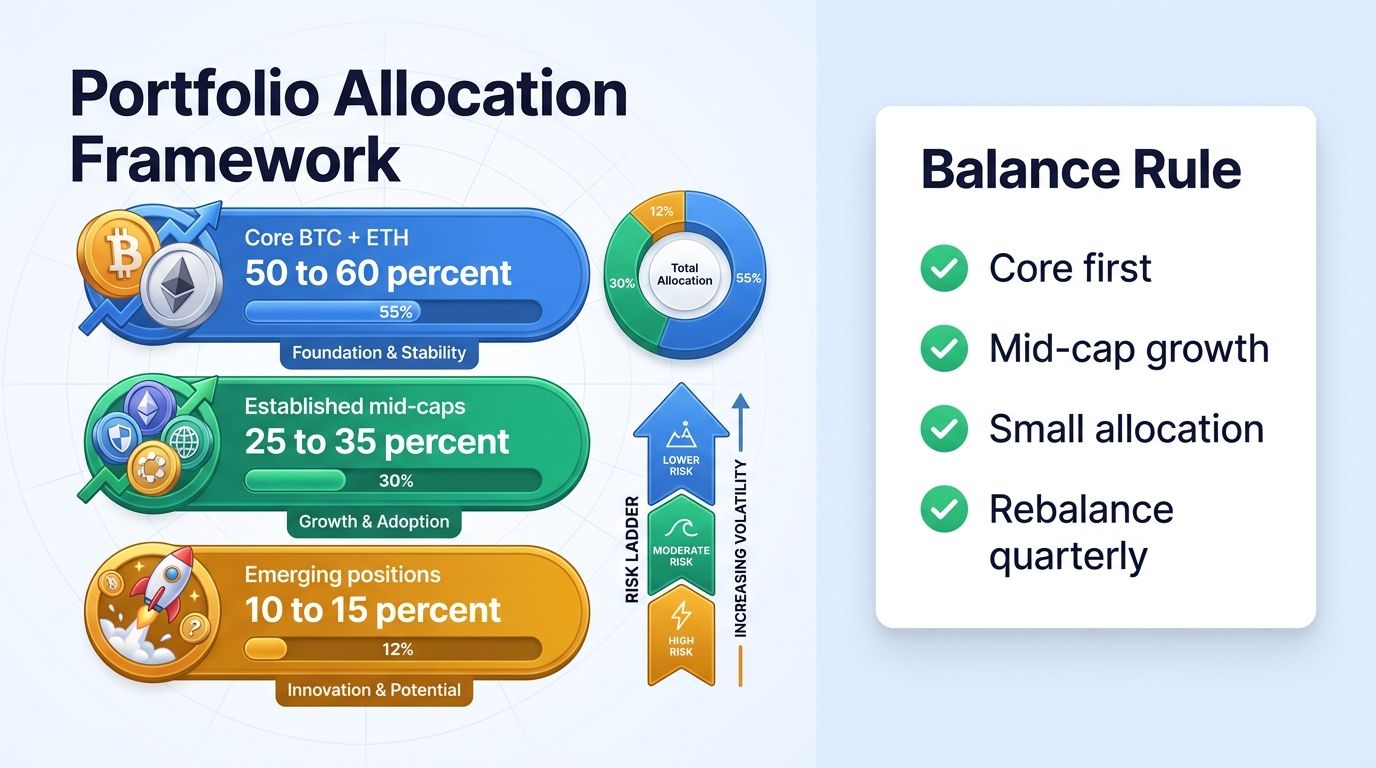
A balanced long-term crypto portfolio typically follows a tiered structure. Allocate 50% to 60% to large-cap assets (Bitcoin and Ethereum) as the foundation. These provide stability and have the highest probability of surviving multiple market cycles. Assign 25% to 35% to established mid-cap projects (like SOL, LINK, AVAX) that offer higher growth potential with moderate risk. Reserve 10% to 15% for higher-risk positions in emerging projects with strong fundamentals but less proven track records.
This framework adapts to your risk tolerance. Conservative investors may allocate 70% to 80% to Bitcoin and Ethereum alone. Aggressive investors might reduce the large-cap allocation to 40% while increasing mid-cap and small-cap exposure. The key is defining your allocation before buying and sticking to it regardless of market sentiment.
Dollar-Cost Averaging for Long-Term Accumulation
 How dollar-cost averaging reduces your average cost over time
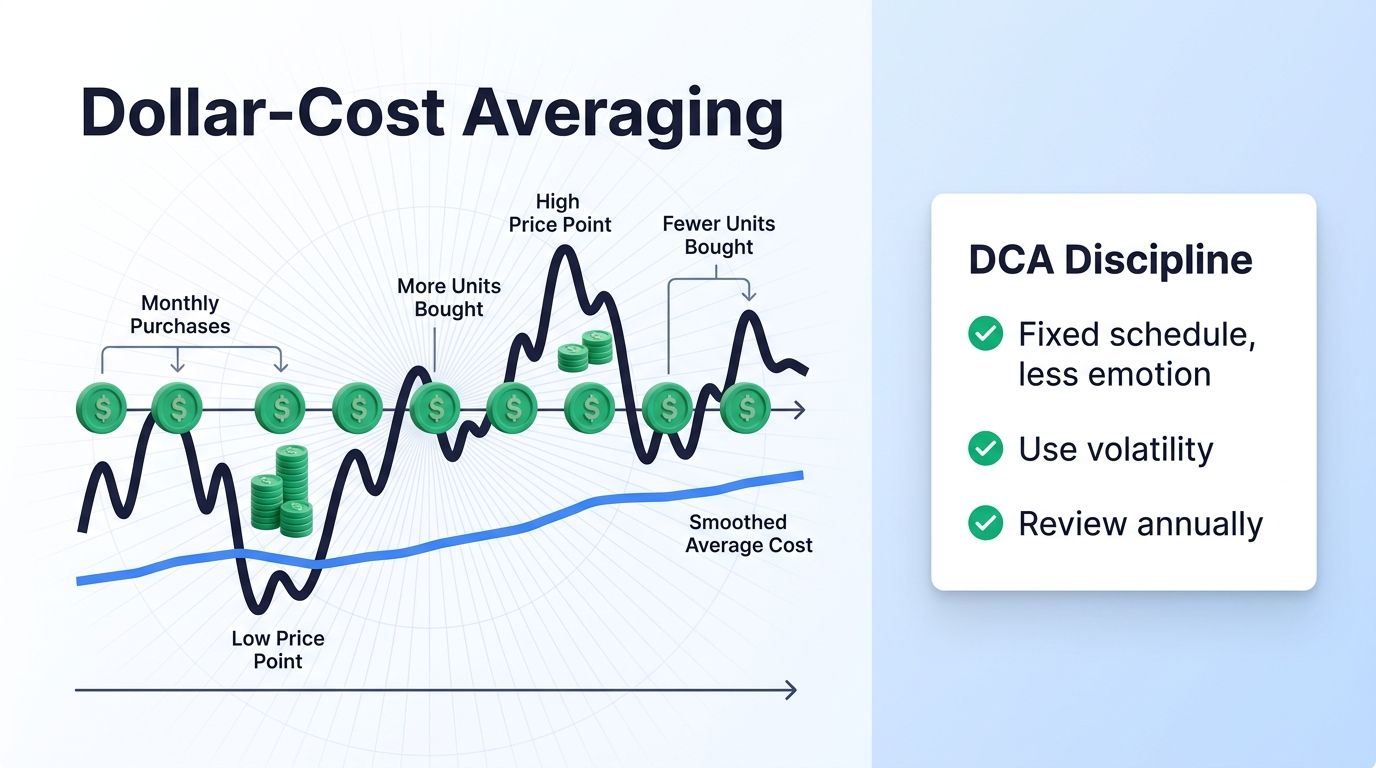
Dollar-cost averaging (DCA) is the most effective strategy for building long-term crypto positions. Instead of trying to time the market with a lump-sum purchase, DCA involves investing a fixed amount at regular intervals, weekly or monthly, regardless of price.
Historical data shows that DCA into Bitcoin over any rolling three-year period has been profitable, even if you started buying at cycle peaks. The strategy removes emotion from the equation and takes advantage of volatility by purchasing more units when prices are low and fewer when prices are high.
Set up automated purchases through your trading platform and resist the urge to deviate from the schedule during market panics or euphoria. Consistency is the single most important factor in successful long-term DCA.
Rebalancing Your Portfolio
As crypto prices move, your portfolio allocation naturally drifts from your target. A position that was 10% of your portfolio might grow to 30% after a strong rally, concentrating your risk in a single asset. Rebalancing involves periodically selling overweight positions and buying underweight ones to restore your target allocation.
Rebalancing may also involve reducing exposure to specific assets when they become too large within a portfolio. For investors who need to sell solana, using a reliable crypto off-ramp can be part of a practical portfolio management process.
Quarterly rebalancing works well for most long-term investors. More frequent rebalancing increases transaction costs and tax events without significantly improving returns. Some investors prefer threshold-based rebalancing, only adjusting when a position deviates more than 5% from its target weight.
Risks of Long-Term Crypto Investing
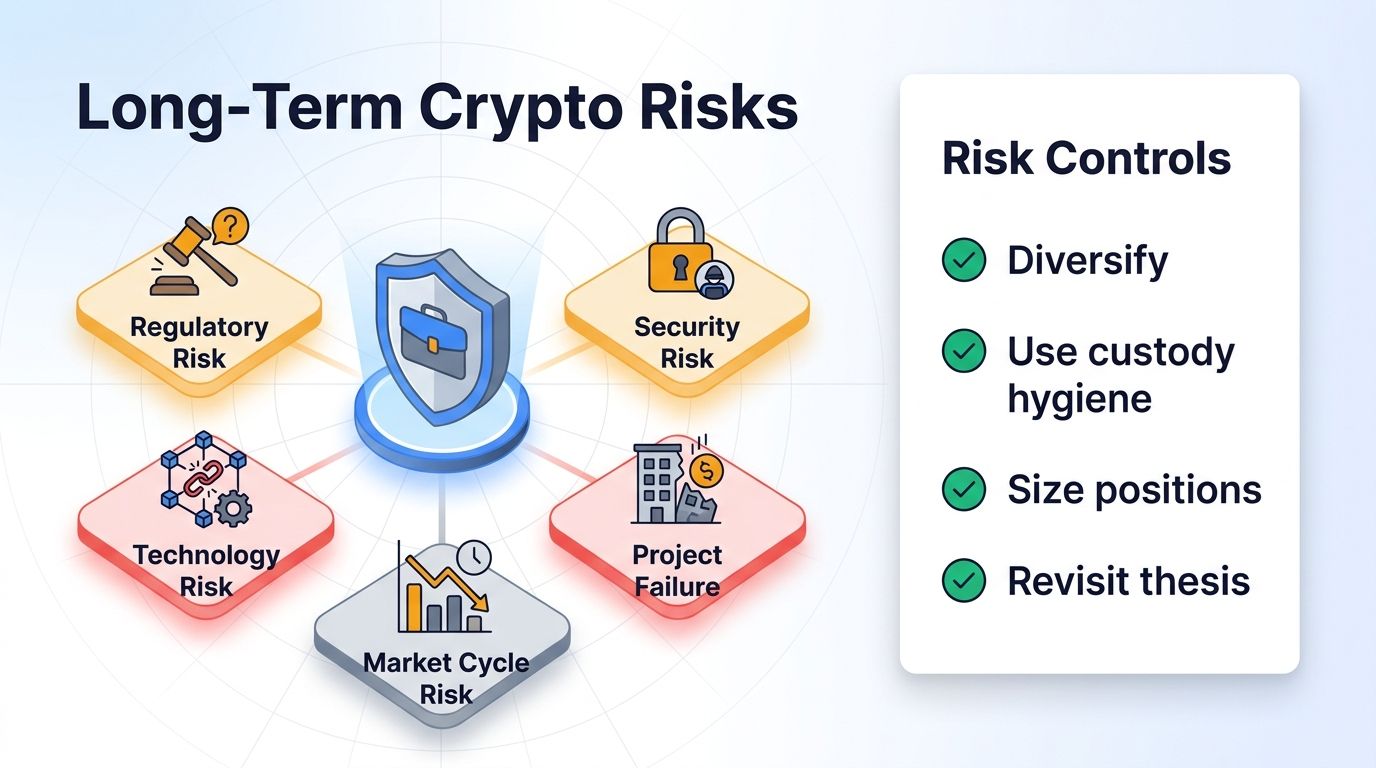 Key risk categories for long-term crypto investors
Long-term crypto investing offers significant potential returns but carries risks that differ from traditional investments. Understanding these risks helps you size positions appropriately and avoid catastrophic losses.
Regulatory Risk
Cryptocurrency regulation continues to evolve globally. Changes in tax treatment, trading restrictions, or outright bans in certain jurisdictions can impact token prices and your ability to access your holdings. Diversifying across regulatory jurisdictions and staying informed about regulatory developments in your country reduces this risk.
Technology Risk
Smart contract vulnerabilities, consensus mechanism failures, or successful attacks on a blockchain can result in permanent loss of value. Mitigate technology risk by concentrating long-term holdings in battle-tested protocols with extensive audit histories and large bug bounty programs. Newer protocols should represent smaller portfolio positions until they establish longer track records.
Market Cycle Risk
Crypto markets move in pronounced cycles, with drawdowns of 50% to 80% occurring regularly. A long-term investment thesis requires the conviction and financial stability to hold through these drawdowns without panic selling. Only invest capital you genuinely will not need for at least three to five years, and maintain adequate emergency savings outside of your crypto portfolio.
Project Failure Risk
Even projects with strong fundamentals can fail due to team departures, competitive pressure, or shifts in market demand. Diversification across multiple projects and sectors (Layer 1s, DeFi, infrastructure, AI) protects your portfolio from the failure of any single holding. Regularly review each project's development activity, community engagement, and competitive position to identify warning signs early.
Security Risk
Long-term holders face unique security challenges since assets must remain safe for years rather than days. Exchange hacks, lost private keys, and phishing attacks have cost investors billions of dollars. Use hardware wallets for any holdings you plan to keep long-term, store seed phrases in multiple secure physical locations, and never share private keys or seed phrases digitally. Consider using a multi-signature setup for large holdings, requiring multiple approvals before any funds can be moved. The effort invested in security today protects years of accumulated value.
Tools for Managing Long-Term Crypto Positions
Managing a diversified long-term crypto portfolio across multiple exchanges requires tools that provide clarity and automation. Without proper tracking, it is easy to lose sight of your overall allocation, miss rebalancing triggers, or fail to notice when a holding's fundamentals deteriorate.
Portfolio tracking dashboards that aggregate balances across all your exchange accounts give you a single view of your total holdings and their current allocation. Price alerts at key levels help you stay informed without constantly checking prices. Automated DCA features execute your accumulation plan on schedule, removing the emotional component that causes most investors to deviate from their strategy.
Break-even calculators show your average cost basis per asset, helping you make informed decisions about adding to positions or taking profits. Performance tracking over time reveals which holdings are contributing most to your portfolio returns and which are underperforming.
Whether you hold crypto across two exchanges or ten, having all your positions visible in one place is the foundation of disciplined long-term portfolio management. Start your free trial to see how consolidated portfolio tracking and automated trading tools can help you build and manage your long-term crypto investments more effectively.
Frequently Asked Questions
What is the best cryptocurrency to invest in for the long term?
Bitcoin and Ethereum are widely considered the safest long-term cryptocurrency investments due to their established networks, institutional adoption, and proven track records across multiple market cycles. Bitcoin serves as a digital store of value with a fixed supply cap, while Ethereum provides exposure to the entire smart contract ecosystem. Most financial advisors who recommend crypto allocations suggest starting with these two assets before diversifying into smaller projects.
How long should I hold crypto for long-term investment?
Most successful long-term crypto investors hold for a minimum of three to five years, allowing their positions to benefit from at least one full market cycle. Historically, holding Bitcoin for any four-year period (covering one halving cycle) has produced positive returns regardless of the entry point. The longer your time horizon, the less impact short-term volatility has on your overall returns.
How much should I invest in crypto for the long term?
Financial experts generally recommend allocating no more than 5% to 10% of your total investment portfolio to cryptocurrency. Within your crypto allocation, concentrate 50% to 60% in Bitcoin and Ethereum as core holdings, with the remainder spread across other established projects. Only invest money you can afford to hold for several years without needing to access, and maintain adequate emergency savings outside of crypto.
Is it too late to invest in Bitcoin for the long term?
Every market cycle produces claims that Bitcoin has peaked, yet it has consistently reached new all-time highs in subsequent cycles. Institutional adoption through ETFs, corporate treasury allocations, and growing recognition as a portfolio diversifier suggest that Bitcoin's addressable market continues to expand. Dollar-cost averaging reduces the impact of entry timing and has historically been profitable over any rolling three-year period regardless of when you started.
What are the biggest mistakes in long-term crypto investing?
The most common mistakes include panic selling during bear markets, over-concentrating in speculative altcoins, neglecting security (using hardware wallets and proper backup procedures), failing to rebalance portfolios, and investing money needed for short-term expenses. Successful long-term investors establish a clear strategy before buying, automate their accumulation through DCA, and resist the urge to make emotional decisions based on short-term price movements.