
In May 2026, IREN (formerly Iris Energy) completed a $3 billion convertible notes deal to fund its transition from pure bitcoin mining operations into AI infrastructure provider. The deal was upsized multiple times due to strong investor demand and represents one of the largest capital raises by a public bitcoin miner of all time.
IREN is not alone. Multiple major bitcoin miners are reallocating capacity from BTC mining to AI compute infrastructure. The trend reflects a structural shift in how mining infrastructure is valued: not just for hash rate, but for the underlying combination of cheap energy, data center facilities, and GPU compute capability.
This guide explains why bitcoin miners are pivoting to AI, the economic logic behind the shift, the major companies leading the transition, the implications for bitcoin network security, and what the pivot means for traders watching mining stocks and crypto markets.
What Drove the Pivot
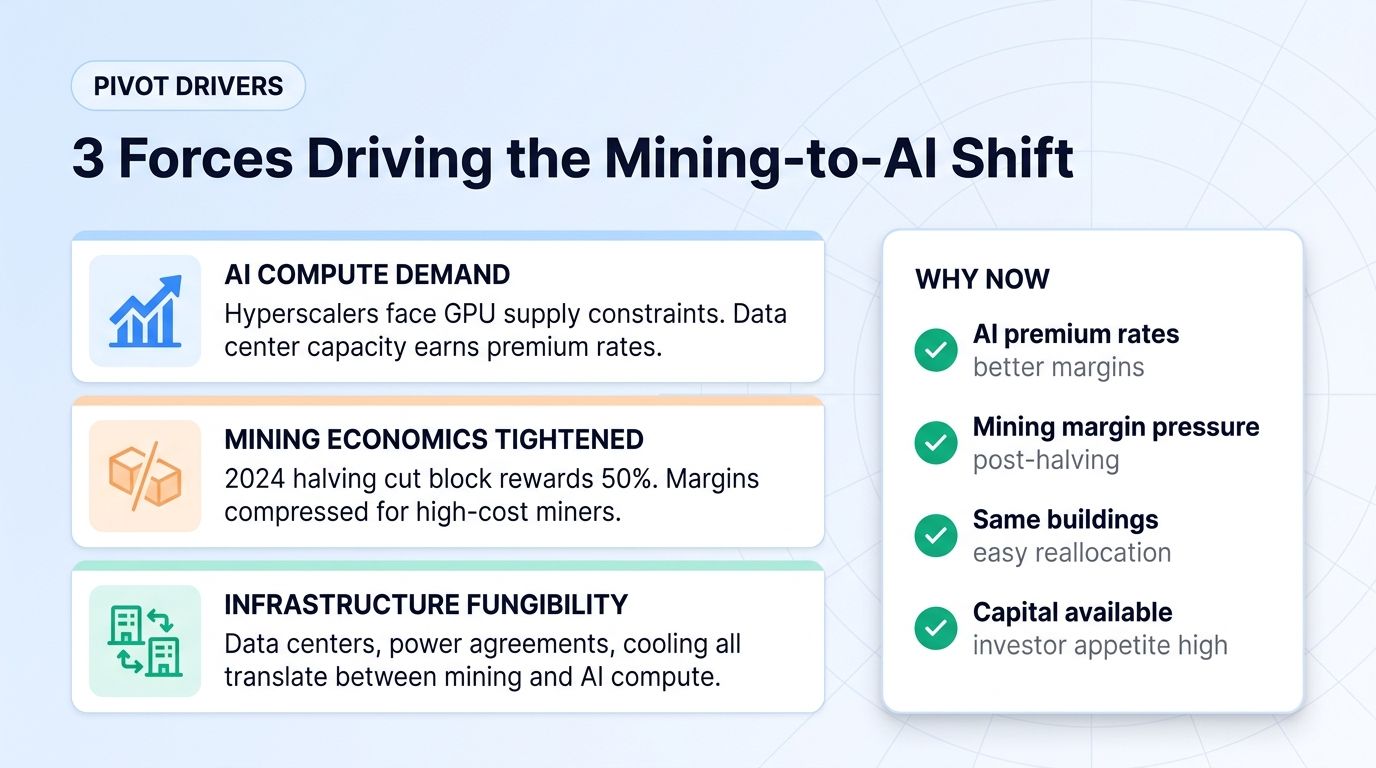
Three structural forces converged through 2024-2026.
First, AI compute demand exploded. Training and serving large AI models requires enormous GPU resources. Hyperscalers (Microsoft, Google, Amazon, Meta) face GPU supply constraints. Companies with existing data center infrastructure can charge premium rates for AI compute capacity.
Second, bitcoin mining economics tightened. The April 2024 halving cut block rewards in half. Bitcoin price appreciation partially offset the reward cut, but mining margins compressed for miners with higher cost structures. The economics of pure mining became more challenging.
Third, the underlying assets (data center facilities, power agreements, cooling infrastructure) translate naturally between mining and AI compute. ASIC mining hardware does not directly convert to AI workloads, but the buildings, electrical capacity, and operations skills do. Miners realized their facilities had option value beyond bitcoin.
For IREN specifically, the $3 billion convertible notes deal is structured to fund AI infrastructure buildout while retaining bitcoin mining operations. The company is not exiting mining; it is adding a second business line.
The IREN $3 Billion Deal Structure
The convertible notes deal has several features worth understanding.
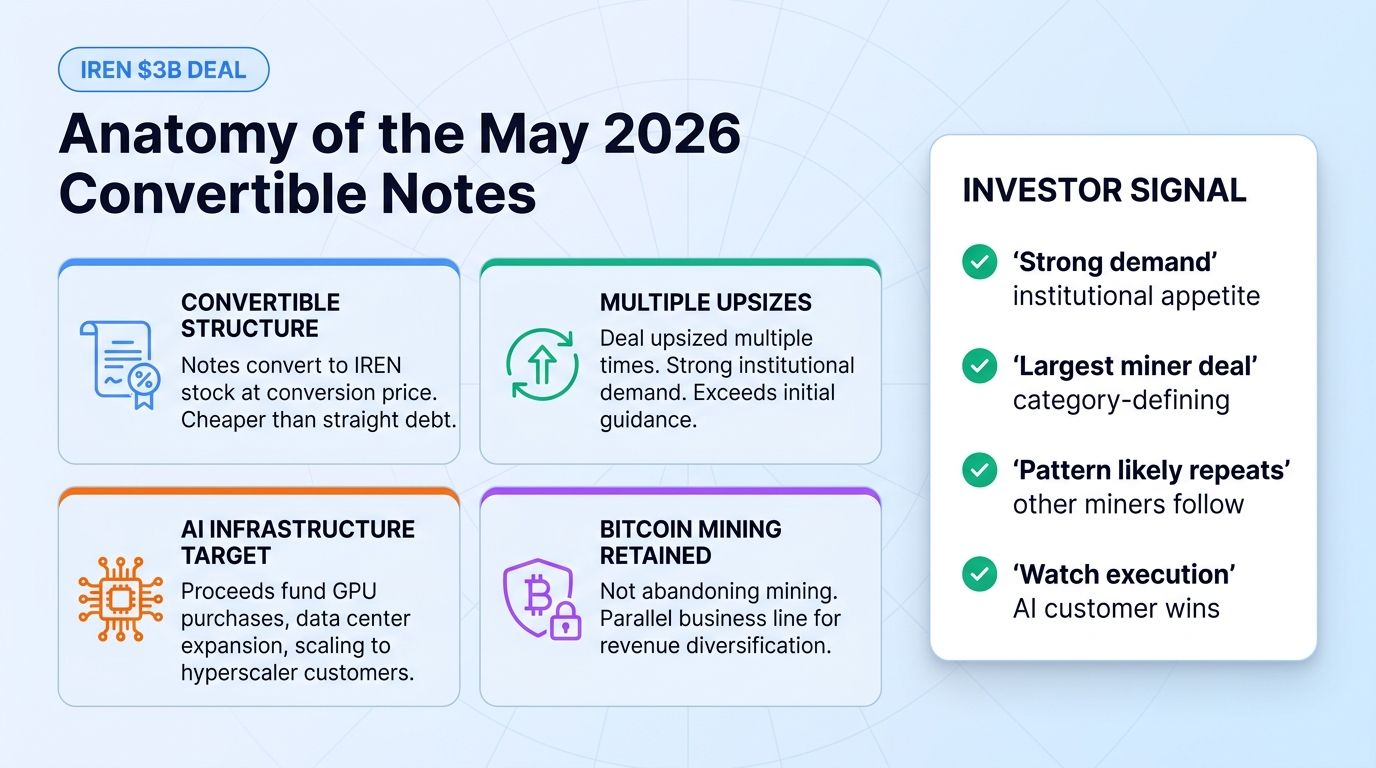
Convertible structure: The notes can be converted into IREN stock at a specified conversion price. This gives bondholders upside exposure to IREN equity if AI infrastructure thesis plays out, while providing IREN with cheaper financing than straight debt.
Multiple upsizes: The deal was upsized multiple times due to strong investor demand. The final $3 billion exceeds initial guidance, signaling strong institutional appetite for the AI infrastructure thesis.
Capital deployment: The proceeds fund GPU purchases, data center expansion, and operational scaling. IREN has signaled targeting hyperscaler customers (companies needing large-scale AI compute) rather than retail GPU rental markets.
Bitcoin mining retention: IREN is not abandoning bitcoin mining. The company retains its mining operations and continues to grow hash rate, while AI infrastructure becomes a parallel business.
The combination of factors made the deal one of the most-watched mining industry capital markets events of 2026.
Other Miners Pivoting to AI
IREN is the most visible case, but multiple major miners are following similar paths.
Core Scientific (CORZ)
Core Scientific has signed multiple long-term contracts with hyperscaler partners. The company's data center capacity is being converted to AI infrastructure under multi-year revenue agreements. Bitcoin mining remains a component but becomes a smaller fraction of total revenue.
Marathon Digital (MARA)
Marathon, the largest publicly traded bitcoin miner by hash rate, has been more cautious on AI pivot but has acquired AI-relevant facilities and announced exploratory partnerships. The strategic direction is evolving.
Riot Platforms (RIOT)
Riot has focused primarily on bitcoin mining expansion but has acknowledged AI infrastructure as a potential business line. Specific AI investments are smaller than IREN or Core Scientific to date.
CleanSpark (CLSK)
CleanSpark has emphasized continued bitcoin mining focus with some AI-adjacent infrastructure investments. The company's strategic direction has been more pure-mining than the AI pivot leaders.
Hut 8 Mining (HUT) / Bitfarms
Smaller but still meaningful miners. Hut 8 has explored high-performance compute (HPC) services including AI. Bitfarms has focused on mining expansion.
The pattern is clear: the largest miners are increasingly diversified, with bitcoin mining as one of multiple revenue lines. Pure-play mining is becoming less common at the top of the industry.
The Economics: Bitcoin Mining vs AI Infrastructure
The unit economics differ significantly.
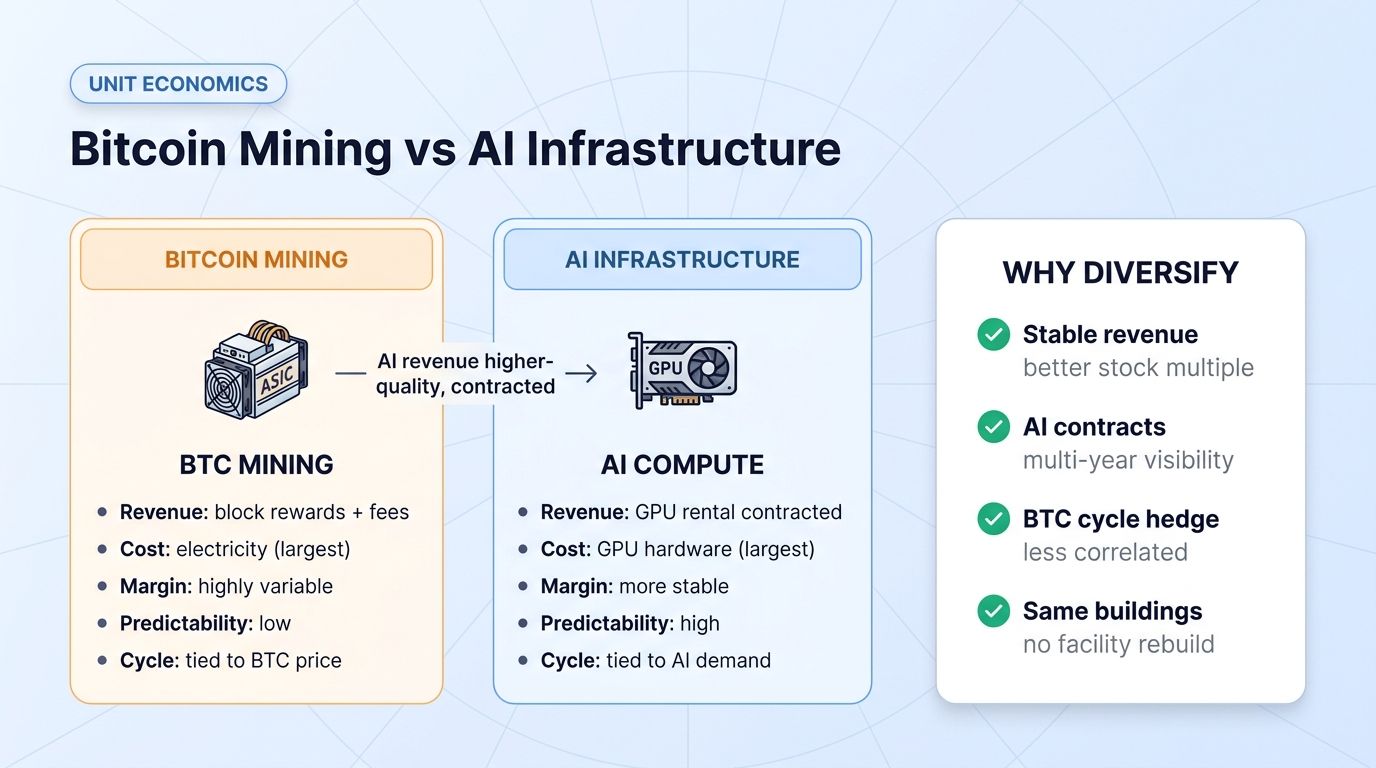
Bitcoin Mining
- Revenue: bitcoin block rewards + transaction fees
- Cost: electricity (largest), ASIC hardware depreciation, operations
- Margin: highly variable, depends on bitcoin price and difficulty
- Predictability: low (depends on bitcoin price)
- Cycle exposure: tied to bitcoin cycle
AI Infrastructure
- Revenue: GPU compute rental (per hour, per token, or subscription)
- Cost: GPU hardware depreciation (largest), electricity, operations
- Margin: more stable, contracted rates
- Predictability: high (long-term customer contracts)
- Cycle exposure: tied to AI demand cycle
For investors, the AI infrastructure revenue is generally higher quality (more predictable, contracted) than bitcoin mining revenue. The market values predictable cash flows at higher multiples. This creates incentive for miners to add AI infrastructure even if bitcoin mining remains profitable.
Implications for Bitcoin Network Security
Three observations.
Observation 1: Hash rate may not grow as fast. If major miners redirect capital from mining hardware to AI infrastructure, hash rate growth slows. This could affect bitcoin's difficulty adjustment dynamics.
Observation 2: Smaller miners gain relative share. As large miners diversify, smaller specialized miners with focused operations may gain market share. This is mildly positive for network decentralization.
Observation 3: Mining margins improve for those who stay. Less hash rate growth means slower difficulty increase, which means better unit economics for pure miners. This creates a sustainability floor for the remaining mining operations.
The net effect on bitcoin network security is probably neutral. The total compute remains substantial. The distribution may shift.
Implications for Investors
Three practical implications.
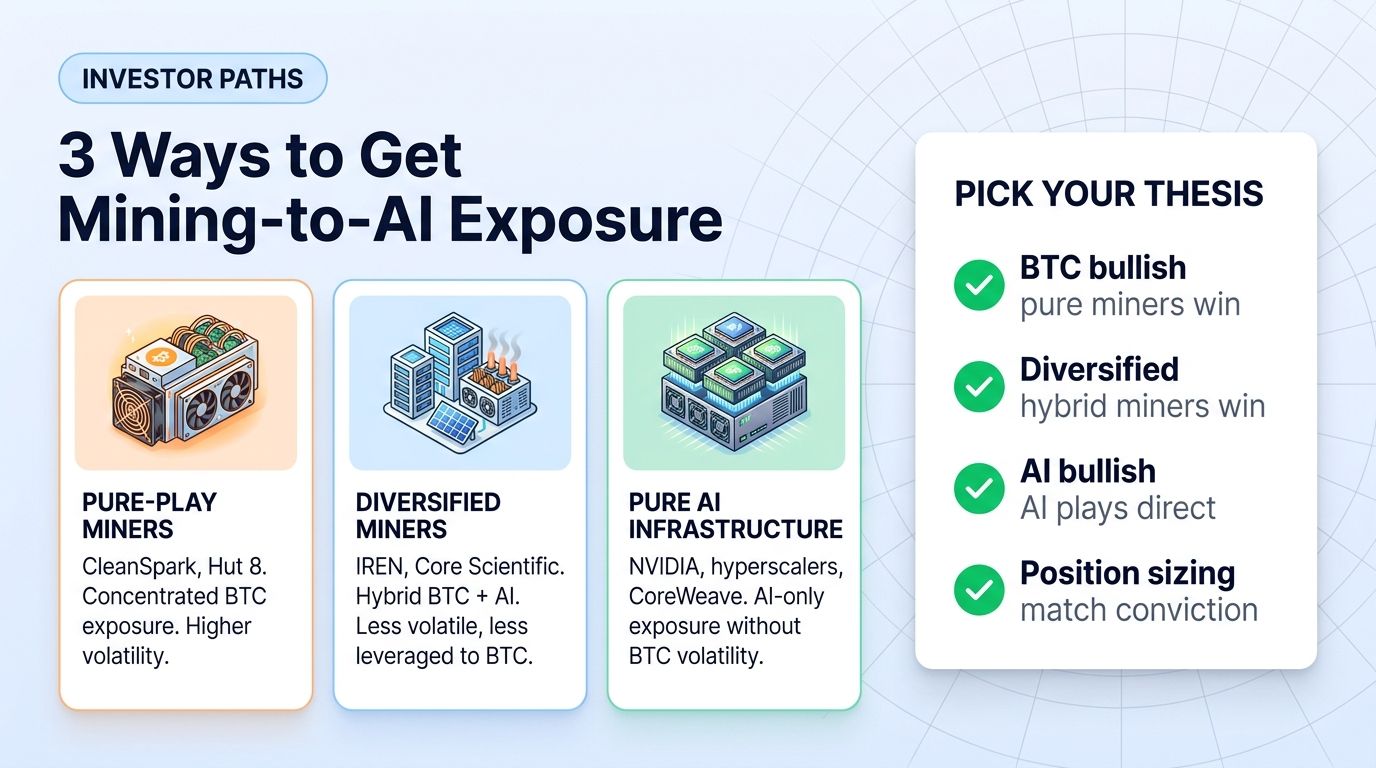
Investing in Pure-Play Miners
If you want bitcoin mining exposure, pure-play miners (those still focused primarily on mining without significant AI diversification) provide more direct exposure to bitcoin price action. CleanSpark and several smaller miners fit this profile.
The trade-off is volatility. Pure mining stocks are more volatile than diversified miners with AI revenue.
Investing in Diversified Miners
Diversified miners (IREN, Core Scientific) provide exposure to both bitcoin mining and AI infrastructure themes. The combined exposure is less volatile but also less leveraged to bitcoin specifically.
For investors who want both crypto and AI exposure in one position, diversified miners can be efficient.
Investing in AI Infrastructure Directly
If your thesis is primarily AI infrastructure rather than bitcoin mining, pure AI infrastructure plays (NVIDIA, hyperscalers, data center REITs) provide cleaner exposure without bitcoin volatility.
For active traders managing positions across exchanges and stocks, a platform like Altrady (connecting to 19+ crypto exchanges) handles the crypto portion. Mining stock exposure happens through traditional brokerages.
How the Pivot Affects Bitcoin Treasury Companies
The IREN pivot is distinct from the bitcoin treasury company narrative (covered in previous Altrady articles). Treasury companies (Strategy, Bitmine, Twenty One Capital) hold bitcoin on balance sheet as a reserve asset. They are not bitcoin miners; they are bitcoin holders.
Miners that pivot to AI may also hold bitcoin treasury reserves, creating a hybrid model. IREN has accumulated bitcoin while diversifying into AI. Marathon similarly holds significant bitcoin treasury.
For traders, the categories are converging. Pure-play bitcoin miners, treasury companies, AI infrastructure providers, and crypto operating companies all increasingly overlap. The cleanest categorization is by primary revenue source.
The Risks of Mining-to-AI Pivot
Execution risk. Converting mining infrastructure to AI infrastructure requires different operational capabilities. Mining operations focus on uptime and electricity efficiency. AI infrastructure requires GPU expertise, customer management, and SLA discipline.
Capital intensity. AI infrastructure requires expensive GPU hardware (NVIDIA H100 / H200 / Blackwell). The capital expenditure may outpace cash flow generation for several years.
Competition. Hyperscalers (Microsoft, Google, Amazon) and pure AI infrastructure plays (CoreWeave, Lambda) have significant operational advantages over pivoted miners.
Bitcoin price exposure dilution. Investors who held mining stocks for bitcoin exposure see that exposure diluted as AI revenue grows. The thesis becomes more about AI than bitcoin.
AI demand cycle risk. If AI compute demand cools (training efficiency improvements, model size plateau), AI infrastructure margins compress. Miners who pivoted heavily may face revenue pressure.
Bitcoin difficulty adjustment. If many miners pivot, hash rate growth slows, difficulty adjusts down, mining margins improve, more miners stay. The system reaches new equilibrium but transition can be choppy.
How the Mining Industry Fits Into a Crypto Portfolio
A practical framework:
- Direct bitcoin exposure (BTC spot): 30-50% of crypto allocation. Foundational.
- Bitcoin treasury company stocks (Strategy, Bitmine): 5-15%. Leveraged BTC exposure.
- Diversified miner stocks (IREN, Core Scientific): 0-5%. Hybrid BTC + AI exposure.
- Pure-play mining stocks (CleanSpark, others): 0-5%. Concentrated BTC exposure.
- AI infrastructure (NVIDIA, hyperscalers, CoreWeave): 0-15%. AI-only exposure.
Most investors should not concentrate in mining stocks given the multiple revenue streams now in play. Diversified positioning across the underlying themes (BTC, AI infrastructure, treasury accumulation) provides better risk-adjusted returns.
What to Watch in the Next 12 Months
Three indicators.
Indicator 1: IREN execution. Does IREN actually deploy the $3 billion effectively? Do AI customer contracts materialize at expected rates? How does the dual-business operation perform?
Indicator 2: Other miner announcements. Which miners announce AI pivots in the next 6 months? At what scale? How does the market react?
Indicator 3: Bitcoin hash rate trajectory. Does hash rate growth slow as miners redirect capital? Does difficulty adjustment behavior change?
If all three trend in line with the AI pivot thesis, the mining industry is structurally changing. If they trend back toward pure mining focus, the IREN pivot may be more idiosyncratic.
2026 Update: What to Check Before You Act
The miner-to-AI-infrastructure pivot should be evaluated as a business-model shift, not just a bullish headline. Power access, capex, customer contracts, and revenue mix matter more than the label.
| Check | What to review | Why it matters |
|---|---|---|
| Power advantage | Assess whether the miner has low-cost, scalable, reliable power and data-center-ready sites. | AI infrastructure is power-constrained, but power alone is not enough. |
| Capex and financing | Track GPU/data-center investment, debt, dilution, and payback assumptions. | A pivot can improve revenue quality or strain the balance sheet. |
| Revenue mix | Separate Bitcoin mining revenue from hosting, cloud, HPC, or AI infrastructure contracts. | Investors need to know whether the company is actually diversifying. |
Quick trader checklist
- Compare announced AI deals with delivered revenue.
- Watch energy contracts, site expansion timelines, and customer concentration.
- Do not assume every miner can become a competitive AI infrastructure company.
FAQ
Is bitcoin mining dying?
No. The industry is restructuring. Some miners are reallocating capital to AI infrastructure, but bitcoin mining itself continues with significant hash rate. The remaining miners may be more profitable per unit of hash rate as competition softens.
Should I sell my bitcoin mining stocks?
This depends on which miners you hold and your thesis. Pure-play miners may face margin pressure if bitcoin price stagnates. Diversified miners (IREN, Core Scientific) may benefit from AI revenue growth. The portfolio decision depends on your specific holdings and conviction.
Will the pivot affect bitcoin price?
Marginally. Less hash rate growth from miners pivoting away affects difficulty but not directly price. The treasury accumulation by some miners (and by treasury companies) is a more direct price impact than mining capacity changes.
What about smaller miners?
Smaller miners may benefit relatively. Less hash rate growth from large miners means relatively higher market share for those who continue pure mining. Smaller miners with cheap energy contracts can be highly profitable in this environment.
Can I trade bitcoin mining stocks on Altrady?
Bitcoin mining stocks (IREN, MARA, RIOT, CLSK, CORZ, HUT) trade on traditional equity exchanges (NASDAQ, NYSE), not on crypto exchanges. Altrady focuses on crypto trading across 19+ crypto exchanges. For mining stock exposure, you would use a traditional brokerage. Altrady provides the unified view for your crypto positions and automated strategies.
Why are Bitcoin miners moving into AI infrastructure?
Some miners have access to power, sites, and operational infrastructure that can be useful for high-performance computing. The opportunity depends on capex, customer contracts, and execution.
Conclusion
The IREN $3 billion convertible notes deal marks one of the clearest moments yet in the bitcoin mining industry's pivot to AI infrastructure. For an industry that has historically been defined by hash rate growth and pure bitcoin exposure, the shift represents a structural change in how mining infrastructure is valued.
For investors, the practical takeaway is this: the bitcoin mining industry is bifurcating. Pure-play miners continue with concentrated bitcoin exposure. Diversified miners add AI revenue streams that improve margin predictability but dilute bitcoin exposure. Both models can be profitable; they serve different investor preferences.
The longer-term trajectory looks toward more diversification. AI compute demand is structural rather than cyclical (at least in the medium term). Bitcoin mining margins remain volatile. The combination favors diversified business models for the largest players.
The next 12 to 24 months will produce decisive data. IREN's execution, additional miner announcements, and bitcoin hash rate trajectory will all clarify whether the pivot represents a permanent industry shift or a temporary diversification phase. Either way, the mining industry of 2026 is meaningfully different from the mining industry of 2024.