
What Is DeFi Trading?
DeFi trading refers to buying, selling, and exchanging cryptocurrency assets through decentralized protocols rather than traditional centralized exchanges. Instead of relying on an intermediary to hold your funds and match your orders, DeFi trading uses smart contracts on blockchains like Ethereum, Solana, and Arbitrum to execute trades directly from your wallet.
The core difference is custody. When you trade on a centralized exchange, the exchange holds your assets. When you trade through DeFi protocols, your tokens remain in your wallet until the moment the smart contract executes the swap. This eliminates counterparty risk but introduces smart contract risk, which is a fundamental tradeoff every DeFi trader must understand.
DeFi trading has grown dramatically since 2020, with decentralized exchanges now handling billions of dollars in daily volume. Protocols like Uniswap, Curve, and dYdX have matured into robust platforms that offer features previously exclusive to centralized exchanges, including limit orders, leverage, and advanced charting. For traders willing to learn the mechanics, DeFi opens up strategies that simply do not exist in traditional finance or even centralized crypto trading.
Understanding DeFi is no longer optional for serious crypto traders. Whether you actively trade on decentralized exchanges or simply want to understand how liquidity flows through the market, DeFi literacy gives you a competitive edge in an increasingly on-chain world.
Why DeFi Trading Differs from Centralized Exchange Trading
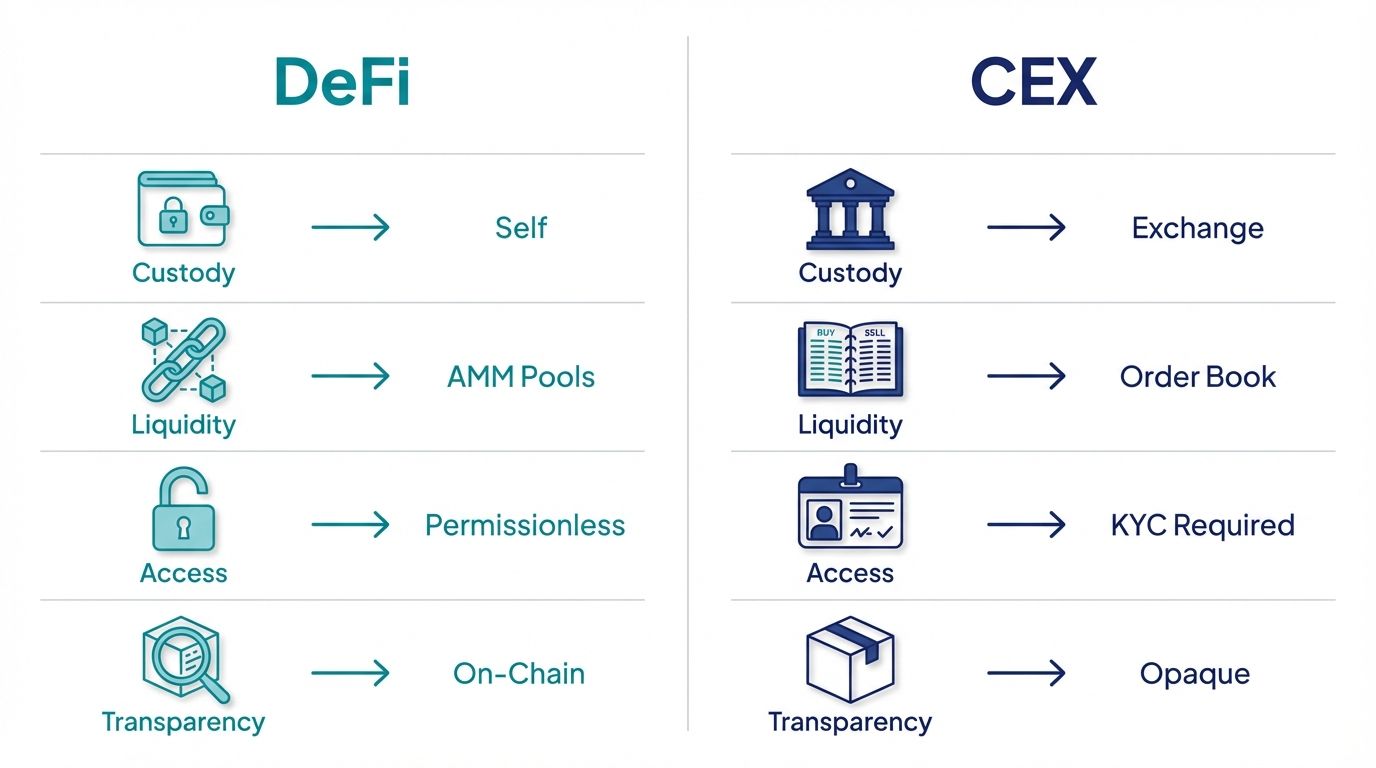
Before diving into specific strategies, understanding the key differences between DeFi and centralized exchange (CEX) trading helps set proper expectations.
Execution and Settlement
On a centralized exchange, trades execute instantly against an order book maintained by the exchange. In DeFi, trades settle on-chain, meaning they are subject to block confirmation times and gas fees. Ethereum transactions may take 12 to 15 seconds and cost anywhere from $0.50 to $50 depending on network congestion. Layer 2 networks like Arbitrum and Base reduce this to under a second with fees below $0.10, making them the preferred choice for active DeFi traders in 2026.
Liquidity Mechanisms
Most centralized exchanges use traditional order books where buyers and sellers place limit orders. DeFi protocols primarily use Automated Market Makers (AMMs) that rely on liquidity pools instead of order books. When you swap tokens on Uniswap, you trade against a pool of tokens deposited by liquidity providers rather than against another trader's order. This creates different price dynamics, including slippage on larger orders and the concept of impermanent loss for liquidity providers.
Access and Permissionlessness
Anyone with a crypto wallet can access DeFi protocols without KYC verification or account approval. New tokens become tradeable on decentralized exchanges within minutes of launch, long before they are listed on centralized exchanges. This creates opportunities for early access but also increases exposure to scam tokens and rug pulls. Verifying smart contract addresses and auditing token contracts before trading is essential.
Transparency
Every DeFi transaction is recorded on a public blockchain. You can verify the exact state of any liquidity pool, see the transaction history of any wallet, and audit the smart contract code powering any protocol. This transparency enables data-driven strategies like whale tracking and liquidity analysis that are impossible on opaque centralized exchanges.
7 Best DeFi Trading Strategies in 2026
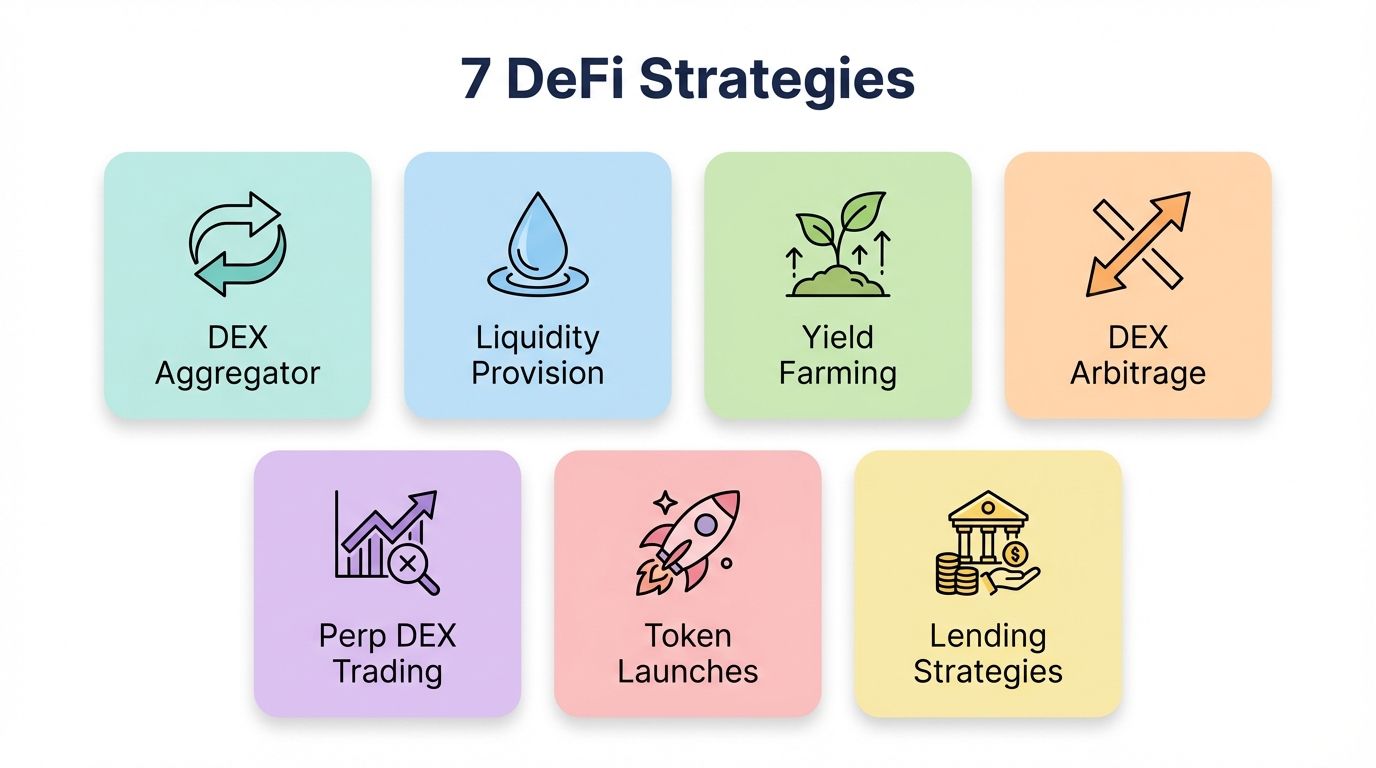
The following strategies range from beginner-friendly approaches to advanced techniques used by professional DeFi traders. Each strategy includes practical implementation steps and risk considerations to help you determine which approaches fit your skill level and risk tolerance.
Strategy 1: DEX Aggregator Optimization
DEX aggregators like 1inch, Jupiter, and Paraswap split your trade across multiple decentralized exchanges to find the best price with the lowest slippage. Using an aggregator instead of trading directly on a single DEX can save 0.5% to 3% per trade, which compounds significantly for active traders.
The strategy goes beyond simply using an aggregator. Experienced traders compare aggregator outputs across multiple platforms before executing, because different aggregators have access to different liquidity sources. A trade that routes through Uniswap V3 and Curve on 1inch might find a better path through Balancer and SushiSwap on Paraswap.
Timing also matters. Gas fees fluctuate throughout the day, with the lowest fees typically occurring during off-peak hours for your target blockchain's primary user base. For Ethereum, this means late evening to early morning UTC. For Solana-based DEXs, gas is negligible, but network congestion during high-volume periods can cause failed transactions. Setting up price alerts to notify you when favorable conditions align with low gas fees maximizes the efficiency of this strategy.
For larger trades exceeding $10,000, consider using aggregators that offer MEV protection, such as CoW Swap or MEV Blocker-integrated routers. Miner Extractable Value (MEV) bots can front-run your transaction, buying tokens before you and selling them to you at a higher price. MEV-protected aggregators route your transaction through private mempools to prevent this extraction.
Strategy 2: Liquidity Provision on Concentrated AMMs
Providing liquidity on concentrated liquidity AMMs like Uniswap V3 and V4 allows you to earn trading fees by depositing token pairs into specific price ranges. Unlike traditional AMMs where your liquidity is spread across all prices from zero to infinity, concentrated liquidity lets you focus your capital within a narrow range where most trading activity occurs.
A well-managed concentrated liquidity position on a high-volume pair like ETH/USDC can generate annualized returns of 20% to 100% from trading fees alone. The key is selecting the right price range. Too narrow and your position goes out of range quickly, stopping your fee earnings. Too wide and your capital efficiency approaches that of a traditional AMM with lower returns.
Start with stable pairs like USDC/USDT where the price stays within a tight range, offering consistent fee income with minimal impermanent loss risk. As you gain experience, move to volatile pairs like ETH/USDC with wider ranges that require active management. Tools like Revert Finance and DeFi Llama help you analyze historical fee data and optimal range settings before committing capital.
Active management is critical. Set alerts for when price approaches the edge of your range and be prepared to reposition. Some traders automate this using vault protocols like Arrakis or Gamma Strategies, which automatically adjust your position as the price moves. These vaults charge a management fee but remove the need for constant monitoring.
Strategy 3: Yield Farming with Smart Rotation
Yield farming involves depositing tokens into DeFi protocols that reward depositors with additional tokens, typically the protocol's governance token. While the astronomical yields of early DeFi (1,000%+ APY) are largely gone, disciplined yield farming still generates meaningful returns in 2026.
The smart rotation approach involves monitoring yield opportunities across protocols and chains, then rotating capital to wherever risk-adjusted returns are highest. Use yield aggregator dashboards like DefiLlama, Zapper, or Beefy Finance to compare APYs across hundreds of farms. Focus on protocols with proven track records, audited smart contracts, and sustainable yield sources (real trading fees rather than purely inflationary token emissions).
Risk assessment is paramount. Higher yields almost always mean higher risk. Evaluate each farming opportunity against these criteria: Is the protocol audited by reputable firms? How long has it been live without an exploit? What is the source of yield (trading fees, lending interest, or token emissions)? What is the TVL trend (growing or declining)? Protocols with declining TVL and increasing yields are red flags since the yield is rising because liquidity is leaving, often because informed participants have identified a risk.
Gas costs on Ethereum can eat into farming profits quickly, especially for smaller positions. For capital under $10,000, focus on Layer 2 chains like Arbitrum, Optimism, or Base where gas costs are negligible. Only use Ethereum mainnet for farming with larger positions where the higher yields justify the transaction costs.
Strategy 4: DEX Arbitrage
Arbitrage involves buying a token on one exchange where it is cheaper and selling it on another where it is more expensive, capturing the price difference as profit. In DeFi, arbitrage opportunities exist between different DEXs on the same chain, between the same DEX on different chains, and between DEXs and centralized exchanges.
Manual arbitrage on popular pairs is nearly impossible in 2026 because automated bots execute these trades within milliseconds. However, opportunities still exist in less-efficient markets: new token listings, cross-chain price discrepancies, and smaller DEXs with lower liquidity where price deviations persist longer.
Cross-chain arbitrage is the most accessible form for individual traders. When a token trades at $1.00 on Ethereum but $0.97 on Arbitrum, bridging and selling can capture the spread. The catch is that bridge times and fees must be factored in. A 3% spread means nothing if bridging costs 2% and takes 15 minutes during which the price could equalize.
For traders with development skills, building simple arbitrage bots using tools like Flashbots, Jito (on Solana), or custom scripts monitoring DEX prices via public APIs can capture opportunities that manual traders miss. Start with paper trading your bot logic before committing real capital to identify edge cases and failure modes.
Strategy 5: Perpetual DEX Trading
Decentralized perpetual exchanges like dYdX, GMX, Hyperliquid, and Jupiter Perps now offer trading experiences comparable to centralized futures platforms. These protocols let you trade with leverage (up to 50x on some platforms) without surrendering custody of your funds.
The primary advantage of perpetual DEX trading is transparency. You can see the exact funding rates, open interest, and liquidation levels on-chain, giving you data that centralized exchanges may not share. Funding rate arbitrage, where you go long on a platform with negative funding (getting paid to hold) and short on another with positive funding, is a popular market-neutral strategy.
Position management requires extra attention on perpetual DEXs because liquidation mechanisms differ from centralized exchanges. Some protocols use pool-based systems where your profit comes from the losses of other traders, while others use oracle-based pricing that can differ from spot prices. Understanding the specific mechanism of your chosen platform prevents unexpected liquidations.
Start with lower leverage (2x to 5x) and smaller position sizes until you are comfortable with the platform's interface and execution speed. Monitor gas fees on the underlying blockchain since closing a position during a network congestion spike can delay your exit and increase slippage. Layer 2 perpetual DEXs like those on Arbitrum or purpose-built chains like Hyperliquid minimize this risk.
Strategy 6: Token Launch and Early Access Trading
New tokens typically launch on decentralized exchanges before listing on centralized platforms. Early buyers can capture significant gains if the project gains traction, but this strategy carries the highest risk of any approach on this list.
Due diligence separates successful early access traders from scam victims. Before buying any newly launched token, verify the smart contract on a block explorer, check if the contract is verified and readable, look for red flags like mint functions that allow unlimited token creation, hidden transfer fees, or honeypot mechanisms that prevent selling. Tools like Token Sniffer, GoPlus, and DEXTools provide automated contract analysis.
Launchpads and Initial DEX Offerings (IDOs) provide a more structured approach to early access trading. Platforms like Camelot on Arbitrum, Raydium on Solana, and established launchpads vet projects before listing, reducing (but not eliminating) scam risk. Allocations are typically limited, so returns on capital deployed can be significant when a project succeeds.
Position sizing is critical. Never allocate more than 1% to 2% of your portfolio to any single token launch. The asymmetric payoff (potential 10x to 100x gain versus potential 100% loss) means you need many small positions rather than a few large ones. Track your hit rate and average return across launches to determine if this strategy is profitable for you over time.
Strategy 7: Lending and Borrowing Strategies
Note: Beyond these strategies, the yield tokenization category has emerged as a distinct DeFi sub-sector. Pendle Finance dominates with $5B TVL and 50-60% market share of DeFi yield trading.
DeFi lending protocols like Aave, Compound, and Morpho allow you to lend assets for interest or borrow against your holdings without selling them. Strategic use of lending and borrowing creates trading opportunities that do not exist in traditional finance.
The looping strategy is popular among yield seekers. Deposit ETH as collateral, borrow a stablecoin at a lower interest rate, swap the stablecoin for more ETH, deposit the additional ETH as collateral, and repeat. This amplifies your yield on the deposited ETH but also amplifies your exposure. If ETH drops significantly, cascading liquidations can wipe out the entire position. Only loop with a conservative loan-to-value ratio (below 60%) and assets you are willing to hold through volatility.
Rate arbitrage between lending protocols is a lower-risk approach. When Aave offers 3% on USDC deposits while Compound charges 2% for USDC borrowing, you can deposit on Aave and borrow on Compound, capturing the 1% spread. Monitor rate changes closely because DeFi lending rates are variable and can shift rapidly as utilization changes.
Flash loans, uncollateralized loans that must be repaid within a single transaction, enable advanced arbitrage strategies with zero upfront capital. While implementing flash loans requires Solidity programming knowledge, understanding how they work helps you recognize market dynamics driven by flash loan activity.
Essential Risk Management for DeFi Trading
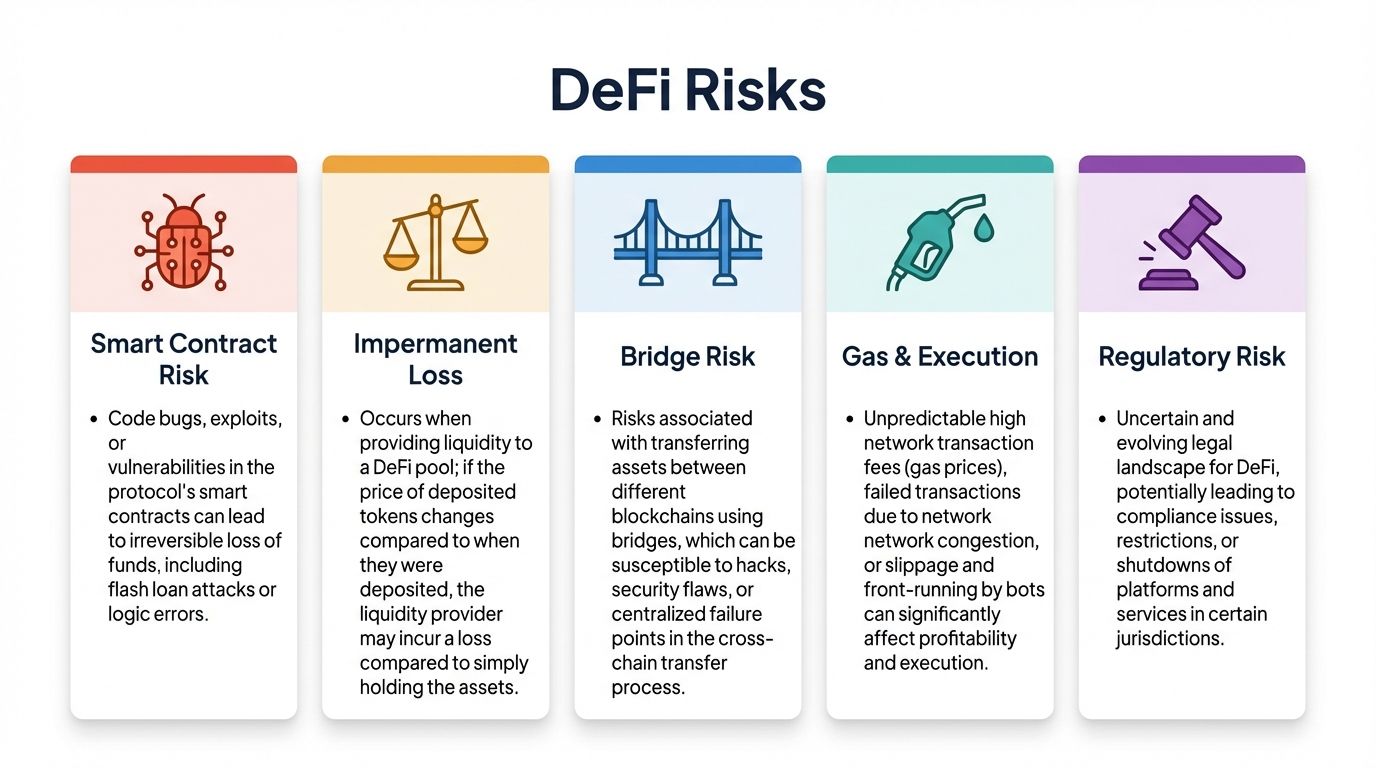
DeFi trading introduces risk categories that do not exist in centralized exchange trading. Managing these risks is not optional; it is the foundation of long-term profitability.
Smart Contract Risk
Every DeFi interaction involves trusting a smart contract to execute as intended. Even audited contracts can contain vulnerabilities. Mitigate this risk by diversifying across multiple protocols, using only battle-tested contracts with years of track record, and limiting the amount of capital deployed in any single protocol. A general rule is never to place more than 20% of your DeFi portfolio in a single protocol.
Impermanent Loss
Liquidity providers face impermanent loss when the relative price of their deposited token pair changes. If you deposit equal values of ETH and USDC and ETH doubles in price, your position would have been worth more if you had simply held both tokens separately. Calculate potential impermanent loss before entering any liquidity position and ensure that trading fee income exceeds the expected loss based on your price movement assumptions.
Bridge and Cross-Chain Risk
Moving assets between blockchains through bridges introduces additional risk. Bridge exploits have resulted in billions of dollars in losses since 2021. Use only established bridges with strong security track records. When possible, use native bridges operated by the Layer 2 networks themselves (like Arbitrum's native bridge) rather than third-party bridges. Accept longer withdrawal times in exchange for higher security.
Gas and Execution Risk
High gas fees during network congestion can turn a profitable trade into a loss. Always check current gas prices before submitting a transaction and use gas limit settings that account for potential spikes. On Ethereum mainnet, consider using Flashbots Protect to submit transactions through a private mempool, avoiding both failed transactions and MEV extraction.
Regulatory Risk
The regulatory landscape for DeFi continues to evolve. Some jurisdictions have implemented or proposed regulations that could affect access to certain protocols. Stay informed about regulatory developments in your jurisdiction and maintain records of all DeFi transactions for tax reporting purposes. Many DeFi aggregators now integrate with portfolio tracking tools that automatically generate transaction histories for tax reporting.
Tools You Need for Successful DeFi Trading
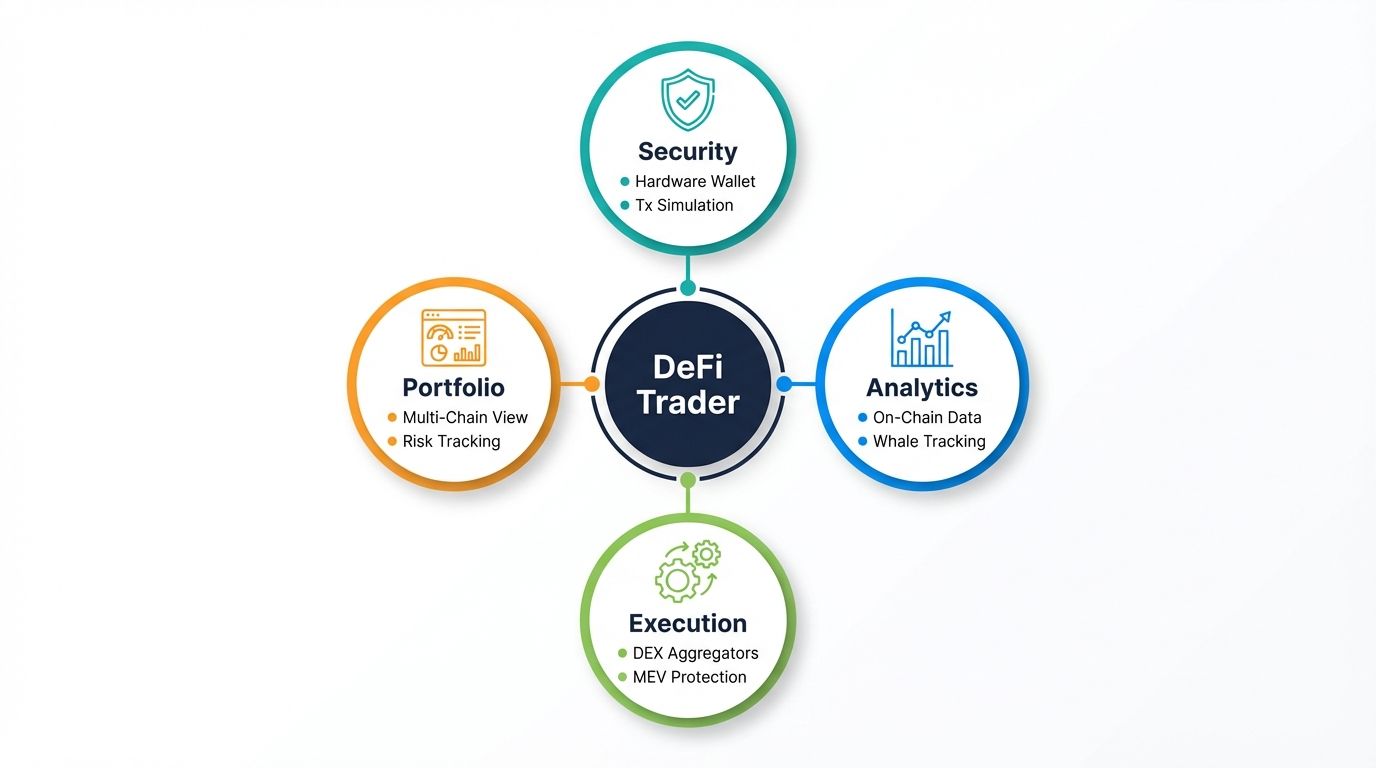
Successful DeFi trading requires a toolkit that spans wallets, analytics, and execution platforms.
A hardware wallet (Ledger or Trezor) connected to a browser extension like MetaMask or Rabby provides the best balance of security and convenience. Never store significant amounts in a hot wallet without hardware wallet protection. Use separate wallets for different purposes: one for trading, one for yield farming, and one for long-term holdings.
On-chain analytics tools give you an edge that most traders overlook. DeBank shows portfolio tracking across chains. Nansen and Arkham Intelligence provide whale tracking and smart money alerts. DeFi Llama aggregates TVL, yield data, and protocol metrics across the entire DeFi ecosystem. Dune Analytics lets you query blockchain data directly to build custom dashboards.
Transaction simulation tools like Tenderly and Fire allow you to preview the outcome of a transaction before submitting it. This prevents costly mistakes like accidentally approving unlimited token spending or interacting with a malicious contract. Make transaction simulation a mandatory step before any interaction with a new protocol.
For portfolio management across both DeFi and centralized exchanges, having all positions visible in a single interface is essential. When you split capital between on-chain strategies and CEX trading, losing track of your total exposure and risk is easy. A consolidated dashboard that tracks positions across multiple exchanges and chains prevents the fragmentation that leads to poor risk management.
Trade Smarter Across DeFi and CeFi with Altrady
Managing a trading portfolio that spans multiple centralized exchanges alongside DeFi positions requires powerful tools that bring everything together. Altrady connects to all major exchanges through a single interface, giving you unified portfolio tracking, automated trading features, and real-time alerts across every exchange you use.
Smart trading features like automated stop-losses, take-profit orders, and trailing stops protect your positions around the clock. Price alerts across multiple exchanges notify you when arbitrage opportunities emerge between platforms. Break-even calculators show your exact position cost basis so you can make informed decisions about entries and exits.
For traders who combine DeFi strategies with centralized exchange trading, having a clear view of your entire portfolio is the difference between coordinated strategy execution and fragmented guesswork. Start your free trial to see how Altrady can streamline your multi-exchange trading workflow and help you execute DeFi and CeFi strategies more effectively.
Frequently Asked Questions
Is DeFi trading profitable in 2026?
Yes, DeFi trading remains profitable in 2026 for traders who understand the mechanics and manage risk properly. Strategies like concentrated liquidity provision, DEX aggregator optimization, and cross-chain arbitrage generate consistent returns for skilled practitioners. However, the easy yields of early DeFi are gone, and profitability now requires deeper knowledge, better tools, and more disciplined risk management than in previous years.
How much capital do I need to start DeFi trading?
You can start DeFi trading with as little as $100 on Layer 2 networks like Arbitrum, Base, or Solana where gas fees are minimal. On Ethereum mainnet, you typically need at least $5,000 to $10,000 to ensure that gas costs do not erode your profits. Start small, learn the mechanics of wallet interactions, token approvals, and DEX swaps, then scale up as you gain confidence and develop profitable strategies.
What are the biggest risks in DeFi trading?
The biggest risks include smart contract exploits (bugs or vulnerabilities in protocol code), rug pulls (malicious projects that steal deposited funds), impermanent loss (for liquidity providers), and bridge hacks (when moving assets between chains). Additionally, user error such as sending tokens to wrong addresses, approving malicious contracts, or falling for phishing attacks accounts for a significant portion of DeFi losses. Using hardware wallets, verifying contracts, and simulating transactions before execution mitigates these risks substantially.
Can I combine DeFi and centralized exchange trading?
Absolutely. Many professional traders use DeFi for specific strategies like yield farming, early token access, and on-chain arbitrage while using centralized exchanges for high-frequency trading, deep liquidity execution, and perpetual futures. The key is maintaining a clear view of your total portfolio across both DeFi and CeFi platforms to manage overall risk exposure. Portfolio tracking tools that aggregate positions across exchanges and chains are essential for this hybrid approach.
Do I need programming skills for DeFi trading?
Basic DeFi trading does not require programming skills. Most protocols have user-friendly interfaces for swapping tokens, providing liquidity, and lending assets. However, advanced strategies like building arbitrage bots, executing flash loans, or automating yield farming rotations do require knowledge of Solidity, Python, or JavaScript. Even without coding skills, understanding how smart contracts work and being able to read basic contract functions on block explorers significantly improves your ability to evaluate risks and opportunities.