
Wall Street crypto services became a fresh topic because the story has changed. The old version was about whether traditional finance would accept crypto at all. The 2026 version is about which banks, brokers, exchanges, and market infrastructure firms can offer digital assets safely enough for mainstream clients.
Axios reported on June 9, 2026 that traditional financial firms are moving toward crypto services as demand from retail investors, institutions, and wealthy clients grows. That does not mean every bank will become a crypto exchange. It means Bitcoin, Ethereum, stablecoins, and tokenized assets are becoming part of the product roadmap.
Why Wall Street Changed Its Mind
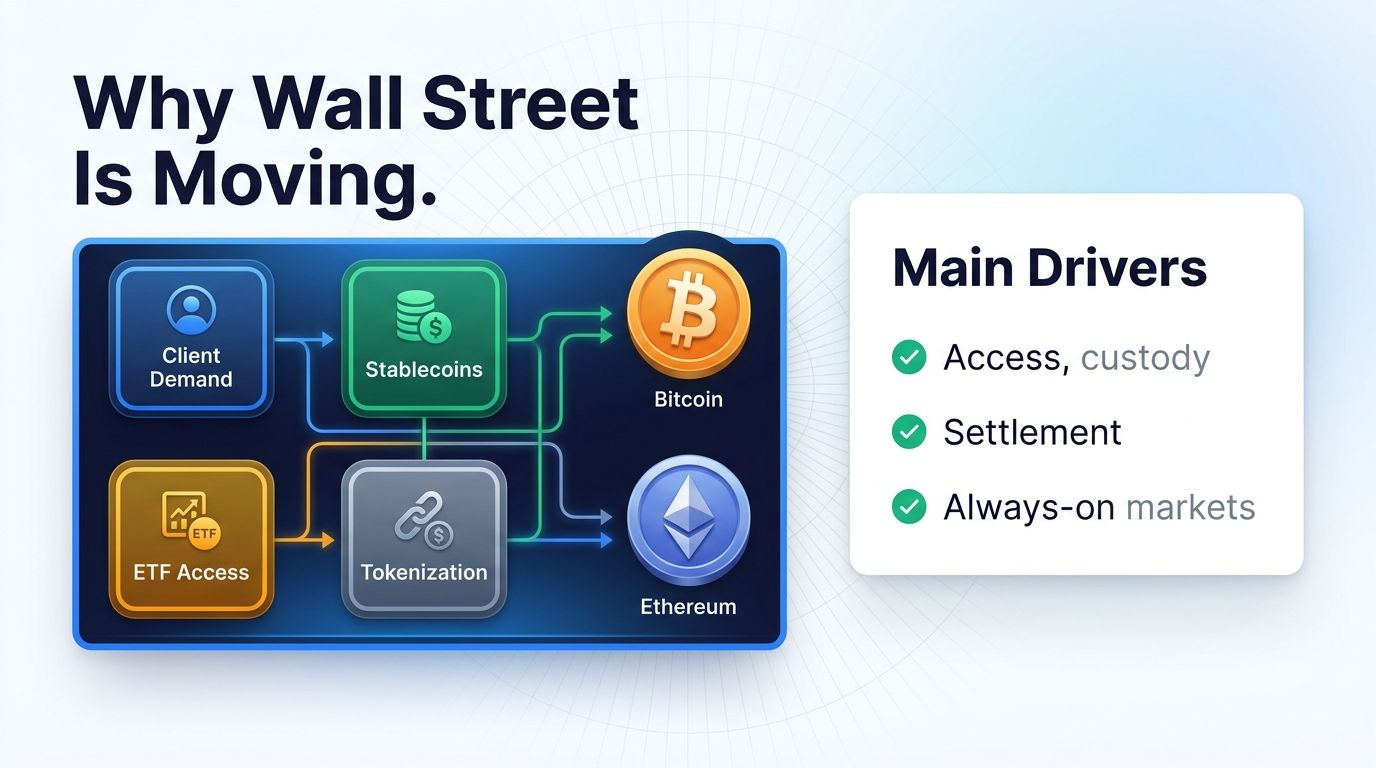
The first reason is client demand. Investors already have exposure through spot ETFs, crypto equities, stablecoin companies, and public digital asset platforms. If clients want access, custody, reporting, and advice, financial firms have an incentive to build controlled versions of those services.
The second reason is market structure. Crypto trades 24/7, stablecoins settle quickly, and tokenized assets can expand access to markets that were previously limited by geography, hours, or account type. Traditional finance may not copy crypto culture, but it can adopt useful rails.
- Clients want access through familiar institutions.
- ETFs made crypto easier to package.
- Stablecoins proved demand for digital dollars.
- Tokenization points toward always-on markets.
What Services Are Likely to Come First
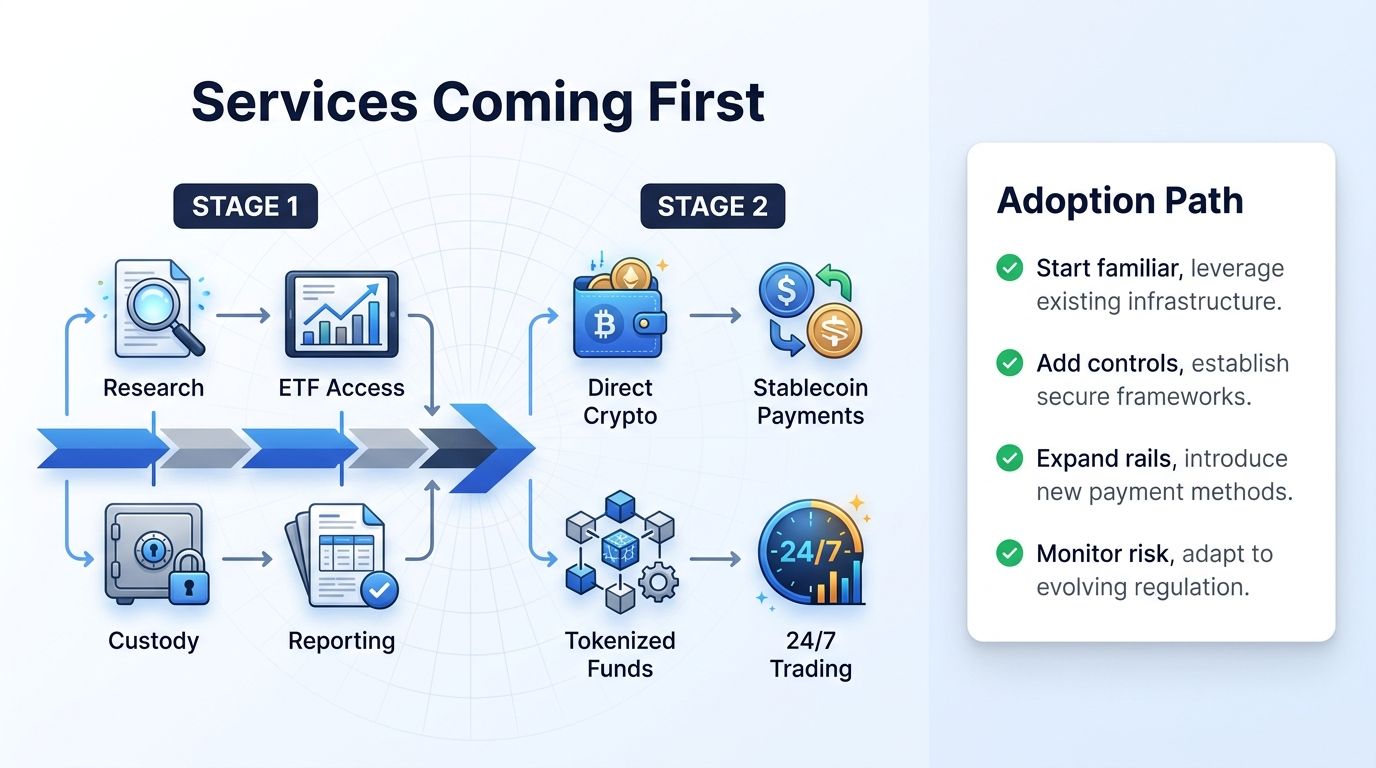
The first wave is usually the least disruptive: research, custody, ETF access, wealth allocation models, and trading through regulated channels. These services fit existing client relationships and can be added with compliance controls.
The second wave is more structural. Banks and brokers may offer direct Bitcoin and Ethereum access, stablecoin payment tools, collateral services, tokenized funds, and extended-hours or always-on trading infrastructure. This is where crypto starts changing operations, not only product menus.
- Research and education are low-friction services.
- Custody and ETF access fit existing wealth workflows.
- Direct asset access requires stronger controls.
- Tokenized markets can change settlement and trading hours.
Why Bitcoin and Ethereum Still Lead
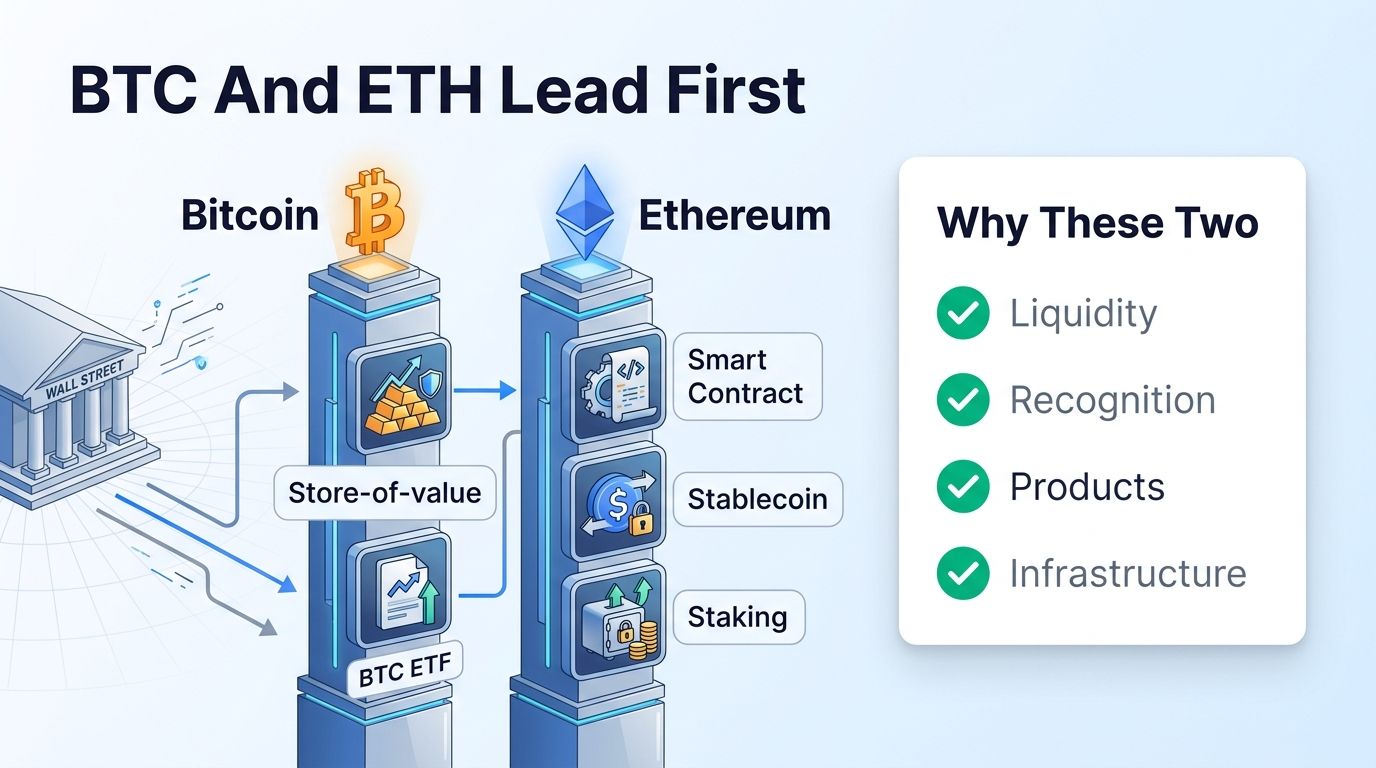
Bitcoin and Ethereum remain the easiest starting points because they are large, liquid, well-known, and already connected to regulated investment products. Bitcoin is the store-of-value and treasury asset in most institutional conversations. Ethereum is the smart contract and settlement platform that supports stablecoins, staking, and tokenization narratives.
That does not mean smaller assets disappear. It means banks usually start where liquidity, client recognition, and regulatory familiarity are strongest. Once controls are proven, broader asset support can follow more slowly.
- Bitcoin has the clearest institutional identity.
- Ethereum connects to settlement and smart contracts.
- Liquidity matters for large clients.
- Broader asset access may come later.
Risks Traders Should Not Ignore
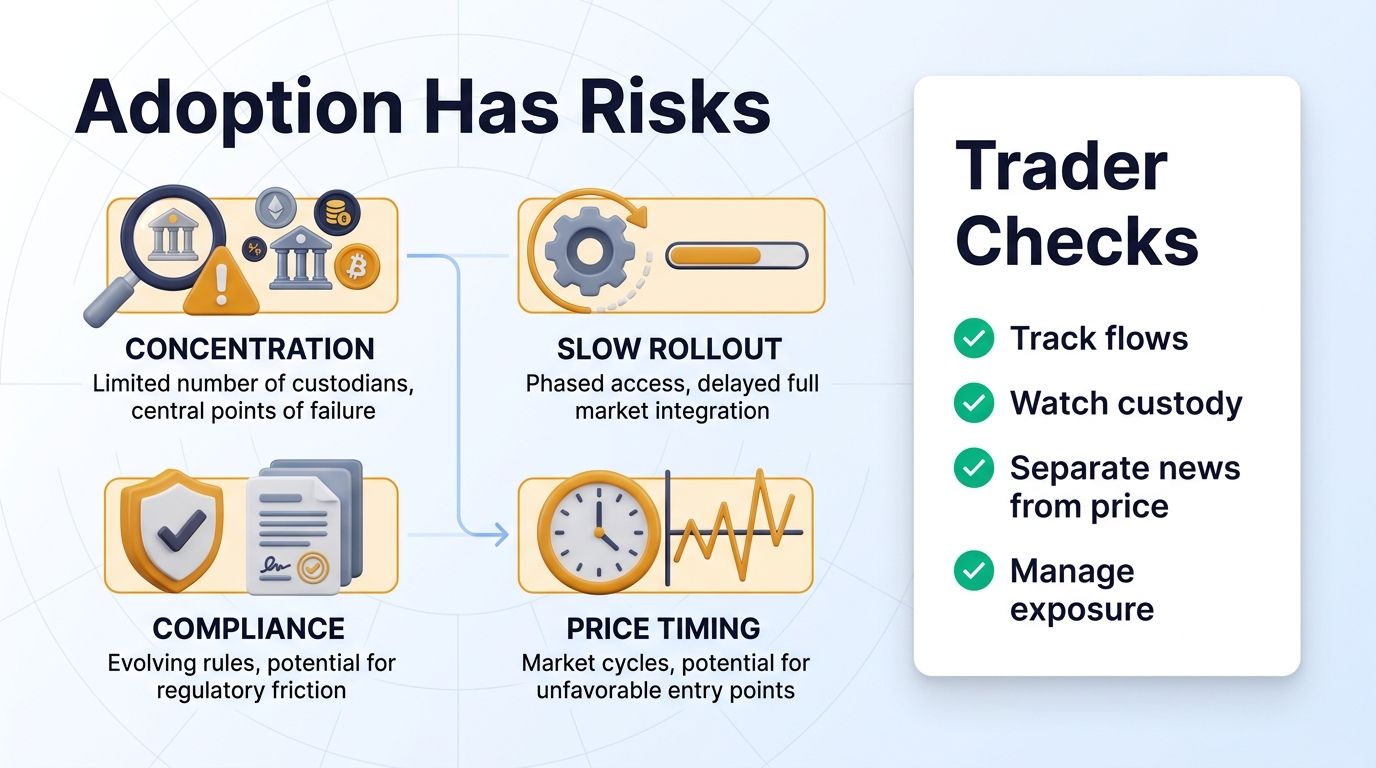
Wall Street adoption can improve access, but it can also concentrate activity in a few large platforms. If investors only use the biggest ETF issuers, custodians, brokers, or banks, liquidity may look deep while operational dependencies become more concentrated.
There is also a timing risk. Institutional adoption stories can sound bullish while price is still correcting. A bank adding a roadmap item does not guarantee immediate inflows. Traders need to separate strategic direction from short-term positioning.
- Adoption can increase concentration risk.
- Product announcements do not guarantee inflows.
- Compliance controls can slow rollout.
- Traders still need independent risk management.
How Traders Can Track the Shift
A useful tracking routine starts with products, flows, and rails. Products show what institutions are willing to offer. Flows show whether clients are actually using them. Rails show whether settlement, custody, and reporting infrastructure is becoming more efficient.
For example, a bank announcing crypto research is less important than a bank offering custody, collateral, or direct trading. An ETF launch is less important than sustained inflows. A tokenized asset pilot is less important than secondary liquidity and real users.
The point is not to cheer every announcement. The point is to ask whether the announcement changes access, liquidity, cost, or risk for real market participants.
- Track product rollout, not only headlines.
- Compare announcements with flows.
- Watch custody and settlement rails.
- Measure real user adoption.
Bottom Line
Wall Street's crypto shift is real, but it is practical rather than romantic. Banks and brokers are not trying to become crypto natives. They are trying to serve clients, defend deposits, improve settlement, and participate in tokenized markets without losing control of compliance.
For traders, that creates a long-term adoption tailwind and a short-term analysis challenge. The market can price the story before the flows arrive. Good execution still depends on timing, position size, volatility, and liquidity.
The smartest approach is to watch where real money moves, not only where the marketing language goes.
- Wall Street adoption is about access and control.
- Bitcoin and Ethereum remain the first entry points.
- Flows matter more than announcements.
- Risk management still decides trade quality.
A Trader's Wall Street Adoption Scorecard
A useful scorecard separates three layers: access, assets, and activity. Access asks which clients can actually use the service. Assets asks whether the offering is limited to ETFs, Bitcoin, and Ethereum, or whether it expands into stablecoins and tokenized funds. Activity asks whether money is flowing through the product.
This matters because announcements can sound similar while their impact is different. A research desk publishing a report is not the same as a broker enabling direct trading. A tokenized pilot is not the same as a liquid product with daily volume. A custody partnership is not the same as clients moving assets.
The scorecard should also include risk. Ask who holds the assets, how settlement works, whether clients can withdraw, what fees apply, and what happens during market stress. Wall Street wrappers can make access easier, but the underlying exposure still has volatility.
If the scorecard improves over several months, the adoption story becomes more concrete. If product launches arrive without flows, traders should treat the narrative carefully and wait for proof.
This is especially important when several themes overlap. A bank can announce crypto access, a broker can test tokenized equities, and an exchange can promote always-on trading in the same week. The trader's job is to identify which change affects liquidity now.
If none of the changes affect liquidity, access, or execution in the near term, the story may still matter strategically but should not force a trade. A patient trader can save the theme for a watchlist until flow data catches up. That patience is often the difference between trading adoption and trading headlines.
- Separate access, assets, and activity.
- Compare service type with real client usage.
- Review custody, settlement, and withdrawal limits.
- Demand flow evidence before upgrading the thesis.
FAQ
Why is Wall Street adding crypto services?
Financial firms are responding to client demand, ETF adoption, stablecoin growth, and the rise of tokenized assets.
Which crypto assets are likely to come first?
Bitcoin and Ethereum are likely to lead because they are large, liquid, familiar, and tied to regulated products.
Does Wall Street adoption guarantee higher prices?
No. Adoption can support long-term access, but short-term price still depends on flows, liquidity, macro conditions, and sentiment.
What should traders watch?
Watch product rollouts, ETF flows, custody announcements, settlement infrastructure, and whether clients actually use the services.