
Most "what is blockchain" guides read like a computer science lecture. They explain hashing, Merkle trees, and consensus mechanisms in beautiful detail, then leave you wondering how any of this connects to the chart you are actually trying to trade. This guide is different. It treats blockchain as infrastructure that affects your fills, your fees, your arbitrage windows, and your risk exposure.
If you have not yet read the companion piece on what is DeFi or smart contracts explained, those build directly on what blockchain enables.
If you trade crypto, blockchain is not optional knowledge. It is the rail your orders run on, the reason gas spikes during volatility, and the explanation for why a Solana arbitrage opportunity closes in 400 milliseconds while an Ethereum one stays open for 12 seconds. Understanding it as a trader, not a developer, is the goal here.
What Blockchain Actually Is (in 60 Seconds)
A blockchain is a distributed database that thousands of independent computers maintain together, where new entries are bundled into "blocks" that link to previous blocks through cryptographic hashes. Once a block is added and confirmed, rewriting it requires rewriting every block that came after, which is computationally or economically impractical depending on the consensus model.
For a trader, this matters in three ways. First, it means transactions are settled by the network itself rather than a custodian, so when you swap on Uniswap, no broker is matching your order, the contract is. Second, the database is public, so every transfer, swap, liquidation, and contract interaction is visible to anyone willing to read it. Third, the rules are code, not policy, which means they execute the same way every time regardless of who is asking.
The technical word for this combination is "trust-minimized settlement." The trader-friendly translation is: you can move value, settle trades, and verify state without asking permission, but you also bear all the operational responsibility yourself.
The 4 Properties That Matter for Traders
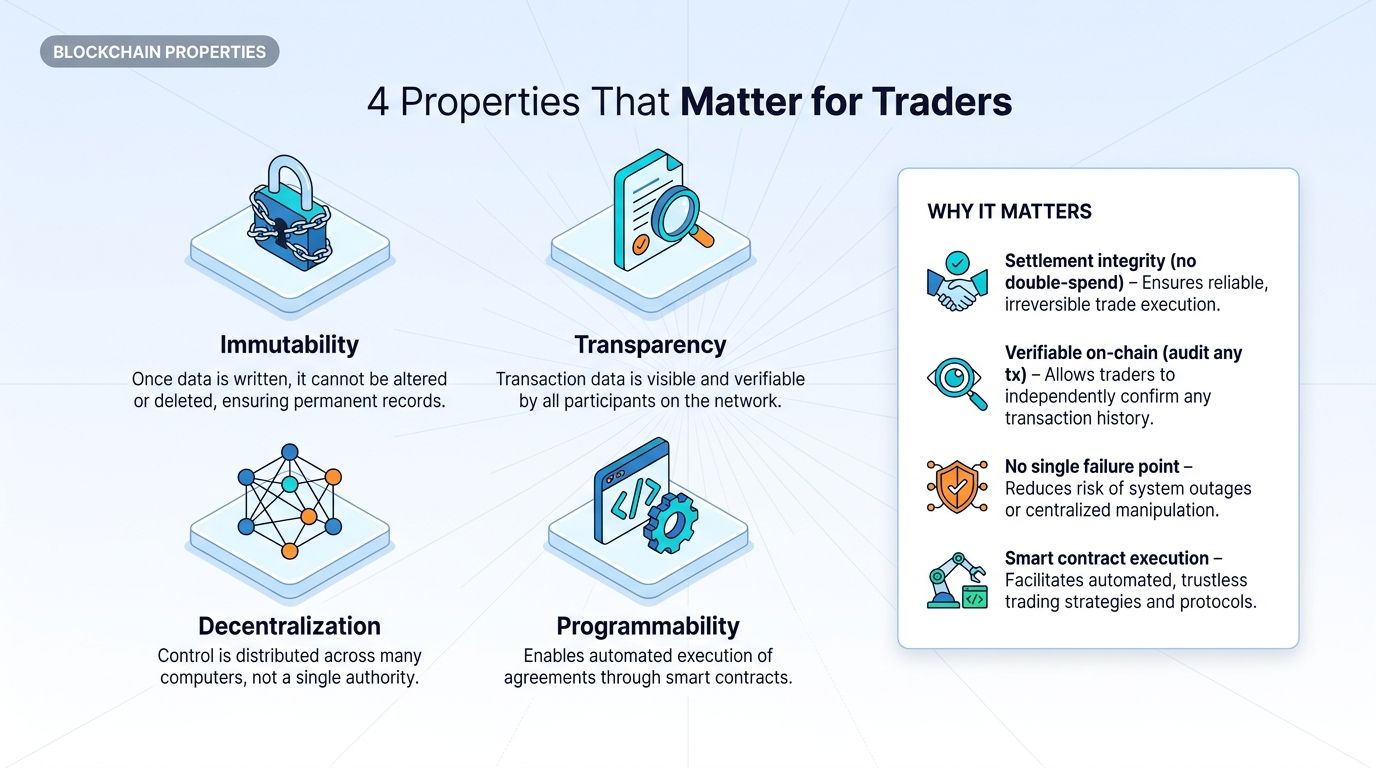
Four blockchain properties translate directly into trading outcomes, and most other features are downstream of these.
Immutability. Once a transaction is confirmed, it cannot be reversed. There is no chargeback, no support ticket, no overnight reversal. This is why an approval to a malicious contract drains a wallet permanently, and why double-checking a recipient address before sending six figures is non-negotiable. For traders, immutability means your operational discipline matters more than your strategy on any given week.
Transparency. Every wallet, every transaction, every smart contract state is visible on-chain. This is the foundation for tools like Etherscan, Dune dashboards, Nansen alerts, and DEX volume trackers. You can watch a whale wallet position itself, see liquidation cascades forming on Aave, or track stablecoin mints from Tether before they hit exchanges. CEX traders rarely have anything close to this signal.
Decentralization. The network has no head office, which means no one can switch it off, freeze your funds at the protocol level, or change the rules unilaterally. The practical limit: decentralization varies a lot. Bitcoin and Ethereum are highly decentralized. Many "decentralized" L1s have a small number of validators or a foundation with admin keys. Always check the actual decentralization profile before treating a chain as censorship-resistant.
Programmability. Beyond Bitcoin, most chains let developers deploy smart contracts that run when conditions are met. This is what makes DEX trading, lending, perpetuals, and yield strategies possible. As a trader, programmability is what gives you 24/7 markets, automated liquidations, on-chain options, and composability between protocols.
How Blockchain Affects Your Trading
The technical parameters of a blockchain shape the trading environment as much as any exchange feature.
Block times determine how quickly your transaction can be included. Bitcoin averages 10 minutes per block. Ethereum settles every 12 seconds. Solana targets 400 milliseconds. Arbitrum, Base, and other L2s confirm in under 2 seconds at the sequencer level. If you are arbitraging price gaps between a centralized exchange and a DEX, a 12-second window on Ethereum versus a 400-millisecond window on Solana changes everything about which strategy is feasible.
Gas fees are the cost of including your transaction in a block. They float with demand. On Ethereum mainnet, a simple ERC-20 swap might cost 4 dollars on a quiet Sunday and 80 dollars during a memecoin frenzy. This single fact has driven trillions of dollars of activity to L2s and alternative L1s. Before you fire off a series of small trades, calculate whether gas alone will outrun your edge.
Finality is when a transaction is considered economically irreversible. Bitcoin uses probabilistic finality (most exchanges credit deposits after 3 to 6 confirmations). Ethereum has economic finality after roughly 13 minutes once two epoch checkpoints pass. Solana reaches finality in about 13 seconds. Cross-chain bridges almost always wait for finality before releasing funds on the destination chain, which is why a deposit from Ethereum to an exchange can sit "pending" for 15 minutes during high load.
MEV (maximal extractable value) is the profit that block producers and searchers can extract by reordering, including, or excluding transactions. For traders, MEV shows up as sandwich attacks on DEX swaps, front-running of profitable arbs, and worse fills than expected. Tools like MEV-protected RPCs and aggregators with private mempools (Flashbots Protect, Cowswap, 1inch Fusion) exist specifically to counter this.
Major Blockchain Architectures Compared
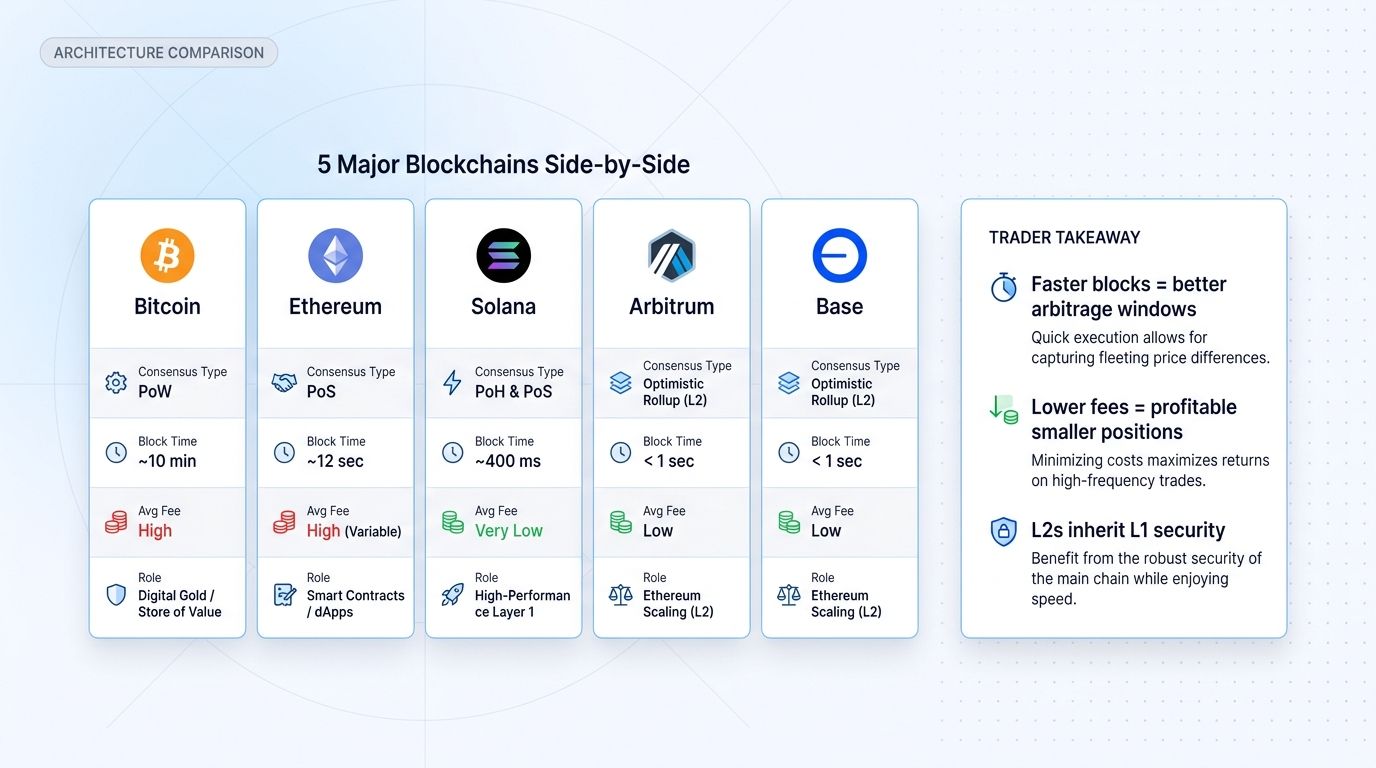
Different architectures make different trade-offs, and each one creates a different trading environment.
Bitcoin (Proof of Work). The original blockchain. Settlement is slow but exceptionally robust. There are no smart contracts in the Ethereum sense, so most "Bitcoin DeFi" runs on layer 2 systems like Lightning, Rootstock, or BitVM-based rollups. As a trader, you mostly interact with BTC as a deposit asset on exchanges or through wrapped versions like WBTC on Ethereum.
Ethereum (Proof of Stake). The dominant smart contract platform. Settlement is slow by modern standards but the security and decentralization profile is the highest of any programmable chain. Almost every serious DeFi protocol launches on Ethereum first. Fees are high during peak demand, which is why most retail trading has migrated to L2s.
Solana. A high-throughput, single-state-machine chain optimized for speed. Block times under half a second and fees of fractions of a cent enable strategies (high-frequency DEX arb, on-chain order book trading on platforms like Phoenix or Jupiter limit orders) that are economically impossible elsewhere. Trade-offs include occasional network outages and a more centralized validator set than Ethereum.
Layer 2s (Arbitrum, Base, Optimism, zkSync). Rollups that batch transactions off-chain and post compressed proofs back to Ethereum. You get Ethereum-grade security with fees of 1 to 50 cents and confirmation in under 2 seconds. This is where most active DeFi traders operate in 2026. The catch: withdrawals back to Ethereum mainnet have a delay (7 days for optimistic rollups, near-instant for ZK rollups), so capital is not always immediately mobile.
App-chains and modular L1s (Sei, Berachain, Monad, Hyperliquid L1). Specialized chains optimized for trading or specific applications. They tend to offer the lowest fees and fastest execution but with less battle-tested security and less liquidity diversity than the majors.
When Blockchain Network State Hurts Your Trades
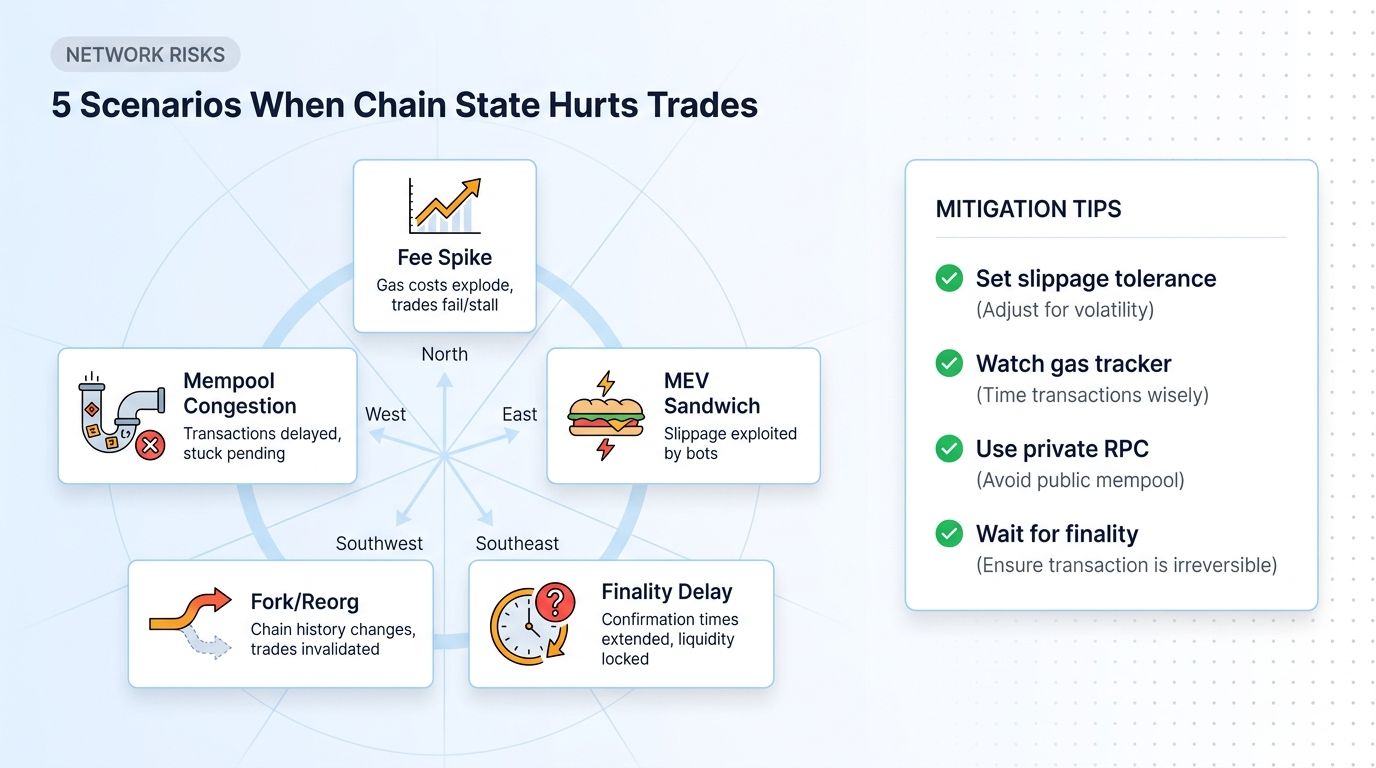
Blockchains are not always operating in calm seas, and their network state often deteriorates exactly when you need it most.
Fee spikes during volatility are the classic problem. When BTC dumps 10 percent and you want to top up margin on a CEX, gas on Ethereum can hit 200 gwei or higher. A simple deposit transaction that normally costs 3 dollars suddenly costs 50, and your transaction sits unconfirmed because you used yesterday's gas estimate. The fix: always have a fast-fee buffer ready, or pre-position capital on the exchange before high-impact events.
Congestion and timeouts. During NFT mints, memecoin launches, and airdrop claim events, networks like Ethereum, Solana, and even some L2s slow to a crawl. Solana has had multi-hour outages. Arbitrum's sequencer has gone down. If your strategy depends on chain availability at a precise moment, plan for the chain not being available.
Fork events and chain upgrades. Major upgrades like Ethereum's Shanghai or Dencun, or contentious forks like Bitcoin Cash splits, can pause exchange deposits and withdrawals for hours or days. Most exchanges publish notices in advance. Reading them is cheap insurance.
MEV-related slippage. Even on a healthy chain, your DEX swap can get sandwiched. The price you saw on the aggregator quote is not always the price you get on chain. Always set realistic slippage limits and consider routing through MEV-protected paths for trades over a few thousand dollars.
Reading On-Chain Data Like a Trader
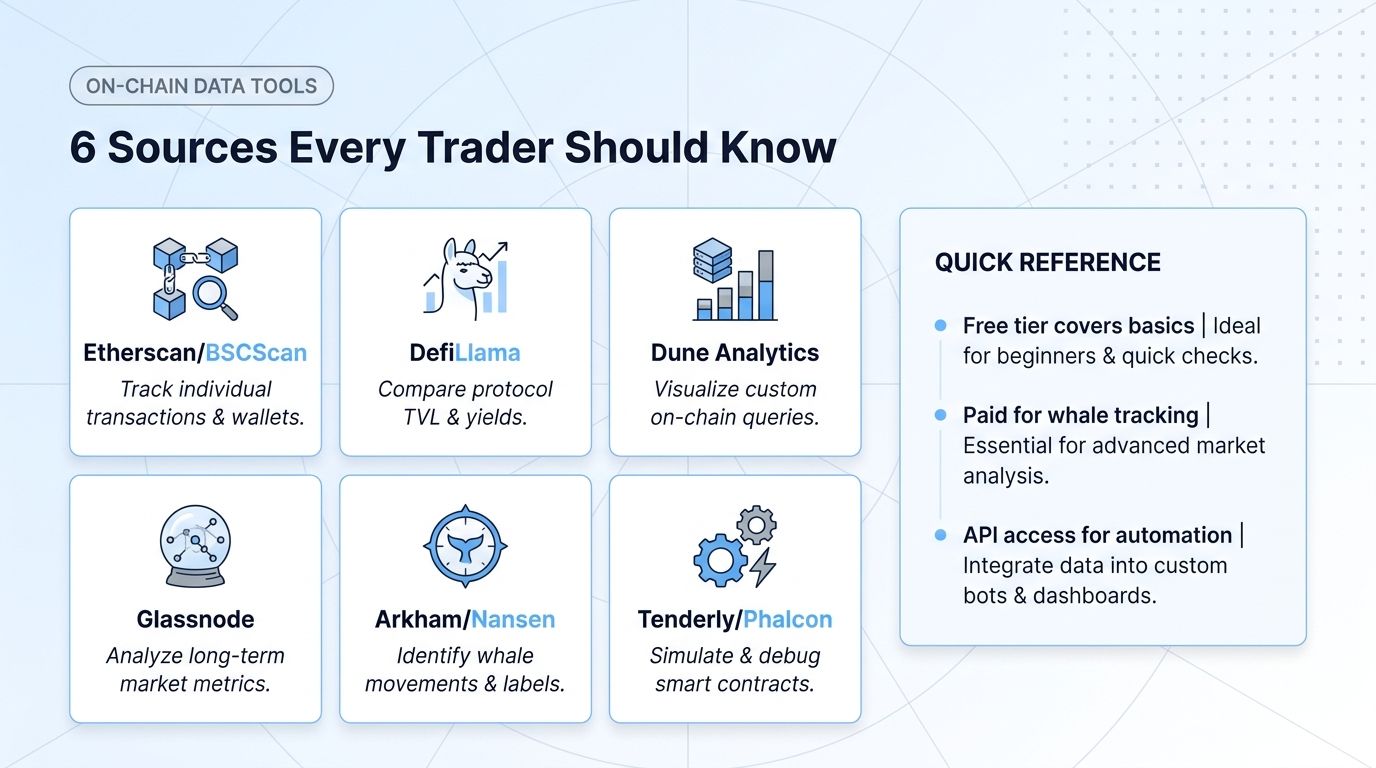
The transparency property is your edge if you learn to use it. A few practical entry points:
Block explorers (Etherscan, Solscan, Arbiscan). Look up any contract or wallet, see live transaction flow, decode swaps and approvals. Bookmark the wallets of large depositors, market makers, or protocol treasuries you care about.
Aggregator dashboards (DefiLlama, Dune, Token Terminal). Track total value locked, fees, revenues, stablecoin supplies, and protocol usage in near real time. A sudden spike in stablecoin mints or a drop in a DEX's TVL often precedes a price move.
Whale and flow trackers (Nansen, Arkham, Lookonchain). Label-rich views of which wallets are buying, selling, depositing to exchanges, or moving stablecoins. Useful for confirming or contradicting the narrative you see on social feeds.
Mempool tools (Blocknative, Eden). Watch unconfirmed transactions. Useful for spotting large pending swaps, oracle updates, or liquidations before they settle.
You do not need to read raw bytecode. You need to know which dashboards answer the questions you care about (where is liquidity moving, who is positioning, when are large unlocks scheduled) and check them with the same consistency you check your charts.
FAQ
Is blockchain the same as Bitcoin?
No. Bitcoin is one specific blockchain, the first and most secure. Blockchain is the underlying technology pattern that thousands of networks now use, including Ethereum, Solana, and many others. Treating "blockchain" and "Bitcoin" as synonyms is like treating "internet" and "Gmail" as the same thing.
How does block time actually affect my trading?
Faster block times shorten the window for arbitrage and allow more frequent strategy execution, but also mean MEV competition is fiercer. Slower block times give you a longer window to react but increase the risk that prices move against you between submission and confirmation. Match your strategy to the chain's block cadence rather than fighting it.
Why do gas fees go crazy during volatility?
Block space is fixed but demand is not. When everyone wants to deposit collateral, close positions, or front-run a liquidation cascade, they all bid up gas at the same time. The base fee on Ethereum then doubles per block until demand cools. Plan for this by pre-funding accounts and avoiding chain-dependent strategies during macro events.
Are L2s safe to trade on?
L2s like Arbitrum, Base, and Optimism inherit Ethereum's security for the underlying state but introduce new risks (sequencer centralization, bridge contract risk, and in some cases, fraud-proof immaturity). For active trading, L2s are widely used. For long-term storage of large positions, mainnet Ethereum or self-custody on Bitcoin is still the conservative default.
Can I avoid MEV and front-running entirely?
You cannot eliminate MEV, but you can mitigate it. Use private mempools (Flashbots Protect on Ethereum), MEV-aware aggregators (Cowswap, 1inch Fusion), and tight slippage limits. For very large trades, RFQ-based DEXs and OTC desks bypass the public mempool entirely.
Final Thoughts
Blockchain is not a buzzword if you trade on it every day. It is a settlement layer with measurable parameters that affect your fills, fees, and risk. The traders who treat block times, gas, finality, and MEV as first-class variables outperform the ones who only look at price.
You do not need to memorize every consensus algorithm. You need to know how the chain behind your favorite trading venue actually behaves under load, what it costs to operate on it, and what tools let you read its state in real time.
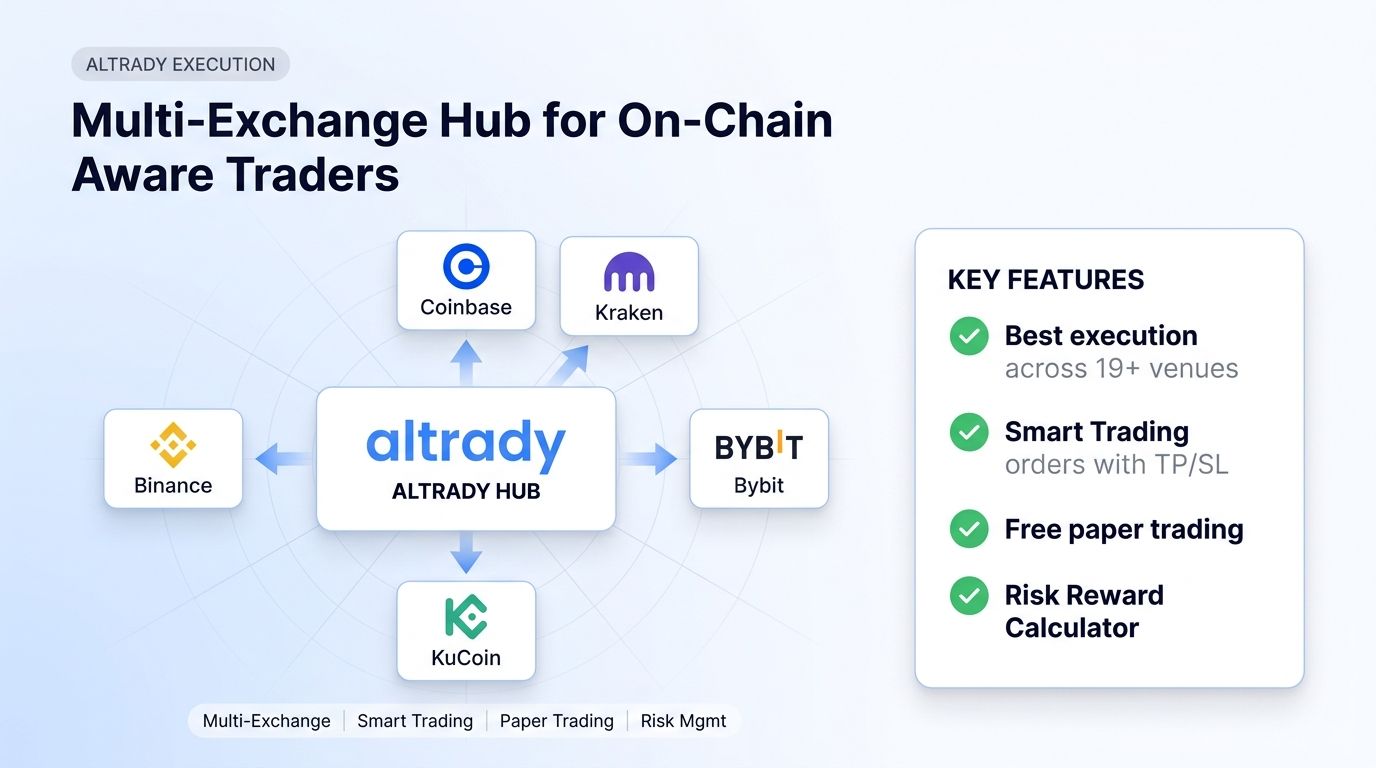
If you are managing positions across multiple exchanges and chains, the mental load can pile up fast. Altrady gives you a single multi-exchange terminal with smart trading tools, paper trading to test ideas without risk, and execution across centralized venues so you can focus on strategy instead of switching tabs. Try Altrady free and see how much cleaner your workflow gets when your trading platform respects the realities of how blockchains actually work.