
You have read three "what is DeFi" explainers and you still cannot answer the only question that matters: what do I do with this as a trader, and where do I lose my money if I get it wrong? This one is built for traders who want to know what to actually do with DeFi, where the real risks hide, and how to integrate decentralized markets with the centralized exchanges they already use.
DeFi only makes sense once you understand what is blockchain at the foundational level, and the smart contracts explained piece breaks down the engine running every DeFi protocol.
By the end you should know the core primitives, when DeFi beats a CEX, when it does not, and how to take a position on a DEX, lending market, or perp protocol without donating capital to the next exploit headline.
What DeFi Actually Means
DeFi (decentralized finance) is the umbrella term for financial services that run on smart contracts rather than through a regulated intermediary. Instead of an exchange's order matching engine, a DEX has an automated market maker contract. Instead of a bank issuing loans, a lending protocol has a pool that anyone can borrow from against on-chain collateral. Instead of a broker holding your assets, your wallet does.
The defining feature is that you can interact with these services without a custodian. Your funds sit in a self-custody wallet, you sign transactions, and the protocol's code does the rest. No support desk, no KYC for most actions, and no one to reverse a mistake. That same property attracts traders looking for permissionless markets and punishes anyone who treats DeFi like a video game.
By 2026, DeFi has matured well past the original yield farming era. TVL across major protocols has stabilized in the hundreds of billions, perpetual DEX volume rivals second-tier centralized exchanges, and integrations with real-world assets, restaking, and on-chain treasuries have given the space a foundation that did not exist three years ago.
The Core DeFi Primitives Every Trader Should Know
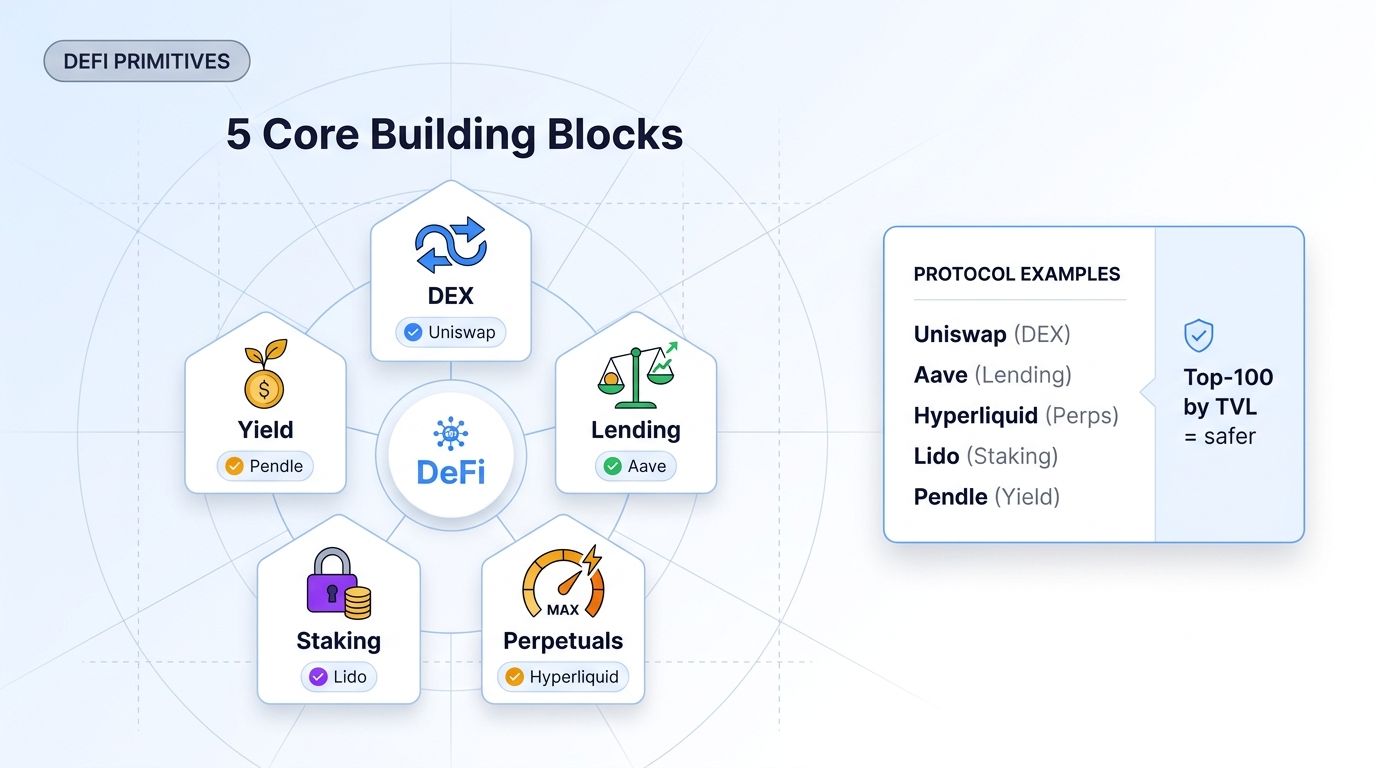
Five primitives cover most of what you will actually use as a trader.
Decentralized exchanges (DEXs). Two main flavors. AMMs like Uniswap, Curve, and PancakeSwap use liquidity pools and pricing curves. Order book DEXs like dYdX, Hyperliquid, and Phoenix run matching engines on chain or in a hybrid model. AMMs handle spot swaps and long-tail tokens well. Order book DEXs offer tighter spreads for active trading. Aggregators like 1inch, Jupiter, Cowswap, and Matcha route across multiple DEXs to find the best price.
Lending and borrowing. Aave, Compound, Morpho, Spark, and Kamino on Solana are pooled lending markets. You can deposit ETH or stablecoins to earn interest, or borrow against collateral. Traders use these to lever long without touching a CEX, to short by borrowing tokens and selling them, or to free up stablecoin liquidity without selling their core holdings. Liquidations are automated and unforgiving. Maintain comfortable health factors, not minimum ones.
Perpetual futures DEXs. Hyperliquid, GMX, dYdX, Vertex, and Jupiter Perps offer perpetual futures on chain with up to 50x to 100x leverage. They have reshaped DeFi trading volume since 2024. The advantage over a CEX is self-custody and no KYC. The trade-offs are oracle risk, sometimes wider spreads, and exposure to vault depositors as the counterparty in pool-based designs.
Staking and liquid staking. Lock ETH to secure the network and earn issuance rewards. Liquid staking tokens (LSTs) like Lido's stETH, Rocket Pool's rETH, and Jito's JitoSOL on Solana let you keep capital productive while still using it as collateral or in DEX positions. As a trader, LSTs are useful as yield-bearing collateral and as an on-ramp to restaking yield.
Yield strategies and aggregators. Vaults from Yearn, Beefy, Pendle, and others stack DeFi primitives on your behalf. Pendle deserves a special mention because it lets you trade yield itself, splitting a yield-bearing token into a principal token and a yield token. For traders, this is one of the few clean ways to express a directional view on interest rates.
DeFi vs CEX: Where Each Wins
One growing sub-category worth mentioning is the perp DEX token, where decentralized perpetual exchanges (Hyperliquid, dYdX, GMX) issue native tokens that capture trading fees through buyback or distribution mechanisms.
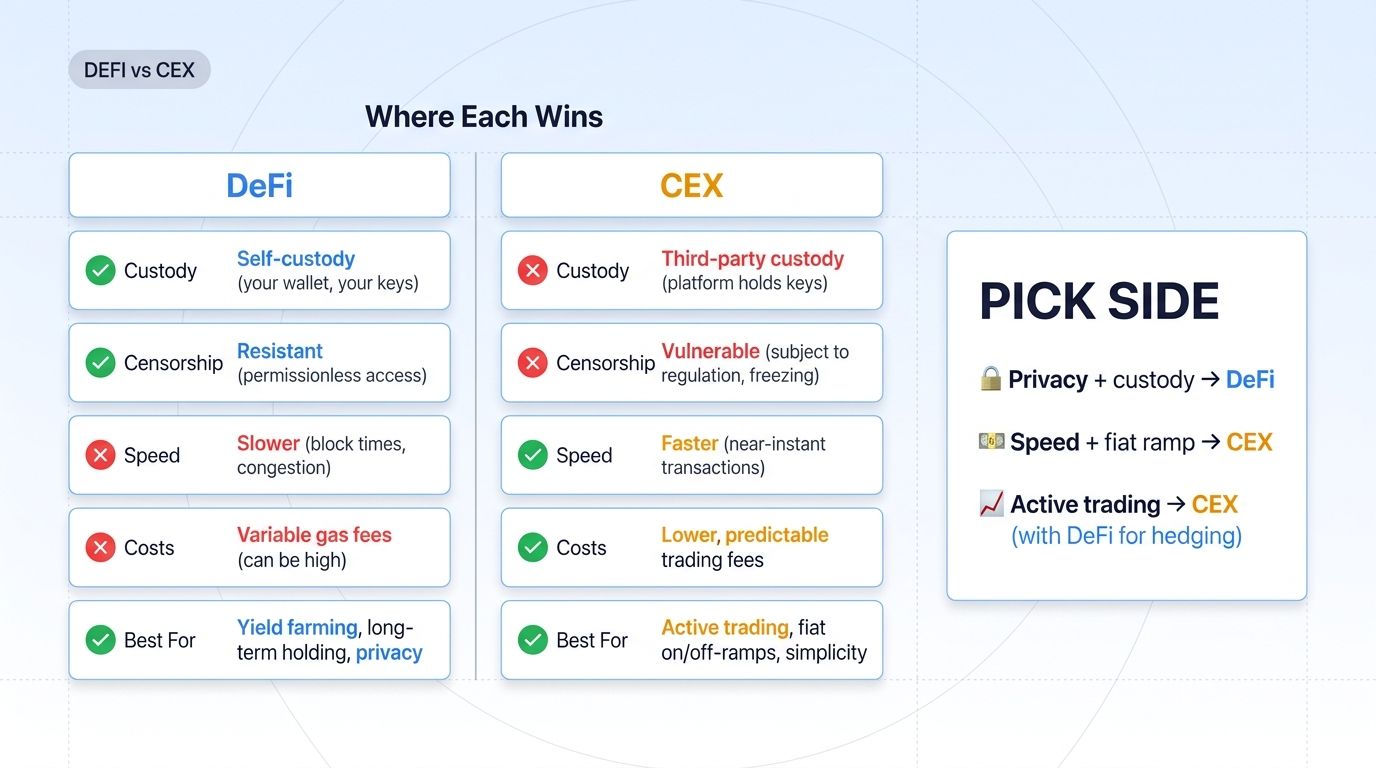
DeFi and centralized exchanges are not in direct competition for the same use cases.
CEX wins for deep liquidity on majors, low spreads, fiat on-ramps, tax tool integration, customer support, and zero gas costs per trade. If you are scalping BTC perpetuals with high frequency, a top-tier CEX still has the edge.
DeFi wins for self-custody, access to long-tail tokens that never list on major CEXs, composable strategies (borrow against an LST, deposit into a yield vault, hedge on a perp DEX, all in one transaction), and the ability to do all of it without revealing your identity.
The hybrid model most professionals use: hold long-term positions in self-custody, use a CEX for high-volume execution on majors, use DeFi for long-tail tokens, on-chain yield, and any strategy where avoiding centralized custody matters. The 2022 FTX collapse permanently rebalanced how many traders weight self-custody.
Rule of thumb: if your edge depends on tight spreads, lean CEX. If it depends on on-chain markets or self-custody, lean DeFi.
The Real Risks Nobody Talks About
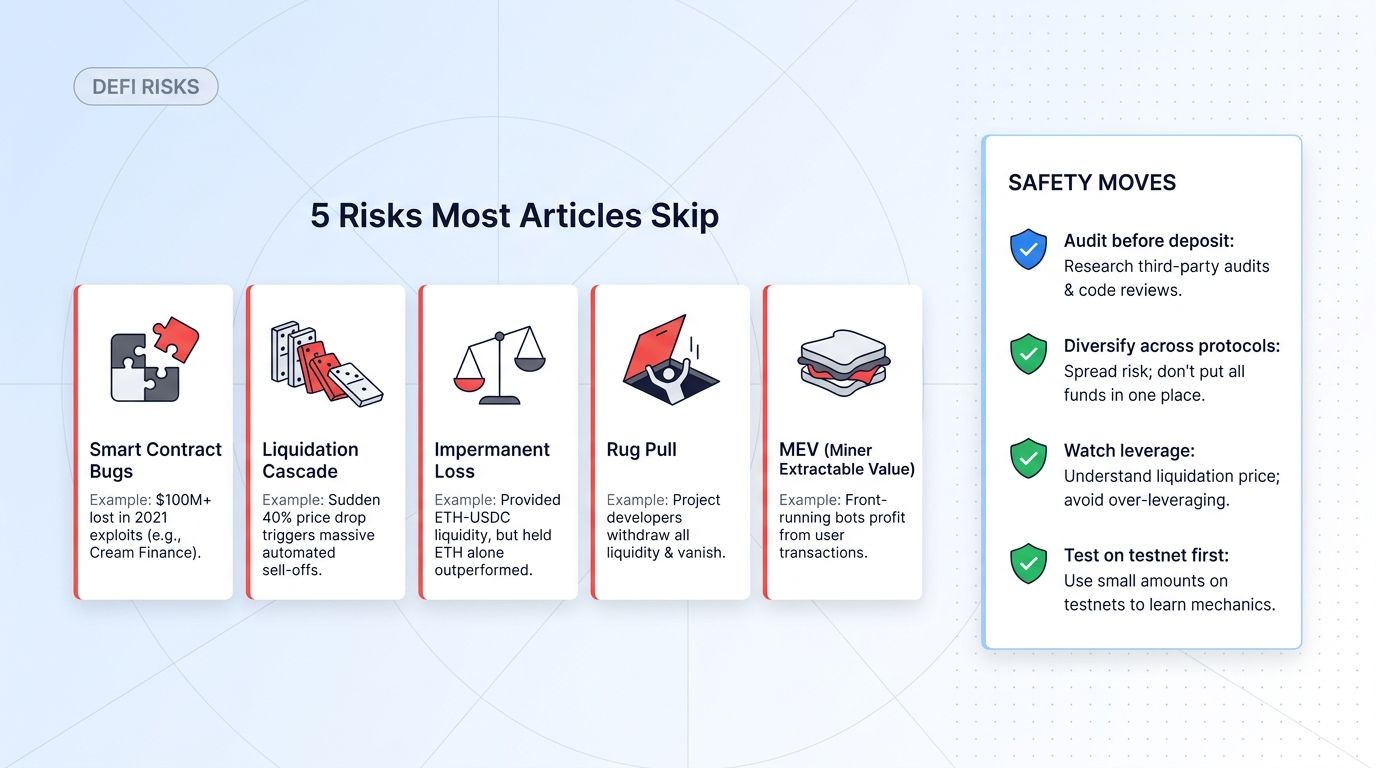
Most DeFi losses do not come from price moves. They come from operational risks that traders new to the space underestimate.
Smart contract bugs. Even audited protocols get exploited. Euler Finance lost 197 million dollars in 2023 to a previously unnoticed flaw, despite multiple audits. Curve was exploited in 2023 because of a Vyper compiler bug, not a logic error in the protocol itself. The lesson: audits reduce risk but never eliminate it. Spread exposure across multiple protocols and never put more on a single contract than you are willing to write off.
Liquidations. On-chain lending and perpetuals positions are liquidated automatically when health factors or margin ratios drop below threshold. Unlike a CEX, there is no margin call email and no friendly support agent. During fast moves, liquidation cascades can compound losses across the whole market. Aave and Compound have liquidation bots that scan for positions every block. If your collateral ratio is tight, you are an exit on someone else's strategy.
Impermanent loss. A standing risk for AMM liquidity providers. When the price ratio of the two assets in a pool changes, you end up with more of the underperforming asset and less of the outperformer than if you had just held both. Concentrated liquidity (Uniswap v3, v4) amplifies this. Treat LP positions as active trades that need to be managed, not as set-and-forget yield.
Rug pulls and exit scams. New token launches, pumped on social media and seeded with thin liquidity, can be drained by the deployer in a single transaction. Common red flags: liquidity that is not locked, large premints in deployer wallets, unaudited contracts with mint or pause functions held by an EOA. If you trade memecoins, cap your exposure and assume any unverified contract is hostile until proven otherwise.
MEV and sandwich attacks. Public mempool transactions can be sandwiched by searchers who insert their own buy in front of yours and a sell behind it. The result is a worse price than you saw on the quote. For trades over a few thousand dollars, route through MEV-protected paths like Cowswap, 1inch Fusion, or Flashbots Protect.
Bridge risk. Most catastrophic DeFi losses in history came from bridge exploits (Ronin, Wormhole, Nomad, Multichain). When you bridge assets across chains, you are usually trusting a multisig or a custom contract that holds the underlying. Use canonical bridges where possible, keep bridged stablecoin balances small, and unbridge as soon as you no longer need the position.
How to Get Started Safely
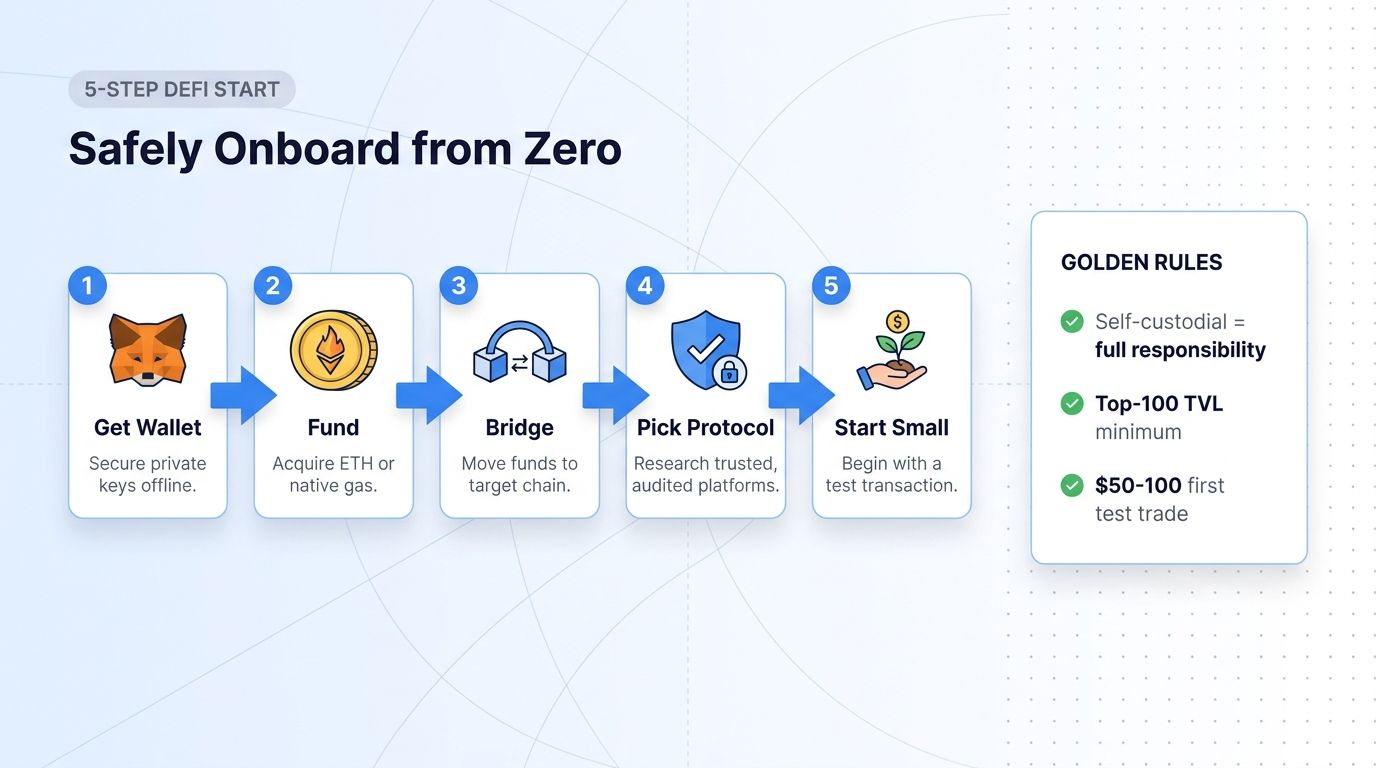
A practical path that minimizes the chance of a six-figure learning experience.
Start with the wallet. A non-custodial wallet (MetaMask, Rabby, Phantom on Solana) is your account. Use a hardware wallet (Ledger, Trezor) for any meaningful balance and treat your seed phrase like an unrecoverable bearer instrument. Rabby is worth a special look because it shows transaction simulations and warnings before you sign, which is a practical defense against most malicious approvals.
Fund with gas, not your life savings. Bridge a modest amount of ETH or SOL to your target chain to cover gas. Send a small test transaction to confirm everything works before moving size.
Stick to top-tier protocols early. Uniswap, Aave, Lido, Curve, Hyperliquid, Jupiter, Pendle. They are not bug-free but they have battle-testing and economic skin in the game that newer protocols lack. The 5 percent extra yield on a fork of a fork is rarely worth the marginal risk.
Set realistic slippage. Default to 0.5 percent on majors, up to 1 percent for mid-caps, never higher than 3 to 5 percent without a specific reason. Tight slippage protects against sandwich attacks and stale quotes.
Use protocol-specific tools. DeFiLlama, Token Terminal, and protocol dashboards (Aave's UI, Uniswap's analytics) give you the data you need to size positions sensibly. Watch utilization rates on lending markets before depositing or borrowing, and check pool liquidity depth before assuming you can exit at the listed price.
The 2026 DeFi Landscape
A few trends define the current era and will shape what you trade for the next 18 months.
Perpetual DEXs are eating CEX volume. Hyperliquid alone has averaged daily volumes that put it in the same range as mid-tier centralized exchanges. The combination of self-custody, deep liquidity, and a slick interface has shifted the perception that on-chain perps are a poor cousin to CEX perps. Expect more institutional flow to follow.
Real yields beat token emissions. The 2020 to 2022 era of triple-digit "APY" came from inflationary token emissions. The current era rewards protocols that generate fees from real economic activity (DEX trading fees, lending interest, perp funding) and pass them to stakers and token holders. When evaluating a yield, the question to ask is "where does this come from" rather than "what is the headline rate."
Real-world assets (RWAs) are now meaningful. Tokenized US Treasuries from BlackRock's BUIDL, Ondo, and Maple have brought traditional fixed income on chain. Traders get a low-risk dollar yield benchmark and new collateral types in lending markets.
Restaking and liquid restaking. EigenLayer, Symbiotic, and the LRT ecosystem let staked ETH secure additional services and earn extra yield. Risks are not fully understood, but the design space is attracting major capital.
Account abstraction and intent-based trading. Smart wallets and intent aggregators are shifting on-chain execution. Instead of specifying exact paths, you specify outcomes, and solvers compete to fill them. Cowswap and Anoma-style designs are early examples.
FAQ
Is DeFi safer than a centralized exchange?
Different risk profile, not strictly safer. DeFi removes counterparty custody risk but adds smart contract risk, MEV exposure, and operational responsibility. A well-run CEX is probably safer for a non-technical user. A well-run DeFi position with a hardware wallet and top-tier protocols is probably safer than the average exchange for someone who knows what they are doing.
How much capital do I need to start using DeFi?
On Ethereum mainnet, gas costs make positions under a few thousand dollars inefficient. On L2s like Arbitrum and Base, or on Solana, fees are low enough that a few hundred dollars works fine. Start small, learn the workflows, and scale up only after a few cycles of execution.
What is the easiest yield strategy for a beginner?
Depositing stablecoins like USDC into Aave or Spark on a low-fee chain. The yield is modest (typically 4 to 10 percent) but the mechanism is simple, the liquidations rarely affect lenders, and you can withdraw at any time as long as utilization is healthy.
Can I lose more than I deposit in DeFi?
On a spot DEX swap or a deposit into a lending pool as a lender, no. On leveraged positions (perp DEXs, borrowing against collateral), yes you can be liquidated and lose the collateral, though most protocols are designed to prevent negative balances. On LP positions with leverage or recursive borrowing, losses can stack quickly.
Do I need to do anything special for taxes?
Yes. Every swap, every yield claim, every reward distribution is potentially a taxable event in most jurisdictions. Track everything from day one. Tools like Koinly, CoinTracker, and Crypto Tax Calculator handle most major DeFi protocols. Reconstructing a year of unmonitored DeFi activity later is genuinely painful.
Final Thoughts
DeFi is not a replacement for the rest of your trading. It is a parallel toolkit with its own rules, its own opportunities, and its own failure modes. Used carefully, it gives you access to markets, yields, and instruments that simply do not exist on centralized venues. Used carelessly, it gives you a fast track to losses that nothing on a CEX can replicate.
The traders who do well in DeFi are usually the ones who treat it the same way they treat any other trading environment: with sized positions, written rules, regular reviews, and zero tolerance for protocols they have not vetted.
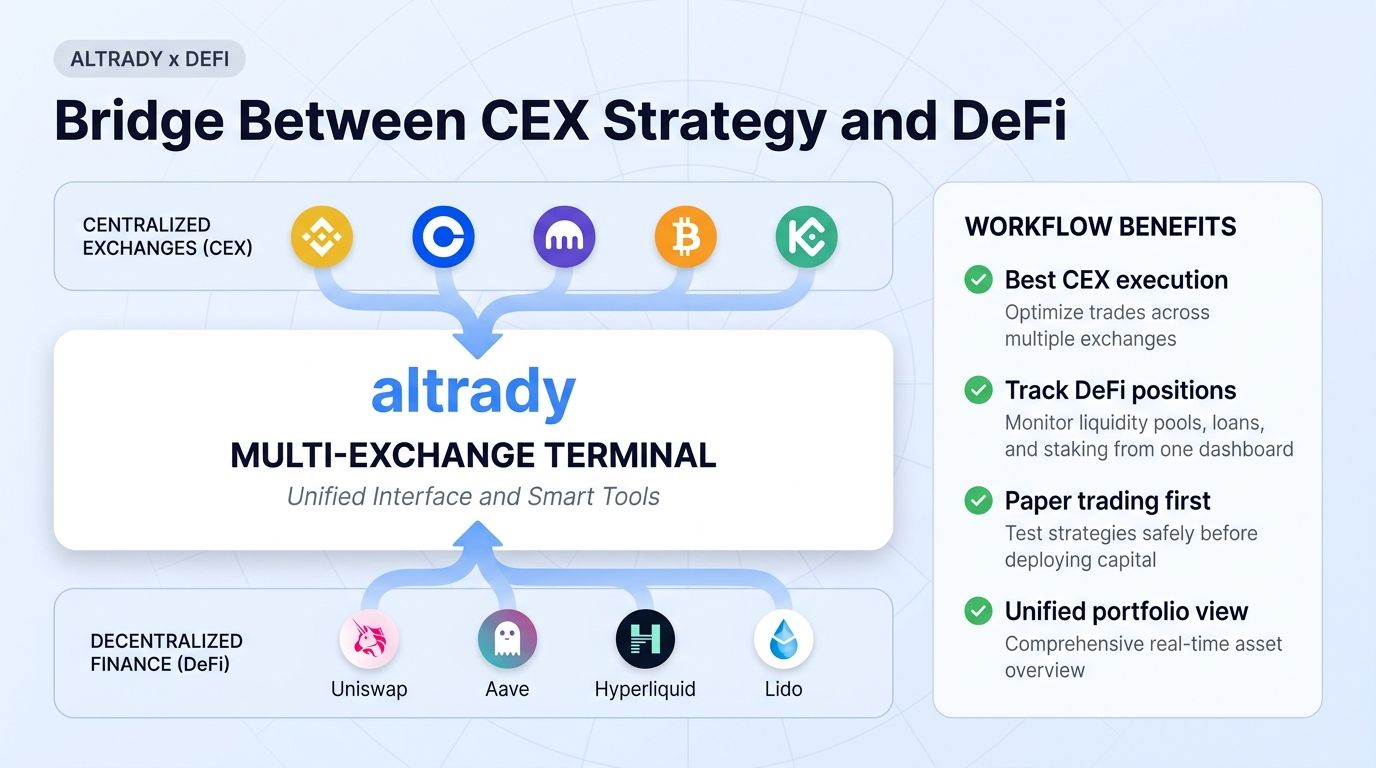
Whether your trading is mostly on chain, mostly on centralized exchanges, or split across both, you will eventually want a single place to manage execution, view your positions, and run paper trading on new strategies before risking capital. Altrady connects to multiple major exchanges, gives you a unified terminal with smart trading features, and lets you test setups in paper trading mode without spending a single dollar of gas. Start a free trial and see how much faster your workflow gets when your tools match the breadth of how modern crypto trading actually works.