

In the volatile world of cryptocurrency, one category of digital assets stands apart from the rest: stablecoins. Unlike Bitcoin or Ethereum, which can swing 10% or more in a single day, stablecoin crypto is designed to hold a consistent value, usually pegged to a fiat currency like the US dollar. For traders, investors, and everyday users, stablecoins have become a foundational tool for navigating the crypto market without constantly converting back to traditional bank accounts.
But stablecoins are not all the same. They come in different types, backed by different mechanisms, and carry very different levels of risk. Some have collapsed entirely, wiping out billions in value overnight. Understanding how they work, where they fit in a trading strategy, and what can go wrong is essential knowledge for anyone operating in the crypto space today.
1. What Is Stablecoin Crypto
A stablecoin is a type of cryptocurrency designed to maintain a stable value relative to a reference asset, most commonly the US dollar. The goal is to combine the benefits of blockchain technology, such as fast transfers, transparency, and programmability, with the price stability of traditional currencies.
The term "stablecoin crypto" broadly refers to any digital token whose value is pegged or soft-pegged to an external benchmark. The most popular stablecoins by market cap include USDT (Tether), USDC (USD Coin), DAI, and BUSD. Each one aims to maintain a 1:1 ratio with the US dollar, meaning one stablecoin should always be worth approximately $1.00.
Stablecoins serve as a bridge between the traditional financial world and the decentralized economy. They allow users to move value across borders without the friction of banking, earn yield in DeFi protocols, and sit on the sidelines during market downturns without fully exiting crypto. For traders specifically, stablecoins are the default "safe harbor" asset when volatility spikes.
- Price stability: Stablecoins are engineered to avoid the dramatic price swings of other cryptocurrencies.
- Blockchain-native: They exist on public blockchains, enabling fast settlement and 24/7 transfers.
- Programmable: Smart contracts can use stablecoins for automated payments, lending, and trading.
- Widely accepted: Most crypto exchanges and DeFi platforms support at least one major stablecoin.
2. Types of Stablecoin Crypto
Not all stablecoins use the same mechanism to maintain their peg. Understanding the different types helps you assess the risk profile of each asset before using it in a trade or holding it in your portfolio.
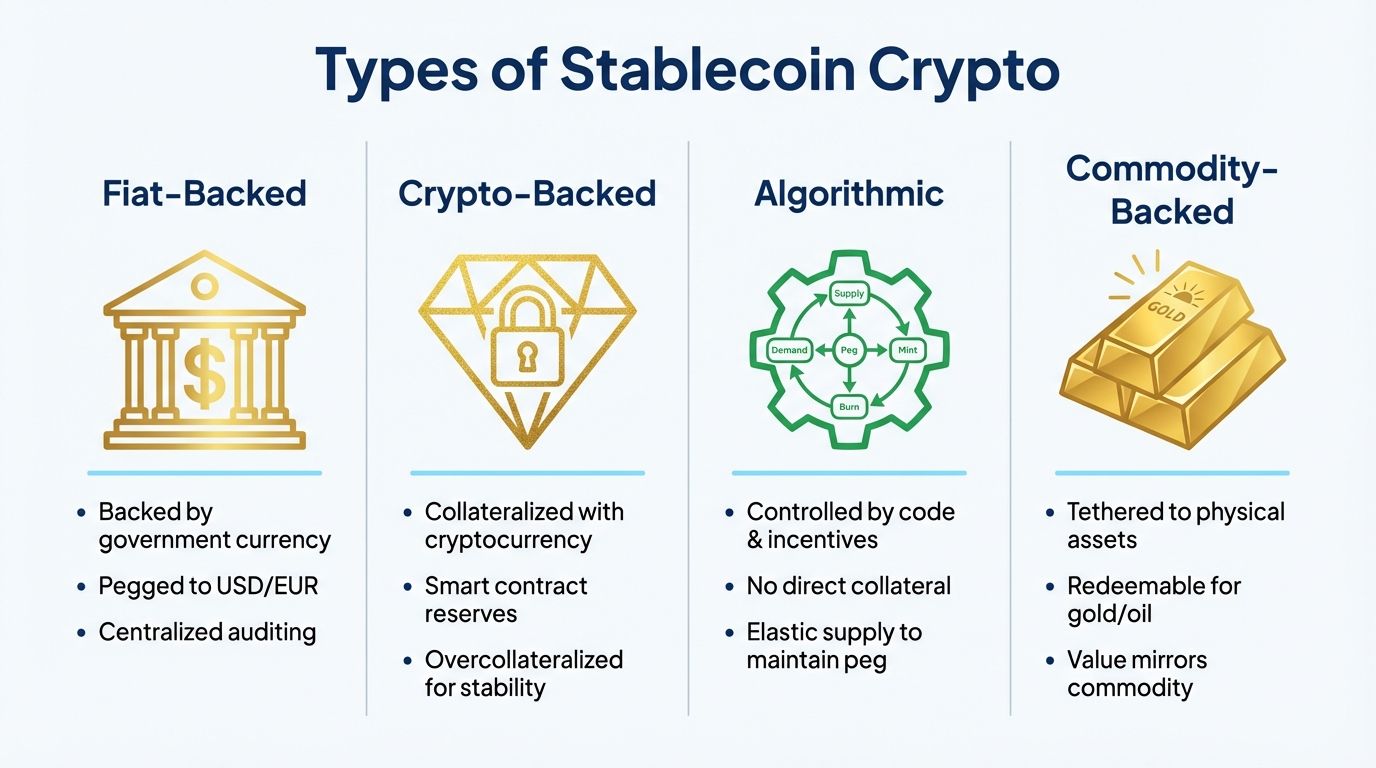
Fiat-backed stablecoins are the most straightforward type. The issuer holds actual fiat currency, such as US dollars, in a reserve bank account, and issues an equivalent amount of tokens. USDT and USDC are the two largest examples. When you redeem a fiat-backed stablecoin, the issuer theoretically sends you the equivalent fiat amount. The stability of these coins depends on trust in the issuer and the integrity of their reserves.
Crypto-backed stablecoins use other cryptocurrencies as collateral instead of fiat. Because crypto is volatile, these systems are typically overcollateralized. DAI, for example, requires users to lock up more value in ETH or other assets than the DAI they receive. If the collateral drops in value, the system liquidates positions automatically to protect the peg. This type is more decentralized but more complex to manage.
Algorithmic stablecoins attempt to maintain their peg purely through software mechanisms, often involving a paired token that absorbs price fluctuations. There are no reserves. Instead, smart contracts expand or contract the supply of the stablecoin based on demand signals. This model proved fragile and led to one of the largest collapses in crypto history.
Commodity-backed stablecoins are pegged to real-world assets like gold or oil. Paxos Gold (PAXG) and Tether Gold (XAUT) are examples where each token represents ownership of a specific amount of physical gold stored in a vault. These coins offer exposure to commodity prices with blockchain convenience, though they do not maintain a fixed dollar value since commodities fluctuate in price.
3. How Stablecoins Maintain Their Peg
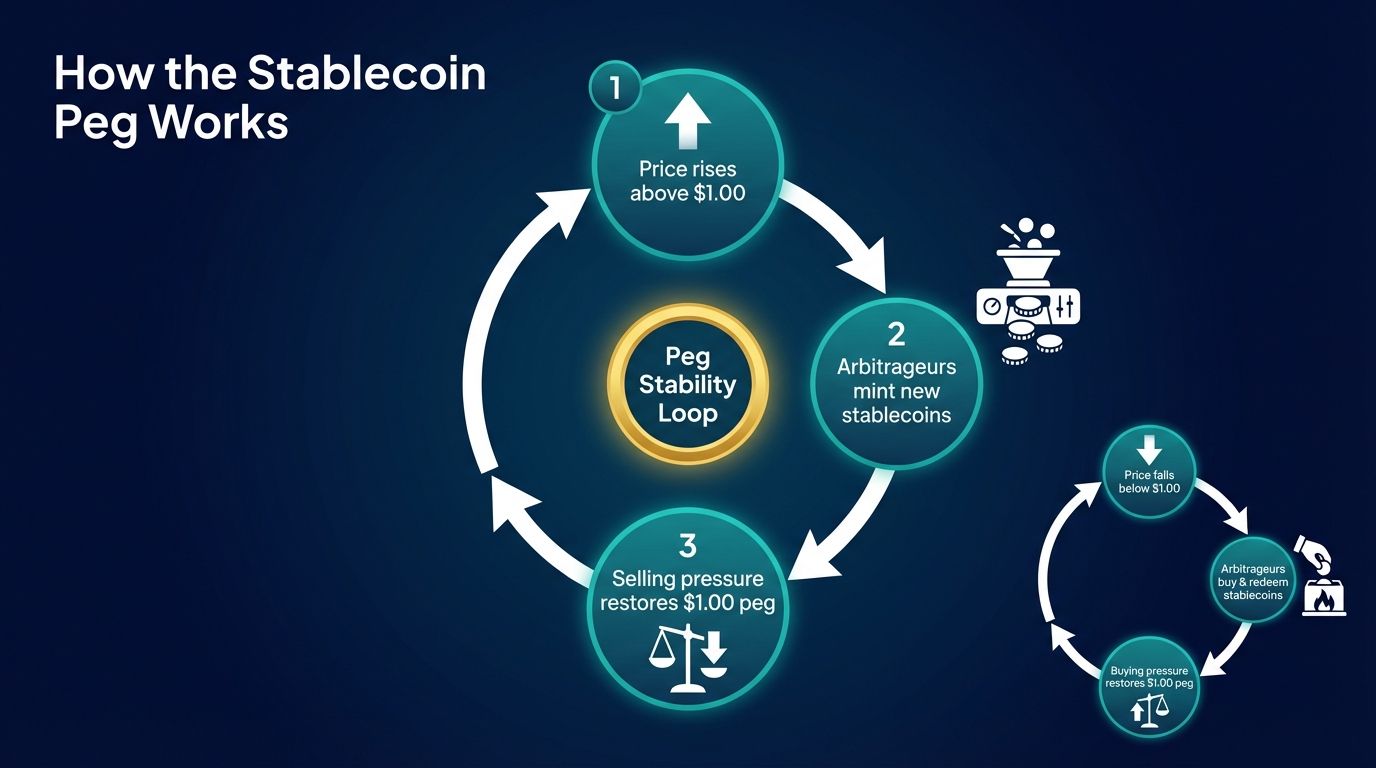
Maintaining a stable price peg requires constant balancing of supply and demand. The mechanism varies by stablecoin type, but the core logic is the same: if the price drifts above or below the target, the system needs a correction mechanism.
For fiat-backed stablecoins, the peg is maintained through arbitrage. If USDT trades at $1.01 on an exchange, arbitrageurs can mint new USDT at $1.00 from the issuer and sell it at the higher market price, earning the difference. This selling pressure pushes the price back down. If USDT trades at $0.99, arbitrageurs buy cheap tokens and redeem them for $1.00 from the issuer, pushing the price back up. This simple loop keeps fiat-backed stablecoins tightly pegged under normal conditions.
For crypto-backed stablecoins like DAI, the MakerDAO protocol adjusts borrowing rates (the stability fee) to incentivize or discourage the creation of new DAI. It also uses a savings rate to attract holders when supply needs to contract. Liquidations of undercollateralized vaults act as a floor under the system's solvency.
Algorithmic stablecoins tried to maintain pegs using mint-and-burn mechanics tied to a companion token. However, this created what analysts call a "death spiral" risk, where loss of confidence triggers a cascade of selling that destroys both tokens simultaneously. This is exactly what happened with TerraUSD (UST) in May 2022, causing tens of billions in losses within days.
- Arbitrage loops: Price deviations create profit opportunities that pull the price back to peg.
- Interest rate adjustments: Protocols increase or decrease incentives for holding or minting the stablecoin.
- Liquidation engines: Automatic collateral auctions protect overcollateralized systems from insolvency.
- Reserve redemptions: Centralized issuers allow direct redemption, anchoring market price to the reserve value.
4. Use Cases for Stablecoin Crypto
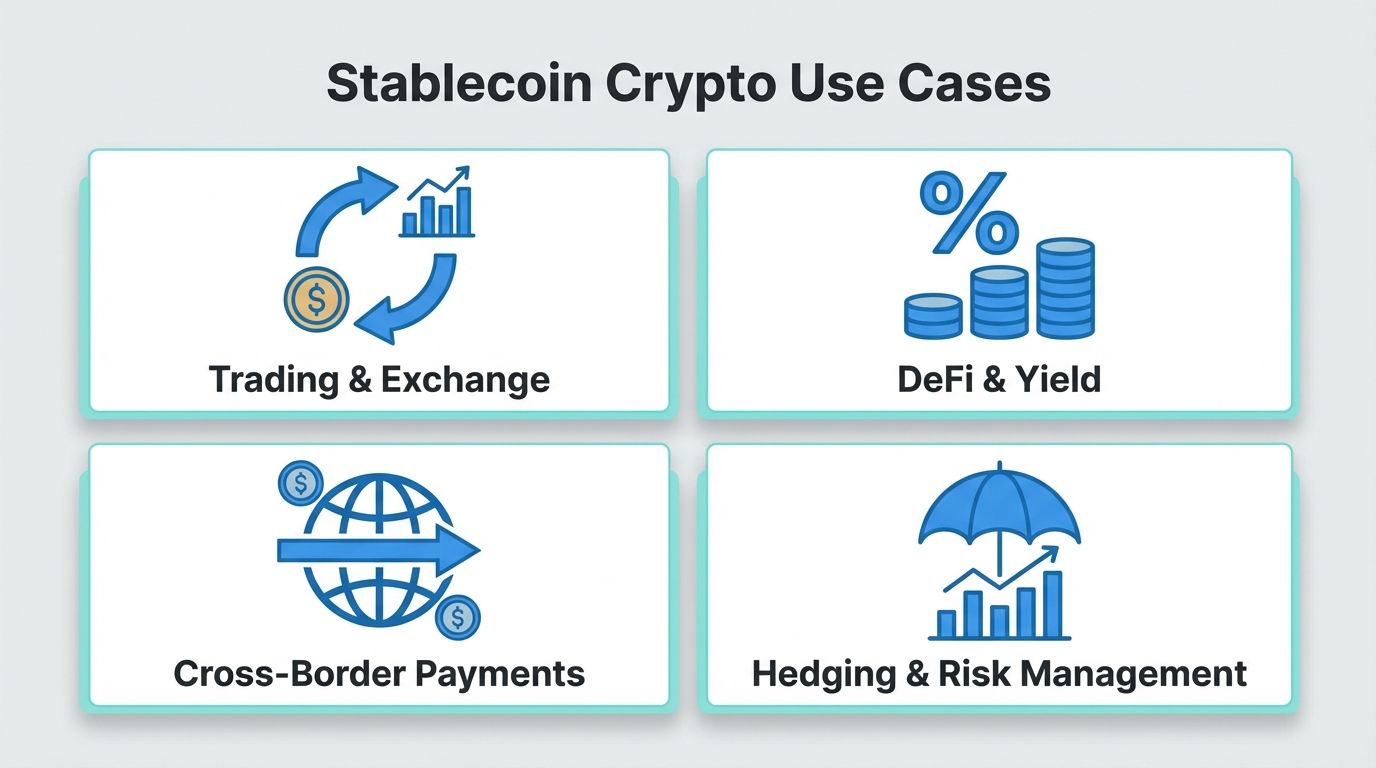
Stablecoins have moved far beyond a simple parking spot for crypto gains. The 2026 cycle introduced major TradFi stablecoin launches from Western Union, PayPal, and others, expanding the category beyond crypto-native issuers. Today they power a wide range of financial activities across trading, decentralized finance, cross-border payments, and risk management. The expansion of stablecoin infrastructure across major chains has turned them into a foundational rail for daily on-chain transactions.
Trading and exchange: Most crypto trading pairs on centralized and decentralized exchanges use stablecoins as the quote currency. A trader who believes Bitcoin is overbought can sell BTC for USDT and wait for a better entry, without leaving the crypto ecosystem or triggering a taxable fiat conversion in some jurisdictions. This is one of the most common uses of stablecoin crypto among active traders.
DeFi and yield generation: Stablecoins are the backbone of decentralized finance. Lending protocols like Aave and Compound allow users to deposit stablecoins and earn interest from borrowers. Liquidity pools on decentralized exchanges incentivize stablecoin deposits with trading fee revenue and governance tokens. Some protocols have offered double-digit APY on stablecoin deposits, though these yields fluctuate with market demand.
Cross-border payments: Traditional international wire transfers can take days and cost significant fees. Sending USDC from one country to another takes seconds and costs a fraction of a cent in some networks. For freelancers, remote workers, and businesses operating internationally, stablecoins offer a practical alternative to SWIFT transfers and currency conversion fees.
Hedging and risk management: During periods of market stress, traders convert volatile assets into stablecoins to preserve capital without fully exiting the market. This allows them to move quickly back into positions when conditions improve. Portfolio managers also use stablecoins to rebalance exposure without selling to fiat, which can simplify accounting in certain contexts.
5. Risks and Depegging Events in Stablecoin Crypto
Stablecoins carry real risks that users often underestimate, especially because the word "stable" implies safety. In practice, every type of stablecoin has a specific failure mode, and history has shown that these failures can be sudden and catastrophic.
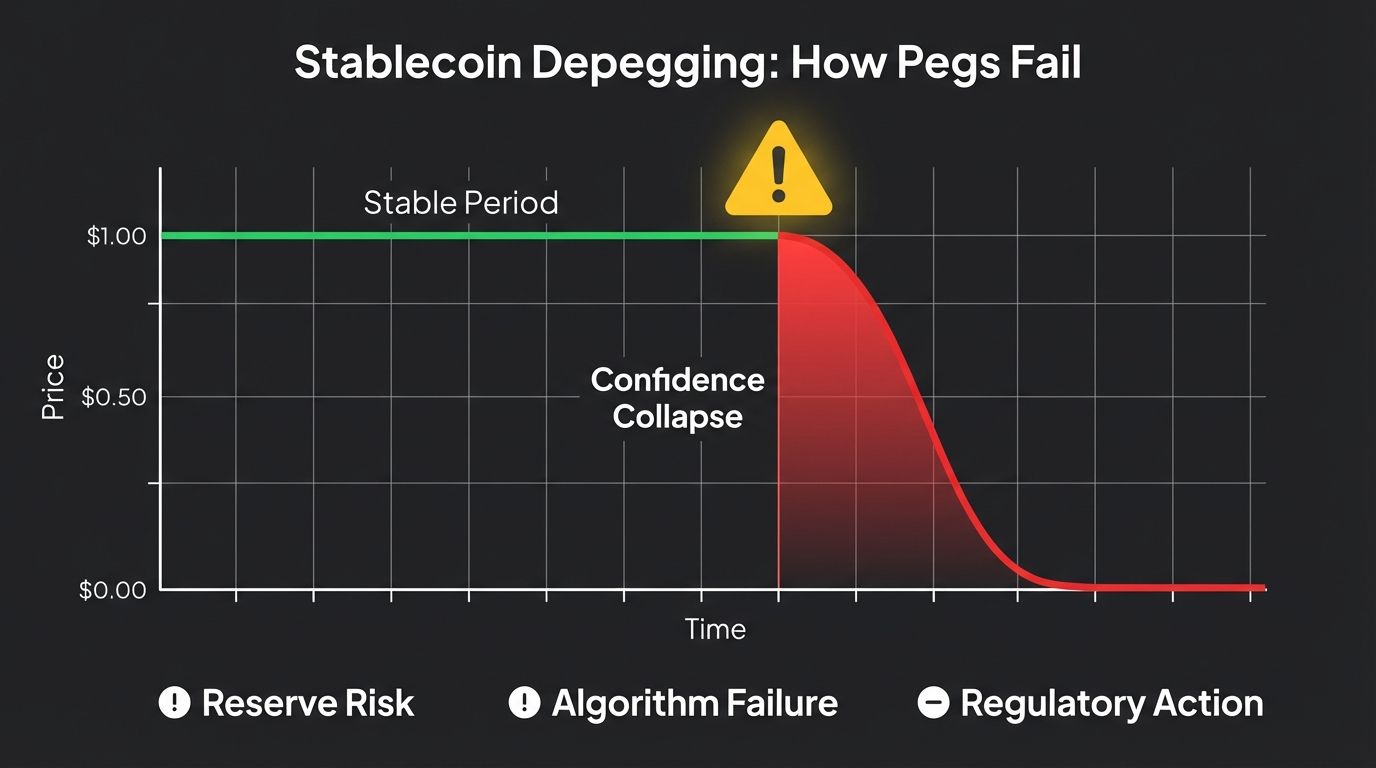
The most dramatic example of stablecoin failure was the collapse of TerraUSD (UST) in May 2022. UST was an algorithmic stablecoin paired with the LUNA token. When confidence in the system wavered, large holders began selling UST, pushing its price below $1.00. The algorithm responded by minting more LUNA to absorb selling pressure, but this flooded the market with LUNA tokens, crashing its price. This made UST holders even less confident, triggering more selling in a death spiral. Within days, UST lost nearly all of its value, destroying approximately $40 billion in combined market cap and triggering a broader crypto market selloff.
Fiat-backed stablecoins face their own risks. In March 2023, USDC briefly lost its peg when Circle announced it had $3.3 billion in reserves held at Silicon Valley Bank, which had just failed. USDC dropped to around $0.87 before recovering once Circle confirmed access to its funds would be restored. The event highlighted how counterparty risk in traditional banking can affect even well-collateralized stablecoins.
Other documented risks include:
- Reserve opacity: Some issuers have faced scrutiny over whether their reserves are fully backed by actual cash or by riskier assets like commercial paper.
- Smart contract vulnerabilities: Crypto-backed and algorithmic stablecoins run on code that can have exploitable bugs.
- Regulatory risk: Governments are increasingly scrutinizing stablecoin issuers, and regulatory action could restrict redemptions or freeze assets.
- Liquidity crises: Even a well-backed stablecoin can lose its peg temporarily if redemption demand overwhelms the issuer's ability to process withdrawals quickly.
- De-listing risk: Exchanges occasionally remove support for specific stablecoins, reducing liquidity and making it harder to exit positions at peg.
The lesson from these events is that diversifying across stablecoin types and issuers reduces concentration risk. Relying entirely on a single stablecoin exposes a trader to the specific failure mode of that one system.
6. How to Trade and Monitor Stablecoin Crypto Effectively
For active crypto traders, stablecoins are not just a safe haven asset. They are a strategic tool. The ability to move quickly between volatile assets and stablecoins, track peg stability across multiple coins, and execute trades based on market conditions is a real competitive advantage.
Monitoring stablecoin peg health in real time is important when you have significant capital in play. A stablecoin trading at $0.995 versus $1.000 might seem trivial, but at scale, or as an early warning signal of a broader depegging event, that gap matters. Traders who noticed UST drifting below peg in early May 2022 and acted quickly avoided catastrophic losses.
Setting up price alerts for stablecoins helps you catch depegging signals before they become crises. You can also use trading bots to automatically rebalance out of a stablecoin that begins drifting from its peg. Portfolio tracking tools that display all your holdings in one dashboard, including stablecoin balances across multiple exchanges, give you a real-time picture of your risk exposure.
Keeping a portion of your portfolio in stablecoins at all times also enables fast execution when opportunities arise. When the market drops sharply, traders with stablecoin reserves can enter positions immediately without waiting for bank transfers to clear. Speed and readiness are often the difference between capturing a move and missing it entirely.
Take Control of Your Stablecoin Strategy with Altrady
Managing stablecoins across multiple exchanges, tracking peg deviations, setting alerts, and executing trades quickly all become significantly easier with the right platform. Altrady is a professional crypto trading terminal that connects to all major exchanges in one place, giving you a unified view of your stablecoin holdings and volatile assets at the same time.
With Altrady, you can set up price alerts for stablecoin pairs, build and automate trading bots that shift between stablecoins and other assets based on market signals, and analyze your portfolio performance with built-in reporting tools. Whether you are using stablecoins as a safe haven during volatility or as the base currency for your active trades, Altrady gives you the infrastructure to act faster and with more precision.
Start your free trial with Altrady today and see how a professional trading terminal changes the way you manage stablecoin crypto in your portfolio. No credit card required to get started.
FAQ: Stablecoin Crypto
What is the safest type of stablecoin crypto?
Fiat-backed stablecoins issued by regulated entities, such as USDC issued by Circle, are generally considered the safest because they are backed by actual cash and cash-equivalent reserves held in regulated financial institutions. However, "safe" is relative. As the 2023 USDC depegging event demonstrated, even fiat-backed stablecoins carry counterparty risk tied to the health of the banks holding their reserves. Diversifying across two or more reputable stablecoins reduces concentration risk.
Can you lose money holding stablecoin crypto?
Yes. If a stablecoin loses its peg and you are unable or unwilling to sell before the price crashes, you can experience significant losses. This is exactly what happened to holders of TerraUSD (UST) in 2022, where the stablecoin dropped from $1.00 to nearly $0.00 within days. Even temporary depegging events can result in losses if you sell at the wrong moment. Additionally, holding stablecoins in DeFi protocols introduces smart contract risk, where a hack or exploit could result in losing your deposited funds.
Is stablecoin crypto regulated?
Regulation of stablecoins varies by country and is still evolving rapidly. In the United States, stablecoin issuers operate under a patchwork of state and federal regulations, with ongoing debates about whether they should be treated as bank deposits or securities. The European Union's MiCA regulation, which took effect in 2024, introduced specific rules for stablecoin issuers operating in Europe, including reserve requirements and redemption rights. In many jurisdictions, holding stablecoins as a retail user is not directly regulated, but the platforms facilitating their issuance and trading are increasingly subject to licensing requirements.
What happened to UST and why did it depeg?
TerraUSD (UST) was an algorithmic stablecoin that maintained its $1.00 peg through a mint-and-burn mechanism tied to the LUNA token. In May 2022, a series of large coordinated UST withdrawals from the Anchor Protocol created downward price pressure. The algorithm responded by minting more LUNA to restore the peg, but this hyperinflation of LUNA supply destroyed its value. As LUNA collapsed, confidence in UST evaporated, triggering a bank-run style sell-off. The death spiral erased roughly $40 billion in value within 72 hours and is considered one of the largest single financial collapses in crypto history.
How do traders use stablecoin crypto in their strategies?
Traders use stablecoins in several key ways. First, as a parking asset during downturns, converting volatile holdings to stablecoins to preserve capital without exiting the market entirely. Second, as the quote currency for executing trades across multiple pairs on an exchange. Third, as collateral in DeFi protocols to borrow other assets or earn yield without selling their core holdings. Fourth, for dollar-cost averaging, where a trader holds stablecoins and deploys them in fixed amounts at regular intervals to build a position in a volatile asset over time. The flexibility of stablecoins makes them one of the most versatile tools in an active trader's toolkit.