

A chart is pumping. Social media is yelling about “the next big breakout.” Your alerts already went off, and you ignored them. Now the candles are ripping without you, and your brain starts whispering what every trader hates to admit.
“If I don’t get in now, I’m going to miss everything.”
That is FOMO swing trading in a nutshell. It’s the psychological trap that makes smart traders behave like beginners the moment the market moves fast. The problem is simple. When you chase a pump, you often buy high. When the hype fades, you panic. That usually ends with selling low. It’s the opposite of the goal you set when you first learned what swing trading is supposed to be.
But FOMO isn’t random weakness. In crypto, it’s a predictable force built right into the structure of the market. The good news is you can control it. Once you understand how it works and build the right habits, FOMO loses its grip and your swing trading becomes sharper, calmer, and much more profitable.
This guide breaks down why FOMO hits so hard in crypto, what it does to traders, and how to defeat it with simple tactics that actually work in the real world.
What FOMO Really Is in Crypto Swing Trading
FOMO in crypto swing trading shows up when you feel anxious watching others make money on a move you did not catch. It hits during sudden spikes, loud social media hype, or when a coin you have been tracking starts running without warning.
Crypto makes this emotional pull even stronger. The market never sleeps. Prices jump at random hours. Twitter, Telegram, and Discord push constant noise. Every pump looks like the start of something huge, and every missed move feels like a personal failure.
The result is a cycle that traders know too well. You see a rally you don’t want to miss out on. You enter late and pay an inflated price. The move cools off. You panic. You exit at the worst possible moment. You look at the chart after and wonder why you did that to yourself yet again.
FOMO swing trading traps you because it shifts your focus away from strategy and toward emotion. You stop making decisions based on data and start reacting to fear. The more volatile the market, the easier it is to fall into that trap.
Why Crypto Makes FOMO Stronger
Crypto swing trading creates the perfect environment for FOMO to thrive. A few reasons:
- High volatility. A coin can pump 20 percent in minutes. Your brain treats that as danger mixed with opportunity.
- 24-hour markets. There’s no closing bell. You always feel like something is happening somewhere.
- Social media hype. Influencers, paid shills, and pumps disguised as “alpha” flood your feed. When everyone sounds confident, resisting becomes harder.
- Whale manipulation. Big players push prices to create excitement. Retail traders jump in late and become exit liquidity.
- Short news cycles. A single headline can move a chart. Missing it feels like missing the entire trend.
This environment keeps your fight or flight response constantly active, which makes emotional trading much more likely. The goal isn’t to remove emotion completely, but to keep it in the back seat while your strategy stays in control.
Tactics That Actually Work To Beat FOMO in Swing Trading
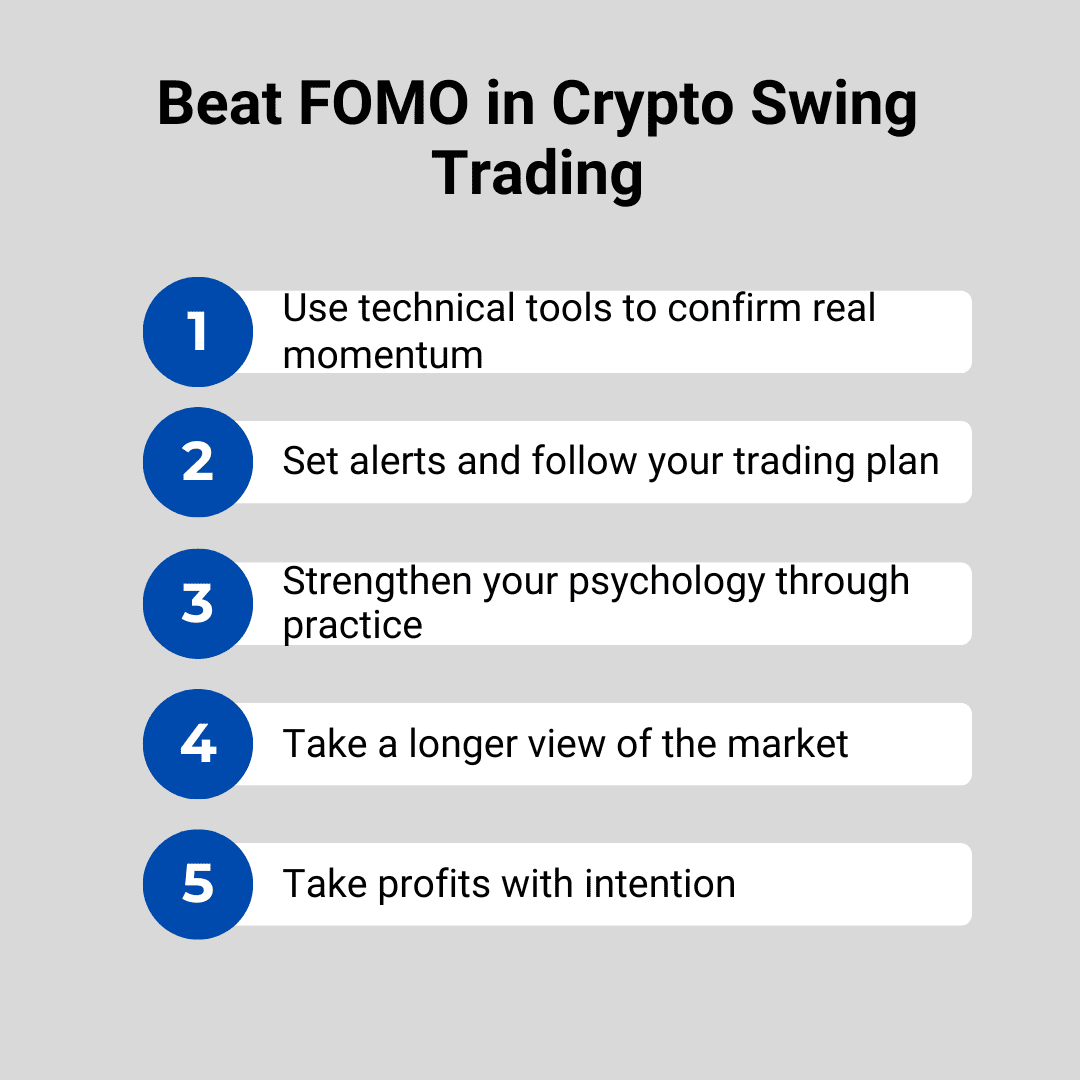
Here are the most effective methods to control FOMO while still trading aggressively and confidently.
1. Use Technical Tools To Confirm Real Momentum
FOMO ignores logic. Technical analysis brings you back to reality.
The simplest way to avoid chasing hype is to step back and check the higher time frames. Before entering any swing trade, look at the 4-hour and daily charts. If the macro trend does not support the move, you already know to wait.
A few tools help you identify when a move is genuine and when it is just noise:
- VWAP. It helps you see if price is extended. If price is far above VWAP on multiple timeframes, the move is overcooked.
- OBV. On Balance Volume reveals whether the pump has true buying pressure or if it is built on thin volume that can collapse.
- Ichimoku Cloud. Great for spotting trend strength and potential reversals. If the price shoots far above the cloud, momentum might be unsustainably stretched.
- RSI. If RSI is overheated on the 4-hour or daily chart, jumping in becomes dangerous. You wait for the pullback instead of chasing.
Pair that with on-chain metrics and volume data. Look for clear inflows, whale accumulation, and real liquidity. When a pump is driven only by hype, the on-chain data looks weak. That alone can save you from a bad entry.
This approach protects you from emotional trades while keeping you ready for the moves that actually matter.
2. Set Alerts and Follow Your Trading Plan
If you want to kill FOMO at the root, remove guesswork.
Every swing trader should have a written plan that includes:
- Entry levels
- Exit targets
- Stop loss placement
- Position sizing rules
- Maximum number of trades per week
Once these are set, you let alerts trigger your decisions instead of your emotions.
When you have a plan, you stop chasing. You wait for your levels. If the price never comes back to your entry, that is fine. There are always more opportunities.
Limiting the number of trades helps too. Overtrading is often just FOMO disguised as “activity.” Jumping between trending coins also increases fees and reduces focus. Pick a few charts and stick to them. That alone improves discipline.
3. Strengthen Your Psychology Through Practice
FOMO is psychological. You cannot fix it with indicators alone. You need habits that make your brain less reactive.
A few proven methods:
- Accept missed moves. It is impossible to catch them all. Even the best traders only capitalize on a fraction of the market. Missing a pump does not mean you failed. It means you are a trader, not a gambler.
- Use paper trading. Simulated trading builds confidence without emotional pressure. Once your strategy works consistently in simulation, real trading becomes calmer.
- Keep a journal. Write down why you entered and exited every trade. In a few weeks, you will spot patterns. Journaling makes emotional mistakes obvious, and the improvement is dramatic.
- Avoid hype sources. If someone on social media makes you feel rushed or anxious, mute them. Curate your feed like your portfolio. Noise is expensive. Calm is profitable.
When you train your mind, your technical skills suddenly work the way they were supposed to.
4. Take a Longer View of the Market
Zooming out is one of the easiest ways to break the emotional cycle. Traders fall into FOMO swing trading because they stare at small time frames. A five minute chart makes everything look urgent.
Shift your focus:
- Look at daily and weekly candles
- Study broader trends
- Pay attention to support and resistance zones that actually matter
Once you see the big picture, you realize you don’t need to time every peak or bottom. You only need to catch the middle of the move. That is where swing traders make their money.
Longer-term thinking also reduces emotional pressure. You stop asking “what did I miss” and start asking “what is coming next.”
5. Take Profits With Intention
FOMO isn’t only about entering late. It also shows up when you hesitate to exit. You hold because you think the pump will continue forever. You fear leaving money on the table.
The solution is simple. Decide your profit targets before the trade and lock them in. You can scale out instead of closing everything at once. Taking partial profits gives you confidence and protects you from emotional swings. When part of your position is secured, the rest becomes easier to manage.
This removes the panic of “should I sell now or wait” and keeps your decision-making clean.
Final Thoughts
Beating FOMO swing trading isn’t about eliminating emotion. It’s about replacing emotional reactions with structured habits. When you combine technical confirmation, disciplined planning, psychological awareness, and long-term perspective, FOMO becomes much weaker.
You start trading only when conditions match your strategy. You stop chasing hype and avoid impulsive entries. Most importantly, you protect your capital. That’s what keeps you in the game long enough to see real results.
Crypto rewards those traders who think clearly when everyone else is panicking or rushing. Build your process and trust your rules. Let the setup come to you. If you do that consistently, FOMO stops controlling your decisions and your swing trading becomes far more profitable.