
Solana moves fast. That is what makes SOL exciting for traders, but it is also what makes manual trading harder. Price can break a level, reverse, or run before you finish checking your chart.
A Solana trading bot can help you turn a clear plan into repeatable execution. But it is not a shortcut to guaranteed profit. A bot only follows the rules you give it, so the real advantage still comes from strategy, risk control, and discipline.
What Is a Solana Trading Bot?
A Solana trading bot is an automation tool that places trades based on predefined rules. These rules can include price levels, alerts, indicators, order size, take-profit targets, and stop-loss conditions.
For example, a bot can open a SOL trade when price breaks above resistance. It can also place buy and sell orders inside a range, or build a position gradually using a DCA plan.
The main benefit is consistency. A bot does not hesitate, panic, chase candles, or change the plan because of emotion. But that also means a poor setup can lose money faster if the rules are weak.
When a Solana Trading Bot Makes Sense
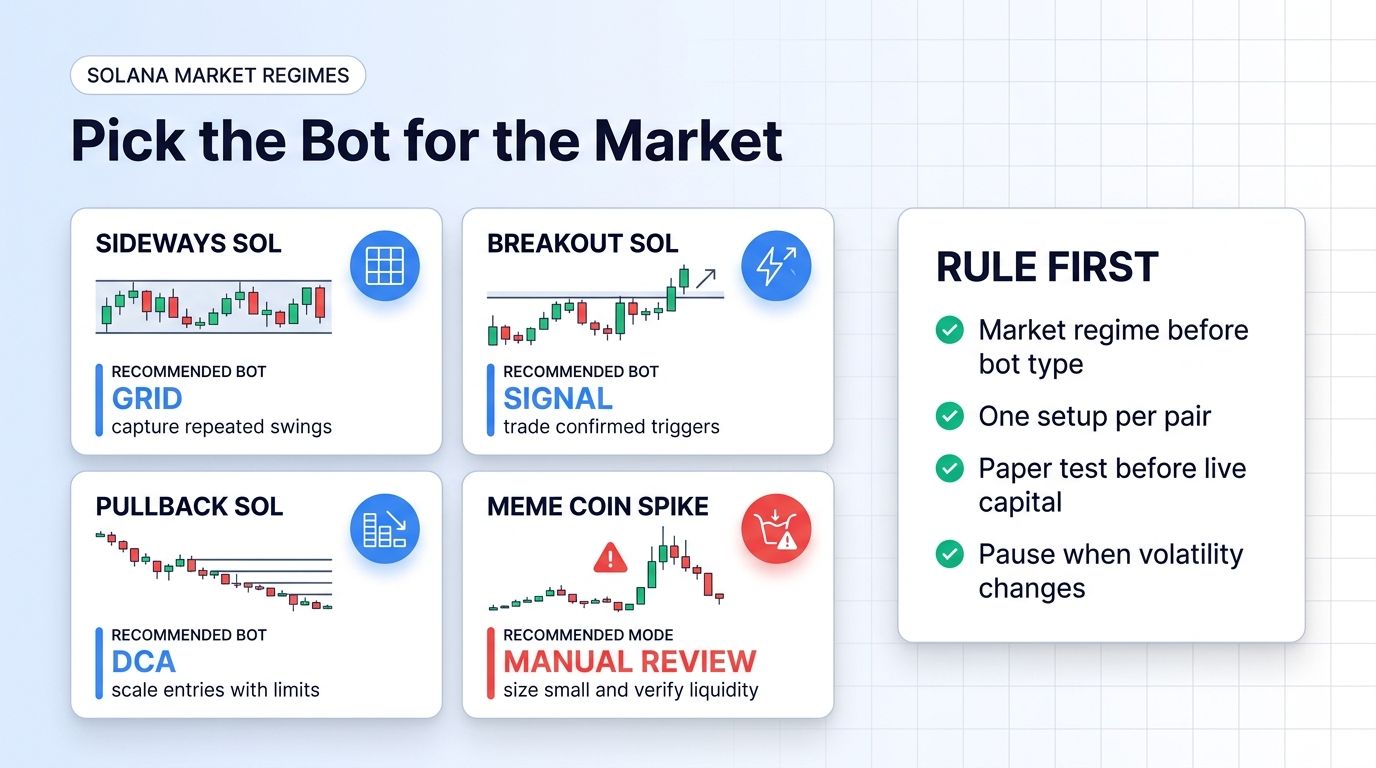
A bot works best when the market condition is clear. Before choosing the bot type, look at what SOL is actually doing.
If SOL is moving sideways between clear support and resistance, a Grid Bot may fit. It can place buy and sell orders across the range and try to capture repeated price swings.
If SOL is approaching a breakout level, a Signal Bot may be better. It can wait for a defined trigger before opening the trade.
If you want to build a SOL position gradually, a DCA Bot can help. It splits entries into planned levels instead of putting the full position at one price.
For Solana meme coins, be more careful. Liquidity can be thin, spreads can be wide, and price can move violently. In that case, automation should be smaller, stricter, and easier to pause.
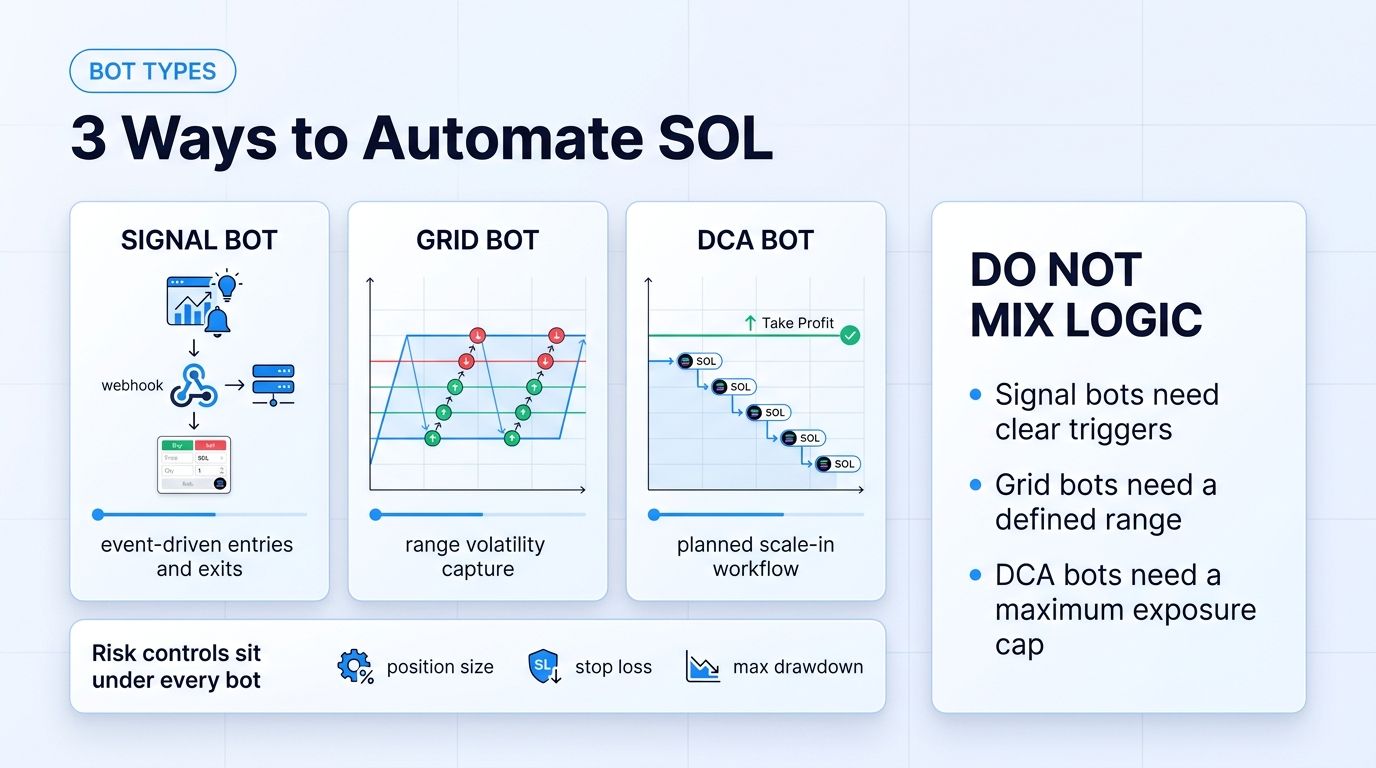
3 Bot Types for SOL Trading
Signal Bot
A Signal Bot waits for a specific trigger. This can come from a TradingView alert, webhook, indicator condition, or another trading signal.
For example, you may only want to enter SOL if price breaks resistance and closes above it. The Signal Bot helps execute that rule without requiring you to sit at the screen all day.
This works best for breakout, momentum, and confirmation-based setups. The key is to define the trigger clearly before the bot is turned on.
Grid Bot
A Grid Bot is designed for range movement. It divides a price zone into multiple buy and sell levels.
When price moves down, the bot can buy at lower grid levels. When price moves back up, it can sell at higher levels. This can work well when SOL keeps moving inside a defined range.
The risk is trend movement. If SOL breaks strongly in one direction, the grid may no longer match the market. That is why every grid needs a stop, pause rule, or range invalidation level.
DCA Bot
A DCA Bot builds a position in stages. Instead of entering with the full amount at once, it places planned entries at different price levels.
This can reduce entry timing pressure. But it must have a maximum allocation. Without a cap, DCA can turn one small idea into a large unwanted position.
Risk Controls Before You Automate SOL
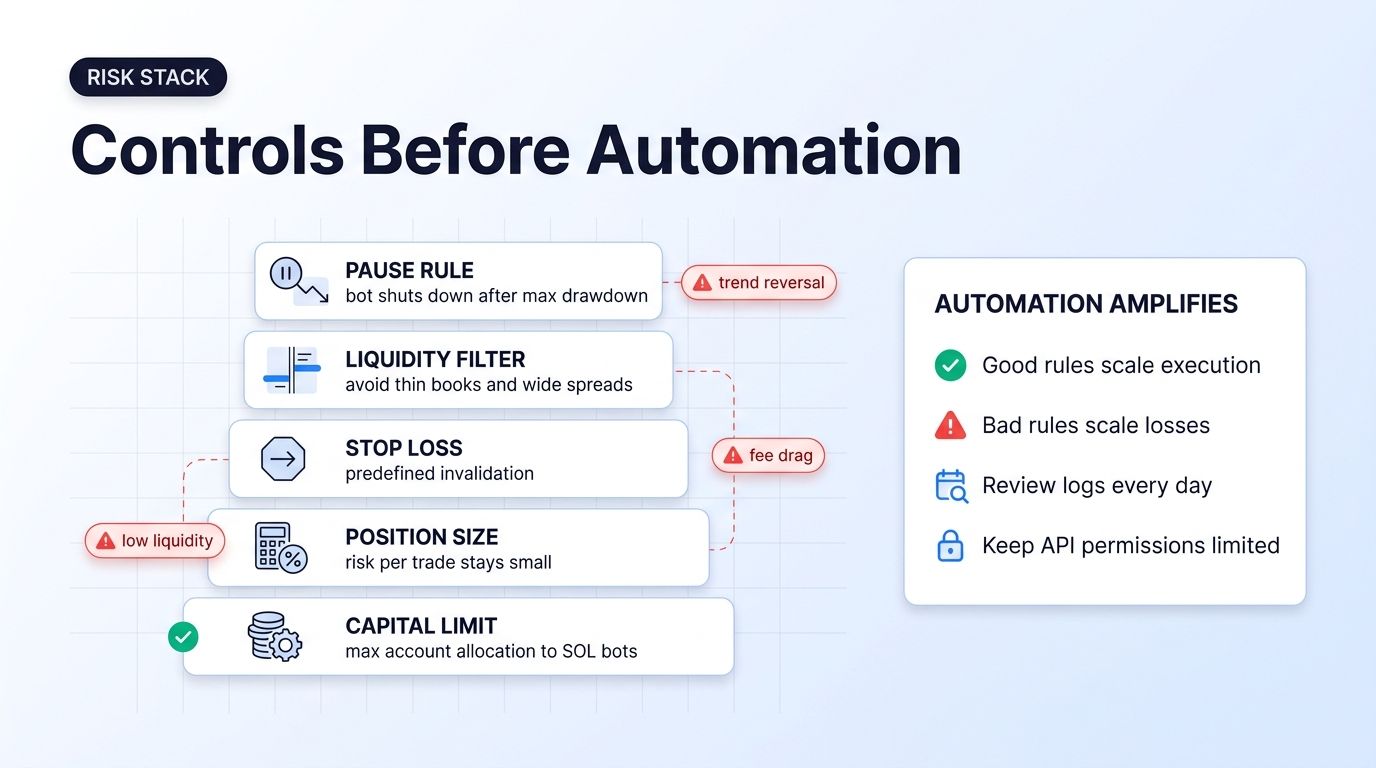
Automation does not remove risk. It removes hesitation. That can be helpful when your rules are good, and dangerous when your rules are unclear.
Before running any Solana trading bot, define these controls:
- Maximum capital allocation: decide how much of your account can be used for SOL bot strategies.
- Risk per trade: know the amount you can lose if one trade fails.
- Stop-loss logic: define the price, structure, or condition that invalidates the setup.
- Daily loss limit: set a point where the bot pauses and you review the strategy.
- Liquidity filter: avoid pairs with thin order books, wide spreads, or weak volume.
- Fee and slippage budget: make sure the strategy can beat real trading costs.
- Pause rule: decide when market conditions are no longer suitable for the bot.
Also check your API settings carefully. If you connect an exchange to a trading platform, avoid giving withdrawal permission unless it is truly required. For most trading workflows, trading permission is enough.
How to Build a Solana Bot Workflow in Altrady
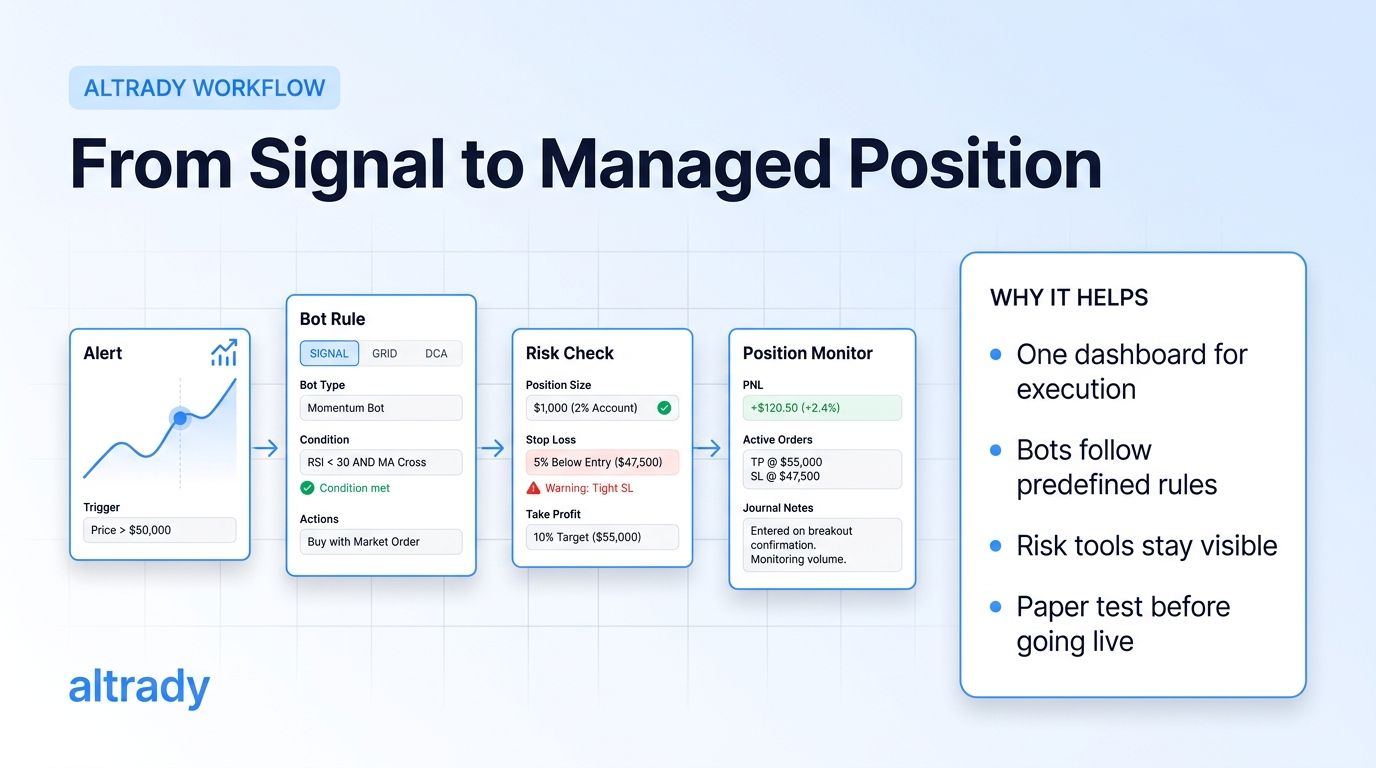
Altrady can help traders manage SOL bot workflows in one place. You can use Signal Bot, Grid Bot, DCA Bot, Smart Trading, paper trading, alerts, and the Risk Reward Calculator as part of a structured setup.
A simple workflow looks like this:
- Choose the SOL market you want to trade.
- Decide whether the setup needs Signal Bot, Grid Bot, or DCA Bot.
- Set position size, stop-loss, and maximum exposure.
- Test the strategy with paper trading.
- Start small if you move to live capital.
- Review bot logs, open orders, and drawdown every day.
This keeps the bot inside a managed trading plan. The goal is not to automate every decision. The goal is to automate the parts of the plan that should stay consistent.
Common Mistakes With Solana Trading Bots
The first mistake is using one bot setting for every SOL market. SOL spot pairs, SOL perpetuals, and Solana ecosystem tokens do not behave the same way.
The second mistake is running a grid during a strong trend. Grid bots need range movement. When the market starts trending, the setup should be reviewed.
The third mistake is using DCA without a limit. Scaling into a position can be part of a plan, but unlimited adding is not risk management.
The fourth mistake is ignoring fees and slippage. A strategy that looks good before costs may be much weaker after real trading costs.
The fifth mistake is skipping paper trading. Testing with full live capital is usually an expensive way to learn.
Read also: Pump.fun memecoin trading and how to trade memecoins if you want to understand the higher-risk side of Solana ecosystem trading.
FAQ
What is a Solana trading bot?
A Solana trading bot is a tool that automates SOL trades based on predefined rules. It can help with entries, exits, order placement, and trade management, but it still needs a clear strategy.
Can a Solana trading bot guarantee profit?
No. A bot cannot guarantee profit. Results depend on the strategy, market condition, liquidity, fees, slippage, and risk management.
When should I use a Grid Bot for SOL?
A Grid Bot may fit when SOL is moving inside a clear range. If SOL starts trending strongly, the grid setup may need to be paused or adjusted.
What is the difference between a Signal Bot and a DCA Bot?
A Signal Bot enters when a trigger happens. A DCA Bot enters gradually at planned price levels. Signal bots are better for event-based setups, while DCA bots are better for staged entries.
Can I use Altrady for Solana bot workflows?
Yes, if the connected exchange supports the SOL market you want to trade. Altrady offers Signal Bot, Grid Bot, DCA Bot, Smart Trading, paper trading, alerts, and risk tools that can support a SOL trading workflow.
Conclusion
A Solana trading bot can help you trade SOL with more structure and less emotion. But the bot is only as good as the rules behind it.
Start with a clear market condition, choose the right bot type, define risk first, and test before going live. Automation should support your trading plan, not replace it.
Try a Solana Bot Workflow With Altrady
Want to build a cleaner SOL trading workflow? Altrady gives you Signal Bot, Grid Bot, DCA Bot, Smart Trading, paper trading, alerts, and the Risk Reward Calculator.
You can start with the 5-day free trial and test your setup before using larger capital. Keep the first setup small, review the results, and only scale when the workflow behaves as expected.