
Chande Momentum Oscillator for Crypto Trading fills a clean Altrady content gap for traders who want to understand a specific technical indicator before adding it to a real workflow.
This guide keeps the focus practical. Instead of treating the Chande Momentum Oscillator as a magic signal, it explains what it measures, how crypto traders can read it, when it works best, and how to combine it with alerts, Smart Trading, and risk planning.
What the Chande Momentum Oscillator Measures
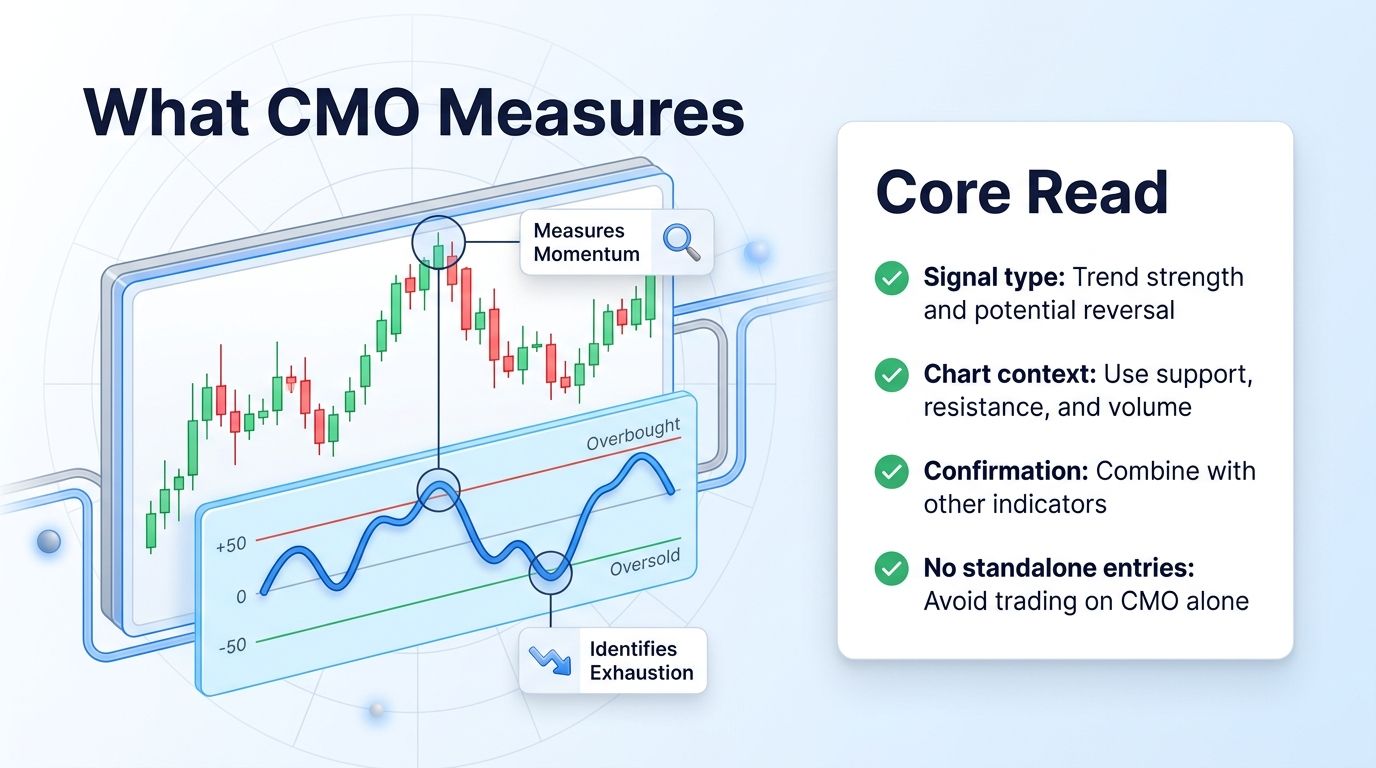
The Chande Momentum Oscillator, often shortened to CMO, measures the balance between recent higher closes and recent lower closes, scaled from minus 100 to plus 100. It gives traders a structured way to read one slice of market behavior instead of reacting to every candle.
In crypto, that matters because a candle can look meaningful on its own while the broader signal remains weak. A good indicator does not remove uncertainty, but it can help separate a tradable setup from ordinary chart noise.
Fidelity describes CMO as the difference between sums of recent higher and lower closes divided by total movement, usually scaled from minus 100 to plus 100.
- Use CMO to organize the chart signal.
- Compare the signal with price structure.
- Avoid treating one reading as a full system.
- Review the same setup across timeframes.
How to Read CMO Signals
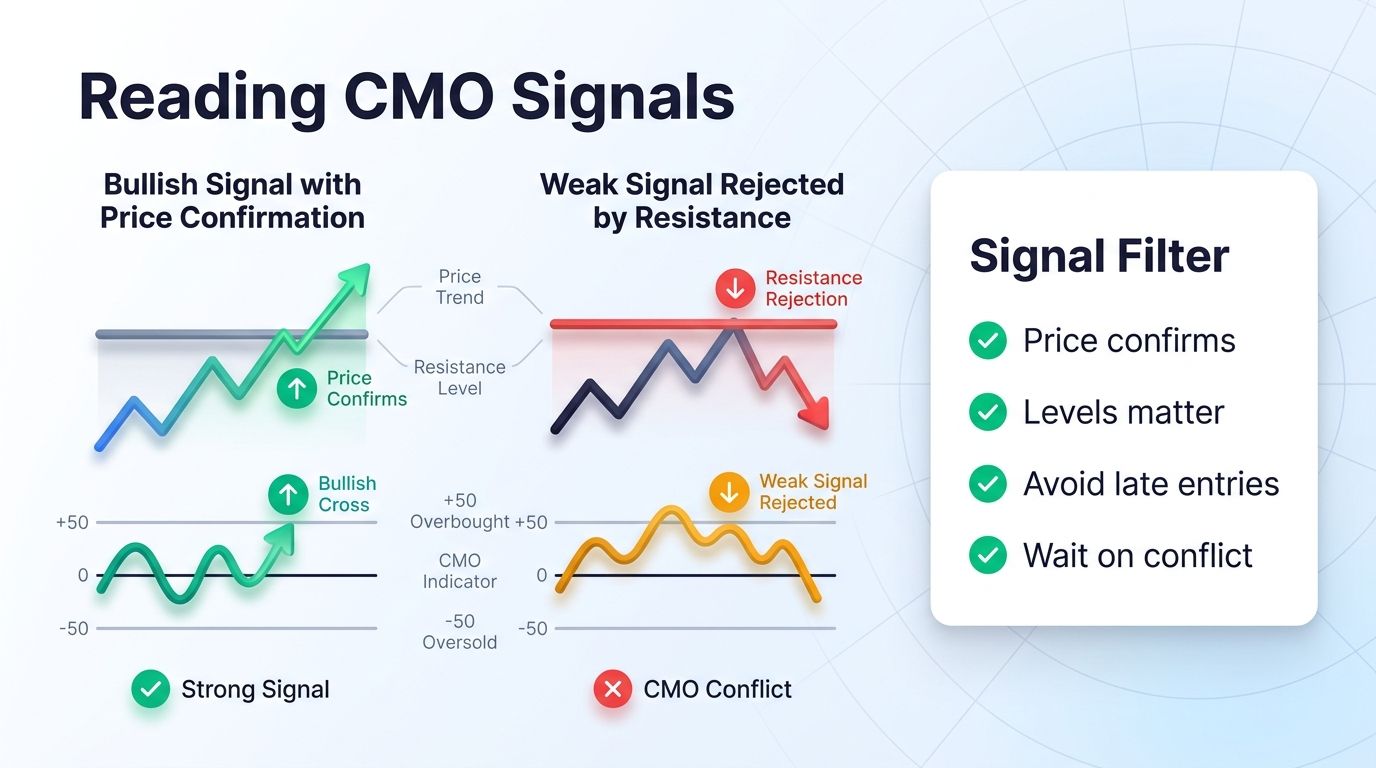
A constructive signal appears when CMO rises through the zero area or forms a higher low while price reclaims structure. That does not mean the trade is automatically valid. It means the trader has a reason to check whether the chart supports the same direction.
A defensive signal appears when CMO falls below zero or makes a lower high while price fails near resistance. In that case, traders should reduce confidence in aggressive long setups, tighten review rules, or wait for a cleaner structure before adding risk.
Signals become more useful when they align with location. If CMO turns positive while price is still trapped below resistance, the signal is weaker. If price breaks structure and CMO confirms, the setup has more weight.
- Separate the signal from the trade entry.
- Check whether price confirms the indicator.
- Use support and resistance as filters.
- Treat disagreement as a reason to wait.
When CMO Works Best in Crypto
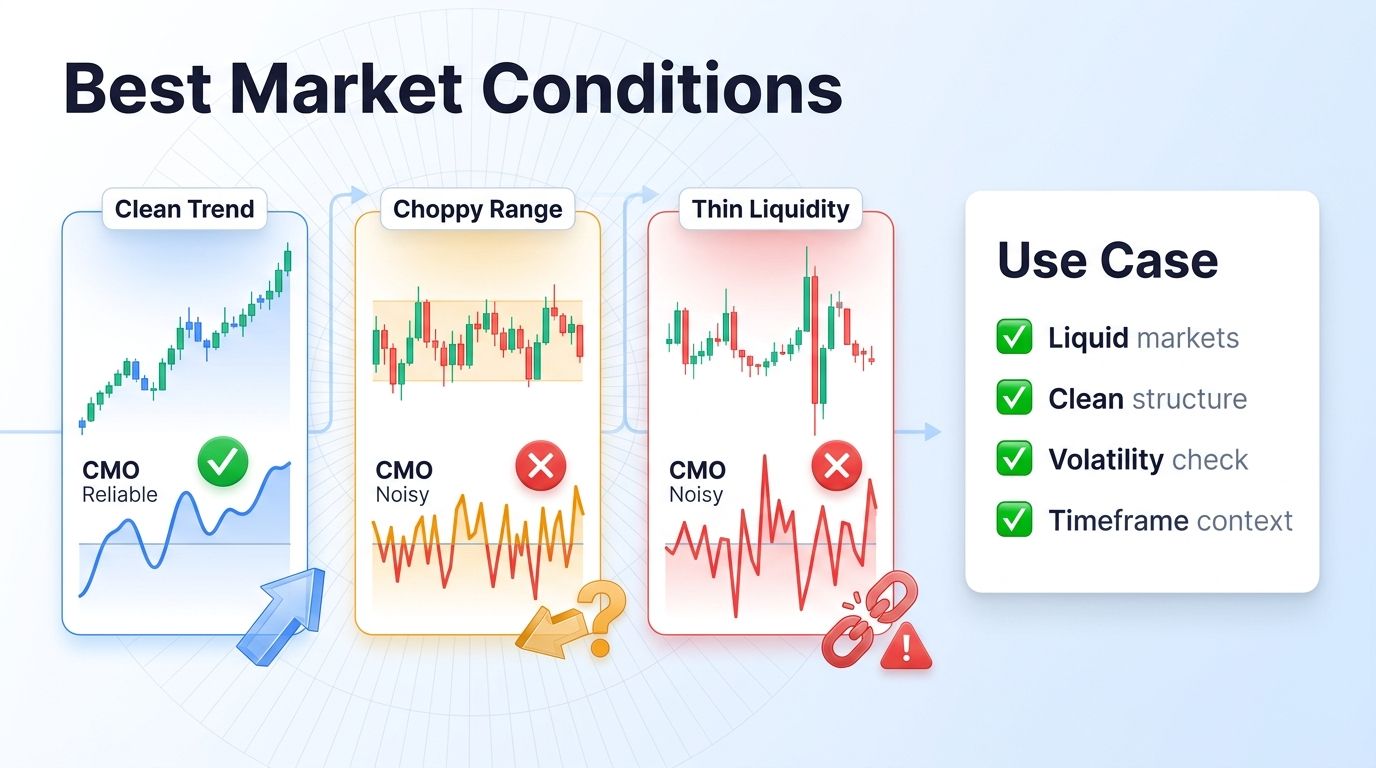
CMO works best in liquid markets where momentum swings are clean enough to compare across candles. In those conditions, the indicator has enough structure to summarize market behavior without being pulled around by every random wick.
It works poorly in flat ranges that push the oscillator from one side of zero to the other without follow-through. Crypto traders see this often on low-volume pairs, weekend sessions, and assets moving only because of short-lived attention.
Liquidity matters because indicators only read the data they receive. A signal on BTC, ETH, or another deep market usually carries more information than the same signal on a thin token with wide spreads and irregular candles.
- Prefer liquid pairs.
- Avoid thin markets with messy candles.
- Check volatility before trusting the signal.
- Use higher timeframes for cleaner context.
How to Combine CMO With an Altrady Workflow
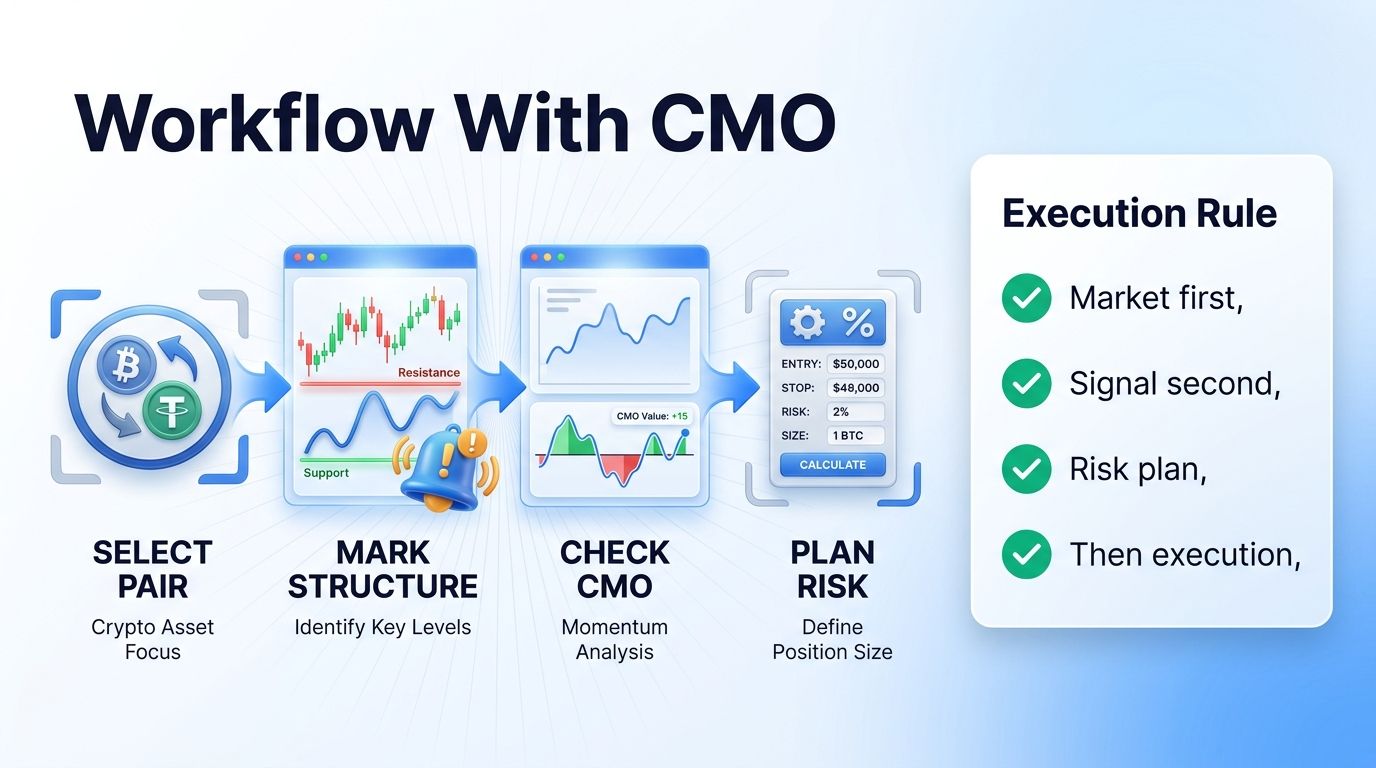
A practical workflow starts with market selection. Choose liquid pairs, mark the trend, and decide whether the asset is trending, ranging, or transitioning. Only then should CMO refine the read.
Next, compare CMO with RSI or with simple price structure. If both point in the same direction and price is near a reasonable level, the setup is easier to evaluate. If they disagree, the cleaner choice is usually to wait.
Altrady traders can keep this process simple: create alerts around key levels, review the indicator on the chart, and use Smart Trading only after the entry, stop, and target are planned. The Risk Reward Calculator should come before execution, not after the position is live.
- Select the market first.
- Use CMO as a signal filter.
- Compare with RSI or price structure.
- Plan risk before execution.
Common CMO Mistakes to Avoid
The first mistake is treating CMO as a prediction engine. It is a structured reading of recent market behavior, not a promise that the next move will follow the indicator.
The second mistake is ignoring chart location. A bullish signal directly below resistance is very different from a bullish signal after a clean reclaim. A bearish signal after a large drop can also arrive too late to justify chasing the move.
The third mistake is skipping risk planning. Indicators help with analysis, but every trade still needs invalidation, position size, and a realistic target. Without those pieces, even a clean signal can become a poor trade.
- Do not treat indicator signals as predictions.
- Filter every signal by chart location.
- Avoid chasing after large moves.
- Define invalidation before entry.
A Simple CMO Review Checklist
Before using CMO on a live setup, write a short checklist. Start with the pair, timeframe, market state, and the exact signal you are waiting for. This prevents the indicator from becoming a vague excuse for an emotional trade.
Then define what would prove the CMO read wrong. That might be a failed reclaim, a close back below support, a break of the trend line, or a change in volume behavior. Decide before the candle moves, not after the loss is already uncomfortable.
Finally, record the result after the trade or after the skipped setup. Over time, that review shows whether the indicator actually helps your process or only adds visual confidence. A useful indicator should improve decisions, not decorate the chart.
- Write the timeframe and market state.
- Define the exact signal before entry.
- Plan what would invalidate the read.
- Review skipped setups as well as taken trades.
Bottom Line
The Chande Momentum Oscillator is useful because it uses both upward and downward momentum directly, which can make momentum shifts easy to compare. That makes it a practical addition to a technical toolkit for traders who want a more specific read than price alone.
The cleanest use is not to trade every CMO signal. Use it to narrow attention, confirm momentum or trend behavior, and decide whether the chart deserves more work. The final decision should still come from price structure, liquidity, and risk-reward.
In crypto, that discipline matters more than the indicator choice. A simple tool used consistently is usually more valuable than a complex tool used impulsively.
- Use CMO as a decision support tool.
- Combine it with structure and liquidity.
- Plan entries before execution.
- Let risk-reward decide whether the setup is worth trading.
FAQ
What is the Chande Momentum Oscillator?
The Chande Momentum Oscillator is a technical indicator that measures the balance between recent higher closes and recent lower closes, scaled from minus 100 to plus 100. In crypto trading, that helps turn noisy candle movement into a cleaner read of trend pressure, momentum, volatility, or smoothing behavior. It does not predict the next candle by itself, but it gives traders a more consistent way to compare current price action with broader market structure.
Is CMO a buy or sell signal by itself?
No. CMO should be treated as a decision support tool, not a standalone entry trigger. A signal becomes more useful only when price structure, support and resistance, liquidity, volume, and the higher timeframe point in the same direction. If those pieces disagree, the cleaner choice is usually to wait instead of forcing a trade from the indicator alone.
What market conditions fit CMO best?
CMO works best in liquid markets where momentum swings are clean enough to compare across candles. It is less useful in flat ranges that push the oscillator from one side of zero to the other without follow-through, because the signal can flip, lag, or react to noise instead of meaningful behavior. Before trusting the indicator, check whether the pair has enough liquidity, whether the timeframe is clean, and whether the current market is trending, ranging, or transitioning.
How should crypto traders use CMO in Altrady?
Use CMO as part of a repeatable review process in Altrady. Start by checking the indicator against chart structure, then set alerts around the levels where the signal would matter. Before using Smart Trading, define the entry, invalidation level, target, and position size with the Risk Reward Calculator so the trade has a plan before execution.