
BlackRock's USD Institutional Digital Liquidity Fund (BUIDL) has become one of the most consequential products in crypto's institutional adoption story. By Q2 2026, BUIDL holds approximately $2.4 billion in assets under management, making it the largest tokenized US Treasury fund and one of the most-watched institutional crypto products. On May 8, 2026, BlackRock filed with the SEC for two new tokenized funds plus onchain shares for a $7 billion money-market fund, signaling acceleration rather than experimentation.
For traders, BUIDL represents a structural development. Unlike speculative crypto tokens, BUIDL is a regulated investment product offering Treasury-bill yields (currently approximately 4.5-5.0% APY) with onchain accessibility. The fund's growth from $0 to $2.4B in roughly two years, paired with BlackRock's continued investment in tokenization, signals that traditional asset management is genuinely committing to crypto rails rather than experimenting.
This guide explains what BUIDL is, the broader tokenized treasury category it leads, the strategic positioning of BlackRock's tokenization push, the use cases driving adoption, and what the implications are for the broader crypto ecosystem.
What Is BlackRock BUIDL?
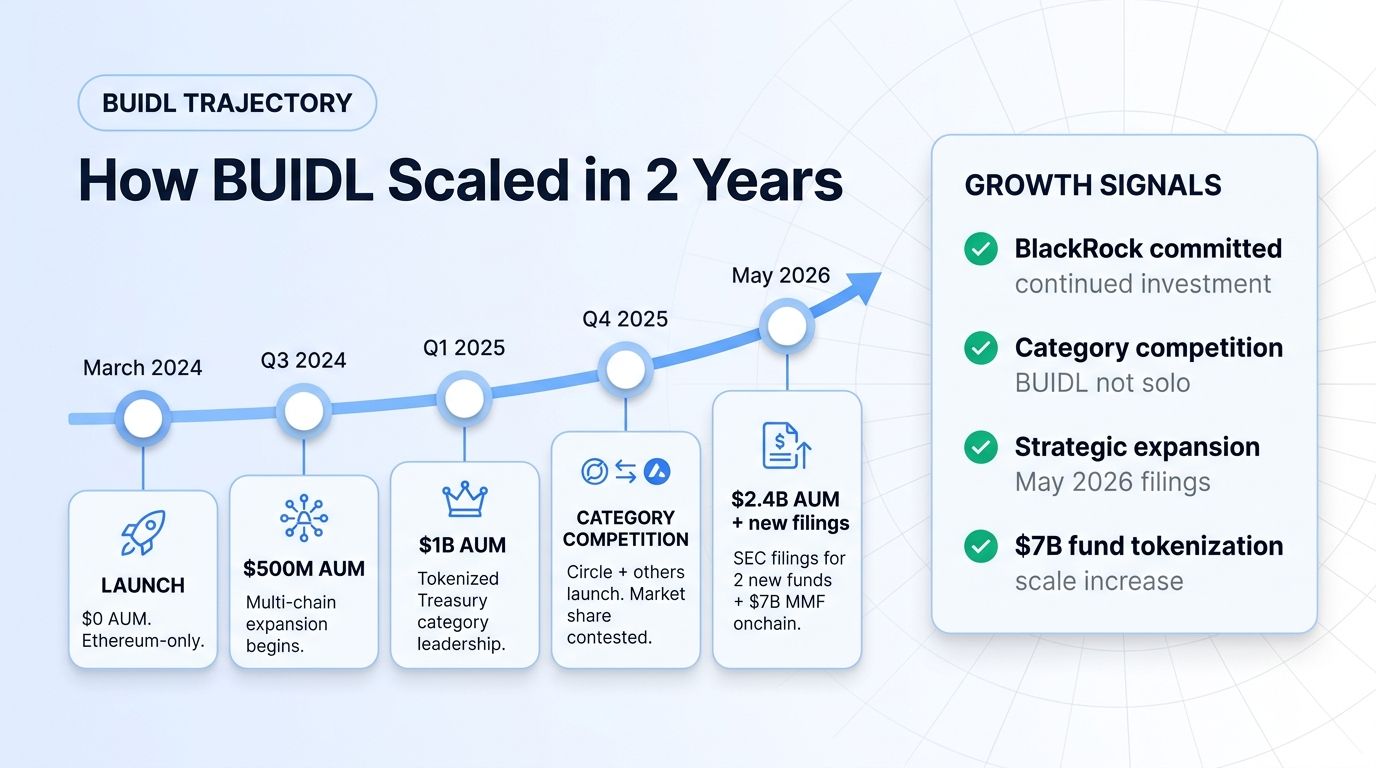
BUIDL (BlackRock USD Institutional Digital Liquidity Fund) is a tokenized money market fund that invests in cash, US Treasury bills, and overnight repurchase agreements. The fund was launched in March 2024 on Ethereum through a partnership with Securitize, BlackRock's institutional tokenization platform.
The product has three core structural characteristics.
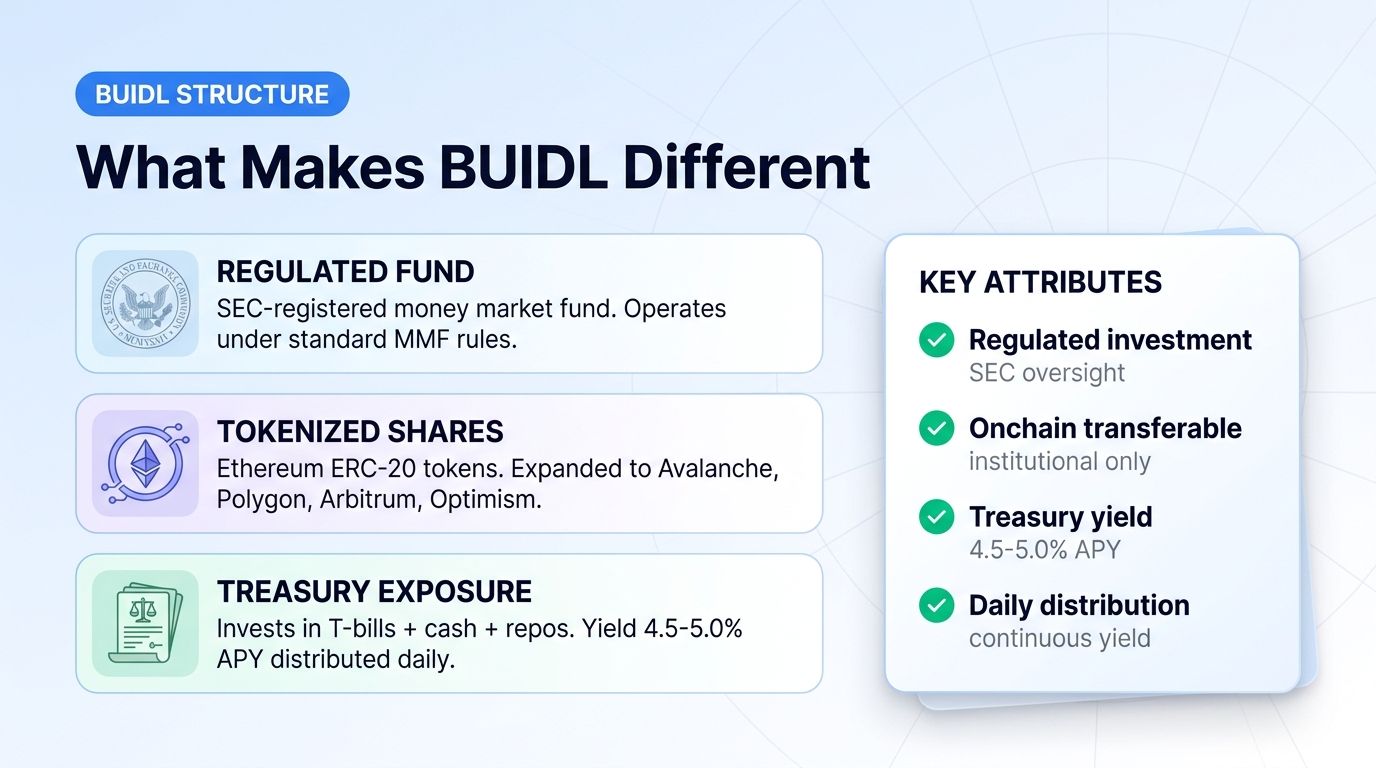
First, regulated investment vehicle. BUIDL is registered with the SEC and operates under standard money market fund regulations. Investors receive tokenized fund shares that represent fractional ownership of the underlying portfolio.
Second, tokenized accessibility. The fund shares are issued as ERC-20 tokens on Ethereum (and later expanded to additional networks including Avalanche, Polygon, Arbitrum, Optimism, and others). Token holders can transfer shares onchain to other approved investors, providing liquidity benefits not available in traditional money market funds.
Third, traditional yield. The fund generates yield from US Treasury exposure (currently 4.5-5.0% APY based on short-duration T-bill rates). Yield is distributed daily to token holders.
The combination produces a product that bridges traditional asset management and crypto infrastructure. Investors get regulated Treasury exposure with onchain operational benefits.
Why BUIDL Matters Structurally
Three structural impacts.
First, institutional crypto entry validation. BlackRock manages approximately $11 trillion in assets globally. The decision to launch and scale BUIDL signals that the world's largest asset manager views tokenized products as a long-term strategic priority rather than an experiment. Other large asset managers (Fidelity, Vanguard, State Street) watch BlackRock's actions closely.
Second, tokenized RWA category growth. BUIDL leads the broader tokenized US Treasury category, which has grown from approximately $1 billion in early 2024 to $15+ billion by Q2 2026. The total tokenized real-world assets (RWA) category has grown to $30+ billion. BUIDL's scale and credibility have driven category expansion.
Third, DeFi institutional capital pool. BUIDL tokens can be held by DeFi protocols (subject to compliance requirements) and used as collateral, liquidity backstops, or yield-bearing reserves. Stablecoin issuers, DeFi lending protocols, and other applications can now access regulated Treasury yield without traditional brokerage relationships.
For the broader crypto ecosystem, BUIDL's growth has been transformative. The category of "regulated, institutional-quality yield-bearing tokens" did not effectively exist before BUIDL. It now anchors significant capital flows.
The May 2026 SEC Filings
Note: BlackRock's tokenized fund filings unfolded against the backdrop of the SEC Innovation Exemption framework for tokenized stocks, which was delayed in May 2026 after pushback from traditional exchanges.
On May 8, 2026, BlackRock filed with the SEC for two additional tokenized fund products plus onchain shares for an existing $7 billion money-market fund.
The filings have several specific elements.
First, additional tokenized Treasury fund products. BlackRock is launching variants targeting different investor segments and use cases. The specific differentiation includes yield optimization strategies, geographic focus, and integration with specific DeFi protocols.
Second, expansion of an existing $7 billion money-market fund to onchain shares. This represents a much larger scale move than BUIDL's growth. The fund being tokenized has existing institutional credibility and scale that BUIDL took two years to develop.
Third, infrastructure investments. BlackRock continues investing in tokenization infrastructure including Securitize's platform, cross-chain compatibility, and institutional access protocols.
The filings collectively signal that BlackRock views tokenization as a multi-product, multi-billion-dollar strategic priority rather than a single experimental fund.
How BUIDL Has Lost (and Regained) Category Ground
An interesting category dynamic developed in late 2025.
For most of 2024 and early 2025, BUIDL led the tokenized Treasury category by a clear margin. By mid-2025, Ondo Finance's USDY and other competitors gained market share. By late 2025, BUIDL's category share dropped as Circle launched a competing tokenized money market fund and as new entrants captured DeFi-native flows.
BlackRock's response was strategic. Rather than competing on yield optimization (where DeFi-native products can be more aggressive), BlackRock emphasized institutional credibility, regulatory positioning, and integration breadth. The May 2026 filings reflect this strategy: launching additional products and onchain shares of larger funds to defend and expand BlackRock's category position.
The category dynamic illustrates that tokenization is not winner-take-all. Multiple major players (BlackRock, Circle, Ondo, others) can coexist with different value propositions.
The Broader Tokenized RWA Landscape
Tokenized real-world assets have become one of the most consequential 2026 crypto categories.
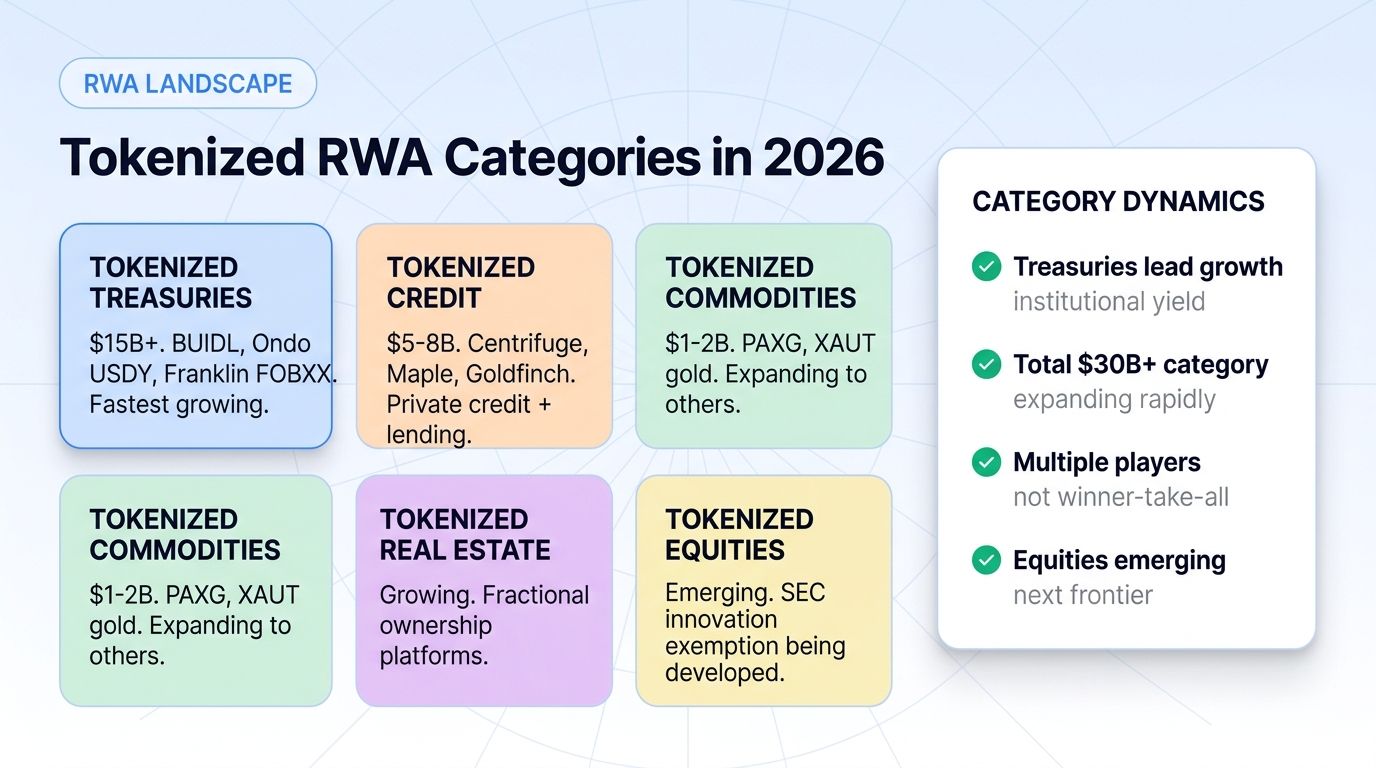
Tokenized US Treasuries: $15+ billion. Leaders include BUIDL, Ondo USDY, Franklin Templeton FOBXX, Hashnote USYC, others. Growing fastest.
Tokenized credit and lending: $5-8 billion. Includes private credit, real estate-backed lending, and similar products through Centrifuge, Maple, Goldfinch, and others.
Tokenized commodities: $1-2 billion. Mostly gold (PAXG, XAUT) but expanding to other commodities.
Tokenized real estate: Growing but smaller scale. Companies like Lofty, Cityfunds, and others tokenize fractional real estate ownership.
Tokenized equities (emerging): SEC's "innovation exemption" framework being developed in 2026 may enable tokenized stocks. Early experiments exist.
The total tokenized RWA category is on track to exceed $50 billion by end of 2026 and potentially $100+ billion within 18-24 months. Growth is largely driven by tokenized Treasuries.
How Traders Should Think About BUIDL
For most retail traders, BUIDL is not directly accessible. The fund has institutional minimum investment requirements (typically $5 million) and qualified investor restrictions.
However, BUIDL's impact reaches retail traders through several channels.
First, indirect exposure through stablecoins and DeFi protocols. Stablecoin issuers and DeFi protocols that hold BUIDL as backing or as a yield source pass benefits to their users. USDC reserves include BUIDL exposure. Some DeFi yield products are structured around BUIDL-style instruments.
Second, related token exposure. Securitize's own token (if and when launched), tokenization-focused crypto projects, and Ondo Finance (a comparable institutional tokenization protocol) can be retail-accessible.
Third, signal value. BUIDL's growth and BlackRock's continued investment signal positive macro conditions for crypto infrastructure broadly. Traders monitoring institutional adoption use BUIDL as one data point.
For institutional or accredited investors, direct BUIDL access provides regulated Treasury exposure with onchain operational benefits.
How BUIDL Compares to Traditional Money Market Funds
The comparison illustrates the value proposition.
Traditional money market funds (Vanguard VMRXX, Fidelity SPRXX, others): Offer similar yield (Treasury-bill-anchored, 4.5-5.0% APY). Accessible through standard brokerage. T+1 or T+0 settlement. No onchain features.
BUIDL: Same Treasury exposure and yield. Tokenized for onchain operational use. Daily yield distribution to token holders. Programmable for DeFi integration. Higher minimum investment requirements.
For traditional investors, the difference is operational. Onchain transferability and programmability provide use cases (DeFi integration, programmatic treasury management, fractional integration into smart contract systems) not available with traditional money market funds.
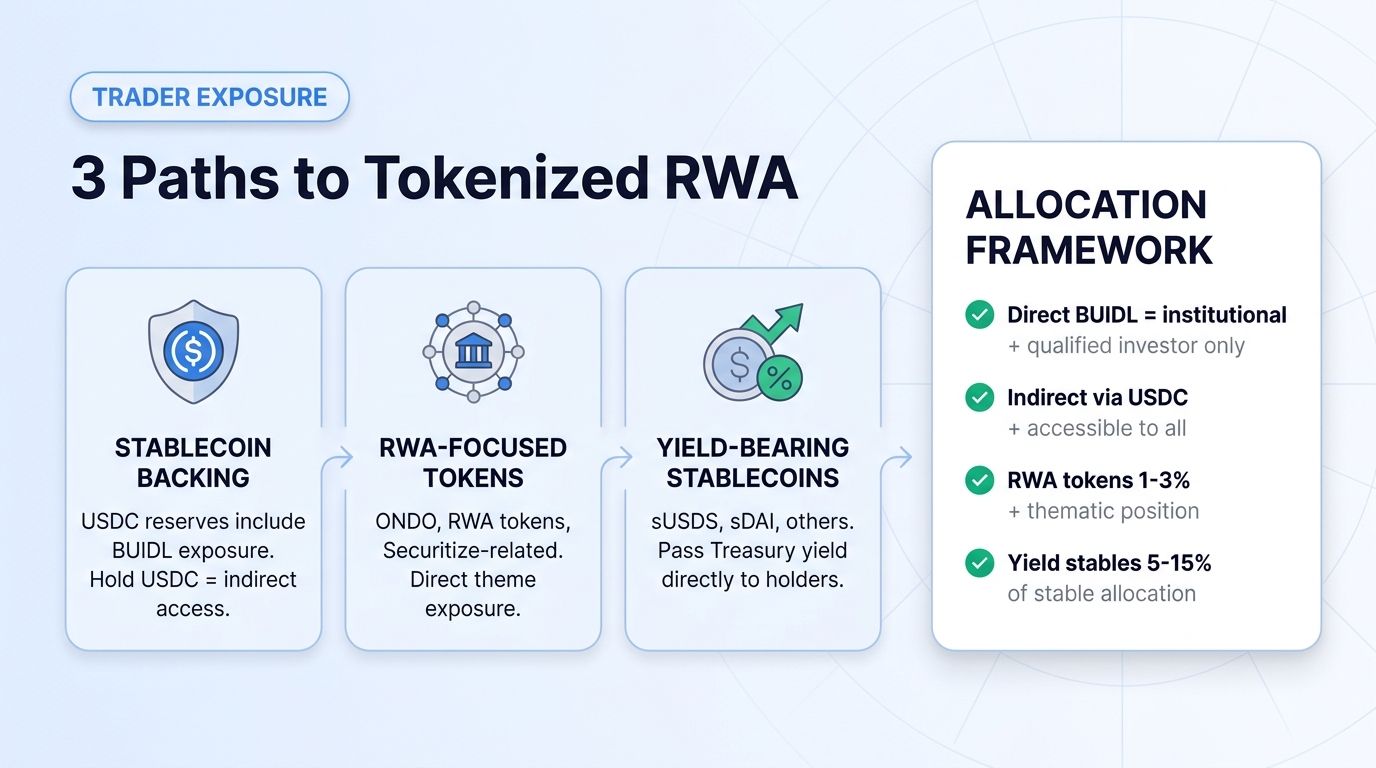
How Traders Can Get Tokenized RWA Exposure
Three practical paths.
Path 1: Hold stablecoins backed by RWA reserves. USDC, USDT, and other regulated stablecoins increasingly include tokenized Treasury exposure in their reserves. Holding stablecoins provides indirect RWA exposure.
Path 2: Hold RWA-focused crypto tokens. Tokens of protocols like Ondo (ONDO), Securitize (if and when token launches), and others provide direct exposure to the tokenization theme. Altrady connects to 19+ exchanges supporting these tokens.
Path 3: Hold yield-bearing stablecoin variants. Products like sUSDS, sDAI, and others pass tokenized Treasury yield to holders.
The Risks of Tokenized RWA Exposure
Liquidity risk. Token redemptions depend on issuer redemption windows. Onchain trading liquidity may be thin compared to traditional money market funds.
Issuer risk. Each tokenized product depends on the specific issuer's operational reliability and regulatory positioning. BlackRock's standing is strong but specific issuer events could affect specific products.
Smart contract risk. Tokenization protocols introduce smart contract risk that traditional money market funds do not have. Bugs or exploits could affect token holders.
Regulatory risk. The regulatory framework for tokenized securities continues evolving. New requirements could affect operational economics.
Yield variability. Treasury yields fluctuate with Federal Reserve policy. Current 4.5-5.0% APY may be higher or lower in the future.
How Tokenized RWA Fits Into a Portfolio
A practical framework:
- Direct tokenized Treasury exposure (BUIDL, USDY, others): 0% for non-accredited investors directly; indirect through stablecoins and yield-bearing variants
- RWA-focused crypto tokens (ONDO, others): 1-3% of crypto allocation
- Yield-bearing stablecoin variants: 5-15% of stablecoin allocation
- General stablecoin allocation: 5-15% of total portfolio
- Active crypto positions: 60-80% of total crypto allocation
The exact allocation depends on risk tolerance and yield priorities. Conservative investors emphasize tokenized Treasury exposure; aggressive investors emphasize active crypto positions.
What to Watch in the Next 12 Months
Three indicators.
Indicator 1: BUIDL and tokenized Treasury TVL growth. Does the category continue scaling toward $50 billion? Growth above current pace would signal accelerating institutional adoption.
Indicator 2: New BlackRock onchain product launches. Does BlackRock follow through on the May 2026 filings with launches? Speed and breadth of execution matters.
Indicator 3: Competitor and category expansion. Do Vanguard, Fidelity, State Street, or other major asset managers launch competing tokenized products? Category expansion validates the broader thesis.
If all three trend positively, tokenization establishes as a durable institutional crypto category. If they stagnate, BUIDL remains a successful niche product without broader category transformation.
FAQ
What is BUIDL?
BUIDL is BlackRock's tokenized money market fund that invests in US Treasury bills, cash, and overnight repurchase agreements. The fund operates as a regulated investment product with tokenized shares accessible onchain (initially Ethereum, expanded to multiple networks). Yields are typically 4.5-5.0% APY.
Can retail investors buy BUIDL directly?
BUIDL has institutional minimum investment requirements (typically $5 million) and qualified investor restrictions. Most retail investors access BUIDL exposure indirectly through stablecoin reserves, DeFi protocols using BUIDL, or related tokenized RWA products.
How does BUIDL compare to USDC?
USDC is a stablecoin (1:1 dollar-backed, no yield to holders). BUIDL is a yield-bearing investment fund (variable share price tracking the underlying portfolio plus yield). USDC reserves include BUIDL exposure, so USDC holders benefit indirectly. They serve different primary purposes.
Is BUIDL safer than other crypto investments?
BUIDL is structurally less risky than most crypto investments because the underlying is US Treasury bills (one of the safest traditional assets). However, BUIDL has additional layers of risk (smart contract risk, issuer operational risk, redemption liquidity) not present in direct Treasury exposure.
Can I trade tokenized RWA tokens on Altrady?
ONDO, RWA-related tokens, and yield-bearing stablecoin tokens are listed on multiple exchanges. Altrady connects to 19+ exchanges, so you can manage RWA token positions alongside other crypto holdings, run automated strategies via the signal bot, grid bot, or DCA bot, and use unified portfolio tracking. Direct BUIDL access requires institutional brokerage relationships.
Conclusion
BlackRock's BUIDL represents one of the most consequential institutional crypto products of the current cycle. The growth from launch to $2.4 billion in approximately two years, combined with the May 2026 SEC filings for additional products, signals that the world's largest asset manager views tokenization as a long-term strategic priority.
For traders, the practical takeaway is this: most retail investors will not access BUIDL directly due to institutional minimums and qualified investor requirements. However, the tokenized RWA category that BUIDL leads is shaping the broader crypto infrastructure. Yield-bearing stablecoins, DeFi protocols using tokenized Treasury reserves, and RWA-focused crypto tokens all benefit from category growth.
The longer-term significance is that tokenization may transform how traditional asset management interacts with crypto infrastructure. If BlackRock's continued investment validates the model, other major asset managers (Fidelity, Vanguard, State Street, JP Morgan, others) are likely to follow. The result would be tens of billions of dollars in tokenized traditional assets accessible through crypto rails.
The next 12-24 months will produce decisive data on category trajectory. For diversified crypto portfolios, indirect tokenized RWA exposure through stablecoin reserves and RWA-focused tokens makes sense as part of broader crypto exposure. Watching BUIDL's growth and BlackRock's product execution will help calibrate the broader institutional crypto narrative.