
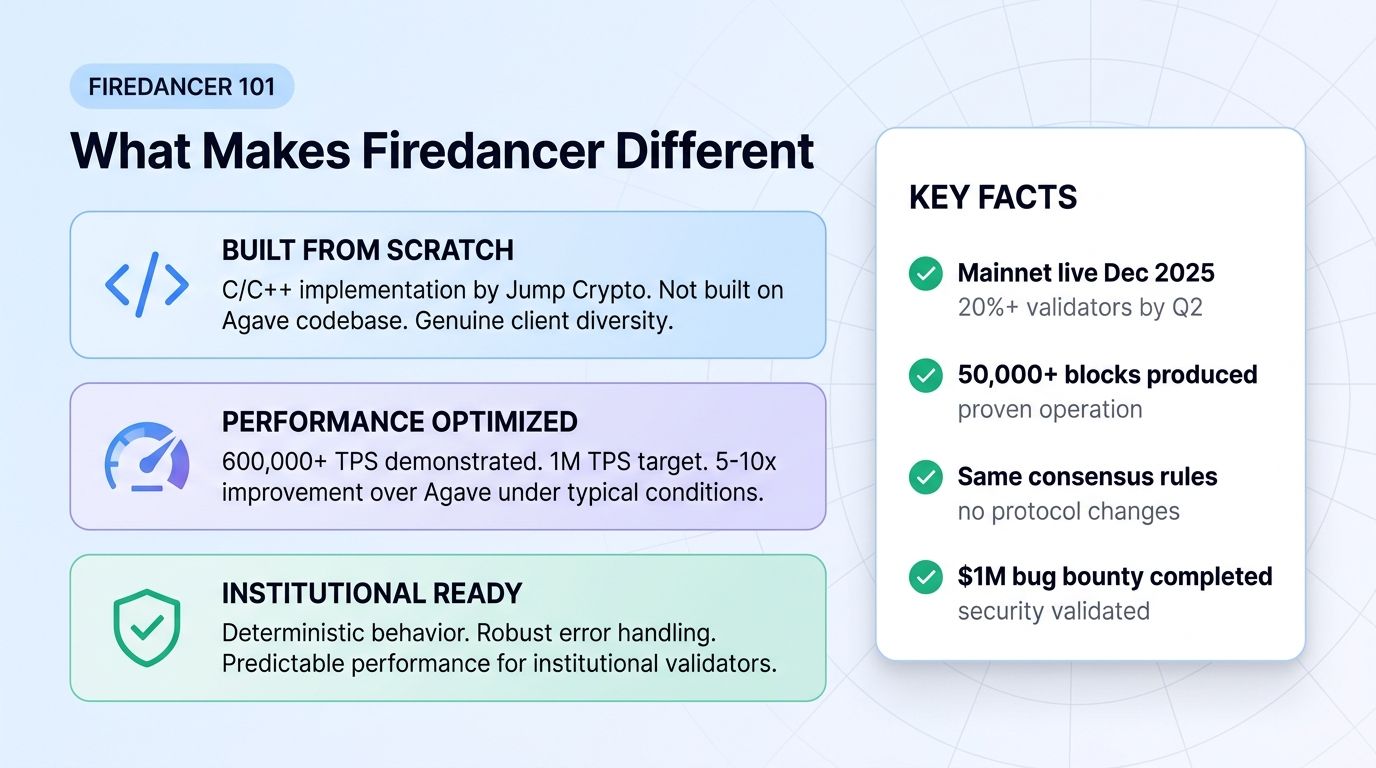
After three years of development, Firedancer went live on Solana mainnet in December 2025. By Q2 2026, the new validator client is running on 20%+ of active validators, has successfully produced 50,000+ blocks, and is establishing itself as the second major validator implementation for Solana alongside the original Agave client. For Solana traders and observers, Firedancer represents one of the most consequential infrastructure upgrades in the network's history.
The numbers behind Firedancer are striking. Jump Crypto built the client from scratch in C/C++ to target performance beyond what existing Solana clients could achieve. The hybrid Frankendancer implementation demonstrated 600,000+ transactions per second in live conditions. The full Firedancer aims for over 1 million TPS, a throughput that would dramatically exceed any other blockchain network.
This guide explains what Firedancer is, why it matters for Solana's scalability and resilience, the gradual rollout approach, how it compares to other L1 scaling solutions, and what the implications are for SOL token and ecosystem positioning.
What Is Solana Firedancer?
Firedancer is a new, independent validator client for the Solana network, built from scratch by Jump Crypto in C/C++ programming languages. It serves as an alternative implementation of Solana's consensus and transaction processing rules, providing client diversity to a network that previously relied on a single major client.
The client has three core architectural characteristics.
First, written from scratch in C/C++. Rather than building on the existing Agave (formerly Solana Labs) codebase, Jump Crypto built Firedancer as a completely independent implementation. This provides genuine client diversity rather than incremental optimization.
Second, optimized for performance. The C/C++ implementation, combined with extensive performance optimization, enables Firedancer to process transactions significantly faster than the original Agave client. Performance benchmarks suggest 5-10x improvement under typical conditions.
Third, designed for institutional reliability. Firedancer's architecture emphasizes deterministic behavior, robust error handling, and predictable performance. These properties matter for institutional validators and users.
The client follows the Solana consensus rules exactly, so Firedancer validators operate alongside Agave validators without protocol-level changes required.
Why Firedancer Matters Structurally
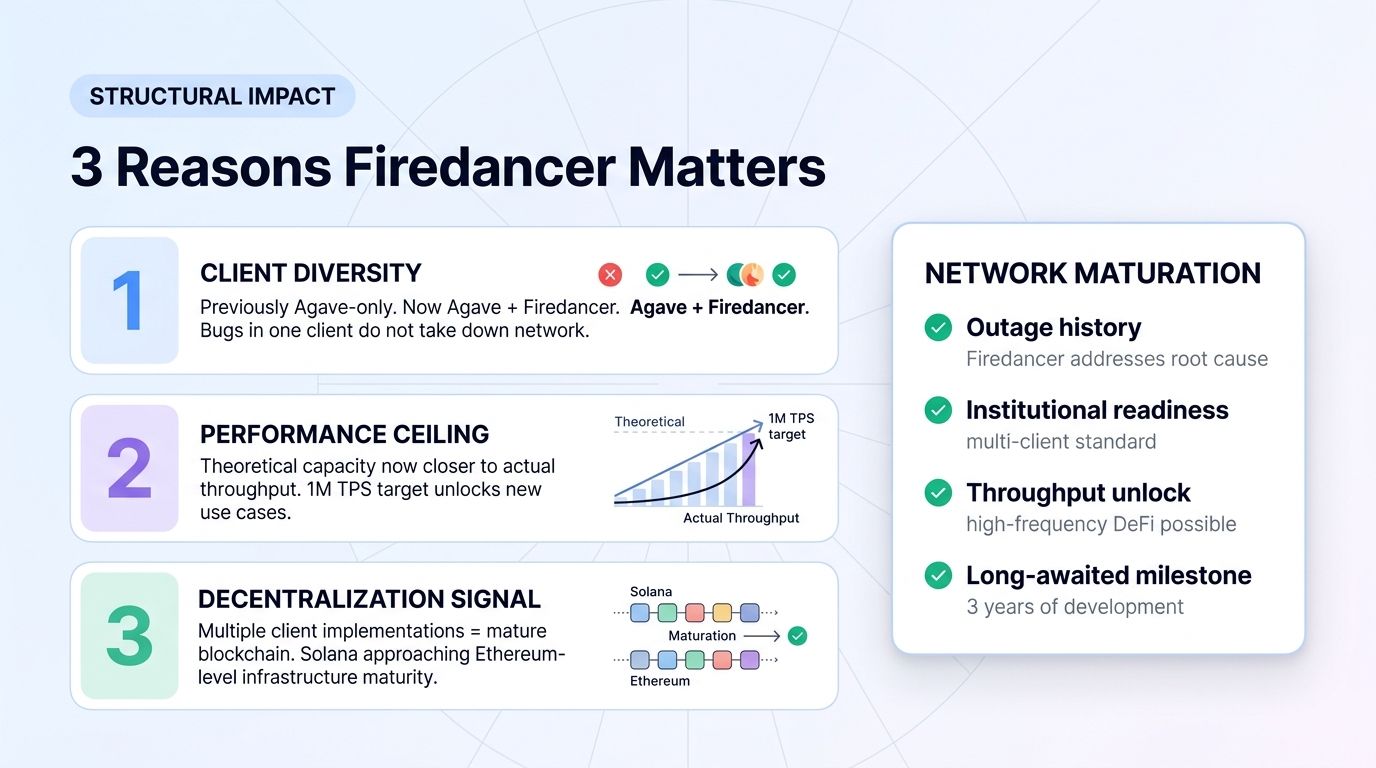
Three structural impacts.
First, client diversity. Before Firedancer, Solana relied on a single major validator client (Agave). Bugs or vulnerabilities in Agave would affect the entire network. Firedancer provides a second implementation, meaning protocol-level issues would have to affect both clients simultaneously to take the network down. This is a significant resilience improvement.
Second, performance ceiling. Solana's theoretical capacity has always exceeded its actual throughput due to client implementation constraints. Firedancer pushes the practical throughput much closer to the theoretical maximum. The 1M TPS target represents a multiple-X improvement over current sustained throughput.
Third, decentralization signal. Multiple client implementations are a standard sign of mature blockchain networks. Ethereum has multiple execution clients (Geth, Nethermind, Erigon, Besu) and multiple consensus clients (Lighthouse, Prysm, Teku, Nimbus, Lodestar). Solana having two major clients (Agave + Firedancer) brings it closer to that level of infrastructure maturity.
For Solana, Firedancer's successful mainnet operation marks a major milestone in the network's evolution from a single-client experiment to a robust institutional blockchain.
The Gradual Rollout Approach
Jump Crypto adopted a deliberately cautious rollout strategy rather than a sudden public launch.
The phased approach has been:
Phase 1 (Sep 2025): Initial mainnet activation with a small set of validators (under 10) running Firedancer in production. Heavy monitoring.
Phase 2 (Oct-Nov 2025): Expansion to 30-50 validators. Continued monitoring. Some operational issues identified and resolved.
Phase 3 (Dec 2025): Public confirmation of mainnet status. 100+ validators running. 50,000+ blocks produced successfully.
Phase 4 (Q1-Q2 2026): Expansion to 20%+ of active validators. Continued performance optimization and bug fixes.
Phase 5 (Future): Further expansion based on continued validation. Eventually targeting majority adoption among validators.
The gradual approach is unusual for blockchain client launches but matches Jump Crypto's institutional discipline. The team also completed a $1 million bug bounty competition in late 2025, which surfaced several issues and gave the team confidence to expand adoption.
The trade-off is slower deployment but lower risk. For a network that experienced multiple major outages in 2021-2023, the cautious approach is strategically sensible.
How Firedancer Compares to Other L1 Scaling Solutions
The blockchain scaling landscape has multiple approaches.
Solana Firedancer (single-chain optimization): New client implementation pushing single-chain throughput toward 1M TPS. No sharding, no rollups, just optimized base-layer execution.
Ethereum L2 rollups (Optimistic + ZK): Scale through Layer 2 rollups that batch transactions off-chain and commit proofs to mainnet. Different architecture but similar end-result for users.
Sui and Aptos (parallel execution): Use Move language and parallel transaction execution. Different consensus mechanisms but similar performance goals.
Avalanche L1 transformation (subnet model): Multi-chain architecture where each application can run its own customized L1.
Cosmos (independent chains + IBC): Network of independent chains connected by Inter-Blockchain Communication protocol.
Each approach has trade-offs. Solana's single-chain approach with Firedancer maximizes composability (all transactions on one chain can interact) at the cost of higher requirements for validators. Ethereum's L2 approach scales through partitioning at the cost of some composability between rollups. Sui/Aptos take a middle path with parallel execution.
For traders, the practical implication is that Solana with Firedancer can handle significantly more transaction volume than previously, making it more competitive with Ethereum L2s for high-frequency DeFi applications.
Impact on Solana DeFi and Trading
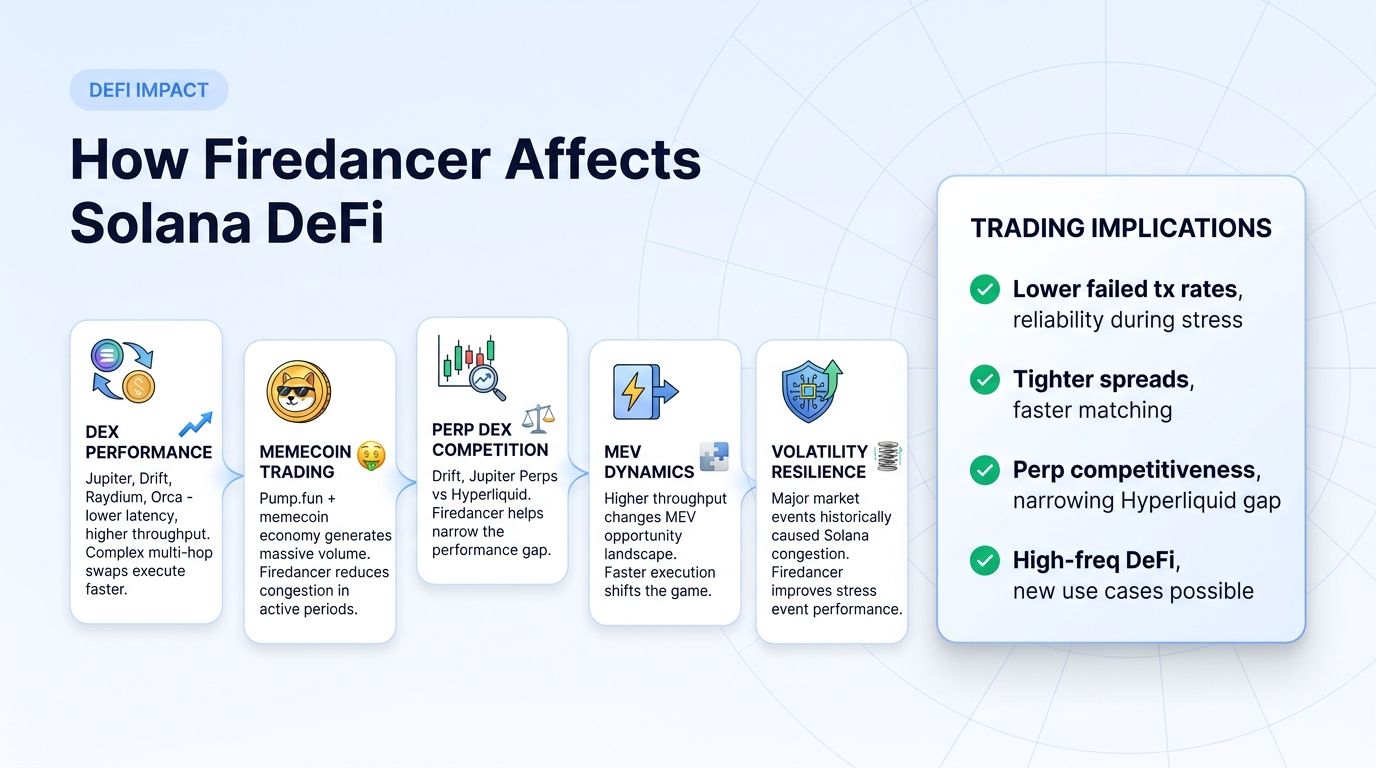
Firedancer's performance improvements directly affect Solana's competitive position in DeFi.
DEX performance: Solana DEXs (Jupiter, Drift, Raydium, Orca) benefit from lower latency and higher throughput. Order matching, large trades, and complex multi-hop swaps execute more efficiently.
Memecoin trading: Solana's memecoin economy (Pump.fun, etc.) generates massive transaction volume. Firedancer's throughput improvements reduce congestion during high-volume periods.
Perpetual DEX competitiveness: Solana perp DEXs (Drift, Jupiter Perps) compete with Hyperliquid for perp DEX market share. Firedancer's performance helps narrow the gap.
MEV and orderflow: Higher throughput affects MEV dynamics. Faster execution and higher transaction volume create different opportunities and risks for traders.
Network resilience during volatility: Major market events (rapid price moves, liquidation cascades) historically caused Solana congestion. Firedancer improves resilience during these stress events.
For active Solana traders, Firedancer's expanding adoption translates to more reliable execution and lower transaction failure rates during high-activity periods.
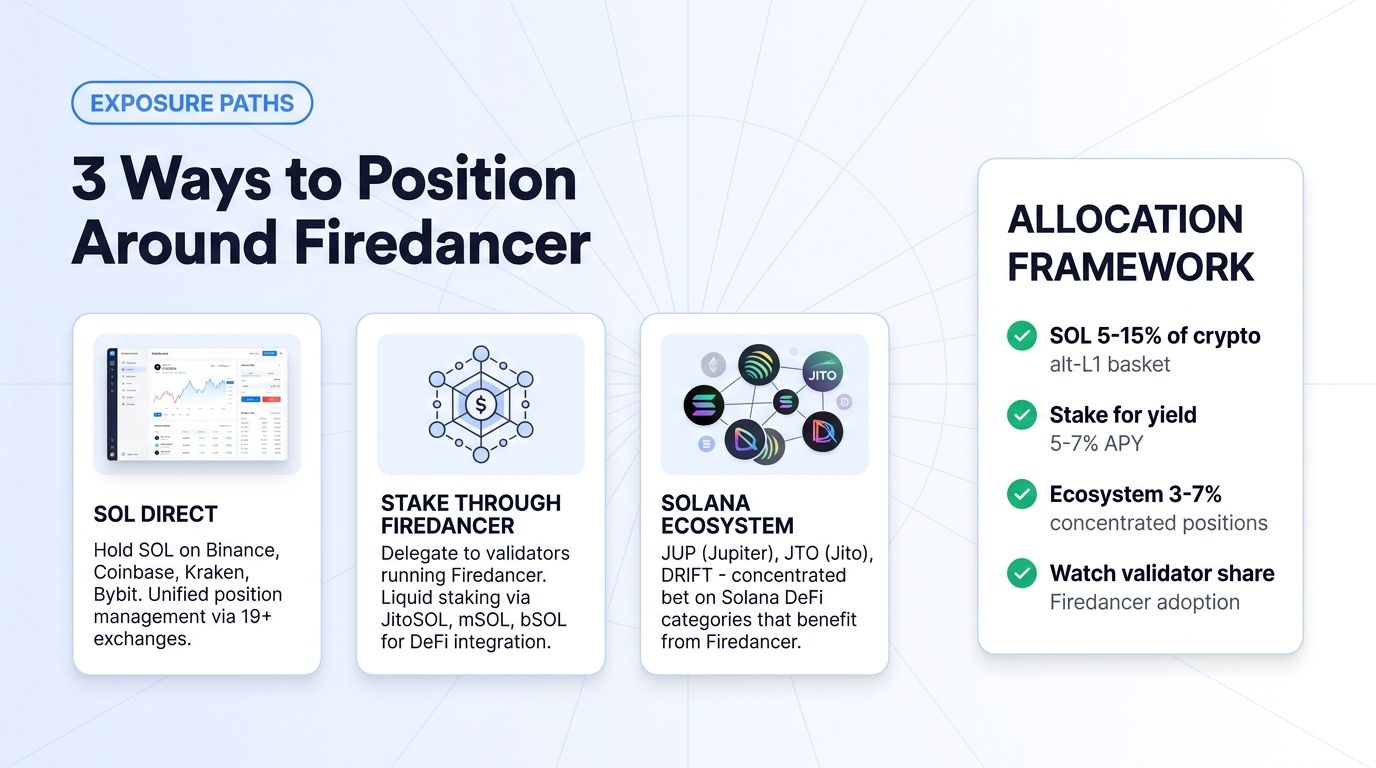
How to Get Solana Exposure During the Firedancer Era
Three practical paths.
Path 1: Hold SOL directly on a centralized exchange. SOL trades on Binance, Coinbase, Kraken, Bybit, KuCoin, and most major exchanges. Altrady connects to 19+ exchanges, providing unified position management for SOL alongside other crypto holdings.
Path 2: Stake SOL through validators. SOL staking yields 5-7% APY through validator delegation. Choose validators running Firedancer for direct exposure to the network's modernization. Staking is liquid through liquid staking tokens (JitoSOL, mSOL, bSOL) that integrate with DeFi.
Path 3: Hold Solana DeFi protocol tokens. JUP (Jupiter), JTO (Jito), DRIFT, and others provide concentrated exposure to specific Solana DeFi categories that benefit from Firedancer improvements.
The Risks of Solana Investment
Centralization concerns (despite Firedancer). Even with two major clients, Solana's validator set remains smaller than Ethereum's. Geographic concentration and infrastructure requirements limit decentralization.
Network outage history. Solana experienced multiple major outages in 2021-2023. Firedancer aims to improve resilience but historical patterns are worth watching.
Concentration risk on Solana ecosystem. SOL's value depends partly on Solana ecosystem activity (DeFi, memecoins, DePIN). Ecosystem stagnation affects SOL.
Competitive pressure. Other high-throughput L1s (Sui, Aptos, Monad) compete for similar use cases. Solana must continue innovating to maintain leadership.
Regulatory risk. Solana's regulatory status has been less contested than XRP's, but future SEC or other regulatory actions could affect the network.
Validator economics. Firedancer's adoption depends on validator economics. If staking yields don't justify operations, validator count could decline.
How Solana Fits Into a Crypto Portfolio
A practical framework:
- Core large-cap holdings (BTC, ETH): 50-65% of crypto allocation
- Major alt-L1 exposure: 10-25%
- - SOL specifically: 5-15% typical
- - Other L1s (Sui, Aptos, Monad, TON): 5-10% combined
- DeFi protocol tokens (Solana ecosystem): 3-7%
- Cash reserves: 5-15%
SOL allocation in the alt-L1 basket varies by conviction. Higher conviction on Solana's mainstream-consumer thesis suggests higher allocation. Lower conviction suggests more diversification across multiple L1s.
What to Watch in the Next 12 Months
Three indicators.
Indicator 1: Firedancer validator adoption. Does the percentage of validators running Firedancer continue growing? Strong adoption signals successful rollout.
Indicator 2: Throughput milestones. Does Solana achieve sustained throughput beyond current levels? Demonstrated 200,000+ TPS in production conditions would validate the performance thesis.
Indicator 3: Network outage frequency. Does outage frequency continue declining? Improved resilience is the major operational benefit of client diversity.
If all three trend positively, Solana establishes itself as a mature institutional-grade blockchain. If issues emerge, the network may revert to its earlier reputation for occasional outages.
FAQ
What is Firedancer?
Firedancer is a new, independent validator client for the Solana network, built by Jump Crypto in C/C++ from scratch. It provides client diversity (alongside the existing Agave client) and targets 1 million transactions per second performance, representing a significant scalability and resilience upgrade for Solana.
Is Firedancer fully launched on Solana mainnet?
Firedancer is live on mainnet as of December 2025 and running on 20%+ of active validators by Q2 2026. The rollout has been gradual rather than sudden. Full majority adoption is expected over the next 12-24 months.
Does Firedancer change SOL tokenomics?
No, Firedancer is a validator client implementation, not a protocol change. SOL token economics remain identical. Firedancer affects how validators process transactions, not what transactions can occur or how SOL is issued.
How does Firedancer compare to Ethereum's multi-client setup?
Ethereum has multiple execution and consensus clients (Geth, Nethermind, Erigon, Besu for execution; Lighthouse, Prysm, Teku, Nimbus, Lodestar for consensus). Solana now has two major clients (Agave + Firedancer). The level of client diversity is approaching but not yet matching Ethereum's maturity.
Can I trade SOL on Altrady?
SOL is listed on Binance, Coinbase, Kraken, Bybit, KuCoin, MEXC, Bitget, and most major exchanges. Altrady connects to 19+ exchanges, so you can manage SOL positions alongside other crypto holdings, run automated strategies via the signal bot, grid bot, or DCA bot, and use unified portfolio tracking.
Conclusion
Solana Firedancer represents one of the most consequential infrastructure developments in the network's history. After three years of careful development by Jump Crypto, the second major validator client is now live on mainnet, providing client diversity and substantial performance improvements.
For traders, the practical takeaway is this: Solana's reliability and throughput are improving meaningfully through Firedancer adoption. The network's competitive position against Ethereum L2s and other high-throughput L1s strengthens as Firedancer rollout progresses.
The longer-term trajectory depends on continued Firedancer adoption growth and on Solana's ability to sustain improved network reliability through future stress events. The next 12-24 months will produce decisive data on whether the client diversity and performance improvements translate to category leadership in mainstream crypto applications.
For diversified crypto portfolios, SOL allocation in the alt-L1 basket makes sense as part of broader exposure to high-performance blockchain infrastructure. The Firedancer-era Solana is a meaningfully different network from the 2022-2023 version, and that change is favorable for the long-term thesis. Sizing positions appropriately based on conviction and risk tolerance remains the standard discipline.