
Hyperliquid's HYPE token has emerged as one of the most-watched DEX tokens of 2026. With the underlying Hyperliquid platform commanding approximately 70 to 80 percent market share of all decentralized perpetual derivatives volume and processing over $208 billion in monthly volume, the network is by any measure the dominant perp DEX of the cycle.
For traders evaluating HYPE specifically (versus using the Hyperliquid platform for trading), the question is whether the token captures the network's economic value or whether it sits as a governance asset somewhat detached from the trading flow. The 2026 catalysts (Bitwise BHYP ETF allocating fees to HYPE, validator expansion, SpaceX pre-IPO synthetic trading launch) all bear on the answer.
This guide explains what HYPE is, how it differs from the platform itself, the token economics, the 2026 catalysts, the competitive landscape against other DEX tokens, and how traders should think about HYPE allocation in their portfolios.
What Is HYPE?
HYPE is the native token of the Hyperliquid Layer 1 blockchain and decentralized perpetual exchange. The token launched in late 2024 through a community-focused airdrop that distributed approximately 31 percent of total supply to early users, traders, and ecosystem participants.
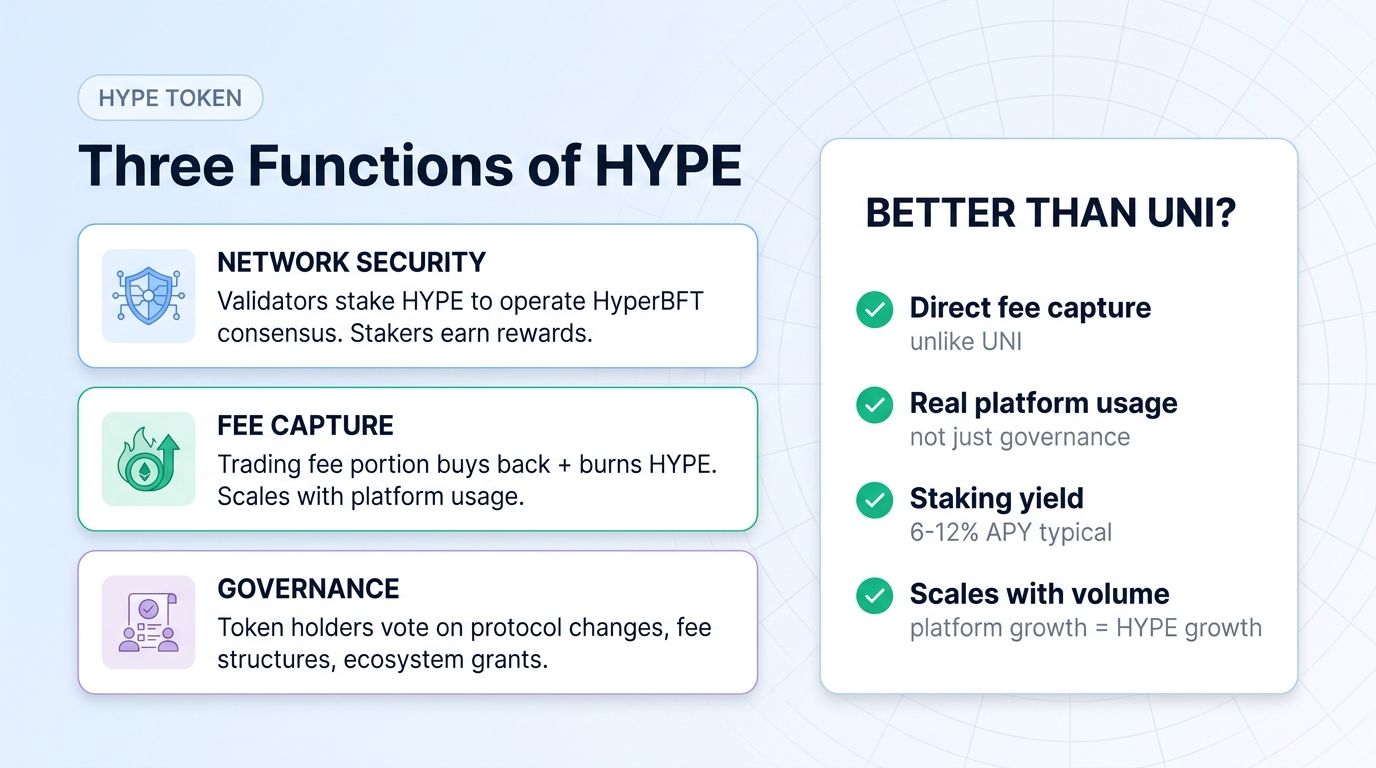
The token has three core functions.
First, HYPE secures the network. Validators stake HYPE to operate the Hyperliquid L1 (HyperBFT consensus). Stakers earn rewards from network fees and emissions. The total staked HYPE determines network security.
Second, HYPE captures fee revenue. The Hyperliquid platform charges trading fees (0.025 percent maker and 0.05 percent taker on most pairs). A portion of these fees is allocated to buyback and burn mechanisms that reduce HYPE supply over time.
Third, HYPE is the governance token. Holders participate in protocol governance decisions including fee structures, validator set parameters, and ecosystem grants.
The combination of staking yield, fee capture, and governance makes HYPE more economically active than many DEX tokens that are primarily governance-only.
Why HYPE Is Different in 2026
Three structural advantages.
First, the underlying platform has product-market fit. Hyperliquid is not a speculative protocol with theoretical use cases. It processes more than $208 billion in monthly volume with real trading activity. The fee revenue is substantial and growing.
Second, the platform captures fee economics for HYPE holders. Many DEX tokens (Uniswap UNI, dYdX historically) have governance utility but limited direct fee capture. Hyperliquid's design routes meaningful fee revenue back to HYPE through buyback and burn.
Third, the institutional adoption story is gaining momentum. Bitwise's announcement of a Hyperliquid ETF (BHYP) allocating 10 percent of management fees to purchasing and holding HYPE tokens signals institutional interest. The validator count expansion (from 24 to 27) further enables institutional participation.
For traders, HYPE represents one of the cleaner ways to express conviction in the DeFi perpetual derivatives thesis without holding the underlying volatile perp positions.
The 2026 Catalysts in Detail
Three specific catalysts have shaped HYPE's trajectory through 2026.
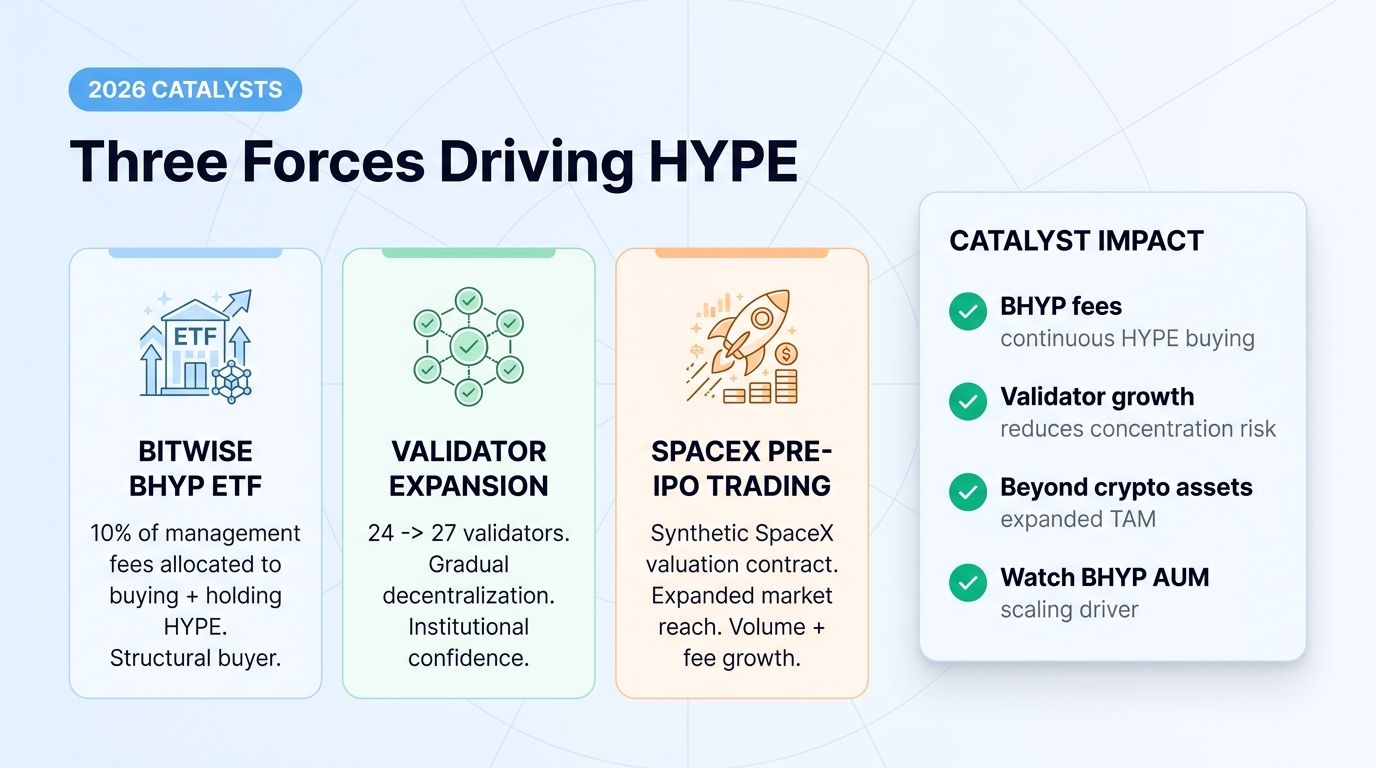
Catalyst 1: Bitwise BHYP ETF Fee Allocation
In early 2026, Bitwise Asset Management launched the Bitwise Hyperliquid ETF (BHYP). The ETF holds HYPE tokens on behalf of investors who want exposure without managing crypto wallets and exchanges directly.
The structurally interesting feature: Bitwise announced it will allocate 10 percent of management fees from BHYP to purchasing and holding HYPE tokens on its balance sheet. This creates a structural buyer for HYPE every time BHYP charges fees.
The mechanism is small in absolute terms (10 percent of fees on a relatively new ETF) but represents a category innovation. If other crypto ETFs adopt similar structures, the pattern could become more impactful.
Catalyst 2: Validator Set Expansion
Hyperliquid's active validator count increased from 24 to 27 in early 2026. The expansion represents the network's commitment to gradual decentralization while maintaining performance.
More validators generally produces:
- Better decentralization
- Higher network resilience
- Slightly more decentralized fee distribution
- Higher coordination overhead
The 24 to 27 expansion is gradual rather than dramatic. The network philosophy appears to favor measured decentralization over rapid validator set scaling.
Catalyst 3: SpaceX Pre-IPO Synthetic Trading
Hyperliquid launched synthetic trading on SpaceX's pre-IPO valuation in early 2026. The product allows traders to take leveraged positions on SpaceX's implied valuation through a perpetual futures contract.
This is significant for two reasons. First, it demonstrates Hyperliquid's expansion beyond traditional crypto assets into broader synthetic markets. Second, it generates additional trading volume and fee revenue that flow into HYPE buyback mechanisms.
The SpaceX pre-IPO contract has been one of Hyperliquid's most-traded products in 2026, with significant institutional and retail interest.
The HYPE Token Economics
The token economics combine several mechanisms.
Supply mechanics: HYPE has a fixed maximum supply with a multi-year emission schedule. Validators earn emissions for operating the network. Token unlocks follow vesting schedules.
Buyback and burn: A portion of platform fee revenue is used to purchase HYPE on the open market and burn the tokens. This creates a deflationary pressure that scales with platform usage.
Staking yield: Validators and delegators earn yield from emissions and a portion of fees. Yields typically range 6-12 percent APY depending on validator performance.
Governance: Token holders vote on protocol changes. Voting power scales with staked HYPE.
The combination produces a token that benefits from both platform growth (more fees = more buyback) and direct staking returns. This is more aligned with traditional equity economics than many crypto governance tokens.
How HYPE Compares to Other DEX Tokens
The DEX token landscape includes multiple competitors.
HYPE vs UNI (Uniswap)
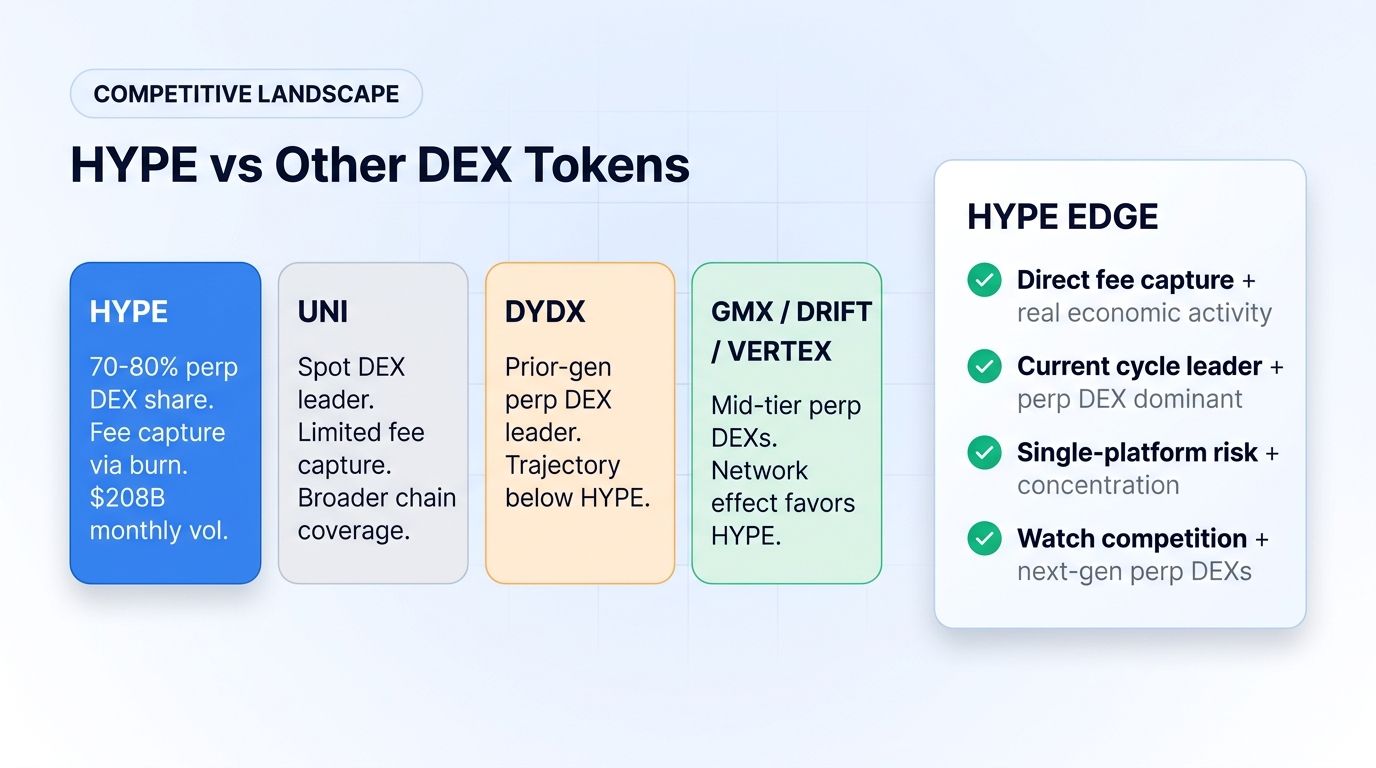
UNI is the largest DEX token by market cap. Uniswap dominates spot DEX volume on Ethereum and several L2s. UNI's economics are primarily governance with limited direct fee capture (the fee switch has been debated for years).
HYPE has more direct fee capture through buyback and burn. UNI has larger ecosystem and broader chain coverage. Different value propositions.
HYPE vs dYdX
dYdX is the previous-generation perp DEX leader. The migration to Cosmos and dYdX Chain in 2023 was complex. HYPE has overtaken dYdX in volume and mindshare through 2024-2026.
For traders, HYPE represents the current perp DEX leader; dYdX represents the prior-generation leader. The trajectories favor HYPE.
HYPE vs GMX, Vertex, Drift
These are mid-tier perp DEXs. Each has specific niches but smaller market share than Hyperliquid. HYPE benefits from network effect concentration.
HYPE vs Solana DEXs (Jupiter, Drift)
Solana-based DEXs benefit from Solana's broader ecosystem momentum. Jupiter is the dominant DEX aggregator on Solana. Different chain ecosystems but similar competitive dynamics.
How Traders Can Get HYPE Exposure
Three practical paths.
Path 1: Hold HYPE on a centralized exchange. HYPE trades on Binance, Coinbase, Kraken, Bybit, KuCoin, and most major exchanges. This provides clean direct exposure. A platform like Altrady connects to 19+ exchanges and supports unified HYPE position management.
Path 2: Stake HYPE to validators. Holding HYPE and delegating to validators earns staking rewards. Requires using a Hyperliquid-compatible wallet (Rabby, MetaMask, Phantom configured for Hyperliquid).
Path 3: Hold the Bitwise BHYP ETF. For investors who prefer traditional brokerage exposure, BHYP provides HYPE exposure through standard ETF channels. The 10 percent management fee allocation to HYPE purchases is a unique feature.
The Risks of HYPE Investing
Concentration risk on a single platform. HYPE's value depends almost entirely on Hyperliquid platform usage. If Hyperliquid faces competitive pressure or operational issues, HYPE is directly exposed.
Regulatory risk. Perpetual futures trading faces ongoing regulatory scrutiny in multiple jurisdictions. The US, EU, and other regulators continue debating appropriate frameworks. Future regulatory action could affect Hyperliquid's operations.
Centralization concerns. Despite the validator expansion, Hyperliquid is more centralized than ideal-state DeFi protocols. 24 to 27 validators is small compared to networks like Ethereum.
Smart contract risk. Hyperliquid L1 is relatively new. While no major exploits have occurred, complex blockchain systems can have unforeseen issues.
Token unlock pressure. HYPE has multi-year vesting schedules. Continued unlocks create supply pressure that may affect price.
Fee revenue concentration. Hyperliquid's fee revenue depends on continued high trading volume. If trading volume declines (due to market conditions or competition), buyback mechanism produces less HYPE demand.
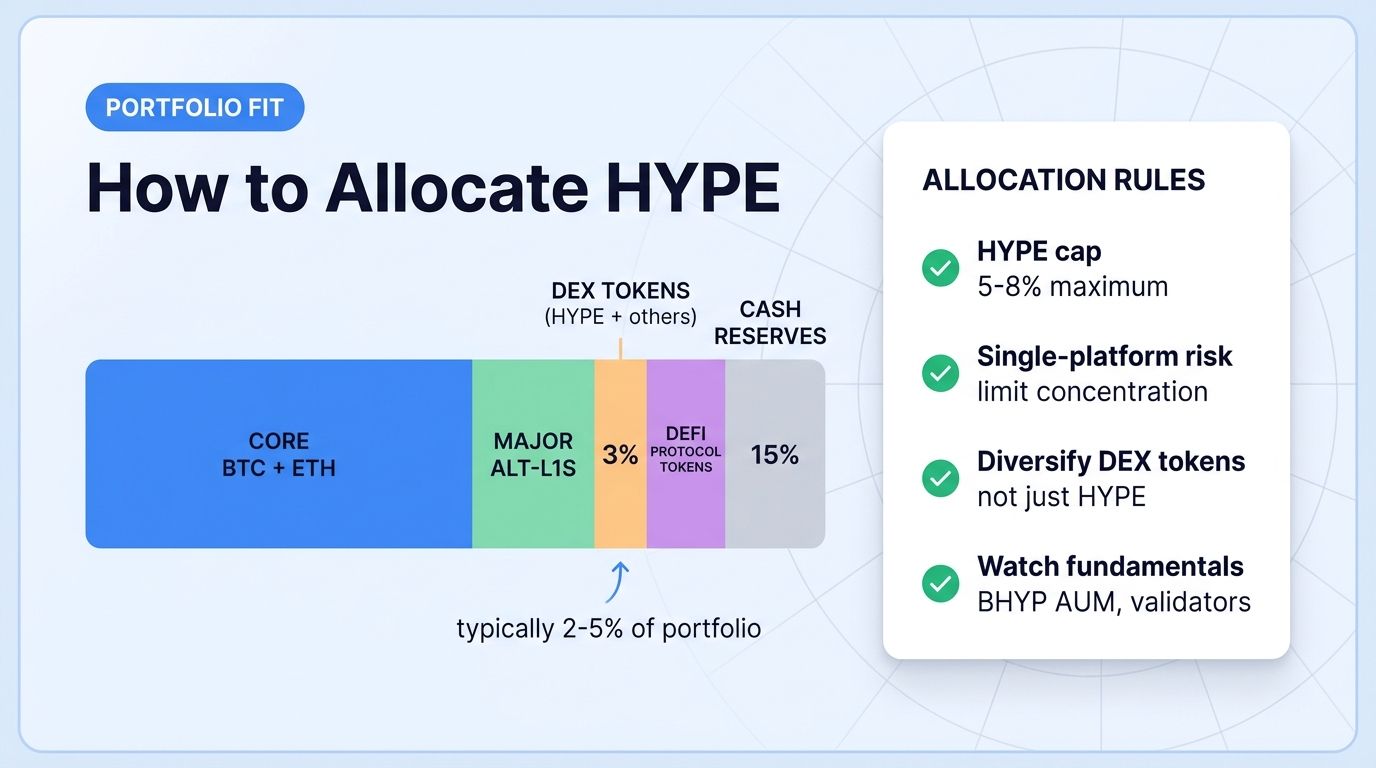
How HYPE Fits Into a Crypto Portfolio
A practical framework:
- Core large-cap holdings (BTC, ETH): 50-65% of crypto allocation
- Major alt-L1 exposure (SOL, others): 10-20%
- DEX tokens (HYPE, others): 3-10%. HYPE typically 2-5% of total portfolio
- DeFi protocol tokens: 5-10%. Beyond DEXs (lending, derivatives, stables)
- Cash reserves: 5-15%
HYPE allocation rarely exceeds 5-8% of total portfolio due to single-platform concentration. The thesis is real but the risk profile suggests sizing as one component of a diversified crypto allocation.
What to Watch in the Next 12 Months
Three indicators.
Indicator 1: Hyperliquid platform volume trajectory. Does the platform maintain 70 to 80 percent perp DEX share? Does monthly volume grow above $208 billion?
Indicator 2: BHYP ETF AUM growth. Does Bitwise's HYPE ETF attract significant AUM? The 10 percent fee allocation to HYPE purchases scales with ETF AUM.
Indicator 3: Validator expansion and decentralization metrics. Does the validator count continue to grow? Are stake distribution and operational dynamics improving?
If all three trend positively, HYPE could outperform broader crypto in the next 12 months. If platform share declines or institutional adoption stalls, HYPE could underperform.
FAQ
What is the difference between HYPE and Hyperliquid?
Hyperliquid is the platform (Layer 1 blockchain plus perpetual derivatives DEX). HYPE is the native token of that platform. Traders use the Hyperliquid platform for trading; investors hold HYPE for token exposure. The two are related but distinct decisions.
Can I use HYPE to pay fees on Hyperliquid?
Trading fees on Hyperliquid are charged in the traded asset's quote currency (typically USDC). HYPE is used for network gas, staking, and governance, not for direct fee payment by traders. The buyback and burn mechanism converts trading fees into HYPE demand indirectly.
How does staking HYPE work?
Token holders can stake HYPE to validators (delegated staking) or run a validator themselves. Delegated staking is simpler and earns yields based on the chosen validator's performance. Typical yields are 6 to 12 percent APY.
Is the Bitwise BHYP ETF available to retail investors?
BHYP is a publicly traded ETF available through traditional brokerages. Retail investors can purchase BHYP shares like any other ETF. Check with your brokerage for availability in your jurisdiction.
Can I trade HYPE on Altrady?
Yes. HYPE is listed on Binance, Coinbase, Kraken, Bybit, KuCoin, and most major exchanges. Altrady connects to 19+ exchanges, so you can manage HYPE positions alongside other crypto holdings, run automated strategies via the signal bot, grid bot, or DCA bot, and use unified portfolio tracking.
Conclusion
HYPE represents one of the cleanest DEX-token investment theses of 2026. With the underlying Hyperliquid platform commanding 70 to 80 percent perpetual DEX market share, processing over $208 billion monthly, and benefiting from institutional catalysts (Bitwise ETF, validator expansion, SpaceX synthetic launch), the token has structural support that many crypto governance tokens lack.
For traders, the practical takeaway is this: HYPE is a credible position in the DEX token category with specific fee-capture mechanisms that align token value with platform growth. The risks (single-platform concentration, regulatory uncertainty, validator centralization) are real but balanced by genuine product-market fit.
The longer-term trajectory depends on whether Hyperliquid can defend its market share against the next generation of perp DEX competitors (Drift on Solana, GMX V2 evolution, others). The current lead is substantial but not unassailable.
The next 12 months will produce decisive data on platform growth, institutional adoption, and competitive dynamics. Traders who maintain HYPE positions while watching these indicators will be positioned to size up or scale back based on actual performance rather than narrative assumptions alone.