
On May 19, 2026, the tokenization of real-world assets passed another major milestone. NUVA, a new institutional-grade RWA marketplace built on Ethereum, launched with nearly $19 billion in tokenized assets sourced from Figure Technologies. Co-created by Animoca Brands and Nuva Labs (formerly known in some early documentation as ProvLabs), and led by a former Bank of New York Mellon executive, NUVA represents one of the most ambitious bridges yet between regulated US capital markets and on-chain finance.
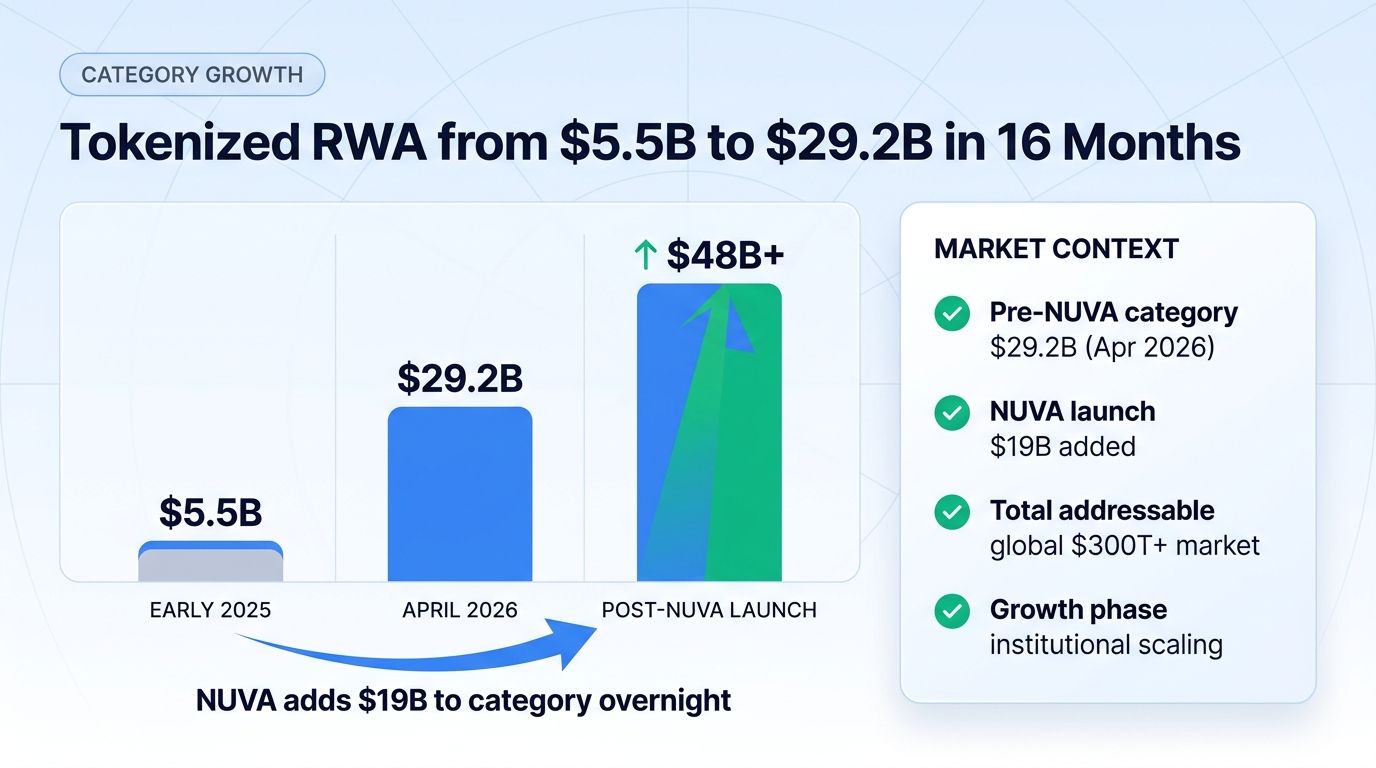
For crypto traders watching the broader RWA category grow from $5.5B to $29.2B in just 16 months, NUVA's launch is a significant data point. If institutional-scale tokenized assets continue scaling at this pace, the category transitions from interesting niche to material slice of the global capital markets within a few years.
This guide explains what NUVA is, how Figure Technologies sources the underlying assets, the products (nvYLDS and nvPRIME), the institutional thesis, and what the launch means for crypto traders thinking about RWA exposure.
What Is NUVA?
NUVA is an Ethereum-based marketplace designed to connect institutional issuers and investors seeking yield-bearing tokenized real-world assets. The platform was launched in May 2026 by a team led by a former BNY Mellon executive, with co-creation backing from Animoca Brands and Nuva Labs.
The structural architecture has three components.
First, the marketplace itself. NUVA aggregates tokenized RWA offerings from multiple issuers, providing a single point of discovery and access for institutional investors. Rather than each issuer building their own platform from scratch, NUVA standardizes the issuance, distribution, and trading infrastructure.
Second, curated institutional assets. NUVA focuses on regulated, institutional-grade tokenized products. The initial launch features two flagship products tied to Figure Technologies' balance sheet, with additional issuers planned.
Third, on-chain settlement. All tokenized assets settle on Ethereum, providing the composability and accessibility of public blockchain infrastructure. Investors can hold tokens in standard Ethereum-compatible wallets and use them in DeFi protocols where supported.
The Two Launch Products: nvYLDS and nvPRIME
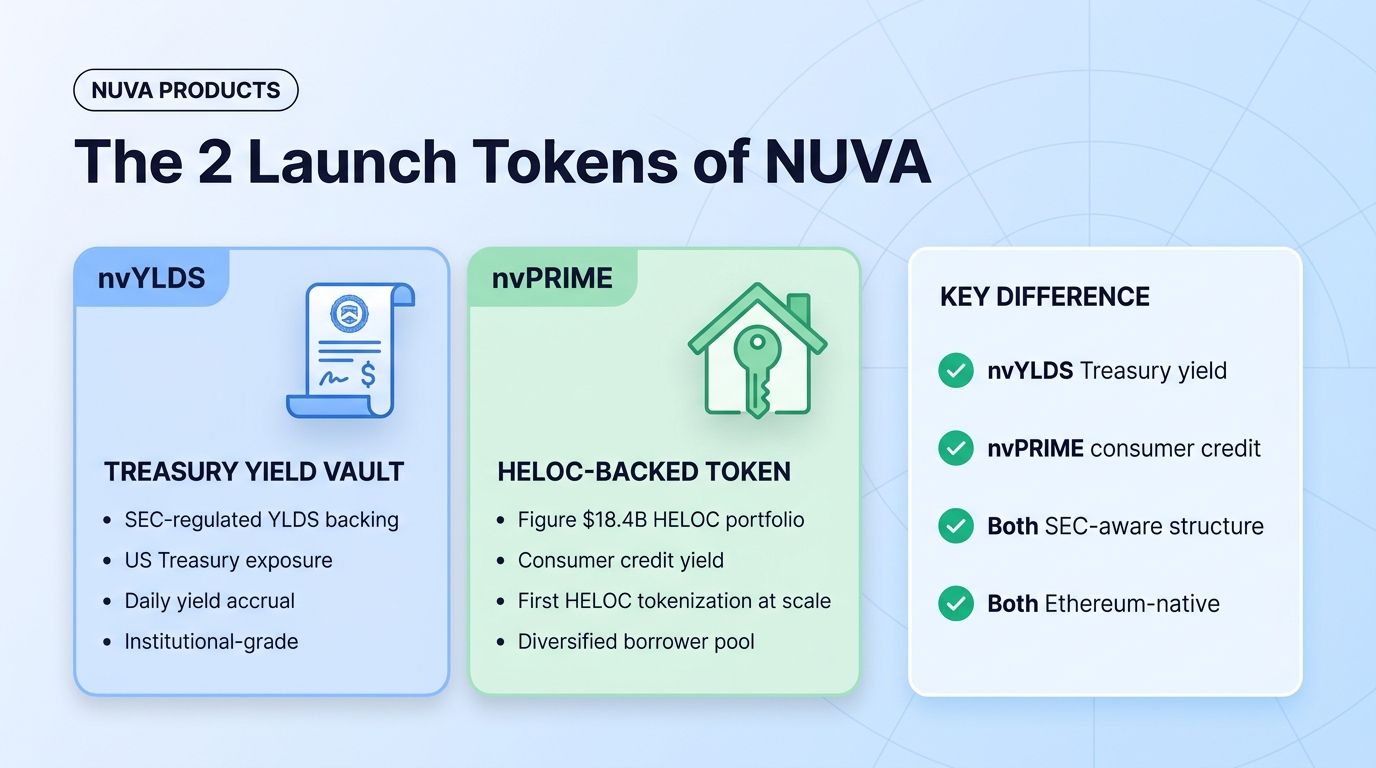
NUVA launched with two tokenized products, both backed by Figure Technologies assets.
nvYLDS (Treasury Yield Vault)
nvYLDS is a yield vault tied to Figure's SEC-regulated YLDS stablecoin. The vault provides exposure to US Treasury yields through a tokenized wrapper. Investors receive proportional yield distributions from the underlying Treasury portfolio.
Key characteristics:
- SEC-regulated underlying assets
- Treasury-backed yield generation
- Daily or weekly yield distribution (depending on structure)
- Liquid secondary market through the NUVA platform
For investors who want tokenized Treasury exposure with strong regulatory standing, nvYLDS is the cleanest institutional option launched in 2026.
nvPRIME (HELOC-Backed Token)
nvPRIME is more innovative and represents the more ambitious side of the launch. It is backed by Figure's $18.4 billion portfolio of home equity lines of credit (HELOCs).
Key characteristics:
- HELOC-backed (homeowner equity loans)
- $18.4 billion underlying portfolio scale
- Yield from HELOC interest payments
- Diversified across thousands of US homeowners
nvPRIME represents one of the first attempts to tokenize a major consumer credit product at institutional scale. If successful, it opens a path for tokenizing other consumer credit categories: auto loans, student loans, credit card receivables, and more.
Why Figure Technologies Matters
Figure Technologies is the asset originator behind NUVA's launch. The company has a unique position in the broader crypto-finance landscape.
Figure was founded by Mike Cagney (former SoFi CEO) and has built a vertically integrated consumer lending business with a blockchain-native back-end. The company:
- Originates HELOCs and other consumer credit products at scale
- Uses blockchain (its own Provenance blockchain) for back-end settlement
- Has SEC registration for various credit products
- Listed on NASDAQ as FIGR in September 2025 via IPO
Figure's combination of regulatory compliance, scale, and crypto-native architecture makes it one of the most credible bridges between traditional consumer credit and tokenized markets. NUVA's launch leverages this position.
The $19B figure represents the combined notional value of nvYLDS + nvPRIME at launch. As Figure originates additional loans, the underlying pool can grow, and NUVA can issue additional tokens.
Why NUVA Matters for the Broader RWA Category
Three structural impacts.
Impact 1: Scale validates the category. Prior tokenized RWA products had typically launched at the $50M-$500M scale. NUVA's $19B launch demonstrates that the infrastructure can handle institutional scale. This shifts perception from "interesting experiment" to "scalable category."
Impact 2: HELOC tokenization opens new asset classes. Treasury tokenization has been the entry point for RWA. Tokenizing HELOCs (a consumer credit product) demonstrates that the model extends to more complex assets. If HELOCs work, auto loans, mortgages, credit card receivables, and other consumer credit categories follow.
Impact 3: Animoca Brands backing signals broader institutional appetite. Animoca Brands is a major Asian crypto investor with deep relationships across the institutional landscape. Their co-creation backing provides distribution channels and credibility that pure-startup projects struggle to access.
For traders watching the broader RWA tokenization category (now $29.2B and growing), NUVA's launch is one of the strongest signals yet that institutional capital is committing to the model.
How Traders Can Access NUVA Products
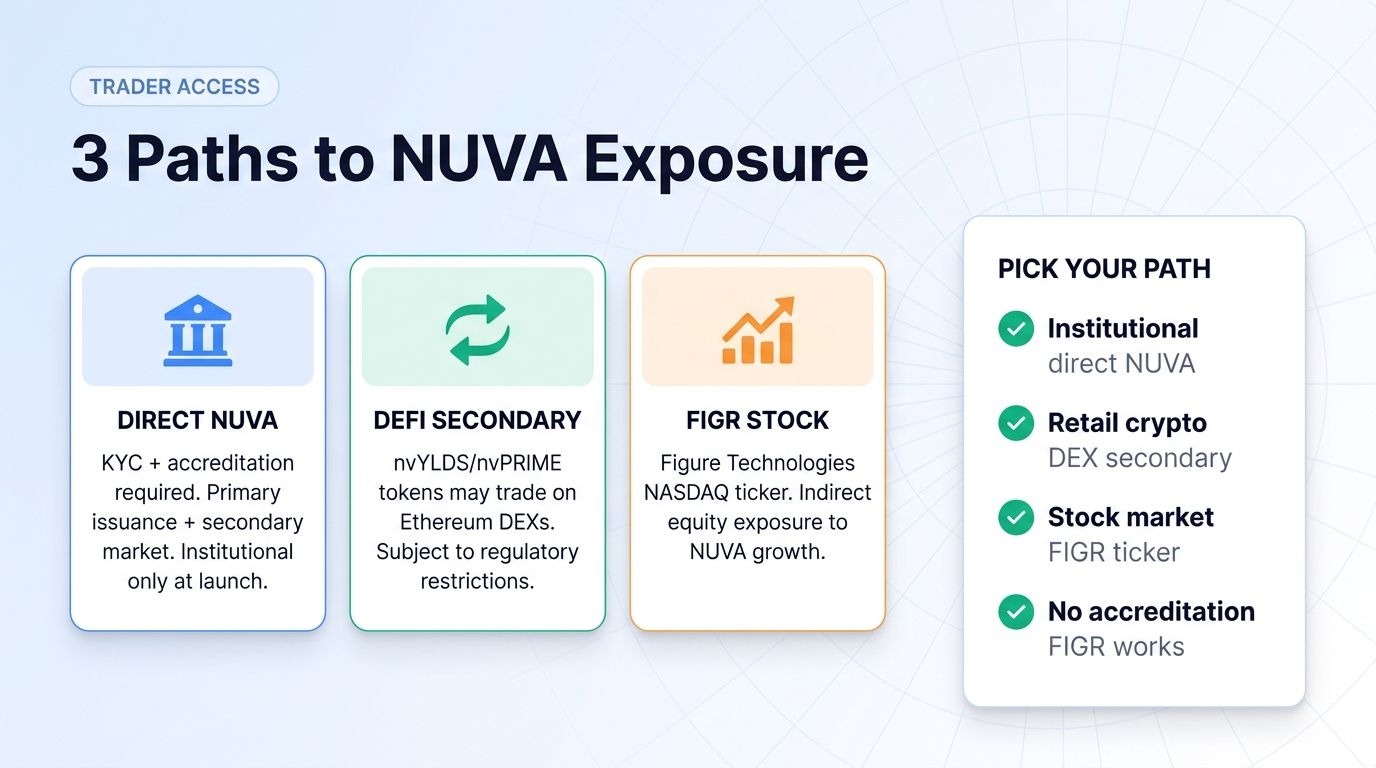
Three practical paths.
Path 1: Direct NUVA Platform Access
Institutional investors can sign up for NUVA directly. The platform requires KYC and accreditation verification (since underlying products are securities in most jurisdictions). For qualified institutional investors, NUVA provides primary issuance and secondary market access.
Path 2: Secondary Market via DeFi
For broader access, nvYLDS and nvPRIME tokens may trade on Ethereum DEXs (subject to regulatory restrictions). As the products mature and ecosystem integrations develop, retail accessibility through secondary markets typically improves.
A crypto trading platform like Altrady connects to 19+ exchanges and can support managing positions across CEX listings if NUVA tokens are eventually listed on centralized exchanges.
Path 3: Indirect Exposure via Figure (FIGR) Stock
Investors who want exposure to the NUVA thesis but cannot access the tokens directly can hold Figure Technologies stock (FIGR on NASDAQ). As Figure's tokenization business scales, the equity benefits from increased revenue and platform value.
How NUVA Compares to Existing Tokenized RWA Platforms
The 2026 tokenized RWA category includes several major players, each with different specializations.
Ondo Finance: Focus on tokenized US Treasuries (USDY, OUSG). Pioneer of retail-accessible Treasury tokens. Multi-billion in tokens outstanding.
BlackRock BUIDL: Institutional Treasury tokens. Higher minimums ($5M+). Limited retail accessibility.
Franklin Templeton BENJI: Institutional money market fund tokens. Similar to BUIDL but different issuer.
NUVA: New entrant. Focus on Treasury yield (nvYLDS) + HELOC credit (nvPRIME). $19B launch scale. Institutional focus initially.
RealT, Lofty: Real estate tokenization. Different asset class from Treasuries and credit.
NUVA's differentiation is the HELOC tokenization. No other major platform has tokenized US consumer credit at this scale. If it works, NUVA captures a unique market position.
The Institutional Thesis
Three forces drive institutional appetite for NUVA and similar platforms.
Force 1: Yield compression in traditional fixed income. Institutional investors face yield compression in traditional fixed income markets. Tokenized yield products with comparable or higher yields, but with on-chain composability, offer compelling alternatives.
Force 2: Operational efficiency. Tokenized assets settle in minutes rather than days, support 24/7 trading, and reduce intermediation costs. For institutional treasuries and trading desks, the efficiency gains compound.
Force 3: Regulatory clarity. The CLARITY Act passing through Congress and broader regulatory frameworks reduce the legal risks of holding tokenized securities. Institutional investors increasingly view tokenized products as legitimate components of their portfolios.
For traders, the institutional thesis matters because institutional buying creates structural demand that supports tokenized asset prices and category growth.
The Risks of NUVA Investing
Counterparty risk. NUVA tokens rely on Figure Technologies as the asset originator and Nuva Labs as the platform operator. If either entity faces operational, financial, or legal trouble, token value can be impaired.
Smart contract risk. Tokenized assets live on Ethereum smart contracts. Bugs, exploits, or governance issues can affect token holders.
HELOC underwriting risk. nvPRIME is backed by HELOCs. If US housing market conditions deteriorate significantly, HELOC default rates rise and underlying value decreases. The diversification across thousands of borrowers helps but does not eliminate this risk.
Liquidity risk. As a new platform, NUVA's secondary market liquidity is still developing. Selling large positions may produce slippage or require time.
Regulatory risk. While Figure has strong regulatory standing and YLDS is SEC-registered, the broader tokenization regulatory framework continues evolving. Future changes could affect specific products.
Concentration risk. NUVA's initial products are concentrated in Figure-originated assets. As additional issuers join the platform, this concentration decreases.
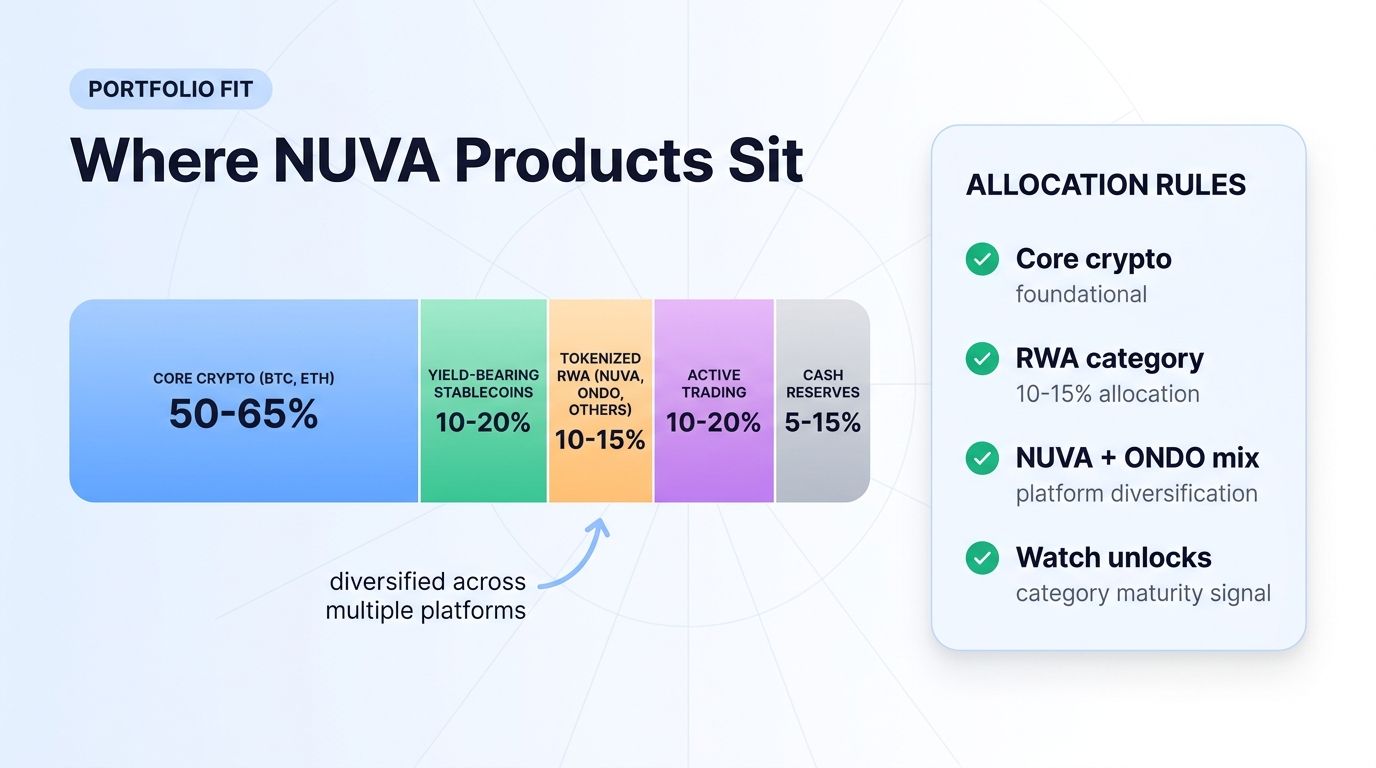
How NUVA Fits Into a Broader Strategy
A practical framework:
- Core crypto holdings (BTC, ETH): 50-65% of crypto allocation
- Yield-bearing stablecoins (USDY, USDe, sUSDS): 10-20%. Stable yield baseline.
- Tokenized RWA (NUVA products, Ondo, others): 10-15%. Diversified RWA exposure.
- Active trading positions: 10-20%. Spot, derivatives, DeFi.
- Cash reserves: 5-15%. Opportunistic deployment.
For investors qualified to access NUVA directly, allocating a portion of the tokenized RWA bucket to nvYLDS or nvPRIME provides exposure to consumer credit alongside Treasury exposure from Ondo and similar platforms.
The Broader Tokenization Trend
NUVA's launch reinforces a longer-term pattern.
2023-2024: Tokenized Treasuries proved the model at $50M-$500M scale. 2025: Category grew to $5.5B. Multiple platforms launched. Retail accessibility improved. Early 2026: Category reached $29.2B. Real estate, private credit, additional asset classes expanded. May 2026 (NUVA): $19B single-launch demonstrating institutional-grade scalability with new asset class (HELOCs).
If the pattern continues, tokenized RWA reaches $100B+ by mid-2027 and $500B+ by 2030. This trajectory positions the category as one of the most significant crypto-finance themes of the decade.
FAQ
What is NUVA?
NUVA is an Ethereum-based institutional-grade tokenized real-world asset marketplace that launched in May 2026. It connects issuers (like Figure Technologies) with institutional investors seeking yield-bearing tokenized assets. The platform launched with nearly $19 billion in initial tokenized assets across two flagship products: nvYLDS (Treasury yield) and nvPRIME (HELOC-backed).
How does nvPRIME differ from a traditional REIT or bond?
nvPRIME is backed by HELOCs (home equity lines of credit) rather than properties or government bonds. The token holder receives a share of HELOC interest payments. The structure provides exposure to US consumer credit yield through a tokenized wrapper. Compared to traditional REITs, nvPRIME has different risk profile (consumer credit vs property) and different liquidity characteristics (on-chain settlement vs traditional brokerage).
Can retail investors buy NUVA tokens?
The initial launch focuses on institutional investors with appropriate KYC and accreditation. Retail accessibility through secondary markets may develop over time, depending on regulatory clarity and platform expansion. Currently, most retail crypto investors will get RWA exposure through more retail-accessible platforms like Ondo (USDY) or by holding Figure stock (FIGR).
Is NUVA SEC-regulated?
NUVA's products tie to SEC-regulated underlying assets (Figure's YLDS stablecoin and HELOC portfolio). The exact regulatory treatment of the tokens varies by product structure. Figure Technologies has strong SEC standing as a publicly traded company. The broader regulatory framework for tokenized securities continues to evolve under the CLARITY Act and related legislation.
Can I trade NUVA-related assets on Altrady?
NUVA tokens themselves are not currently listed on standard centralized exchanges. However, Figure Technologies stock (FIGR on NASDAQ) provides indirect exposure. Altrady connects to 19+ crypto exchanges where you can hold the underlying cryptocurrencies (BTC, ETH, USDC, USDT, and related) used to fund RWA positions across platforms.
Conclusion
NUVA's launch is one of the most significant institutional crypto events of 2026. With $19 billion in tokenized assets at launch, backing from Animoca Brands and Figure Technologies, and a former BNY Mellon executive leading the effort, the platform represents a serious bridge between regulated US capital markets and tokenized finance.
For crypto traders, the practical takeaways are clear:
First, the tokenized RWA category continues scaling rapidly. NUVA's $19B launch alongside Ondo's growth, BlackRock BUIDL's expansion, and the broader category reaching $29.2B all point to a sustained structural growth phase.
Second, the asset classes are diversifying. Beyond Treasuries, tokenized real estate, private credit, and now HELOCs are operational at institutional scale. The model demonstrably works across asset classes.
Third, institutional capital is committing. Animoca Brands, Figure Technologies, and the major asset managers (BlackRock, Franklin Templeton) backing tokenization signal that this is not a speculative experiment but a strategic infrastructure build-out.
For 2026 specifically, NUVA's launch reinforces that tokenization is one of the highest-conviction long-term themes in crypto. Direct exposure remains constrained for retail investors today, but proxies (Figure stock, broader RWA tokens) provide meaningful participation. The longer-term direction is clear: significant portions of global capital markets will eventually move on-chain, and platforms like NUVA are building the rails to make that transition operational.