
ICT (Inner Circle Trader) is the original trading method taught by Michael J. Huddleston, with its own rules, terms and time windows. SMC (Smart Money Concepts) is the broader, simplified framework that other educators built mostly from ICT ideas. Both read price through liquidity, market structure and institutional order flow.
In practice the two share most of their tools, often under different names. This guide shows where ICT and SMC overlap, where they differ, how their terms map to each other, and how to apply either one to crypto's 24/7 markets. It describes how traders use these methods and is not trading advice.
Key Takeaways
- ICT came first. SMC is largely a community-built simplification of ICT concepts, not a separate discovery.
- ICT is more rule-based. It adds specific entry models, Fibonacci levels and time windows such as killzones; SMC keeps the core structure and liquidity ideas and leaves more to the trader.
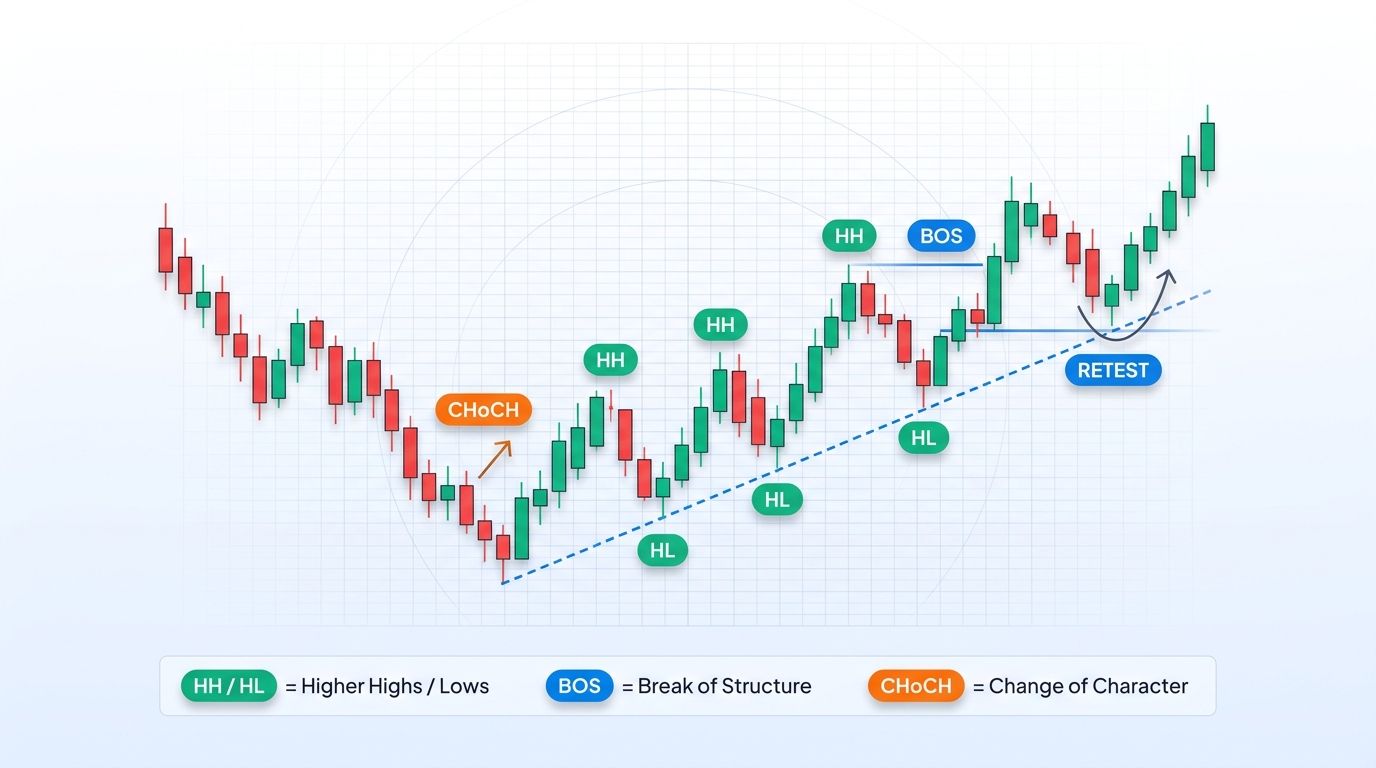
- Many terms mean the same thing. An ICT fair value gap is an SMC imbalance; an ICT market structure shift is close to an SMC change of character.
- Neither uses indicators. Both are price-action methods built on swing points, liquidity and order blocks.
- Crypto needs adjustments. Markets never close, so ICT's session timing is less clear-cut, and volatility calls for wider invalidation and smaller size.
What Is the Difference Between ICT and SMC?
The main difference is origin and strictness. ICT is a complete, prescriptive method with defined entry models and timing. SMC takes ICT's core ideas, mainly market structure, liquidity, order blocks and imbalances, and presents them as a looser framework that traders adapt to their own style.
| ICT (Inner Circle Trader) | SMC (Smart Money Concepts) | |
|---|---|---|
| Origin | Created and taught by Michael J. Huddleston | Developed by the wider trading community, largely from ICT ideas |
| Structure | Rule-based models with set steps | Flexible framework, more trader judgement |
| Timing | Uses killzones and session windows | Usually no fixed time rules |
| Entries | Specific models, such as optimal trade entry and the silver bullet | Entries at order blocks or imbalances after a break of structure |
| Terminology | Large, specific vocabulary (PD arrays, MSS, BSL/SSL, breaker blocks) | Smaller core set (BOS, CHoCH, order block, liquidity, inducement) |
| Learning curve | Steeper: more rules and terms | Gentler start, but more room for inconsistent reads |
| Indicators | None; price, time and Fibonacci levels | None; price action only |
What ICT and SMC Have in Common
Both assume large players need liquidity to fill big orders, and that liquidity sits where many traders place stops: above swing highs and below swing lows. Both read the chart in the same order: higher-timeframe structure first, then a sweep of liquidity, then a shift in structure, then an entry at a zone where price is likely to react.
- Market structure: highs and lows that define the trend. See how to identify swing highs and lows and market structure in SMC.
- Liquidity: clusters of stops and pending orders that price tends to run before reversing. See liquidity sweeps.
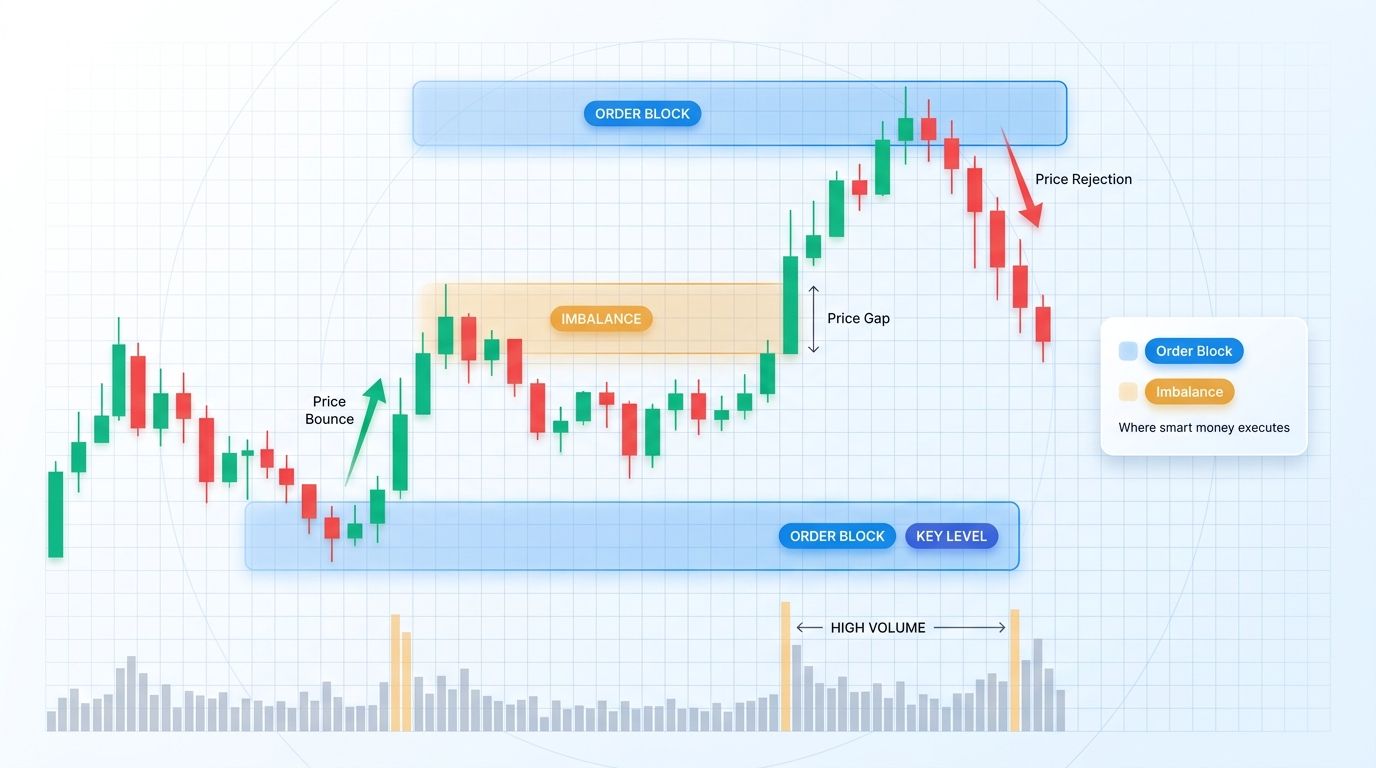
- Order blocks: the last opposite candle before a strong move, used as a reaction zone. See bearish order blocks.
- Imbalances: fast moves that leave a gap between candle wicks. See fair value gaps.
ICT and SMC Terms Compared
Much of the confusion comes from vocabulary. These pairs describe the same or very similar ideas.
| ICT term | SMC term | What it means |
|---|---|---|
| Fair value gap (FVG) | Imbalance | A three-candle gap left by a fast move, which price often revisits |
| Market structure shift (MSS) | Change of character (CHoCH) | The first break against the trend, hinting at a reversal |
| Break in market structure | Break of structure (BOS) | A break in the direction of the trend, confirming it |
| Buy-side and sell-side liquidity (BSL/SSL) | Liquidity, liquidity pools | Stops resting above highs and below lows |
| Order block | Order block, supply and demand zone | The last opposite candle before a strong move |
| Premium and discount | Premium and discount, supply and demand | Above or below the midpoint of a range |
| Stop hunt, liquidity run | Inducement, liquidity grab | A move that takes out stops before the real move |
What ICT Adds
ICT goes further than SMC in a few specific areas:
- Optimal trade entry (OTE): an entry zone between the 62% and 79% Fibonacci retracement of a swing, after a shift in structure.
- Killzones: session windows, such as the London and New York opens, when ICT expects the most meaningful moves.
- Power of three: the daily or weekly cycle of accumulation, manipulation and distribution.
- PD arrays: a ranked list of reaction zones (order blocks, fair value gaps, breakers and more) used to pick the most likely one. See the PD array matrix.
- Named models: step-by-step setups such as the silver bullet, which combines a time window with a fair value gap entry.
For a full walkthrough, read our ICT trading strategy guide.
What SMC Adds
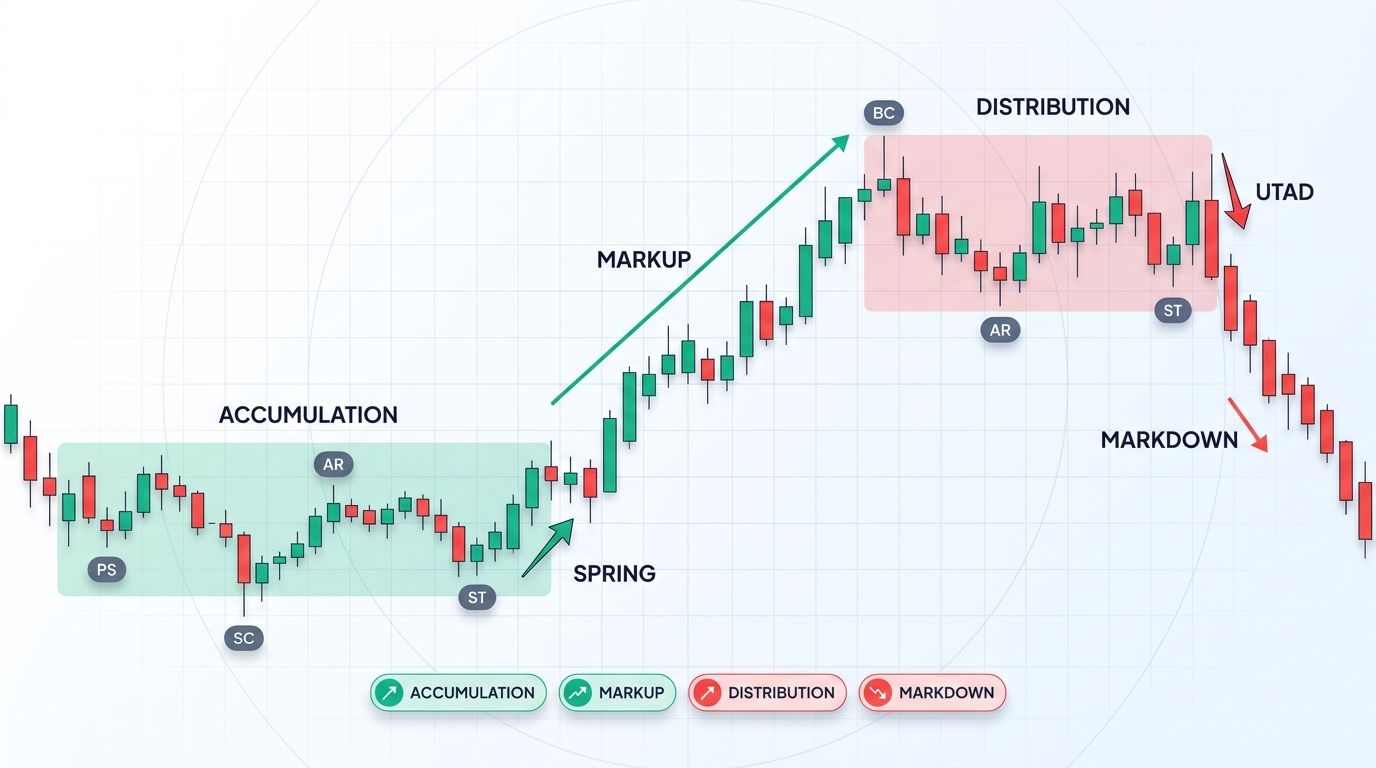
SMC keeps fewer rules but often brings in ideas from outside ICT, such as Wyckoff accumulation and distribution phases, supply and demand trading, and inducement as a separate step before an entry. That makes it easier to blend with other price-action methods, at the cost of more subjective reads. Read more about smart money concepts and the Wyckoff method.
ICT vs SMC: Which Should You Use?
- Choose ICT if you want a complete rulebook, are comfortable learning a large vocabulary, and want time-based entry models.
- Choose SMC if you want the core structure and liquidity ideas without strict timing rules, or want to combine them with your own setups.
- Combine them if you already read SMC structure and want ICT's more precise entry models. Many traders mark SMC structure on a higher timeframe and use an ICT entry on a lower one. See combining ICT and SMC.
Whichever you pick, judge it on a record of your own trades rather than on examples chosen after the fact. Both methods are discretionary, and results vary widely between traders.
Applying ICT and SMC to Crypto
- Markets never close. ICT's killzones come from forex sessions. Crypto trades 24/7, so session opens still bring volume, but the windows are less defined. Test whether a time filter actually helps on the pair you trade.
- Volatility is higher. Liquidity sweeps in crypto can run further than in forex, so stops just beyond a swing are hit more often. Leave room for invalidation and size positions to match.
- Liquidity varies by coin. Structure and order blocks are cleaner on liquid pairs such as BTC and ETH than on thin altcoins.
- Leverage multiplies mistakes. A correct read with too much leverage can still be liquidated during a sweep.
Using ICT and SMC in Altrady
Altrady's Smart Money indicator marks market structure from a higher timeframe on your chart: swing points, buy-side and sell-side liquidity, fair value gaps and the OTE zone. It covers the shared building blocks of both methods, so you can read the setup and place the trade on the same screen. Add it from Indicator in the chart toolbar.
From there you can set the entry, stop loss and take profits in one smart order, test your model on a paper trading account, and set price alerts at the levels you marked so you do not have to watch the chart.
Frequently Asked Questions
What is the difference between ICT and SMC?
ICT is the original method taught by Michael J. Huddleston, with strict rules, specific entry models and time windows. SMC is a simpler, more flexible framework built largely from ICT ideas by other educators. Both use market structure, liquidity, order blocks and imbalances.
Is ICT the same as SMC?
Not exactly. They share most core ideas and many terms describe the same thing, but ICT adds rules and tools that SMC usually leaves out, such as killzones, optimal trade entry and named models like the silver bullet.
Which came first, ICT or SMC?
ICT came first. Huddleston taught his concepts for years before the wider community packaged the main ideas as Smart Money Concepts, often with simplified or renamed terms.
Is ICT or SMC better for beginners?
SMC is usually easier to start with because it has fewer rules and terms. ICT gives more precise steps once you are comfortable with structure and liquidity, but it takes longer to learn.
Do ICT and SMC work for crypto?
Traders apply both to crypto, especially on liquid pairs like BTC and ETH. Because crypto trades 24/7 and moves fast, session timing is less clear and stops need more room, so test any model on paper before using real funds.
Do ICT and SMC use indicators?
No. Both are price-action methods built on swing points, liquidity, order blocks and imbalances, with ICT also using Fibonacci levels and time windows. Some platforms, including Altrady, offer indicators that mark these levels automatically.