
Many crypto traders love patterns. Some swear by classic formations like head and shoulders or triangles. Others chase more obscure ideas. Then there is the Quasimodo pattern, sometimes called the Over and Under pattern, which sits in that sweet spot between simple and advanced. It shows up often on crypto charts because volatility helps shape its structure.
When you understand it well, it becomes a reliable tool for spotting reversals and grabbing high probability entries.
This guide breaks down what the Quasimodo pattern is, how to identify it, what its strengths and weaknesses are, how to interpret it, and some practical crypto strategies built around it.
What Is the Quasimodo Pattern
At its core, the Quasimodo pattern is a reversal structure. It signals that the current trend is losing strength and that price may be ready to flip in the opposite direction. Traders use it to time entries with tight invalidation levels, which is a big reason it has become popular in leveraged markets like crypto.
The pattern gets its name because the left shoulder and right shoulder do not match, which makes it look a bit “off.” That imperfect symmetry hints at imbalance in the market.
The pattern can appear in both bullish and bearish forms.
- A bullish Quasimodo forms after a downtrend and suggests price might soon push upward.
- A bearish Quasimodo forms after an uptrend and hints at a coming drop.
The value comes from seeing where liquidity has been grabbed and where price reacts after taking out obvious highs or lows.
How to Identify It
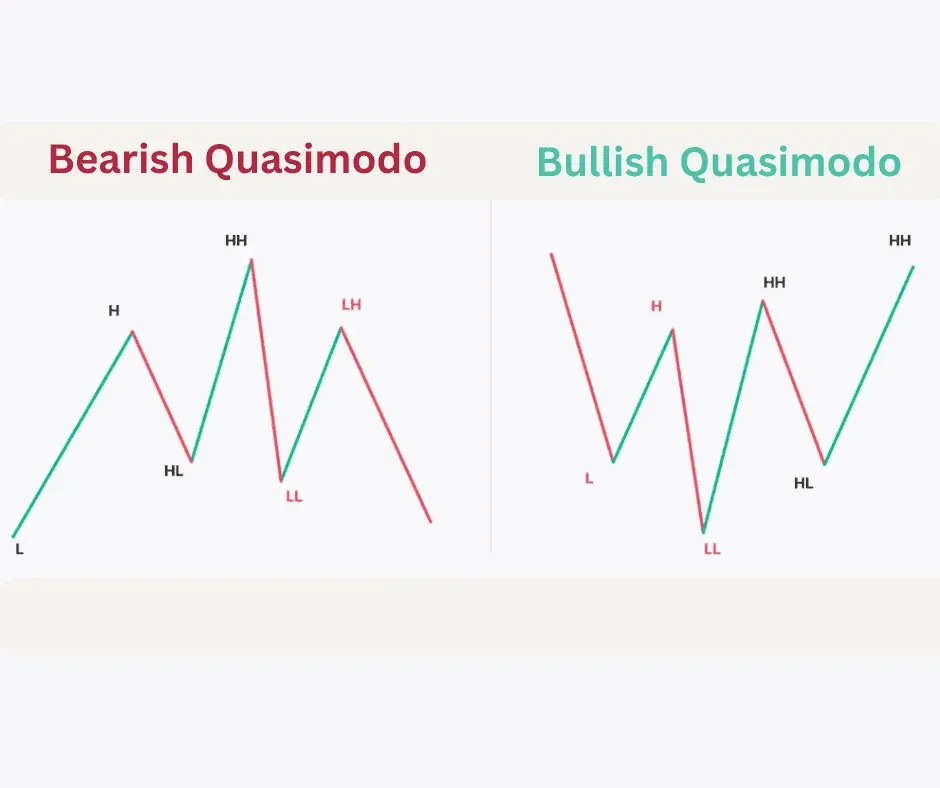
The Quasimodo has five distinct points. Once you know what you are looking for, you can spot it quickly.
1. The Initial High or Low
This confirms the current trend. In an uptrend, you start with a strong high. In a downtrend, you start with a clear low.
2. A Pullback
Price retraces from that high or low. This pullback is normal and still in line with the trend.
3. A New Higher High or Lower Low
This is where things get interesting. Price pushes beyond the initial point and sweeps liquidity. In a bullish Quasimodo, price makes a lower low that grabs stops. In a bearish one, it makes a higher high that wipes out shorts.
This sweep is one of the most important pieces of the pattern because it exposes the exhaustion of the current trend.
4. A Strong Reaction in the Opposite Direction
After sweeping liquidity, price snaps back past the pullback area. This is where smart money usually reveals its hand. The reaction shows that the sweep was not continuation but a trap.
5. The Retest
The final piece is the retest. Price pulls back to the level created by the pullback that came before the sweep. This zone becomes the entry area.
So in simple form:
- For a bullish Quasimodo:
High → Pullback → Lower low sweeps → Strong break upward → Retest of the pullback zone. - For a bearish Quasimodo:
Low → Pullback → Higher high sweeps → Sharp drop → Retest of the pullback zone.
Why the Retest Matters
Many traders chase the reversal too early. The retest provides structure, risk control, and confirmation. If the Quasimodo is valid, price should react from this retest with momentum. If it fails, you get stopped out quickly with minimal damage.
Chart Behavior to Look For
- A sharp sweep instead of a slow drift
- A decisive break after the sweep
- A clean, untested level to use as your entry zone
- Wicks that show trapped traders caught on the wrong side
Crypto markets create these often because liquidity clusters around obvious highs and lows, and market makers love to sweep them.
Pros and Cons of the Quasimodo Pattern
Pros
1. Strong risk-to-reward potential
Because the invalidation level sits close to the retest area, you can place tight stops. This gives you room for larger targets without taking oversized risks.
2. Works across all time frames
You can use Quasimodo on the one-minute chart for scalps or on the daily for swing trades.
3. Uses real market behavior
The pattern is built on liquidity sweeps and trapped traders, not arbitrary lines. This makes it more reliable than patterns with no logic behind them.
4. Helps avoid chasing breakouts
Breakouts are often fake in crypto. The Quasimodo structure forces patience and keeps you from buying tops or shorting bottoms.
Cons
1. Requires practice to verify
Beginners often mistake random price noise for a Quasimodo. The pattern is easy to force when you want to see it.
2. Crypto volatility can break retests
Sometimes price will front run the retest or blast straight past it before you can enter.
3. Depends on clean market structure
If the chart is choppy or full of overlapping candles, the pattern loses clarity.
4. Not ideal during news events
Major announcements can invalidate the structure instantly.
Understanding these limitations helps you use the Quasimodo smarter, not blindly.
How to Interpret the Quasimodo Pattern
At its heart, the Quasimodo is an imbalance signal. It tells you that the market swept liquidity, flipped structure, and then invited you to join the new direction at a logical point.
Here is what each stage communicates:
The Sweep
The market hunts obvious stop loss levels. This flush creates liquidity for bigger players. When price quickly rejects the sweep, it exposes the trap.
The Break
This confirms that momentum has shifted. It does not guarantee the reversal will hold, but it shows a shift in sentiment.
The Retest
This is where smart money reloads. You should not enter before this because the reversal isn’t confirmed.
The Reaction
When price bounces from the Quasimodo level, it signals that the pattern is active. From here, you target logical structure points: previous highs, imbalance fills, or higher time frame supply and demand zones.
What Makes a Strong Quasimodo
- The sweep is obvious and clean
- The retest lines up with a supply or demand zone
- Volume spikes on the break
- Higher time frame structure supports the reversal
- Price rejects the retest immediately with conviction
If those elements line up, you have a high-quality setup.
Quasimodo Pattern Strategies for Crypto Traders
Let's cover a few practical strategies that crypto traders actually use with this pattern.
Strategy 1: The Classic Retest Entry
This is the standard approach.
- Spot the sweep and break of structure.
- Mark the pullback level that comes before the sweep.
- Set a limit order at that level for the retest.
- Stop goes below the Quasimodo low (for bullish) or above the Quasimodo high (for bearish).
- Target the next liquidity pool.
This strategy is clean and fits both leveraged and spot trading.
Strategy 2: The Quasimodo plus FVG Combo
Crypto charts often leave Fair Value Gaps. When a Quasimodo retest lines up with an FVG, the probability spikes.
- Identify the Quasimodo structure.
- Check if the break-of-structure created an FVG.
- Look for the retest to land inside that gap.
- Enter when price shows the first reaction inside the zone.
This combo works well on ETH, SOL, and other assets that produce frequent imbalances.
Strategy 3: The Higher Time Frame Bias Filter
This strategy helps avoid low-quality setups.
- Start on the 4H or Daily. Establish trend direction.
- Only take Quasimodo patterns that align with that direction.
- In an uptrend, take bullish Quasimodo entries.
- In a downtrend, take bearish ones.
- Drop to lower time frames to refine entries.
This creates setups that are both precise and contextually strong.
Strategy 4: The Break and Reclaim Variation
Some traders wait for extra confirmation.
- Identify the sweep and break.
- Wait for price to retest the Quasimodo level.
- Do not enter right away.
- Only take the trade after price reclaims the retest level and prints a higher low or lower high.
- Enter on the reclaim with stops tucked under the reclaim point.
This method is slower but filters out fake retests.
Strategy 5: Using Quasimodo for Scalping
Scalpers love this pattern because it gives structure fast.
Use the one-minute or three-minute chart. Pair the pattern with volume spikes.
Keep stops tight and targets modest. Take partial profits early.
Scalping Quasimodo setups works best on assets with steady liquidity like BTC and ETH.
Bottom Line
The Quasimodo pattern is not magic. It will not win every trade. But it is a powerful way to read structure and understand where the market is trapping traders. Crypto volatility helps shape the pattern often, which makes it especially useful in this space.
If you learn to spot the sweep the break, and the retest, you can build a reliable system around it. Use it with smart money concepts, supply and demand, and solid risk management, and it becomes a strong addition to your trading playbook.