
You spend a lot of time looking for signals that warn when a trend is losing strength. Markets move fast. Sentiment flips without warning. A chart pattern that helps you spot a potential top before things roll downhill is worth paying attention to. One pattern traders often rely on for this is the Tower Top.
The Tower Top isn’t as famous as a Head and Shoulders or a Double Top, but it still has a loyal following. It shows up on a range of timeframes, from shorter intraday charts to long-term swings. When it forms cleanly, it can point to exhaustion in a bullish trend and hint that sellers are about to take control. This makes it valuable for risk management, entries, exits, and broader market awareness.
Here’s more on what a Tower Top is, what it looks like, why it can be useful, and how you can build trading strategies around it.
What Is the Tower Top Pattern
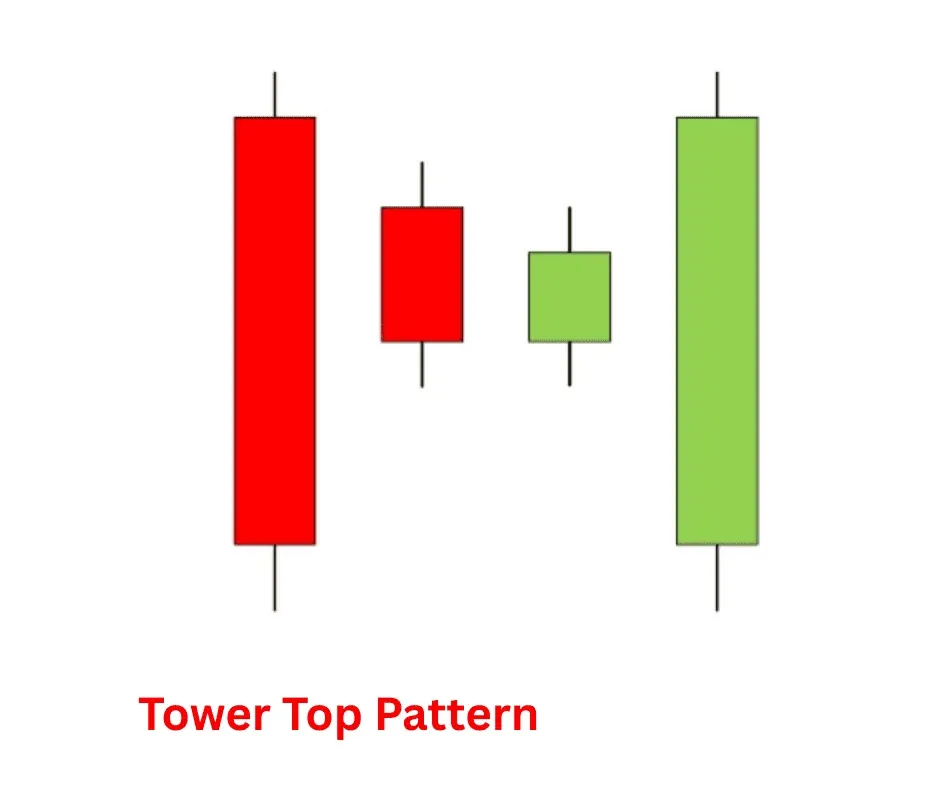
A Tower Top is a bearish reversal pattern. It often appears after a strong or extended uptrend. The name comes from how it looks visually. The price shoots up like a tall tower, stalls near the top with a cluster of candles, then breaks down with strong selling pressure.
Think of it as the market sprinting upward, running out of energy near the top, and then dropping hard once the crowd loses confidence.
Although the pattern is most commonly referenced in traditional technical analysis, it fits naturally into crypto markets due to their volatility and tendency to overshoot. Crypto assets often push higher until buyers get exhausted. When volume fades and sellers start pushing back, a Tower Top structure can form.
The Tower Top usually signals that momentum has shifted. It doesn’t guarantee a full trend reversal, but it often marks the start of a bearish phase or at least a significant correction.
How to Identify It
A Tower Top has three basic parts:
-
A strong upward rise in price
The left side of the “tower” forms when the market pushes upward with high momentum. Candles are often large and green. Volume can be elevated. Traders are confident, FOMO kicks in, and buyers dominate. -
A period of consolidation near the peak
This is the actual “top” of the tower. Price no longer rises aggressively. Instead, it stalls and starts printing smaller candles, often with wicks on both sides. This signals indecision. Bulls are no longer in full control. Sellers start showing up and absorbing buy orders. -
A sharp breakdown with strong bearish candles
This is the right side of the “tower.” Once sellers take over, the price drops quickly. You usually see long red candles and increasing volume. This confirms the pattern and sets the direction for the potential downtrend.
Visual cues that strengthen the pattern
To spot a clean Tower Top, look for the following technical details:
- Tall, fast rally heading into the top
- A clear plateau or congestion zone made of smaller candles
- Volume rising during the rally, dipping during the top, then rising again during the breakdown
- A decisive close below support at the base of the top zone
- Momentum indicators turning bearish, such as RSI crossing down from overbought or MACD forming a bearish cross
The cleaner the structure, the more reliable the signal. Messy versions can still work, but traders treat them more cautiously.
Pros and Cons of the Tower Top Pattern
Pros
1. It appears naturally in volatile markets
Crypto markets love big spikes followed by exhaustion. That makes the Tower Top fairly common and often more obvious than in slow-moving assets like bonds or large-cap stocks.
2. It provides early warning of trend fatigue
The consolidation zone at the top gives you time to react. You don’t have to catch the very top. The pattern itself gives structure to a potential reversal.
3. It works well with volume signals
Volume behavior is a big part of validating the pattern. When you see heavy buy volume on the way up, weak volume at the top, then strong sell volume on the way down, the message is clear.
4. It pairs nicely with other indicators
You can combine it with support and resistance, moving averages, RSI, MACD, or even on-chain metrics if you are dealing with a major crypto asset. It plays well with most systems.
Cons
1. It can be confused with normal consolidation
Not every sideways pause turns into a Tower Top. Markets consolidate all the time before moving higher. You need confirmation before acting.
2. It can fail in strong bull markets
If the whole market is trending aggressively upward, a Tower Top might not lead to a meaningful drop. Price can break upward instead and form a continuation breakout.
3. Volume conditions are not always clear in crypto
Because crypto trades across many exchanges, volume signals can be noisy. Some pairs or tokens have irregular liquidity, which weakens pattern reliability.
4. It does not give perfect entry timing
The pattern helps you identify conditions, but entries and exits still require your own rules. If you enter too early, you risk getting trapped in a false top.
How to Interpret the Pattern
Interpreting the Tower Top correctly involves understanding what it says about market psychology.
During the rally, buyers feel confident and aggressive. Price climbs fast. As it reaches the top, that confidence fades. The consolidation box at the peak shows uncertainty. Buyers are no longer willing to push higher, and sellers start probing the downside.
The key moment is the breakdown. This shows that one side has won the struggle. Once price closes below the support level of the consolidation zone, the pattern is basically confirmed. If volume also jumps, the signal is stronger.
When interpreting the pattern, consider these questions:
- How strong was the previous uptrend?
- Is the broader market bullish or weak?
- Are momentum indicators pointing toward a shift?
- Is there a nearby support level below the breakdown?
- How does volume behave before and after the breakdown?
Context matters. A Tower Top in isolation gives you a clue. A Tower Top combined with other bearish signals gives you a plan.
Examples of Crypto Trading Strategies Using the Tower Top Pattern
There are many ways to trade a Tower Top. Here are a few practical strategies traders use.
Strategy 1: The Conservative Breakdown Trade
This is the simplest and most common approach.
- Identify the strong rally into the peak.
- Mark the consolidation zone that forms the top of the tower.
- Wait for a clean breakdown candle that closes below the support level of the zone.
- Enter a short (or exit a long) on the candle close.
- Place a stop above the consolidation zone.
- Target the nearest support levels below.
This strategy avoids guessing. You react only after the market confirms the bearish shift.
Strategy 2: Shorting the Retest
Often, after price breaks down, it retests the bottom of the tower. This gives you a second chance.
- Wait for the breakdown to occur.
- Don’t enter immediately.
- Watch for price to rally back toward the broken support.
- Look for rejection signs such as wicks, decreasing momentum, or low volume.
- Enter a short on the rejection.
- Place a stop above the retest high.
This method can offer better risk-to-reward since you enter closer to the invalidation point.
Strategy 3: Using Tower Tops for Risk Management
Even if you’re not shorting, the pattern helps you manage long positions.
- When you see a Tower Top forming after a long uptrend, reduce position size.
- Move stop losses tighter.
- Take profits on part of the trade.
- Avoid adding to your position unless the pattern breaks upward instead of downward.
Sometimes, defensive moves are better than trying to trade the reversal directly.
Strategy 4: Combining the Tower Top With RSI or MACD
Momentum confirmation improves odds.
With RSI:
If the Tower Top forms while RSI is above 70, then breaks down as RSI drops through 60 or 50, the setup strengthens.
With MACD:
- A bearish MACD cross during the consolidation phase is an early warning.
- A full breakdown with widening negative histogram bars supports the trade.
- Indicators help filter out weak or fake Tower Tops.
Strategy 5: Multi-Time Frame Tower Top Confirmation
Crypto traders often combine charts.
- If you see a Tower Top forming on the 4-hour chart
- And a smaller Tower Top already completed on the 15-minute or 1-hour chart
- The confluence can give you more confidence in the bearish direction
This is useful for traders who want to refine entries.
Final Thoughts
The Tower Top pattern isn’t the most famous reversal pattern, but it earns its place in a trader's toolkit. Crypto markets are volatile, emotional, and full of sudden shifts in behavior. The Tower Top helps you read when momentum is fading and when buyers are losing control.
The key isn’t to treat it as a magic button. It works best when paired with volume signals, trend context, and your personal trading rules. If you respect confirmation, understand the psychology behind the pattern, and manage risk properly, the Tower Top can help you catch reversals early or protect your capital before the market turns.